Is ChatGPT Watermarking Its Text? What's Actually True — and What It Means for Your SEO
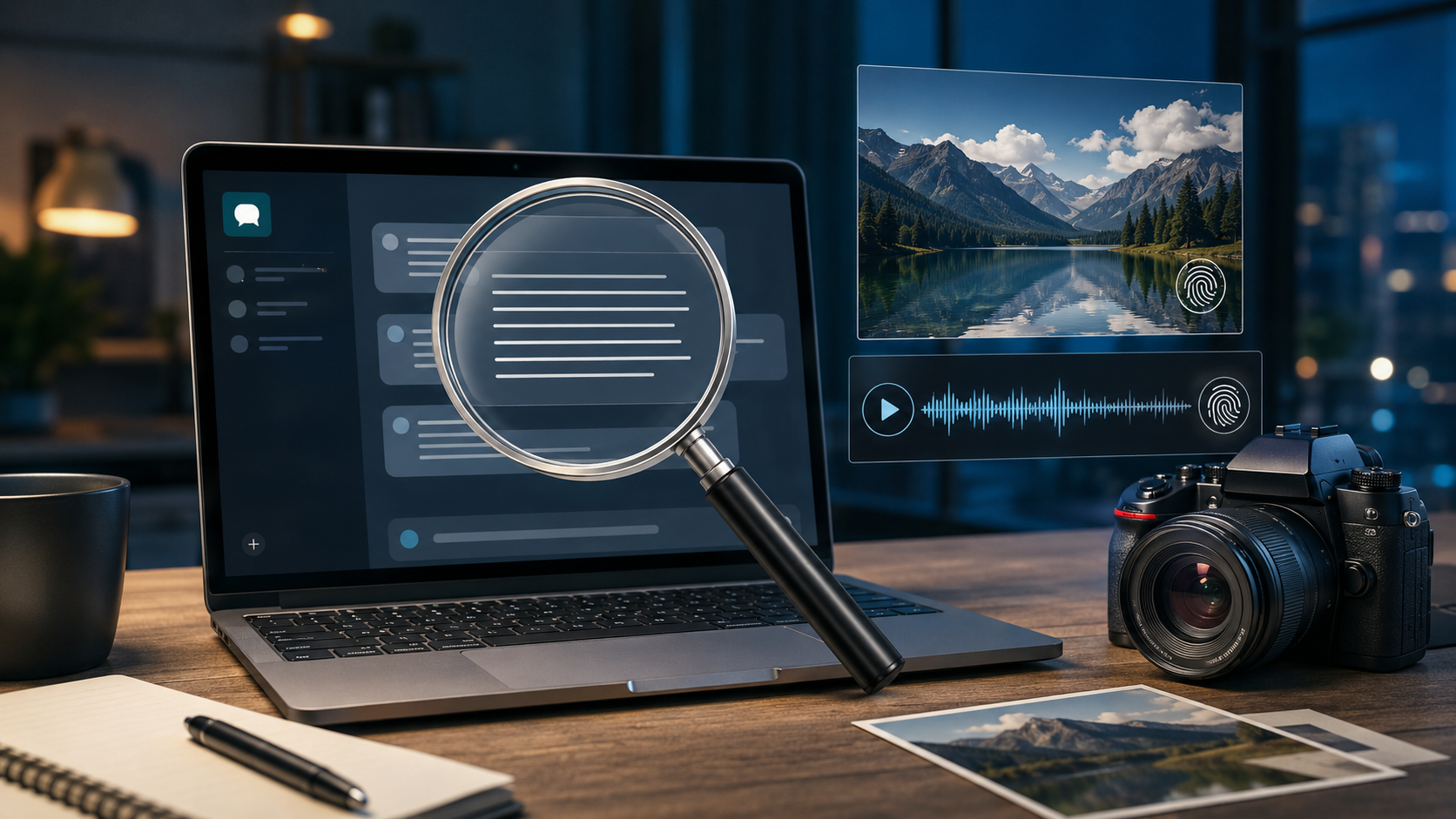
You've probably seen some version of the claim by now — in a LinkedIn hot take, a TikTok, or a panicked group chat: "ChatGPT is secretly watermarking everything it writes, and Google's going to nuke every site that used it."
Like most viral tech claims, it's built on a kernel of truth, wrapped in three layers of confusion. The kernel: OpenAI really did build a text-watermarking system, researchers really did find weird invisible characters in ChatGPT's output, and OpenAI really is now watermarking some of what its tools produce. The confusion: those are three different stories, only one of them involves an actual deployed watermark, and it isn't the one about text.
So this post does two jobs. First, the sorting: what's verified, what's rumor, and what OpenAI has actually shipped, with every claim linked and dated — our standard for everything, and doubly necessary on a story this muddled. Second, the part that matters for your business: what any of it means for SEO — because the honest answer is "less than the panic suggests, and more than zero," and the direction it points is something every local business should be building for anyway.
Story one: the text watermark that exists but never shipped
Here's the verified core. OpenAI developed a genuine text-watermarking method years ago — a system that subtly biases the model's word choices to leave an invisible statistical pattern, detectable by a companion tool that internal documents reportedly rated about 99.9% accurate on unedited text. The watermark is invisible to readers, survives copy-paste, and doesn't degrade the writing.
And OpenAI has deliberately declined to turn it on. As of this writing, there is no publicly confirmed watermark in ordinary ChatGPT text output — not on the free tier, not on Plus, not in the API. The company's own stated reasons, which are worth taking seriously because they're the same reasons it may stay unshipped: the watermark washes out under translation, paraphrasing, or rewriting with another model; false positives could unfairly punish innocent people; and the users most likely to get burned are honest ones — notably non-native English speakers using AI as a legitimate writing aid — while determined bad actors scrub the signal easily. A watermark that mostly catches the honest is a bad product, and OpenAI has said as much. (Worth noting: OpenAI also built and then killed its public AI-text classifier for low accuracy — the detection problem is genuinely hard.)
Status: real technology, deliberately on the shelf. Could that change tomorrow? Yes, and we'll get to what that world looks like. But "ChatGPT text is watermarked today" is false.
Story two: the invisible characters that went viral
This is the story your group chat probably saw. In 2025, the team at Rumi discovered that newer ChatGPT models were embedding special Unicode characters — primarily the narrow no-break space, a character that looks identical to a regular space but isn't one — in longer generated responses. Cue the headlines: the secret watermark, found.
Except OpenAI contacted Rumi directly and denied it, calling the characters a quirk of large-scale reinforcement learning— a training artifact, not a tracking mechanism. Independent analyses since have landed in the same place: odd invisible characters do appear in some outputs, OpenAI says they're unintentional, and either way a simple find-and-replace removes them — which is precisely why they'd make a terrible watermark. A provenance system defeated by Ctrl+H isn't a provenance system.
Is the denial true? We can't verify OpenAI's internals and neither can anyone else writing about this. What we can say: a deliberate watermark this fragile would be pointless, the artifact explanation is technically plausible, and an entire cottage industry of "watermark remover" tools has sprung up to solve a problem that, per every verifiable source, doesn't exist in text yet. File under: mostly noise — but noise that tells you where the world is heading, because everyone believed it instantly.
Story three: the watermarking that actually shipped — just not for text
Here's the part the viral versions miss, and it's the most consequential: while everyone argued about text, OpenAI quietly did start watermarking — images and audio.
In a 2026 provenance announcement, OpenAI confirmed it now embeds Google DeepMind's SynthID — an invisible watermarking layer — in images generated through ChatGPT, Codex, and the API, layered on top of the C2PA Content Credentials metadata those images have carried since 2024, with supported AI-generated audio now carrying SynthID too— and, critically, a public verification tool anyone can use to check a file. Two reinforcing systems: metadata that travels with the file, plus an invisible watermark baked into the pixels that survives even when metadata gets stripped.
Read that as a business owner, not a tech spectator: AI-generated images are now checkably AI-generated. Not "detectable by an unreliable guesser" — verifiable, by design, through the maker's own public tool, with the biggest AI and search companies aligned on the standard. Text provenance is stuck on hard problems; media provenance is shipping. That asymmetry is the single most actionable fact in this whole story, and we'll come back to it in about four paragraphs.
Meanwhile, what Google actually says — because Google is the referee that matters
Step back from OpenAI for a second, because for SEO purposes the watermark question is really a Google question, and Google answered it years ago in plain language: AI-generated content is not against its guidelines — the target is content made to manipulate rankings rather than help people, however it's produced. Quality, not production method. What Google does police, aggressively, is scaled content abuse — mass-producing pages of commodity content with little value, which its 2024 policy updates targeted by name, AI-made or human-made alike.
Hold those two facts together and the watermark panic resolves into something clearer: Google doesn't need a watermark to devalue commodity content, because it already does — behaviorally. Interchangeable content earns no links, no engagement, no citations, and no AI answers, watermark or not. The sites that got wrecked by the scaled-content crackdowns weren't caught by a hidden signature; they were caught by being worthless at scale. A watermark would merely make cheaper what behavior already reveals.
Why everyone believed it instantly — and what that tells you
Before the SEO implications, one observation worth a minute, because it's the most strategically useful part of the whole episode: notice how fast the watermark story spread, and how little resistance it met. Nobody said "that seems implausible." The near-universal reaction was "of course they are" — followed immediately by an arms race of removal tools for a watermark that, per every verifiable source, doesn't exist in text.
That reflex is the market talking, and it's saying two things at once. First: everyone assumes provenance is coming, because everyone can feel the flood — the interchangeable AI listicles, the synthetic review profiles, the "team photos" of people who don't exist. When a rumor confirms what the audience already suspects the world needs, it doesn't get fact-checked; it gets shared. The specific claim was wrong, but the collective instinct behind it — someone is going to start proving what's real — is correct, and it's already shipping in images and audio, in platform policy, and in regulation.
Second, and more useful: the panic sorted businesses into two groups, and the sorting was diagnostic. The businesses that felt a cold spike of fear at "your AI content is traceable" were, whether they'd admit it or not, businesses whose content strategy depends on nobody looking too closely. The businesses that shrugged were the ones whose pages carry their own fingerprints — real specifics, real names, real photos — and would survive any audit because there's nothing to find. Which group a business lands in has nothing to do with whether it uses AI tools, and everything to do with whether the content could only have come from that business. If the headline scared you, that's not information about OpenAI. It's information about your content — and it's fixable.
So what does it actually mean for your SEO? Four implications, ranked
1. The image implication is live right now — and it favors real photos. Since AI images from major tools are now invisibly watermarked and publicly verifiable, a business that fills its site with AI-generated "photos" of its "team" and "office" is publishing checkable synthetic material — at the exact moment search engines, AI answer engines, and users are all converging on rewarding demonstrable realness. We've been hammering the real-photos point in every playbook we publish — the dealership's actual truck with its honest scratches, the practice's actual waiting room, the fire company's actual crew — for trust reasons. Provenance tech now adds a technical reason: real photography is the one image asset no verification tool can ever flag, and its value rises with every improvement in synthetic-media detection. If your site leans on AI imagery for things that should be real, fixing that just moved up the priority list.
2. The text implication is a direction, not an event. No text watermark is live, and one may never be — but the ecosystem is unmistakably moving toward provenance: regulators pushing transparency, platforms adopting C2PA, detection tooling improving on statistical tells even without watermarks. The safe strategic read: build content that would be proud to have its provenance known. Content anchored in your first-hand facts — your pricing, your process, your town, your thirty years of answers — has nothing to fear from any future detector, because its value never depended on hiding how it was drafted. Content that's interchangeable filler has everything to fear, and honestly, it's already losing without the watermark's help.
3. If the text watermark ever does ship, the content-mill era ends overnight — position for that world now. Imagine the switch flips: every unedited, mass-generated page becomes flaggable at scale. Who gets hurt? Not the business whose AI-assisted drafts are rewritten in the owner's voice, loaded with specifics only the owner knows, and reviewed by the person whose name is on it — that content is transformed, exactly the operation that washes out statistical watermarksand, more importantly, exactly the operation that makes content worth ranking. Who gets flattened: the $299 "SEO package" pumping out five hundred untouched pages a month. In other words, the watermark scenario doesn't change the winning strategy at all. It just executes the losing one faster.
4. And it makes "who really made this" a competitive claim you can win. As synthetic content floods every channel, provenance becomes a positioning asset: the review from a verifiable customer, the photo that's checkably real, the guide with a named author who demonstrably exists at your address. That's the hometown advantage, again — the businesses that aren't faking anything are the ones for whom every advance in fake-detection is free marketing.
Where we stand, since we're not neutral
Full disclosure, and it's already on our homepage toolbox: we use AI tools every day — ChatGPT and Claude are listed right next to Search Console and Semrush, because pretending otherwise in 2026 would be the marketing equivalent of a carpenter hiding his nail gun. So our position on watermarks isn't "AI content bad."
It's this: AI is the power tool; your business is the material. The test that matters — for Google today, for AI engines today, and for any watermark-shaped future — was never "did AI touch this?" It's "could anyone else have published this?" A page carrying your real prices, your real process, your real photos, your real answers to the questions your real customers ask, in your recognizable voice, passes that test no matter what drafted the first sentence. A page that could hang on any competitor's site fails it no matter who typed it. Every deliverable we ship is built to pass — which is also why nothing we publish for a client would need to fear a provenance check, and why we put our own numbers up monthly for the same reason. Verifiability is the brand.
One warning while we're being direct: don't buy "undetectable AI content" or "watermark removal" services.They're selling insurance against a text watermark that isn't deployed, using tools that at best delete stray Unicode characters — and a vendor whose pitch is "we help you hide how your content was made" has told you exactly what they think of its quality. Spend the money making content worth signing instead.
The honest part
Three things, plainly, because this story has a short shelf life. It can change any week — OpenAI could ship text watermarking, regulators could force it, or the shelf could be where it stays forever; every claim above carries a dated source, and when the picture changes materially we'll update, as we did when ChatGPT's ads launched. The denials could be wrong — we can't audit OpenAI's models, nobody outside can, and this post reports the verifiable record, not gospel. And detection cuts both ways — imperfect AI-detectors are already falsely flagging human writing, so if anyone ever accuses your genuinely human content of being synthetic, the same provenance logic defends you: named authors, real photos, first-hand specifics, and a paper trail. Receipts protect the honest in every direction. Keep yours.
The bottom line
Four sentences, like always. ChatGPT's text is not watermarked today — the technology exists on a shelf, the viral "hidden characters" got an official denial, and what OpenAI actually shipped is invisible, verifiable watermarking on images and audio, which quietly makes real photography a bigger SEO asset than it already was. Google's rules never hinged on a watermark anyway: helpfulness is the policy, scaled commodity content is the target, regardless of who or what wrote it. Every plausible future — watermark shipped, shelved, or leaked — rewards the same strategy: content only your business could publish, verified by real specifics, real photos, and a real name behind it. If your content would be embarrassed by its provenance, the watermark isn't your problem; the content is.
Frequently Asked Questions
Does ChatGPT watermark its text?
No — as of 2026, there is no deployed watermark in ChatGPT's ordinary text output, on any tier or via the API. OpenAI built a working text-watermarking system reportedly ~99.9% accurate on unedited text but has deliberately withheld it over robustness gaps (translation and rewriting wash it out) and false-positive risks to honest users. That could change; it hasn't yet.
What are the "invisible characters" people found in ChatGPT output?
Researchers at Rumi found special Unicode characters — mainly the narrow no-break space, visually identical to a normal space — appearing in longer outputs from newer models. OpenAI responded directly that they're a reinforcement-learning training artifact, not a watermark, and either way they're removable with find-and-replace — far too fragile to function as tracking. Verdict: a real oddity, an official denial, and mostly noise.
Are ChatGPT's images and audio watermarked?
Yes — and this is the part of the story that actually shipped. Images generated through ChatGPT, Codex, or the API now carry Google DeepMind's SynthID invisible watermark plus C2PA Content Credentials metadata, with supported audio watermarked too, and a public verification tool for checking files. Practical upshot for a business website: AI-generated imagery is checkably synthetic, which makes real photos of your real place, team, and work more valuable, not less.
Will Google penalize my site for using AI-written content?
Not for the AI part. Google's published position is that production method doesn't matter — helpfulness does — while its spam policies target scaled, low-value commodity content regardless of who made it. The risk was never "AI-made"; it's "nobody-made" — interchangeable pages with no experience, specifics, or accountability in them. AI-assisted content carrying your real expertise and voice is fine today and safe in every watermark scenario.
Should our business stop using AI for content?
No — but it should stop using AI instead of itself. The durable rule, watermark or none: AI drafts, your business supplies the material — real prices, real process, real photos, real answers, the owner's voice, a named reviewer. That content passes Google's helpfulness bar, earns AI-engine citations, and fears no future detector. And skip the "undetectable AI" and "watermark remover" services entirely — they're solving a problem that doesn't exist with a strategy that advertises low quality.
What should a local business actually do about all this?
Three moves, in order. Audit your imagery: replace AI-generated "photos" of things that should be real — team, premises, work — with actual photography, which is now the one image asset no provenance tool will ever flag. Put your fingerprints on your content: specifics only you know, your voice, a real name, so its provenance is an asset. And judge any content vendor by one question — would this page survive its provenance being public? If you'd like a plain-English read on how your current content, images, and AI visibility hold up, that's what the free check is for.
Find out how your content actually holds up
Here's the offer, plainly: we'll run your business through the free visibility check — what ChatGPT, Gemini, and Claude currently say about you, how your Google presence and site health stand, and an honest read on whether your content and imagery are assets or liabilities in a provenance-checking world — with what we'd fix first, in plain English. Yours whether or not you ever hire us, with a real reply from the founder within one business day. No pressure, no pitch deck.
Get your free visibility check → — mention "AI content" in the form.
Sources
Rumi — New ChatGPT models seem to leave watermarks on text — with OpenAI's on-record denial
Economy Middle East (WSJ-derived reporting) — OpenAI's unreleased text watermark: ~99.9% detector accuracy, and why it's shelved
AI Detectors — Does ChatGPT have a watermark? 2026 status
Pixel Logic — No confirmed universal text watermark as of August 2026; media is different
GPT Watermark Remover blog — The Unicode-character claims, examined
AICheckr — AI text watermarks vs. detection vs. plagiarism: the distinctions
Google Search Central — Guidance on AI-generated content and spam policies including scaled content abuse