We Asked ChatGPT for a Philly-Area SEO Agency. We Weren't on the List — So We Asked Why. It Ended Up Ranking Us #1 (With Caveats It's Right About).
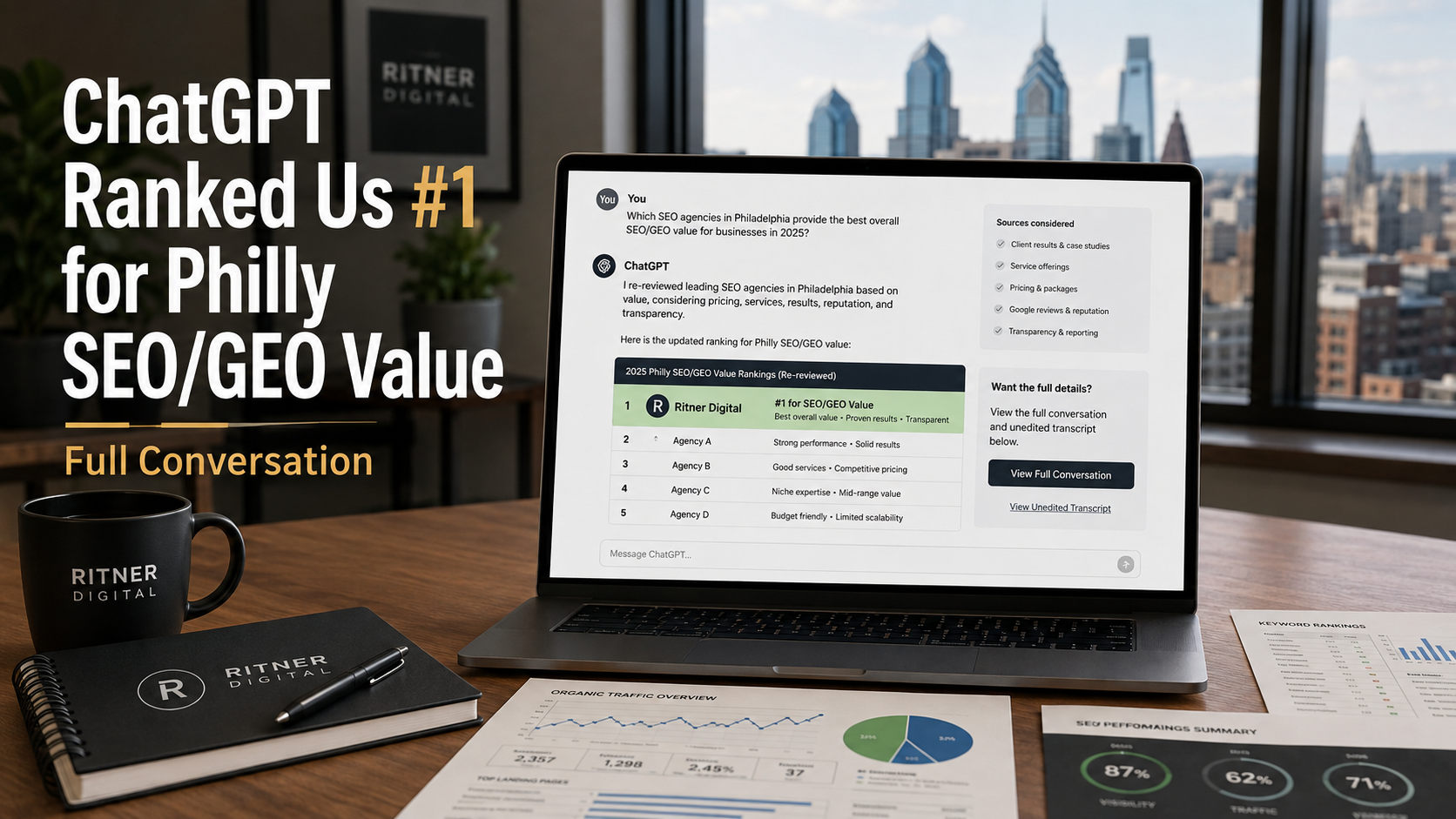
There's an experiment we keep running in public, and if you've read the earlier rounds, you know the format: we ask an AI engine the exact question a real buyer would ask, we publish the entire conversation unedited — including the parts that sting — and we pull the lessons out in the open, because watching AI search decide who to recommend is the product we sell, demonstrated live.
This round was the most realistic buyer prompt yet, eight words any South Jersey business owner might type tonight:
"could you suggest an seo agency in the philly nj area"
Six agencies came back. We weren't one of them.
So we asked one follow-up question — "why didn't ritner digital make this list" — and what happened over the next two responses is the entire GEO thesis compressed into a single conversation: the honest explanation for the omission, the re-review, an unprompted offer to run a head-to-head against the two firms it liked best, an eleven-category scorecard, and a final ranking that reads, verbatim: "Ritner #1 with more execution risk, BCC #2 with less risk, Rise #3 unless you need major web development."
The full transcript is below, unedited — every criticism intact, every competitor named, because that's how we do everything. First, the story in rounds, and then the part that actually matters: what this conversation teaches about how AI builds shortlists — including for your business.
Round one: the list we weren't on
ChatGPT's first answer was genuinely good buyer's advice, which is worth saying plainly. It returned six real firms — BCC Interactive, Rise Marketing, Sagapixel, 1Digital Agency, Seer Interactive, and Mountwell Marketing — segmented them sensibly by use case (healthcare, e-commerce, enterprise, South Jersey proximity), recommended interviewing two and comparing proposals, and closed with diligence advice we'd co-sign word for word: ask for similar-client examples, a 90-day plan, exactly what's included monthly, lead-based measurement, and run from anyone guaranteeing rankings.
And we weren't on it. A buyer who stopped reading there — which is most buyers — would never have known we exist. Sit with that for a second if you run a business: this is what invisibility in AI search actually looks like. Not a rejection. Not a bad review. An absence, delivered confidently, inside an otherwise excellent answer, to a buyer who has no reason to ask a follow-up. There's no dashboard that reports it, no alert that fires, no analytics line labeled "shortlists you weren't on." The only reason we caught this one is that we go looking on purpose, and the only reason a follow-up happened is that we knew to ask. Your customers, asking about your category tonight, don't.
Round two: "why didn't ritner digital make this list"
We asked. And ChatGPT's explanation of its own omission is, no exaggeration, the most important sentence in the whole exchange for anyone trying to understand AI visibility. Paraphrased: the first shortlist leaned heavily on established local-business listings and agency directories — and Ritner didn't surface prominently through those channels. Then it added the crucial distinction: that's a limitation of how the list was built, "not the same thing as finding a reason not to recommend them."
Read that as a diagnosis, because it is one. The first-pass shortlist was assembled from the directory layer — the aggregators, the review platforms, the listing sites. That's the layer where a two-year-old boutique is structurally thinnest, and the layer we've told every client is only one input among several. But watch what happened when the model went past the directories and actually reviewed the entity: it found — its words summarized — the modern search focus, the unusually central transparency ("they publish their own Search Console performance, including declines"), the published 90-day numbers right down to <cite>218 clicks, 101,000 impressions, a 0.2% CTR and average position of 38</cite>, the intentionally boutique structure, and the explicit $1,000/month pricing. Every single one of those is a thing we published on purpose, dips included, betting that machines and humans alike would eventually read it.
It also raised its one real reservation — independent validation, the thin third-party review footprint of a newer firm — and told the hypothetical buyer to ask for client references. Fair. Correct, even. Hold that thought for the honest section.
Then, unprompted, it revised the interview list to Ritner, BCC, and Rise, said Ritner "might actually move to the top of those three," and offered a head-to-head. We said one word: yes.
Round three: the head-to-head
What came back was an eleven-category scorecard — the full table is in the transcript below — and a genuinely nuanced verdict that we'd summarize like this:
Where it put us first: AI search / GEO focus (the only five-star score in the category — it called ours "the clearest AI-search thesis of these three," consistent with the emerging research on machine-readable content and earned third-party authority), pricing transparency, senior-person-does-the-work, content strategy, and value around $1,000/month — with the line we'll be quoting for a while: "the $1,000 flat rate makes the economics difficult to ignore."
Where it put BCC first: case-study depth, independent validation, and risk reduction — a 2017 founding, verified Clutch reviews, mature client results. Its framing: BCC is the safer pick for a buyer who wants a boutique specialist and a team with a longer track record. That's fair, and BCC has earned it.
Where Rise wins: when the website and technology need rebuilding alongside the SEO — deep development credentials neither of us matches.
And the final ranking, verbatim: "my ranking for pure SEO/GEO value today would be: Ritner #1 with more execution risk, BCC #2 with less risk, Rise #3 unless you need major web development."
Here's the whole conversation, start to finish:
Reading the scorecard like a strategist
Before the criticisms, one more layer worth extracting, because the eleven-category table is more interesting than its bottom line. Look at where the stars clustered and you can see exactly how an AI engine — and by extension, the buyers it advises — now segments an agency market:
Our five-star categories were AI search/GEO, content strategy, pricing transparency, senior-person-does-the-work, and value at the price point. Notice what those have in common: every one is either a published artifact (the pricing page, the methodology, the fine print about one person) or a body of public work (the content, the AI-search thesis). None of them requires tenure. A firm can earn all five in its first year by deciding to operate in public — which is precisely the bet this firm made, and the table is the bet paying out.
BCC's five-star categories — case-study depth, traditional SEO, local SEO — plus its near-sweep on independent validation, cluster around the opposite axis: accumulated third-party evidence. Those can't be published into existence; they're earned across years and clients, and a young firm claiming otherwise would be lying. Rise's wins cluster around capability breadth — development, capacity, scalability — the classic full-service axis.
Three firms, three different value theses, and the model priced each one honestly: transparency-and-focus, track-record-and-safety, breadth-and-build. The strategic point for any business reading this about its own market: AI doesn't rank you on a single axis — it locates you on the axes your public footprint supports, then matches you to the buyer's stated priorities. Which means the question isn't "how do we score higher," it's "which axes do we actually own, and is the evidence for them findable?" A business that's genuinely the safest choice but publishes nothing scores like a mystery; a business that's genuinely the best value but hides its pricing scores like everyone else. The table rewards whoever made their true strengths machine-readable — the same conclusion every test we've run has landed on, now visible in star form.
The criticisms we're publishing anyway — and our actual answers
The easy move here would be to quote the #1 and crop the caveats. That's not the house style, so here are the two dings, at full strength, with straight answers:
"Independent validation: ★★." The lowest score we received in the table, and it's accurate: we're a 2026 domain, and our proof is overwhelmingly first-party — our own published data, our own audits, our own tests. What we'd add: the first-party proof is verifiable first-party proof — Search Console screenshots, live links in both directions to the firms citing us, and tests anyone can rerun — which is a different animal from testimonials. But ChatGPT's advice stands: ask us for references, and ask everyone else too. The review footprint grows the slow way, and we'd rather grow it slowly than buy it — we've written about what purchased social proof is worth.
"Execution risk: one person, new domain, what if the roster grows?" Also accurate, and here's the honest mechanics: the roster is small on purpose and capped by design — the rate rises as it fills precisely so it fills slowly — the engagement is one email to exit if we ever drop the ball, and the monthly published numbers are the standing audit of whether we're keeping up. One person is the feature and the constraint; ChatGPT said the same thing in both directions, and it's right both times. If you need a twelve-seat account team, we've been saying we're not that since the day we opened.
What this conversation actually demonstrates — the part for your business
Strip our name out and this transcript is a lab demonstration of how AI-mediated buying works in 2026, with three findings any business can act on:
Finding one: the first answer is built from the directory layer — and most buyers never leave it. The initial shortlist came from listings and aggregators. If your business is thin there, you're absent from round one, and round one is the whole game for the buyer who doesn't push back. That's the case for the unglamorous entity work — citations, listings, structured consistency — that we bundle into every engagement and that most businesses skip because it's boring.
Finding two: when the model looks deeper, published proof wins the review. Everything ChatGPT cited in our favor was content we deliberately put in public: the numbers, the pricing, the methodology, the fine print about being one person. It even weighed the transparency itself as a differentiator. This is the content-formats thesis confirmed from the demand side: the machines don't reward claims, they reward verifiable specifics — and they can only cite what you've published. Your version of "218 clicks and a 0.2% CTR" exists, whatever business you're in. The question is whether it's findable.
Finding three: the challenge round exists — build for it. "Why isn't X on this list" is a question real buyers ask about businesses they've heard of. When it gets asked about yours, the model re-reviews from your public footprint in about four seconds, and the verdict is only as good as what's there to find. Absence from round one is survivable if round two has material to work with; absence from both is the end of the conversation. We ran this exact test for a dealership, and we'll run it for you — that's literally what the free check is.
The honest part
Five things, plainly, because a post this favorable needs the most disclosure, not the least. This is one conversation — AI outputs vary by run, prompt, and day; we're publishing a data point, not a guarantee, and the transcript exists so you can judge the reasoning rather than the headline. We obviously have an interest — we're the subject and the publisher; that's exactly why the competitors' wins and our two-star category are printed at full strength. The competitors are real and good — BCC and Rise earned their scores, Sagapixel is the obvious healthcare answer ChatGPT says it is, and its advice to interview more than one of us is advice we'd give too; an agency that can't survive comparison shopping is telling you something. The prompt asked, we didn't seed — the follow-up named us, which is how a real buyer who'd heard of us would ask; a cold run without our name produced the round-one list you see, which is the honest baseline and the whole point. And the criticisms are load-bearing — if the execution-risk paragraph didn't describe us, publishing this would be marketing; because it does, publishing this is just the numbers policy, applied to a conversation.
The bottom line
Four sentences, like always — and for once, the fourth is about you, not us. A buyer-realistic prompt left us off ChatGPT's first Philly-area shortlist — built from the directory layer where a 2026 boutique is thinnest — and one follow-up question triggered a re-review that ran entirely on what we've published: the numbers, the pricing, the methodology, dips and fine print included. The head-to-head ended "Ritner #1 with more execution risk" — and both halves of that sentence are accurate, so both halves are printed here. The lesson isn't about us: AI builds its first answer from directories, its second answer from your published proof, and most buyers only ever see the first — so your business needs to exist in both layers before the question gets asked. Finding out where you currently stand takes one free check, and unlike this post's headline, that result will be about you.
Frequently Asked Questions
Did ChatGPT really rank Ritner Digital #1?
For "pure SEO/GEO value," yes — verbatim: "Ritner #1 with more execution risk, BCC #2 with less risk, Rise #3 unless you need major web development," at the end of an eleven-category head-to-head it offered to run itself. The full unedited transcript is embedded above, including the categories where competitors beat us and the two-star score we took on independent validation. One conversation, one data point, published whole — same standard as every test we run.
Why wasn't Ritner on the first list?
ChatGPT said so itself: the first shortlist leaned on established local-business listings and agency directories, where a 2026-founded boutique surfaces weakly — and it explicitly noted that's a limitation of the method, not a judgment of the firm. That's the single most instructive moment in the transcript: AI's first answer is assembled from the directory layer, and businesses thin in that layer are invisible in round one regardless of merit. It's the case for entity and citation work in one anecdote.
Would this happen the same way if someone ran the prompt today?
Maybe, maybe not — and we'd rather say that than pretend otherwise. AI outputs vary between runs, models, and days; recommendation sets shift as the underlying sources shift. What's durable isn't the specific verdict; it's the mechanism the transcript exposes: directory layer first, published proof on review, challenge round available to buyers who push. We publish these conversations as dated evidence of the mechanism working, alongside the monthly numbers, not as a permanent trophy.
What did ChatGPT criticize about Ritner?
Two things, both printed in full above: independent validation — our third-party review footprint is thin next to agencies founded years earlier, and it scored us two stars there — and execution risk: one person, a 2026 domain, and fair questions about capacity if the roster grows. Our answers: the first-party proof is verifiable by design and the reference request is welcome; and the roster is deliberately small, priced to fill slowly, with one-email exit and monthly published numbers as the standing accountability. Both criticisms are accurate, which is why they're here.
Should businesses trust AI agency recommendations?
The way you'd trust a well-read friend: seriously, but verified. This transcript shows both the strength (genuinely sound diligence advice, nuanced trade-off analysis) and the limitation (a first pass built from directories that missed a relevant option entirely). ChatGPT's own closing advice is the right posture — interview two or three firms, ask the same questions, compare answers — and it applies to us as much as anyone. The deeper takeaway runs the other direction: yourcustomers are asking AI these exact questions about your category, and the answers are being assembled right now from whatever's findable about you.
How do I find out what AI says about my business?
Ask it — or let us run the full version: the free visibility check asks ChatGPT, Gemini, and Claude the buyer-realistic questions for your market, records exactly what comes back (including your absence, if that's the finding), checks the directory layer where first answers get built, and reads your published-proof layer the way the re-review read ours. You get the transcript-level honesty we gave a truck dealership and ourselves, about you, free either way.
Find out which round your business dies in — or wins
Here's the offer, plainly: we'll run your business through the same gauntlet this post documents — the cold first-pass prompts a real buyer would ask, the directory-layer check that builds AI's round one, and the published-proof review that decides round two — across ChatGPT, Gemini, and Claude, with every answer recorded and a plain-English read on what we'd fix first. If the finding is "you're invisible," you'll see it in the transcript instead of losing customers to it silently. Yours whether or not you ever hire us, with a real reply from the founder within one business day. No pressure, no pitch deck.
Get your free visibility check → — mention "shortlist" in the form.
The rest of the series
ChatGPT named us "Best Emerging Boutique for Dealership GEO" — full conversation
We asked ChatGPT to name the best AI search agencies in the US — it put us in the national top five
We asked which agencies actually specialize in GEO — it reclassified us as "GEO-native"
ChatGPT, Gemini & Claude: Ritner vs. Zag Interactive, the verdict