Local SEO in Indianapolis: How to Rank Higher on Google Maps in 2026
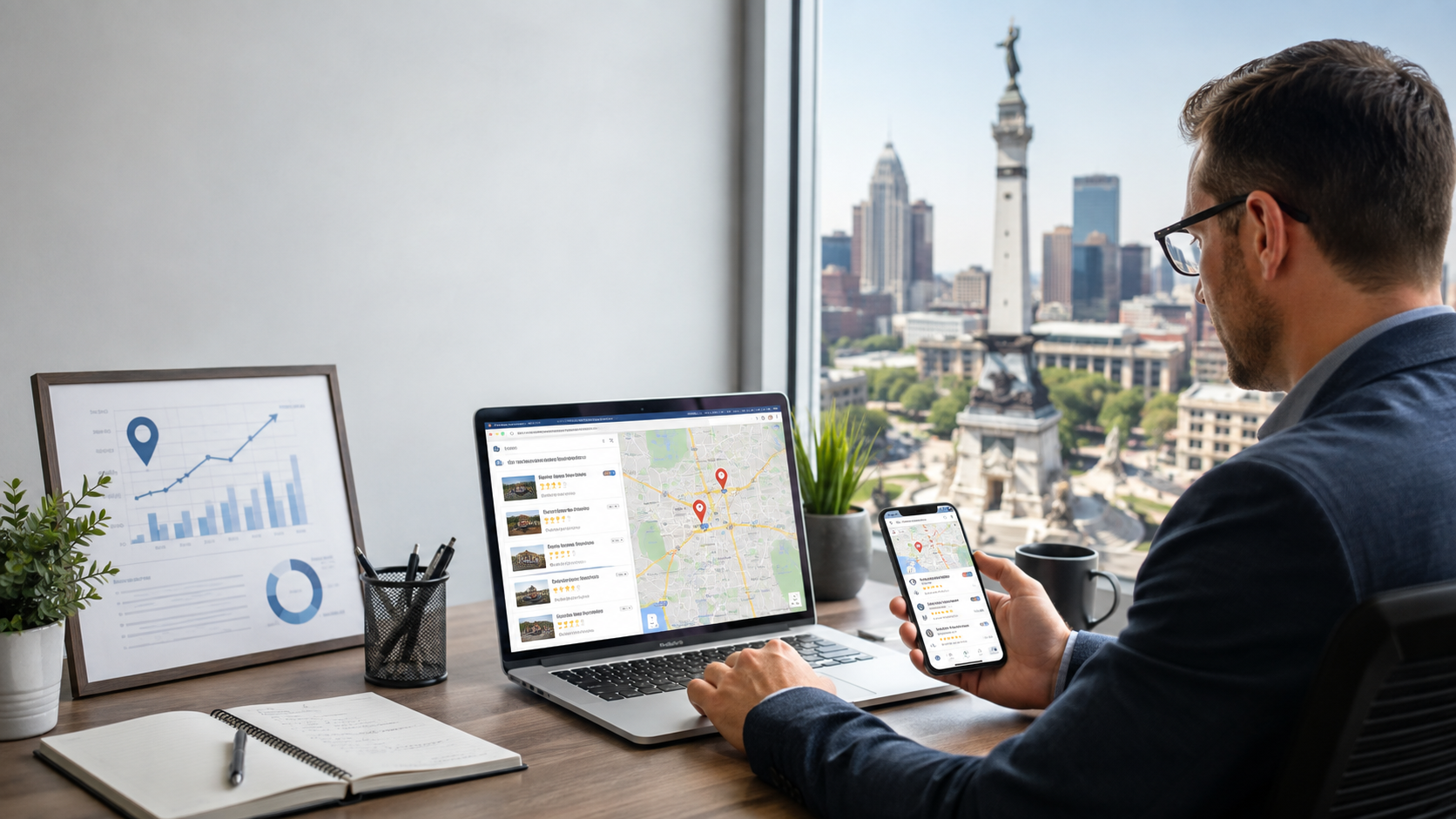
Someone in Indianapolis needs exactly what your business sells.
They pull out their phone and search:
“HVAC company near me”
“Indianapolis personal injury lawyer”
“plumber Indianapolis”
“roof repair near me”
“dentist Indianapolis”
“electrician near me”
“commercial cleaning Indianapolis”
Google has to decide which businesses deserve to appear.
And for many searches with local intent, some of the most valuable real estate isn't a traditional website result at all.
It's Google Maps.
That creates a simple problem for Indianapolis businesses:
If your competitors consistently appear in Google's local results and you don't, they have an opportunity to get the customer before that customer ever reaches your website.
Google says local results are mainly determined by three factors: relevance, distance, and prominence. Google also says businesses cannot request or pay for better organic local rankings.
That means there is no legitimate switch you can flip to become number one on Google Maps.
There is also no single local SEO trick that works by itself.
More reviews don't automatically guarantee first place.
Adding “Indianapolis” everywhere on your website doesn't guarantee first place.
Stuffing keywords into your Google Business Profile name doesn't guarantee first place.
Buying hundreds of directory listings doesn't guarantee first place.
Local SEO works when Google can confidently answer three questions about your business:
What does this company do?
Where does this company actually operate?
Why should this company be considered a credible and prominent result?
For Indianapolis businesses, building those signals properly can improve visibility across Google Search, Google Maps, and the local results customers use when they're ready to call, visit, schedule, or buy.
This guide explains how to do it in 2026.
If your business operates across Indiana, you can also see how Ritner Digital approaches SEO and AI search visibility throughout Indiana. Ritner's Indiana strategy specifically includes technical SEO, Google Business Profile work, review strategy, and local and city-level landing pages.
Why Local SEO Matters for Indianapolis Businesses
Traditional SEO and local SEO overlap, but they aren't identical.
Someone searching:
“How does a heat pump work?”
may simply be gathering information.
Someone searching:
“heat pump repair near me”
has a very different problem.
The second search is more likely to involve immediate local intent.
That customer needs a company that:
Provides the service.
Serves their location.
Looks trustworthy.
Is available.
Makes it easy to take the next step.
Google's local results attempt to solve those questions quickly.
That's why a strong local presence can be particularly valuable for:
HVAC contractors
Plumbers
Electricians
Roofers
Remodelers
Attorneys
Dentists
Medical practices
Auto repair shops
Restaurants
Home service businesses
Accountants
Cleaning companies
Property service providers
Financial institutions
Local retailers
Other businesses dependent on a defined geographic market
Consumer behavior supports the importance of local search. BrightLocal's 2025 search-behavior study found that 70% of general online searches among respondents were conducted through Google, while its local SEO research reports that one in five consumers conducts local searches directly within mapping platforms.
So your website matters.
Your Google Business Profile matters.
Your reputation matters.
And how those assets work together matters even more.
How Does Google Decide Which Indianapolis Businesses Rank on Maps?
Before trying to improve local rankings, understand what Google says it evaluates.
Google identifies three primary local-ranking concepts:
Relevance
Distance
Prominence
Relevance
Relevance describes how well your business matches what someone is searching for.
Imagine someone searches:
“commercial electrician Indianapolis.”
Google needs enough information to understand that your company actually provides commercial electrical services and is relevant to that geographic search.
Signals that can help establish what your business does include:
Google Business Profile information
Business categories
Service information
Website content
Service pages
Page titles
Headings
Internal links
Business descriptions
Other webpages that reference the business
Google specifically recommends providing complete and detailed Business Profile information to help it understand the business and match it to relevant searches.
Distance
Distance is the geographic part of local SEO.
Google considers how far a potential business is from the person conducting the search. If the searcher doesn't specify a location, Google says it may calculate distance using what it knows about that person's location.
This explains why local rankings are not one fixed leaderboard.
A business can perform differently for the same query depending on whether the search occurs in Downtown Indianapolis, Broad Ripple, Fountain Square, Speedway, or another part of the metro.
You can optimize relevance.
You can build prominence.
You cannot ethically manipulate your physical location every time somebody searches.
Prominence
Prominence is essentially how established or well-known a business appears.
Google says prominence is based partly on information it has about a business from across the web. It specifically mentions links and reviews, and says that more reviews and positive ratings can help local ranking.
This is where:
Reviews
Backlinks
Website authority
Brand mentions
Articles
Citations
Organic SEO
can become important.
And it's why having more Google reviews than every competitor does not automatically guarantee that you'll outrank them.
Ritner Digital covers that exact problem in Why Competitors With Fewer Reviews Are Outranking You on Google.
1. Fully Optimize Your Google Business Profile
For Indianapolis businesses trying to increase Google Maps visibility, the Google Business Profile is an obvious place to start.
Google says an eligible business can manage how it appears on Search and Maps through a Business Profile at no charge.
Review every major element of yours:
Business name
Primary category
Additional categories
Address
Service area
Phone number
Website
Business hours
Special hours
Services
Business description
Photos
Reviews
Review responses
Other applicable profile attributes
The goal is completeness and accuracy.
Google specifically recommends keeping business information complete and up to date.
Don't treat Google Business Profile optimization as something you do once when the business launches and never revisit.
Your company changes.
Services change.
Hours change.
Staff changes.
Photos become outdated.
Locations move.
Competitors improve.
Periodically audit the profile to ensure it still accurately represents the business customers will encounter in the real world.
2. Choose the Right Google Business Profile Categories
Business categories help Google understand what kind of company you operate.
This directly relates to relevance.
If you're an Indianapolis plumbing contractor, Google shouldn't have to guess whether you're a plumber, remodeling company, general contractor, or home improvement store.
Choose the category that most accurately describes your core business.
Then add legitimate additional categories when they accurately represent services you actually provide.
The objective is not:
“How many categories can we possibly fit into this profile?”
The objective is:
“Which categories most accurately explain our business?”
Then make sure the website supports the same positioning.
If your primary category indicates that you are a roofing contractor, Google should find meaningful roofing content on your website.
That might include:
Roof replacement
Roof repair
Commercial roofing
Residential roofing
Storm damage
Roofing projects
Roofing FAQs
Roofing testimonials
Roofing articles
Your website and Google Business Profile should reinforce one another instead of describing two different businesses.
3. Don't Stuff Keywords Into Your Business Name
One common local SEO shortcut is turning a legitimate business name like:
Smith Heating & Cooling
into:
Smith Heating & Cooling | Best HVAC AC Repair Indianapolis Furnace Experts
because someone believes all those extra keywords will improve visibility.
Don't do it unless those words are legitimately part of the business's real-world name.
Google's guidelines say businesses should represent themselves consistently with how they're recognized and represented in the real world.
Your Business Profile name field isn't another title-tag field.
Use the tools Google gives you for explaining what the company does:
Categories
Services
Website
Description
Content
Reviews
Protecting a legitimate Business Profile is far more valuable than trying to squeeze temporary ranking value from a misleading name.
4. Use a Legitimate Indianapolis Address or Service Area
This is especially important for Indianapolis home service businesses.
Not every company operates from a storefront that customers visit.
Google allows eligible service-area businesses and hybrid businesses to configure service areas, but the company's profile still needs to accurately represent how the business operates. Google says businesses that don't serve customers at their business address should remove the address from the public Business Profile.
Google's guidelines also put limits around service areas and how businesses represent locations.
The practical takeaway:
Don't manufacture Indianapolis locations you don't actually have.
That means being cautious with:
Mailboxes
Fake offices
Virtual addresses
Unstaffed “locations”
Duplicate profiles created only to rank in another city
If you operate as a service-area business, configure the profile accordingly.
If you have a real customer-facing location, represent that location accurately.
Local SEO should strengthen the footprint your business actually has—not invent one.
5. Build a Website That Supports Your Google Maps Visibility
One of the biggest local SEO mistakes is treating your website and Google Business Profile as unrelated assets.
They aren't.
Your Business Profile gives Google important local information.
Your website lets you provide far more depth.
Suppose an Indianapolis plumbing company has a four-page website:
Home
About
Services
Contact
Google knows something about the company.
Now compare that with an Indianapolis plumbing website containing:
Indianapolis Plumbing Services
Emergency Plumbing
Water Heater Repair
Drain Cleaning
Sewer Line Repair
Sump Pump Installation
Commercial Plumbing
Residential Plumbing
Financing
Project Examples
Customer FAQs
Local Educational Content
Google now has significantly more context about the services the company actually provides.
This isn't an argument for creating hundreds of pages just to make the website bigger.
It's an argument for giving important services enough room to be explained properly.
Google's SEO guidance recommends useful, well-organized content and descriptive links that help users and search engines understand pages and their relationships.
6. Create a Strong Indianapolis Landing Page
If Indianapolis is a primary market for your business, your website should make that obvious.
A dedicated Indianapolis page can help explain:
What services you offer
Who you serve
Your geographic footprint
Why Indianapolis customers choose you
How customers can contact you
But don't create a generic 300-word page that exists only to repeat “Indianapolis” 40 times.
A strong Indianapolis landing page might contain:
A Clear Value Proposition
Tell Indianapolis customers exactly what you provide.
Not:
“Welcome to our Indianapolis page.”
Instead:
“Commercial HVAC repair and preventive maintenance for Indianapolis facilities.”
Specificity is stronger than filler.
Relevant Services
Explain the individual services you provide and link to deeper service pages.
Geographic Context
Describe the market you actually serve.
If you serve Indianapolis and surrounding communities, say so accurately.
Local Proof
Whenever available, use:
Indianapolis projects
Indiana customers
Local case studies
Testimonials
Original photography
Community involvement
Partnerships
Local experience
Frequently Asked Questions
Answer questions prospective customers genuinely ask before hiring.
Calls to Action
Don't make someone read 1,500 words and then hunt for the phone number.
Make the next step obvious.
Ritner Digital uses this type of market-specific positioning on its Indiana AI Search & SEO Agency page, including SEO, local signals, Google Business Profile work, review strategy, and city-level landing pages.
7. Create Service Pages for the Searches That Generate Revenue
Your homepage doesn't need to rank for every keyword in your market.
Give major services their own pages.
An Indianapolis HVAC company might need pages for:
AC repair
AC installation
Furnace repair
Furnace installation
Heat pump repair
Commercial HVAC
Preventive maintenance
Emergency HVAC service
An Indianapolis attorney might need:
Personal injury
Car accidents
Truck accidents
Wrongful death
Slip and fall
Workers' compensation
A roofing company might need:
Roof replacement
Roof repair
Storm damage
Commercial roofing
Residential roofing
Metal roofing
Each page can target a different customer problem and search intent.
That gives Google more precise information than asking one general “Services” page to explain the entire business.
It also improves conversions.
A person searching specifically for furnace repair should arrive on a page discussing furnace repair—not a generic homepage where they have to figure out whether you provide it.
8. Use Internal Linking to Build Local Relevance
Internal linking deserves far more attention than it gets.
Imagine an Indianapolis roofer publishes:
“How Much Does a New Roof Cost in Indianapolis?”
That article could naturally link to:
Indianapolis roofing page
Roof replacement
Financing
Residential roofing
Contact page
Then those pages can link to other useful supporting resources.
That creates a connected content architecture instead of a collection of isolated pages.
Google's SEO documentation emphasizes using links that are crawlable and helpful to users.
For an Indianapolis local SEO strategy, a cluster could look like this:
Primary commercial page:
Indianapolis SEO Services
Supporting articles:
Local SEO in Indianapolis: How to Rank Higher on Google Maps
Why Your Indianapolis Business Isn't Showing Up on Google Maps
How Much Does SEO Cost in Indianapolis?
Google Business Profile Optimization for Indianapolis Businesses
How to Rank for “Near Me” Searches in Indianapolis
Indianapolis Local Citation Guide
SEO vs. Google Ads for Indianapolis Businesses
How Indianapolis Businesses Can Get Recommended by ChatGPT
These pages shouldn't compete in isolation.
They should support one another.
That's the type of SEO system Ritner Digital builds through SEO, local search, content, and AI search optimization.
9. Build a Consistent Google Review Strategy
Reviews matter for rankings.
They also matter for customers.
Google explicitly says more reviews and positive ratings can help a business's local ranking.
But reviews also affect whether someone chooses you after seeing you.
Imagine an Indianapolis homeowner sees three HVAC companies.
One has:
4.9 stars and hundreds of customer reviews.
Another has:
3.5 stars and 18 reviews.
The ranking got both companies into consideration.
Reputation may decide which one gets the call.
The answer isn't buying reviews.
It's building legitimate review generation into your customer experience.
A basic workflow might look like:
Service completed → thank-you message → direct Google review request
The process should be simple enough to happen consistently.
The longer and more complicated you make it, the less likely customers are to follow through.
10. Never Buy or Incentivize Google Reviews
If your competitor has hundreds of reviews and you have 27, buying 200 reviews can look like a tempting shortcut.
Don't.
Build legitimate reviews from real customers.
Google's policies prohibit fake engagement and manipulated content. Businesses should not manufacture positive reputation signals or create reviews that don't represent genuine experiences.
A fake review strategy also creates another business problem:
You're optimizing a trust signal by making it less trustworthy.
That's backwards.
A better goal is sustainable review velocity.
Ask legitimate customers.
Make it easy.
Keep doing it.
Over time, your review profile becomes a competitive asset that is much more difficult for a competitor to copy overnight.
11. Respond to Positive and Negative Reviews
Don't only collect reviews.
Manage them.
Google allows verified businesses to respond directly to Business Profile reviews.
For positive reviews, don't respond with the exact same copy every time:
“Thanks for your review!”
Personalize the response where possible.
For negative reviews:
Stay professional
Don't attack the reviewer
Don't expose private customer information
Acknowledge the concern
Explain what you can appropriately explain
Provide an offline resolution path when useful
And don't report every one-star review just because you dislike it.
Google allows businesses to flag reviews that violate its policies, but disagreement itself doesn't automatically make a review inappropriate.
Prospective customers understand that real businesses sometimes get negative feedback.
What they want to see is how the company handles it.
12. Add Real Photos of Your Indianapolis Business
Trust becomes much easier when customers can see evidence.
Add legitimate photographs showing:
Your employees
Vehicles
Equipment
Storefront
Office
Completed work
Before-and-after projects
Products
Team events
Community involvement
Your actual work environment
Google Business Profiles are designed to help businesses present information about their company through Search and Maps, including visual information.
Photography isn't just about ranking.
It's about conversion.
Imagine comparing two Indianapolis contractors.
Contractor A has:
Logo
Two stock photos
One blurry building image
Contractor B has:
Clearly branded work trucks
Employees on real job sites
Finished projects
Recent photos
A visible team
Actual Indiana work
Which one provides more evidence that it is a legitimate operating business?
Local SEO gets you seen.
Trust gets you chosen.
13. Keep Your Business Information Consistent Across the Web
A local citation is a mention of your company and identifying business information elsewhere online.
This frequently includes:
Business name
Address
Phone number
Website
Your information can appear on:
Google
Apple Maps
Bing
Facebook
Yelp
Chamber websites
Local organizations
Industry directories
Professional associations
Manufacturer directories
Vendor websites
News websites
You don't need hundreds of meaningless directory submissions.
You need a clean and credible business footprint.
Citation cleanup becomes particularly important after:
Moving offices
Changing phone numbers
Rebranding
Changing domain names
Merging companies
Acquiring another company
Closing an old location
Long-established Indianapolis businesses can accumulate outdated information simply because they've been operating for years.
Periodically audit important citations and correct significant discrepancies.
14. Earn Indianapolis and Industry-Relevant Backlinks
Google specifically names links as part of the information that can contribute to prominence.
But that doesn't mean:
Buy 5,000 backlinks for $99.
Think about links as digital endorsements.
An Indianapolis business may be able to earn legitimate links through:
Local organizations
Sponsorships
Community events
Chambers of commerce
Charities
Industry associations
Manufacturers
Vendors
Professional organizations
Local media
Strategic partnerships
Original research
Expert commentary
Useful public resources
An Indianapolis roofing company could publish original storm-damage data.
An HVAC company could create a detailed Indiana seasonal maintenance guide.
An attorney could create an Indiana accident-resource hub.
A commercial real estate company could publish Indianapolis market data.
Give people a reason to reference the website.
Strong authority building isn't about asking:
“Where can I insert my link?”
It's about asking:
“What could we create, contribute, sponsor, research, or explain that deserves to be referenced?”
15. Create Content Around Real Indianapolis Customer Questions
Generic blog posts rarely create meaningful local differentiation.
You don't need another article called:
“5 Benefits of Hiring a Professional.”
Build content around questions customers actually ask.
Indianapolis HVAC Content Ideas
How Much Does a New HVAC System Cost in Indianapolis?
Heat Pump vs. Furnace: What's Better for an Indiana Home?
Why Is My Indianapolis Home So Humid?
When Should I Replace My Air Conditioner?
How Often Should Indiana Homeowners Service Their Furnace?
Indianapolis Roofing Content Ideas
How Much Does Roof Replacement Cost in Indianapolis?
Does Homeowners Insurance Cover Hail Damage in Indiana?
Metal Roofing vs. Asphalt Shingles for Indiana Homes
What Should You Do After Indianapolis Storm Damage?
How Long Does Roof Replacement Take?
Indianapolis Legal Content Ideas
What Should I Do After a Car Accident in Indianapolis?
How Long Do I Have to File a Personal Injury Claim in Indiana?
What Happens After a DUI Arrest in Indiana?
What Evidence Should I Collect After an Accident?
How Are Personal Injury Settlements Calculated in Indiana?
The best local content earns traffic because the geography changes the question, the answer, or the customer's intent.
That's much stronger than publishing generic information and inserting “Indianapolis” into every paragraph.
16. Avoid Thin City Pages
Businesses often discover location pages and immediately create:
Indianapolis
Carmel
Fishers
Greenwood
Noblesville
Speedway
Avon
Plainfield
Brownsburg
Lawrence
Zionsville
Location pages themselves aren't the problem.
Thin location pages are.
If every page says:
“Looking for a plumber in CITY? We provide the best plumbing services in CITY. Contact our CITY plumbers today.”
and the only difference is the city name, you're not creating much value.
Google's broader SEO guidance emphasizes useful content made for people rather than pages existing primarily for search-engine manipulation.
Make location pages different when reality gives you something different to say.
Use:
Local projects
Local testimonials
Photos
Customer examples
Geographic context
Unique FAQs
Relevant service differences
Local regulations where applicable
Community involvement
If you cannot explain why a customer would benefit from a separate page, reconsider whether you need one.
17. Add LocalBusiness Structured Data Where Appropriate
Structured data is machine-readable information that helps search engines interpret webpage content.
Google says structured data provides explicit clues about a page's meaning.
Google also supports LocalBusiness structured data, which can communicate information about a local business, including details such as hours and business information.
Depending on the website, structured data may help clarify information about:
Organization
Local business
Business address
Hours
Services
Breadcrumbs
Other supported entities
But treat schema correctly.
It isn't a secret Maps-ranking button.
Adding schema doesn't mean:
“We installed LocalBusiness schema yesterday, so we should rank number one tomorrow.”
Use structured data to make your website easier for search systems to interpret.
That's increasingly useful as search expands beyond a traditional list of blue links.
18. Improve the Mobile Experience
Many local searches happen in situations where speed and convenience matter.
Someone may be:
Standing outside a locked business
Dealing with a leaking pipe
Looking for emergency HVAC repair
Searching for an attorney after an accident
Trying to find dinner
Comparing local service providers
Looking for directions
Trying to schedule an appointment
Your website needs to work well on a phone.
Google's mobile-first indexing guidance emphasizes ensuring that important content and structured information are available properly on mobile versions of sites.
Check your site for:
Slow loading
Tiny text
Broken forms
Difficult navigation
Buttons that are too small
Intrusive pop-ups
Images that overwhelm the screen
Missing content
Difficult phone-number access
Broken appointment forms
And make local conversions obvious.
If calls are valuable, make the phone number easy to tap.
If appointments matter, make the appointment button easy to find.
If quote requests drive revenue, don't make the form 30 fields long.
Ranking is only part of local SEO.
You still have to convert the traffic you earn.
19. Track Local Visibility Geographically
One of the biggest misconceptions about Google Maps is that every business has one universal ranking.
It doesn't work that way.
Distance is one of Google's stated local ranking factors.
That means a business might rank extremely well around its physical location and lose visibility as searches move farther away.
So instead of asking:
“What position are we for plumber Indianapolis?”
ask:
“Where are we visible across Indianapolis?”
Geographic rank tracking can reveal:
Areas where you dominate
Areas where competitors dominate
Proximity limitations
Weak geographic relevance
Service-area opportunities
Locations where visibility has improved
Locations where additional work may be necessary
A single search from the business owner's laptop isn't a sufficient local SEO report.
You want the broader pattern.
20. Measure Leads Instead of Obsessing Over Rankings
SEO agencies love ranking reports because rankings are easy to show.
Business owners should care about something more important:
Did the visibility create demand?
Track outcomes such as:
Qualified phone calls
Contact submissions
Quote requests
Appointment bookings
Direction requests
Organic leads
Google Business Profile interactions
Search impressions
Search clicks
Local visibility
Review growth
Organic landing-page performance
Closed business when attribution is available
Rankings are diagnostic.
Revenue is the outcome.
A keyword moving from position 12 to position 4 matters if it produces useful traffic and leads.
Ranking number one for a phrase nobody searches—or nobody buys from—doesn't deserve the same celebration.
This is why Ritner Digital publishes real performance data rather than relying only on selected ranking screenshots.
The Ritner Digital 90-Day SEO Report Card documented the site's early search growth, while the July 2026 SEO Benchmark Report reported month-over-month growth in clicks alongside improved average search position.
The principle is simple:
Measure before. Make changes. Measure after.
A 90-Day Local SEO Plan for Indianapolis Businesses
Trying to fix everything at once usually creates chaos.
A better strategy is sequencing the work.
Days 1–30: Fix the Foundation
Start with an audit.
Review:
Google Business Profile
Verification status
Business name
Categories
Address
Service areas
Hours
Website URL
Services
Reviews
Review responses
Photos
Website indexation
Mobile experience
Technical SEO
Main service pages
Existing Indianapolis content
Important citations
Analytics and tracking
Competitors
Correct obvious problems first.
If the address is wrong, fix it.
If the primary category doesn't reflect the actual business, review it.
If important pages aren't indexed, investigate why.
If the website is broken on mobile, address that before writing 30 new articles.
Foundations compound everything that follows.
Days 31–60: Build Relevance
Once the foundation is stable, improve the content architecture.
Work on:
Indianapolis landing page
Core service pages
Location pages where justified
Internal linking
Content gaps
Titles
Headings
Local FAQs
Project pages
Case studies
Structured data
Review-request workflow
The goal during this period is to make it increasingly obvious what your business does and where it provides those services.
Days 61–90: Build Prominence
Now push outward.
Focus on:
Review generation
Review responses
Local citations
Industry citations
Partnerships
Backlinks
Sponsorships
PR opportunities
Original resources
Expert commentary
Authority-building content
Track what changes.
Don't assume every tactic is working merely because it appeared on the SEO checklist.
How AI Search Changes Local SEO in 2026
Indianapolis customers aren't discovering businesses in only one place anymore.
Google remains enormously important, but business discovery increasingly happens across:
Google Search
Google Maps
ChatGPT
Gemini
Perplexity
Social platforms
Review platforms
Other AI-assisted experiences
BrightLocal's 2026 research found a substantial increase in consumers using AI to seek local business recommendations, illustrating how quickly local discovery behavior is changing.
That does not mean businesses should abandon Google Maps optimization.
It means the digital information surrounding a business needs to become clearer and more consistent.
The same underlying assets that strengthen traditional search can also make your business easier for other systems to understand:
Clear business information
Strong service pages
Demonstrated expertise
Real reviews
Original content
Authoritative mentions
Backlinks
Structured data
Consistent entity information
Strong brand signals
Local SEO and AI search optimization are increasingly connected by the same fundamental question:
Can a search system confidently understand who your company is, what you do, where you operate, and why you deserve to be recommended?
That's why Ritner Digital combines traditional SEO, local search strategy, authority building, and AI search visibilityinstead of treating them as completely separate channels.
The Biggest Local SEO Mistakes Indianapolis Businesses Should Avoid
Creating Fake Locations
Don't create an Indianapolis office that doesn't legitimately exist.
Follow Google's Business Profile eligibility and representation guidelines.
Keyword-Stuffing the Business Name
Use the actual business name instead of turning it into a list of target keywords.
Buying Reviews
Build reviews from genuine customers rather than manufacturing trust.
Focusing Only on Review Count
Reviews matter, but Google also evaluates relevance, distance, and prominence.
A competitor with fewer reviews can still outrank you.
Publishing Thin Location Pages
Don't generate 50 pages that differ only by city name.
Make each important location page useful.
Ignoring the Website
Your Google Business Profile cannot do all the work.
Build a website that reinforces services, expertise, location, and authority.
Ignoring Mobile Users
Your customers shouldn't struggle to contact you because the mobile website is difficult to use.
Tracking One Ranking From One Location
Local rankings can vary geographically because distance matters.
Expecting Immediate Results
Local SEO is a compounding process.
Some changes may produce faster improvements than others, but durable authority is usually built through consistent work.
Frequently Asked Questions
What Is Local SEO?
Local SEO is the process of improving a company's visibility for searches connected to a specific geographic area.
For an Indianapolis business, examples could include:
“plumber Indianapolis”
“HVAC company near me”
“Indianapolis personal injury attorney”
“roof repair Indianapolis”
“dentist near me”
Local SEO commonly involves Google Business Profile optimization, website SEO, location and service content, customer reviews, citations, backlinks, structured data, and reputation management.
Google says local results are primarily influenced by relevance, distance, and prominence.
How Do I Rank Higher on Google Maps in Indianapolis?
There is no single action that guarantees a higher Google Maps ranking.
Focus on improving the areas that influence relevance and prominence while understanding that physical distance remains a factor.
That can include:
Completing your Google Business Profile
Selecting accurate categories
Keeping business information current
Creating strong service pages
Building useful Indianapolis content
Generating genuine customer reviews
Responding to reviews
Earning reputable backlinks
Maintaining accurate citations
Improving technical SEO
Strengthening internal links
Improving mobile usability
Google's own guidance recommends keeping Business Profile information complete and accurate and identifies relevance, distance, and prominence as the major local ranking factors.
How Long Does Local SEO Take in Indianapolis?
There is no universal timeline.
Results can depend on:
Industry competition
Current website authority
Business location
Website age
Technical SEO
Existing rankings
Google Business Profile quality
Number and quality of reviews
Backlinks
Content
Competitor investment
Geographic market
A well-established company with years of authority may be in a very different position than a new Indianapolis business with a new domain, few reviews, and no backlinks.
SEO should be measured over time rather than judged from a handful of days.
Ritner Digital's own SEO benchmark reports use month-over-month data to evaluate whether visibility and clicks are moving in the right direction.
Does Having More Google Reviews Help Local Rankings?
Google says more reviews and positive ratings can help a business's local ranking.
But more reviews do not automatically guarantee a higher position.
Google also evaluates relevance, distance, and prominence.
That means a business with fewer reviews may still outrank a competitor because of:
Better location relative to the searcher
Better category relevance
Stronger website content
Stronger backlinks
Better organic SEO
Greater overall prominence
For a deeper explanation, read Why Competitors With Fewer Reviews Are Outranking You on Google.
How Many Google Reviews Does My Indianapolis Business Need?
There is no universal number.
The appropriate benchmark depends heavily on the industry and competitors.
Instead of targeting an arbitrary number like 100 or 500, compare your business with companies competing for the searches that matter to you.
Look at:
Review count
Average rating
Review recency
Review consistency
Competitor profiles
Then create a legitimate system that continually asks real customers for feedback.
The objective is consistency—not an overnight spike.
Can I Pay Google to Rank Higher on Google Maps?
No, not for a better organic local ranking.
Google explicitly states that businesses cannot request or pay for better local rankings.
Paid advertising is separate from organic Maps visibility.
Be cautious when an SEO provider claims it can simply pay Google or guarantee the number-one organic Maps position.
Does My Website Affect My Google Maps Visibility?
Yes, your website can support local visibility.
Your site gives search engines more information about:
Services
Expertise
Geographic relevance
Business authority
Related topics
Customer questions
Google's broader SEO documentation recommends making websites crawlable, understandable, and useful to searchers.
A strong local strategy therefore combines Google Business Profile optimization with website SEO instead of treating them as isolated projects.
Do I Need an Indianapolis Address to Rank in Indianapolis?
Physical location matters because distance is one of Google's stated local ranking factors.
However, legitimate service-area businesses can serve customers away from a public storefront and should configure their Business Profiles according to Google's rules. Google says businesses that don't serve customers at their address should remove that address from the public profile and use service areas appropriately.
What you should not do is create fake offices or misleading locations solely to acquire map rankings.
Should I Create a Separate Indianapolis Landing Page?
If Indianapolis is a meaningful market for your business, a dedicated landing page can make sense.
The page should offer more than a city keyword.
Include useful information about:
Services
Service area
Local projects
Relevant customers
Testimonials
FAQs
Unique expertise
Contact options
Then link the Indianapolis page naturally to your individual service pages and supporting content.
Should I Create Pages for Indianapolis, Carmel, Fishers, Greenwood, and Other Nearby Areas?
Only when you can make those pages genuinely useful.
Creating multiple location pages isn't inherently a problem.
Creating nearly identical pages and changing only the city name creates a poor user experience and weak differentiation.
Build local pages when you have a real reason to explain:
Local service differences
Projects
Testimonials
Geographic context
Local questions
Relevant regulations
Community involvement
Quality matters more than how many city names appear in your sitemap.
What Is the Google Local Pack?
The Local Pack is the group of local businesses Google may display prominently for queries with local intent.
These results can help searchers quickly compare nearby or relevant companies and access information such as ratings, hours, business details, and map information.
BrightLocal describes the Local Pack as a prominent section of Google's local search experience for searches with local intent.
Because these results can appear prominently for valuable commercial searches, earning local visibility can put a business in front of customers at an important point in their buying process.
Why Does My Google Maps Ranking Change Depending on Where I Search?
Because distance matters.
Google says local rankings consider how far each potential result is from the person conducting the search.
Therefore, someone searching near your office may see your business more prominently than another person performing the same query farther away.
That's why local SEO performance should be measured across the geographic market instead of relying on one manual search.
Are Backlinks Important for Indianapolis Local SEO?
They can be.
Google specifically mentions links when describing prominence.
The best strategy is not accumulating the maximum possible number of backlinks.
Prioritize legitimate authority.
Useful opportunities might include:
Indianapolis organizations
Indiana associations
Industry organizations
Local media
Sponsorships
Manufacturers
Vendors
Business partners
Original research
Helpful local resources
Aim for links that make sense for a real business to have.
Do Local Citations Still Matter?
Accurate business information across important platforms helps create a cleaner local footprint.
Citation management is especially useful when a company has changed:
Business name
Address
Phone number
Website
Location
Prioritize accurate information on reputable platforms instead of chasing hundreds of irrelevant directories.
Does Schema Markup Help Indianapolis Local SEO?
Structured data helps search engines interpret webpage information more explicitly. Google supports LocalBusiness structured data for providing details about local businesses.
That makes schema useful.
But it isn't a guaranteed Maps-ranking hack.
Think of structured data as additional clarity for search systems—not a substitute for reviews, content, authority, technical SEO, or a properly configured Google Business Profile.
How Often Should I Update My Google Business Profile?
There isn't a guaranteed posting or editing schedule that automatically improves rankings.
Instead, keep important business information accurate.
Update the profile when:
Hours change
Holiday hours change
Services change
Contact information changes
You move
New relevant photos become available
Customer reviews arrive
Google lets verified businesses edit profile details to keep information current.
Is Google Maps SEO Different From Traditional SEO?
Yes, but they overlap significantly.
Traditional SEO focuses heavily on website visibility.
Google Maps SEO adds geographic and Business Profile signals, including:
Distance
Business information
Categories
Reviews
Local prominence
Location relevance
The strongest strategy uses both.
Your website builds depth and authority.
Your Google Business Profile provides direct local business information.
Your reviews build reputation.
Your backlinks and mentions reinforce prominence.
Your location helps establish proximity.
Together, they create a much stronger local presence.
Sources
This guide was researched using current materials available in August 2026, with Google's own documentation used as the primary authority for statements about Google Search and Google Business Profile behavior.
Google Business Profile Help — Tips to Improve Your Local Ranking on Google. Google's official guidance on relevance, distance, prominence, reviews, and organic local ranking.
Google Business Profile Help — Guidelines for Representing Your Business on Google. Google's policies for business names, locations, service-area businesses, and profile representation.
Google Business Profile Help — Manage Your Service Areas. Google's official service-area guidance.
Google Business Profile Help — Get Started With Google Business Profile. Google's overview of managing how eligible businesses appear on Search and Maps.
Google Business Profile Help — Manage Customer Reviews. Google's documentation on reviewing and responding to customer feedback.
Google Search Central — LocalBusiness Structured Data. Google's technical guidance for LocalBusiness markup.
Google Search Central — Introduction to Structured Data. Google's explanation of how structured data provides explicit information about page content.
Google Search Central — Mobile-First Indexing Best Practices. Google's mobile indexing guidance.
Google Search Central — SEO Starter Guide. Google's guidance on making websites more accessible and understandable to search engines and users.
BrightLocal — Consumer Search Behavior. 2025 research into how consumers use Google and other platforms to discover businesses.
BrightLocal — Local SEO Statistics. Research covering local search and mapping-platform usage.
BrightLocal — AI and Local Business Recommendations. 2026 research into consumer use of AI for local-business discovery.
Want More Indianapolis Customers Finding Your Business?
Ranking higher on Google Maps isn't about chasing one trick.
It's about building a stronger local search system.
Your Google Business Profile needs to be accurate.
Your website needs to clearly explain what you do.
Your Indianapolis content needs to match what customers actually search for.
Your reviews need to demonstrate real customer trust.
Your citations need to be clean.
Your backlinks and mentions need to build authority.
And increasingly, your business needs to be understandable not only to Google, but to the AI search platforms customers are starting to use for recommendations.
Ritner Digital helps businesses build that entire system—from local SEO and Google Business Profile optimization to technical SEO, content, authority building, internal linking, structured data, and AI search visibility.
If your Indianapolis business isn't appearing where customers are searching—or you're watching competitors dominate Google Maps and don't know why—let's find the gap.
Ready to See What's Holding Back Your Indianapolis Visibility?
Contact Ritner Digital today and tell us where you want to grow.
We'll look at where your search visibility stands, where competitors are beating you, and what should be prioritized to turn more Indianapolis searches into calls, leads, and customers.