Why Your Blog Posts Rank and Your Service Pages Don't
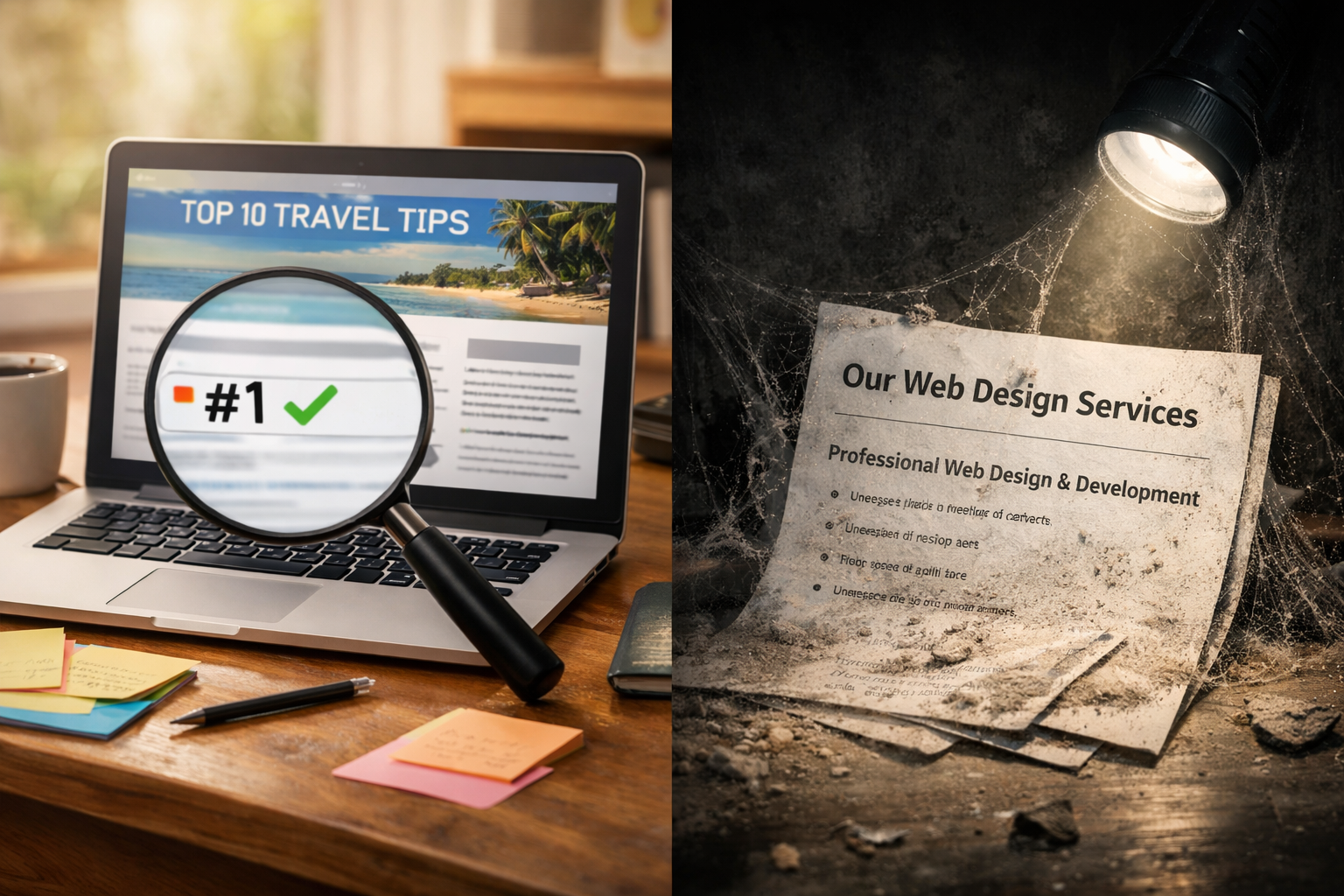
The SEO Gap Explained — And How to Close It for Good
You've invested real time and money into your website. Your service pages are polished. The copy is tight, the layout is clean, and everything looks exactly the way a professional business website should look. You describe what you do, who you help, how much experience you have, and how to get in touch.
And yet — a blog post you wrote on a slow Tuesday afternoon two years ago is sitting on page one of Google, while your core service page is buried somewhere on page four or five.
This isn't bad luck. It isn't a glitch. It happens to business owners constantly, across industries, across regions, and across website platforms. And there are clear, documented reasons why.
This post will walk you through exactly what's happening — and, more importantly, what to do about it.
The Core Problem: Search Intent
To understand why blogs outrank service pages, you first need to understand how Google thinks about search queries. Every search a person types into Google has an underlying intent — a reason behind the question. SEO professionals categorize these into four main types: informational, navigational, commercial, and transactional.
According to SE Ranking, the breakdown of search intent in 2025 looks like this: 70% of searchers have informational intent, 22% commercial intent, 7% navigational, and just 1% transactional. SeaRanks Put plainly, the overwhelming majority of searches are from people who want to learn something, not from people who are ready to call a contractor.
Your service page — the one that says "We provide expert web design services to South Jersey businesses" — is written for a transactional visitor who has already decided what they want and is ready to hire. That's a tiny sliver of the total search universe. Your blog post, by contrast, is written to answer a question. It serves the much larger audience that is still learning, still researching, still figuring out what they need.
Google's job is to match search queries with the most relevant, useful result — and for the majority of queries, that means surfacing an educational piece, not a sales page. As Backlinko explains, informational content — the kind that starts with "how to," "what is," or "why does" — dominates search results for most non-branded queries. Backlinko Service pages are built to close, not to inform. And if the dominant intent for a keyword is informational, a closing page will rarely rank on its own.
From a strategic standpoint, informational content builds awareness and trust, commercial content guides evaluation and persuasion, and transactional content captures conversions. Mastering the interplay between these three types allows your marketing strategy to guide users along the buyer journey seamlessly — from curiosity to purchase. Great Ape DigitalThe mistake most small business websites make is publishing only the last piece of that chain and expecting Google to reward them for it.
Why Blogs Naturally Earn Backlinks (And Service Pages Don't)
Backlinks — links from other websites pointing to yours — remain one of the most important ranking signals Google uses. When a reputable site links to your page, it's essentially casting a vote of confidence in your content. The more of those votes your page earns, the more authority it carries in search results.
Here's the problem: nobody links to a service page.
Think about it from a human perspective. When a blogger, journalist, or business owner wants to reference something helpful in their own content, they link to resources that taught them something, solved a problem, or provided useful data. They don't link to "Our Web Design Services" pages. They don't share vendor sales copy on social media. They share guides, case studies, how-to posts, and industry insights.
According to Orbit Media, 82% of bloggers report that their blog drives at least some measurable results. Visual content in particular attracts significantly more shares — which in turn generates more inbound links and signals to Google that the content is worth surfacing. The HOTH
Every link a blog post earns compounds over time. It builds domain authority, improves the overall trustworthiness of your site, and can indirectly lift the ranking potential of other pages — including your service pages — through a concept called internal link equity, which we'll cover in depth shortly. Service pages, by contrast, sit largely invisible to the external web. They get indexed, they wait, and they rarely attract the kind of organic link activity that moves rankings.
The Keyword Competition Problem
Service pages tend to target high-intent, bottom-of-funnel keywords. These are the terms people search when they're ready to hire: "web designer South Jersey," "SEO agency near me," "IT support Cherry Hill NJ." The problem is that these are also the most competitive keywords in any local market. Every competitor in your space is fighting for those same terms, and the businesses that rank for them have usually spent years building domain authority and earning backlinks.
Blog posts, by contrast, can target longer, more specific queries — what SEOs call long-tail keywords. These are lower-volume searches, but they're also far less competitive, and they often convert at higher rates because the searcher's intent is more precise. Research shows that long-tail keywords carry a 36% conversion rate — higher than most optimized landing pages — precisely because the searcher already knows what they're looking for. The HOTH
A business owner searching "how to tell if my website is hurting my Google ranking" is further along the decision path than one searching "web design services." They're more qualified, more engaged, and more likely to become a client when they land on a page that actually answers their question and connects to your services.
Grow and Convert's data shows that in many cases, a blog post format gives you more room to include relevant keywords and answer the intent of the searcher — making blog posts often easier to rank highly than landing pages. Their analysis found that product landing pages don't always convert better than blog posts, and in some cases convert at significantly lower rates. Grow and Convert This challenges the assumption that service pages are always the best vehicle for capturing ready-to-buy visitors.
Google's Helpful Content System Changed the Rules
In March 2024, Google rolled out a significant core update that fundamentally shifted what kinds of content receive ranking preference. The update reinforced what Google calls its "Helpful Content" system: a set of signals designed to reward pages that provide genuine, first-hand value to real users over pages built primarily to rank.
According to SEO analysis of the update, content without original insights now gets downgraded. Helpful, credible, and human-centered content ranks. The shift emphasizes fresh perspectives, updated data, and active internal linking as ongoing quality signals. Snoika
A blog post that walks through a real client problem, explains a nuanced concept, or offers an original take on an industry trend satisfies these quality signals far better than a page that says "We are a full-service marketing agency dedicated to helping your business grow" — language so generic it could appear on any website in any market.
Google's June 2025 core update reinforced the importance of topical authority, rewarding sites that cover a subject thoroughly, consistently, and credibly rather than relying solely on legacy domain-level metrics. Pages that function like complete answers — not just superficial responses — saw measurable uplift in search rankings and traffic. Search Engine Land Service pages, by their nature, are not designed to be complete answers to anything. They're designed to convert. And in the current SEO environment, that design works against them in organic search.
Topical Authority: The Framework That Connects Everything
Topical authority refers to your website's perceived expertise in a specific subject area. Rather than publishing random blog posts or keyword-stuffed pages, the most effective SEO strategies today organize content into interconnected clusters — a framework that has become central to how competitive sites rank.
The model works like this: you create a central "pillar page" that covers a broad topic comprehensively — typically your core service page or a dedicated resource — and then surround it with a series of "cluster" blog posts that each address a specific subtopic in depth. Each cluster post links back to the pillar, and the pillar links out to each cluster. This creates a tightly interconnected content ecosystem that signals deep expertise to both users and search engines.
Content grouped into clusters drives about 30% more organic traffic and holds rankings 2.5x longer than standalone pieces, according to HireGrowth's 2025 analysis. Search Engine Land
A single pillar page supported by 20 cluster pages will consistently outrank competitors relying on standalone long-form articles for the same head terms. Sites that sustain cluster publishing for 12 or more months see 40% higher organic traffic than comparable single-page strategies. Digital Applied
This is the key insight that most small business websites are missing: your blog posts and your service pages are not separate initiatives. They are — or should be — part of a single connected system. When blog posts earn authority and link strategically to service pages, those service pages start to rank. When service pages link back to supporting blog content, users stay longer and the engagement signals reinforce the whole cluster.
How Internal Linking Distributes Authority to Service Pages
This is the most actionable concept in this entire post, so it's worth spending real time on it.
Internal links pass PageRank from pages with lots of external authority to other internal pages. A page that earns many backlinks has more authority via PageRank, and that authority can then be passed to connected pages by way of internal links. Semrush In practical terms: your blog post that earns links from five other websites becomes a conduit. If that post contains a link to your service page, it transfers a portion of its ranking power to the service page — for free, with no additional link building required.
When your site earns backlinks from reputable websites, internal links allow you to pass that authority to other pages. This gives other pages a signal boost. A well-linked page is easier for search engine crawlers to find because crawlers use links to move from one page to another. If a page has no internal links pointing to it, crawlers may not discover it until much later, if at all. Search Engine Land
This last point is critical. Many small business service pages are effectively orphaned — they exist on the site, but no other page links to them. Google's crawlers find them eventually, but they carry almost no internal weight. They're invisible not just to users, but structurally, to Google itself.
Google patents on ranking explicitly describe how "numerous other web pages associated with the same domain containing links to a particular web page" signals that the page is of greater importance within the domain. Internal links from topically related pages are considered more likely and thus more valuable than links between unrelated pages. WordStream
This means that the anchor text you use in your internal links matters too. Linking to your web design services page with the anchor text "learn more" tells Google nothing. Linking with the anchor text "South Jersey web design services" sends a clear topical signal that reinforces what that page should rank for.
Strong internal linking improves crawl paths and clarifies topical relationships for both Google and AI search engines. Prioritized, strategically mapped links boost authority signals and can elevate mid-ranking pages into visibility. seoClarity
What Service Page Copy Gets Wrong
Beyond the structural issues, there's a content problem that affects most service pages independently of linking strategy.
Pages built on user search intent usually have higher time-on-site and lower bounce rates, because readers stick around for the answer they came for. Intent-focused SEO means creating content that matches each type of search: informational intent demands in-depth guides with walkthroughs and visuals; commercial intent demands comparison tables and expert reviews; transactional intent demands a clear path to action. Siteimprove
Most service pages attempt to serve transactional intent but fail to serve commercial or informational intent at all. The user who lands on a service page cold — without first being warmed up through helpful content — has no context for why your agency is worth hiring over the four competitors also on page one. The page is asking for a decision the visitor isn't ready to make.
When you encounter mixed intent in your keyword research, it's helpful to create content that can serve multiple needs. Mixed intent is a sign that users are exploring, learning, and evaluating their options. By covering multiple angles in one helpful piece of content, you meet their expectations and give them the freedom to choose their next step. Yoast
The fix isn't to gut your service page and turn it into a blog post. It's to add substance — a section that explains how your process works, a FAQ that addresses objections, a case study that proves results. And then, critically, to build the blog infrastructure around it that sends warm, informed traffic to that page in the first place.
The Practical Fix: A Content Strategy That Works Both Ways
Here is how you close the gap between your performing blog content and your invisible service pages.
Step 1: Audit what's already ranking. Open Google Search Console and look at which blog posts are generating impressions and clicks. These are your most authoritative pages. They're earning traffic and potentially links. Now ask: do any of them link to your service pages? If not, that's your first quick win — add contextual internal links from your best-performing blog posts to the service pages you want to rank.
Step 2: Map your content clusters. For each service you offer, identify the questions your ideal clients ask before they're ready to hire. "How do I know if my website is hurting my business?" "What does a good local SEO strategy look like?" "How long does a website redesign take?" Each of those questions is a blog post. Each blog post is a future internal link to your service page.
Step 3: Fix your service page copy. Run a search for the primary keyword your service page is trying to rank for and look at the actual search results. If the results are mostly guides and how-to articles, the intent is informational — and a pure sales page won't compete. If you see product pages and comparison content, the intent is more commercial and your page may be closer to aligned. Yoast Adjust your page to better match what Google is already rewarding.
Step 4: Build with intent, not just keywords. Google prioritizes fresh insights, updated data, and active internal linking as part of ongoing quality signals. Regularly refreshing older pages is no longer optional — it's essential. Snoika Don't let your service pages sit untouched for two years. Update them, add new sections, reflect changes in your business, and keep them connected to new content as you publish it.
Step 5: Think in terms of the full buyer journey. In 2025, SEO is less about gaming the system and more about becoming the best resource on the web for your niche. Build your content around pillar pages covering broad topics and cluster content addressing specific subtopics. This structure signals to search engines that you have comprehensive coverage. EnFuse Solutions A visitor who reads three of your blog posts before landing on your service page is infinitely more likely to convert than someone who found the service page cold. The blog isn't a distraction from the funnel. It is the funnel.
The Bottom Line
The reason your blog posts rank and your service pages don't isn't a mystery. Blogs answer questions, earn links, target achievable keywords, and satisfy Google's intent signals. Service pages pitch services to a small fraction of the search audience that's already decided to buy — and they often do it with copy generic enough to describe any business in any city.
The solution isn't to choose one over the other. It's to build a strategy where your content and your service pages operate as a connected system — where every blog post earns authority and funnels it downstream, and where every service page benefits from the trust and traffic your content generates.
That's what a real SEO strategy looks like. And it's what separates businesses that grow organically from businesses that wonder why they're invisible on Google despite having a great-looking website.
If you're not sure where your site stands — which pages are carrying authority, which are orphaned, and what connecting them could do for your rankings — that's exactly the kind of audit Ritner Digital does. Reach out and we'll take a look.
FAQ
Why Do Blog Posts Rank Better Than Service Pages?
Blog posts are written to answer questions, which aligns with how the majority of people actually search. According to SE Ranking, 70% of all searches have informational intent — meaning most people are looking to learn something, not hire someone. Google rewards content that matches that intent, and blog posts do that naturally. Service pages are written to close a sale, which is valuable for conversion but rarely what Google wants to serve to most searchers.
Should I Turn My Service Pages Into Blog Posts?
No. Service pages and blog posts serve different purposes and you need both. Your service page is what converts a visitor into a client — it needs to stay focused on your offer, your process, and your call to action. The goal is to use blog posts strategically to drive warm, informed traffic to your service pages through internal links, not to replace one with the other.
What Is an Internal Link and Why Does It Matter for SEO?
An internal link is a hyperlink from one page on your website to another page on the same website. From an SEO standpoint, internal links pass authority — sometimes called "link juice" or PageRank — from pages that have earned it through external backlinks to pages that haven't. If your blog post earns five links from other websites and that post links to your service page, some of that ranking power transfers to the service page. It's one of the highest-leverage SEO moves available to a small business website.
How Many Blog Posts Do I Need Before My Service Pages Start Ranking Better?
There's no magic number, but the research on content clusters suggests that sustained publishing over 6 to 12 months is where the real compounding begins. The more important factor is whether the blog posts you publish are topically related to your services and whether they consistently link to your service pages with descriptive anchor text. Three tightly connected, well-written posts that point to a service page will do more than twenty unrelated posts that link to nothing.
My Website Is Fairly New. Does Any of This Still Apply?
Yes — and for newer sites, this strategy matters even more. When you don't yet have the domain authority to compete for high-intent service keywords, targeting long-tail informational queries through blog content is often the fastest path to organic visibility. You can rank for specific, lower-competition questions relatively quickly, build authority through that content, and use it to feed your service pages while your overall domain grows. Waiting until your site is "established" before investing in content is one of the most common SEO mistakes newer businesses make.
Can I Just Hire Someone to Build Links to My Service Pages Directly?
You can, but it's expensive, harder to sustain, and increasingly risky as Google gets better at identifying artificial link patterns. The more durable approach is to create content that earns links naturally — which blog posts do far better than service pages — and then route that authority to your service pages through internal linking. It's a slower build, but the results compound over time and don't disappear the moment you stop paying for them.