Why So Many Business Owners Are Allergic to SEO
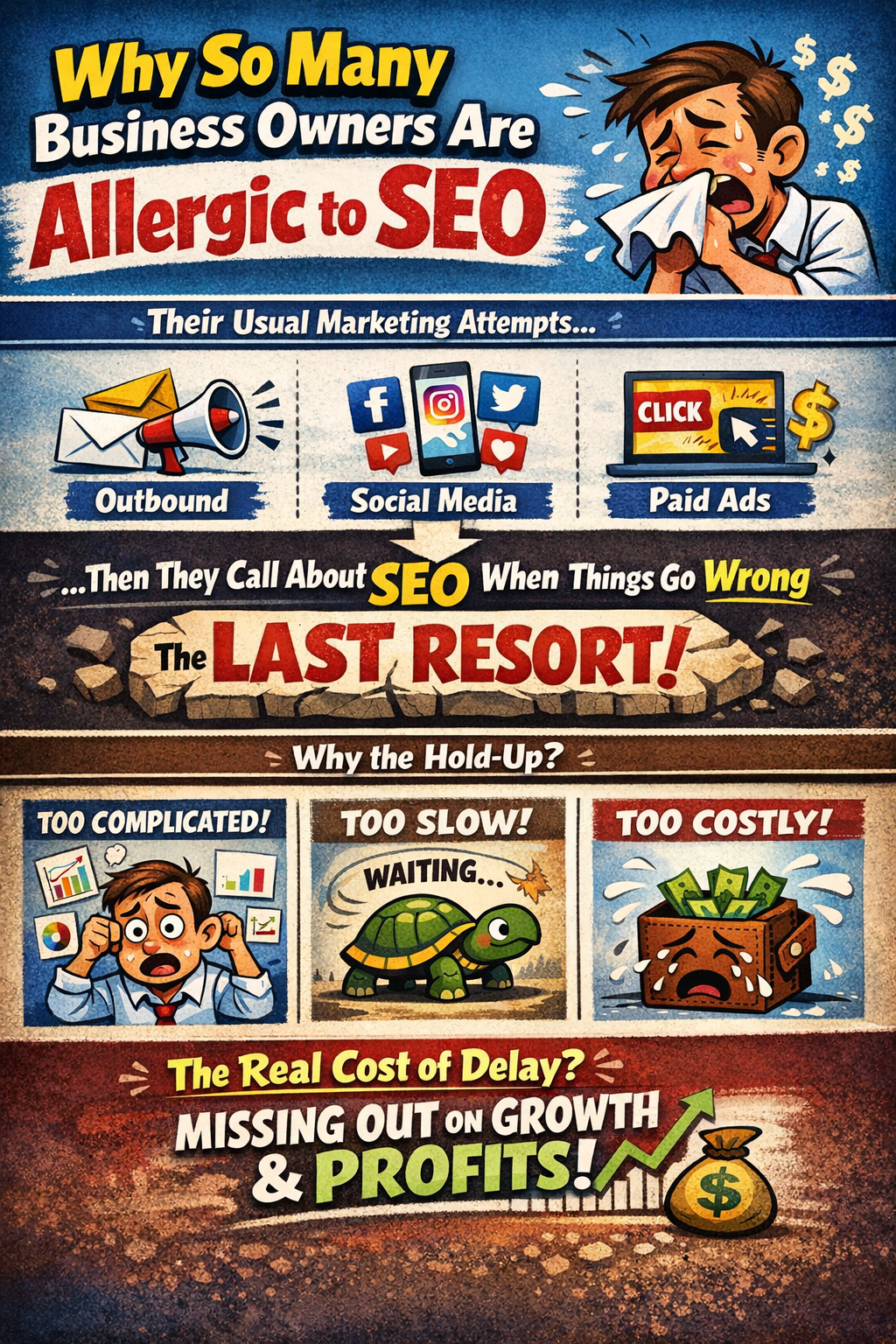
They'll Try Outbound. They'll Try Social. They'll Try Everything. Then, Finally, They'll Call About SEO.
There's a pattern that shows up constantly in conversations with small business owners, and it goes roughly like this:
They try networking events. Then cold outreach. Then direct mail. Then they start posting on Facebook every day for three months. Then Instagram. Then they run some Google Ads. Then they pause the Google Ads because they couldn't figure out why the leads weren't converting. Then they hire a social media manager who posts beautiful content to 400 followers for six months. Then something isn't working and they can't quite explain what. Then, finally — usually after some combination of frustration, a slow quarter, or a conversation with a competitor who's ranking on page one — they call about SEO.
It's always the last thing. The emergency lever. The option they arrive at after exhausting everything else.
And the maddening part is that if they had started with SEO — or even just included it alongside the other channels — they'd be in a completely different position by now.
This post is about why that pattern exists, why it's so predictable, and why the business owners who break out of it almost always end up regretting how long they waited.
First, the Data That Should End the Debate
Before getting into the psychology of why business owners avoid SEO, it's worth establishing what they're avoiding.
Organic search accounts for 46.98% of all traffic worldwide. That means nearly one in two visits to a website still begins with an organic search engine. SeaRanks
Organic social media, by contrast, has been flat at around 5% of website traffic since 2014 — contributing on average just 1/11 as much traffic as organic search. BrightEdge
According to research from Digital Silk, 94% of clicks on Google go to organic results, while only 6% go to paid results. The main reason: most searches don't have commercial intent. Digital Silk
SEO delivers an average ROI of 748% in 2025, and organic leads convert at 14.6% versus just 1.7% for outbound leads. Single Grain
61% of B2B marketers say that SEO and organic traffic generate more leads than any other marketing channel. 49% of marketers find organic search to have the best ROI of any channel. Digital Silk
And yet: 61% of small businesses are currently not investing in SEO. WordStream
Let that sit for a second. The channel that drives roughly half of all web traffic, converts at nearly nine times the rate of outbound, and delivers an average return of 748% is the channel most small businesses are skipping. Meanwhile, they're spending time and money on channels that drive a fraction of the traffic and convert at a fraction of the rate.
So what's going on?
Reason #1: SEO Doesn't Feel Real Until It Works
The most fundamental reason business owners resist SEO is that it's invisible in the early stages. You invest time and money, and for weeks — sometimes months — you can't point to anything tangible. No new followers. No campaign impressions. No call volume spike. Nothing.
Contrast that with a Facebook ad. You put $500 in, you get impressions, clicks, and data back almost immediately. You can see the machine running. Even if the results aren't great, there's movement. There's the feeling of doing something.
Cold outreach has the same quality. You send 200 emails, you get three responses, and even though the conversion rate is terrible, at least something happened. The activity was visible. The effort produced an immediate, measurable reaction.
SEO produces no such reaction. You optimize a page, you publish a blog post, you build some links — and then you wait. Google crawls your site on its own schedule. Authority accumulates slowly. Rankings shift over weeks and months, not hours and days. For a business owner used to tying effort directly to output, this feels like throwing money into a void.
Many business owners give up on SEO too soon. While some results may be visible within a few months, the biggest improvements typically happen within 12 to 24 months. Etchedmarketing That timeline is simply incompatible with the way most small business owners think about marketing spend. They want to see the meter move. SEO asks them to trust a process that moves on a timeline they can't control.
Reason #2: SEO Got a Bad Reputation It Hasn't Fully Shaken
Ask a business owner who's been around for more than ten years about their SEO experience, and there's a decent chance they have a horror story. An agency that promised page-one rankings in 30 days. A consultant who submitted their site to 5,000 directories and charged $300 a month for the privilege. A developer who "did SEO" as part of the website build and delivered keyword-stuffed pages that read like they were written by a robot.
These experiences were real, and they were widespread. The early SEO industry attracted a significant number of bad actors who sold results they couldn't deliver using tactics that were, at best, temporarily effective and, at worst, actively harmful to the sites they were supposedly helping.
Many business owners attempt to learn SEO through free resources, but the internet is filled with outdated or incorrect advice. If you follow the wrong strategies, you won't see results. And not all SEO professionals are equal — some businesses invest in SEO and don't see results because the SEO setup was simply wrong from the start. Etchedmarketing
The field has matured enormously. Modern SEO is about earning genuine authority through helpful content, technical hygiene, and credible backlinks — not gaming a system. But the perception of SEO as a shady, unpredictable industry where results can't be trusted persists among business owners who formed their opinions during the early years and haven't revisited them.
Reason #3: SEO Is Harder to Explain Than Other Marketing
When a business owner asks a social media manager what they do, the answer is intuitive: "I create posts, grow your following, and run ads." When they ask a web developer what they're building, they can look at it. When they ask a cold outreach specialist what they're doing, they can read the emails.
When they ask an SEO professional what they do, the explanation gets complicated fast. Keyword research. On-page optimization. Technical audits. Crawlability. Domain authority. Core Web Vitals. Internal linking structures. Content clusters. Schema markup.
Many small business owners perceive SEO as a costly, complex endeavor — an exclusive tactic reserved for large enterprises with deep pockets. This perception often leads to hesitation or outright dismissal of SEO's potential benefits. Ai Boost
That complexity is real, but it's also partly a communication problem on the industry's end. Too many SEO professionals explain their work in technical language that obscures rather than clarifies, which makes business owners feel like they're buying something they can't evaluate or verify. That feeling breeds distrust. And distrust breeds avoidance.
The irony is that the core concept of SEO is actually simple: help the right people find you when they're already looking for what you offer. Everything else is implementation detail. But the implementation details are what most people lead with, and they lose the room immediately.
Reason #4: Social Media Feels Like Marketing. SEO Feels Like IT.
There's a cultural dimension to this that doesn't get talked about enough. Social media is something most business owners engage with personally. They use Facebook. They scroll Instagram. They have a sense of how it works, what good content looks like, and what kind of engagement they're trying to create. It feels creative, human, and familiar.
SEO, by contrast, feels technical. It's associated with websites, code, algorithms, and data — things that many business owners have outsourced entirely or actively avoided learning. Even if the content side of SEO (blogging, writing, explaining your expertise) is something they're perfectly capable of, the broader concept gets filed in the "IT stuff" category of their brain, alongside their email server settings and their SSL certificate.
This framing means that even business owners who might enjoy writing or who are genuinely good at explaining their value proposition don't connect that skill to SEO. They hire a social media manager to write captions for Instagram but never consider that the same energy applied to blog content would drive ten times the traffic with ten times the longevity.
Many business owners spend hours creating social media content, only for their posts to disappear within a day or two. SEO takes effort upfront, but once your content ranks, it requires far less maintenance than social media marketing. You can spend five hours creating the perfect reel that might get thousands of views for a few days, or spend those same five hours creating content that drives traffic for years to come. Etchedmarketing
That comparison is devastating when you sit with it. Social media content has a half-life measured in hours. SEO content has a half-life measured in years. And yet the average small business invests far more time and money in the former than the latter.
Reason #5: Outbound Feels Like Control
Cold email. Cold calling. Direct mail. Door-to-door. Networking events. Trade shows. These tactics share something that SEO fundamentally lacks: the illusion of control. When you want more leads, you do more outbound. When you need a quick win, you pick up the phone or hit send on a campaign. The relationship between effort and output feels direct, even when the conversion rates are dismal.
Outbound leads convert at just 1.7% on average, compared to 14.6% for organic leads. Single Grain Organic search visitors are already looking for what you offer when they find you. They've expressed intent through their search query. They're not being interrupted — they're being answered. The quality difference between an outbound lead and an organic search lead is enormous, but because outbound feels more controllable, business owners keep reaching for it.
SEO requires giving up a different kind of control. You can't decide when Google will index your content. You can't force a page to rank faster. You can't turn organic traffic on and off like an ad campaign. For business owners who are used to being the ones pushing the action, this passivity is uncomfortable — even when the long-term results are vastly superior.
Reason #6: The Industry Talks About SEO in Ways That Breed Skepticism
"We'll get you to page one." "Guaranteed rankings in 90 days." "Our proprietary algorithm will boost your visibility."
These are real things that real SEO agencies have said to real business owners. And when the promises didn't materialize — which they often didn't, because meaningful organic rankings can't be guaranteed on a short timeline regardless of what anyone tells you — business owners drew the reasonable conclusion that SEO was either a scam or simply too unpredictable to invest in.
The legitimate SEO industry has a messaging problem: the most honest practitioners are the least likely to make bold promises, which means they often lose business to agencies willing to say whatever it takes to close the deal. The business owner who's been burned once or twice has no easy way to distinguish the reliable from the unreliable, so they write the whole category off.
Some businesses invest in SEO and don't see results. One case involved a client who paid a consultant for two years without receiving a single report. They didn't know it, but their website traffic declined every month they were paying. After fixing the underlying issues, they saw consistent year-over-year growth for the next eight years. EtchedmarketingThe problem wasn't SEO. The problem was the practitioner.
What Business Owners Who Delay SEO Are Actually Giving Up
Here's what makes the avoidance so costly: SEO is a compounding asset. Every month you're not building it, you're not just missing out on current traffic — you're missing out on the authority, content, and links that would be making your future traffic cheaper and more plentiful.
Well-optimized content will keep attracting clients even after you stop directly investing in it. SEO is a long-term approach that lets you build digital assets that keep delivering results over a long period. SeoProfy
An ad campaign stops the moment you stop paying. A social media post fades within 48 hours. A cold email campaign produces whatever it produces and then it's done. But a well-optimized page, a strong content cluster, and a healthy backlink profile produce traffic months and years after the work was completed. The return doesn't stop — it accumulates.
A thought leadership SEO campaign, which invests in regular, strategic content creation, can deliver a 748% ROI. And 71% of small businesses that are investing in SEO report being satisfied with their results. WordStream
Every competitor who understood this a year ago is a year ahead of you now. Every month you continue doing cold email and social media posts instead of building organic authority is a month you're paying more to acquire the same customer your competitor is getting for free.
The Moment the Switch Flips
The business owners who finally commit to SEO almost always describe a version of the same moment. They search for something in their industry — a question their customers ask, a service they offer, a problem they solve — and they find a competitor sitting on page one, pulling traffic they'll never see. Or they get an inbound call from someone who found them through Google, and the conversation is already half closed before it begins. The lead knew who they were, had read their content, had spent time on their site.
That experience — the effortless, pre-sold lead — is what SEO produces at scale once it's working. It's the opposite of cold outreach, where you're interrupting strangers and hoping they're in the market. It's the opposite of social media, where you're fighting an algorithm for the attention of followers who may never need what you sell.
It's being found by someone who is already looking for exactly what you offer, at exactly the moment they're ready to buy.
In an era where 53.3% of website traffic originates from organic search and Google dominates over 90% of global search traffic, ignoring SEO can mean forfeiting a substantial share of potential customers. Ai Boost
So What Should You Do?
If you've been doing outbound and social and ads and you haven't started building organic authority, the answer isn't to abandon what's working. It's to stop treating SEO as the emergency lever you'll pull when everything else fails, and start treating it as the foundation everything else should be built on top of.
Outbound can get you through the next 90 days. SEO builds the next three years. You need both, but the business owners who only ever do one tend to stay stuck in the short game, grinding for leads that get more expensive every year while competitors compound their organic authority in the background.
The best time to start was a year ago. The second best time is today.
If you're not sure where your site stands — what you're ranking for, what you're missing, and what it would actually take to show up when your ideal clients are searching — that's exactly what Ritner Digital does. Reach out, and we'll give you a straight answer.
Frequently Asked Questions
Why do so many business owners avoid SEO when the data clearly supports it?
A combination of factors: SEO takes longer to show results than other channels, the industry has a reputation problem from years of bad actors making promises they couldn't keep, and the technical language around SEO makes it feel inaccessible. Most business owners form their opinion of SEO based on either a bad experience or secondhand skepticism, and they never revisit that opinion with fresh eyes. The data is overwhelming in SEO's favor, but data rarely changes minds that are made up from experience.
Is cold outreach or social media a better short-term option while I wait for SEO to kick in?
Yes — and that's actually the right way to think about it. Outbound and paid ads can generate leads while your organic presence is being built. The mistake isn't using those channels. The mistake is using them exclusively and never building the asset that eventually makes them unnecessary. SEO takes 6 to 12 months to show meaningful results and compounds significantly in years two and three. The businesses that get ahead are the ones running short-term lead generation in parallel with long-term organic investment, not choosing one or the other.
How do organic search leads compare to outbound leads in quality?
Significantly better. Organic search leads convert at around 14.6% on average, compared to 1.7% for outbound leads. The reason is intent: someone who finds you through Google was already looking for what you offer. They typed a query, found your site, read your content, and reached out. That's a fundamentally different conversation than someone you interrupted with an email or a cold call. They're pre-educated, pre-interested, and much closer to a decision before you've said a single word.
I tried SEO before and it didn't work. Why would it be different now?
Usually one of three things happened: you worked with the wrong provider, you stopped too soon, or the strategy was wrong for your market. None of those are failures of SEO itself — they're failures of execution. The industry has a lot of bad actors who use outdated tactics, make promises they can't keep, and deliver reports full of metrics that don't connect to revenue. A legitimate SEO strategy is transparent, tied to business goals, and measured in traffic, leads, and rankings — not vanity metrics. If you never saw any of those move, the problem wasn't the channel.
Does social media posting count as SEO?
No. Social media and SEO are separate channels that can complement each other but don't substitute for one another. Social media content has a lifespan measured in hours. A well-optimized page or blog post can drive traffic for years. Organic social media accounts for roughly 5% of website traffic on average, while organic search accounts for nearly 47%. You can be extremely active on social media and completely invisible in Google search — and for most service-based businesses, Google search is where the high-intent buyers are looking.
What's the actual cost of waiting another year to invest in SEO?
It's not just the traffic you're missing today — it's the compounding authority you're not building. Every month a competitor publishes content, earns backlinks, and climbs the rankings, they become harder to displace. SEO rewards early movers and punishes late ones. The business that started 12 months ago is already ranking for terms you haven't touched yet. A year from now, if you still haven't started, you'll be another 12 months behind on a timeline that already felt long. The cost isn't just lost traffic. It's the growing gap between you and whoever is showing up when your customers search.