AI Knows Wade's Care First. It Just Won't Recommend It.
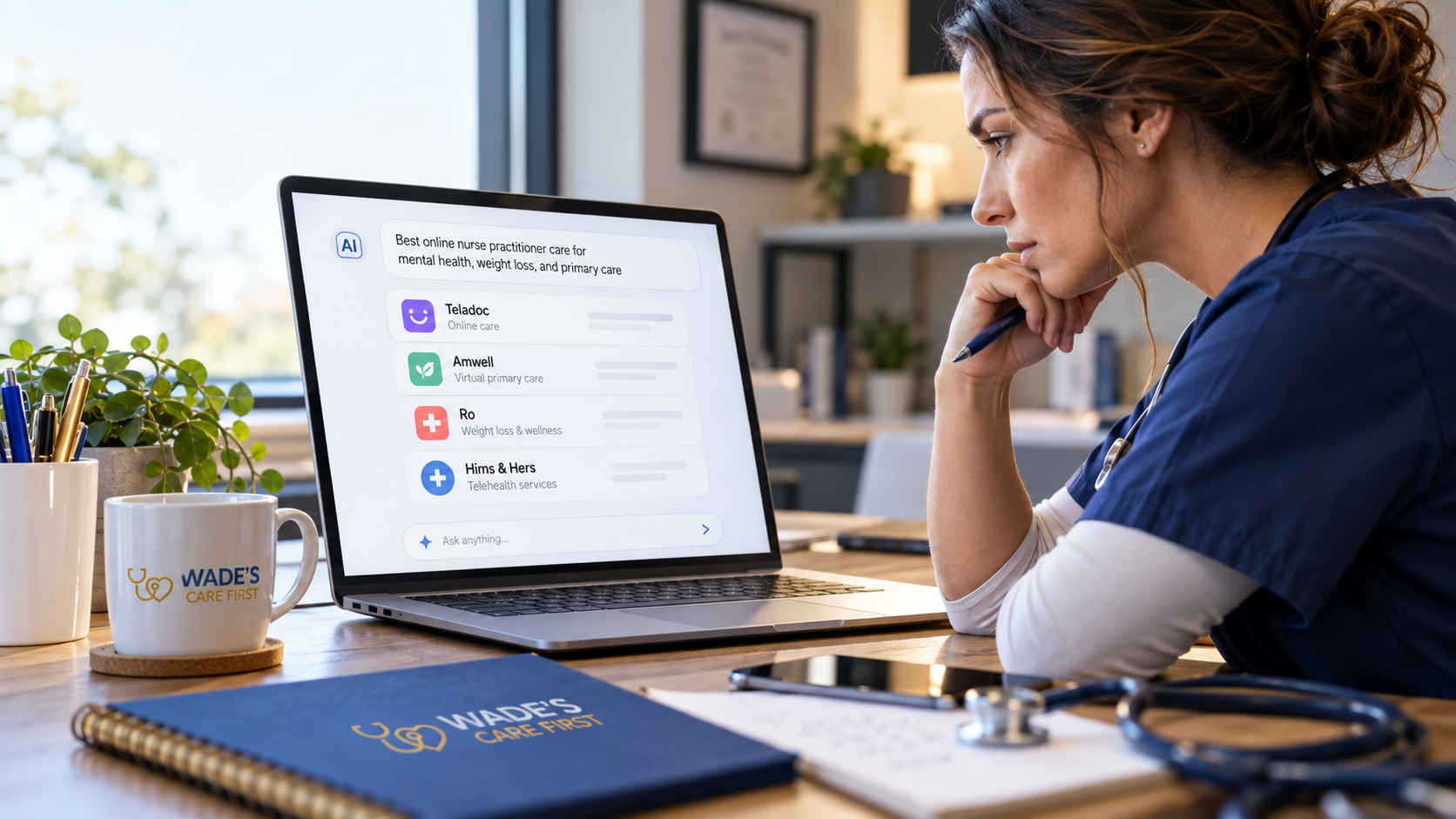
Nine out of 30. Every one of those nine points came from a prompt that already had Wade's Care First or Charles Wade in it.
This is the second half of our Wade's Care First audit. Part one looked at the backlink profile and found a gap that's rare for a small practice, and painful. Charles Wade has 135 five-star reviews on Klarity and 47 on Birdeye, yet his own website gets roughly one organic visit a month. His reputation is real. It just lives on other companies' domains, spread across profiles that disagree about his address, his phone numbers, his prices and even which states he serves.
That audit relied on third-party link data. This one asks the engines themselves. We wrote 10 prompts a real patient might type, four local, three regional and three industry, and ran every one through ChatGPT, Claude and Gemini. The result splits cleanly in two:
When a prompt names the practice, AI knows it. Nine of nine possible points: the right phone number, a full list of services and glowing summaries of the reviews.
When a prompt doesn't name it, AI never recommends it. Zero of 21. That includes a Kentucky anxiety-and-depression prompt, a New York same-week visit and a Texas weight-loss prompt, all in states Wade's lists and for services it offers.
The engines didn't forget Wade's Care First. They just never had a reason to bring it up. The rest of this post shows who they brought up instead, where those answers came from, and what it would take to change them. Our earlier audits found versions of the same pattern: River Rat Motorsports kept losing to a competitor named first, and Victory SK scored 8 of 12 locally but 0 of 9 regionally. Healthcare adds a twist those audits didn't have: a booking platform has become the main source of truth about the practice it books for.
Methodology, stated plainly
Each prompt ran once per engine in a fresh session with default settings and web search left as it ships, on September 26, 2026. Each engine that named Wade's Care First or Charles E. Wade, FNP-BC earned one point, for 30 possible. AI outputs aren't deterministic, so re-running these prompts will produce different wording and possibly different results. Treat the score as directional, not statistical.
The prompts fall into three tiers:
Local (Q1–Q4): Indianapolis and Indiana, where the practice is based, including two prompts that name Wade's directly.
Regional (Q5–Q7): Kentucky, New York and Texas, three of the nine states Wade's says it serves.
Industry (Q8–Q10): general questions a patient asks before looking for a provider, plus one that asks what Wade's Care First is.
One caveat shaped how we wrote them. We ran every test from Williamstown, New Jersey, and New Jersey isn't one of Wade's states. AI answers are personalized by location, so every provider prompt names a state explicitly. Q9 shows why that matters: the only prompt without a state came back from two engines as an answer about New Jersey law.
The full scorecard and every transcript are in the embed below. Answers are reproduced word for word; we removed interface elements like map controls and citation chips, and flattened tables into lists. We redacted one address that an engine described as a likely private residence.
Part One: The Local Tier, 6 of 12
The local tier split exactly down the middle. The two prompts that didn't name Wade's scored 0 of 6. The two that did scored 6 of 6. Indianapolis is where the practice is based and where it should be strongest, and it still couldn't earn a mention on its own.
Q1: "Who are the best telehealth nurse practitioners in Indianapolis?" (0 of 3)
This was the prompt we expected Wade's to have the best shot at, and no engine named it. Going in, our guess was that Klarity would crowd him out. That turned out to be wrong, and more interesting.
ChatGPT named six individual NPs across two tracks, primary care and psychiatry, including Ascension clinicians, Virtu30 and three psychiatric NPs.
Gemini named four providers, pulled from Kiwi Health, LifeStance and Psychology Today listings. Its fourth pick was sourced to a civic group in Tompkins County, New York, not Indiana.
Claude refused to rank individual NPs at all and pointed to IU Health and Community Health Network's virtual care programs instead.
One name appeared twice: Kimberly Grider, a psychiatric NP at LifeStance, made both ChatGPT's and Gemini's lists. LifeStance would come up again and again. Claude's answer is a different problem. When an engine decides the safe answer is "use a hospital system," no independent practice can win that question, however good its reviews are.
Q2: "Where can I get online mental health medication management in Indiana that takes Healthy Indiana Plan?" (0 of 3)
All three engines treated this as an insurance question, not a provider question. They sorted their answers by which company manages the patient's HIP coverage (Anthem, CareSource or MHS) and named the virtual providers those plans promote. Brave Health and Teladoc appeared in every answer. ChatGPT was the only engine to name Indiana organizations, Aspire Indiana Health and Centerstone, and both are large behavioral health providers.
Gemini also listed MDwise as a HIP plan. Claude and ChatGPT both said MDwise stopped serving HIP on January 1, 2026. For a Medicaid prompt, the lesson is blunt: a small practice only enters the answer if the plan's own materials or a directory put it there.
Q3: "What's the phone number and address for Wade's Care First?" (3 of 3)
The first points on the board. Every engine found the main line, (317) 765-0603, and most found the state-specific text lines too. But being named isn't the same as being right. The three engines gave three different answers for the address:
Claude gave 7116 Waldemar Dr, from a map listing linked on the practice's own site. It also pulled a second address from the Florida business registry and described it as a likely residence. We redacted that one in the transcript.
ChatGPT gave 6101 N Keystone Ave, Suite 100, PMB 1084. PMB means private mailbox.
Gemini gave no address at all. It said the practice serves six states, and it sourced that list to Klarity. The practice's site lists nine; Kentucky, Nevada and Texas were missing.
That last detail matters for the rest of the audit. The backlink audit found profiles listing six, one or nine states depending on the platform. Here, one of those stale profiles fed straight into an AI answer about the practice itself.
Q4: "Is Charles Wade, FNP-BC a good nurse practitioner? What do patient reviews say?" (3 of 3)
The warmest answers in the audit. All three engines said patients consistently praise him for listening, explaining options and not rushing. ChatGPT counted 134 Klarity reviews at 4.99 stars, 47 Google reviews on Birdeye at 5.0 and 31 on Zocdoc. Claude called the record "consistently positive" and flagged that some quotes come from the practice's own site.
Look at where the praise comes from, though. All three engines cited Klarity, and five of Gemini's six citations were Klarity. Wade's own site and his Google reviews didn't appear in Gemini's answer at all. The engines also disagreed on the numbers: Claude counted 28 Birdeye reviews against ChatGPT's 47, and zero rater8 ratings against ChatGPT's 11. The backlink audit found 47 on Birdeye, so ChatGPT was closer there.
Claude contradicted itself, too. In Q3 it gave the Waldemar Dr address and nine states. In Q4 it gave the Keystone address and six licensed states. The inconsistency across Wade's profiles now shows up inside a single engine's answers.
Local verdict: 6 of 12, and the split is the story. AI can describe Wade's accurately and warmly when you ask for him. It has no reason to suggest him when you don't.
Part Two: The Regional Tier, 0 of 9
Wade's Care First lists nine states on its website. We tested three of them, each with a prompt matched to a service the practice offers. None of the nine possible points landed. This tier matters most for a telehealth practice, because a patient in Louisville or Houston is exactly as reachable as one in Indianapolis.
Q5: "I live in Kentucky. Which telehealth nurse practitioners can prescribe anxiety or depression medication here?" (0 of 3)
This prompt describes the practice almost word for word: an NP, telehealth, anxiety and depression medication, in a state the site lists. It scored zero.
ChatGPT named seven individual psychiatric NPs, and four were from LifeStance. By this point LifeStance had appeared in three of five prompts.
Claude named two Kentucky practices and five national platforms (Brightside, Talkspace, Cerebral, LifeStance and Talkiatry). For solo NPs it pointed readers to Psychology Today's directory rather than naming any.
Gemini did something new. It named three independent, NP-owned Kentucky telehealth clinics: Nunn Psychiatric Care, CareClinic/Resova Health and Kentucky Online Adult Psychiatry. It was also the only engine to say family nurse practitioners can prescribe these medications, which is Wade's credential.
Gemini's answer proves the slot exists. Small NP practices can win a regional prompt. Wade's didn't, and Q3 suggests one reason: the Klarity profile Gemini read doesn't list Kentucky at all.
Q6: "I'm in New York and need a same-week telehealth visit for under $100. Who should I try?" (0 of 3)
All three engines read this as a cash-price urgent-care question and answered with marketplaces and national brands: Sesame, Amazon One Medical, Teladoc, GoodRx Care, CVS MinuteClinic, Doctor on Demand and MDLIVE. Sesame, a marketplace where patients pick a clinician and book at a listed price, was the only name on all three lists.
The engines disagreed on prices, even for the biggest brands. Teladoc was $75 according to Claude and $89 according to ChatGPT. GoodRx Care was $59.99 according to ChatGPT and $49 according to Gemini.
Here's the detail that stings. In Q10, Claude found Wade's self-pay rates on its website, about $50 to $250 per visit, so some visits fall under this prompt's budget. The price exists, but no engine connected it to a New York patient looking for an affordable visit. When price is the filter, the price has to be published where the engines look, stated consistently, and tied to the states it applies to. The backlink audit found the site listing $100 and $50 while TherapyDen showed $191 to $224.
Q7: "Which online providers in Texas offer medical weight loss with medication?" (0 of 3)
Zero again, in a state Wade's lists, for a service its site describes. But this prompt holds the most useful lesson in the audit.
Claude produced the longest list in the audit, 18 providers, from manufacturer programs like LillyDirect to four Texas practices.
Gemini named nine providers and led with a Texas practice.
ChatGPT named six national programs (WeightWatchers, Ro, Form Health, Found, Sesame and Noom) and no Texas practices.
The Texas practice Gemini led with was Optima Tyler, a practice in Tyler run by nurse practitioners. Claude named it too, and Claude's source was Optima's own blog post ranking telemedicine weight-loss clinics. Claude even warned that "several 'best of' lists are written by providers that rank themselves first, including Optima's," and cited the post anyway.
That's the whole AI visibility game in one example. A small NP practice wrote a useful comparison page about its own market. The engines read it, used it and named the practice. Wade's has the same credential type, the same telehealth model and the same service. What it doesn't have, as far as these engines can tell, is that page.
Regional verdict: 0 of 9 across three states Wade's serves. The engines filled these answers with LifeStance, national platforms, marketplaces and a few small practices that had published something the engines could use.
Part Three: The Industry Tier, 3 of 9
Industry prompts are the questions patients ask before they're shopping for a provider. Nobody expects a small practice to be named in an answer about a medication. What these prompts show is whose content the engines use to answer, and whether a practice can earn a citation.
Q8: "Does Wellbutrin help with anxiety?" (0 of 3)
Claude and ChatGPT didn't search. They answered from what they already knew, with no sources and no providers, so no practice could have earned a mention. Both answers were careful and accurate: bupropion isn't approved for anxiety and can make it worse, but it may help when anxiety comes with depression.
Gemini searched, and every source it cited was a practice's own blog: Talkiatry, Nurx, Elevate Psychiatry and Luxury Psychiatry. Those are telehealth and psychiatry competitors, collecting citations on a question patients ask before they ever look for a provider. It's the same mechanism as Optima Tyler in Q7, applied to clinical education instead of a comparison page.
Q9: "Can a telehealth nurse practitioner diagnose and treat ADHD in adults?" (0 of 3)
This was the one provider-adjacent prompt without a state, and it showed why the others have one. Claude and ChatGPT both picked up the tester's New Jersey location. Claude said "since you appear to be in New Jersey" and walked through a July 2026 New Jersey law on telehealth stimulant prescribing. ChatGPT used New Jersey as its worked example. Both answers were thorough and cited law firms and government sources, not providers.
Gemini again built its answer from provider content. It cited Doctronic, a telehealth company, four times for the whole diagnostic process, plus Mission Connection, Nortex Psychiatry and Sachs Center. Adult ADHD care by telehealth is a service Wade's offers, and the explainer the engines use belongs to someone else.
Q10: "What is Wade's Care First, and what services does it offer?" (3 of 3)
The most accurate answers in the audit. All three engines described a practice led by Charles Wade, FNP-BC, offering psychiatric care with GeneSight testing, medical weight management, primary and urgent care, women's and men's health, dermatology, pediatrics from age 5 and geriatric care.
Claude read the site and found the most detail: nine states, the insurers accepted, self-pay rates of about $50 to $250 and the athenahealth booking page. It also credited Klarity with 100+ five-star reviews.
ChatGPT listed all nine states correctly and was the only engine to mention Wade's Care First Staffing Services, the side of the business that places NPs, RNs and other clinicians with facilities.
Gemini cited only the practice's own website this time, not Klarity. It said the practice offers in-person visits, though in Q3 it said there's no physical clinic.
Q10 is the clearest proof that the website works. When the engines are sent to wadescarefirst.com, they read it well and repeat it accurately. The site does its job for anyone who already knows the name. It doesn't get the practice onto a list for anyone who doesn't.
Industry verdict: 3 of 9. Full marks on the branded prompt, zero on the two clinical questions, where competitors' blogs got the citations.
What This Audit Actually Proves
Being known and being recommended are two different things. Wade's scored 9 of 9 on the prompts that named it and 0 of 21 on the prompts that didn't. All three engines tied at 3 of 10, and every one of their points came from the same three branded prompts. No engine is "better" for Wade's. They all know him, and none of them suggests him.
Klarity has become the practice's reputation, and its source of errors. Klarity was cited in Q3, Q4 and Q10, and it was nearly Gemini's only source on reviews. That works in Wade's favor on reputation, because 135 reviews at 4.99 stars is strong proof. It works against him on facts: the Klarity-sourced state list Gemini used in Q3 left out Kentucky, Nevada and Texas, and two of those, Kentucky and Texas, had regional prompts that scored zero. New York was on that list and also scored zero, so the state list isn't the whole story. But the engines were reading a profile that told them he doesn't serve two of the states we tested.
Inconsistent details become contradictory answers. The backlink audit found two addresses, several phone numbers, three different state lists and conflicting prices. In this audit, those conflicts showed up as three different addresses across three engines, review counts that disagreed by as much as 19, and one engine giving two different addresses and state counts in two answers. AI doesn't pick the correct version. It repeats whichever version it finds.
Small practices get named when they publish something the engines can use. Optima Tyler made two Texas lists on the strength of its own comparison post. The three NP-owned Kentucky clinics in Gemini's Q5 answer show the same slot is open in other states. In the industry tier, every source Gemini cited was a practice's blog. The engines aren't reserving these answers for big brands. They credit whoever wrote the useful page.
These names filled the answers Wade's could have been in:
None of these are out of reach. LifeStance and Teladoc win on scale. Sesame and Klarity win because they're the places patients book. Optima Tyler wins because it wrote the page. Of those three routes, only the last one is realistic for a solo practice, and it's the cheapest.
The Roadmap
The backlink audit's advice still stands: don't buy links, and connect the reputation Wade already has to the website he owns. This audit adds a second job, which is giving the engines something to cite when a patient doesn't know his name. In order:
Make every profile say the same thing, starting with Klarity. Pick one public address and one main phone number, and list all nine states everywhere, with the same self-pay prices. Klarity comes first because it's the profile the engines read most. Then Birdeye, TherapyDen, Psychology Today, Kiwi Health, rater8 and Zocdoc (reactivate it or remove it). Update the principal address on the Florida LLC filing to a business address, since at least one engine is already pulling it. Ask Healthgrades whether its Charles Wade, NP listing in Lebanon, Indiana is him, and merge or correct it.
Link every profile back to wadescarefirst.com. The engines treated the site as the authority whenever they were sent to it, as Q10 shows. Profiles that point to the site send them there more often.
Build one page per state. Nine short pages, one for each state Wade's serves: the services offered there, licensure, the insurers accepted in that state, self-pay prices and a booking link. Add MedicalBusiness schema with each state in areaServed. Kentucky, Texas and New York come first, since those are the prompts that scored zero.
Write the comparison pages patients search for. Optima Tyler shows the format: "How to choose an online weight-loss provider in Texas," "Getting anxiety or depression medication by telehealth in Kentucky," and "Same-week telehealth visits in New York: what they cost." Be honest about the alternatives, including the national platforms. That honesty is what makes an engine willing to cite the page.
Byline clinical explainers to Charles E. Wade, FNP-BC. Write for the questions Gemini answered with competitors' blogs: Wellbutrin and anxiety, and adult ADHD by telehealth, including state rules on stimulants. Re-byline the site's existing health articles, add a provider page with credentials and NPI, and use Person and Article schema, as the backlink audit recommended.
Publish self-pay prices in one place and repeat them everywhere. A visible table on the site, by visit type, with the same numbers on every profile. When price is the filter, as in Q6, the practice with a clear, consistent price is the one that gets named.
Re-run this audit in 90 days. Use the same 10 prompts, the same three engines and a location outside Wade's states. The branded prompts should stay at 9 of 9 and stop contradicting each other. The regional tier is the one to watch.
Frequently Asked Questions
How was this test scored?
One point each time an engine named Wade's Care First or Charles E. Wade, FNP-BC in its answer. Ten prompts across three engines makes 30 possible points. Each prompt ran once per engine in a fresh session on September 26, 2026, from Williamstown, New Jersey. We didn't score accuracy separately, but we flagged every error in the transcripts.
Is 9 out of 30 bad?
The number matters less than the split. Nine of nine on branded prompts means the engines know the practice and describe it well. Zero of 21 on everything else means they never recommend it to someone who doesn't already know the name. For a telehealth practice that depends on patients in nine states finding it, the zero is the number to fix.
Why did Wade's score perfectly on some prompts and zero on others?
Because the prompts that named it sent the engines straight to the practice's website and profiles, and those are accurate enough. The unbranded prompts sent the engines looking for a category, like telehealth NPs in Kentucky or weight-loss providers in Texas. The pages that answer those questions belong to LifeStance, national platforms, marketplaces and a few practices that wrote about their own markets.
Is Klarity good or bad for Wade's Care First?
Both. Klarity holds his biggest collection of reviews, and the engines trust it, which is why the reputation answers in Q4 were so strong. But Klarity is also where at least one engine got an outdated state list, and every review there builds Klarity's domain rather than his. The fix isn't leaving Klarity. It's keeping the profile accurate and linking it to his own site.
Why did Claude refuse to name any nurse practitioners in Indianapolis?
Claude judged that there's no trustworthy ranking of individual NPs and pointed to two large health systems instead. That's a defensible answer for a patient, and one no small practice can win directly. Clear, specific content about who Wade's serves and how gives cautious engines like Claude something concrete to cite without having to rank anyone.
Why did two engines answer the ADHD question about New Jersey?
The prompt didn't name a state, so Claude and ChatGPT used the tester's location. Claude said so directly: "since you appear to be in New Jersey." It's a reminder that AI answers depend on where the patient is, and it's why every provider prompt in this audit names a state.
Do the AI engines say anything negative about Wade's Care First?
No. Every answer about the practice was positive, and several said they found little or no negative feedback. The problems were factual (conflicting addresses, review counts and state lists), not reputational.
What's the fastest thing to fix?
Making every profile agree, starting with Klarity. It's free, it takes days rather than months, and it removes the contradictions the engines are already repeating. The content work in the roadmap takes longer, and it's what moves the regional score.
Can you run this test on my business?
Yes. We write 10 prompts for your industry and your markets, run them across ChatGPT, Claude and Gemini, and send you the transcripts, your scorecard and a plain-English read on what to fix first.
Find Out What AI Says About Your Business
Most businesses assume that if AI knows their name, it's recommending them. This audit shows how far apart those two things can be. We'll run the same test on your business: 10 prompts written for your industry and markets, run across ChatGPT, Claude and Gemini, with the unedited transcripts, your scorecard against the patterns from every audit we've published and a plain-English read on what to fix first.
Get your free AI visibility check →
Methodology and Sources
All AI responses were captured September 26, 2026 from ChatGPT, Claude and Gemini in fresh sessions with default settings from Williamstown, New Jersey. Transcripts are reproduced word for word in the embed above; interface elements and citation chips were removed, tables were flattened to lists and one likely residential address was redacted. The scoring framework is Ritner Digital's and is directional rather than statistical.
Referenced throughout:
Backlink Audit: Wade's Care First, Ritner Digital
AI Always Names Anderson First, Ritner Digital
AI Can Find Victory SK, Ritner Digital
Wade's Care First, the practice's website
Charles E. Wade, FNP-BC on Klarity, cited by all three engines
Charles Wade, FNP-BC on Birdeye, cited by Claude and ChatGPT
Optima Tyler: Best Telemedicine Weight Loss Clinics, cited by Claude in Q7
Indiana Medicaid managed care health plans, cited by Claude in Q2
Nixon Peabody: NJ expands telemedicine rules for Schedule II controlled substances, cited by Claude in Q9