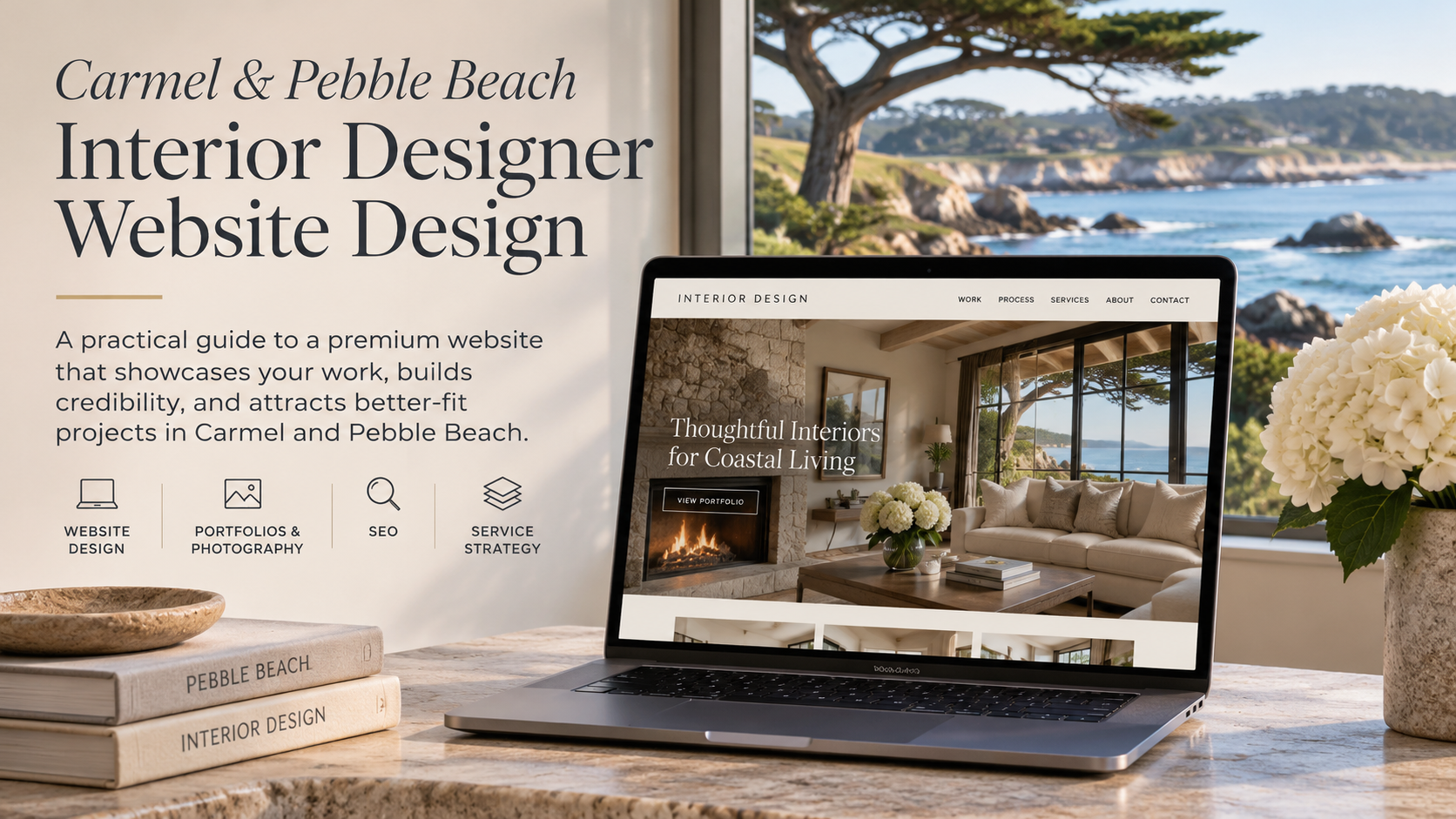
Your portfolio may be exceptional. Your clients may love your work. But does your website communicate the same level of care, creativity, and sophistication? For interior designers serving Carmel-by-the-Sea, Pebble Beach, and the Monterey Peninsula, premium web design should showcase beautiful spaces while building trust, attracting the right projects, and making it easier for prospective clients to take the next step.
An interior designer can spend months getting every detail of a home exactly right.
The proportions.
The materials.
The lighting.
The relationship between furniture and architecture.
The way someone moves through a room.
The feeling a space creates when everything finally comes together.
Nothing is accidental.
Then someone visits the designer's website.
And the experience doesn't reflect any of that care.
The homepage uses a generic template.
Project photographs are difficult to navigate.
The text says little beyond "timeless luxury interiors."
The site looks beautiful on a large monitor but becomes awkward on a phone.
The portfolio doesn't explain which projects the designer actually completed.
And the contact page provides almost no information about what happens after someone submits an inquiry.
It's a disconnect.
The quality of the design work and the quality of the digital experience don't match.
For an interior designer serving Carmel-by-the-Sea, Pebble Beach, or the surrounding Monterey Peninsula, that gap matters.
Your next prospective client may find your studio through a referral, Google search, Instagram post, design publication, or professional connection.
They may already admire your work.
But before requesting a consultation, they often have more questions.
Does your design style fit what they're imagining?
Do you work on projects of their scale?
Are you available for new engagements?
How do you collaborate with architects, builders, and homeowners?
What is your process?
Do you provide full-service interior design, furnishing and styling, renovation consultation, or another type of service?
And perhaps most importantly:
Would I feel confident trusting this person with my home?
Your website should help answer those questions.
Not through aggressive sales tactics.
Not through unnecessary animation.
And not by trying to attract the largest possible audience.
Through thoughtful design, authentic project photography, clear positioning, useful information, and an experience that reflects the standards of your studio.
That's the purpose of premium website design for interior designers.
A website shouldn't simply display beautiful work.
It should help the right people understand the work, appreciate the thinking behind it, and determine whether your studio is a suitable fit.
A Beautiful Portfolio Isn't Automatically a Great Website
Interior designers have an advantage that many other professional service businesses don't.
Their work is inherently visual.
A completed living room, kitchen, or residential interior can communicate taste and craftsmanship almost immediately.
But strong images alone don't guarantee a useful digital experience.
A gallery can show what a room looks like.
It doesn't necessarily explain what the designer contributed.
A photograph may reveal a beautiful collection of furnishings.
It might not communicate the scale of the engagement.
A prospective client can admire a project without knowing whether the studio provides the services they need.
And a website may receive compliments about its appearance while generating few relevant inquiries.
That's why the distinction between a portfolio and a business website matters.
A portfolio demonstrates the work. A well-designed website helps prospective clients understand the business behind it.
Houzz's guide to building an interior design website emphasizes selecting strong photography, organizing projects clearly, and presenting useful project descriptions.
Those are important starting points.
But for a premium design studio, the goal should extend beyond assembling attractive images.
The website also needs to communicate the studio's point of view, scope of services, working process, and professional identity.
Those elements turn visual interest into a more informed evaluation.
Why Carmel and Pebble Beach Designers Need a Distinctive Digital Presence
Carmel-by-the-Sea and Pebble Beach are closely associated with distinctive residential architecture, coastal scenery, art, hospitality, and highly individualized properties.
But it would be a mistake to assume every home or client wants the same interior style.
Some homeowners may prefer restrained contemporary interiors.
Others may appreciate traditional architectural details, collected furnishings, or warmer materials.
Some projects involve existing residences.
Others may be part of larger architectural or construction collaborations.
Design preferences are also changing over time.
Houzz's September 2026 Fall Design Trends Report describes growing interest among its surveyed design professionals in personal storytelling, natural materials, character, and interiors that feel collected rather than generic.
That research describes broader design trends, not a statistically representative survey of Carmel and Pebble Beach homeowners.
Still, it highlights a useful consideration.
Clients may want a home that reflects their own lives.
Your website should communicate how your studio approaches that individuality.
It shouldn't make every project appear to follow one fashionable visual formula.
A Carmel interior designer may have a completely different aesthetic from a studio serving a similar geographic market.
That's a strength.
The website should make the distinction understandable.
Premium web design should amplify your creative identity, not replace it with someone else's idea of what luxury looks like.
Start With the Client You Actually Want to Attract
Before choosing a website platform, redesigning a homepage, or selecting photography, define the kinds of projects your studio wants.
An interior designer specializing in full residential projects has different marketing needs from a studio focused on furnishings and styling.
A designer collaborating extensively with architects and builders may need to communicate a different process from someone offering smaller, room-specific engagements.
A practice serving both residential and hospitality clients may need separate pathways for those audiences.
The website should reflect those distinctions.
Consider three questions.
What projects define your best work?
Review the assignments that most accurately represent the studio's strengths.
They may not be the most expensive projects or the ones with the most photographs.
They may be projects where the design approach, client relationship, and finished result best reflect the work you want to continue doing.
Which clients are the best fit?
Think about the scope, collaboration style, expectations, and project requirements associated with successful engagements.
A good fit is not simply someone who can afford the service.
It's someone whose project aligns with what the studio is prepared and qualified to provide.
What do you want the studio to be known for?
Perhaps your defining strength is thoughtful material selection.
Maybe it's creating cohesive interiors across a larger property.
It could be working sensitively with existing architecture, coordinating intricate furnishing programs, or bringing together design elements from different periods.
You don't need to adopt a narrow visual label if your work is varied.
But your website should communicate a recognizable point of view.
That positioning becomes the foundation for the design.
Without it, the website risks becoming a collection of beautiful but disconnected images.
1. Build a Homepage That Feels Like Your Studio
The homepage is often the first substantial experience a prospective client has with your business.
It should make a strong visual impression.
But visual impact shouldn't come at the expense of clarity.
An oversized photograph with a vague slogan may look sophisticated.
It can also leave visitors uncertain about what the studio does.
Imagine a homepage that says:
"Timeless Elegance. Elevated Living."
That language may align with the brand's aesthetic.
But it provides little information about the actual offering.
Now consider a more specific example.
"Thoughtfully layered residential interiors for homes across Carmel and the Monterey Peninsula."
Supporting copy might explain the studio's genuine specialization, such as full-service residential design or furnishings and interiors.
This is illustrative copy, not a description of any particular local studio.
The important point is that a clear explanation can coexist with refined visual presentation.
A premium homepage doesn't require paragraphs of text above the fold.
It does need enough information for someone to understand who you are.
What the homepage should establish
A strong opening experience might introduce the studio's design philosophy, show one representative project, and offer a clear pathway to view more work.
It should also help visitors discover the services and the people behind the practice.
The visual hierarchy matters.
Photography should command attention.
Typography should feel intentional.
Spacing should allow the design to breathe.
And the interface should make it easy to move through the site.
The goal is not minimalism for its own sake.
It's thoughtful composition.
The same principle that guides an interior can guide a webpage.
Every element should have a reason to be there.
2. Curate Your Portfolio Instead of Publishing Everything
One of the most common portfolio mistakes is including every project simply because the photographs exist.
A design studio may have completed dozens of assignments.
Some represent the work it wants to do now.
Others reflect an earlier stage of the business.
Some may have involved only furnishings or limited consultation.
Others represent comprehensive design engagements.
If everything receives equal prominence, the portfolio may communicate an unclear identity.
A more intentional approach starts with curation.
Choose projects that represent your current capabilities, preferred work, and creative point of view.
A strong portfolio doesn't necessarily need the largest number of images.
It needs the right images and enough context to make them meaningful.
For example, a studio pursuing substantial residential engagements might feature complete project stories rather than dozens of isolated room photographs.
A designer specializing in distinctive smaller spaces might select work that demonstrates that expertise.
Neither approach is universally better.
The correct selection depends on the studio.
Organize the work in a way clients understand
You may choose to organize projects by residence, service category, or another structure that reflects how clients evaluate the business.
Avoid complicated filters when a simple project index would be clearer.
Each portfolio thumbnail should give visitors a reason to explore.
A meaningful project name, relevant location where disclosure is permitted, and a short description can help.
The goal is to make the portfolio feel like a carefully edited presentation.
Not an unorganized archive.
If your portfolio is the digital equivalent of a showroom, every featured project should earn its place.
3. Turn Portfolio Galleries Into Project Stories
Beautiful photographs inspire interest.
Project stories explain the design thinking.
That distinction is especially important for premium interior designers.
A completed dining room may look extraordinary.
But the website could help a prospective client understand the problem the studio was asked to solve.
Was the goal to create a more functional gathering space?
Did the project require coordination with existing architectural details?
Was the studio responsible for furnishings, finishes, or a broader interior design scope?
What decisions shaped the final result?
These explanations demonstrate expertise without relying entirely on promotional claims.
A useful project page might include
The project context: A general explanation of the residence and the client's goals, within appropriate privacy boundaries.
The design direction: The atmosphere, priorities, or practical considerations guiding the work.
The studio's role: Which services the team actually provided.
The work: Relevant photographs and concise descriptions of important decisions.
The result: An accurate explanation of the completed scope, without inventing client testimonials or outcomes.
A project story doesn't need to reveal everything.
In fact, some of the most compelling descriptions are concise.
The purpose is to help readers understand what they are seeing.
It also helps distinguish original design work from generic inspiration photography.
For search visibility, the surrounding text provides important context.
Google's image SEO documentation explains that images are better understood when placed near relevant text on pages describing their subject.
A project page can therefore serve both the prospective client and search discovery.
4. Explain Your Actual Role in Every Project
This is an important credibility issue.
A finished interior may reflect work by many professionals.
Architects.
Interior designers.
Builders.
Landscape architects.
Specialty contractors.
Photographers.
Furniture makers.
And other contributors.
A website should accurately represent the studio's role.
If the designer selected furnishings and finishes, it shouldn't imply responsibility for the building's architecture.
If a project involved collaboration with another design practice, that relationship should be described appropriately.
If the studio's involvement was limited, the website can still present the work beautifully without exaggerating the scope.
This is not about diminishing your contribution.
It's about making the contribution clear.
Prospective clients evaluating substantial projects want to understand what your studio can actually deliver.
Ambiguous project attribution can create unrealistic expectations.
A concise credit line may be useful.
For example:
"Interior furnishings and styling by the studio. Architecture and construction by separate project partners."
The exact wording depends on the work and contractual permissions.
Where appropriate, other contributors can be credited accurately.
Premium positioning becomes more credible when the website is precise about what you do.
5. Invest in Photography That Communicates More Than Decoration
Photography is one of the most important assets for an interior design website.
But not all photographs serve the same purpose.
A wide-angle image can communicate the overall spatial composition.
A detail photograph can demonstrate material choices, texture, and craftsmanship.
A carefully framed image can reveal the relationship between architecture and furnishings.
An editorial image may communicate atmosphere.
Each contributes something different.
A strong portfolio may need several types of imagery to tell a complete story.
Choose photographs that support your positioning
If the studio's expertise involves layered, highly personalized interiors, its photography should capture those details.
If the work is architectural and restrained, images should communicate proportion, light, and spatial relationships.
If the practice focuses on furnishing programs, the photography should clearly illustrate the completed selections and overall composition.
The images should reflect the actual work.
Generic stock photography may be attractive, but it doesn't demonstrate the studio's experience.
Plan photography permissions early
Professional photography can involve several separate rights.
A photographer may own copyright in the images unless an agreement establishes otherwise.
The designer may require a license for website, editorial, advertising, or social media usage.
Homeowners may need to approve photography or public disclosure.
Other contributors may have relevant contractual arrangements.
A website redesign should include a review of usage permissions.
The business should not assume that paying for a photo session automatically grants every possible right.
Nor should a private residence be publicly identified without appropriate authorization.
For many Pebble Beach clients, discretion is an important consideration.
A project can often be presented beautifully without publishing an exact address, private security information, or identifiable owner details.
6. Make Your Website Feel Premium Without Making It Slow
Large photographs are essential to many interior design websites.
Unfortunately, they can also create substantial performance problems.
A homepage may contain several oversized images and an automatically playing background video.
The visual experience might look impressive on a fast desktop connection.
On a mobile device, it could become frustrating.
Images may load slowly.
Buttons may move as the page settles.
The gallery may be difficult to interact with.
Potential clients may leave before reaching the services or contact page.
Google's Core Web Vitals guidance identifies three measures of real-world page experience:
Largest Contentful Paint (LCP): A good experience generally targets loading the largest visible content element within 2.5 seconds.
Interaction to Next Paint (INP): A good experience generally targets interaction responsiveness of 200 milliseconds or less.
Cumulative Layout Shift (CLS): A good experience generally targets a score of 0.1 or less.
These are user-experience benchmarks, not guarantees of rankings or inquiries.
What a premium photography site should do
Use high-quality images at appropriate display sizes.
Provide responsive versions so mobile users aren't forced to download unnecessarily large desktop files.
Choose modern image formats when suitable.
Reserve the correct amount of layout space to reduce unexpected movement.
Review how galleries load and respond.
And consider whether decorative video adds enough value to justify its performance cost.
Google's image SEO recommendations specifically emphasize balancing visual quality with loading performance.
A premium website should not force visitors to choose between a beautiful presentation and a functional experience.
The best technical implementation supports both.
7. Design Mobile Pages With the Same Care as Desktop Pages
Interior design websites are often reviewed and approved on large monitors.
That makes sense during the creative process.
But prospective clients may encounter your studio on a phone.
Perhaps someone sends them a project link.
They might discover a photograph through social media.
They could be researching designers while traveling.
Or they may be checking your contact information after receiving a referral.
The mobile experience matters.
A desktop layout may display three elegant columns of photography.
On a phone, those same images may become tiny thumbnails.
A sophisticated navigation menu may consume too much space.
Text may become difficult to read.
Important project captions might disappear.
The contact button may become difficult to find.
Mobile design should therefore be treated as part of the core experience.
Test the tasks that matter
Can someone view a project comfortably?
Can they read about the studio?
Can they find the service they're researching?
Can they understand the design process?
Can they submit an inquiry without excessive effort?
The answer should be yes regardless of device size.
Google's mobile-first indexing guidance explains that Google primarily uses the mobile version of website content for indexing.
That makes it important to preserve substantive content and useful context across devices.
A beautifully designed mobile experience isn't simply a compressed desktop site.
It is a deliberate presentation for a different screen and interaction pattern.
8. Let Your Typography and Layout Reflect Your Design Philosophy
Typography, color, spacing, and composition influence how a website feels.
For interior designers, these choices can communicate a great deal about the studio's identity.
A restrained architectural practice may benefit from a highly structured visual system.
A studio with a colorful, expressive aesthetic may choose more distinctive typography and a bolder palette.
A designer whose work emphasizes warmth and texture may want an editorial presentation with generous space for storytelling.
But there is no single luxury design formula.
Not every premium website needs beige backgrounds, oversized serif typography, and minimal navigation.
Those elements can work beautifully for some brands.
For others, they may erase the very personality that makes the studio distinctive.
The goal is consistency.
Develop a coherent visual system
Use a limited, intentional typography system.
Create consistent image proportions and spacing rules.
Establish clear heading and body-text styles.
Make interactive elements recognizable.
Keep the navigation easy to understand.
And use the design system consistently across project pages, services, About content, and contact forms.
A premium experience often comes from the quality of these small decisions.
The website shouldn't feel like several unrelated templates assembled over time.
It should feel considered.
Just as the spaces you design do.
9. Write Website Copy That Sounds Like Your Studio
Interior design websites often rely on familiar language.
"Timeless interiors."
"Elevated spaces."
"Curated living."
"Luxury reimagined."
"Beautifully bespoke."
These phrases may fit the brand's tone.
But they can also make different studios sound remarkably similar.
A more distinctive website explains what makes the actual practice different.
Perhaps the studio has a particular approach to working with existing architecture.
Maybe it emphasizes layered interiors that reflect a client's personal collections.
Perhaps its process focuses on detailed coordination and comprehensive furnishing programs.
Or it may be known for balancing contemporary design with the character of older properties.
That information is more useful than a collection of broad adjectives.
Start with actual client conversations
What questions do prospective clients ask?
Why do existing clients say they chose the studio?
What do they appreciate about the process?
Which services are most frequently misunderstood?
What kind of work does the studio want to attract next?
Those answers provide stronger material than generic luxury copywriting.
For example, rather than saying "We create elevated spaces," a studio might explain:
"We design residential interiors around the architecture of the home, the way clients live, and the details that make each space personal."
That is still brand-oriented language.
But it communicates an approach.
The wording should accurately reflect the practice.
The objective is not to sound more expensive.
It's to sound more like the business.
10. Make Your Design Process Visible
A prospective client may love your portfolio and still hesitate to make contact.
They may not understand what working with an interior designer involves.
Do you begin with a consultation?
What happens after the initial conversation?
Do you collaborate with architects and builders?
How are design concepts developed?
When are furnishings selected?
How is procurement handled?
What decisions will the client need to make?
A clear process page can answer these questions without giving away every operational detail.
It can also help qualify prospective clients.
Explain the stages honestly
A studio might describe its process through discovery, concept development, detailed design, sourcing, coordination, and installation.
But only use stages that accurately reflect how the company works.
If the studio offers a limited styling service, the process may be much simpler.
If the practice provides comprehensive residential design, the process may be more extensive.
There is no requirement to present every engagement as a large architectural production.
The point is to make expectations understandable.
A strong process page can communicate professionalism without becoming overly technical.
It can also make the initial inquiry feel less intimidating.
Beautiful work creates interest. A clear process helps prospective clients imagine working with you.
11. Build an About Page That Earns Trust
The About page is often treated as secondary.
For premium interior design, it can be one of the most important parts of the website.
A client isn't simply purchasing a finished object.
They may be entering a working relationship that involves personal preferences, private spaces, significant decisions, and repeated communication.
The people behind the studio matter.
An About page can introduce the founder or team, explain the studio's background, describe its design philosophy, and communicate relevant expertise.
Use authentic photography.
Avoid invented awards or unsupported claims.
If the designer has qualifications or professional affiliations, present them accurately.
If the team collaborates regularly with architects, builders, and other professionals, explain those relationships without exaggerating their formality.
The Nielsen Norman Group's research on About Us information found that users value authenticity, transparency, real photographs, and clear descriptions of a company's purpose.
That research wasn't specific to interior design.
But its findings are particularly relevant to personal professional services.
A prospective client may want to know who will be involved with the project.
A thoughtful About page helps make the business more human and understandable.
12. Use Testimonials and Press Thoughtfully
Client feedback can provide an additional perspective on the studio's work.
But testimonials should feel credible.
A vague statement such as "Absolutely amazing!" provides limited information.
A more useful testimonial might describe the communication process, design collaboration, or overall experience.
Only publish real feedback with appropriate permission.
Don't create fictional endorsements.
Don't imply that a publication featured the studio if it did not.
And don't present a paid appearance as independent editorial recognition without appropriate disclosure.
For premium residential work, privacy may limit what a client is comfortable sharing.
That should be respected.
You may be able to publish an authorized quotation without identifying the client's home.
You might reference legitimate press coverage or professional recognition.
Or you can demonstrate credibility through authentic project stories and detailed process information.
Not every design studio needs a large testimonial library.
The more important question is whether the available evidence helps visitors understand the work and the business.
Trust comes from consistency.
The website's claims, portfolio, public information, and actual client experience should tell the same story.
13. Create Service Pages That Attract the Right Projects
An interior design studio may offer several types of services.
Full-service residential interior design.
Renovation-related design.
Furnishings and styling.
New construction collaboration.
Commercial interiors.
Hospitality projects.
Consultations.
The exact offerings vary by practice.
A website should make those distinctions clear.
A prospective client looking for comprehensive design may not realize the studio handles that level of work if every service is described only as "interior design."
Likewise, someone seeking a single-room consultation shouldn't assume the studio offers that service if it primarily accepts larger engagements.
A useful service page should answer
Who is the service for?
What does the engagement generally involve?
How does the studio work with clients and other professionals?
What types of projects are appropriate?
What happens during the initial inquiry?
What information should a prospective client prepare?
The page should also link to relevant portfolio examples.
If a studio offers full-service residential design, show actual work demonstrating that scope.
If a service has important limitations or minimum commitments, communicate them appropriately.
This isn't about being unwelcoming.
It's about helping suitable clients recognize a good match.
A premium website should generate more informed conversations.
Not simply maximize form submissions.
14. Make Local SEO Work Without Making the Website Feel Generic
Interior designers serving Carmel and Pebble Beach may want visibility for relevant searches such as:
"Carmel interior designer"
"Pebble Beach interior design"
"Full-service interior designer Carmel-by-the-Sea"
"Residential interior design Monterey Peninsula"
These are examples of potential search phrases, not verified keyword-volume recommendations.
The important point is that search intent can vary.
Someone seeking a full residential engagement may search differently from someone looking for a local furniture consultation.
A useful SEO strategy starts with the actual services and intended clients.
Then it helps search engines understand those offerings.
Use clear page titles and headings
A service page can identify the type of interior design offered and the relevant location where appropriate.
Avoid repeating city names unnaturally.
Explain your genuine service area
A studio based in Carmel may serve Pebble Beach clients.
That doesn't require pretending to maintain an office in Pebble Beach.
Accurate geographic coverage is more valuable than misleading location claims.
Improve your Google Business Profile
If the studio is eligible, maintain accurate categories, contact information, hours, and appropriate location or service-area details.
Google's local ranking guidance emphasizes relevance, distance, and prominence.
No agency can guarantee a particular local ranking.
Connect local context with useful information
A website might describe the types of residential projects the studio works on throughout the peninsula.
But don't create multiple near-identical pages that simply replace one community name with another.
Location content should provide genuine value.
Local SEO should help relevant clients discover your studio without making your website read like a directory listing.
15. Treat Image SEO as Part of Portfolio Design
For an interior designer, images are not just decoration.
They are the work.
They may also create opportunities for discovery through image search and other visual experiences.
Google's Image SEO Best Practices recommend using descriptive image filenames, appropriate alternative text, relevant surrounding content, and technically accessible image elements.
This creates several opportunities.
Use descriptive filenames
Instead of uploading an image called IMG_8492.jpg, consider a short filename that accurately describes the content.
For example:
carmel-residential-living-room.jpg
Use location names only when they accurately describe the project and disclosure is authorized.
Write useful alternative text
Alt text should describe the image's meaningful content for users who cannot see it.
For example:
"Living room with curved cream sofa, warm wood paneling, and large windows overlooking trees."
That's more useful than:
"Luxury Carmel interior designer best luxury interior design Pebble Beach."
Keyword-stuffed alt text is not helpful.
Provide relevant captions
A caption can explain the studio's role, design intention, or project details.
Preserve image discoverability
Important images should be implemented in ways search engines can access.
They shouldn't exist only inside inaccessible scripts or visual effects.
Respect accessibility
The W3C's image accessibility tutorial explains that informative images need meaningful text alternatives, while purely decorative images can use empty alt text.
The appropriate treatment depends on an image's purpose.
For a portfolio, many photographs convey information that matters.
Image SEO and accessibility should therefore be considered together.
16. Give Prospective Clients a Clear Next Step
A design studio's contact page doesn't need aggressive sales language.
But it should explain what happens when someone reaches out.
A generic button that says "Contact Us" may be adequate when the surrounding page is clear.
An outcome-focused invitation may be more useful for some studios.
For example:
"Let's talk about the home you're imagining and whether our process is the right fit."
The button could say:
"Request a Design Consultation."
The wording should match the studio's actual inquiry process.
If an introductory consultation involves a fee, that should be communicated appropriately.
If the studio has limited availability, be accurate about it.
If project scope determines whether an engagement is accepted, a brief inquiry form may help collect relevant information.
But don't make the form unnecessarily difficult.
A prospective client may not yet know the exact square footage, full budget, or timeline.
Ask for information that is genuinely useful at the first stage.
The purpose is to begin an appropriate conversation.
Not turn an initial inquiry into a complete project specification.
17. Make the Website Accessible Without Sacrificing Design
Premium websites sometimes prioritize appearance so heavily that usability suffers.
Thin text may have insufficient contrast.
Navigation labels may be tiny.
Interactive elements may be difficult to identify.
Project galleries may not work with a keyboard.
Or a contact form may be difficult to complete using assistive technology.
Accessibility should be part of the design process.
The Web Content Accessibility Guidelines provide an established technical framework for making web content more accessible.
Appropriate considerations include readable text, keyboard navigation, understandable form labels, useful image alternatives, and clear focus indicators.
These are not incompatible with sophisticated design.
In fact, a well-structured website often feels more refined because unnecessary friction has been removed.
Accessibility requirements can also involve legal considerations depending on the business.
A technical audit isn't an automatic certification of legal compliance.
Where necessary, seek appropriate accessibility and legal expertise.
The guiding principle is simple.
A premium experience should be welcoming and usable, not merely beautiful in a screenshot.
The Ideal Website Structure for a Carmel or Pebble Beach Interior Design Studio
Not every studio needs the same number of pages.
But a thoughtful website structure can help visitors move naturally from discovery to evaluation.
A practical starting point might include:
Homepage
Introduce the studio's identity, specialization, and strongest relevant imagery.
Make it easy to explore work, services, and the team.
Portfolio
Present a curated collection of completed projects.
Organize it according to the studio's actual work rather than an unnecessarily complex classification system.
Individual project pages
Show meaningful photography and explain the design direction, project context, and studio's role.
Services
Describe the types of engagements offered and the customers they're intended for.
Process
Explain how an engagement begins and the major phases of working together.
About the studio
Introduce the designers, philosophy, relevant experience, and professional identity.
Journal or insights
Publish useful articles about design decisions, project planning, and topics that genuinely interest the intended audience.
Contact
Provide an appropriate consultation pathway and set expectations for the next step.
This structure is a starting framework, not a universal requirement.
A smaller studio may combine services and process information.
A larger practice may need separate residential and commercial sections.
The important thing is that the architecture reflects the business.
The website shouldn't become complicated simply to appear sophisticated.
What Should an Interior Design Studio Publish on Its Blog?
A blog can help a design studio become discoverable to people researching questions before contacting a professional.
But content should be relevant to the kinds of projects the studio actually wants.
A practice specializing in full residential design may not benefit much from publishing generic DIY decorating articles that attract readers who intend to complete their own projects.
Instead, it can focus on design decisions and planning questions.
Potential topics include:
"What to Know Before Hiring a Full-Service Interior Designer in Carmel"
Explain what a homeowner should clarify about scope, process, and collaboration.
"Interior Design vs. Interior Styling: Which Service Fits Your Project?"
Help readers understand the differences, while accurately describing the services the studio provides.
"How Interior Designers Collaborate With Architects and Builders"
Explain the roles and stages involved without claiming responsibility for work performed by others.
"What Happens During an Interior Design Consultation?"
Clarify the firm's real process and what prospective clients should prepare.
"How to Prepare for a Furnishings and Interior Design Project"
Help homeowners organize their goals, priorities, and relevant information.
"Why Professional Interior Photography Matters"
Explore how photographs communicate design decisions and why rights and permissions should be reviewed.
These are editorial ideas, not claims that every phrase has substantial search volume.
The appropriate topics should come from customer research, the studio's expertise, and the services it wants to promote.
The best content answers real questions.
It doesn't exist simply to increase the number of indexed pages.
Why a Design Journal Shouldn't Replace the Portfolio
A journal can be valuable.
It can introduce the studio's thinking.
It can answer questions about project planning.
It can showcase original perspectives on materials, layout, and collaboration.
But it shouldn't become a substitute for clear services and completed work.
Some businesses publish a large number of articles while their main portfolio remains difficult to use.
Others invest in broad design trend content that attracts people who have no interest in hiring a professional.
A stronger approach connects content to the business.
An article about preparing for a renovation can link to the studio's renovation-related services.
A discussion of materials can connect to a relevant project example.
A guide to working with a designer can lead naturally to the process page.
This structure helps readers explore further.
It also gives search engines more context about the relationship among the pages.
The purpose is to support a useful customer journey.
Not simply create more marketing material.
Social Media Should Lead to a Website Worth Visiting
Instagram, Pinterest, and other visually oriented platforms can help people discover interior design work.
A beautiful photograph may introduce a prospective client to a studio.
But social engagement and business inquiries are different outcomes.
Someone might save a project image without knowing the designer's location, services, or availability.
The website helps bridge that gap.
A useful social media link should lead to a relevant destination.
If you're sharing a specific completed project, consider linking to its project page.
If you're discussing a service, the corresponding service page may be more appropriate.
If someone is researching the process of working with you, the process or consultation page should be easy to find.
The website should not simply repeat the social media feed.
It should provide additional value.
More context.
Clear services.
A stronger explanation of the studio.
And a way to make contact.
Social platforms can create initial interest.
Your website should help turn that interest into an informed decision.
Can a Premium Interior Design Website Help With AI Search?
AI-assisted search is becoming another way people research businesses and services.
A prospective client may ask a conversational tool about different interior design approaches or how to evaluate a local studio.
The specifics of future discovery systems will continue to evolve.
But there is no reason to abandon established website fundamentals.
Google's AI search documentation explains that its AI search features continue to rely on foundational SEO requirements.
Useful content, accessible pages, accurate information, and appropriate technical implementation remain important.
For interior designers, this means maintaining clear service descriptions, authentic project information, and useful educational content.
It also means being accurate about geographic coverage and professional experience.
An agency shouldn't promise guaranteed recommendations from an AI assistant.
Nor should a studio assume that adding a special markup file will automatically make its business appear in conversational results.
A credible digital presence is the better starting point.
The goal is to make the studio's information easy to discover, understand, and verify across different search experiences.
When Does an Interior Designer Need a Full Website Redesign?
Not every outdated website requires replacement.
Sometimes a site needs new photographs, clearer copy, or an improved portfolio structure.
Other times, the underlying design and technology no longer support the studio.
A full redesign may deserve consideration when several important problems occur together.
For example, the existing layout may be difficult to use on mobile devices.
The gallery system may not support meaningful project stories.
The website may no longer reflect the studio's current visual identity.
The platform may be difficult to maintain.
Important service information may be scattered across an outdated structure.
Or the entire inquiry process may need to be reconsidered.
Before making that investment, conduct an audit.
Determine which problems are visual, which are technical, and which involve business positioning.
A redesign should have defined objectives.
For an interior design studio, those might include improving portfolio presentation, communicating services more clearly, preserving organic search visibility, and generating more appropriate consultation inquiries.
That's more useful than commissioning a new website simply because the old one feels dated.
Don't Lose Existing SEO Value During a Redesign
Established design studios may have valuable search visibility associated with their current websites.
Project pages may receive organic traffic.
Photography may appear in image search.
Old articles may attract relevant readers.
Other websites may link to project features or editorial coverage.
A redesign should account for those assets.
Google's website migration guidance recommends identifying existing URLs, mapping old pages to relevant destinations, implementing appropriate redirects, and monitoring the site after launch.
For an interior designer, the migration plan should also consider image URLs and project assets.
If a gallery page currently has useful visibility, removing it without a plan may create unnecessary problems.
Likewise, deleting project descriptions in favor of image-only layouts can remove useful context.
A redesign should improve the experience without casually discarding what already works.
Before launch
Review important pages, images, traffic sources, and backlinks.
Establish which content should be retained.
Map any changed URLs.
Test mobile layouts and forms.
Confirm image permissions and metadata.
After launch
Check redirects and indexing.
Test project galleries.
Monitor Search Console.
Verify that inquiries are reaching the right destination.
Review page performance.
A website isn't finished simply because the new design is live.
The launch is the beginning of its next operating phase.
How Much Should an Interior Design Website Cost?
Premium website pricing varies significantly.
A small portfolio refresh is different from a fully custom website with extensive photography, copywriting, project migration, and advanced functionality.
A design studio may already have a usable platform.
In that case, strategic improvements may be more appropriate than a complete rebuild.
Another firm may need a new visual identity, a redesigned portfolio, additional service pages, and a carefully managed migration.
The cost should reflect the actual scope.
Important budget considerations include design strategy, custom layouts, content development, image optimization, accessibility work, technical SEO, integrations, testing, and ongoing maintenance.
Photography and licensing may be separate expenses.
Before comparing proposals, ask exactly what is included.
Does the price cover copywriting?
Will the agency help organize portfolio content?
Who uploads the projects?
Are accessibility and performance reviews part of the build?
Will old URLs be redirected appropriately?
Who owns the website and the assets?
What happens after launch?
A lower price can be appropriate for a narrow project.
A larger investment may be justified when the website requires more substantial work.
But the value should come from the quality and relevance of the deliverables.
Not simply from the appearance of luxury.
A 90-Day Website Redesign Plan for Interior Designers
A premium website benefits from a thoughtful development process.
The exact timeline will depend on scope and resources, but a 90-day planning framework can help organize the work.
This is an illustrative schedule, not a guarantee that every custom website can be completed within three months.
Days 1–30: Strategy, audit, and content planning
Begin with the business.
Clarify the studio's services, preferred projects, audience, and design philosophy.
Review the existing website.
Identify important content and search assets.
Evaluate current project photography and usage rights.
Create a proposed sitemap.
Determine which portfolio projects should be featured.
Develop a visual direction aligned with the studio's identity.
This phase should establish what the website needs to communicate before development begins.
Days 31–60: Design and content development
Develop key page layouts.
Design the project portfolio system.
Write or refine service descriptions.
Prepare project stories.
Optimize photography.
Develop the About page and consultation pathway.
Review mobile presentation and accessibility considerations.
Test the proposed structure with people who are unfamiliar with the studio where practical.
The goal is to create a coherent website experience rather than simply a beautiful homepage.
Days 61–90: Development, testing, and launch preparation
Implement the approved design.
Configure technical SEO foundations.
Check image performance.
Test navigation and contact forms.
Review accessibility issues.
Prepare redirects if URLs are changing.
Confirm analytics and ownership arrangements.
Then launch when the website is ready.
After launch, monitor important pages and customer interactions.
The website should continue to evolve as the studio grows and new work becomes available.
Measure the Inquiries That Matter, Not Just the Number of Visitors
A premium interior design studio may not need tens of thousands of monthly website visitors.
It may need a relatively small number of well-matched project inquiries.
That difference should shape how success is measured.
Traffic and search visibility are useful indicators.
But they don't necessarily explain whether the website is helping the business.
A stronger evaluation considers whether prospective clients are finding the correct services, exploring relevant projects, and submitting appropriate inquiries.
It may also consider whether those inquiries turn into consultations and suitable engagements.
Useful measures include
Relevant search visibility and organic clicks.
Engagement with important portfolio and service pages.
Contact form functionality and completed inquiries.
Consultation requests that match the studio's scope.
Geographic relevance of prospective clients.
Project type and readiness.
Signed engagements, where reliable records exist.
The business should also evaluate qualitative feedback.
Do clients mention seeing a particular project?
Do they understand the process before the first call?
Are inquiries becoming more relevant?
Does the website accurately set expectations?
A higher conversion rate isn't always the sole objective.
For a selective studio, a more informative site may discourage unsuitable inquiries while encouraging better-matched prospects.
That can be a meaningful improvement.
The best interior design website isn't necessarily the one generating the most inquiries. It's the one helping the right clients recognize the right fit.
The Questions to Ask Before Hiring a Web Designer for Your Studio
Interior designers are visually sophisticated buyers.
That can make the website selection process both easier and harder.
You know when a design feels wrong.
But an agency portfolio may not reveal whether the provider is strong in performance, SEO, content architecture, or technical implementation.
Before hiring a website designer, ask:
Will you research our business before designing the site?
The provider should understand the studio's services, creative identity, and intended clients.
How will our portfolio be structured?
Ask how projects, captions, credits, and relevant details will be presented.
Who handles copywriting?
A beautiful design can still communicate very little if the content remains vague.
How will image performance be managed?
Premium photography shouldn't make the website unnecessarily slow.
What accessibility work is included?
Clarify the expected scope and testing approach.
How will existing SEO value be protected?
Discuss redirects, image handling, metadata, and search monitoring.
Who owns the website?
Confirm domain, hosting, platform, and administrative access.
Can our team add projects after launch?
A portfolio that requires expensive development every time you complete a new project may become difficult to maintain.
What will the site be measured against?
The answer should connect to the studio's goals, not simply the appearance of the finished design.
These questions help distinguish a digital design partner from a provider focused exclusively on visual production.
How Ritner Digital Approaches Premium Web Design
At Ritner Digital, the purpose of website design is to help a business become easier to understand, easier to discover, and easier to choose.
That begins with the business itself.
What does the studio do?
What makes its work distinctive?
Which projects does it want to attract?
How do prospective clients evaluate its services?
And what information helps them decide whether to make contact?
For interior designers serving Carmel, Pebble Beach, and the broader Monterey Peninsula, those questions should shape the entire website.
The portfolio needs to make the work shine.
But the site should also explain services, establish credibility, support search discoverability, and provide a clear consultation process.
Ritner Digital's web design services emphasize custom design, mobile usability, SEO-ready structure, and websites organized around business goals.
Our broader SEO services focus on relevant search visibility, technical foundations, and useful content.
For a premium design studio, combining those perspectives can be valuable.
A site shouldn't have to choose between visual quality and search performance.
Nor should it sacrifice the designer's distinct aesthetic simply to follow a generic conversion template.
The objective is to bring the business identity, customer journey, design experience, and technical implementation into alignment.
Sometimes that requires a full redesign.
Sometimes a carefully planned improvement project is the better choice.
The right recommendation should follow the actual needs of the studio.
Frequently Asked Questions
1. What makes a good website for a luxury interior designer?
A strong luxury interior design website combines curated project photography, a distinctive visual identity, clear service descriptions, information about the design process, and an appropriate inquiry pathway. It should also work well on mobile devices, load efficiently, and make relevant portfolio information accessible to visitors and search engines.
2. Why do Carmel and Pebble Beach interior designers need professional website design?
A professional website helps prospective clients evaluate a studio's style, experience, services, and process. It also supports referrals and online search discovery. For designers whose projects involve substantial personal and financial commitments, a clear and credible digital experience can help prospective clients determine whether the studio is a suitable fit.
3. How many projects should an interior designer include in a portfolio?
There is no universal ideal number. A studio should feature enough work to demonstrate its capabilities and design perspective without making the portfolio difficult to navigate. The selection should emphasize projects that accurately represent the services and engagements the business wants to attract. Quality and relevance matter more than volume.
4. Should interior design portfolios include written project descriptions?
Yes, when useful. Brief descriptions can help visitors understand the design direction, the studio's responsibilities, and relevant project considerations. They also provide context for search engines. Project descriptions should be accurate and should not disclose private client information without appropriate permission.
5. Does an interior design website need SEO?
SEO can help prospective clients discover the studio through relevant searches, including service, location, and project-related queries. A useful strategy may involve service pages, project content, image optimization, technical improvements, and accurate local business information. No agency can guarantee particular search rankings.
6. How do I optimize interior design photographs for Google Images?
Use high-quality images with appropriate file sizes, descriptive filenames, meaningful alt text, relevant surrounding content, and technically accessible image elements. Google recommends responsive images and efficient loading. Descriptions should reflect the actual photograph rather than stuffing keywords or claiming locations that aren't relevant.
7. Should an interior designer use Squarespace, WordPress, Webflow, or another platform?
The best platform depends on the studio's content needs, design requirements, budget, and maintenance preferences. A smaller portfolio may not require the same technical system as a large firm with extensive projects and integrations. Evaluate ease of updating, performance, customization, ownership, and long-term support rather than choosing solely on popularity.
8. How much should a premium interior design website cost?
Costs vary based on custom design requirements, page count, portfolio complexity, photography, content, technical SEO, accessibility, and integrations. A focused portfolio refresh may cost less than a complete custom rebuild. Request a proposal that separates deliverables and explains what is included before evaluating value.
9. Do interior designers need a blog?
Not every studio needs an extensive blog. However, useful articles can answer prospective client questions about services, project planning, collaboration, and the design process. A focused editorial strategy may support search discoverability and help clients evaluate the studio. Content should reflect genuine expertise rather than simply target high-volume decorating trends.
10. Should designers publish project budgets or pricing?
Not necessarily. Highly customized projects can be difficult to price without understanding scope, materials, and other requirements. Studios can still explain how engagement fees are structured, what influences project costs, and whether consultations are paid. Clear expectations may help prospective clients determine whether the studio is a suitable fit.
11. Can a Carmel interior designer rank for Pebble Beach searches?
Potentially. A studio based in Carmel may legitimately serve Pebble Beach clients. Website content can explain that service coverage, while Google Business Profile visibility also depends on relevance, distance, and prominence. Businesses should avoid claiming nonexistent offices or creating misleading location pages.
12. How important is mobile design for an interior design studio?
Mobile design is important because prospective clients may discover projects through social media, referrals, or search on their phones. Project photography, navigation, service information, and contact forms should remain usable on smaller screens. Google also primarily uses mobile website content for indexing.
13. Can a website redesign hurt existing SEO rankings?
Yes, if important pages, project information, image assets, or URLs are removed or changed without appropriate planning. Google recommends mapping old URLs, implementing suitable redirects, updating internal links, and monitoring performance after a migration. A redesign should preserve useful existing assets where appropriate.
14. How do luxury interior designers generate more qualified website inquiries?
The website should clearly explain the studio's services, intended project types, process, and consultation pathway. Authentic project examples and accurate qualifications can support evaluation. Success should be measured through suitable inquiries and engagements rather than traffic or form submissions alone.
15. Should an interior designer hire a local web design agency?
A local agency may be convenient for photography, in-person creative meetings, or other work requiring physical presence. A remote specialist may be suitable for website strategy, design, development, SEO, and content. The best choice depends on relevant expertise, communication, project requirements, and the provider's ability to represent the studio accurately.
16. Can Ritner Digital design websites for interior designers serving Carmel and Pebble Beach?
Ritner Digital offers custom website design, SEO, content strategy, and related digital services. Interior design studios can discuss their portfolio, existing website, preferred projects, and marketing objectives to determine whether a redesign or focused improvement project may be appropriate.
Your Work Deserves a Website That Represents It Properly
Your design work is intentional.
The materials are considered.
The proportions matter.
The photography tells a story.
And the finished space reflects the care you've invested in every decision.
Your website should receive the same level of thought.
It should showcase your best projects without overwhelming visitors.
It should explain your services without sounding generic.
It should communicate your design philosophy while making the process understandable.
And it should help the right prospective clients decide whether to begin a conversation.
For interior designers serving Carmel-by-the-Sea, Pebble Beach, and the surrounding Monterey Peninsula, premium website design isn't simply about looking expensive.
It's about creating a digital experience that feels as considered as the work itself.
At Ritner Digital, we connect website design with SEO, content strategy, technical performance, and meaningful business goals.
Whether your studio needs a complete redesign, a more effective portfolio, clearer service pages, or an improved inquiry experience, the first step is understanding what's already working and what needs attention.
Your portfolio shows what you can create. Your website should help the right clients understand why they should work with you.
Sources and Further Reading
The recommendations in this article draw on professional design-industry resources, usability research, accessibility standards, and official Google documentation. The examples are illustrative and do not represent a completed audit of any specific Carmel or Pebble Beach interior design studio.
Houzz Pro — How to Build an Interior Design Website Step by Step. Guidance on homepages, portfolio photography, project organization, and effective interior design website content. Read the guide.
Houzz — 2026 U.S. Fall Design Trends Report. September 2026 research discussing personalization, character, materials, and emerging design priorities. Read the report.
Houzz — 2026 U.S. Emerging Summer Trends Report. Research into search interest involving materials, textures, forms, and other residential design preferences. Read the report.
Nielsen Norman Group — About Us Information on Websites. User research on authenticity, transparency, organizational credibility, and the value of genuine photography and clear information. Read the research.
Google Search Central — Google Image SEO Best Practices. Official guidance on image accessibility, responsive images, alt text, filenames, loading speed, and contextual information. Read the documentation.
Google Search Central — SEO Starter Guide. Recommendations for useful content, website organization, descriptive pages, internal linking, and search discoverability. Read Google's guide.
Google Search Central — Understanding Core Web Vitals. Official loading, interaction, and visual stability performance benchmarks. Read the documentation.
Google PageSpeed Insights. Website performance testing and improvement guidance. Use PageSpeed Insights.
Google Search Central — Mobile-First Indexing Best Practices. Official guidance on responsive sites, mobile content, and search indexing. Read the documentation.
W3C Web Accessibility Initiative — Images Tutorial. Best practices for informative, decorative, and functional images and text alternatives. Read the tutorial.
W3C — Web Content Accessibility Guidelines. Established technical standards for accessible website content and interaction. Explore WCAG.
Google Search Central — Website Moves and Migrations. Guidance on preserving website functionality and organic search discoverability during URL changes and redesigns. Read the guide.
Google Business Profile — Tips to Improve Your Local Ranking. Official explanation of relevance, distance, prominence, and local business information. Read Google's guidance.
Google Search Central — AI Features and Your Website. Guidance on established SEO fundamentals and discoverability within Google's AI-assisted search features. Read the documentation.
Ritner Digital — Web Design Services. Ritner Digital's published approach to custom design, mobile usability, website structure, SEO, and business-focused digital experiences. Explore web design services.
Ritner Digital — SEO Services. Information about technical SEO, local search, content strategy, and visibility measurement. Explore SEO services.
Ritner Digital — Contact. Direct inquiry page for businesses interested in a website audit, redesign, or digital strategy. Contact Ritner Digital.