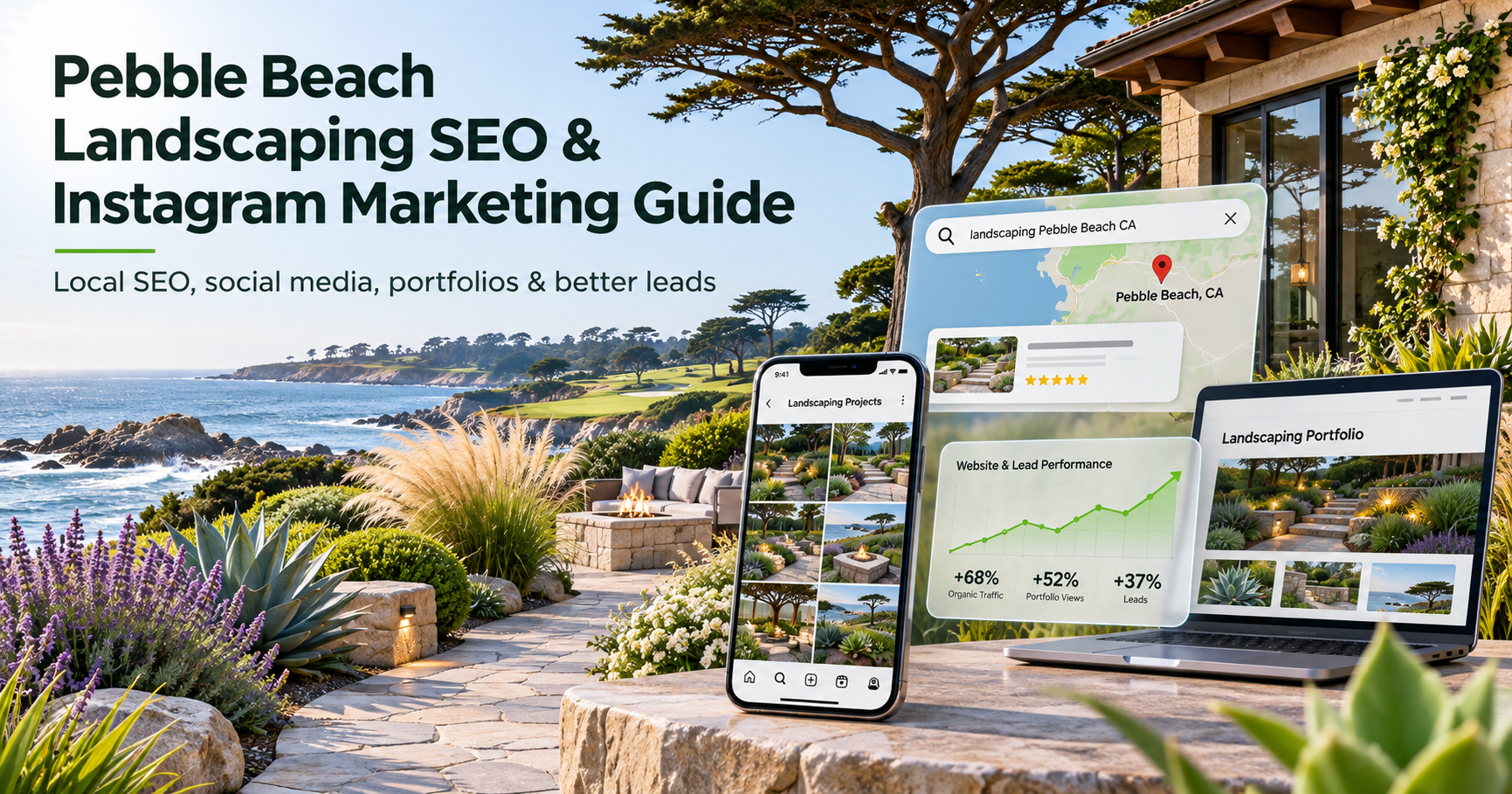
Your landscaping projects may look exceptional on Instagram. But beautiful photos alone won't build a complete customer acquisition strategy. Here's how landscaping and outdoor living businesses serving Pebble Beach can combine local SEO, social media, project portfolios, and content marketing to reach the property owners they actually want to work with.
A landscaping company completes an extraordinary project in Pebble Beach.
The outdoor space looks completely different.
Carefully selected plants complement the architecture.
Paths and gathering spaces create a natural flow through the property.
The finished landscape feels intentional, inviting, and beautifully maintained.
The company takes photographs.
Someone creates an Instagram Reel.
The before-and-after transformation looks incredible.
The post gets likes.
People leave comments.
A few users share it.
The team feels proud of the response.
And they should.
The work deserves attention.
But a few weeks later, the business owner asks an important question.
Did any of that attention turn into the kinds of landscaping inquiries we actually want?
That's where things get complicated.
A beautiful Instagram account can demonstrate craftsmanship, establish a visual identity, and introduce a company to new audiences.
But it doesn't automatically make the business discoverable when a Pebble Beach homeowner searches for landscape design, outdoor renovations, garden maintenance, or another specific service.
It doesn't necessarily explain the company's capabilities.
It may not clarify where the business operates.
And it doesn't guarantee that the people admiring the photographs are local property owners with relevant projects.
A beautiful social media presence is valuable.
It's simply not the same thing as a complete marketing strategy.
Instagram can make homeowners admire your work. SEO helps them discover your company when they're researching the work they need.
For landscaping companies serving Pebble Beach, Carmel-by-the-Sea, Monterey, Pacific Grove, and the surrounding Monterey Peninsula, the strongest digital presence often connects those two experiences.
Social media showcases the work and the people behind it.
A search-optimized website explains the services.
Google Business Profile helps customers discover relevant local providers.
Educational content addresses questions property owners ask before starting projects.
And clear inquiry pathways make it easier for suitable customers to take the next step.
The objective isn't simply more followers.
Or more website visitors.
Or more attractive posts.
It's to build a digital presence that helps the right property owners discover, evaluate, and contact the business.
That is where coordinated SEO and social media marketing becomes worth considering.
The Instagram Problem: Attention Isn't the Same as Demand
Instagram is naturally appealing for landscaping businesses.
The industry produces visual transformations.
Before-and-after photographs can communicate substantial changes.
Short videos can show materials, planting, maintenance techniques, and completed spaces.
A well-photographed project can demonstrate the company's aesthetic and attention to detail.
These are genuine advantages.
But social media attention has limitations.
Someone in another state may admire a Pebble Beach garden.
A homeowner might save a photograph as inspiration for a project they won't begin for several years.
A design enthusiast may follow the company without any intention of hiring it.
A post could attract substantial attention because the property is visually striking, even if the viewers have little interest in the services performed.
None of that engagement is inherently worthless.
Brand recognition and inspiration have value.
But they should not be confused with qualified customer demand.
Consider two hypothetical outcomes.
One landscaping business receives thousands of views on a Reel showing a dramatic garden transformation.
Another receives a single inquiry from a Pebble Beach homeowner considering a substantial landscape renovation.
Which result is more valuable?
The answer depends on the company's objectives.
But for a landscaping contractor whose goal is to secure appropriate projects, the second interaction may have more direct commercial relevance.
That's why businesses should distinguish attention metrics from business outcomes.
Instagram views, saves, shares, and follows help describe social media engagement.
Qualified inquiries, consultations, proposals, and acquired customers help describe the commercial opportunities that follow.
The two categories can be related.
They aren't interchangeable.
Why Landscaping Companies Need Both Discovery and Credibility
A homeowner doesn't always begin the buying process in the same place.
One person may discover a beautiful landscape on Instagram.
Another may receive a referral from an architect or neighbor.
Someone else may search Google for a specific landscaping service.
A property owner preparing a major outdoor renovation might research materials, planning considerations, and different service providers before contacting anyone.
These experiences involve different needs.
Inspiration
The homeowner is exploring possibilities.
They may enjoy project photography, save ideas, or follow a landscaping company because they like its work.
Instagram can be especially useful here.
Research
The homeowner begins investigating the type of service required.
They may search for landscape design-build companies, garden maintenance providers, irrigation specialists, or outdoor living contractors.
Search visibility and informative website pages become more important.
Evaluation
The homeowner compares companies.
They look at previous work, qualifications, reviews, service areas, and processes.
A strong project portfolio and credible website help support this stage.
Inquiry
The homeowner is ready for a conversation.
They want to understand how to begin, whether the company accepts their type of project, and what information is needed.
A clear contact pathway matters.
A complete marketing strategy supports these different stages.
Instagram doesn't have to perform the job of every other marketing channel.
And SEO doesn't have to replace the visual storytelling that makes landscaping work compelling.
The goal is to give each channel a clear role—and make those roles work together.
Pebble Beach Landscaping Is Not One Uniform Market
Pebble Beach is associated with distinctive residential properties and premium outdoor experiences.
But landscaping companies serving the area can have very different specialties.
Some businesses focus on routine garden maintenance.
Others provide landscape construction.
Some specialize in planting design or ongoing horticultural care.
Others work on substantial outdoor renovations involving multiple trades.
A company may provide landscape design-build services, while another may coordinate with independent landscape architects, designers, or specialist contractors.
These distinctions are important for marketing.
A maintenance business may want recurring service relationships.
A design-build contractor may prefer fewer but larger projects.
A specialized planting company may want customers who understand its particular expertise.
A landscaping business that simply advertises "beautiful outdoor spaces" may not communicate which of these needs it serves.
The website should explain the offering.
The Instagram content should reinforce that explanation.
And the SEO strategy should reflect the actual service categories.
A business that wants large design-build inquiries shouldn't necessarily focus its entire content strategy on quick garden tips.
A company specializing in maintenance shouldn't advertise complete landscape construction if it doesn't provide that work.
The best marketing begins with a clear understanding of the projects the company is prepared to deliver.
1. Start With the Landscaping Services You Want to Be Known For
Before hiring a social media manager or SEO agency, identify the business's most important offerings.
This sounds obvious.
But many landscaping websites use broad descriptions that make their services difficult to distinguish.
"Landscape solutions."
"Outdoor transformations."
"Beautiful gardens."
"Luxury landscaping."
These phrases communicate an aesthetic.
They don't always explain the service.
A prospective customer may need to know whether you provide:
Landscape design and installation.
Garden maintenance.
Planting and horticultural care.
Irrigation-related services.
Outdoor living construction.
Hardscape installation.
Renovation of existing landscapes.
Ongoing property landscape management.
Only advertise work your company is qualified and prepared to perform.
For California contractors, applicable licensing requirements matter.
The California Contractors State License Board defines the scope of the C-27 landscaping contractor classification.
The classification and the licensing rules should not be treated as permission to perform every possible construction trade.
A business should verify its actual license, classifications, and any requirements associated with the proposed work.
Once the services are clear, digital marketing becomes easier to organize.
A social post can show a specific completed project.
A website page can explain the associated service.
An educational article can address questions homeowners ask before beginning similar work.
And the inquiry form can help identify whether the customer's project is a good fit.
2. Treat Instagram as Your Visual Portfolio, Not Your Entire Website
A landscaping company's Instagram account can be one of its strongest visual assets.
But relying on Instagram as the primary explanation of the business creates limitations.
Social posts are typically consumed individually.
A new visitor may see a single Reel without understanding the company's service area, qualifications, or full project capabilities.
Older posts can become difficult to find.
Important business information may be scattered among captions, Highlights, and profile links.
And the platform controls much of how content is presented and distributed.
A dedicated website provides a different experience.
You can organize projects by service.
Explain the process.
Publish detailed case studies.
Present relevant qualifications.
Answer recurring questions.
And create clear contact pathways.
Instagram can support this website rather than replace it.
For example, a beautiful before-and-after post might invite interested viewers to explore the complete project.
The corresponding website page could contain more photographs, a description of the work, and a link to the relevant service.
This is a more complete experience than simply adding "DM us for details" to every post.
Messaging can be a useful inquiry channel.
But the business should still have an organized way to communicate what it offers.
Instagram shows the result. Your website can explain how the result came together.
3. Turn Your Best Landscaping Photographs Into Search-Friendly Project Pages
One of the biggest missed opportunities in landscaping marketing is allowing exceptional photographs to exist only on social media.
Consider a hypothetical landscape renovation completed for a residential property.
The team photographed the original site, documented major phases, and captured the completed work.
The company publishes an Instagram carousel.
Followers can see the transformation.
But the business never creates a project page on its website.
That means the photographs have limited supporting context.
A dedicated project page could explain what the company was hired to do.
It could describe the general scope, planning considerations, planting or construction work, and the company's role.
It could also link to the appropriate service page.
What a useful landscaping project page includes
Project overview: A concise explanation of the work and its intended purpose.
Scope of services: A description of what the company actually performed.
Design or planning considerations: Relevant decisions that shaped the work.
Photographs: An authorized selection showing meaningful stages and completed details.
Professional roles: Appropriate credit where designers, architects, or other contractors contributed.
Related services: Links to pages explaining the relevant offerings.
Next step: A clear invitation for property owners with similar needs to inquire.
Project descriptions should be accurate.
Don't invent construction challenges, client goals, or measurable outcomes.
And don't imply the company designed elements that were actually created by another professional.
Google's Image SEO Best Practices explain that images can be better understood through relevant surrounding text, descriptive filenames, and appropriate alternative text.
A project page provides that context.
It also gives prospective customers a more informative way to evaluate the work.
4. Optimize Your Project Photography for Google, Not Just Instagram
A photograph prepared for Instagram isn't necessarily optimized for a website.
Social media platforms have their own image formats and compression methods.
Websites have different requirements.
A landscaping company may have high-resolution images from a professional photographer.
Those files are valuable.
But uploading enormous originals directly into a website can slow the experience.
Google recommends balancing image quality with performance.
For landscaping portfolios, that may involve appropriately sized files, responsive images, and efficient formats.
Image accessibility also matters.
Alternative text should describe meaningful visual content.
For example:
"Residential courtyard with stone paving, layered planting, and a seating area."
That's more useful than:
"Best Pebble Beach landscaper luxury landscaping Pebble Beach garden design."
Keyword stuffing doesn't help the reader.
A useful image filename might describe the actual subject, such as residential-courtyard-landscape.jpg.
Add geographic information only when it's accurate and appropriate to disclose.
The surrounding page should explain the project.
A photograph's meaning is clearer when visitors can understand why it was included.
And the website should remain usable on mobile devices.
The goal is to preserve the visual quality of the work while making the images easier for people and search engines to access.
5. Make Google Business Profile Part of Your Landscaping Strategy
Instagram may help someone discover your work while browsing.
Google Business Profile may become especially relevant when a homeowner searches for a landscaping provider in a particular area.
Google's official local ranking guidance identifies three major ranking factors:
Relevance: How well the business matches the search.
Distance: How far the business is from the searcher's location or the location associated with the query.
Prominence: How well known or established the business appears through relevant signals.
A landscaping company can work on factors within its control.
That may include maintaining accurate business information, selecting appropriate categories, describing services, adding genuine project photographs, and responding professionally to customer reviews.
But no provider can guarantee a particular Maps position.
And no agency can sell a guaranteed organic local ranking.
A strong local SEO approach begins with accuracy.
Does the profile represent the real business?
Is the phone number correct?
Are the services described appropriately?
Is the primary category relevant?
Does the profile reflect the company's actual location or service-area arrangement?
Are the photographs genuine?
These basics matter before more ambitious optimization tactics.
6. Represent Your Pebble Beach Service Area Honestly
A landscaping company may serve Pebble Beach without being based there.
It might operate from Monterey, Carmel, Pacific Grove, or another nearby community.
That's a legitimate business arrangement.
But the website and Google Business Profile should distinguish actual locations from geographic service coverage.
Google's service-area business guidelines explain that businesses visiting customers at their locations may use service-area settings.
If the company doesn't receive customers at its business address, it generally needs to hide that address on its profile.
Google also has specific restrictions concerning duplicate profiles and ineligible virtual offices.
Adding Pebble Beach as a service area does not guarantee that a business will rank there.
Distance remains a factor in local search.
That distinction is especially important when agencies advertise local SEO packages.
A provider should never recommend creating a fake Pebble Beach office merely to appear more prominent in Maps results.
Instead, the website can truthfully describe the company's geographic coverage.
For example, a landscaping contractor may explain that it serves residential properties across Pebble Beach and surrounding Monterey Peninsula communities.
Relevant project pages can support that description when authorized.
The goal is to help customers recognize the company's legitimate service area.
Not to manufacture local relevance.
7. Create Individual Pages for Your Most Important Landscaping Services
A landscaping website shouldn't rely on one general services page if the company offers several distinct services that customers research differently.
Someone looking for recurring garden maintenance may have very different questions from a property owner considering a major outdoor renovation.
Those customers shouldn't be forced to interpret the same vague description.
A useful website might have distinct pages for its actual core offerings.
A landscape design-build page could explain the planning and implementation process.
A garden maintenance page could describe the scope and frequency of available services.
An irrigation services page could explain the company's qualified role and what is involved in an evaluation.
A landscape renovation page could describe the types of existing spaces the business works on.
Each page should answer relevant questions.
Who is this service for?
What does it involve?
Which projects are appropriate?
What qualifications apply?
Where is it available?
How does an inquiry begin?
The content should be original and specific.
Don't create dozens of nearly identical pages simply to repeat location names.
Google's SEO Starter Guide recommends clear organization and useful content rather than keyword repetition.
For landscaping companies, this means making the service itself understandable.
A property owner should be able to recognize whether the business is worth contacting.
8. Use Social Media to Show the Process, Not Just the Finished Result
Finished landscaping photographs are compelling.
But they don't always demonstrate the work required to create the result.
A more informative social strategy can show parts of the process.
A landscape contractor might share authorized progress photographs and explain what was being completed.
A horticultural specialist could discuss general considerations involved in planting design.
A maintenance company might explain how its team approaches recurring property care.
A design-build business could show how different project phases come together.
The content should reflect genuine expertise.
It shouldn't provide unsafe construction instructions or present specialized advice without qualified review.
The objective isn't to reveal every technical detail.
It's to help people appreciate the experience behind the work.
Examples of useful Instagram content
A Reel might show a sequence of completed project stages, supported by a caption describing the scope.
A carousel could compare the original space with the finished landscape.
A short video could introduce the crew members responsible for a particular service.
A post might explain how the company approaches consultations.
Another might answer a common homeowner question.
These posts give prospective customers more than visual inspiration.
They provide context.
And that context can help differentiate one landscaping company from another.
Beautiful photographs show craftsmanship. Clear explanations help people understand the business behind it.
9. Create Content That Answers the Questions Property Owners Ask Before Hiring
Many landscaping inquiries develop over time.
A homeowner may begin by researching options.
They might compare different project approaches.
They may be uncertain whether an existing space needs maintenance, renovation, or more substantial work.
Before they request an estimate, they may want to understand what kind of professional they need.
A landscaping company can address those questions through educational content.
For example:
"How to Prepare for a Landscape Design Consultation"
"What to Consider Before Renovating an Established Garden"
"Landscape Maintenance vs. Landscape Renovation: Understanding the Difference"
"Questions to Ask Before Hiring a Landscaping Contractor"
"What Homeowners Should Know Before Planning a Major Outdoor Living Project"
These are illustrative topics, not verified keyword-volume opportunities.
They should be evaluated against the company's actual services and expertise.
The best subjects are questions the business already answers during consultations.
That creates an opportunity to turn firsthand knowledge into useful content.
The website can host a detailed explanation.
Instagram can introduce the topic through a shorter post.
A short video can demonstrate an appropriate concept.
And the service page can help interested readers understand the next step.
One useful idea can support several channels without becoming repetitive.
10. Make Water-Wise Landscaping Content Accurate and Locally Relevant
Local expertise can be valuable.
But landscaping businesses should be careful about turning local conditions into generic marketing claims.
The Monterey Peninsula has water management requirements that may affect certain landscape projects.
The Monterey Peninsula Water Management District publishes information about water-efficient landscape requirements, documentation, and relevant project conditions.
That makes water-efficient landscape planning a potentially useful content topic for appropriately qualified professionals.
But the requirements depend on the project, property, jurisdiction, and applicable rules.
A landscaping company shouldn't imply that every Pebble Beach property must follow identical procedures.
Nor should a marketing agency publish technical advice without input from qualified professionals.
A responsible article might explain which questions property owners should raise before beginning a landscape installation.
For example:
Does the project require a water-efficient landscape documentation package?
Which authority has jurisdiction?
Are irrigation plans or inspections required?
What information will a professional need to evaluate the project?
The article can direct readers to official sources and recommend appropriate professional review.
That is more useful than publishing sweeping claims about which plants or irrigation systems are legally required everywhere in Pebble Beach.
The distinction is important.
Local content should demonstrate genuine knowledge, not simply include local keywords.
11. Use Reviews to Support the Reputation Your Photos Create
A beautiful landscaping portfolio can make someone interested in a business.
Reviews may help them evaluate the experience of working with that business.
For an established contractor, customers may want to understand communication, professionalism, project coordination, and whether the service matched the agreed scope.
A review can provide some of that perspective.
But reviews must be genuine.
Google allows businesses to request honest feedback.
It does not allow businesses to purchase positive ratings or offer prohibited incentives.
The FTC's Consumer Reviews and Testimonials Rule also addresses deceptive practices involving fake reviews and testimonials.
For a landscaping business serving private properties, privacy matters.
Don't reveal customer addresses or personal details in review responses.
Don't publish client photographs without permission.
And don't imply a testimonial came from a particular property owner unless the attribution is authorized.
A useful digital strategy should connect real evidence.
Project photographs show the finished work.
Service pages explain what was provided.
Qualifications establish professional context.
And authentic feedback can help prospective customers understand the client experience.
No single element has to carry all the trust-building.
Together, they create a more complete picture.
12. Use Instagram Stories and Reels With a Purpose
Social media management can become overly focused on frequency.
Post more often.
Create more Reels.
Add more Stories.
Increase the number of monthly content pieces.
Consistency can be useful.
But quantity alone doesn't establish a successful strategy.
A landscaping company should know why it's publishing.
A Reel featuring a completed project may support portfolio awareness.
A behind-the-scenes post may communicate the team's process.
A Story may help existing followers stay familiar with the company.
An educational carousel might answer a common question.
A testimonial post may support credibility.
Each piece should have a purpose.
That doesn't mean every post must directly sell a service.
Not all useful content leads to an immediate inquiry.
But the overall editorial strategy should be connected to the business.
Make the next step clear
When appropriate, a social post can direct viewers to a related project page, service page, or consultation form.
Use a relevant destination rather than sending everyone to the homepage regardless of context.
For example, a post about a substantial outdoor renovation could link to a website page explaining that type of work.
A maintenance-focused post may be more useful to people researching ongoing service arrangements.
The goal is continuity.
Someone should be able to move from the visual story to more detailed information without starting the research process over again.
13. Build a Repeatable System for Capturing Project Content
One of the biggest challenges landscaping companies face is producing consistent marketing material while the team is busy performing the work.
A crew may complete outstanding projects.
But nobody remembers to take photographs.
Or the only images available are a few rushed phone pictures.
The marketing agency receives inconsistent content.
Social publishing becomes sporadic.
And the website portfolio stops reflecting recent work.
The solution doesn't necessarily require an elaborate production process.
It may require a straightforward documentation routine.
Before the project
Identify which photographs or videos would be useful, if permitted.
Confirm client authorization and any property restrictions.
Document the general scope.
During the project
Capture meaningful progress at appropriate stages without interfering with work or safety.
Record relevant notes about what the team is doing.
After completion
Photograph the finished result.
Confirm which images may be published.
Document the company's actual role.
Collect a concise explanation from the project lead.
During marketing production
Select the best assets.
Develop a project page.
Prepare social posts.
Write accessible image descriptions.
Update relevant service pages when appropriate.
This process turns project documentation into a reusable marketing asset.
It also reduces the burden of creating something entirely new every week.
A single completed project may support a website case study, several Instagram posts, a short Reel, and an educational article.
But those outputs should serve different purposes.
They shouldn't simply repeat the same caption everywhere.
14. Protect Client Privacy When Sharing Beautiful Properties
For Pebble Beach landscaping companies, photography can create privacy concerns.
Some residential projects involve private homes with distinctive features.
An image may reveal an exact location or details about property access.
A video could capture people, vehicles, security features, or other information the owner doesn't want published.
This is particularly important when marketing to luxury residential clients.
A company should obtain appropriate permission before sharing project images.
That permission should address the intended uses where relevant.
Posting photographs on Instagram is not necessarily equivalent to licensing them for advertisements, a website portfolio, or third-party publications.
The company should also review copyright and photographer usage rights.
A professional photographer may retain rights to images unless a contract provides otherwise.
Property owner permission and image copyright are separate issues.
Both may need consideration.
Where necessary, the company can crop images, omit identifiable details, or describe the project more generally.
A project doesn't need an exact address to communicate quality.
Privacy-conscious marketing is not a limitation on professionalism. It is part of professionalism.
15. Connect Social Media Interest to a Website That Converts Relevant Visitors
A homeowner may discover your landscaping business on Instagram.
Then they click through to the website.
What happens next?
Can they identify the services?
Does the site explain the geographic coverage?
Are there relevant project examples?
Can they find qualifications and contact information?
Does the inquiry process work on a phone?
If the answer to those questions is unclear, additional social media reach may not solve the problem.
The website becomes the next part of the customer experience.
That means the SEO and social media strategy should be supported by usable web design.
The homepage
Explain the business and its relevant services.
The portfolio
Show authorized, representative work.
The service pages
Help homeowners understand what they can hire the company to do.
The About page
Introduce the business, team, qualifications, and approach.
The contact page
Explain how a prospective client can begin a conversation.
A clear call to action might be:
"Discuss Your Landscape Project."
Or:
"Request a Landscape Consultation."
The wording should match the actual service process.
If consultations carry fees, explain that appropriately.
If the business only accepts certain types of projects, provide enough information for customers to assess suitability.
The goal isn't to maximize the number of forms submitted.
It's to help the right homeowners contact the company with realistic expectations.
What an Integrated SEO and Social Media Strategy Looks Like
The strongest combined strategy doesn't treat Instagram and SEO as two unrelated monthly tasks.
It begins with a shared understanding of the business.
Which projects does the company want?
Which services are most important?
Who are the intended customers?
Which geographic areas are genuinely served?
What questions do potential clients ask?
Which past projects best demonstrate the company's capabilities?
Once those answers are clear, the channels can support one another.
A completed landscaping project becomes a detailed website portfolio page.
That page links to the relevant service.
Photographs from the project become Instagram content.
A short video introduces the design or implementation process.
An educational article addresses an issue related to the project.
The Google Business Profile features appropriate business information and genuine photos.
And the inquiry pathway helps property owners request a conversation.
This coordinated approach creates a more coherent digital presence.
The Instagram account doesn't need to explain every technical detail.
The website doesn't need to imitate social media.
And the SEO strategy doesn't need to manufacture low-value pages.
Each channel contributes something useful.
Example: Turning One Pebble Beach Landscaping Project Into a Marketing System
Imagine a hypothetical landscape design-build company that completes a substantial residential outdoor renovation.
The project includes appropriate planting, a redesigned gathering area, and improvements carried out within the company's qualifications and project scope.
This is an illustrative example, not a documented client case study.
The company could use the project in several ways.
The Instagram reveal
Publish a short before-and-after Reel.
The caption introduces the transformation and identifies the company's actual role.
The post highlights the finished work without revealing private property information.
The website case study
Create a dedicated page explaining the project.
Include authorized photographs, general objectives, relevant work performed, and links to the service pages.
The educational article
Publish a guide addressing a question associated with the project.
For example:
"What to Consider Before Renovating an Established Residential Landscape."
The article provides useful general information and directs readers to qualified professionals for property-specific decisions.
The Google Business Profile update
Add appropriate photographs and maintain accurate service information.
Avoid pretending the project itself guarantees Maps visibility.
The consultation pathway
Provide a clear next step for homeowners exploring similar work.
For example:
"Discuss a Landscape Renovation."
The result is a connected set of assets.
Instead of one Instagram post disappearing into an archive, the project becomes part of the company's longer-term digital presence.
The content can remain useful as long as it stays accurate and accessible.
What Should a Monthly SEO and Social Media Retainer Actually Include?
For landscaping companies with ongoing marketing needs, a monthly retainer may be appropriate.
But it should be built around a defined scope.
A company shouldn't automatically purchase a large package simply because it combines SEO and social media.
The provider should explain what each service is intended to accomplish.
SEO strategy and maintenance
This may involve relevant search research, website optimization, technical monitoring, and improvements to important service pages.
Google Business Profile work
The agency may review information accuracy, categories, service descriptions, authorized photographs, and customer review processes.
Content planning
A shared editorial calendar can connect website articles, project pages, and social publishing.
Social media production
The scope may include captions, image selection, carousels, video editing, publishing, and content approval.
Community management
Depending on the agreement, the agency may help manage comments and messages.
The contractor should establish who is authorized to respond to prospective customers or make commitments.
Portfolio development
Completed projects can be transformed into useful website pages when sufficient information and permissions are available.
Reporting
The provider should explain website visibility, social engagement, inquiries, and other relevant measures.
Strategy reviews
Regular meetings or written reviews can help determine what should be continued, changed, or stopped.
Not every company needs all these services immediately.
A business with a strong Instagram account but a weak website may need more SEO and web work initially.
Another with excellent search visibility but inconsistent visual content may require a stronger social production system.
A good retainer should reflect the problems the business is trying to solve—not an arbitrary number of posts and keywords.
Why You Should Be Careful With Marketing Retainer Pricing
Marketing fees vary depending on the scope, provider, and amount of ongoing work.
A monthly arrangement may cover strategy, technical improvements, content creation, social publishing, and measurement.
But proposals can differ substantially.
One agency might include only caption writing and scheduling.
Another may include original video production.
One SEO retainer might focus on technical and local visibility improvements.
Another may include extensive new website content.
The business should compare actual deliverables.
Ritner Digital publishes a marketing retainer pricing guide describing different levels of monthly marketing support.
That provides a useful reference for the kinds of work that may be included, but the appropriate engagement for a landscaping company should still depend on its needs.
Before signing any agreement, ask:
What work is included?
Who creates or supplies photographs and videos?
How many website pages or content pieces will be developed?
Who approves posts?
What technical SEO work is planned?
Are paid advertising budgets separate?
Who owns the website and social media accounts?
How is success measured?
And what happens if the business decides to end the engagement?
A clear answer to these questions is more valuable than a package promising a large number of deliverables without explaining their purpose.
How Should Landscaping Companies Measure Social Media ROI?
Instagram provides useful engagement information.
A professional account can help businesses review content performance, audience activity, and related indicators.
Meta's Business Suite insights guidance describes reporting for views, interactions, follows, and other metrics.
But those numbers should be interpreted carefully.
A Reel receiving more views isn't automatically generating more business.
A post getting fewer likes may still be useful if it reaches the right audience.
A saved project photo may indicate interest without showing whether the viewer will ever become a customer.
A landscaping company should therefore evaluate social media alongside its inquiry process.
Useful questions include:
Are relevant homeowners discovering the account?
Are visitors clicking through to service or portfolio pages?
Are prospective clients mentioning Instagram during consultations?
Are direct messages becoming appropriate inquiries?
Does the content communicate the kinds of work the business wants?
These questions provide more commercial context.
Even then, attribution can be imperfect.
A customer may see an Instagram post, receive a referral, search Google, and contact the company later.
The business shouldn't automatically assign all the value to whichever channel was clicked last.
A practical measurement system should recognize that customers may encounter the brand in several places.
How Should Landscaping Companies Measure SEO ROI?
SEO reporting should also go beyond raw traffic.
Google Search Console helps businesses understand search impressions, clicks, queries, and important landing pages.
Google Business Profile provides performance information about selected customer interactions.
Analytics can help track relevant website actions when properly configured.
But the business should connect those metrics with qualified opportunities where possible.
For example:
Which services are generating inquiries?
Are customers located within the actual service area?
Do the projects match the company's capabilities?
Are the inquiries becoming consultations?
How many lead to proposals?
Which proposals become signed work?
Not every question will be answerable with perfect precision.
But the reporting should move toward outcomes that matter.
A landscaping business may benefit more from a handful of suitable project inquiries than from a large increase in visitors seeking unrelated services.
That distinction should influence both SEO priorities and social content.
The purpose of marketing isn't simply to generate attention. It's to help create the right kinds of business opportunities.
When Paid Social Advertising Might Make Sense
Organic Instagram content and paid advertising serve different purposes.
A business may use organic social media to showcase projects and maintain a recognizable presence.
Paid social campaigns can distribute messages to selected audiences, subject to platform targeting options and policies.
But advertising should not be the automatic next step for every landscaping company.
Before spending money, consider whether the offer is clear.
Does the website explain the service?
Are relevant project examples available?
Is the inquiry process functional?
Can the business handle additional demand?
Has the company defined which projects it wants to attract?
If those foundations are weak, paying to send more people to the website may not solve the underlying problem.
A focused advertising test could be appropriate when the company has a defined objective, suitable landing page, measurement plan, and available budget.
The business should also distinguish paid media spending from agency management fees.
Not every Instagram boost produces useful inquiries.
And social advertising results depend on targeting, creative, competition, customer demand, and other factors.
A responsible agency should explain the test rather than promise a guaranteed number of high-value customers.
A 90-Day SEO and Social Media Plan for Pebble Beach Landscapers
A coordinated program doesn't need to begin with daily publishing.
A focused first 90 days can create a stronger foundation.
The following framework is illustrative and does not guarantee rankings, traffic, or leads within three months.
Days 1–30: Understand the business and audit the digital presence
Start with the company's actual services.
Identify the projects it wants to attract.
Review its service area and qualifications.
Audit the website, Google Business Profile, and Instagram account.
Check whether the website clearly explains the offerings.
Review important service pages and past project content.
Identify which photographs and videos can legally and appropriately be used.
Evaluate current search visibility and available social insights.
Then develop a prioritized plan.
If the website has serious technical or content problems, those may deserve attention before increasing posting frequency.
Days 31–60: Improve the website and build a project-content system
Update the highest-priority service pages.
Correct legitimate business profile information.
Develop one or more detailed project pages using authorized material.
Create a repeatable process for collecting project photographs and information.
Build an editorial plan that connects social content with the company's services.
Publish useful educational material based on customer questions.
Begin producing social posts with clear roles.
Some may showcase projects.
Others may explain the process or introduce the team.
Focus on quality and relevance rather than publishing volume alone.
Days 61–90: Expand relevant content and evaluate early results
Continue improving service and project pages.
Publish another useful educational resource.
Review whether Instagram content is reaching an appropriate audience.
Assess the quality of inquiry traffic.
Confirm that forms, calls, and messages are being handled consistently.
Examine search performance and determine which relevant queries deserve attention.
Review whether the content being produced matches the company's desired project mix.
Then adjust the next phase.
The goal after 90 days should be a clearer, better-connected marketing system.
Not an unsupported promise that the company will become the top landscaping contractor in Pebble Beach.
Seven Mistakes That Keep Landscaping Marketing Stuck on Instagram
Mistake 1: Publishing beautiful photographs without explaining the service
A stunning outdoor space may not reveal whether the company designed, installed, renovated, or maintained it.
Mistake 2: Chasing follower counts without considering geography
A large audience outside the service area may not contribute much to local project inquiries.
Mistake 3: Keeping completed projects off the website
Project stories can provide useful context and support search discoverability.
Mistake 4: Treating hashtags as a replacement for SEO
Hashtags can help organize or describe social content, but they don't replace service pages, local business information, or search-focused website content.
Mistake 5: Publishing generic landscaping articles with no connection to the business
Content should reflect the company's actual expertise and the customers it wants to reach.
Mistake 6: Making unsupported claims about coastal properties or landscaping rules
Technical and regulatory information should come from qualified professionals and appropriate official sources.
Mistake 7: Reporting likes and traffic without measuring suitable inquiries
Attention is useful to understand, but it isn't the same as acquiring appropriate customers.
The solution isn't to stop using Instagram.
It's to give Instagram a clearer place within the broader strategy.
Questions to Ask Before Hiring an SEO and Social Media Agency
A landscaping business evaluating marketing providers should look beyond attractive sample posts.
Ask the agency how it will understand your services and ideal projects.
Request an explanation of the local SEO work.
Find out who will write and approve technical landscaping content.
Clarify how project photography will be collected, licensed, and organized.
Ask whether the agency will create meaningful website project pages or only post to social media.
Determine how Google Business Profile will be managed.
Review whether the strategy accounts for contractor licensing and client privacy.
Ask who will respond to direct messages and inquiries.
Confirm who owns the website, advertising accounts, and social media profiles.
And establish how the agency will evaluate qualified opportunities.
A provider should also acknowledge limitations.
It cannot guarantee first-place Google rankings.
It cannot guarantee that every social media post will perform well.
And it cannot promise that a particular number of views will produce a particular number of projects.
A good proposal should explain the work, the expected sequence, and the indicators used to evaluate progress.
That's more useful than a presentation filled with impressive-looking social media metrics.
Frequently Asked Questions
1. Why isn't Instagram enough for a Pebble Beach landscaping company?
Instagram is useful for showcasing visual work, building familiarity, and engaging an audience. But it doesn't necessarily provide the detailed service information, local search visibility, organized portfolio, or lead tracking that a landscaping business needs. Combining social media with a useful website and local SEO creates more opportunities for appropriate customers to discover and evaluate the company.
2. Should a landscaping company invest in SEO or social media first?
The answer depends on the company's current needs. A business with strong Instagram content but weak Google visibility may benefit from SEO and website improvements. Another with a well-optimized site but limited project photography may need a better social content system. An audit can help determine which work deserves priority.
3. What SEO keywords should Pebble Beach landscapers target?
Relevant keyword ideas may include landscape design, landscape construction, garden maintenance, landscape renovation, and other actual services combined with legitimate geographic coverage. The specific strategy should be based on search research, competition, service offerings, and customer intent. Avoid targeting services the business does not provide.
4. Can Instagram help landscaping companies get high-value clients?
It can help potential customers discover and evaluate projects, particularly when the work is visually compelling. However, Instagram engagement doesn't guarantee leads. The business should provide clear service information and appropriate pathways to its website or inquiry process, then evaluate the quality of resulting opportunities.
5. How do landscaping businesses get found on Google Maps?
Eligible businesses can improve their local presence by maintaining accurate Google Business Profiles, selecting relevant categories, providing legitimate service information, and collecting genuine customer feedback. Google ranks local results primarily through relevance, distance, and prominence. No agency can guarantee a particular Maps position.
6. Does a landscaping company need an office in Pebble Beach to rank there?
No. A legitimate landscaping service-area business based in a neighboring community may serve Pebble Beach customers. However, location and distance can influence search results. Businesses must accurately represent their real locations and follow Google's eligibility and service-area guidelines rather than creating fake storefronts.
7. Should landscapers create separate website pages for each service?
Distinct service pages can be useful when the company offers genuinely different services that customers research separately. A landscape renovation page may answer different questions from a recurring maintenance page. Each page should contain original, helpful information rather than repeating generic copy with different keywords.
8. What should a landscaping project portfolio include?
A useful portfolio includes authorized photographs, accurate project descriptions, the company's actual role, relevant services, and appropriate professional credits. Where possible, provide context about the general objectives and work completed. Avoid publishing private property details without permission or exaggerating the company's contribution.
9. What should a monthly landscaping social media retainer include?
Depending on the scope, a retainer may include content planning, captions, image selection, video editing, scheduling, account management, and reporting. Some agreements also include original photography or community management. Businesses should confirm exactly what is included, what they must supply, and how the work supports their goals.
10. Is a combined SEO and social media retainer worth it?
It may be worthwhile when a business needs ongoing support across search visibility, service pages, project content, and social publishing. The work should be coordinated and clearly defined. A company that only needs a website correction or focused audit may not require a broad ongoing program.
11. How much does SEO and social media marketing cost for a landscaping company?
Pricing varies by provider, scope, production requirements, and the amount of ongoing work. A narrow local SEO engagement may cost less than a program involving technical improvements, project portfolios, original video, social publishing, and advertising. Request itemized proposals and distinguish agency fees from advertising spend.
12. How often should a landscaping business post on Instagram?
There is no universally correct posting frequency. The business should choose a schedule it can sustain while maintaining quality and relevance. A smaller number of useful project and educational posts may be more appropriate than publishing daily content that doesn't reflect the services or audience.
13. Are before-and-after landscaping photos good for marketing?
They can be effective at communicating visual changes and the nature of completed work. They are stronger when accompanied by accurate context about what the business performed. Ensure appropriate image rights, homeowner authorization, and privacy safeguards. Do not misrepresent project results or imply work the company did not complete.
14. Should landscapers publish water conservation and irrigation articles?
Yes, when the information is relevant to the company's expertise and has been checked against applicable requirements. The Monterey Peninsula has specific water management considerations, but rules can vary by project and jurisdiction. Marketing content should reference reliable official sources and avoid unsupported technical or legal claims.
15. How can landscapers measure whether marketing is generating qualified leads?
Track relevant website inquiries, phone calls, direct messages, consultation requests, and acquired projects where reliable records exist. Review whether prospects are located within the service area and seeking appropriate work. Search rankings, social reach, and engagement can provide context but do not automatically measure commercial success.
16. Can Ritner Digital manage SEO and social media for Pebble Beach landscaping companies?
Ritner Digital provides SEO, local search, social media marketing, content strategy, website design, and related services. Landscaping businesses can discuss their service area, desired projects, current digital presence, and marketing priorities to determine whether a focused project or ongoing partnership may be appropriate.
Your Best Landscaping Projects Deserve to Be Found—Not Just Admired
Your landscaping company may already produce extraordinary work.
You may have beautiful photographs.
A growing Instagram audience.
Satisfied clients.
And a reputation built through years of craftsmanship.
Those are valuable assets.
But if homeowners can't find your company when they search for relevant services, your online presence may be missing an important opportunity.
If social media visitors can't understand the scope of your work, they may never become appropriate inquiries.
And if your project photography exists only on Instagram, you may be overlooking opportunities to build a more useful, searchable portfolio.
The answer isn't abandoning social media.
It's connecting your channels.
Let Instagram show the beauty of the work.
Let your website explain the services and projects.
Let local SEO help relevant homeowners discover the company.
Let educational content answer meaningful questions.
And let your inquiry process make it easy for suitable property owners to begin a conversation.
At Ritner Digital, we connect SEO, content strategy, social media, web design, and performance measurement to the actual goals of a business.
For Pebble Beach landscaping companies, that means looking beyond follower counts and generic traffic.
It means helping the right property owners discover the work you're qualified to perform.
Whether your company needs a local SEO audit, a more effective project portfolio, a stronger Instagram content strategy, or coordinated monthly marketing support, the best starting point is understanding what's working and what needs improvement.
Your beautiful landscaping work deserves more than likes. It deserves a digital presence that helps the right customers find it.
Sources and Further Reading
This article draws on official search guidance, platform documentation, California contractor information, and Monterey Peninsula landscape requirements. Examples are illustrative and do not represent documented client results, independently verified local search volumes, or guaranteed marketing outcomes.
Google Business Profile — Tips to Improve Your Local Ranking. Google's official explanation of relevance, distance, prominence, business information, photographs, and reviews. Read the guidance.
Google Business Profile — Manage Service Areas. Requirements and instructions for businesses serving customers at their locations, including service-area settings and address display. Read Google's instructions.
Google Business Profile — Guidelines for Representing Your Business. Eligibility and accuracy requirements for storefront and service-area businesses. Read the guidelines.
Google Search Central — Image SEO Best Practices. Recommendations for descriptive filenames, alternative text, contextual project pages, and technically accessible images. Read Google's documentation.
Google Search Central — SEO Starter Guide. Guidance on useful content, clear website structure, search intent, internal linking, and discoverability. Read the guide.
Google Search Central — Creating Helpful, Reliable, People-First Content. Guidance on original information, trustworthy expertise, and writing for readers rather than search engines alone. Read Google's guidance.
Meta Business Help Center — View Insights in Meta Business Suite. Information about social content views, interactions, followers, and performance reporting. Read Meta's documentation.
California Contractors State License Board — C-27 Landscaping Contractor Classification. Official description of landscaping contractor activities within the applicable classification. Read the classification.
California Contractors State License Board — Finding the Right Contractor. Official guidance concerning license verification, advertising requirements, and evaluating contractors. Read CSLB guidance.
Monterey Peninsula Water Management District — Landscape Permit Requirements. Local water-efficient landscape requirements and related documentation considerations. Read the district's guidance.
Federal Trade Commission — Consumer Reviews and Testimonials Rule. Official guidance concerning fake reviews, deceptive testimonials, and prohibited review practices. Read FTC guidance.
Federal Trade Commission — Advertising Endorsements. Guidance on truthful endorsements, advertising claims, and disclosing relevant relationships. Explore FTC guidance.
Google Search Console — Performance Report. Official documentation for measuring website search queries, clicks, impressions, and related performance. Read the documentation.
Ritner Digital — SEO Services. The practice's published approach to technical SEO, local search, content, and performance measurement. Explore SEO services.
Ritner Digital — Social Media Management. Published information about social strategy, content planning, publishing, engagement, and reporting. Explore social media services.
Ritner Digital — Marketing Retainer Pricing. Information about monthly marketing partnership structures and service scope. Review the pricing guide.
Ritner Digital — Contact. Direct inquiry page for businesses exploring SEO, social media, website improvements, or ongoing marketing support. Contact Ritner Digital.