Cincinnati Neighborhood SEO: How to Actually Rank in OTR, Hyde Park, Oakley, Mason, and West Chester
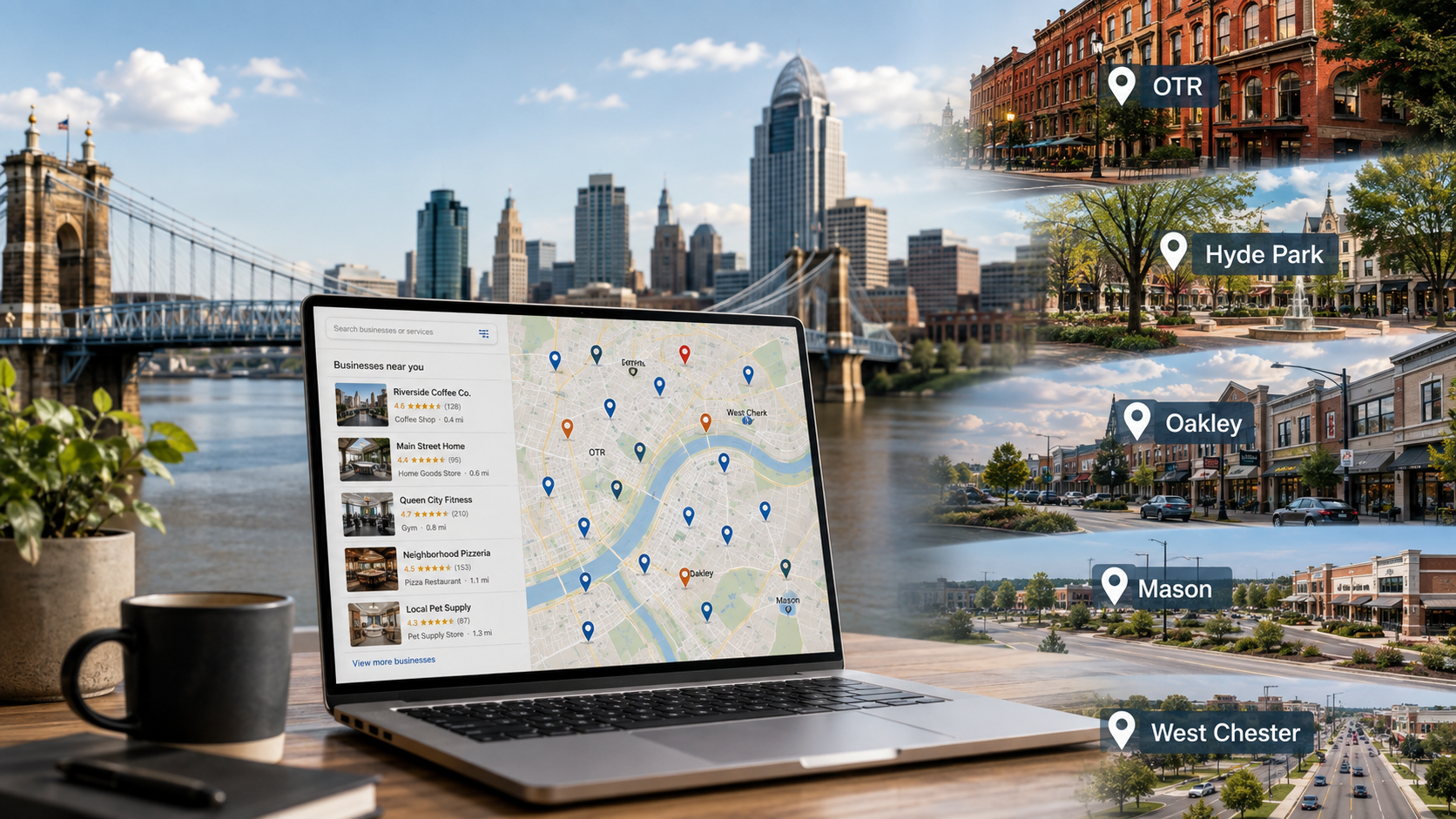
"Cincinnati SEO" is mostly a fiction — nobody hires a plumber for a metro area. They hire one for their street, and Google knows it: every neighborhood and suburb generates its own results, its own map pack, its own winners. Here's the tactical guide to competing at that level — what makes OTR, Hyde Park, Oakley, Mason, and West Chester five completely different games, the anatomy of a neighborhood page that ranks versus the doorway page that gets you flagged, and the order to build it all in.
Here's a test worth running before you read another word: open an incognito window and search your service plus "Hyde Park Cincinnati." Then the same service plus "Mason OH." Then "West Chester."
Different results. Different map packs. Often entirely different winners — and if your business appears in one and not the others, you've just seen the real structure of the Cincinnati market: not one competition, but dozens of small ones, each awarded separately. We covered why this happens in our local SEO playbook for the metro — Google's own framework weighs distance alongside relevance and prominence, so every search origin point re-runs the contest. This post is the how: the tactical layer, neighborhood by neighborhood, page by page.
One promise up front, because this topic attracts the worst advice in local SEO: we are not going to tell you to spin up forty near-identical town pages. That tactic has a name in Google's spam policies — doorway abuse — and a penalty attached. The whole craft here is doing the legitimate version well.
Five names, five different games
Treating Cincinnati's neighborhoods as interchangeable pins on a map is the first mistake. The five in this post's title aren't just different places — they're different search markets, with different intent, different customer economics, and different competitive dynamics. Read them as archetypes; your target areas will rhyme with one of them.
Over-the-Rhine (OTR) is the dense urban game. A walkable historic district where discovery happens on foot and on phones in the same hour — evening and weekend intent, heavy "near me now" behavior, and a market where reviews and photos do most of the converting because the searcher is often choosing between places they could walk to. Tactical wrinkle: the neighborhood answers to two names, and searchers use both. Your pages, profile, and citations should speak "OTR" and "Over-the-Rhine," because machines treat them as different strings until your content teaches them otherwise.
Hyde Park is the affluent-established game. High customer values, deep incumbency — the professional services, home services, and medical practices serving Hyde Park have often been there for decades, with the review counts and citation age to match. You don't out-volume incumbents here; you out-specific them: content and proof that speaks to exactly this area's housing stock, its square, its price points.
Oakley is the growth game — younger, faster-changing, with new residents forming service relationships from scratch every month. Fewer entrenched incumbents than Hyde Park next door, more searches from people who don't yet have "their" mechanic, dentist, or HVAC company. The neighborhoods in flux are where map-pack positions actually turn over.
Mason is the suburban-city game, and here's the mental shift it demands: Mason residents don't think they live in Cincinnati. They search "Mason" — dentist Mason, HVAC Mason OH — and a page or profile that only speaks "Cincinnati" is invisible to them. Family-driven service demand, real spending power, and a distinct civic identity your content has to respect to rank for.
West Chester is the same game with a disambiguation twist that quietly costs businesses rankings: West Chester, Ohio shares its name with a well-known Pennsylvania borough, and machines confuse them constantly. Every signal you build here should say "West Chester, OH" or "West Chester Township" explicitly — in titles, schema, citations — because ambiguity in the machine's mind is resolved against you, not for you.
The anatomy of a neighborhood page that ranks (and the one that gets you flagged)
Now the core tactic — and the line down its middle.
Google's spam policy is explicit about what it punishes: pages "targeted at specific regions or cities that funnel users to one page" — the classic template job where "Plumber in {NEIGHBORHOOD}" gets find-and-replaced across forty URLs. The industry consensus on where the line sits is equally plain: doorway abuse begins the moment location pages stop containing genuinely different information about each location. Same copy, swapped place names = spam. Real, distinct, locally useful pages = the single most effective tactic in neighborhood SEO.
So here's what a real one contains — the checklist we build against:
Proof you've actually worked there. Jobs completed in the neighborhood, with specifics: the kind of houses, the kind of problems, photos. "We've repaired forty slate roofs in Hyde Park, and here's what its 1920s housing stock does to flashing" is a sentence no template can fake — and it's simultaneously ranking content, conversion content, and the kind of concrete detail AI engines pull into answers.
The area's actual questions. Every neighborhood generates its own FAQ: parking and access realities in OTR, historic-district considerations, township permit quirks in West Chester, HOA patterns in Mason subdivisions. Answering the questions this area's customers ask is what "genuinely different information" means in practice.
Reviews from that area, showcased. Pull the Google reviews that mention the neighborhood onto its page. Third-party voices naming the place are corroboration for machines and social proof for humans in one move.
Logistics that only make sense for this page. Drive time from your location, service hours or crews for the area, the embedded map. Small signals, but they're the difference between a page about a place and a page wearing one.
A real place in your site's structure. Doorway pages are orphans — linked to the main site but never from it. Real neighborhood pages sit in navigation, get linked from relevant service pages and blog posts, and link out to the specific services that area buys most.
Build to that standard and the math changes: five genuinely good neighborhood pages beat forty templates on rankings, conversions, and risk — because the forty-template play doesn't just underperform, it invites the penalty that takes the whole site down with it.
Beyond pages: the neighborhood signals that decide ties
The page is the anchor; the surrounding signals are what let it win. Three layers, each covered in depth elsewhere and summarized here for the neighborhood lens:
Your Business Profile, tuned for geography. Service-area settings that name the areas honestly, posts and photos that reference them, and — for storefront businesses — the understanding that proximity gives you a home-field advantage in your own neighborhood that no competitor can take, and a handicap everywhere else that only the other signals offset.
Reviews that write the map for you. When you ask for reviews, make it natural for customers to say where they are — "great work on our Oakley bungalow" is a geographic citation in a customer's voice, sitting on the platform recommendation engines weight heaviest. A review base that names your neighborhoods is quietly one of the strongest ranking assets in this entire discipline.
Citations from the neighborhood's own institutions. Every one of these areas has an ecosystem — business districts and chambers, community councils, neighborhood publications and event sponsorships. A mention from an OTR institution tells machines you're of OTR in a way no on-page claim can. This is digital PR at the block level, and almost nobody does it, which is exactly why it works.
The build order: rings, not blankets
Don't build all five at once — sequence beats coverage, for three reasons. First, quality: each real page takes genuine effort (gathering the jobs, the photos, the area FAQs), and effort spread across ten pages produces ten templates. Second, the physics: proximity means you'll win nearest-first anyway, so build outward from where distance already favors you — your home area, then the adjacent ring, then the reach targets — weighted by customer value and by competition (an Oakley in flux before a Hyde Park fortress, unless Hyde Park's economics justify the siege). Third, the settle-in: a small site adding pages steadily gives Google a rhythm to recalibrate around; a sudden blanket of new pages invites the rougher version of the re-evaluation wobble every content push causes. One genuinely good neighborhood page a month, supported by its reviews and citations, is a pace that compounds; expect each to mature on the standard local curve — weeks for profile-level movement, a few months for the page itself.
Measure it at the level you're playing it. Search Console, filtered by query, tells you which neighborhood terms you're gaining impressions and clicks for. Incognito checks from each target area show the pack. And a handful of AI prompts per neighborhood — "best [service] in Mason," "near West Chester" — reveal the layer no dashboard covers. Neighborhood SEO run without neighborhood-level measurement is just hoping with extra steps.
Frequently asked questions
What is neighborhood SEO and how is it different from regular local SEO?
It's local SEO played at the level where results are actually awarded: individual neighborhoods and suburbs, each generating its own rankings and map pack because distance is a core factor in Google's local algorithm. Regular local SEO optimizes for "Cincinnati"; neighborhood SEO builds the specific pages, reviews, and citations that win Hyde Park, Mason, or West Chester one at a time — which is how small businesses beat metro-wide competitors, ring by ring.
Are location pages for every suburb bad for SEO?
Templated ones are — Google's spam policies explicitly target near-identical pages aimed at different cities that funnel users to one place, and the line is whether each page contains genuinely different, locally useful information. Real neighborhood pages — with area-specific jobs, questions, reviews, and logistics — are among the most effective tactics in local search. The test: could this page only have been written about this place?
How many neighborhood pages should a Cincinnati business build?
As many as you can build well — which for most businesses means one genuinely good page a month, sequenced outward from your location by proximity, customer value, and competition. Five excellent pages beat forty templates on every metric that matters, and a steady cadence avoids the re-evaluation turbulence a sudden page-dump invites.
Can a business in one neighborhood rank in another one?
Yes — proximity is a headwind, not a wall. Organic results and spec-specific searches cross neighborhood lines readily; the map pack is harder but moves on relevance and prominence too. The offsetting signals: a real page for the target area, reviews from customers there, and citations from its institutions. The same logic scales all the way up to ranking across the metro from another state entirely.
Why does my business rank in Cincinnati but not in Mason or West Chester?
Because their residents search their city's name, not the metro's — and machines match labels. A footprint that only says "Cincinnati" is invisible to "dentist Mason OH." The fix is the full neighborhood kit for each target: an honest page, service-area settings, reviews naming the area, and — for West Chester specifically — explicit "OH"/"Township" disambiguation everywhere, so the machines stop splitting your signals with Pennsylvania.
How long until a neighborhood page starts ranking?
On the standard local timeline: indexing and first impressions within weeks, meaningful rankings for neighborhood-level queries typically in two to four months, faster where competition is thin (a growth-game area like Oakley) and slower against entrenched incumbents (a Hyde Park). The page's supporting signals — area reviews and citations — are usually what separates the fast cases from the slow ones.
The bottom line
Cincinnati search is won at the neighborhood level, and the five markets in this post's title show the range of games being played: OTR's on-foot immediacy, Hyde Park's incumbent fortress, Oakley's turnover, Mason's civic self-identity, West Chester's two-state name problem. The winning kit is the same everywhere — a genuinely local page that couldn't have been written about anywhere else, reviews and citations that name the place, a profile tuned to it, and measurement at the level you're competing — built in rings, at a sustainable pace, on the right side of the doorway-page line.
If you want to know which neighborhoods you currently win, which you're invisible in, and which would pay back first — including what the AI assistants say when each area's residents ask — that's the free visibility check, run suburb by suburb, in plain English.
Get your free visibility check →
Sources
Google Search Central: Spam policies — doorway abuse
Google Business Profile Help: Local ranking factors — relevance, distance, prominence
Coozmoo: Google spam policies explained — where location pages cross the doorway line
RicketyRoo: Location pages — what crosses into doorway abuse
Ritner Digital: Local SEO for Cincinnati — GBP, reviews, and the neighborhood factor