How an Indiana Dealership Shows Up in Cincinnati Searches: The Playbook We're Running in Public
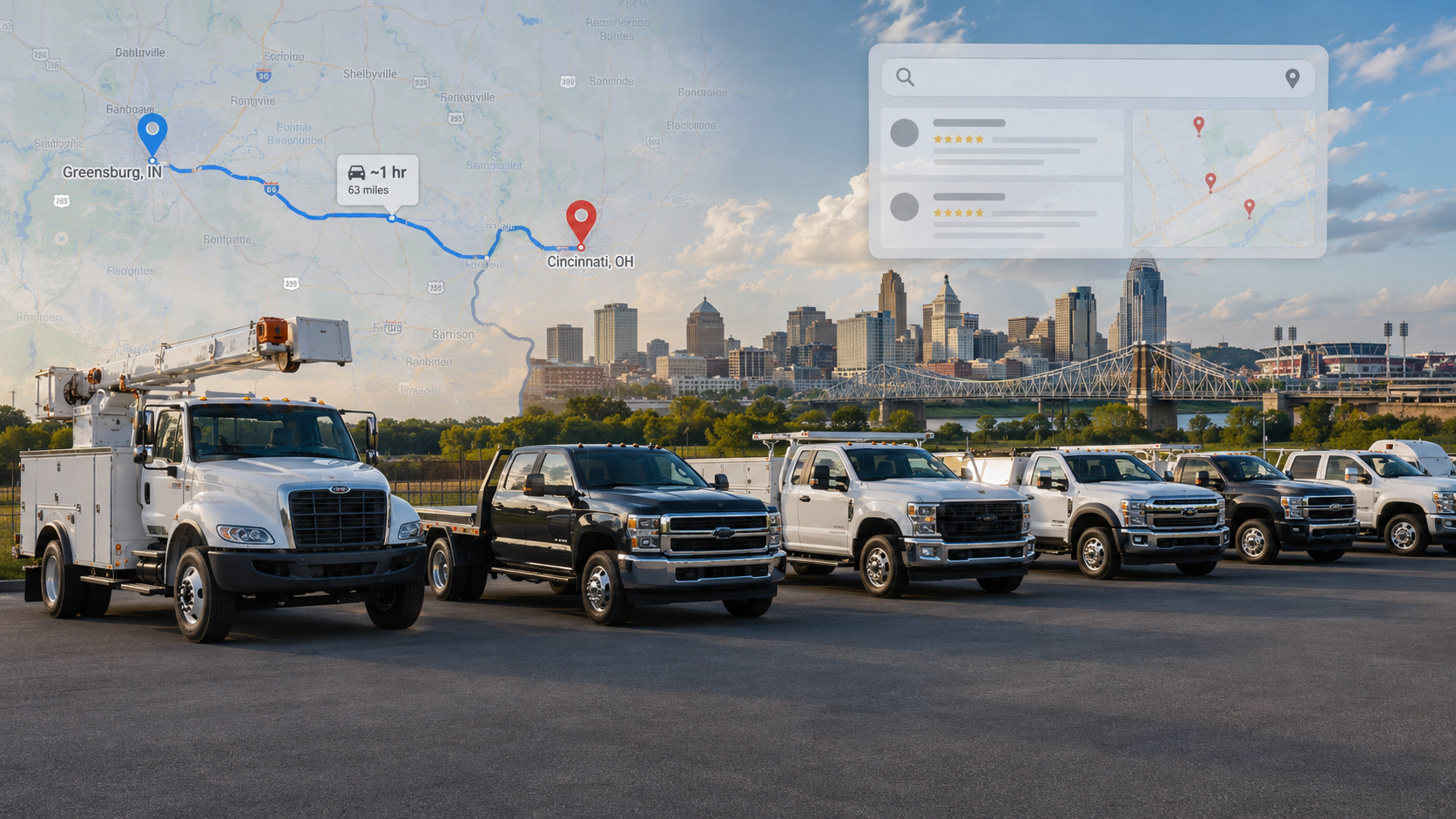
True Blue Autos sells commercial trucks from Greensburg, Indiana — about an hour from downtown Cincinnati, well inside the distance a work-truck buyer will happily drive. The buyers think regionally. The machines don't: to Google and ChatGPT, a Greensburg address means "Indiana," and Cincinnati searches belong to Cincinnati addresses. Here's the playbook for closing that gap — the one we're actually running, with the audits published and the numbers reported monthly, dips included.
Here's a geography problem worth real money, and it belongs to thousands of businesses, not just one.
True Blue Autos is a family-run dealership in Greensburg, Indiana: hand-picked Super Duty trucks and flatbeds, a no-commission sales team, shipping to job sites nationwide. Their natural market is the whole tri-state — a contractor in West Chester or a fleet manager in Florence is exactly the buyer who travels for the right unit, and an hour on I-74 is nothing next to the right one-owner dually at the right price.
But when that West Chester contractor searches "used flatbed trucks near Cincinnati," or asks ChatGPT where to buy a work truck in the area, the machines consult their labels — and every label says Greensburg, Indiana. The address is sixty miles from the customer's mental map of "near me," and to a ranking algorithm or a language model, sixty miles of label distance can outweigh every mile of actual willingness to drive.
We know precisely how wide this gap is because we measured it before touching anything. That's the whole method: audit in public, work in public, report in public. So this post is the playbook itself — how a dealership (or any business) whose real service area is bigger than its address shows up in the metro next door — written from the engagement we're running right now, with every baseline document linked.
The starting line, published
Two audits set the baseline, both public because everything is.
The AI visibility test. We asked ChatGPT, Gemini, and Claude where to buy a truck — thirty times, prompt by prompt. The result was the cleanest possible statement of the problem: True Blue won its hometown and vanished everywhere else. Strong where the labels already pointed; invisible one ring out — including the ring containing two million tri-state buyers.
The backlink audit. The authority baseline showed the second half of the problem: the citations and links that make Google and AI engines treat a business as prominent — the trust layer Google's own local framework names outright — were thin, and what existed was anchored to Indiana. Machines had no corroboration for a Cincinnati relationship because, in text, none existed yet.
Diagnosis in one line: the buyers already considered True Blue part of the Cincinnati market; the web didn't. And machines read the web, not the buyers.
Why you can't shortcut this (and shouldn't try)
Before the playbook, the tempting wrong answers, because dealers get pitched all three:
You can't fake an address. Virtual offices, a borrowed Cincinnati mailing address, keyword-stuffing "Cincinnati" into your business name — all of it violates Google's guidelines, gets listings suspended, and torches the trust every other signal depends on. The same rule we gave Northern Kentucky businesses applies in mirror: keep the real address, and make the relationship explicit and true.
You can't just buy your way across the line. Paid ads absolutely can target Cincinnati from Greensburg — and should, surgically, at the region's below-benchmark click costs. But rented visibility resets every month, and it does nothing for the AI-assistant answers where no ad inventory exists. The organic relationship has to be built either way.
You can't wait for the machines to learn geography. Models improve unevenly, and "eventually ChatGPT will figure out my service area" is a hope, not a plan. The businesses writing the relationship down now are collecting the cross-market customers while competitors wait.
What's left is the honest version: teach the machines what the buyers already know, in the places machines read. Six moves.
The playbook
Move 1: State the relationship everywhere descriptions live
The foundational fix is almost embarrassingly simple: say it, truthfully, in machine-readable places. "Serving greater Cincinnati, Northern Kentucky, and southeast Indiana from Greensburg" — in the site copy, the Google Business Profile description, the About page, the schema markup's service-area fields, every directory bio. Machines can't infer a metro relationship from a map; they can only read one that's written. Most out-of-market businesses have never written it anywhere, and then wonder why no engine knows.
Move 2: Let the inventory outrank the address
Here's the strategic heart of it for a dealership specifically: spec beats geography. The working buyer searches "2021 F-350 dually flatbed diesel for sale," and for searches that specific, the competitive pool is thin enough that a well-built listing page from Greensburg can absolutely surface for a searcher in Mason — if the page actually says, in crawlable text, everything the search says. Full configuration, real photos, honest condition notes, the details a spec-driven buyer filters on. The address only decides ties; inventory description decides whether you're in the fight at all. This is the out-of-market dealer's single biggest lever, and it costs organization, not money.
Move 3: Publish content the metro actually needs
Rankings and AI citations both need something substantive to point at, and generic "we serve Cincinnati!" pages aren't it. What works is the material we've documented as the formats AI search actually cites: real answers to real tri-state buyer questions — what work trucks actually cost, what to inspect before buying used, how job-site delivery works, gas versus diesel for a Cincinnati contractor's duty cycle. Every genuinely useful piece is a page that can rank for a metro query, a source an AI can quote, and a reason for the next move's links to exist. One honest warning that applies to any small settled site starting this: expect the normal early turbulence before the climb.
Move 4: Earn the Cincinnati-side corroboration
The backlink audit's finding gets fixed here: mentions, citations, and links from sources labeled with the target market — tri-state directories, Ohio-and-Kentucky-side publications, regional business organizations, industry roundups that cover the metro. Large-scale studies show AI recommendations lean hard on third-party corroboration — review platforms, community discussion, press — and every Cincinnati-labeled source that vouches for an Indiana dealer is a brick in the bridge the machines will eventually walk across. This is digital PR with a geographic thesis, and it's the slowest, most durable move on the list.
Move 5: Let customers write the geography for you
Reviews are corroboration machines can't dismiss — and buyers write geography into them naturally when asked well. "Drove down from Fairfield, worth every mile." "They shipped our flatbed to a job site in Florence." Each one is a first-person, third-party statement that the Cincinnati relationship is real, sitting on exactly the platforms recommendation engines weight heaviest. The system is the same earn-answer-showcase engine from the local SEO playbook; the only addition is inviting customers to mention where they came from.
Move 6: Retest, publicly, on a schedule
The 30-prompt AI test wasn't a one-time stunt — it's the measurement instrument. Rerun quarterly with geographic variation (Cincinnati, the northern suburbs, Northern Kentucky, "near me" framings), logged the same way, and the playbook stops being faith and starts being a tracked metric: which rings has the visibility expanded to, which engines moved first, what's still dark. That, plus the monthly benchmark reports where the client's real Search Console numbers run next to ours, is the accountability layer — the difference between a strategy and a story.
Honest expectations, because that's the brand
Timeline: the entity and service-area fixes (Moves 1–2) can register in weeks, since engines read the live web. The corroboration and content layers (Moves 3–5) ride the standard quarters-long search curve. And expansion is ring-shaped, not binary — the realistic arc is the eastern Indiana ring first, then the western Ohio suburbs, then deeper into the metro, each ring earned by the content and citations that name it. We're not going to claim victories here that the published reports don't show; the reports come out monthly, and the dips get printed with the wins. Watch it happen or catch us being wrong — either way, that's the deal.
This isn't really a dealership story
Strip the trucks out and the playbook is universal: it belongs to every business whose real service area is bigger than its address. The HVAC company in Lawrenceburg that works Cincinnati's west side. The Batesville manufacturer selling into three states. The Covington firm invisible in "Cincinnati" answers over 900 feet of river. The machines slicing markets by label are everyone's problem, and the fix is the same six moves: state the relationship, let your offering outrank your address, publish what the target market needs, earn its corroboration, let customers write the geography, and measure with real prompts instead of assumptions.
Frequently asked questions
Can a business rank in Google for a city it's not located in?
Yes — organic results, spec-specific searches, and AI answers are all winnable across market lines; the map pack is the hardest surface because distance is one of Google's three explicit local factors. The levers: truthful service-area declarations, content built for the target market, corroborating citations from that market's sources, and reviews that name it. What's not winnable: faking an address, which violates Google's guidelines and risks the whole listing.
How far will Cincinnati buyers actually travel to a dealership?
For commodity vehicles, not far. For specific configurations — work trucks, commercial units, one-owner specialty inventory — buyers routinely cross the whole tri-state, and shipping extends the radius to the country. The constraint is never the buyer's willingness; it's whether the channels ever show them the inventory exists.
Should an out-of-market business put the target city in its business name?
No. Name and address misrepresentation violates Google's Business Profile guidelines and gets listings suspended. The legitimate version: keep the real name and address, and make the service relationship explicit everywhere descriptions live — site copy, GBP description, schema service areas, directory bios — plus the content and citations that corroborate it.
How do AI assistants decide which dealers to recommend for "near Cincinnati"?
By cross-referencing text: reviews, community discussion and review platforms, press, directories, and business sites — resolved against the geographic labels in all of it. That's why an Indiana dealer can be dominant at home and absent one ring out: the corroboration existed only where the labels pointed. The fix is building Cincinnati-labeled corroboration, then testing with real prompts.
How long does it take to show up in a neighboring metro's searches?
Foundation fixes register in weeks; the compounding layers — content, citations, reviews — follow the standard 3–12 month curve, and visibility expands ring by ring rather than all at once. Anyone promising a neighboring metro in 30 days is running the guaranteed-rankings scam with a geography twist.
Where can I see whether this playbook is actually working?
In the reports — that's the point of running it in public. True Blue's real Search Console data publishes monthly next to our own, dips included, the baseline audits are linked above, and the AI test reruns on a schedule. Judge the playbook by the printed numbers, not this post.
The bottom line
An Indiana dealership shows up in Cincinnati searches the same way any business shows up anywhere its address isn't: by teaching the machines what the buyers already know. State the relationship truthfully everywhere machines read. Build inventory and content specific enough to outrank the geography. Earn the target market's corroboration — its citations, its press, its customers' reviews naming the drive. Then measure with real prompts, publish the results, and let the rings expand on the timeline search actually runs on.
That's the engagement we're running, in public, right now. And if your business's real market is bigger than its address — whatever you sell, whichever line you're stuck behind — the free visibility check will show you exactly where the machines currently end your market, and what we'd do to move the border.
Get your free visibility check →
Sources
Ritner Digital: We asked ChatGPT, Gemini & Claude where to buy a truck — 30 times (the baseline AI test)
Ritner Digital: True Blue Autos backlink profile audit (the authority baseline)
Ritner Digital: Monthly benchmark reports — client numbers published next to our own
Google Business Profile Help: Local ranking factors — relevance, distance, prominence
Search Engine Land: AI search engines cite Reddit, YouTube, and LinkedIn most — 30M-source study
True Blue Autos: trueblueautos.com