The Used Truck Market in the Cincinnati Tri-State: Where Buyers Actually Search in 2026
A contractor in West Chester needs a Super Duty before the next job starts. A farm in Dearborn County needs a flatbed that hasn't been abused. A fleet manager in Florence needs three matching 3/4-tons by Q4. None of them are driving dealer row to find one. Here's where used truck buyers in the tri-state actually look — the data on every channel, the geography twist that makes truck shopping different from car shopping, and what it means whether you're selling trucks or buying one.
There's a specific moment when a work truck gets bought in the Cincinnati tri-state, and it almost never happens on a lot.
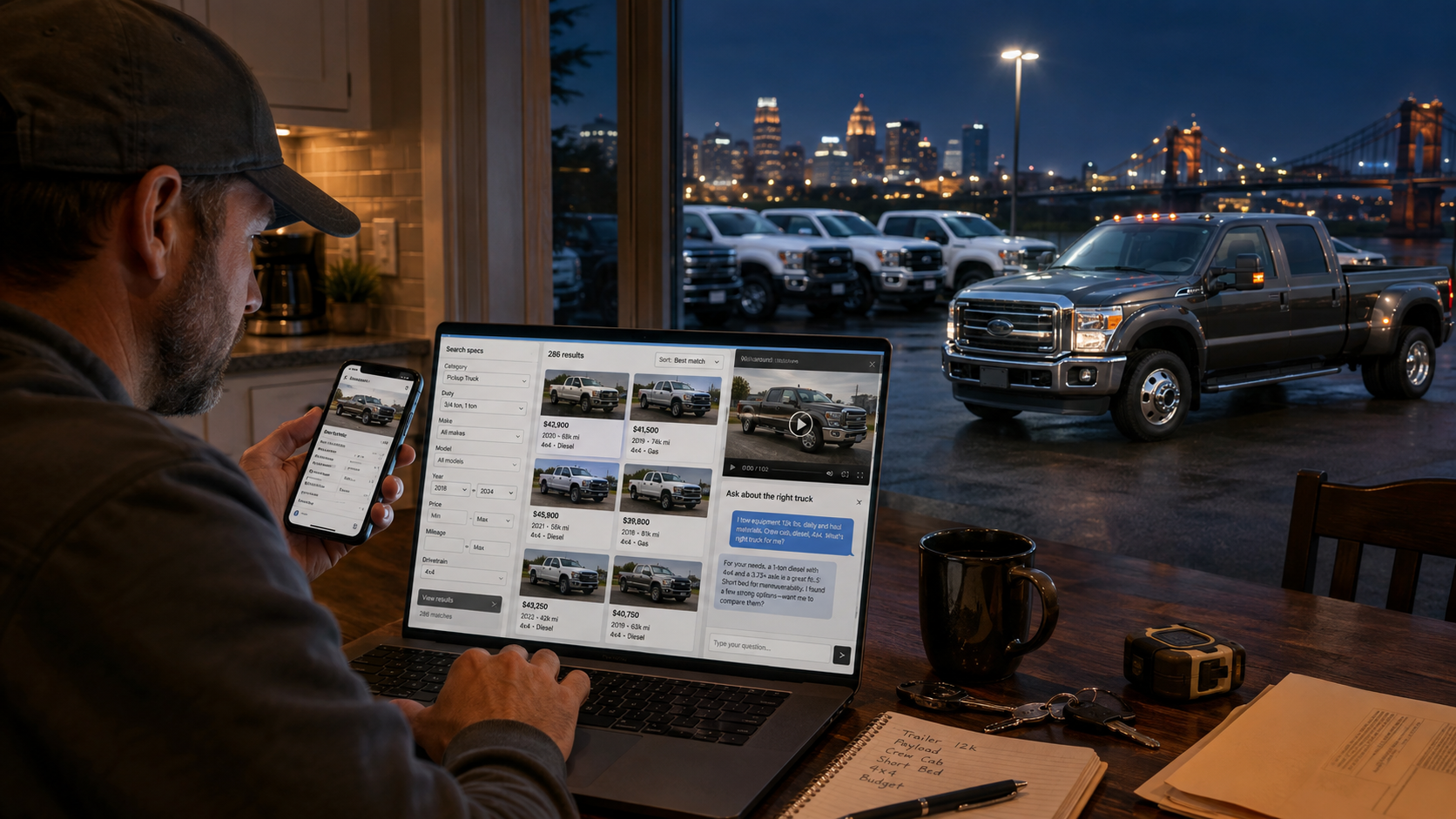
It happens at 9 PM at a kitchen table in Loveland, when a contractor whose F-250 just dropped a transmission is scrolling listings with a coffee. It happens in a site trailer in Hebron between pours. It happens when a landscaper in Independence types "used F-350 flatbed near me" into a phone with dirt still on it. By the time any of these buyers physically stands on a lot — if they ever do — the decision is mostly made.
That's not a hunch; it's the most documented fact in automotive retail. Around 95% of vehicle buyers use online resources to research, a buyer is twice as likely to start the search online as at a dealership, and the average shopper puts in roughly 14 hours of research across more than 900 digital touchpoints over a journey spanning weeks. The showroom didn't disappear. It just moved into the phone — and for trucks specifically, it reorganized around a few channels that behave very differently from each other.
We watch this market closely because we run search for a dealership in it — True Blue Autos, a family-run commercial truck dealer in Greensburg, Indiana, about an hour from Cincinnati, whose real numbers we publish monthly. So consider the bias disclosed, and consider the data real: this is where tri-state truck buyers actually are, channel by channel.
First: the tri-state has two different truck buyers
Before the channel map makes sense, you have to split the market, because "used truck buyer" describes two people who shop nothing alike.
The personal buyer — the half-ton for commuting, towing the camper to Brookville Lake, general life. This buyer shops much like a car buyer: browsing broadly, comparing trims, undecided for weeks. Fully 60% of vehicle shoppers start their search undecided on make and model.
The working buyer — the contractor, hauler, farm, or fleet. This buyer is nothing like that. They shop by spec, not vibe: diesel or gas, single or dual rear wheel, flatbed or service body, payload, gooseneck-ready, one-owner if possible. Their search strings are sentences — "2021 F-350 dually flatbed diesel" — and their timeline is brutal, because the truck is a tool and the job it's needed for has a start date. They'll decide in days, and they'll travel for the right unit.
Both buyers use the same channels. They just use them in a different order, at different speeds — and the working buyer is the one the tri-state's dealers most misunderstand, because almost everything written about "car shoppers" describes the first buyer.
The channel map: where the searching actually happens
1. Google — where the spec search lives
The working buyer's journey usually starts as a search box, and the searches are gloriously specific: model plus configuration plus "for sale" plus geography. This is where organized inventory wins — dealer sites whose listing pages actually say flatbed, DRW, gooseneck hitch, deleted/not deleted, in text a search engine can read, get found for the exact-spec searches; sites with three photos and "CALL FOR DETAILS" don't exist. Local intent stacks on top: the map pack, reviews, and Google Business Profile signals that decide "near me" results work the same for trucks as for plumbers, and 88% of buyers use the internet just to find dealer locations and hours. Note the device reality while you're at it: 58% of shoppers start on mobile — the site trailer and the kitchen table, not the desktop.
2. Marketplaces and third-party sites — where the browsing lives
The aggregators are unavoidable and the data says so: between 72% and 81% of buyers use third-party sites during their search, and 41% find the vehicle they ultimately purchase on one. For tri-state trucks the roster has its own shape: Facebook Marketplace punches far above its weight in the truck world (and social media generally now influences 44% of buyers, with Facebook leading); CarGurus, Autotrader, and Cars.com carry the personal buyer; and the working buyer adds the commercial-specific layer — Commercial Truck Trader and its cousins — that car-market analysis never mentions. The strategic point for dealers: these platforms are rented ground. Essential for discovery, but the buyer who finds you there should be one click from ground you own.
3. Video — where trust gets built before the visit
79% of buyers use online video in their research, and 64% say video can change their mind — and nowhere does this matter more than used trucks, where every buyer's real question is what's this specific unit actually like? A plain-spoken walkaround — cold start, underside, bed floor, the rust or the lack of it — does what forty photos can't: it proves nobody's hiding anything. For a no-commission, straight-answers operation, video isn't content marketing. It's the sales pitch, delivered at 9 PM to a contractor you've never met.
4. Reviews and word of mouth — where the shortlist gets cut
Trucks are a burned-before market. Everyone knows someone who bought a pretty truck with an ugly history, so the trust layer — Google reviews, the reputation that travels through trade networks, the neighbor's recommendation — decides who makes the shortlist. This is prominence in Google's own ranking framework, it's the strongest input to the next channel on this list, and it's earned the slow way: by being the dealer people don't warn each other about.
5. AI search — the channel almost nobody's watching
And here's the frontier. Buyers have started asking ChatGPT, Gemini, and Perplexity the question directly — "where should I buy a used work truck near Cincinnati?" — and taking the answer. AI-powered research tools are now an acknowledged part of the vehicle shopping journey, and the answers are already picking winners with no dashboard anywhere recording it. We know because we tested it for this exact market: thirty prompts across three AI engines asking where to buy a truck. The client won its hometown and vanished everywhere else — the most common shape of AI visibility in local markets, and the reason entity signals and citation-worthy content now belong in a dealership's channel plan next to Autotrader.
The geography twist: truck buyers travel, and the tri-state is built for it
Here's what makes the used truck market genuinely different from the used car market, and it's the fact the whole tri-state region quietly runs on: the right truck beats the near truck.
A commuter sedan is a commodity; nobody drives two hours for one. A one-owner F-350 dually flatbed with the right miles is not a commodity — supply of any specific configuration is thin at any moment, and the working buyer knows it. So truck buyers search wide radii on purpose, and the tri-state's geography cooperates: Cincinnati, Northern Kentucky, and southeast Indiana form one road-connected market where an hour's drive is a normal Tuesday. A Greensburg dealer an hour west of the city and a Florence buyer south of the river are, functionally, neighbors — True Blue ships trucks to job sites nationwide precisely because for commercial buyers, the radius has effectively become the country.
But — and this is the catch the whole market hangs on — the buyer's willingness to travel only matters if the channels show them the inventory. Search engines and AI assistants slice this road-connected market along labels: city names, state lines, "Cincinnati" versus "Indiana" versus "Northern Kentucky." A dealer whose digital footprint only says Greensburg is invisible to the West Chester contractor who'd happily make the drive; a Covington lot can vanish from "Cincinnati" answers over 900 feet of river. Machines don't know the tri-state is one market unless somebody writes it down where they read — service-area signals, cross-border content, citations on all three sides of the lines. The buyers already think regionally. The channels have to be taught to.
What this means for tri-state truck dealers
Put the channel data and the geography together and the playbook writes itself. Inventory pages built for the spec search — full configuration in crawlable text, real photos, honest condition notes — because that's the working buyer's front door. A Google Business Profile and review engine run like a channel, not a set-and-forget listing. Marketplace presence that funnels to owned ground. Walkaround video as standard practice, not special occasion. Content that answers what buyers actually ask — costs, comparisons, what to check before buying — which is the material AI engines demonstrably cite. Explicit tri-state geography everywhere machines read. And speed on the follow-up, because dealers responding within five minutes are 21x more likely to connect, and the working buyer with a job starting Monday is gone by the second ring of silence. What it costs to run all this — channel by channel, with real numbers — is a breakdown we've published separately, and it's the piece of ours other firms cite most.
What this means if you're the one buying the truck
Flip everything above and it's a buyer's manual. Search by full spec, not just model — the sentence-length search surfaces the dealers organized enough to describe their inventory, which correlates suspiciously well with dealers organized enough to recondition it. Widen the radius deliberately; the tri-state is one market and the right unit is worth the drive. Ask the AI assistants and Google — different channels surface different dealers, and the gaps are informative. Weight video and reviews heavily; a dealer who films the underside is telling you something, and so is one who doesn't. And read how a dealer answers — the no-commission, straight-answer operations reveal themselves in the first reply.
Frequently asked questions
Where do most used truck buyers search first?
Online, overwhelmingly — 95% of buyers research digitally and buyers are twice as likely to start online as at a dealership. Personal buyers typically start broad on marketplaces and third-party sites (72–81% use them); working buyers more often start with a spec-specific Google search and, increasingly, a question to an AI assistant.
How far will tri-state buyers travel for a used truck?
Much farther than car buyers — because specific configurations are scarce, the right truck beats the near truck. Within the Cincinnati–Northern Kentucky–southeast Indiana triangle, an hour's drive is routine, and commercial buyers increasingly treat the whole country as the radius when dealers ship to the job site. The practical limit isn't distance; it's whether the channels ever show the buyer that the inventory exists.
Is Facebook Marketplace really a serious channel for trucks?
Yes — disproportionately so versus cars. Social media now influences 44% of vehicle buyers, with Facebook leading at 38%, and the truck world's private-party culture made Marketplace a default browsing surface for work trucks specifically. For dealers the caveat stands: it's rented discovery. Convert the Marketplace looker into a visitor to inventory pages you own.
Do people actually ask ChatGPT where to buy a truck?
They do, and the answers are already routing buyers. AI research tools are a documented part of the 2026 vehicle-shopping journey — and when we tested it for this exact market with 30 prompts, the engines confidently named dealers, with a strong hometown bias and blind spots one town over. Whether they name you is testable — and worth testing before your competitors do.
What should a dealership fix first to capture these buyers?
The highest-leverage sequence: inventory pages that describe trucks the way buyers search for them (full spec, in text); a complete, actively managed Google Business Profile with a real review flow; then video and citable content. Everything else — marketplaces, AI visibility, paid — amplifies a foundation or papers over its absence. The channel-by-channel cost breakdown shows what each layer runs.
Why is a Philadelphia SEO firm writing about Cincinnati truck buyers?
Because we work in this market: True Blue Autos, our spotlight client, sells commercial trucks an hour from Cincinnati, and their search data — dips included — gets published monthly next to our own. Bias disclosed, receipts public; that's the whole way we operate.
The bottom line
The tri-state's used truck market runs on a handful of channels with very different jobs: Google for the spec search, marketplaces for the browse, video for the trust, reviews for the shortlist, and — newly, quietly — AI assistants for the recommendation itself. Layered over all of it is the geography truth the region already lives by: buyers think regionally and travel readily, but the machines slicing the market by city and state labels will hide a willing dealer from a willing buyer across a line neither of them cares about.
The dealers winning the next five years of this market are the ones treating that as the job: inventory machines can read, trust buyers can verify, geography written down everywhere the engines look, and AI answers tested instead of assumed.
If you sell trucks — or anything else — in the tri-state and want to know exactly where buyers can and can't find you right now, that's the free visibility check: your Google presence, your map-pack standing, and what ChatGPT, Gemini, and Claude say when buyers ask about your market. Plain English, real prompts, no pressure.
Get your free visibility check →
Sources
Demand Local: Purchase intent signal statistics — third-party site usage, social influence, 5-minute response data
WifiTalents: Car buying statistics — 41% find their vehicle on third-party sites; mobile and video usage
Urban Science / Harris Poll: U.S. auto buying becomes more digital and fragmented in 2026
Google Business Profile Help: Local ranking factors — relevance, distance, prominence
Ritner Digital: We asked ChatGPT, Gemini & Claude where to buy a truck — 30 times