Dealership Advertising Costs in Ohio, Kentucky, and Indiana: What Tri-State Dealers Actually Pay in 2026
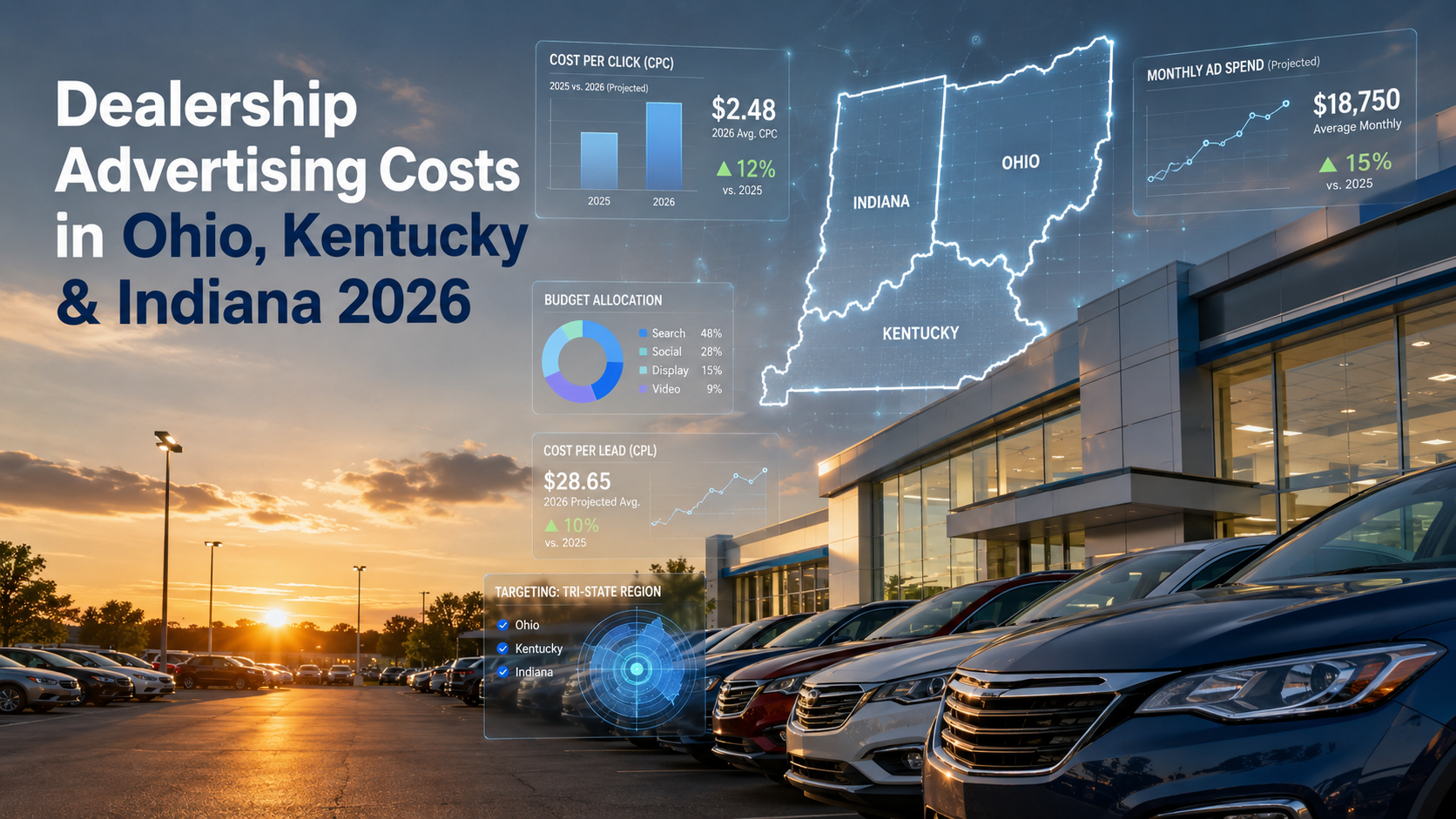
The national benchmarks say the average dealership now spends $586K a year on advertising — $739 for every vehicle it sells. But national averages blend Los Angeles with rural Kansas, and the Ohio–Kentucky–Indiana market has its own math: cheaper clicks than the coasts, media markets that leak across three state lines, and a metro-versus-rural split that changes what every channel costs. Here's the regional version of the numbers — and where the money should actually go.
Every dealer principal in the tri-state has the same conversation each budget season, usually with a rep on the other side of the desk: what should we actually be spending, and on what?
The reps all have answers, and the answers all involve buying more of whatever the rep sells. So let's do this differently — the way we did in our national channel-by-channel breakdown of dealership advertising costs, the piece of ours that other firms in this industry cite most: benchmarks first, from named sources, then the regional adjustments that make the numbers true for a dealer in Cincinnati, Columbus, Louisville, Lexington, Indianapolis, or the small-town markets between them.
Standard disclosure: we run search for a dealership in this region — True Blue Autos in Greensburg, Indiana, whose numbers we publish monthly — and we sell one of the line items discussed below. Bias on the table; sources on everything.
The national baseline: what NADA says dealers spend
Start with the industry's own scorecard. Per NADA's 2025 data, the average franchised dealership spent $586,246 on advertising for the year — about $739 per vehicle sold, with digital claiming 74.9% of every ad dollar. Industry-wide, dealer ad spending hit a record $9.96 billion.
Where the average budget actually goes, per the same NADA data:
Search engine marketing: 21.1% — the biggest single line, roughly $124K at the average store
Third-party listing sites: 20.0% — Autotrader, CarGurus, Cars.com and kin, ~$117K
SEO: 19.5% — ~$114K, and the fastest-rising major line
Social media advertising: 14.2% — up from 12.7% a year earlier
Television: 10.5% and radio: 6.9% — both shedding share every year; the average radio budget has fallen by more than half since 2015, from $83,725 to $40,451
Direct mail (5.6%) and newspaper (2.1%) — the long tail of the old world
Two more anchors before we regionalize. The per-vehicle cost has climbed steadily — $633 in 2015 to $739 now, a 16% rise — meaning acquisition keeps getting more expensive per unit. And NADA's own guidance says the optimal number is far lower than the actual one: roughly 6–7% of gross profit, with an ideal target near $250 per vehicle sold. The average dealer spends nearly triple the recommended per-unit figure. Hold that gap in mind — the whole regional strategy question is really about closing it.
What's different about Ohio, Kentucky, and Indiana
National averages are made of places that aren't here. Three structural facts change the math for tri-state dealers.
1. Your clicks cost less than the benchmarks assume
Automotive is already one of the cheaper high-intent verticals — average auto CPCs run around $3.13, about 36% below the all-industry average, with auto sales campaigns typically landing between $1.81 and $3.25 per click and cost per lead around $29–$52. Layer on geography: location is one of the biggest CPC multipliers, with major coastal metros running 30–60% above smaller and rural markets. Cincinnati, Columbus, Indianapolis, Louisville, Lexington, and Dayton are solidly mid-cost media markets — competitive, but nothing like the auction pressure of LA or Miami — and the rural stretches between them are cheaper still. Practical translation: a tri-state dealer's paid-search dollar buys meaningfully more clicks than the national benchmark implies, which cuts both ways — your budget goes further, and so does your competitor's.
2. The DMA problem: broadcast here pays for three states
Here's the regional quirk with real money attached. The Cincinnati media market — like Louisville's and Evansville's — spills across state lines by design: a TV or radio buy in the Cincinnati DMA reaches Ohio, Northern Kentucky, andsoutheast Indiana, whether or not your store realistically draws from all three. For a metro mega-dealer, fine. For everyone else, broadcast in a tri-state DMA means paying to reach counties that will never cross the river to you — one more reason the industry-wide migration out of TV and radio bites harder here than the national percentages suggest. Digital's counter-advantage is surgical in this region: county-level and radius targeting lets a dealer buy exactly the Ohio-Kentucky-Indiana triangle it actually sells into, and nothing else.
The organic mirror of this problem is one we've written about repeatedly: search engines and AI assistants slice this road-connected market along city and state labels, hiding willing dealers from willing buyers across lines nobody local cares about. Paid geo-targeting solves it with money every month; entity and service-area work solves it with work that stays solved.
3. Metro pressure, rural discount — and the buyer who travels
Within the region, costs split sharply. In the metros, franchise stores and the national aggregators bid on the same high-intent keywords, and auction pressure concentrates on generic terms like "used trucks for sale near me." Out in the small-town markets — Greensburg, Batesville, Georgetown, Maysville — clicks are cheaper and broadcast is cheaper, but the local search volume is thinner. The equalizer, at least for trucks and commercial inventory, is the fact the whole regional market runs on: buyers travel for the right unit. A rural dealer with specific inventory and a digital footprint that reaches the metros gets metro demand at rural cost — the single best arbitrage available in this region, and the one most rural dealers never build.
Budget math for three tri-state dealer profiles
Benchmarks only matter applied, so here's the per-vehicle arithmetic for the three dealer shapes this region actually contains.
The metro franchise store (Cincinnati, Columbus, Indy metro): you live nearest the national averages — call it $700+ per vehicle at current course, with SEM and third-party fees doing the heavy lifting and the aggregators taxing every lead. Your leverage point is mix, not volume: every lead your owned presence generates is a lead the aggregators didn't bill you for.
The independent used lot: no factory co-op, no national brand air cover — every dollar is yours. The national per-vehicle figure would bankrupt most independents, which is fine, because NADA's ~$250-per-vehicle optimal is the honest target here: a lean paid-search core on specific inventory terms, marketplace presence, and an organic foundation doing the rest.
The specialist (commercial trucks, niche inventory, rural address): the arbitrage profile. Your buyers search by spec across a wide radius, your local media costs are the region's lowest, and your entire challenge is visibility in the metros you don't sit in — which is a content, entity, and reputation problem far more than a media-buying one. This is True Blue's exact shape, and it's why their program is weighted the way it is.
The line that changes the trajectory
Look back at the per-vehicle trend — $633 to $739 in a decade — and at what it's made of: mostly channels you rent. SEM stops producing the day the spend stops; the aggregators charge again next month for the same shelf; broadcast evaporates on airing. The one major line in NADA's breakdown that behaves differently is the one growing fastest: SEO at 19.5% of the average budget and climbing — roughly $114,000 a year at the average store — because dealers have noticed that owned visibility compounds while rented visibility just recurs.
We'd point out, with our bias fully disclosed, two things about that $114K line. First: for a small or independent tri-state dealer, the whole job — SEO, content, digital PR, AI visibility, reporting — can be had for a flat $12K a year, which is not a typo next to the average line item. Second, and more important than who you hire: whatever you spend there, demand the same accountability as your paid channels — countable deliverables, leading indicators, leads on the report— because the organic line attracts more waste than any other precisely because it's hardest for a dealer to inspect. And budget its timeline honestly: paid produces this month; organic produces on a quarters-long curve and then keeps producing after the invoices stop.
Where we'd put a tri-state dealer's next dollar
Priority order, channel-agnostic, argued from the data above: first, the free foundation — Google Business Profile, reviews, and inventory pages that describe vehicles the way buyers actually search for them, because every paid click lands better on it. Second, surgical paid search on inventory-specific and geography-specific terms, exploiting the region's below-benchmark CPCs while skipping the generic-term auction the aggregators dominate. Third, the owned-authority build — content, citations, entity signals across all three states — that closes the DMA gap permanently instead of monthly. Fourth, third-party sites as measured supplements, judged per-lead like anything else. Last, broadcast, only if your draw genuinely matches the DMA. And threaded through all of it: response speed, because dealers answering within five minutes are 21x more likely to connect, and no channel's cost-per-lead survives a slow phone.
Frequently asked questions
How much does the average dealership spend on advertising?
Per NADA's 2025 data: about $586,246 a year, or $739 per vehicle sold, with 74.9% going to digital channels. Note the gap between actual and optimal: NADA's own guidance targets roughly 6–7% of gross profit, or about $250 per vehicle— the average store spends nearly triple that per unit.
Are advertising costs lower in Ohio, Kentucky, and Indiana than nationally?
Generally yes. Automotive CPCs already run well below the all-industry average, and location pricing favors this region — major coastal metros run 30–60% above smaller markets, while Cincinnati, Columbus, Indy, Louisville, and Lexington sit in the mid-cost band with cheaper rural markets between them. Your dollar buys more here; budget strategy, not budget size, is usually the tri-state dealer's real problem.
What channels should a tri-state dealership prioritize?
The average budget's big four — SEM (21.1%), third-party sites (20.0%), SEO (19.5%), and social (14.2%) — are directionally right, but sequence matters: owned foundation first, surgical paid second, compounding organic third, aggregators as measured supplements. The full channel-by-channel economics are in our national breakdown.
Is TV or radio still worth it for tri-state dealers?
Only with eyes open. Both channels lose budget share every year industry-wide, and the tri-state adds a structural tax: DMAs here span three states, so broadcast buys reach counties many dealers will never sell into. Metro mega-stores with genuine tri-state draw can still justify it; everyone else usually gets more from county-level digital targeting of their actual market.
How much should a dealership budget for SEO specifically?
The average store now puts about 19.5% of its ad budget — roughly $114K a year — into SEO. Small and independent dealers don't need that number: honest, comprehensive programs exist at a fraction of it. What matters more than the figure is accountability — countable monthly deliverables and lead-first reporting — and an honest multi-quarter timeline.
Why is per-vehicle advertising cost rising, and can a dealer escape it?
The industry per-vehicle figure climbed from $633 in 2015 to $739 now because most dealer spending rents visibility that resets to zero monthly — SEM, aggregator fees, broadcast. The escape is shifting mix toward owned assets that compound: inventory pages that rank, reviews that accumulate, content that AI engines cite. Dealers who build those watch their blended cost per sale fall even as the rented channels' prices keep rising.
The bottom line
The national numbers give tri-state dealers their bearings — $739 per vehicle at the average store, three-quarters digital, search and third-party sites eating the biggest shares — and the region rewrites them in your favor: cheaper clicks than the benchmarks assume, rural-cost media next to metro-scale demand, and a buyer base that already shops across all three states if your footprint lets them find you. The traps are regional too: DMA buys that bill you for three states, aggregators taxing every metro lead, and the same rising per-vehicle spiral everywhere — escapable only by shifting mix from rented visibility to owned.
If you want the version of this analysis with your store's numbers in it — what you're paying per lead by channel, where your owned presence stands, and what ChatGPT and Google actually say when tri-state buyers ask about your market — that's the free visibility check. Real data, plain English, and we'll tell you if your current mix is already right.
Get your free visibility check →
Sources
Dealers United (NADA 2025 data): Average dealership ad budget — $586,246/year, $739 per vehicle, 74.9% digital
Dealership Guy News (NADA 2025): Dealer ad spend nears $10 billion; channel share shifts
Inside Radio (NADA 2025): Channel-by-channel budget shares; decade trend from $633 to $739 per vehicle
Demand Local: NADA's 6–7% of gross / ~$250 per vehicle guidance; 5-minute response data
Web Tonic (LocaliQ data): Automotive Google Ads benchmarks — CPC, conversion rates, auction dynamics
PPC Chief: Auto-sales CPC and CPL ranges; location-based cost multipliers
Ritner Digital: Car dealership advertising costs — the complete national channel breakdown