Cybersecurity Contractors: How to Market Compliance Expertise Without Sounding Like Everyone Else
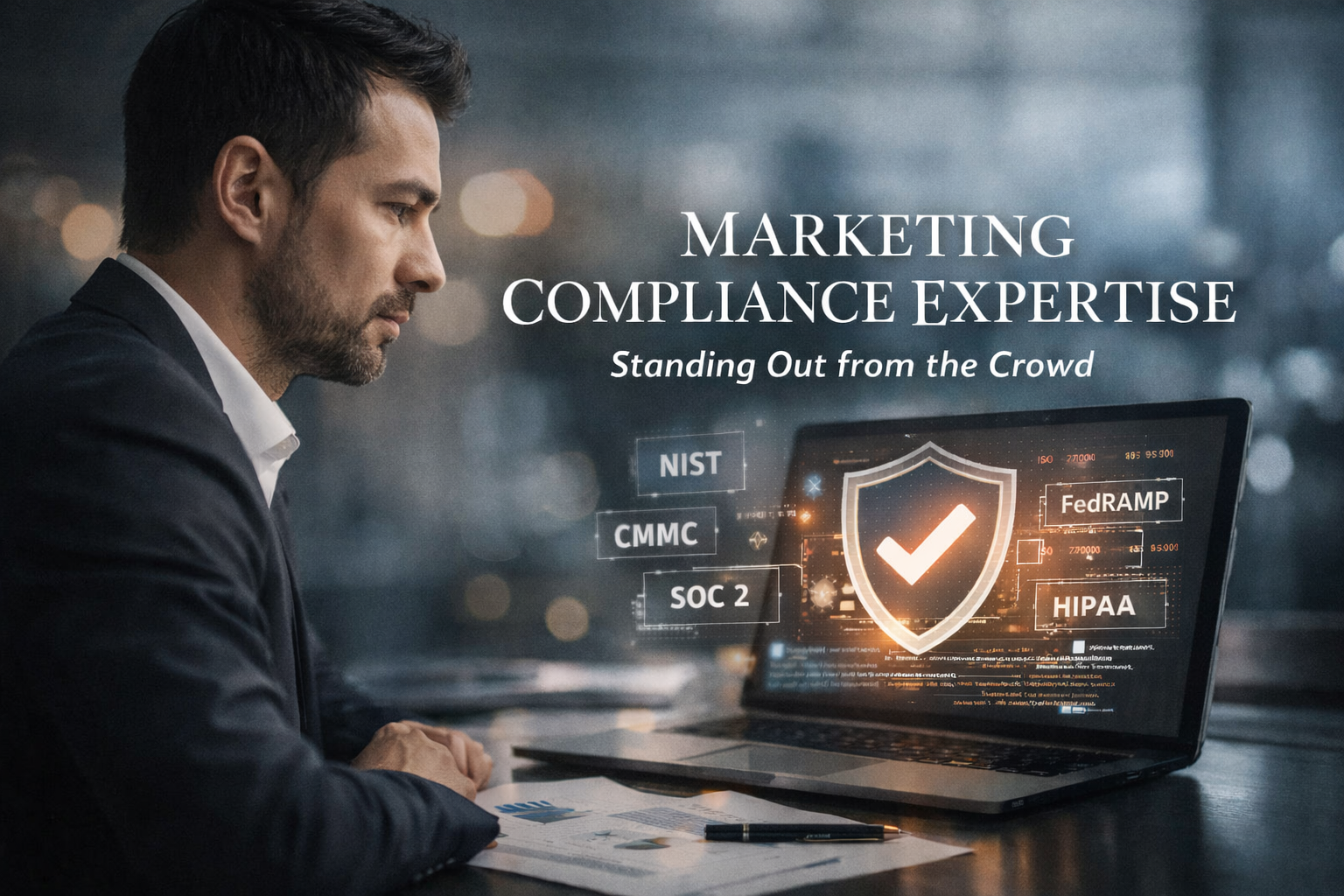
Open the website of any cybersecurity contractor in Northern Virginia and you'll see the same page. The same words. The same claims. The same alphabet soup of frameworks arranged in the same grid of certification logos.
"We help organizations achieve CMMC compliance." "Our team of experts delivers FedRAMP authorization support." "We implement Zero Trust architectures aligned with federal mandates." "Our comprehensive cybersecurity solutions protect your most critical assets."
Now open the next contractor's website. Same page. Same words. Different logo in the corner.
This is the paradox of cybersecurity compliance marketing: the capabilities that should differentiate your company — deep expertise in complex, high-stakes regulatory frameworks — have become commoditized in how they're communicated. Every contractor in Fairfax, Reston, Tysons, and Herndon claims CMMC. Every contractor claims FedRAMP. Every contractor claims Zero Trust. The words have been repeated so many times, by so many companies, in such similar language, that they've lost their ability to communicate anything meaningful to the buyer.
The result is a market where genuine experts are indistinguishable from credential-holders, where companies with decades of hands-on compliance experience look identical to companies that added "CMMC" to their website last quarter, and where the government program manager or the defense contractor CISO trying to choose a cybersecurity partner has almost no way to tell the difference from what's publicly visible.
That's not a market problem. That's a marketing problem. And it's solvable — not by claiming louder or listing more acronyms, but by communicating differently.
Why Everyone Sounds the Same
Before we talk about how to differentiate, it's worth understanding why the cybersecurity compliance space has converged on such homogeneous marketing. It's not because the companies are all the same. It's because several forces push their marketing toward sameness.
The Framework Names Become the Message
CMMC, FedRAMP, NIST 800-171, NIST 800-53, Zero Trust, RMF, FISMA, DFARS 252.204-7012 — these framework names and regulation citations function as keywords that contractors feel compelled to repeat as frequently as possible. The logic is understandable: the buyer is searching for "CMMC consultant" or "FedRAMP authorization support," so the website needs to contain those phrases prominently and repeatedly to rank in search and to match the buyer's vocabulary.
The problem is that when every competitor optimizes for the same keywords using the same language, the result is a wall of identical-sounding content. The framework name becomes the entire message rather than the context for a more specific, differentiated message. Saying "we do CMMC" is like a restaurant saying "we make food." It's technically accurate and communicatively empty.
Compliance Language Is Inherently Conservative
Cybersecurity compliance deals with regulation, liability, and risk. The language gravitates toward the formal, the cautious, and the comprehensive. Nobody wants to sound casual about something that could result in a breach, a failed audit, or a lost contract. So the marketing copy adopts the register of the compliance documentation itself — dense, thorough, and deeply boring.
This conservatism produces websites that read like RFP responses. Every service is described in the most complete, most careful, most qualification-laden language possible. The result is technically accurate and humanly unreadable. The program manager who's trying to figure out whether your company can help them get through a FedRAMP authorization reads three paragraphs of impenetrable compliance language and clicks away — not because you're not qualified, but because the experience of reading your website told them nothing they couldn't get from reading the NIST publication itself.
Nobody Wants to Be Specific
Specificity requires commitment. If you say "we specialize in FedRAMP authorization for SaaS providers serving the DoD," you've defined your market — and by implication, excluded everything else. Most cybersecurity contractors are afraid to do that. They want to appear capable of everything: CMMC at every level, FedRAMP at every impact level, Zero Trust for every architecture, compliance for every framework, risk management for every organization. The result is a capability list a mile wide and an inch deep, which communicates breadth at the expense of credibility.
The buyer who needs help with a specific, complex compliance challenge — and compliance challenges are always specific and usually complex — doesn't want a company that does everything. They want a company that has done the specific thing they need, understands the specific obstacles they'll face, and can speak to those specifics with authority. Generic breadth doesn't build that confidence. Specific depth does.
The Template Problem
Many cybersecurity contractors — particularly smaller ones — use website templates or marketing agencies that serve the defense and government contracting space. These templates and agencies produce competent, professional websites that all follow the same structural and linguistic patterns: hero section with cybersecurity imagery, services grid with framework logos, about section with team credentials, contact form. The websites look professional. They also look identical to each other. The template gives the company a polished appearance and strips it of any distinctive voice.
What the Buyer Actually Wants to Know
The path to differentiation starts with understanding what the buyer is actually trying to figure out when they're evaluating cybersecurity compliance contractors. It's not "do you know what CMMC is?" Every contractor on the first page of Google knows what CMMC is. The buyer's real questions are harder and more specific.
Have You Done This Before — Specifically What I Need?
The most important question any buyer asks is whether you've done the specific thing they need, in a context similar to theirs. Not "have you done CMMC work" — "have you helped a company like mine, in my industry, at my size, with my type of systems, get through the specific level of assessment I'm facing?"
A defense subcontractor with 200 employees and a mix of on-premise and cloud systems preparing for a CMMC Level 2 assessment has a different set of challenges than a defense manufacturer with 2,000 employees and an OT/IT convergence problem. The contractor who can speak to the first scenario specifically — who can describe the typical challenges, the timeline, the pain points, and how they've navigated them — is infinitely more credible than the contractor who says "we help organizations achieve CMMC compliance at all levels."
What's It Actually Going to Be Like Working With You?
Compliance projects are long, often painful, and deeply intertwined with the client's internal operations. The buyer isn't just buying expertise. They're entering a working relationship that will last months and will require close collaboration with their internal team. They want to know what that relationship looks like.
How do you structure the engagement? What does the first month look like? How do you handle the inevitable gaps and remediation requirements? How do you communicate progress? How do you deal with scope changes when the assessment reveals issues nobody anticipated? How do you manage the relationship with the assessor?
These process questions are rarely addressed on cybersecurity contractor websites, and they're among the most important factors in the buyer's decision. The buyer who's been through a bad compliance engagement — and many have — is specifically looking for signals that your company runs a structured, communicative, well-managed process. The absence of any description of how you work is itself a red flag for experienced buyers.
What Am I Going to Learn That I Don't Already Know?
The savviest compliance buyers aren't starting from zero. They've read the NIST publications. They've attended the webinars. They have internal security staff who understand the frameworks at a conceptual level. What they need from an external contractor isn't a tutorial on what CMMC is. It's the practical, hard-won knowledge that only comes from having done the work repeatedly — the things the publications don't tell you, the mistakes organizations commonly make, the interpretations of ambiguous requirements that assessors actually apply, the shortcuts that work and the ones that don't.
Content that provides this kind of practical insight — the stuff that only an experienced practitioner would know — is the most powerful differentiator available to a cybersecurity compliance contractor. It's also the rarest, because most contractors are too busy restating what the framework says to share what they've actually learned from implementing it.
How Much Is This Going to Cost and How Long Is It Going to Take?
Every buyer wants to know this. Almost no cybersecurity contractor addresses it publicly. The reluctance is understandable — costs and timelines vary enormously based on scope, complexity, and organizational readiness. But the complete absence of any pricing or timeline context on your website doesn't protect you from pricing conversations. It just pushes those conversations later in the sales cycle, after the buyer has already formed impressions based on the websites that did provide context.
A page that says "FedRAMP authorization timelines typically range from 12 to 18 months for a moderate-impact system, depending on the maturity of your existing security controls and the responsiveness of your 3PAO" tells the buyer something useful without committing to a fixed number. It also signals experience — only someone who's been through the process multiple times can describe typical timelines with that specificity.
How to Actually Differentiate
With the buyer's real questions in mind, here's how cybersecurity compliance contractors can break out of the sameness and communicate in ways that build genuine credibility.
Tell War Stories (Without Naming Names)
The most compelling content a cybersecurity compliance contractor can publish isn't a framework overview or a service description. It's a story about a real engagement — anonymized, of course — that describes a specific challenge, a specific approach, and a specific outcome.
"A defense subcontractor with 150 employees came to us six months before their CMMC Level 2 assessment deadline. Their SSP was incomplete, their CUI scoping was wrong, and their cloud service provider wasn't FedRAMP authorized. Here's how we prioritized the remediation, what we fixed first and why, what we decided wasn't worth fixing before the assessment, and how the assessment went."
That narrative does more to establish credibility than any amount of "we provide comprehensive CMMC consulting services." It demonstrates experience. It demonstrates judgment. It demonstrates the kind of practical, battle-tested knowledge that the buyer is actually paying for. And it does it in a format that's engaging enough to actually be read, which is more than can be said for most cybersecurity contractor content.
You can't name the client. You usually can't name the agency. But you can describe the scenario, the challenges, the approach, and the outcome in enough detail to be genuinely informative and credible. The anonymization doesn't reduce the value — the buyer doesn't need to know who the client was. They need to know that you've been through this before and that you know what you're doing.
Write these as blog posts, as case studies, as "lessons learned" articles. Publish them regularly. Over time, they form a library of practical experience narratives that collectively tell the story of your expertise in a way that no list of certifications or framework names can match.
Go Deep on One Thing Instead of Broad on Everything
The most effective positioning strategy for a cybersecurity compliance contractor is to be the definitive authority on one specific thing rather than a competent generalist across everything.
This doesn't mean you have to turn away work outside your specialization. It means your marketing — your website, your content, your positioning — leads with the area where your expertise is deepest and most distinctive. The rest of your capabilities are supporting elements, not the headline.
A company that positions itself as "the firm that guides defense manufacturers through CMMC Level 2, specifically organizations with OT environments and industrial control systems" is saying something specific enough to be memorable, credible, and findable. The buyer who has exactly that problem — and there are many of them — recognizes immediately that this company understands their world. The company that positions itself as "comprehensive cybersecurity compliance consulting" is saying nothing that helps any buyer feel specifically served.
The fear is that narrowing the positioning will cost you business. The reality is that clear positioning attracts more of the right business and repels less of it than broad positioning does. The buyer with an OT/CMMC challenge who finds the specialist isn't going to keep looking. The buyer with a different challenge who finds the specialist might still call, because they figure a company smart enough to specialize probably does good work across the board. Specialization signals competence in a way that generalism doesn't.
Publish the Practical Knowledge Nobody Else Will
Every cybersecurity compliance framework has a gap between what the documentation says and what actually happens when you try to implement it. That gap is where the most valuable content lives — and where almost no one is publishing.
What the NIST publication says about CUI scoping and what organizations actually get wrong about CUI scoping are two different articles. The first one has been written a thousand times. The second one has barely been written at all — and it's the one the buyer needs.
What the CMMC assessment guide says about the assessment process and what actually happens during an assessment — the questions assessors ask, the evidence they want to see, the things that trip organizations up, the areas where interpretation is ambiguous — that's the content that demonstrates real expertise. The contractor who publishes a post titled "Five Things That Surprised Our Clients During Their CMMC Level 2 Assessment" is sharing knowledge that only comes from experience. The contractor who publishes "What Is CMMC? A Complete Guide" is sharing knowledge that comes from reading the same website everyone else reads.
This kind of content — practical, experience-based, specific — is the highest-value content a cybersecurity compliance contractor can create. It ranks well in search because it's substantive and unique. It converts well because it demonstrates the exact kind of expertise the buyer is looking for. And it differentiates because nobody else is writing it — they're too busy restating the framework.
Show Your Face and Your Voice
The cybersecurity compliance space is intensely personal. Buyers are choosing a team of people who will be embedded in their organization for months, who will have access to their most sensitive systems and data, and who will represent them to assessors and auditors. They want to know who those people are.
Most cybersecurity contractor websites feature a team page with headshots and titles and nothing else. Or worse, no team page at all — just an anonymous corporate presence. This anonymity makes sense for the largest defense contractors, where the brand is the institution. It makes no sense for a company with fifteen or fifty people, where the buyer is essentially hiring a specific team of practitioners.
Put your people forward. Feature their backgrounds, their certifications, their areas of expertise, and their personalities. If your lead assessor has been through forty CMMC assessments, say that. If your FedRAMP lead spent eight years at a cloud service provider before joining your firm, that's a differentiator — her perspective as a former client shapes how she manages the authorization process. If your founder built the security program at a major defense contractor before starting your company, that origin story matters.
Video is particularly powerful here. A two-minute video of your CMMC practice lead talking about the most common mistakes she sees in assessment preparation — speaking naturally, from experience, without a script — communicates more expertise and builds more trust than ten pages of polished marketing copy. The buyer sees a real person with real knowledge. That's infinitely more credible than a stock photo of a person in a suit next to a paragraph about "our team of seasoned professionals."
Address the Pain Directly
Cybersecurity compliance is painful. Organizations going through it for the first time are often overwhelmed, confused, and anxious. Organizations going through it for the second or third time are often frustrated by the cost, the complexity, and the feeling that the goalposts keep moving. Your marketing should acknowledge that pain directly rather than pretending compliance is a smooth, well-managed process that just needs the right partner.
Content that says "FedRAMP is hard. The timeline is long. The documentation requirements are extensive. The 3PAO relationship is complicated. And the cost is higher than most organizations expect. Here's what we've learned about making it as efficient and manageable as possible" is more honest, more credible, and more helpful than content that says "our streamlined FedRAMP process makes authorization simple and efficient."
The buyer who's in pain wants to know that you understand the pain. They want to know that you've seen it before, that you know why it hurts, and that you have practical strategies for making it less painful — not that you've magically eliminated the difficulty. Acknowledging the reality of the compliance experience builds trust in a way that pretending it's easy never can.
Create Content for Each Stage of the Buyer's Journey
Not every visitor to your website is ready to buy. Some are in the early stages of understanding what compliance requires. Some are evaluating whether to handle it internally or hire external help. Some are comparing specific vendors. Some have already been burned by a bad vendor and are looking for a replacement. Each of these buyers needs different content.
Early-stage content: educational material about what the frameworks require, who they apply to, and what the consequences of non-compliance are. This content captures search traffic from buyers who are just beginning to understand their obligations. It's the content most competitors already have — but you can do it better by being more specific, more practical, and more honest about the difficulty.
Middle-stage content: practical guidance about preparing for compliance, common pitfalls, how to evaluate internal readiness, and when external help makes sense. This content helps buyers who are past the "what is CMMC?" stage and into the "how do we actually do this?" stage. It's more valuable, less common, and more differentiating than educational content.
Late-stage content: engagement descriptions, anonymized case studies, process overviews, team introductions, and pricing/timeline context. This content serves buyers who are actively comparing vendors and trying to determine which one to call. It's the content that converts — and it's the content that most cybersecurity contractors don't have.
Building content across all three stages creates a pipeline: early-stage content attracts traffic, middle-stage content builds trust, and late-stage content converts inquiries. Each stage feeds the next, and the buyer who finds you through an early-stage search may become a client twelve months later after consuming your middle and late-stage content over time.
The Technical SEO Opportunity
Beyond content strategy, there's a technical SEO opportunity that most cybersecurity compliance contractors are missing.
Long-Tail Keyword Targeting
"CMMC consultant" is a high-volume, high-competition keyword that every contractor is chasing. The long-tail variants — "CMMC Level 2 assessment preparation for defense subcontractors," "FedRAMP authorization cost and timeline," "NIST 800-171 gap assessment for manufacturers," "CMMC enclave strategy for small businesses" — are lower volume but dramatically less competitive, and the intent behind them is much more specific.
A contractor who builds content targeting these long-tail queries captures traffic from buyers who are further along in their decision process and looking for exactly the kind of specific expertise that differentiates a real practitioner from a generalist. A page that ranks first for "CMMC enclave strategy for small defense contractors" is reaching a buyer with a very specific need — and a contractor whose content addresses that need specifically is immediately credible.
Build dedicated pages for each specific compliance scenario you address. "FedRAMP Authorization for SaaS Providers." "CMMC Level 2 for Defense Manufacturers." "NIST 800-171 Compliance for DoD Subcontractors With CUI." "Zero Trust Architecture for Federal Civilian Agencies." Each page targets a specific cluster of long-tail keywords and serves a specific buyer segment with specific content.
Framework Comparison and Educational Content
Some of the highest-value search queries in cybersecurity compliance are comparison and educational queries that buyers use during their research phase. "CMMC vs. NIST 800-171 — what's the difference?" "FedRAMP vs. StateRAMP." "NIST 800-53 vs. NIST 800-171." "What level of CMMC do I need?"
These queries represent buyers in the early-to-middle stages of their journey — people who are trying to understand the landscape before they engage a contractor. Content that answers these questions clearly, accurately, and helpfully captures that traffic and establishes your company as a knowledgeable guide. When that buyer moves to the late stage and starts evaluating contractors, the company that educated them during the research phase has a trust advantage.
Local SEO for the NCR Market
Cybersecurity compliance work happens nationally, but the buyer community is concentrated in the National Capital Region. Optimizing for location-specific queries — "CMMC consultant Fairfax," "FedRAMP consulting firm Northern Virginia," "cybersecurity compliance Reston" — captures local search traffic from government contractors, agencies, and defense companies that prefer to work with a local firm.
Your Google Business Profile should be optimized for these local queries. Your website should reference your NCR presence naturally. Content that references local context — industry events in the area, the concentration of defense contractors, proximity to agency headquarters — reinforces your local relevance without being forced.
Measuring Differentiation
How do you know if your marketing is actually working — if you're breaking through the sameness and reaching buyers in ways your competitors aren't?
Track Organic Search Traffic by Content Type
Your educational "what is CMMC" content will generate the most traffic. Your practical, experience-based content will generate less traffic but higher-quality engagement — longer time on page, lower bounce rate, higher conversion to contact form submissions. Track both, but value the latter more. Traffic is a vanity metric. Engagement and conversion tell you whether your content is reaching the right people and resonating.
Monitor Search Query Data
Google Search Console shows you the actual queries that are bringing visitors to your site. Look for movement from generic queries ("CMMC consultant") to specific queries ("CMMC Level 2 gap assessment for subcontractors"). The shift toward specific, long-tail queries indicates that your content strategy is working — you're attracting buyers with specific needs who found your specific content.
Track Lead Quality
The ultimate measure is whether the leads are better. Are the inquiries coming from buyers who've already read your content and arrive with a clear understanding of their needs? Are they referencing specific blog posts or case studies? Are they asking questions that indicate they've done their research? High-quality leads — leads where the buyer has already pre-qualified themselves through your content — are the clearest signal that your marketing is differentiating you from the noise.
The Uncomfortable Truth
Here's the thing that nobody in cybersecurity compliance marketing wants to say: if your company's marketing is indistinguishable from your competitors' marketing, the buyer has no choice but to differentiate on price. And differentiating on price is a race to the bottom that rewards the cheapest provider, not the most capable one.
The entire purpose of marketing — the reason you invest in a website, in content, in positioning — is to create a basis for the buyer to choose you that isn't price. Expertise. Experience. Process. Culture. Trust. These are the dimensions on which premium providers win, and they're all communicable through marketing — if the marketing is specific enough, honest enough, and differentiated enough to actually convey them.
The cybersecurity compliance contractors who will command premium engagements five years from now are the ones who are investing in differentiated marketing today. Not because marketing replaces capability — it doesn't. But because in a market where capability has been commoditized in how it's communicated, the company that communicates differently is the company that's remembered.
The frameworks are the same for everyone. The expertise is not. Your marketing should make the difference visible.
Frequently Asked Questions
Won't Narrowing Our Positioning Cost Us Business From Clients Outside Our Specialty?
This is the most common fear and the least supported by evidence. Narrowing your marketing positioning doesn't mean turning away work — it means leading with your strongest capability. The defense manufacturer looking for CMMC help who finds your specialized content won't hesitate to call. The civilian agency looking for FedRAMP help who finds the same site may still call — because a company that's clearly expert in one compliance domain is probably competent across others. What doesn't happen is the reverse: nobody calls the generalist and thinks "they must be excellent at the specific thing I need." Specialization creates confidence. Generalism creates ambiguity. Confidence converts.
How Technical Should Our Content Be?
Technical enough to be credible to a practitioner, accessible enough to be useful to a decision-maker. Your audience includes CISOs who understand the frameworks deeply and program managers or executives who understand the business implications but not the technical details. The best content serves both — it demonstrates technical depth through specifics and practical examples while remaining readable to someone who isn't a security engineer. If you're writing about CMMC assessment preparation, a CISO should nod in recognition while their CFO should understand why the timeline and the cost are what they are. Write for the CISO's respect and the CFO's comprehension.
We're a Small Firm Competing Against Large Contractors. How Do We Differentiate?
Size is your differentiator if you communicate it correctly. The buyer who hires a large firm often gets a senior team during the sales process and a junior team during the engagement. The buyer who hires a small firm gets the people they met. Small firms can offer direct access to senior practitioners, more responsive communication, more flexible engagement structures, and a level of personal attention that large firms structurally can't provide. If your senior team does the actual work — not just the pitch — say so explicitly. "When you hire us, the people in this room are the people doing the work" is one of the most powerful differentiators a small cybersecurity firm can offer, and it's one that most fail to communicate.
How Often Should We Be Publishing Content?
Consistency matters more than frequency, but aim for a minimum of two substantive pieces per month — one practical or experience-based piece and one educational or thought leadership piece. More is better if the quality holds. The practical pieces are your differentiators — the war stories, the lessons learned, the specific guidance that demonstrates real experience. The educational pieces capture search traffic and feed the top of the funnel. Together, they create a content library that grows more valuable over time. A company that publishes two good pieces per month for a year has twenty-four pieces of substantive content — more than most of their competitors will produce in five years.
Our Competitors Are Copying Our Content. What Do We Do?
Let them. If competitors are copying your content, it means your content is worth copying — which means you're setting the standard, not following it. The copy will always be inferior because it's derivative — it lacks the specific experience and authentic voice that made the original valuable. Meanwhile, you're already working on next month's content while they're imitating last month's. The sustainable advantage in content marketing isn't any single piece of content. It's the consistent production of original, experience-based, substantive content over time. A competitor can copy a blog post. They can't copy a year of accumulated authority, a library of practical knowledge, and a voice that readers recognize as authentic.
Related Reads
〰️
Related Reads 〰️
Why Every GovCon Company on Route 7 Has the Same Website (And What to Do About It)
Drive Route 7 from Tysons to Reston and then visit the websites of the companies you passed. Blue gradient. Shield icon. "Mission-critical solutions for a complex world." They're all the same website — and it's costing them teaming opportunities, cleared talent, and credibility at the moments when evaluators, primes, and candidates are forming first impressions. Here's the playbook for breaking out of the Route 7 template and building a website that actually communicates who you are.

Marketing for Cleared Contractors: How to Attract Talent and Win Work When You Can't Say What You Do
Your best case studies are classified. Your most impressive projects can't be named. Your customer list is restricted. And you still need to attract TS/SCI talent in the most competitive cleared hiring market in the country and win contracts against competitors facing the same constraints. Here's how cleared contractors in Northern Virginia build credibility, employer brand, and market visibility within the boundaries that classification requires.
How Small GovCon Firms in Reston and Tysons Can Compete with the Beltway Giants
You share office parks with companies fifty times your size. Their brand fills the search results, the job boards, and the industry events. But the Beltway giants have weaknesses that small firms can exploit — they can't be specific, can't be personal, can't own a niche, and can't move fast. Here's the content strategy, positioning approach, and digital playbook that lets a forty-person firm in Reston compete with the forty-thousand-person firm next door.