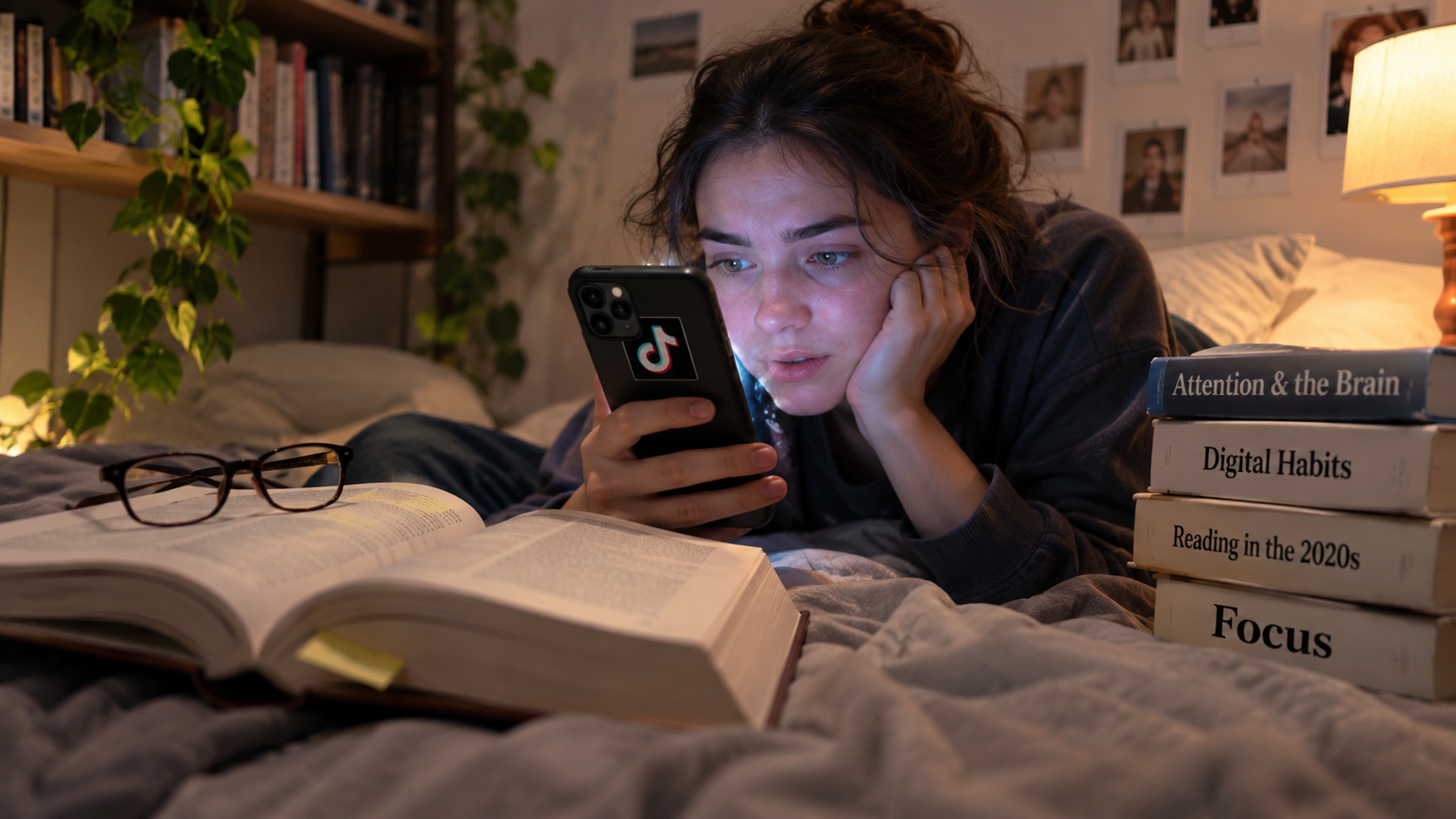
I used to read books. Actual books. With chapters. Now I can watch 47 TikToks explaining the fall of an empire, but a six-paragraph Facebook post feels like an unreasonable demand on my time. Is short-form video destroying our attention spans, or have we simply become accustomed to information arriving in 45-second installments? Here's what the research actually says about TikTok, Reels, reading habits, brain rot, and the very strange state of our collective attention.
I have a confession.
I used to read books.
Not just purchase them.
Not just arrange them attractively on a shelf.
Not just add them to a list of books I was definitely going to read when life became less busy.
I mean actually read them.
I'd open a book.
Read several chapters.
Remember what was happening.
And sometimes, astonishingly, continue reading the following day.
Now?
I can watch a 90-second video explaining an incredibly complicated historical event.
I can watch another video analyzing a celebrity controversy.
I can consume an entire psychological theory through a woman speaking directly into her phone while applying makeup.
I can learn about a court case, a fashion trend, a political scandal, a new skincare ingredient, and the rise and fall of an influencer's business before I've finished my coffee.
But open a blog article?
A long Facebook post?
A book with approximately 400 pages and no embedded video?
Suddenly, I have concerns.
How much time is this going to require?
Why are there so many paragraphs?
Could someone explain this verbally?
Is there a video summary?
Does the author understand that I'm a busy person with a thriving schedule of watching strangers discuss situations that have absolutely nothing to do with me?
I've apparently reached the point where reading a paragraph feels like accepting a new professional responsibility.
And I don't think I'm the only one.
People increasingly describe feeling distracted, impatient with long-form content, or unable to maintain the reading habits they once enjoyed.
The internet has a word for this.
Brain rot.
It's funny.
It's dramatic.
And it captures something many people recognize.
But does the research actually support the idea that short-form video is damaging attention?
Are people reading fewer books?
Is reading genuinely declining, or are we simply consuming information in different formats?
And is it possible to enjoy TikTok without sacrificing the ability to finish a novel?
The answers are more interesting than the usual internet argument.
Because yes, there is legitimate research connecting heavy short-form video use with attention-related difficulties.
Yes, some measures of reading have declined substantially.
But no, scientists have not established that watching TikTok permanently destroys your attention span.
And in one of the strangest contradictions of the modern media landscape, books are still selling in enormous quantities.
Some categories are even thriving.
So apparently, part of society has forgotten how to sit with a book, while another part is purchasing romantasy novels with the intensity of a competitive sport.
Welcome to the attention economy.
The books are alive. Our relationship with reading is having a complicated year.
First, What Does It Actually Mean to Have a Shorter Attention Span?
Before we accuse TikTok of destroying civilization, we should define what we're talking about.
People use attention span to describe several different things.
The ability to remain focused on one task.
The ability to ignore distractions.
The ability to resist switching activities.
The ability to remember information.
The willingness to persist when something is boring.
And the feeling of being mentally present.
These are related, but they aren't identical.
Researchers distinguish among cognitive processes such as sustained attention, selective attention, inhibitory control, working memory, and other executive functions.
A person can perform well on one measure and struggle with another.
Someone might maintain attention during an engaging movie but become restless while reading a difficult textbook.
Another person may be able to work for hours on a creative project but struggle to resist checking social media.
Those differences don't necessarily mean one person has a permanently damaged attention system.
The task matters.
The environment matters.
Motivation matters.
Sleep, stress, health, and individual differences matter.
And the way we measure attention matters.
This distinction becomes important when we examine research on short-form video.
Because a study finding an association between heavy TikTok use and weaker inhibitory control is not automatically proof that someone can only concentrate for eight seconds.
It identifies a relationship involving a particular measure.
The interpretation requires care.
“My brain wants to check Instagram after two paragraphs” is a recognizable experience. It is not, by itself, a neurological diagnosis.
1. What the Biggest Short-Form Video Study Found
Let's start with one of the strongest recent pieces of research.
In 2025, researchers published a systematic review and meta-analysis in Psychological Bulletin titled Feeds, Feelings, and Focus.
The analysis combined evidence from 71 studies involving 98,299 participants.
That's a substantial body of research.
And the findings are worth taking seriously.
Greater short-form video use was associated with poorer cognitive performance overall, with a reported mean correlation of r = -0.34.
The strongest associations involved:
Attention: r = -0.38
Inhibitory control: r = -0.41
Inhibitory control involves the ability to resist an automatic response or suppress a competing impulse.
For example, continuing a task instead of immediately switching to something more stimulating.
The review also found associations between heavier short-form video use and poorer mental health measures, although these relationships varied by outcome.
So did scientists prove TikTok damages attention?
No.
That's the crucial distinction.
The review identified associations.
A correlation means two things are related in the data.
It does not, by itself, establish that one caused the other.
People who already struggle with attention may gravitate toward highly stimulating media.
Heavy short-form video use could contribute to certain difficulties.
Both processes could occur together.
And other factors may influence both.
The researchers also found that relatively few studies examined cognitive domains beyond attention and inhibitory control.
So the study provides a reason for concern.
It doesn't provide a definitive diagnosis of an entire generation.
Still, if you feel that rapidly switching between videos has changed what your brain expects from entertainment, your experience isn't completely disconnected from the research.
There are measurable patterns worth investigating.
2. The 2026 Research Adds an Important Warning About Causation
In September 2026, a systematic review in BMJ Public Health examined short-form video use, cognitive outcomes, and mental health among young adults ages 18 to 29.
The researchers included 17 studies.
They found preliminary evidence associating heavier short-form video use with fragmented attention, weaker markers of executive control, and difficulties with emotional regulation.
Problematic or compulsive use was also associated with certain anxiety and depressive symptoms.
But the researchers emphasized that the evidence had limitations.
Many studies relied on self-reported use.
Definitions of problematic use weren't consistent.
And a substantial portion of the evidence was cross-sectional, meaning researchers observed participants at a particular point rather than proving what caused changes over time.
The review also acknowledged possible bidirectional relationships.
In other words:
People experiencing attention or mental health difficulties may be drawn toward frequent short-form video use.
And frequent short-form video use may potentially contribute to certain difficulties.
The available research doesn't completely disentangle those explanations.
Translation for the internet
The scientific conclusion is:
There are concerning associations that require better longitudinal and experimental research.
The TikTok conclusion would probably be:
"SCIENTISTS CONFIRM YOUR PHONE HAS EATEN YOUR PREFRONTAL CORTEX."
Those are not equivalent statements.
The evidence supports concern.
It doesn't justify declaring permanent brain damage.
3. One New Study Didn't Find the Attention Effect People Expected
Here's an important outlier.
In October 2026, researchers released a preregistered preprint titled The Cost to Scroll: Short-form Video Use and Episodic Memory.
The study involved 502 young adults ages 18 to 24.
Researchers examined device-reported screen time rather than relying entirely on estimates of usage.
Among 398 participants with reported TikTok or Instagram use, heavier short-form video use was not associated with performance on the study's sustained-attention task.
That is an important finding.
It complicates the idea that heavier short-form video use always translates into worse performance on every measure of attention.
However, the study did find an association between greater use and poorer episodic memory performance, particularly for less frequent items in a recognition task.
There are limitations here, too.
The work was a preprint at the time of this article, meaning it had not completed conventional journal peer review.
And a single study cannot resolve a complicated research field.
But it's a useful reminder.
Different studies measure different things.
Different cognitive abilities may respond differently.
And a person can experience difficulty reading long-form text without necessarily showing deficits on every laboratory measure of attention.
The evidence is not a simple contest between “TikTok is harmless” and “TikTok has destroyed everyone's brain.”
The reality is more nuanced.
Unfortunately for the internet, nuanced conclusions are extremely difficult to fit over a video of someone chopping vegetables.
The Reading Data: Are We Actually Reading Fewer Books?
Now for the second part of the question.
Maybe short-form video hasn't been proven to destroy attention permanently.
But what about books?
Are people reading less?
Here, the answer depends on how we define reading.
The number of people who read on a given day is one measure.
The amount of time spent reading is another.
The percentage of people who read at least part of one book in a year is another.
And book sales measure something different again.
These numbers can move in different directions.
Which is exactly what we're seeing.
4. Daily Reading for Pleasure Has Declined Significantly
A 2025 study published in iScience examined 20 years of data from the U.S. American Time Use Survey.
The researchers analyzed 236,270 participants between 2003 and 2023.
They found that the percentage of people who reported reading for pleasure on an average day declined from a high of approximately 28% in 2004 to 16% in 2023.
That's a substantial drop.
The study also found an average relative decline in daily reading participation of approximately 3% per year across the period.
But here's an interesting detail.
Among people who actually read for pleasure on the survey day, the amount of time they spent reading increased somewhat over the long term.
In 2003, those who read spent an average of approximately 1 hour and 23 minutes.
In 2023, readers spent approximately 1 hour and 37 minutes.
So fewer people were reporting reading on a typical day.
But the people who did read were often spending meaningful time doing it.
The research is available through the National Library of Medicine.
The interpretation
The reading population may be becoming more divided.
Some people maintain substantial reading habits.
Others rarely read for pleasure during an ordinary day.
That is different from saying every person's reading ability has declined equally.
And an additional point matters:
The decline began well before TikTok existed.
The data series begins in 2003.
TikTok became a major global platform much later.
So short-form video cannot explain the entire historical decline.
It's possible that modern social media contributes to recent reading habits.
But television, gaming, internet use, work demands, changing leisure habits, and other factors also compete for time.
We shouldn't assign a 20-year cultural shift to an app that wasn't around for most of it.
5. In 2025, Americans Spent Just 16 Minutes a Day Reading for Pleasure
The latest U.S. Bureau of Labor Statistics data reinforces the broader pattern.
According to the 2025 American Time Use Survey, published in July 2026, Americans ages 15 and older spent an average of 16 minutes per day reading for personal interest.
Compare that with approximately 2.6 hours per day watching television.
Before we panic, there's an important statistical detail.
The 16-minute reading figure is averaged across the surveyed population, including people who didn't read at all on the diary day.
It does not mean every reader stopped after 16 minutes.
But it does illustrate how small a share of daily leisure time reading occupies at the population level.
For adults ages 15 to 24, the reported average was approximately 10 minutes per day.
For adults ages 25 to 34, it was also approximately 10 minutes.
This is not a direct measurement of TikTok use.
The categories don't allow us to simply subtract video consumption from reading time.
Still, the broader allocation of leisure time is striking.
We have apparently managed to develop an entertainment economy that can occupy several hours of our day while making a 20-minute chapter feel like a substantial commitment.
6. The 2026 Survey That Sounds Like a Group Therapy Session
In June 2026, CBS News published polling on Americans' reading habits.
About one-third of respondents said they were reading fewer books for personal enjoyment than they had ten years earlier.
Among the people who said they were reading less, approximately half cited a lack of free time.
Another half cited too many distractions.
And 37% said their attention spans had gotten worse.
That last statistic applies specifically to respondents who said they were reading fewer books.
It doesn't mean 37% of all American adults were clinically found to have worse attention.
It's a self-reported explanation.
But the finding is revealing.
People are noticing changes in their own habits.
They're reporting difficulty making time for books.
They're noticing competing distractions.
And some are explicitly describing the problem in terms of attention.
This is the part where I would like the researchers to add an optional response:
"I opened my phone to check the weather and somehow watched 36 videos about celebrity divorces."
A statistically important category.
Perhaps overlooked.
7. But Wait—75% of American Adults Still Read Books
Now for the contradiction.
In April 2026, Pew Research Center reported that 75% of U.S. adults said they had read all or part of at least one book during the previous 12 months.
The survey was conducted in October 2025.
Pew also found that the overall share of adults reporting book reading had remained relatively stable since it first asked the question in 2011.
How is that possible when daily pleasure reading is declining?
Because the two studies measure different things.
Reading part of one book during an entire year is not the same as reading regularly.
Someone may start a novel in January.
Read 40 pages.
Put it down.
Try again in August.
And still accurately report that they read part of a book during the past year.
Meanwhile, a dedicated reader may finish dozens of books.
Both count as people who read.
The metric doesn't tell us how consistently they did it.
This explains why multiple apparently contradictory headlines can all be true.
A large majority of Americans still engage with books at least occasionally, while daily reading has become less common.
That's a more accurate picture than declaring that no one reads anymore.
8. Print Reading Has Declined, but Digital Formats Have Grown
Pew's 2026 report also documented changes in reading format.
The share of adults who had read a print book within the previous year declined from 72% in 2011 to 64% in October 2025.
Meanwhile, the proportion who read e-books increased from 17% in 2011 to approximately 31%.
Audiobook participation more than doubled over the same broad period.
These shifts matter.
Someone listening to an audiobook during a commute may be engaging deeply with a story, even though they're not reading printed words.
A person using an e-reader may be consuming more books than someone who buys hardcovers and never opens them.
The transition between formats complicates the question of whether reading is disappearing.
Maybe some of the reading experience has changed.
Maybe some people are replacing print with audio.
Others may be replacing books with short-form content.
And some people use all of those formats.
A person can listen to a novel, read an article on their phone, and enjoy TikTok.
These activities aren't mutually exclusive.
But they don't necessarily demand identical kinds of attention.
Which brings us to the part of this conversation that feels especially personal.
Why Does Reading Feel So Much Harder Than Watching Someone Explain Something?
Let's say I want to understand a psychology concept.
I have two options.
Option A: Read a 2,500-word article explaining the theory.
Option B: Watch a woman explain it in 65 seconds while doing her skincare routine.
Option B is remarkably appealing.
I don't have to decide how quickly to read.
I don't have to hold my place.
I don't have to make a sustained commitment to a page.
Someone is going to deliver the explanation directly to me.
With pacing.
Expressions.
Examples.
Captions.
And possibly a satisfying transition at the end.
The experience can feel easier.
But why?
9. Video Does More of the Presentation Work for Us
Written text asks the reader to perform certain activities.
You control the pace.
Interpret the structure.
Follow the argument.
Connect one paragraph to another.
And decide when to continue.
Video provides an externally paced experience.
The speaker controls the rhythm.
Their tone offers emphasis.
Visual information may help illustrate the point.
Captions can reinforce spoken language.
And the format can make complicated ideas feel approachable.
This isn't inherently bad.
A well-made educational video can be genuinely useful.
Animations can explain visual processes.
Spoken explanations can help people access information.
And video can provide demonstrations that would be difficult to communicate through text alone.
The problem arises when we begin to expect every explanation to arrive with the same level of stimulation and convenience.
A book doesn't always give us a payoff after 30 seconds.
Sometimes a chapter establishes context.
Sometimes an argument takes several pages to develop.
Sometimes we have to tolerate not knowing where the author is going.
And sometimes the experience requires us to remain with an idea before deciding whether it's worthwhile.
That can feel uncomfortable if we're accustomed to switching content as soon as our interest drops.
But discomfort is not proof that the activity is damaging.
It may simply mean the activity requires a different kind of effort.
10. The Infinite Scroll Has a Distinctive Relationship With Boredom
Think about how different the decision is when you're reading a book.
If a chapter becomes less exciting, you have to decide what to do.
Continue.
Take a break.
Skip ahead.
Or choose another book.
With short-form video, the alternative is always one gesture away.
Swipe.
New subject.
New face.
New sound.
New emotion.
New story.
New opportunity to learn something you did not need to know about a person whose existence you discovered 14 seconds ago.
The transition is almost frictionless.
That's an important design characteristic.
The next piece of content doesn't require a new search.
You don't need to decide what you're interested in.
The feed selects another candidate.
And if that one doesn't work, there is another immediately available.
It's reasonable to hypothesize that repeated exposure to such a system could shape expectations about how frequently content should provide novelty.
But that hypothesis should not be treated as proof of permanent neurological change.
Researchers are still investigating the causal mechanisms.
The practical experience, however, is familiar.
A slow paragraph has to compete with an endlessly available alternative that may be more stimulating.
The book is asking for patience. The app is offering a surprise.
This is not an entirely fair competition.
11. Even Reading on a Screen May Be Different From Reading on Paper
There's another layer to the problem.
Maybe the issue isn't only short-form video.
Maybe the device itself changes the reading experience.
A 2026 network meta-analysis published in Education and Information Technologies compared reading comprehension across paper and digital devices.
The researchers synthesized evidence from 56 studies.
They found that paper generally performed better than computers and smartphones on comprehension measures.
The difference was particularly notable in situations where readers needed to scroll through text.
However, the analysis did not find a reliable difference between paper and tablets in every comparison, and the results depended on the reading conditions.
The researchers also warned that much of the evidence involved college students reading expository or scientific texts, limiting how broadly the findings could be generalized.
What does that mean in everyday life?
Reading a dense article on a phone may be a different experience from reading the same material in a physical book.
Not because the phone has magical powers to erase comprehension.
But because screen size, scrolling, navigation, context, and the way information is presented can affect how people interact with text.
And there is another obvious practical issue.
Your physical book is unlikely to interrupt a paragraph to inform you that someone you knew in high school has posted a new vacation photograph.
Your phone has no such reservations.
A paper book may simply create a more stable environment for sustained reading.
For some people, that could make a meaningful difference.
The Plot Twist: TikTok Is Also Helping Sell Books
Here is perhaps the most entertaining contradiction of the entire conversation.
The platform often blamed for destroying our attention spans is also associated with a major book-discovery community.
BookTok.
Readers post recommendations.
Discuss characters.
React emotionally.
Share favorite passages.
Compare editions.
Build excitement around new releases.
And create communities around authors and genres.
Some of that activity has translated into substantial book sales.
According to Publishers Weekly reporting on Circana BookScan data, U.S. print-book unit sales reached approximately 762.4 million copies in 2025, a slight increase of 0.3% over 2024.
Adult fiction increased approximately 1%.
Romance sales rose 3.9%.
Science fiction grew 22.1%.
And graphic novels rose 9.2%.
Not every category grew.
Fantasy declined.
Certain nonfiction categories were weaker.
But the idea that the book market has simply collapsed doesn't match the sales data.
A book can now become a social media event
Someone recommends a novel.
Readers react.
Videos circulate.
The title becomes recognizable.
People purchase it.
Some read it.
Some discuss it.
Some collect special editions.
And perhaps some add it to a growing stack of books that has become a piece of interior décor.
The final outcome varies.
Book sales aren't the same thing as completed reading.
But the relationship between BookTok and book discovery complicates the argument that short-form video can only compete with literature.
Sometimes it directs people toward it.
Apparently TikTok can both distract you from your book and convince you to purchase six more.
An extraordinary business model.
12. Romance, Romantasy, and Graphic Novels Are Reading Outliers
The book market is not behaving as though every category has the same fate.
Certain genres have particularly active communities.
Romance.
Speculative fiction.
Graphic novels.
Manga.
And books with strong online fan engagement.
Circana's 2026 book trends analysis reported a 45% increase in manga unit sales during the first quarter of 2026.
It also identified demand for hands-on and screen-free products such as guided journals, puzzles, and activity books.
This suggests that some consumers aren't simply surrendering to screens.
They're looking for other experiences.
And some forms of reading have become deeply connected to online communities.
That doesn't prove BookTok is making everyone a more attentive reader.
Nor does it mean genre fiction is inherently easier or less valuable than literary fiction.
The point is that reading behavior is not uniform.
Some readers are highly engaged.
Some are returning to books.
Others are struggling to maintain the habit.
And some are purchasing increasingly elaborate bookshelves in preparation for a reading renaissance that has not yet been scheduled.
13. Younger Readers Show Both Declines and Signs of Recovery
The United Kingdom's National Literacy Trust provides another useful perspective.
Its 2025 Annual Literacy Survey reported that only 32.7% of children and young people ages 8 to 18 enjoyed reading in their free time.
That was the lowest level recorded in its 20-year series.
Daily reading for pleasure had also fallen to 18.7%.
Concerning figures.
But the 2026 survey showed a modest improvement.
In its 2026 report, 36.1% of children and young people ages 8 to 18 said they enjoyed reading.
Daily reading increased to 20.3%.
Those figures remained low relative to earlier years.
But they demonstrate that trends can change direction.
And they complicate the idea that reading is inevitably disappearing.
The National Literacy Trust also found that children's reading motivation varied considerably.
Choice, personal interests, confidence, access to appealing material, and supportive environments all mattered.
Reading isn't simply a contest between books and phones.
It's influenced by whether people have access to reading experiences they actually want.
Is It Brain Rot, or Have We Become Extremely Efficient at Avoiding Boredom?
Let's discuss the phrase itself.
In 2024, Oxford University Press selected “brain rot” as its Word of the Year.
The phrase describes a perceived decline in mental or intellectual functioning associated with consuming excessive amounts of trivial or undemanding content.
Importantly, it's a cultural term.
Not a clinical diagnosis.
And the phrase is much older than TikTok.
Oxford traced its earliest documented use to Henry David Thoreau's Walden in 1854.
Which is, frankly, magnificent.
A man writing about simple living in the nineteenth century was already worried that society wasn't engaging seriously enough with ideas.
We have apparently been accusing one another of intellectual decline for at least 170 years.
The technology changes.
The concern remains.
1854:
Society is becoming too distracted and intellectually shallow.
2026:
I have watched nine consecutive videos of people organizing refrigerators, and now I'm unwilling to read a restaurant's cancellation policy.
Different centuries.
Related anxieties.
Of course, the fact that people have worried about distraction for centuries doesn't mean modern concerns are automatically unfounded.
Technology really has changed.
The volume of content has changed.
The speed of distribution has changed.
And our ability to switch instantly among different forms of stimulation has changed.
But we should distinguish an understandable cultural anxiety from evidence of permanent cognitive deterioration.
Feeling mentally scattered after scrolling is not the same thing as having an irreversibly damaged brain.
And the available research does not justify telling people they've permanently lost the ability to concentrate.
The Department of Attention Has Issued a Formal Statement
Dear Reader,
We regret to inform you that your request to read a book has encountered an unexpected administrative obstacle.
Your attention was last observed opening Chapter Two.
Shortly afterward, it received a notification.
It then remembered that someone on Instagram had posted a vaguely controversial statement.
The attention attempted to investigate.
During the investigation, it encountered a video about a psychological concept.
This led to an unrelated video about a restaurant.
The restaurant video included a reference to a celebrity.
The celebrity reference required additional context.
Your attention is currently reviewing a 14-part TikTok series.
We anticipate that reading operations may resume shortly.
However, no specific restoration timeline is available.
In the meantime, your book remains open on page 17.
Thank you for your patience.
Sincerely,
The Department of Attention and Unnecessary Contextual Research
This announcement is satire. No attention-related neurological diagnosis can be established from a person's social media habits alone.
14. The Research Doesn't Mean Everyone Should Delete TikTok
It would be easy to take the evidence and declare that all short-form video is bad.
But that would be an oversimplification.
Short-form video can be educational.
It can make complicated ideas accessible.
It can introduce people to topics they might not otherwise encounter.
It can build communities.
It can encourage reading.
And it can communicate visual information efficiently.
A person might use TikTok to discover a subject.
Then read a longer article.
Watch a lecture.
Listen to a podcast.
Or explore a book.
The format itself isn't inherently devoid of value.
The more important questions involve how it's used.
How frequently?
For how long?
With what degree of control?
Does it displace activities the person values?
Is the use intentional or compulsive?
Does it interfere with sleep, work, relationships, or other responsibilities?
The research suggests that problematic or compulsive patterns may be especially relevant.
A 2026 systematic review and meta-analysis of 58 studies found that associations with adverse mental health measures were generally stronger for problematic short-form video use than for ordinary usage patterns.
Again, that study does not establish that the videos caused every observed outcome.
But it supports the importance of distinguishing ordinary media use from loss of control.
The goal doesn't necessarily have to be becoming a person who never watches Reels.
It may be becoming someone who can watch Reels and still choose to do something else.
15. Watching a Video Isn't the Same Thing as Understanding a Subject
This one is particularly relevant to the modern information economy.
Short-form videos can make us feel extremely informed.
After 45 minutes of scrolling, you may have encountered explanations about:
Psychology.
Economics.
Science.
History.
Relationships.
Artificial intelligence.
Health.
And several legal matters involving people you've never met.
That's a lot of information.
But exposure and understanding aren't identical.
A video may introduce a concept accurately.
Or oversimplify it.
Or leave out essential qualifications.
Or present a contested interpretation as settled fact.
A 60-second explanation can be an excellent introduction.
It cannot always replace a detailed argument.
The same is true for written summaries.
A short article may communicate the central finding of a research paper while omitting methodological limitations.
A long-form source provides room for context.
You can examine the evidence.
Review definitions.
Follow the reasoning.
And decide whether you agree with the interpretation.
That's one reason long-form reading still matters.
Not because every book is accurate.
Or every long article is insightful.
But because complicated ideas often require more than a quick conclusion.
Understanding the headline is not always the same thing as understanding the argument.
16. Reading Has a Different Relationship With Time
Short-form video can make an enormous amount of information feel available in a very small period.
But reading often requires something different.
Not necessarily more intelligence.
Not necessarily greater effort in every situation.
But a willingness to remain with material as it unfolds.
A novel introduces characters.
Establishes relationships.
Builds tension.
And develops meaning over time.
An essay may introduce an argument before presenting evidence.
A history book can spend several chapters developing context before reaching a major event.
The reader participates by following that progression.
If you're accustomed to immediate novelty, that process may feel slow.
But slowness isn't necessarily a defect.
Sometimes it is part of how the material works.
A good book doesn't need to provide a new surprise every six seconds.
And a reader doesn't necessarily need to feel entertained during every sentence.
There's value in allowing the meaning to develop.
It may be precisely that experience that feels unfamiliar after spending a long time in environments designed for rapid switching.
17. The Problem May Be Less About Ability and More About Habit
Here's a potentially encouraging way to think about the experience.
Maybe the issue isn't that you've permanently lost the cognitive capacity to read.
Maybe your routines have changed.
You reach for your phone more often.
You associate downtime with scrolling.
You expect information to arrive through video.
You read fewer long pieces.
And when you try to return to a book, it feels unusually demanding.
That is a plausible behavioral explanation.
It doesn't establish that your specific attention difficulties have one cause.
But it suggests a useful response.
Rather than assuming your ability is gone, try changing the environment and rebuilding the habit.
The research does not provide a universally validated program that restores reading ability in exactly seven days.
And persistent or significant concentration difficulties can have many causes, including sleep, stress, mood, medications, and attention-related conditions.
If the difficulty is pronounced, new, or affecting daily functioning, professional evaluation may be appropriate.
For ordinary reading-habit frustration, however, there are low-risk adjustments worth trying.
18. The Experiment: Can You Read for Ten Minutes Without Looking at Your Phone?
Here's an experiment.
Not a medical treatment.
Not a scientifically validated cure for brain rot.
Just a practical way to investigate your own habits.
Choose something you genuinely want to read.
Not the book you think an impressive person would read.
Not the 700-page classic you've been avoiding since college.
Something interesting.
A novel.
An essay.
A memoir.
A nonfiction subject you enjoy.
Then put your phone somewhere inconvenient.
Not face down beside you.
Not on silent within easy reach.
Somewhere that creates a deliberate choice before you pick it up.
Set aside ten minutes.
Read.
If your attention wanders, notice it.
Then return to the page.
You don't need to achieve perfect concentration.
The goal is simply to create a short period in which reading is the activity you've chosen.
What might you learn?
Maybe ten minutes is easy.
Maybe it's surprisingly uncomfortable.
Maybe you enjoy the book once you get started.
Maybe the book isn't right for you.
Maybe you're exhausted and need rest rather than another productivity challenge.
The exercise isn't meant to prove anything universal.
It helps you observe what happens when you remove some of the immediate alternatives.
If ten minutes works, you can gradually make more room for reading.
If not, start smaller.
The point is consistency and enjoyment—not turning leisure into another performance metric.
19. Try Separating Reading From the Device That Delivers Your Distractions
If you associate your phone with scrolling, it might help to read somewhere else.
A physical book.
An e-reader without social media notifications.
A tablet with distractions disabled.
Or a computer configured for a focused reading session.
There isn't one universally best format for every person.
But the 2026 digital-reading meta-analysis suggests that reading conditions can affect comprehension.
A device with fewer interruptions may make the experience easier.
The goal isn't to create an elaborate technological system to defeat technology.
It's simply to reduce the number of opportunities to switch activities.
Your book doesn't need to compete with a notification every three minutes.
And your reading environment doesn't need to contain every other form of entertainment you own.
Sometimes a little friction is useful.
Especially when the activity you're trying to protect requires sustained attention.
20. Audio Can Be a Bridge, Not a Failure
Let's also discuss the temptation to have someone explain everything verbally.
Sometimes listening is the format that works best.
An audiobook may make it possible to enjoy a story during a commute.
A podcast can introduce a complex subject.
An educational video may demonstrate something that would be difficult to understand through text alone.
Those aren't failures.
They're different media experiences.
If your goal is to explore a novel, an audiobook may be a perfectly satisfying way to engage with the work.
If your goal is to develop comfort with sustained visual reading, however, listening alone doesn't provide the same practice.
The distinction depends on what you want.
Are you trying to understand the information?
Experience the story?
Practice reading?
Or build a particular concentration habit?
The answer should guide the format.
There is no reason to shame people for using accessible or enjoyable ways of consuming books.
But there is also value in protecting the ability to engage with longer written material when that's important to you.
Listening isn't cheating. Reading isn't obsolete. And TikTok doesn't need to be your entire educational system.
What This Means for Writers, Publishers, and Digital Marketers
Now let's look at the business side.
Because the attention economy affects more than individual reading habits.
It changes how people interact with websites, articles, social media, newsletters, and branded content.
At Ritner Digital, this is particularly relevant.
Businesses still need written information.
Search engines and AI-assisted systems still retrieve and interpret written content.
Customers still need explanations.
But audiences may arrive with different expectations about how information should be presented.
A long article can be valuable.
A short video can also be valuable.
The challenge is determining when each format serves the audience best.
21. Should Every Blog Post Become a 45-Second Video?
Not necessarily.
A short video can introduce an idea.
It can summarize a finding.
It can demonstrate something.
Or it can create interest in a subject.
But some information needs more room.
A detailed guide about choosing a service provider.
An explanation of complicated research.
A legal or technical discussion.
A comparison that depends on several qualifications.
Those subjects may require written content to communicate responsibly.
A 45-second video about the research linking short-form video to attention problems might say:
"Studies find a relationship between heavy use and attention difficulties."
That's a reasonable introduction.
But a complete explanation also needs to discuss correlation, causation, study design, and contradictory findings.
Which is why this article is long.
An objectively hilarious decision, given the subject.
We are discussing the decline of reading by asking you to read an extensive explanation.
The article has become its own controlled experiment.
22. The Answer for Businesses May Be Layered Content
Rather than deciding that all content must be short, businesses can structure information in layers.
A short video introduces the idea.
A clear summary communicates the main point.
A longer article provides supporting evidence and context.
Relevant service pages explain how the business helps customers.
People can engage at the level that suits their needs.
This doesn't mean every article needs ten different versions.
It means content strategy should recognize different kinds of attention.
Someone browsing social media may want a short introduction.
A prospective customer comparing services may need detailed information.
A researcher may want original sources.
A decision-maker may need to verify specific claims.
Good digital communication supports those different needs.
It doesn't assume everyone wants the same format.
23. Does Google Want Shorter Content Now?
Google does not publish a universal word-count requirement for rankings.
Its SEO Starter Guide emphasizes useful, well-organized content that helps people understand a topic.
A short page can be excellent.
A long article can be excellent.
Either can be poor if it fails to answer the reader's question.
The appropriate length depends on the subject.
A restaurant's hours don't require a 3,000-word explanation.
A comprehensive review of scientific research may require substantial detail.
Businesses shouldn't create long articles merely to meet an imagined SEO threshold.
Nor should they remove essential context to make everything fit into a Reel.
The question should be:
What does the reader need to understand, and what format will communicate it accurately?
A short answer may lead to a deeper resource.
A longer article should be organized so readers can navigate it.
And the writing should earn the reader's attention rather than demand it.
24. AI Summaries Add Another Layer to the Attention Economy
There is another modern alternative to reading.
Ask an AI to summarize the article.
Or the book.
Or the research paper.
Or the long Facebook argument.
Suddenly, a complicated document can be reduced to a few paragraphs.
This can be useful.
A summary can help someone decide whether a source is relevant.
It can clarify terminology.
Or provide an overview before deeper reading.
But summaries inevitably select information.
They may omit nuance.
They can contain errors.
And they don't always preserve the reasoning that led to the conclusion.
A summary is not a substitute for the source when the details matter.
For marketers, this creates a new challenge.
A business may need clear written content that helps people understand an offering.
But some users may encounter only a summary.
That makes accurate headings, clear explanations, and strong source material increasingly important.
Not because every business can control how AI systems summarize its information.
It cannot.
But because useful, structured content supports both readers and the systems that retrieve information.
We've moved from “I don't want to read the article” to “Can another computer please read the article and tell me whether I need to care?”
A remarkable achievement.
Potentially useful.
Occasionally dangerous.
And extremely on-brand for 2026.
The Fictional Department of Former Readers Would Like a Word
Dear Former Reader,
Our records indicate that you once completed books voluntarily.
You were capable of following multiple characters.
Understanding complex plots.
And remaining with a narrative for several hours.
Congratulations on this historical achievement.
We regret to inform you that your current reading request has been interrupted by a series of more immediately rewarding alternatives.
These include:
A 34-second explanation of a scientific study.
An argument between two people you do not know.
A video of someone restocking a refrigerator.
A creator explaining why another creator's explanation was inaccurate.
And a recommendation for a book you are unlikely to begin this week.
Your existing books remain available.
Please note that purchasing another book will not automatically complete the previous books.
Our accounting department has confirmed this repeatedly.
If you would like to resume reading, please place your phone outside the room.
We understand this may cause temporary discomfort.
Your attention has become accustomed to receiving a new subject whenever it requests one.
Thank you for your patience as we attempt to restore normal reading operations.
Sincerely,
The Department of Literary Rehabilitation and Unread Purchases
This department is fictional. The relationship between reading habits, media use, and attention is a legitimate subject of ongoing research.
Frequently Asked Questions
1. Did TikTok actually shorten our attention spans?
Research finds associations between heavier short-form video use and certain attention-related difficulties. A 2025 meta-analysis of 71 studies reported meaningful negative correlations with attention and inhibitory control. However, that does not prove TikTok caused a permanent decline, and researchers continue to investigate the direction and mechanisms of the relationship.
2. Does Instagram Reels affect attention the same way as TikTok?
Studies often group short-form video platforms such as TikTok, Instagram Reels, and YouTube Shorts because they share certain design features. However, usage patterns, content, audiences, and platform systems can differ. Research should not assume every platform affects every user identically.
3. Is brain rot a real medical condition?
No. Brain rot is a cultural expression describing a perceived decline in mental sharpness associated with consuming trivial or undemanding content. Oxford named it Word of the Year in 2024. It is not a formal clinical diagnosis or proof of permanent neurological injury.
4. Why does reading feel harder after watching short-form videos?
One plausible explanation is that rapidly changing content and easy access to novelty create different expectations about pace and stimulation. However, reading difficulty can also be influenced by stress, fatigue, sleep, motivation, health, and many other factors. Researchers have not established one universal explanation.
5. What does the research say about short-form video and attention?
A 2025 meta-analysis covering 98,299 participants across 71 studies found negative associations between short-form video use and cognitive measures, particularly attention and inhibitory control. A 2026 systematic review found similar preliminary patterns but emphasized methodological limitations and the need for stronger causal research.
6. Are people reading fewer books in 2026?
The answer depends on the measure. Daily reading for pleasure has declined substantially over the long term. However, Pew's April 2026 report found that the share of American adults who had read all or part of a book within the past year remained relatively stable over time. Book purchases and regular reading are different measures.
7. How much time do Americans spend reading each day?
The U.S. Bureau of Labor Statistics reported that Americans ages 15 and older spent an average of approximately 16 minutes per day reading for personal interest in 2025. That figure includes people who did not read on the surveyed day, so it should not be interpreted as the typical reading session length among active readers.
8. Are young people reading less than previous generations?
Several measures show long-term declines in reading engagement, particularly daily reading for pleasure. The UK's National Literacy Trust reported very low reading enjoyment in 2025, followed by a modest improvement in 2026. Patterns vary across age groups, communities, formats, and individual circumstances.
9. Are print books becoming less popular?
Pew reported that the share of U.S. adults reading print books declined from 72% in 2011 to 64% in October 2025. E-books and audiobooks have become more common. However, the U.S. print-book market still recorded approximately 762.4 million units sold in 2025.
10. Is BookTok helping people read more?
BookTok has contributed to book discovery and sales, particularly in certain fiction categories. However, higher sales do not automatically prove that purchasers finish more books or spend more time reading. Its influence varies by genre and audience.
11. Are audiobooks as good as reading physical books?
Audiobooks can provide meaningful access to books and stories, but listening and visual reading are not identical activities. The appropriate format depends on the person's needs and goals. Someone seeking to develop sustained visual reading habits may benefit from practicing with written text even while enjoying audiobooks.
12. Is reading on a phone worse than reading on paper?
A 2026 network meta-analysis found that paper often supported better reading comprehension than computers and smartphones, especially when digital reading required scrolling. The findings varied by device and conditions, and the evidence had limits involving study populations and text types.
13. Does watching short-form video permanently damage the brain?
Current research does not establish that ordinary short-form video use causes permanent brain damage. Studies have identified concerning associations with certain cognitive and mental health measures, but more longitudinal and experimental research is needed to clarify causality and long-term effects.
14. Can I rebuild a reading habit after spending years scrolling?
Many people may find it helpful to begin with short, enjoyable reading sessions, reduce nearby distractions, and establish a sustainable routine. These are practical habit-building approaches, not guaranteed medical treatments. Persistent concentration difficulties may warrant professional evaluation.
15. Should I delete TikTok to improve my attention?
There's no universal requirement to delete TikTok. Some people may benefit from limiting use, removing notifications, or creating phone-free reading time. The appropriate approach depends on how the platform affects their routines, sleep, responsibilities, and personal goals.
16. Is short-form educational video less valuable than reading an article?
Not necessarily. Video can explain concepts, demonstrate techniques, and introduce new topics effectively. However, complex subjects may require more detail than a brief clip provides. The quality and completeness of the information matter more than treating one medium as universally superior.
17. Why can I watch a long movie but struggle to read a chapter?
Different activities place different demands on attention. A movie supplies visual movement, sound, pacing, and performances, while reading requires the reader to process and follow written language. Difficulty with one activity does not automatically establish a general inability to sustain attention.
18. Does the eight-second attention span claim have scientific support?
The popular claim that humans now have an eight-second attention span is an oversimplification and should not be treated as a universal scientific fact. Attention varies by task, context, person, and measurement method. Research on specific cognitive functions is more meaningful than assigning everyone one fixed number of seconds.
19. Should businesses stop writing long blog posts because people prefer video?
No. Short-form video and long-form written content serve different purposes. A brief video may generate discovery, while a substantial article can provide explanation, evidence, and useful detail. The right approach depends on what customers need to understand.
20. Can Ritner Digital help businesses balance short-form video and written content?
Ritner Digital provides content strategy, SEO, social media, and website services. Businesses can develop a strategy that uses short-form content for relevant discovery while preserving accurate, useful written information for customers who need greater detail.
Final Thoughts: The Book Is Still There. So Is Your Ability to Choose What Gets Your Attention.
I think one of the strangest things about modern internet life is how much information we consume while feeling increasingly impatient with the process of learning.
I can watch someone explain a topic.
Watch a response to that explanation.
Watch a third person dispute the response.
And then watch a fourth person explain why the original explanation was misunderstood.
By the end, I may feel thoroughly informed.
But I haven't necessarily examined a single primary source.
Read the original research.
Or spent enough time with the subject to understand its complications.
And when I finally encounter a detailed article?
My brain wants a narrator.
Preferably with captions.
And maybe a satisfying background activity.
The research suggests this experience is worth taking seriously.
Heavy short-form video use is associated with certain attention-related and self-regulation difficulties.
Daily reading for pleasure has declined.
And people increasingly report feeling distracted and struggling to make time for books.
But the evidence doesn't establish that an entire generation has permanently lost the ability to focus.
It also doesn't support the idea that books have disappeared.
They haven't.
People are still reading.
Some are reading extensively.
Some are discovering books through the very platforms accused of replacing them.
And others may be trying to rebuild a relationship with reading after years of changing habits.
Maybe that's the more useful way to approach the question.
Not as a declaration that our brains are ruined.
But as an invitation to think about what our everyday media environments encourage.
Which kinds of attention do they make easy?
Which require deliberate effort?
What activities are we allowing to disappear from our routines?
And what would we like to make room for again?
For businesses, the lesson is similar.
Attention is valuable.
People have choices.
And no amount of clever formatting can replace the responsibility to communicate something worth understanding.
At Ritner Digital, we help businesses develop content and digital marketing strategies that recognize how people discover, evaluate, and engage with information.
That may involve short-form social content.
Search-focused articles.
Clear website copy.
Useful resources.
Or a combination of formats that meet different customer needs.
The objective isn't simply to compete for the next few seconds of attention.
It's to create something worth paying attention to.
And personally?
I would like to get back to reading books.
Not because TikTok is evil.
Not because watching videos is inherently inferior.
But because I miss the feeling of spending time with something without immediately looking for the next thing.
A book that requires a little patience.
A chapter that doesn't explain its entire purpose in the first sentence.
An idea that takes more than 45 seconds to develop.
And perhaps the radical realization that I can enjoy something without an algorithm selecting what comes next.
Maybe the goal isn't to eliminate short-form content. Maybe it's to remember that our attention can be used for more than scrolling.
Now, if you'll excuse me, I'm going to read a book.
After I check one thing on my phone.
Sources and Further Reading
This article combines peer-reviewed research, preliminary research clearly identified as such, official survey data, and publishing-industry reporting available through November 2026. Research findings are distinguished from personal observations, illustrative jokes, and speculation. Correlations should not be interpreted as proof of causation.
Scientific research on short-form video and cognition
1. Nguyen et al. — Feeds, Feelings, and Focus: A Systematic Review and Meta-Analysis Examining the Cognitive and Mental Health Correlates of Short-Form Video Use. Psychological Bulletin, 2025. Analysis of 71 studies involving 98,299 participants. Read the research abstract.
2. Arouch et al. — Short-form Video, Cognitive and Mental Health Outcomes: A Systematic Review. BMJ Public Health, September 2026. Review of 17 studies involving young adults and discussion of evidence limitations. Read the study.
3. Ebster et al. — Taming the Endless Scroll? Short-form Videos, Digital Routines and Neurocognitive Outcomes in Youth. European Child & Adolescent Psychiatry, June 2026. Systematic review involving 42 studies and 46,912 participants, most of which were cross-sectional. Read the review.
4. Chen et al. — The Cost to Scroll: Short-form Video Use and Episodic Memory. October 2026 preprint. Preregistered investigation of 502 young adults; found an association with episodic memory but not the sustained-attention task. Not yet peer-reviewed at publication. Read the preprint.
5. Zhai et al. — The Influence of Short-Video Usage on Prospective Memory Under Different Cue Type Conditions.Behavioral Sciences, June 2026. Experimental investigation of short-video exposure and prospective memory. Read the study.
6. Association Between Short-Form Video Use and Mental Health: Systematic Review and Meta-Analysis. 2026 research distinguishing problematic use from routine usage patterns. Read the research abstract.
Reading habits and book consumption
7. Bone et al. — The Decline in Reading for Pleasure Over 20 Years of the American Time Use Survey. iScience, 2025. Study using 236,270 survey observations from 2003 through 2023. Read the study.
8. U.S. Bureau of Labor Statistics — Americans Age 15 and Over Read for an Average of 16 Minutes per Day in 2025. July 2026 government report. Read the findings.
9. American Academy of Arts and Sciences — Time Spent Reading. Long-term trends in leisure reading participation and time allocation. Explore the indicators.
10. Pew Research Center — Americans Still Opt for Print Books Over Digital or Audio Versions. April 2026 analysis of October 2025 survey findings. Read Pew's report.
11. CBS News — A Third of Americans Say They're Reading Fewer Books. June 2026 survey reporting on reading habits, distractions, and perceived attention changes. Read the coverage.
12. National Literacy Trust — Children and Young People's Reading in 2025. UK survey documenting low levels of enjoyment and daily reading. Read the report.
13. National Literacy Trust — Children and Young People's Reading in 2026. UK survey documenting modest improvements following several years of decline. Read the report.
Book sales and reading formats
14. Publishers Weekly — Print Book Sales Rose Slightly in 2025. January 2026 reporting on Circana BookScan data showing approximately 762.4 million print units sold. Read the report.
15. Circana — Turning the Page on 2026 Book Trends. Industry analysis of manga, nonfiction, fiction, and screen-free consumer interests. Read Circana's analysis.
16. Clinton-Lisell and Litzinger — Decoding Digital Reading: A Network Meta-Analysis of Comprehension Across Devices. Education and Information Technologies, January 2026. Analysis of 56 studies comparing reading comprehension across paper and digital devices. Read the study.
Culture, language, and digital marketing
17. Oxford University Press — Brain Rot Named Oxford Word of the Year 2024. Cultural history and meaning of the phrase, including its nineteenth-century usage. Read Oxford's announcement.
18. Google Search Central — SEO Starter Guide. Official guidance on useful content, search accessibility, and website organization. Read the guide.
19. Ritner Digital — SEO Services. Website visibility, search strategy, and relevant content. Explore SEO services.
20. Ritner Digital — Content Systems. Developing clear, valuable content for different audiences and channels. Explore content systems.
21. Ritner Digital — Contact. Contact Ritner Digital.
Editorial Note: The Brain Rot Is a Joke. The Research Isn't.
This article uses humor and parody to describe common experiences with short-form video, distraction, and declining reading habits.
The fictional departments, exaggerated examples, and references to brain rot are satirical.
The research findings are presented separately.
The available evidence identifies associations between heavy short-form video use and certain cognitive outcomes but does not establish that ordinary use causes permanent brain damage or inevitably destroys attention.
Reading trends also differ depending on whether researchers measure daily participation, time spent reading, annual book engagement, or book sales.
This article is educational commentary, not medical advice.
Research current through November 2026.