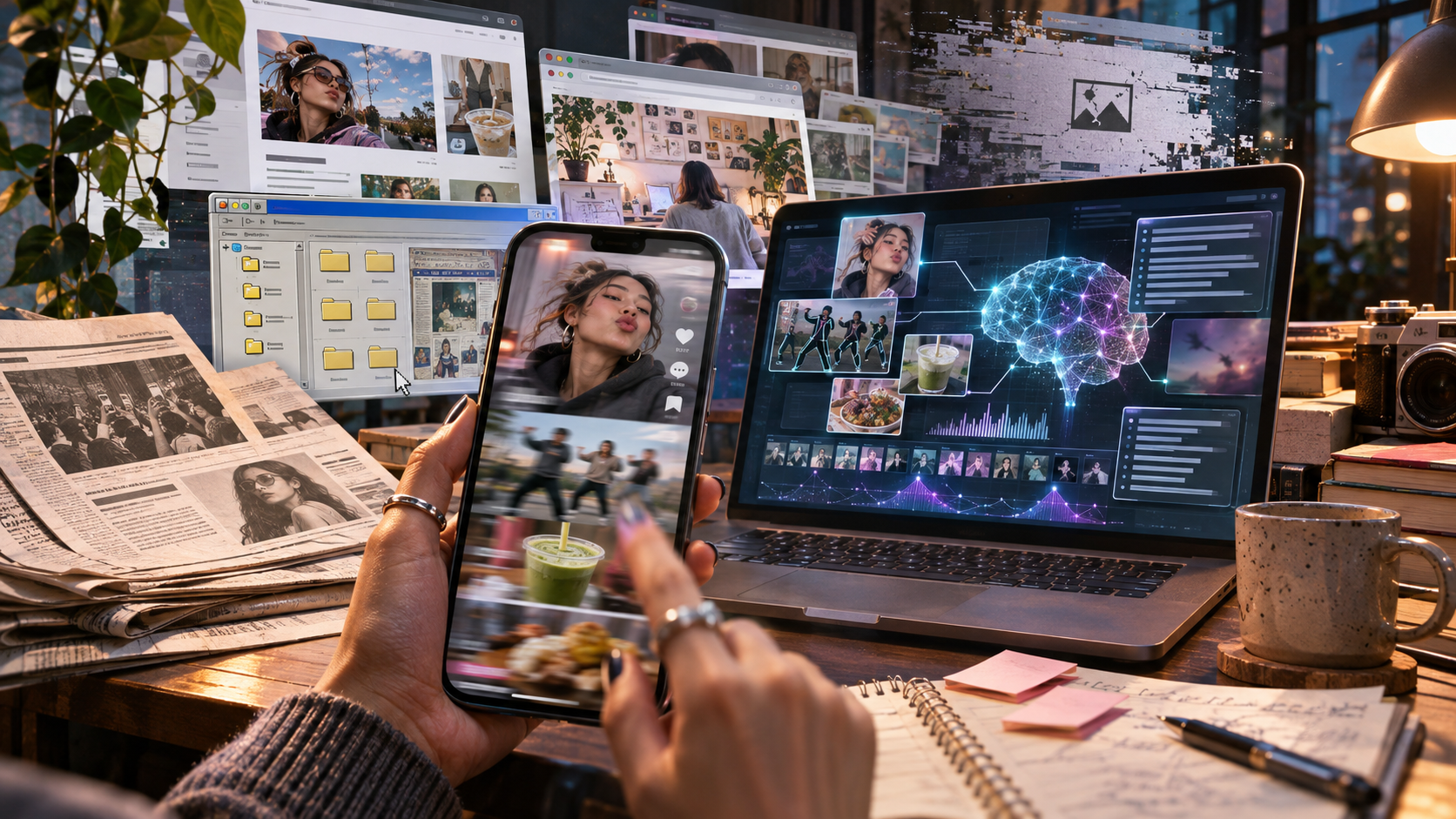
Culture now moves through TikToks, Instagram Reels, viral audio, inside jokes, and videos that sometimes make absolutely no sense unless you've spent the previous six hours online. Meanwhile, AI is trying to understand the world through whatever content it can access. And somewhere, a newspaper is professionally explaining an internet phenomenon that peaked three days ago. Welcome to the increasingly strange relationship between internet culture, artificial intelligence, journalism, and digital memory.
There was a time when you could understand a significant portion of internet culture by reading.
Blogs.
Forums.
Online magazines.
Celebrity websites.
Fashion diaries.
Personal essays.
Lengthy posts about what someone wore to brunch.
The internet wasn't entirely text-based, of course.
But a surprising amount of its cultural activity was documented in words.
If you wanted to know what a fashion blogger loved in 2012, you could read the blog.
If you wanted to understand a particular aesthetic, you could look through dated posts.
If a creator became influential, there might be hundreds of articles explaining their tastes, relationships, recommendations, and everyday lives.
The internet created a record of itself.
Not a perfect record.
Not necessarily an unbiased one.
But an extraordinarily searchable one.
Now imagine trying to document internet culture in November 2026.
Someone starts a trend on TikTok.
Another creator responds.
A third person uses the same sound sarcastically.
Someone uploads a version to Instagram Reels.
A different community changes the meaning entirely.
The original creator deletes their video.
The joke becomes embarrassing.
A reaction account declares that the trend is over.
Someone else makes a video explaining why the backlash is actually the trend.
And all of this happens before a traditional publication has finished assigning the story.
Meanwhile, an artificial intelligence system is asked:
"What's going on with this trend?"
Excellent question.
Unfortunately, the cultural moment is unfolding across videos, comments, sounds, private group chats, and algorithmically personalized feeds.
Some of that material may be accessible to the AI.
Some may be represented through captions or transcripts.
Some may appear through news reports, Reddit discussions, or creator-written explanations.
And some may be inaccessible through the tools or sources available to that particular system.
So the AI tries to reconstruct the moment from whatever evidence it can retrieve.
The journalist attempts to turn the same moment into a coherent story.
The people actually participating in the trend are already discussing something else.
We have developed a cultural ecosystem in which reality is moving faster than our systems for documenting and interpreting it.
And the strangest part is that these systems are deeply interconnected.
Social media creates the trend.
Journalists explain the trend.
AI systems retrieve and summarize information about the trend.
People use those explanations to make more content.
That content creates new trends.
And eventually someone asks whether the original trend was even real.
For businesses, marketers, creators, researchers, and anyone interested in digital culture, the implications are bigger than whether an AI chatbot understands a particular meme.
We're witnessing a change in how culture is created, interpreted, remembered, and potentially forgotten.
And it raises one particularly uncomfortable question:
If a cultural moment happens entirely inside short-form video, who is actually preserving the version of history that future people—and future AI systems—will be able to understand?
First, We Need to Talk About the Three Internets
To understand the problem, imagine three departments responsible for explaining what is happening online.
They occupy the same building.
They share some information.
They occasionally cite one another.
But they are working from different source materials.
Department One: The Internet Where Culture Actually Happens
This is TikTok, Instagram Reels, YouTube Shorts, Stories, livestreams, memes, comments, group chats, and the wider communities surrounding them.
It's fast.
Visual.
Participatory.
Frequently ironic.
And highly dependent on context.
The meaning of a video might depend on a particular audio clip, the creator's previous posts, or a joke that began three months earlier.
Department Two: The Internet AI Can Interpret
AI systems can process text, images, audio, and video—depending on the model, product, and tools available.
They can also search or retrieve certain public information.
But they don't automatically have continuous, unrestricted access to every social media platform.
A model may have sophisticated video-understanding capabilities while its search tool lacks access to the relevant Instagram Reel.
Or it might retrieve a written article describing the trend instead of seeing the original clips.
What an AI can understand and what it can access are separate questions.
Department Three: The Internet as Documented by Journalism
This is the internet translated into reporting.
Articles.
Interviews.
Investigations.
Profiles.
Cultural criticism.
Historical context.
A journalist may watch dozens of videos, talk to creators, verify details, and write a carefully constructed explanation.
That can be extremely valuable.
But the final article may not capture every visual cue, joke, or emotional nuance of the original videos.
And journalism has its own selection process.
Not every trend becomes a story.
Not every community receives equal attention.
The organizational problem
These departments are supposed to be describing the same world.
But they don't have identical access, incentives, or methods.
One department is living the meme. Another is summarizing the meme. The third is explaining the meme to people who have never seen the meme.
No wonder things occasionally get lost in translation.
1. Culture Has Become Increasingly Native to Short-Form Video
Short-form video is no longer simply a promotional format.
It's a major part of how people discover, interpret, and participate in culture.
Fashion.
Beauty.
Language.
Relationships.
Entertainment.
Workplace humor.
Consumer behavior.
Food.
Politics.
Personal identity.
And the constantly changing collection of things that suddenly feel embarrassing, aspirational, outdated, or cool.
These conversations can take place through videos that are only seconds long.
A joke can spread through a particular sound.
A fashion aesthetic can become recognizable through repeated imagery.
A new phrase can gain meaning through context rather than formal definition.
And a video may communicate its point through an expression rather than a spoken explanation.
The shift is measurable.
The Reuters Institute's 2026 Digital News Report found that social media and video platforms had become the most widely used way of accessing online news across its 48 surveyed markets.
The report also found that 77% of respondents across those markets watched online news video weekly.
That's news consumption, not a direct measurement of all cultural activity.
But it demonstrates how central video-led platforms have become to public information.
Meanwhile, Pew Research Center reported in October 2026 that 20% of U.S. adults regularly received news through TikTok, up from 3% in 2020.
For younger audiences, the share was considerably higher.
The point isn't that everything important now happens on TikTok.
It doesn't.
The point is that a significant amount of cultural discussion now takes forms that cannot be completely understood by reading a traditional text document.
And that creates a fascinating problem for systems built around retrieving and summarizing information.
2. A Transcript Is Not the Same Thing as a Video
Imagine someone posts a Reel.
The person looks at the camera.
They say:
"That's amazing."
Then they pause.
Look off-screen.
Raise one eyebrow.
And make an expression suggesting they would rather spend the next six months in airport security than participate in whatever they're discussing.
The transcript says:
"That's amazing."
A flawless record of the words.
A spectacular failure to capture the meaning.
The real message exists in the interaction between language, timing, tone, and facial expression.
A transcript may preserve spoken content.
It does not necessarily preserve the full communication.
What can be lost?
Body language.
Facial expression.
Sarcasm.
Voice inflection.
Timing.
Editing.
Visual references.
Text overlays.
Background audio.
The relationship between the creator and the audience.
And the cultural history of the sound being used.
Even the absence of speech can be meaningful.
Someone might stare silently into the camera while a particular audio clip plays.
The transcript may contain almost nothing useful.
But the video could communicate an entire social observation.
A person who understands the trend immediately recognizes the joke.
Someone reading the transcript may not.
And an AI system relying primarily on that transcript may miss the point entirely.
A transcript can capture the sentence without capturing why the sentence is funny.
3. Sometimes the Meaning Isn't Even Inside the Video
Here's where internet culture becomes especially difficult to archive.
Suppose a creator uses a particular sound.
The sound originally came from an unrelated video.
Then someone used it sarcastically.
Then a community adopted it for a specific kind of joke.
Eventually, the sound became shorthand for an entire emotional situation.
Now a creator posts a completely ordinary video while using that audio.
The joke depends on knowing the sound's cultural history.
You could analyze every pixel in the new video.
Transcribe the entire audio track.
Identify every object.
Recognize every person.
And still miss the joke.
Because the meaning isn't located entirely within that individual file.
It's distributed across a network of previous uses.
The sound means what it means because of what happened before.
This is a problem of context, not simply recognition
An AI might accurately identify:
A person standing in a kitchen.
A popular sound.
A caption about an ordinary experience.
But understanding why that combination is ironic may require knowing the trend's origin, recent reinterpretations, and the audience's expectations.
The model needs cultural history.
Not just better object recognition.
This is one reason claims about AI understanding all video content should be treated cautiously.
In August 2026, researchers introduced DrivelHub+, a benchmark designed to evaluate whether video-language models can interpret implicit, nonliteral meanings in social media clips.
The research highlights a gap between describing what is visible and explaining the pragmatic meaning of a video.
A separate 2026 benchmark on multimodal sarcasm detection likewise addresses difficulties with tone, facial expression, and conversational context.
These aren't arguments that AI can never understand humor.
They show that cultural comprehension involves more than turning a video into text.
4. Meanwhile, AI Is Reading a Different Version of the Internet
Ask an AI assistant about a current cultural phenomenon.
Depending on the system, it may use information from a combination of sources.
Public webpages.
News articles.
Blogs.
Accessible video platforms.
Search results.
Structured databases.
Retrieved documents.
And, where supported, directly supplied images, audio, or videos.
But an AI assistant is not automatically watching the same personalized social media feed you are watching.
It doesn't inherently know the exact sequence of clips that led you to a particular joke.
Its available information depends on the model's capabilities, the tools connected to it, access permissions, content licensing, and retrieval systems.
Some TikTok and Instagram content is publicly discoverable.
Some can be embedded or indexed.
Some can be accessed through authorized tools.
Other material is restricted or unavailable to a given system.
The difference matters.
AI isn't limited to written language anymore
That would have been a more reasonable simplification several years ago.
It's not accurate in 2026.
Multimodal models can analyze images, audio, and video.
But that's different from possessing a continuously updated, legally accessible, context-rich archive of every social media video.
Being capable of understanding a video is not the same thing as having access to every video.
This is one of the central distinctions in the future of AI-powered cultural research.
A system may have an excellent video model.
But if it cannot retrieve the clips that shaped the trend, its cultural understanding remains incomplete.
5. TikTok and Instagram Are Not Completely Invisible to AI
It's tempting to say AI cannot access TikTok, Instagram, or Facebook.
That would overstate the restriction.
The actual situation is more complicated.
Some material on these platforms is publicly available.
Some appears in web search.
Some is accessible through approved APIs or licensed datasets.
And some AI tools can examine specific videos supplied by users or accessible through supported integrations.
However, broad, unrestricted access is another matter.
TikTok's research tools
TikTok provides Research Tools for qualified researchers conducting eligible noncommercial research.
The program can provide information about public videos, accounts, captions, and other data.
But access requires approval and is subject to eligibility rules and usage limitations.
It isn't an open invitation for every commercial AI company to ingest the platform's entire video archive.
Meta's research resources
Meta Content Library and API provide approved researchers with ways to examine public Facebook and Instagram content, including photographs, videos, and Reels.
But access is controlled.
Certain types of analysis take place within secure environments.
And research access is not the same as unrestricted commercial crawling.
The practical conclusion
Some video culture is accessible.
Some isn't.
Access varies by platform, tool, account, geography, policy, and time.
AI systems can analyze much more video than they could a few years ago.
But that doesn't mean a general-purpose chatbot can independently review every Reel posted in the last 24 hours.
At least not today.
And permission to do so is a separate question from whether the technology could process it.
6. Then the Newspaper Arrives, Wearing Times New Roman
Now imagine an internet trend explodes on Monday.
Millions of views.
Several competing interpretations.
A creator controversy.
A new sound.
An entire aesthetic forming and collapsing within approximately 36 hours.
On Wednesday, someone pitches an article.
A journalist begins researching.
They watch the source videos.
Interview people.
Verify the claims.
Explore the history.
Write a story.
Edit it.
Fact-check it.
Add context.
Publish.
The headline is something like:
"Why Young People Are Embracing a New Online Trend."
Below it, a serious paragraph explains that users have adopted a popular audio clip to express feelings about contemporary life.
The article is factually correct.
The analysis may even be excellent.
But to someone who spent the previous two days inside the trend, the prose can feel like a visiting anthropologist has arrived to describe an event that is already over.
The internet has moved on. The newspaper has only just finished defining the word "delulu."
This isn't an argument against journalism.
Quite the opposite.
Professional reporting can be essential for verification, historical context, and accountability.
Some of the best internet-culture journalists understand the platforms intimately and write with the same humor and fluency as the communities they cover.
And traditional outlets increasingly publish their own video-native work.
The "Times New Roman" image is satire, not a claim that journalists are incapable of understanding internet culture.
But the underlying tension is real.
The editorial process may operate on a different timeline from platform culture.
And formal reporting necessarily makes choices about what to explain, what to omit, and how to translate a moment for readers who weren't there.
That translation can add insight.
It can also flatten some of the original experience.
7. Journalism Isn't Just Describing Culture. It's Selecting What Becomes History.
This is where the three systems start to influence each other.
A trend appears online.
A journalist decides it's culturally significant.
The journalist writes about it.
That article becomes searchable.
Another publication cites it.
An AI search system may retrieve both.
A future researcher discovers the trend through those articles.
And now the newspaper's explanation has become part of the durable record.
The problem isn't necessarily that the explanation is inaccurate.
It's that the surviving record represents a selection.
Maybe the journalist covered the most visible creator.
Maybe the trend originated in a smaller community.
Maybe the article emphasized controversy rather than humor.
Maybe the audience's interpretation changed after publication.
Maybe the original source video disappeared.
The article can remain available long after the firsthand material becomes difficult to retrieve.
And the surviving interpretation can gradually become the easiest version of the story to find.
When the primary culture disappears, the secondary reporting becomes unusually powerful.
That's not simply a journalism question.
It's a question about digital memory.
And it's particularly interesting when we look at the earlier influencer era.
Remember When Influencers Had Blogs?
Before the current short-form video ecosystem, there was another kind of internet celebrity.
The lifestyle blogger.
The fashion blogger.
The person whose photographs appeared in a carefully designed post with several paragraphs explaining the weekend, an outfit, or a family adventure.
The era had its own recognizable aesthetic.
White backgrounds.
Oversized photographs.
Personal storytelling.
Affiliate links.
Occasional sponsored collaborations.
And blogrolls.
Actual blogrolls.
An entire network of websites explaining who was friends with whom through little lists in the sidebar.
For many readers, following these creators felt like reading a personal magazine.
The story unfolded chronologically.
Posts were dated.
Photographs had captions.
The creator wrote in a recognizable voice.
And the archive accumulated over years.
If you wanted to understand what a blogger was interested in during a particular period, you could read what they had written.
It wasn't the complete truth about their life.
The content was curated and often commercially influenced.
But it was unusually text-rich.
Which makes the era fascinating to imagine through today's AI capabilities.
8. Love Taza: A Whole Cultural World Built Through Written Posts
One of the most recognizable examples was <Entity category="people" value="Naomi Davis" disambig="Lifestyle blogger known as Love Taza"/>.
Her blog, <Entity category="other" value="Love Taza" disambig="Early lifestyle and family blog by Naomi Davis"/>, began in 2007 as a way of sharing experiences with family and friends.
It became a prominent lifestyle destination documenting family life, travel, and everyday experiences.
For many readers, Love Taza represented a highly recognizable version of aspirational New York City family life.
The photographs were colorful.
The storytelling was personal.
The site developed a devoted audience.
A 2016 Deseret News profile described the blog's significant reach and its creators' interest in documenting ordinary experiences.
A 2021 profile in The Tilt examined how the blog had evolved into a content business.
But what's particularly interesting today is the format.
Love Taza wasn't just a social media feed.
It was a substantial collection of written and photographic posts.
It documented a particular aesthetic and a particular period of influencer culture.
A searchable archive of how a creator described her own life and the world around her.
Imagine an AI culture researcher in 2014
Suppose a sophisticated AI assistant had existed at that time with authorized access to the relevant public blog archives.
You could have asked:
"What aesthetics are becoming popular among lifestyle bloggers?"
"How are fashion and family bloggers changing the relationship between brands and audiences?"
"What cities, products, and lifestyle narratives appear repeatedly in these communities?"
"How do bloggers use personal storytelling to influence consumer tastes?"
The written record could have supplied useful evidence.
Not necessarily enough for perfect cultural interpretation.
But more directly accessible text than many video-native trends provide today.
The AI wouldn't need to infer every observation from a series of visual clips.
The creators had already written extensive explanations.
The blogger era was unintentionally well suited to a world where machines read culture through documents.
Of course, that assumes the documents remain accessible.
Which brings us to a rather strange development.
9. And Then Love Taza's Archive Disappeared From Ordinary Public View
Love Taza became a major name in the early influencer economy.
Then her public presence changed.
By April 2023, readers were noting that the original blog and Instagram presence were no longer readily available.
A current attempt to access the old blog domain doesn't reliably retrieve the original public site.
That doesn't mean every post has been erased from every archive.
Copies, excerpts, archived captures, and external references may survive.
It also doesn't establish why the creator's public presence changed.
Those are different questions.
But the disappearance of the original public archive is significant.
A blog that once documented years of personal and cultural history became difficult for ordinary readers to revisit.
And what's left?
Interviews.
News features.
Old profiles.
References from other bloggers.
Book listings.
A memoir.
Archived material where preservation was successful.
And discussions by people remembering the site.
In March 2026, journalist and author <Entity category="people" value="Jo Piazza" disambig="Author and podcast host"/> published an episode of Under the Influence titled “Where Did Love Taza Go?”.
Consider the irony.
A creator who helped document an era through her own extensive publishing becomes harder to find through her original publication.
A podcast about her disappearance becomes part of the surviving written and audio record.
The disappearance becomes new content.
And future AI systems studying that creator may find the external commentary more readily than the underlying blog posts that originally established the cultural identity.
That is a remarkable shift in who gets to tell the story.
10. Something Navy: When the Blogger Became a Fashion Business
Another example is <Entity category="people" value="Arielle Charnas" disambig="Fashion influencer and founder of Something Navy"/>.
Charnas launched <Entity category="brand" value="Something Navy" disambig="Fashion blog and clothing brand"/> in 2009.
What began as personal fashion blogging eventually developed into an influential digital fashion presence and a commercial apparel brand.
A 2018 Fashionista profile documented the evolution from blogging to major brand partnerships and retail opportunities.
A 2022 Glossy profile explored the brand's development as part of the wider influencer-founded business movement.
Something Navy is useful here because it demonstrates how blogging became more than a hobby.
The creator's taste could influence consumer behavior.
Readers followed outfit selections.
Brands recognized commercial value.
Social media extended the relationship beyond the original website.
And the boundary between personal recommendation, advertising, and commerce became increasingly important.
That's a major part of modern digital marketing history.
But in the blog era, much of the cultural language around those developments was still preserved in conventional written formats.
The blogger described the products.
The press described the blogger.
The retail industry described the commercial results.
The historical record became layered.
For an AI system researching the period today, those written layers provide accessible context.
They may still contain bias or gaps.
But they offer a comparatively stable way to reconstruct the story.
11. Rachel Parcell and the Surviving Blog Archive
Then there's <Entity category="people" value="Rachel Parcell" disambig="Fashion designer and former Pink Peonies blogger"/>.
Her original blog, <Entity category="other" value="Pink Peonies" disambig="Rachel Parcell's fashion and lifestyle blog"/>, began in 2010.
In a 2021 retrospective, Parcell described creating an online journal about newlywed life, family, travel, fashion, beauty, and other interests.
Some original early posts remain accessible through her website.
For example, a September 2011 post discusses her enthusiasm for blogging and the early development of her business.
That is a small but useful piece of primary-source cultural history.
It's the creator describing her own work in her own words, close to the time the work was developing.
An AI could analyze that public text alongside other appropriately accessible sources.
A historian could use it to examine how early fashion influencers discussed their audiences and ambitions.
A marketer could study the transition from personal blogging into professional content and commerce.
Again, none of these sources is a perfect reflection of reality.
A blog is still a curated representation.
But it is a record.
And its continued public accessibility matters.
Two creators can have similarly influential histories and leave behind very different digital archives.
One maintains accessible first-person material.
Another's original site becomes difficult to retrieve.
Future knowledge systems may therefore represent them differently.
Not necessarily because one was more culturally important.
But because different evidence survived.
The Digital Preservation Problem Nobody Put in the Influencer Contract
Let's imagine an early lifestyle blogger spending a decade publishing hundreds of posts.
Photographs.
Captions.
Stories.
Personal reflections.
Brand collaborations.
Travel guides.
Family milestones.
Aesthetic choices.
Product recommendations.
All of it lives on a website.
Then the creator decides to stop.
Maybe they want privacy.
Maybe they're changing careers.
Maybe the website is no longer worth maintaining.
Maybe there's another reason.
The public doesn't necessarily know.
And the creator doesn't necessarily owe the public an explanation.
But from the perspective of cultural history, a substantial collection of firsthand material may become difficult to access.
Does the internet remember everything?
Not reliably.
The Internet Archive's Wayback Machine preserves enormous amounts of web material.
But it does not capture every page.
Dynamic websites, interactive features, missing files, access restrictions, and other limitations can prevent complete preservation.
The Internet Archive itself explains that many dynamic pages are difficult to reproduce and that certain content is not archived.
Its October 2026 guidance on TikTok archiving describes ongoing challenges with replaying profiles, videos, and scrolling feeds.
So even a saved link isn't necessarily a complete historical record.
And there is an ethical tension here.
Creators have legitimate reasons to withdraw from public life or remove material.
Archivists and researchers may see cultural value in preservation.
Those interests don't automatically align.
Cultural importance does not eliminate a creator's interest in privacy or control over their work.
A thoughtful preservation system needs to consider both.
12. When Creators Go Dark, Digital PR May Be What Remains
Here's where this becomes particularly interesting for Ritner Digital.
Consider what remains discoverable after a creator's primary website is no longer publicly available.
A newspaper profile.
An interview.
A magazine feature.
A podcast appearance.
A book.
A conference presentation.
A documented collaboration.
A credible third-party article.
These sources may continue appearing in search results long after the creator has stopped publishing.
The record becomes increasingly dependent on what other people wrote about them.
That is one reason digital PR is significant beyond immediate exposure.
Editorial coverage can become part of a more durable public record.
But there's an important qualification.
Third-party press isn't permanent, complete, neutral, or under the subject's control.
Publications close.
Articles are updated or removed.
Links break.
Archives change.
And journalists choose which details to include.
Earned media also should not be confused with paid placements or guaranteed endorsements.
Still, credible coverage can provide independent context that survives changes to a creator's own platforms.
What this means for businesses
A founder may build an entire public identity through short-form video.
But if those posts disappear, what accessible documentation remains?
Does the business have a website?
Is there an About page that accurately explains its history?
Are major announcements documented?
Have meaningful projects been written up?
Are relevant interviews or independent profiles available?
Does the company maintain an appropriate archive of its own public work?
The objective isn't to keep every piece of content online forever.
It's to recognize that digital memory is fragile.
And the record future customers, journalists, or AI systems can find may depend on what was documented while the business was active.
13. The Forgotten Role of the Original Blog
For years, businesses treated blogs as an SEO tactic.
Publish articles.
Target keywords.
Generate organic traffic.
Capture leads.
Those are legitimate possible uses.
But the early influencer era demonstrates another function.
A blog can serve as a public record of what a person or organization believed, created, and contributed at a particular moment.
That matters for digital history.
It also matters for brand identity.
Imagine a design studio that has been operating for 20 years.
If it has documented projects, professional perspectives, and important milestones in accessible written content, future researchers can examine that history.
If everything existed only as ephemeral social posts, the record may be harder to reconstruct.
This doesn't mean every Reel needs a 2,000-word companion essay.
That would be a fascinating way to ensure no one in the marketing department ever slept again.
But major ideas, original work, and meaningful achievements may deserve a more durable written home.
A website can provide that.
And the point isn't solely to make information easier for AI systems.
It's to make it easier for people, too.
So When Will AI Understand All of TikTok?
Now for the very big question.
When will AI be able to examine the videos, sounds, captions, comments, reactions, and cultural histories of internet platforms and synthesize them into an accurate understanding of what's happening?
The short answer:
AI can already analyze individual videos. Broad, trustworthy cultural synthesis across the entire social internet remains an unresolved problem.
And there isn't a verified date when every piece of public or private internet video will become continuously interpretable by a general-purpose AI assistant.
But we can identify the developments moving us in that direction.
14. The First Challenge: Actually Accessing the Content
Before an AI can understand a video, it needs access to the relevant material.
That sounds obvious.
But it's a major obstacle.
Social platforms have different technical systems and access rules.
Some posts are public.
Some are restricted to followers.
Some are private.
Some disappear.
Some are geographically unavailable.
Some are accessible only through authorized APIs.
And others may be prohibited from automated collection under applicable terms or policies.
A model doesn't gain permission to retrieve material simply because the material would be useful for an answer.
For researchers and commercial developers, access rights are often as important as model capability.
This is why a future system could become excellent at cultural video interpretation while still having an incomplete picture of the internet.
A perfect analyst with an incomplete archive still produces an incomplete history.
15. The Second Challenge: Video Understanding Is Improving Rapidly
The technology itself is advancing.
In September 2026, Google announced agentic video understanding for Gemini.
Rather than examining a video only through a fixed sample of frames, the system can selectively investigate parts of the timeline and combine visual information, audio, and transcripts.
Google's video-understanding documentation describes capabilities such as describing video content, locating moments, and answering questions about what happens at particular timestamps.
This is materially more sophisticated than simply reading captions.
It can help a model notice an action, an expression, or a sequence that would be missed by a transcript alone.
But even advanced video recognition doesn't settle cultural meaning.
A model might see that someone raises an eyebrow.
It still needs context to understand whether the expression is sarcastic, affectionate, skeptical, or part of a recurring joke.
And in a rapidly edited Reel, details can be missed if the model doesn't examine the relevant frames.
That's one reason newer systems are developing more selective ways to inspect video.
Progress is real
AI video understanding is not a distant possibility.
It's happening.
Complete cultural comprehension is not solved
Interpreting irony, relationships, and community-specific meaning remains harder.
Those two statements can both be true.
16. The Third Challenge: A Billion Accurate Video Summaries Still Aren't Culture
Imagine an AI system successfully analyzes an enormous collection of public short-form videos.
For each video, it identifies:
The creator.
The date.
The spoken words.
The visible actions.
The background audio.
The text overlays.
The topic.
The visual style.
And relevant engagement information where available.
That's impressive.
But it creates a new problem.
What matters?
Not everything published online has equal cultural significance.
Some videos are popular for a day.
Some create entirely new formats.
Others are influential within small communities.
A particular joke may be meaningful to a niche audience without receiving enormous engagement.
A highly viewed video might be an advertisement.
A controversial clip may receive attention precisely because people dislike it.
And an apparently original post may simply copy a trend from somewhere else.
So the system must do more than organize videos.
It needs to interpret relationships and relative importance.
Cultural understanding involves questions like:
Where did the trend begin?
Which creators helped popularize it?
Was it copied, challenged, or transformed?
Did it move between communities?
When did the meaning change?
Was the audience enthusiastic, critical, or ironic?
Did the trend affect behavior outside the platform?
How long did its influence last?
Was it meaningful only within a particular community?
And whose perspective is missing?
These are not merely video classification tasks.
They are research questions.
The system needs evidence, historical context, and a defensible method for making judgments.
17. How Would AI Decide Which Trends Matter?
This might be the hardest part.
Suppose one video gets 20 million views.
Another receives 40,000.
Which is culturally more important?
The obvious answer is the first.
But consider the possibility that the second video introduced a format later used by thousands of creators.
The first video might be an isolated moment.
The second might have influenced an entire style of communication.
Or the 20-million-view video might be the result of aggressive promotion.
Meanwhile, the smaller video may have changed how a particular community speaks.
Raw engagement isn't enough.
A useful cultural-ranking system would need multiple signals
Origin: Was the creator an early source or a later participant?
Spread: Did the idea move across platforms or communities?
Transformation: Did people reinterpret it in distinct ways?
Persistence: Did it matter beyond a brief period?
Context: Was it important within a particular subculture?
Independent recognition: Was it documented by credible researchers, journalists, or other sources?
Real-world effects: Did it influence products, language, events, or behavior?
Uncertainty: How strong is the evidence supporting the interpretation?
Even that framework is incomplete.
It could still overrepresent communities with more visible data.
It might favor English-language content.
It could mistake commercial amplification for organic importance.
Or it could privilege trends already recognized by established media.
An AI cultural historian would need to acknowledge that its conclusions depend on the material it can observe.
The system shouldn't just tell us which trend won. It should explain what evidence it used to decide the trend mattered.
18. The Fourth Challenge: Internet Culture Is Different for Every User
Here's another problem.
There is no single universal TikTok experience.
Recommendation systems personalize what people see.
Your feed may revolve around marketing, psychology, fashion, and internet commentary.
Someone else's may focus on gaming.
Or parenting.
Or a particular regional community.
Or niche music.
Or sports.
Two people can use the same platform every day and encounter entirely different cultural worlds.
Writer <Entity category="people" value="Kyle Chayka" disambig="Cultural critic and author of Filterworld"/> explored this broader transformation in his book <Entity category="book" value="Filterworld: How Algorithms Flattened Culture"/>.
In a 2024 interview, he discussed the shift from chronological feeds toward algorithmically recommended culture.
That distinction becomes especially significant for AI.
What does it mean for an AI to understand "what's happening on TikTok" when different users are seeing different versions of TikTok?
It needs to understand not just individual videos.
It needs to understand distribution.
Which audiences saw the content?
How did it reach them?
Which communities interpreted it differently?
What did the algorithm amplify?
And what remained largely invisible?
A system trained on a sample of popular videos might understand the most prominent trends.
But it could easily overlook entire subcultures.
There is no single internet to summarize. There are overlapping, personalized internets.
19. The Fifth Challenge: AI Must Distinguish Original Culture From AI-Generated Culture
Here's a wonderful new complication.
AI is increasingly used to generate the very videos, images, sounds, and captions that circulate on social media.
So future AI systems studying culture may be analyzing material created partly by other AI systems.
Imagine a cultural research model encountering thousands of videos sharing the same aesthetic.
Is that evidence of a genuine shift in taste?
Possibly.
But what if much of the material was generated from similar prompts?
What if an automated content operation produced a large volume of videos?
What if apparent enthusiasm was created through coordinated amplification?
What if the trend exists largely because tools make it inexpensive to reproduce?
The system needs to distinguish observable popularity from broader cultural significance.
And even identifying whether material is AI-generated can be difficult.
Provenance standards and content credentials may help when they are available and reliable.
But they won't resolve every case.
The AI historian of the future may need to answer:
"Did humans actually love this aesthetic, or did 19,000 automated accounts make it look like they did?"
An excellent question.
The spreadsheet has declined to comment.
My Predictions: When Will AI Really Understand Internet Culture?
No one can responsibly promise a date when AI will understand every TikTok, Reel, or online subculture.
But it's possible to outline a plausible progression based on current capabilities.
These are analytical scenarios, not announced product roadmaps or guaranteed release dates.
2027–2028: Better Analysis of Accessible Video Collections
I expect systems to become increasingly capable of analyzing groups of authorized, publicly available videos.
For example, a researcher might supply a licensed collection of relevant clips and ask an AI to identify recurring formats, themes, language, visual styles, and relationships.
Models should become better at combining audio, visual evidence, and captions.
But access restrictions and cultural context will still limit the scope.
This won't mean a chatbot can see all private and public social media activity.
2028–2031: More Useful Cross-Platform Cultural Research
A plausible next step is better integration among video search, social listening, news archives, and analytical tools.
An authorized system could potentially compare a trend's appearance on TikTok, Instagram, YouTube, and public written discussion.
It might identify how a sound evolved.
Which communities popularized it.
How the interpretation changed.
And which publications documented the transition.
But the quality of the conclusions would depend on the completeness, representativeness, legality, and provenance of the collected material.
Cross-platform access could improve unevenly.
And model capability may progress faster than data availability.
Beyond That: The Hard Problem May Never Be Fully Solved
There may never be a system that continuously and accurately synthesizes all internet culture.
Not because computers will necessarily lack the processing power.
But because some of the internet is private.
Some material is deleted.
Some is ephemeral.
Some depends on experiences outside the platform.
Some communities deliberately avoid public documentation.
Some cultural meaning is disputed.
And some interpretations require judgment rather than a single factual answer.
Even a sophisticated future system could describe the best-supported interpretations while acknowledging the evidence it lacks.
That may be the more useful goal.
Not omniscience.
A machine that understands the limits of its cultural knowledge may be more valuable than one that confidently claims to know what everyone online is thinking.
Who Is Actually Talking About This Intersection Right Now?
There isn't one definitive school of thought or a single person leading every aspect of this conversation.
The questions span media studies, journalism, cultural criticism, AI research, platform governance, and digital archiving.
But several people and organizations are especially useful to follow.
Emily Hund — The History of the Influencer Industry
<Entity category="people" value="Emily Hund" disambig="Media researcher and author of The Influencer Industry"/> is an excellent starting point for understanding how blogging evolved into the modern influencer economy.
Her book <Entity category="book" value="The Influencer Industry: The Quest for Authenticity on Social Media"/>examines how creators, brands, and platforms developed the commercial and cultural systems that shaped online influence.
Hund is particularly relevant to the Love Taza, Something Navy, and Pink Peonies era.
Her research helps place early bloggers within a larger historical transition.
Taylor Lorenz — The Internet as a Cultural and Economic System
<Entity category="people" value="Taylor Lorenz" disambig="Technology and internet culture journalist"/> covers internet culture, creators, digital power, and online behavior.
Her book <Entity category="book" value="Extremely Online: The Untold Story of Fame, Influence, and Power on the Internet"/> explores how social platforms changed celebrity and influence.
Through User Mag, she continues reporting and commenting on the culture of being online.
Her work is especially relevant to the speed and social dynamics of platform culture.
Ryan Broderick — Making Sense of Internet Culture While It's Happening
<Entity category="people" value="Ryan Broderick" disambig="Internet culture journalist and Garbage Day founder"/>publishes Garbage Day, a newsletter dedicated to understanding internet behavior, trends, and media culture.
In a January 2026 interview, he described tracking patterns across platforms to understand how online events connect.
His work is particularly relevant to the challenge of translating rapidly evolving internet culture into readable analysis.
Think of it as cultural archaeology conducted before the artifacts have stopped moving.
Kate Lindsay — The Everyday Language and Behavior of Being Online
<Entity category="people" value="Kate Lindsay" disambig="Internet culture writer and author of Embedded newsletter"/> writes Embedded, a newsletter focused on internet culture and the behavior of online communities.
Her work examines trends, language, habits, and the subtle changes in how people communicate online.
She is especially relevant to the question of what happens when a cultural meaning is obvious to people inside a community but difficult to explain to outsiders.
Kyle Chayka — How Recommendation Systems Shape Taste
Chayka's work addresses a foundational problem.
Algorithms don't simply distribute culture.
They can influence which cultural material people encounter and how aesthetic preferences develop.
His work on algorithmic culture helps explain why any AI attempting to interpret online culture must consider recommendation systems themselves.
The feed is not a neutral sample of society.
Sophia Smith Galer — Journalism Native to Short-Form Video
<Entity category="people" value="Sophia Smith Galer" disambig="Journalist and creator focused on language and technology"/> has worked extensively at the intersection of journalism, language, and video-led platforms.
Her reporting and creator work demonstrate how journalism can be produced natively for social media rather than simply adapted from a newspaper article.
She's particularly relevant to the question of whether professional reporting can preserve the tone and cultural language of online communities.
The Reuters Institute — Tracking How News Consumption Is Changing
The Reuters Institute for the Study of Journalism is worth following for empirical research about news, platforms, creators, and AI-assisted information consumption.
Its 2026 Digital News Report is especially relevant because it shows how video platforms and AI interfaces are becoming more important parts of the information ecosystem.
The Researchers Studying Multimodal Cultural Understanding
Researchers working on benchmarks such as DrivelHub+ and MUStReason are addressing the underlying technical challenge.
How can AI distinguish literal descriptions from socially understood meanings?
How does it interpret sarcasm, irony, and nonverbal communication?
What does comprehension mean when the explanation depends on cultural context?
These research efforts speak directly to the difference between an AI that can watch a clip and one that genuinely understands its intended joke.
The Internet Archive — Preserving What Platforms May Not
Finally, the Internet Archive and its preservation tools remain essential to the discussion.
Not because everything can be saved.
It can't.
But because the question of what survives is central to the history future people will be able to reconstruct.
The challenges involved in archiving TikTok demonstrate that preserving modern digital culture is not as simple as saving a webpage.
The culture is interactive.
Dynamic.
Algorithmic.
And sometimes deliberately temporary.
What This Means for Businesses and Digital Marketing
This is where the cultural discussion becomes a practical business question.
If you're a founder, content creator, or marketing professional, you should be thinking about more than which platform currently produces the most engagement.
You should also be thinking about how your ideas will be understood across different media environments.
Social media is where discovery and conversation happen
Short-form video can be powerful for personality, storytelling, and audience participation.
It can communicate tone, timing, and visual detail that text may not capture.
Your website is where important information can be organized
A website provides space for detailed explanations, professional background, project histories, resources, and other information a social media feed may not present coherently.
Independent coverage can create additional context
Credible journalism and earned media may offer perspectives that are separate from a business's own claims.
That doesn't guarantee positive coverage or permanent visibility.
AI systems may discover different parts of that ecosystem
Depending on their tools and sources, AI systems may retrieve written pages, search results, multimedia, or third-party reporting.
No company can guarantee that a particular AI model will encounter or recommend its content.
But making important information clear, accessible, accurate, and well organized remains useful.
The future of digital marketing isn't necessarily video versus writing. It's making sure the different forms of your digital identity support one another.
21. A Reel Can Start a Cultural Conversation. A Written Resource Can Help Preserve It.
Imagine a founder shares an original perspective through a short video.
The video reaches people.
It generates discussion.
The founder develops the idea further.
That deeper explanation becomes a blog article.
Other professionals respond.
A journalist may decide the subject deserves attention.
The founder participates in an interview.
Now the idea exists in several forms.
The video communicates personality and immediacy.
The article provides a detailed explanation.
The interview offers additional context.
The audience can encounter the idea through multiple channels.
And future researchers may have more than one source to evaluate.
This doesn't mean every video requires written repurposing.
But meaningful original perspectives often benefit from having an accessible, substantive home.
For businesses, that's a useful content strategy.
Not because machines deserve special treatment.
But because people also need context.
22. The Real Opportunity in Digital PR Is Contributing to a Verifiable Record
Digital PR is sometimes reduced to backlinks.
Get an article published.
Earn a link.
Increase search visibility.
But external coverage can do more than that.
A credible interview may document the origin of a business.
A profile might explain a founder's perspective.
A publication may independently assess a product or service.
A research contribution may become a reference for future work.
These sources can contribute to public understanding.
And they may remain discoverable after an individual social post disappears.
However, businesses should not treat press coverage as a permanent archive or a guaranteed AI visibility strategy.
Not every article remains available forever.
Not every publication is equally credible.
And independent reporting is valuable precisely because the subject doesn't control the conclusions.
The best approach is to contribute genuine expertise and maintain an accurate record of the company's own public work.
23. AI Visibility Shouldn't Become an Excuse to Manufacture Digital History
As businesses become interested in AI search, another temptation will emerge.
Publish lots of content.
Create numerous versions of the same claims.
Distribute them across websites.
Hope AI systems encounter the repetition.
But repetition doesn't make information independent or authoritative.
If a company publishes the same unsupported claim on ten websites it controls, that doesn't create ten independent confirmations.
Similarly, paid placements shouldn't be presented as independent editorial endorsements.
A trustworthy digital presence should distinguish original sources, third-party reporting, and promotional materials.
Google's AI search guidance emphasizes established SEO fundamentals and useful, reliable content.
It does not promise that more pages or repeated claims will guarantee AI visibility.
The goal should be to create a record worth finding.
Not an artificially inflated impression of consensus.
24. Keep What Matters, But Respect the Right to Go Quiet
There is also a human dimension to digital preservation.
A creator may build a public identity and later decide to leave.
That decision may be intentional.
It may reflect a desire for privacy.
It may be connected to changes in work or personal life.
Or the reasons may never become public.
The fact that an audience found the creator important doesn't create an unlimited right to access their entire history.
Love Taza's disappearance from ordinary public view is interesting as an example of digital memory.
It isn't an invitation to invent explanations about the creator's private circumstances.
For businesses and creators, the practical lesson is to plan thoughtfully.
Decide what public work deserves preservation.
Understand which platforms you control.
Maintain appropriate backups.
Respect copyright and privacy.
And distinguish between professional material that should remain available and personal content that may appropriately be withdrawn.
A digital archive can be valuable.
It shouldn't become a prison.
An Open Letter to the Three Departments Responsible for Explaining the Internet
Dear Department of Short-Form Culture,
Thank you for your continued innovation.
We understand that the meaning of the current trending sound has changed four times since breakfast.
Unfortunately, our documentation team has only just completed the definition of its original meaning.
Please consider slowing down.
Or, at minimum, publishing meeting minutes.
Dear Department of Artificial Intelligence,
We appreciate your efforts to understand contemporary culture.
However, we regret to inform you that the phrase you interpreted literally was sarcastic.
The video did not mean what the person said.
It meant what the person implied while using an unrelated audio clip that was itself referencing a joke from three weeks ago.
We recognize this may complicate your analysis.
Our condolences.
Dear Department of Professional Journalism,
Thank you for your thoughtful article explaining why everyone was using a particular sound.
Unfortunately, the sound is now considered embarrassing.
The original creator has deleted their account.
And a new trend has emerged involving a fictional animal, a niche relationship complaint, and a screenshot that is almost certainly missing context.
We look forward to your coverage next Thursday.
Finally, Dear Department of Digital Archives,
We understand that the original source material is no longer accessible.
Please preserve whatever you can lawfully and responsibly preserve.
And if possible, label the material with enough context that a future historian does not mistake an ironic joke for a sincere social movement.
Thank you all for your service.
Sincerely,
Ritner Digital's Unofficial Department of Explaining Why the Internet No Longer Has a Single Version of Reality
The letter above is satire. The technical and cultural issues surrounding access, interpretation, and preservation are real.
Frequently Asked Questions
1. Why is AI sometimes behind on TikTok or Instagram trends?
AI systems may not have real-time access to every platform or relevant video. Their answers depend on available tools, accessible sources, and the quality of retrieved information. Some systems can analyze video directly, while others may rely on written coverage, captions, and partial public data.
2. Can AI watch TikTok videos?
Some AI systems can analyze TikTok videos when the relevant video is available through an authorized input or tool. However, that doesn't mean they have unrestricted access to every video on the platform. Technical capability and content access are separate issues.
3. Can AI understand Instagram Reels?
Multimodal AI can analyze aspects of video, audio, text, and images when supplied with appropriate material. But understanding a Reel's social meaning may require additional context about sounds, trends, creator history, and audience interpretation.
4. Why aren't transcripts enough to explain internet culture?
Transcripts primarily preserve spoken words. They can miss facial expressions, gestures, visual editing, music, timing, sarcasm, text overlays, and cultural references. The meaning of a video may depend on the interaction among several of those elements.
5. Can AI detect sarcasm in videos?
Sometimes, but it remains challenging. Research on multimodal sarcasm detection shows that interpreting tone, expressions, context, and implied meaning can be difficult for current systems. Accurate speech transcription alone does not guarantee correct interpretation.
6. Why does news coverage sometimes feel late to internet trends?
Professional reporting may involve verification, interviews, research, editing, and publication schedules. Meanwhile, social media trends can change rapidly. Some journalists report in real time or natively through short-form video, so the delay isn't universal.
7. Is it true that journalists shape what AI knows about culture?
Journalistic reporting can become part of the public information AI systems retrieve. When original social media content is unavailable, articles and interviews may be among the accessible sources. But AI knowledge can also come from other material, and no single publication controls the complete record.
8. Who was Love Taza?
Love Taza was a prominent lifestyle and family blog created by Naomi Davis in 2007. It became associated with personal storytelling, travel, colorful photography, and family life. The blog was part of the earlier era of influential independent lifestyle websites.
9. What happened to the Love Taza blog?
The original Love Taza blog is no longer readily accessible through its former public site. Readers noted the disappearance of the blog and related public social presence in 2023. The reason for the change should not be assumed without reliable evidence.
10. Is Love Taza completely erased from the internet?
No such conclusion can be established. External profiles, interviews, book information, archived captures, and references remain available. The original public blog's disappearance from ordinary access is different from proving that every historical copy has been deleted.
11. Who created Something Navy?
Arielle Charnas began Something Navy as a fashion blog in 2009. It later evolved into a prominent influencer brand and apparel business. Her career is a useful example of the transition from written fashion blogging to social media-driven commerce.
12. What was Pink Peonies?
Pink Peonies was the original lifestyle and fashion blog associated with Rachel Parcell. She began blogging in 2010, and some early posts remain available on her current website. Her career illustrates the relationship between personal blogging, social media, and fashion entrepreneurship.
13. Would AI have understood blog-era culture better?
Text-rich blogs could have provided an AI system with substantial, dated, directly written material to analyze, assuming lawful and effective access. But blogs were curated, incomplete representations of culture, so they would not have guaranteed comprehensive or unbiased understanding.
14. When will AI understand all short-form video culture?
There is no verified date. AI video understanding is improving, but comprehensive cultural interpretation also requires lawful access, context, reliable provenance, cross-platform analysis, and judgments about significance. Some private, deleted, or inaccessible content may never be available.
15. What is multimodal AI?
Multimodal AI can process more than one kind of information, such as text, images, audio, and video. Its actual capabilities depend on the model and product. Being multimodal doesn't automatically mean the system understands every social or cultural implication of the material.
16. How would AI determine which online trends matter?
A useful system would need to consider factors such as a trend's origin, spread, transformation, persistence, community context, and real-world impact. Engagement counts alone are insufficient. The system should also acknowledge missing information and uncertainty.
17. Why is digital archiving difficult for TikTok and Instagram?
Dynamic interfaces, access restrictions, changing platform features, multimedia dependencies, and large volumes of content complicate preservation. The Internet Archive has documented difficulties reliably capturing and replaying certain TikTok content.
18. Does digital PR help preserve a business's public history?
Credible third-party reporting can provide durable context about a business, creator, or project. But independent coverage isn't guaranteed, permanent, or controlled by the subject. It is one possible component of a broader public record, not a substitute for maintaining appropriate primary documentation.
19. Should businesses publish written articles alongside short-form videos?
Often, for substantial ideas or important information. Video can communicate personality and immediacy, while written resources can provide detail, context, and a more organized record. The best mix depends on the audience and purpose; not every video needs a companion article.
20. Who should I follow to understand internet culture and AI?
Useful voices include Emily Hund, Taylor Lorenz, Ryan Broderick, Kate Lindsay, Kyle Chayka, and Sophia Smith Galer. Research from the Reuters Institute, media scholars, multimodal AI researchers, and digital archivists adds complementary perspectives. They address different parts of the subject rather than representing one unified position.
21. Can AI search guarantee that my business will be mentioned?
No. AI search systems use different sources, models, and ranking or retrieval processes. Accessible, accurate, useful website content can support discoverability, but no agency can guarantee inclusion, recommendations, or citations by a particular AI service.
22. How can Ritner Digital help businesses adapt to this changing landscape?
Ritner Digital offers SEO, content systems, social media strategy, and website services. Businesses can work to connect short-form content, substantive written resources, authentic professional expertise, and appropriate digital PR into a clearer public presence, while recognizing that AI visibility and platform performance cannot be guaranteed.
Final Thoughts: The Internet Is Making Culture Faster Than It Can Remember It
The internet used to feel like a collection of websites.
Now it increasingly feels like a collection of experiences.
A video you saw once.
A sound you recognize.
A comment that changes the meaning of a clip.
A trend that makes sense only because of everything you've watched before it.
These moments are real cultural activity.
But they're not always easy to document.
And the systems attempting to interpret them operate differently.
Social media distributes culture through personalized feeds.
AI interprets the accessible material through models and retrieval tools.
Journalism transforms selected developments into researched public narratives.
Archives preserve portions of what survives.
Each system adds value.
Each system loses something.
And each influences what the others eventually understand.
The early influencer era provides a useful contrast.
Bloggers such as Naomi Davis, Arielle Charnas, and Rachel Parcell helped establish digital cultures through websites that contained extensive first-person writing.
Those archives provided a level of accessible documentation that modern video-native culture doesn't always replicate.
But even blogs are fragile.
When original sites go offline, independent reporting and surviving archives may become the most accessible historical sources.
That should matter to anyone who creates, markets, studies, or remembers culture.
It also matters to businesses deciding where to invest their digital resources.
A viral Reel can create immediate attention.
A useful article can explain the underlying idea.
A strong website can organize a company's knowledge.
Credible journalism can provide independent context.
And thoughtful archiving can preserve material that would otherwise become difficult to find.
None of these replaces the others.
The opportunity is to understand how they work together.
At Ritner Digital, we believe the future of digital marketing will require more than optimizing content for a particular platform.
It will require understanding how ideas move among social media, search engines, AI systems, and independent publications.
That includes creating content people actually want to experience.
Making important information accessible.
Building a coherent digital identity.
And understanding that today's most successful post may not be tomorrow's most discoverable source.
Because the internet's cultural memory is being written in several different formats at once.
And the most interesting challenge isn't simply teaching AI to watch more videos.
It's helping our information systems preserve the context that gives those videos meaning.
The future of AI isn't just understanding what the internet says. It's understanding what the internet means—and knowing when the available evidence isn't enough to tell.
Until then, we'll be over here trying to explain a joke that became outdated while we were writing this paragraph.
Sources and Further Reading
This article combines documented research, historical influencer reporting, platform documentation, and clearly identified predictions. No current AI system is claimed to possess universal real-time access to all social media videos. The satirical material is commentary.
Internet culture and changing media habits
Reuters Institute — Digital News Report 2026. Research across 48 markets on news consumption, creators, video platforms, and AI interfaces.
Pew Research Center — One in Five Americans Regularly Gets News on TikTok. October 2026 data on TikTok's role in news consumption.
Kyle Chayka — Interview on Algorithmic Culture and Filterworld. Discussion of the influence of algorithmic feeds on cultural experience.
Emily Hund — The Influencer Industry. Research on the history of blogging, influencer labor, authenticity, and commercial influence.
Blogging history and digital archives
Deseret News — Naomi and Josh Davis on Documenting Everyday Life. Historical profile of Love Taza and the blog's audience.
The Tilt — Love Taza as a Content Business. May 2021 article about the blog's development.
Under the Influence — Where Did Love Taza Go?. March 2026 episode exploring the former blogger's disappearance from public online life.
Fashionista — How Arielle Charnas Built Something Navy. The evolution of a personal fashion blog into a larger business.
Rachel Parcell — The Evolution of Rachel Parcell. First-person retrospective on the Pink Peonies era.
Rachel Parcell — Pink Peonies, September 2011. An accessible early primary-source blog post.
Internet Archive — Wayback Machine Information. Documentation of the limits of web archiving.
Archive-It — Archiving TikTok. October 2026 guidance on preserving and replaying TikTok material.
AI, video understanding, and platform access
Google — Introducing Agentic Video Understanding in Gemini. September 2026 announcement describing video-analysis advances.
Google AI for Developers — Video Understanding. Technical documentation on video processing, audio and visual inputs, and time-based analysis.
DrivelHub+ — Reading Between the Frames. August 2026 research into implicit, ironic, and culturally contextual meanings in social media videos.
MUStReason — Multimodal Sarcasm Detection. Research on the limitations of video-language models when interpreting sarcasm.
TikTok — Research API. Eligibility and access requirements for approved researchers studying public TikTok data.
Meta — Content Library and API. Controlled access to public Facebook and Instagram research data, including multimedia content.
YouTube — Automatic Captions. Documentation of captioning capabilities and common transcription errors.
Google Search Central — AI Features and Your Website. Current guidance on AI Search visibility and established SEO practices.
OpenAI — Searching the Web With ChatGPT. Explanation of how web search retrieves current information from accessible sources.
People writing about this intersection
Ryan Broderick — Garbage Day. Internet culture, digital media systems, and current platform behavior.
Taylor Lorenz — User Mag. Reporting on social platforms, creators, and internet culture.
Kate Lindsay — Embedded. Essays and interviews on everyday internet culture and changing online behavior.
Sophia Smith Galer — Journalism, Language, and Digital Culture. Work exploring journalism native to social video and changing language.
Ritner Digital
Editorial Note: The Cultural Internet, AI, and a Little Satire
This article uses satire to explore the strange pace and fragmentation of contemporary internet culture.
The imagined departments, fictional correspondence, and jokes about journalism and AI are not descriptions of actual institutions.
The factual discussion distinguishes documented platform capabilities from speculative future possibilities.
Predictions about developments through 2027–2031 are scenarios, not verified launch schedules.
References to Love Taza concern the public availability of a historical digital archive and the reporting that remains accessible. The article does not speculate about the creator's private reasons for reducing her public online presence.
Research current through November 2026. Because AI and platform access policies change rapidly, technical claims should be reviewed before republication.