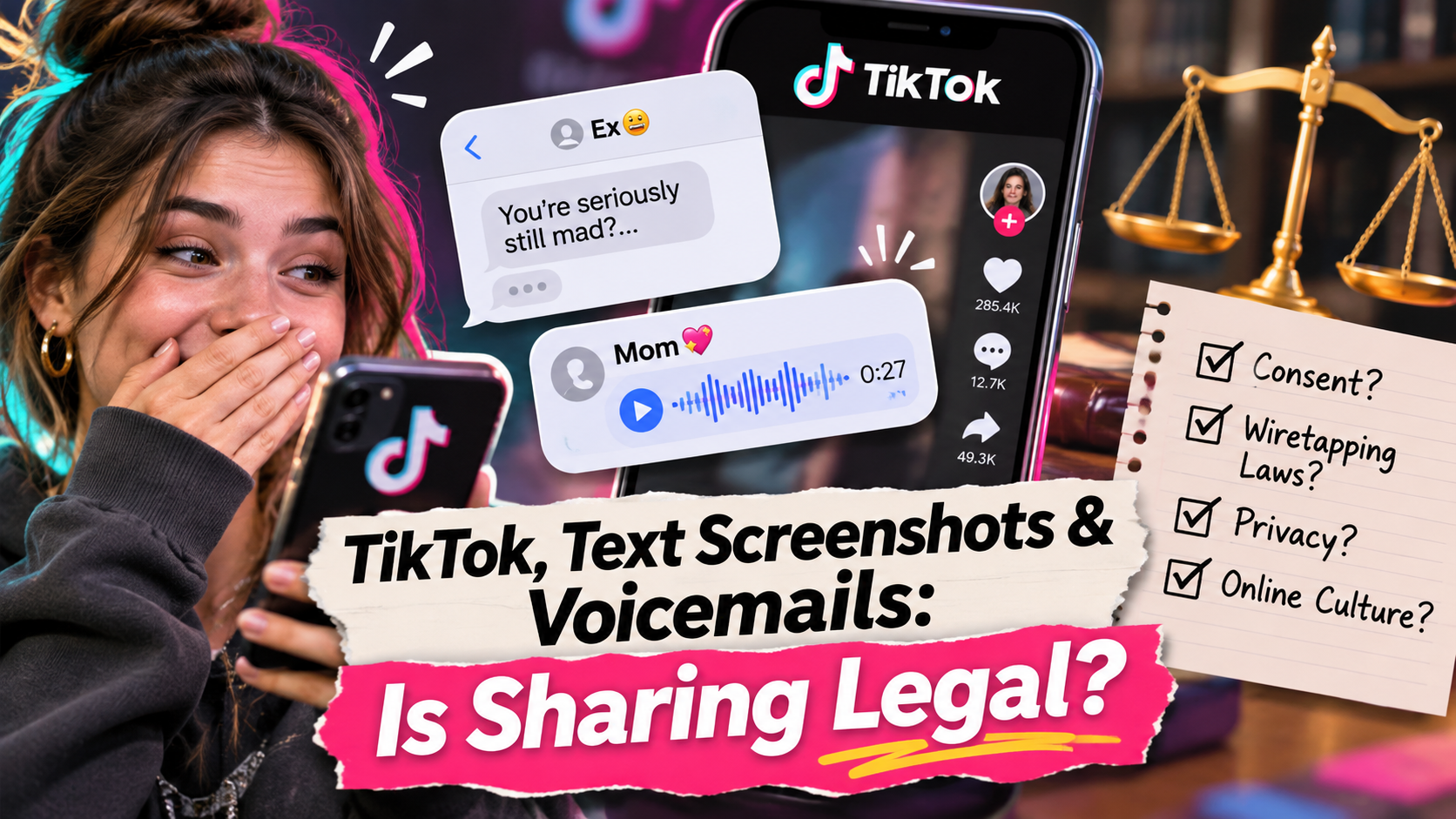
Somewhere along the way, a voicemail from your mother became a TikTok sound, a text from your ex became a song, and a private conversation became a slideshow narrated by a robotic voice. Most of the time, it's harmless, hilarious, or even endearing. But as wiretapping allegations make headlines, it's worth asking an increasingly uncomfortable question: When did receiving a message start feeling like permission to publish it?
Imagine you're having a perfectly ordinary Tuesday.
You send your sister a text.
Maybe it's a ridiculous question.
Maybe you've made an embarrassing typo.
Maybe you're trying to explain something and your autocorrect has decided to pursue an entirely separate creative direction.
Your sister laughs.
She takes a screenshot.
Then she opens TikTok.
She adds an aesthetic photograph.
A trending sound.
Some perfectly timed text transitions.
And suddenly your Tuesday afternoon message has been transformed into a three-slide comedy production.
The first slide says something like:
"Sometimes you just have to read your sister's texts and move on with your day."
The second slide is your actual text.
The third slide is a reaction image.
The comments are delighted.
Strangers are quoting you.
Someone wants a follow-up.
Congratulations.
You've become a recurring character in a content series you didn't know was casting.
And here's the thing.
The video might genuinely be hilarious.
You might even think it's funny when you see it.
You and your sister may have exactly the kind of relationship where sharing embarrassing messages is part of the friendship.
Maybe you'd happily give permission.
Maybe you've been sending each other screenshots for years.
This isn't an argument that every shared text message is a serious privacy violation.
The internet would become a much less entertaining place if every funny family message required a six-page agreement and two witnesses.
But something interesting has happened to our expectations.
We increasingly behave as though a message we received is automatically content we own the right to publish.
Someone sends us a voice note.
We upload it.
Someone leaves a voicemail.
We turn it into a trend.
An ex sends a dramatic paragraph.
We add background music.
A family member says something absurd.
We let text-to-speech read it to 80,000 strangers.
And because the post is funny, endearing, or familiar, the question of permission can seem almost unnecessarily formal.
Until it isn't.
The difference between “they sent this to me” and “they agreed I could share it with the internet” is larger than TikTok culture sometimes makes it feel.
That difference is legal in some situations.
Ethical in others.
And surprisingly relevant to digital marketing, social media strategy, customer trust, and the way brands handle other people's information.
So let's examine how we got here.
Preferably before your father's next voicemail gets remixed into an electronic dance track.
Welcome to the Era of the Accidental TikTok Supporting Character
TikTok has developed an entire genre of content built around things other people have said privately.
Not necessarily celebrities.
Not necessarily public figures.
Often just ordinary people having ordinary conversations.
Parents.
Grandparents.
Partners.
Former partners.
Best friends.
Siblings.
Coworkers.
And occasionally someone who made the unfortunate decision to leave a voicemail while being unintentionally hilarious.
The formula is familiar.
You receive something funny.
You take the original private exchange.
Then you repackage it for a public audience.
Sometimes the message is displayed as a screenshot.
Sometimes it's played as audio.
Sometimes a creator reads it aloud.
Sometimes the message is transformed into a song.
And sometimes an automated voice performs it with the emotional range of a GPS system that has just discovered betrayal.
The content works because everyday communication is funny.
People are strange.
Families have running jokes.
Friends send bizarre messages.
And voice notes capture little moments that feel spontaneous in a way polished content often doesn't.
In November 2025, social media trend researchers documented the TikTok format built around the phrase "sometimes you just have to read your [relative or partner's] text and move on with your day."
The concept involved sharing an unexpected or funny message from another person.
By 2026, creators were also turning messages from exes into songs.
A May 2026 trend analysis described videos that used actual message screenshots alongside musical versions of those conversations.
And Fast Company reported in June 2025 on a trend in which users shared texts and voice messages involving former partners, sometimes pairing them with popular music. <Cite ref="turn468105search6"/>
These weren't all sinister attempts to expose someone.
Some were lighthearted.
Some were affectionate.
Others involved real conflict.
And some crossed into subjects considerably more sensitive than a parent texting a completely unnecessary grocery-store update.
But the common format is important.
A private exchange becomes the raw material for a public performance.
And the person who originally sent the message doesn't necessarily participate in the decision.
The Internet's Newest Unwritten Rule: If It Fits the Trend, It's Content
Let's say your mother texts you:
"Are you coming for dinner and also do you know why my television is speaking Spanish."
You laugh.
You post it.
Everyone loves her.
Someone comments that your mother deserves her own account.
Someone else says the television has clearly entered its international era.
The situation is wholesome.
Nobody is particularly upset.
But what permission did the original message include?
Your mother intended to tell you about dinner and her television.
She probably wasn't consciously considering whether her words could be distributed to the general public.
She might be delighted by the attention.
She might be horrified.
She might ask why strangers know about her cable provider.
You don't necessarily know until you ask.
And that's the curious part of the cultural shift.
The social norm of sharing messages has developed much faster than our habits around asking permission.
It can feel completely ordinary to share a screenshot because the content is funny.
Sometimes that instinct is harmless.
Sometimes it isn't.
The presence of a trending audio clip does not automatically establish the presence of consent.
No matter how good the audio clip is.
Even if the robotic narrator has impeccable comedic timing.
1. Text Messages Have Become a Public Content Format
Text-message screenshots are almost perfectly designed for social media.
They are short.
Easy to read.
Easy to crop.
Easy to place over video.
And they come with built-in characters.
The blue bubble.
The gray bubble.
The person who sends seven messages in a row.
The person who replies "k."
The parent who treats every message as an urgent communication from an air traffic control tower.
The ex who has apparently decided a paragraph break would be a sign of weakness.
The entire story can fit on one screen.
And editing changes the presentation
A creator can select which messages appear.
Remove the surrounding conversation.
Change the order of screenshots.
Add captions.
Include reaction images.
Or use text-to-speech to give the words a particular tone.
Sometimes those choices simply make a joke easier to understand.
But they can also change what the exchange appears to mean.
Imagine a friend responding sarcastically to a conversation.
The recipient publishes only the sarcastic line.
Suddenly the friend sounds serious.
Or cruel.
Or bizarrely unreasonable.
The audience reacts to the version it was shown.
Not necessarily the full conversation.
That's one reason accuracy and context matter even when the original message is authentic.
A real screenshot can still create a misleading story.
And the fact that the words were genuinely typed doesn't establish that the public interpretation is fair.
2. Voice Notes Are Even More Personal
Text messages are one thing.
Voice notes add another dimension.
You hear the person's actual voice.
Their rhythm.
Their confusion.
Their laugh.
Their frustration.
Their accidental mispronunciation of a word that will now follow them for the remainder of their natural life.
A written text can be stripped of personality.
A voice note carries personality inside it.
That makes it entertaining.
It can also make publication feel more personal.
A private voice message isn't usually recorded as a performance for strangers.
It's recorded for the intended recipient.
Someone may speak differently to a sibling than they would to an audience of thousands.
They may use nicknames.
Mention private information.
Reveal where they are.
Or simply sound more emotionally exposed than they intended.
Yet once a voice note becomes content, the recipient can assign it an entirely different audience.
The friend who sent a 45-second message about a chaotic grocery-store experience may discover that the recording has become the week's favorite sound.
And everyone is now using their voice to describe unrelated problems.
An unexpected career in audio production.
No agent.
No contract.
No opportunity to request a different microphone.
3. A Voicemail Is Not Automatically a Secret Recording
This is where the legal distinctions matter.
And where a lot of online conversations become confused.
When someone leaves a voicemail, they generally know they're leaving a recorded message.
When someone deliberately sends a voice note, they know they've recorded their own voice.
When someone sends a text, they know the recipient can read and retain that written message.
Those circumstances differ from secretly recording a live private conversation.
That distinction is important under wiretapping laws.
Federal and state recording laws generally focus on the interception or recording of communications under particular conditions.
The Reporters Committee for Freedom of the Press explains that the requirements vary substantially by jurisdiction and by the type of communication.
Under federal law, recording a conversation generally requires the consent of at least one participant, subject to exceptions and limitations.
Certain states have stricter requirements.
But a voicemail intentionally left in a recipient's mailbox is not automatically the same thing as an unlawfully intercepted telephone conversation.
Similarly, taking a screenshot of a text you legitimately received is not automatically equivalent to secretly tapping into an active communication.
That doesn't mean publishing the material is always lawful or consequence-free.
It means we need to distinguish different acts.
Receiving something, recording something, and publishing something are not the same legal question.
And an alarming number of online discussions proceed as though they are.
4. The Wiretapping Question Is More Complicated Than TikTok Makes It Look
Some states generally permit a participant in a private conversation to record it without informing the other participants.
Other states require all parties to consent in circumstances covered by their laws.
These are often described as one-party and all-party consent states.
The Reporters Committee's recording-law guide explains that state rules can differ by type of communication, setting, privacy expectations, and other facts.
Interstate calls can raise additional questions.
A creator located in one state may communicate with someone in another.
The fact that the creator's own state permits certain recordings doesn't necessarily resolve every applicable issue.
For a specific example, Massachusetts General Laws, Chapter 272, Section 99 restricts secret interception of wire and oral communications, subject to its statutory terms and exceptions.
Massachusetts takes a relatively strict approach to secret recordings.
But it's still inaccurate to announce that every TikTok containing a voicemail is a wiretapping violation.
The person may have deliberately left the message.
The recording may have been made with consent.
Or the relevant legal rules may concern something other than interception.
The legal distinction worth remembering
Situation A: Someone sends you a funny text. You screenshot it.
Situation B: Someone leaves you a voicemail. You save the message.
Situation C: You secretly record a live private conversation.
Situation D: You publish a recording that someone else may have obtained unlawfully.
These situations may involve different legal questions.
And Situation D can be particularly complicated, including issues about knowledge, participation in unlawful activity, public concern, and constitutional protection.
The Reporters Committee's guide to disclosing recordings discusses some of those distinctions.
This article isn't legal advice.
Its point is that the legal analysis can't be reduced to:
"But they sent it to me."
Nor can it be reduced to:
"You posted a message, therefore you're guilty of wiretapping."
Both are oversimplifications.
5. The Recent Wiretapping Headlines Make This Conversation Feel Different
The broader question has become especially timely because of a separate criminal allegation involving online true-crime content.
In October 2026, Massachusetts authorities charged a Florida-based social media creator in a matter involving an allegedly unauthorized recording of a private conversation connected to the family surrounding the Lindsay Clancy case.
The creator has denied the charge.
Reporting has not conclusively established who originally made the recording.
And the criminal allegation remains unresolved.
The facts of that case are materially different from a person sharing a voicemail that was deliberately left for them.
That distinction should not be erased for the sake of a trend comparison.
But the case does provide a useful reminder that publishing audio online can raise serious questions about how it was obtained.
See CBS Boston's reporting for the allegations and their procedural status.
The reason to mention it here isn't to suggest that everyone posting an amusing family voicemail is committing a crime.
It's to recognize the larger cultural gap.
We have become accustomed to treating personal communications as entertainment.
But the rules governing recording, distribution, and privacy haven't simply disappeared because the content is packaged for social media.
A TikTok trend is not a legal exception.
It is, at most, a suggestion from the internet that now would be an excellent time to embarrass your brother.
6. The Weirdest Part Is That Most of These Posts Are Probably Not Intended to Be Harmful
This is what makes the issue genuinely interesting.
A lot of the content is affectionate.
Someone posts their grandmother's hilarious voicemail.
People adore her.
Someone shares a friend's dramatic response to a minor inconvenience.
The friend thinks it's hilarious.
A couple jokes about their strange text exchanges.
Both people are comfortable being included.
These can be enjoyable, consensual forms of storytelling.
The problem isn't the format itself.
It's the assumption that the sender's permission is unnecessary because the recipient thinks the content is funny.
Intentions matter to how we evaluate a situation socially.
But good intentions don't necessarily settle questions of privacy, consent, or legal responsibility.
Someone can share a private message affectionately and still embarrass the sender.
A friend may not mind being the joke within a small group but dislike being recognizable to thousands of strangers.
A family member might find the content funny until coworkers or neighbors recognize their voice.
And a person may be comfortable with one message being shared but not with an entire conversation becoming public.
Consent is contextual.
It's not an unlimited subscription.
Someone being funny in private is not automatically volunteering to be funny in public.
7. We've Turned Group-Chat Humor Into Public Entertainment
There used to be a meaningful distinction between showing a friend something funny and publishing it.
You might say:
"Look at what my dad just texted me."
You'd show the phone.
Everyone would laugh.
Then the conversation would move on.
The audience was limited.
The context was shared.
And the message generally remained within a small social circle.
Now, the same exchange can be published to an audience far beyond the people involved.
It might reach tens of thousands of viewers.
It may be reposted.
Someone might screen-record the TikTok.
Another account may remove the original context.
A sound can be reused.
A screenshot can circulate without the caption that explained it.
And a harmless family joke may become something the sender cannot easily control.
The FTC's guidance on sharing online makes a simple point: people should consider how posts affect others, ask permission where appropriate, and remember that content can be copied or saved even after it is deleted.
The advice is aimed at general online safety, not a legal ruling about every text-message screenshot.
But the principle translates well.
A communication can be intended for one audience and reach another.
And once it does, getting the original context back may be difficult.
8. There Should Be a Department of Accidental Content Contributors
Consider the following entirely fictional organizational announcement.
Important update from the Department of Accidental Content Contributors
Effective immediately, anyone who sends a message to a person with a TikTok account may be considered for one of several unpaid digital roles.
Supporting Character: You sent a funny text.
Recurring Character: You've sent three funny texts.
Breakout Star: Your mother has been asked to leave another voicemail.
Viral Sound Contributor: Your emotional delivery has been separated from its original context and is now being used to discuss supermarket parking.
Executive Producer: You accidentally suggested the phrase everyone is now repeating.
Please note that these positions do not include compensation, creative approval, or advance notice.
A representative will contact you if your message reaches one million views.
Just kidding.
Nobody will contact you.
You will find out when your coworker sends you the video.
This department is fictional. The normalization of turning acquaintances into content without asking, unfortunately, is not.
9. Cropping Out the Name Doesn't Necessarily Make a Post Anonymous
A common defense of message-sharing is:
"I covered their name."
That's a useful step.
But it may not be enough.
A screenshot can reveal identity through context.
Profile photographs.
Contact names.
Dates.
Shared references.
A workplace.
A location.
A unique situation.
Or something the sender said that people familiar with them would recognize.
Voice notes can be even more identifiable.
Someone may recognize the voice immediately.
A person doesn't become anonymous simply because the video doesn't display their full name.
And the more detailed the content, the easier it may be for others to identify the sender.
A useful test
Could someone who knows this person recognize them?
Does the message reveal sensitive information?
Could it create problems at work, school, or home?
Would the person be surprised by this audience?
If so, covering the name may not resolve the larger issue.
Sometimes the better solution is to paraphrase the exchange.
Or recreate the joke with fictional dialogue.
Or ask permission.
Yes, that last option remains available in 2026.
We've checked.
10. The Silly Voice Doesn't Magically Change the Privacy Question
This is one of my favorite absurdities of the format.
A creator takes a private text.
Then has an artificial voice read it dramatically.
Suddenly, the entire exchange feels like comedy.
The robotic narration creates distance.
It turns the message into a performance.
And the audience may forget that the words originated from a real conversation between real people.
But the method of presentation doesn't automatically erase the original source or its privacy implications.
A text read by a synthetic voice may still reveal private information.
A voice note transformed into a musical clip may still contain personal details.
A screenshot decorated with sparkles can still be misleading or identifying.
And an edited clip can create additional accuracy concerns if it changes the apparent meaning.
Technology changes the presentation.
It doesn't necessarily change the responsibilities.
You cannot legally or ethically launder every problem through a funny voice filter.
Although the internet seems determined to test that proposition.
11. Why Does This Content Work So Well?
From a digital marketing perspective, the appeal is understandable.
The content has several features that can make it compelling.
It's immediately relatable
Almost everyone has received a strange text.
It creates recognizable characters
The dramatic parent.
The chaotic friend.
The overexplaining partner.
The person who treats punctuation as an optional lifestyle choice.
It feels spontaneous
The material appears to come from real life rather than a heavily scripted production.
It has a simple structure
The audience quickly understands the setup.
It invites comments
People share similar stories.
They compare their own families.
They tag friends.
They suggest that the sender needs a dedicated account.
But none of these features guarantees virality.
And a successful format doesn't automatically justify using any available message.
This is where content strategy and ethics need to coexist.
The fact that something could perform well is not a complete reason to publish it.
For brands, that's an especially important distinction.
A business has more than the reaction to one post to consider.
It also has relationships, customer trust, privacy obligations, and long-term reputation.
12. Sometimes the Sender Is in on the Joke—and That's Great
It's important not to turn this conversation into an argument against humor.
If your mother knows you're sharing her texts and thinks it's hilarious, that's a different situation.
If a couple agrees to post their funny conversation, fine.
If a friend volunteers a voice note for a skit, great.
If someone intentionally makes content for an audience, there's no reason to pretend they're an unwilling participant.
Consent can make the format collaborative.
And collaboration can make it more enjoyable.
A creator might say:
"Can I post this? I think it's hilarious."
The sender might answer:
"Absolutely, but please remove the part about my job."
Or:
"Yes, but don't include my voice."
Or:
"No, that's just between us."
Those are useful boundaries.
The question isn't whether the creator is allowed to have fun.
It's whether the other person has a meaningful say when their private material is being repurposed.
And if the answer is no, the creator should consider a different way to tell the joke.
13. A Message From Your Ex Can Be More Complicated Than a Message From Your Mom
Not every shared message is a harmless family joke.
Some social media trends involve former partners.
Arguments.
Breakups.
Accusations.
Angry messages.
Or content intended to embarrass someone.
In June 2025, Fast Company documented a TikTok trend involving people publishing screenshots and voice notes from former relationships alongside popular music.
Some of the examples were lighthearted.
Others concerned painful or serious personal situations.
The stakes can change quickly when the post identifies someone or makes damaging claims about them.
Consider the difference
A sibling sends a comically confusing text about a television remote.
A former partner sends a deeply personal message during a difficult breakup.
Both are messages.
Both could technically be screenshotted.
But publishing them may have very different implications.
Depending on the circumstances and jurisdiction, the second situation could raise questions involving privacy, harassment, defamation, or other legal issues.
Truth is important, but it isn't the only relevant consideration.
Some states recognize legal claims involving public disclosure of highly private information, subject to specific requirements and defenses.
The Reporters Committee's First Amendment Handbook explains these distinctions, including privacy, newsworthiness, and the risks of publishing information about private individuals.
Not every embarrassing message creates liability.
But the answer isn't universally "you received it, so you can publish it."
14. There Is a Difference Between Sharing Receipts and Creating a Public Tribunal
People sometimes share messages to document conduct they believe was inappropriate.
There can be legitimate reasons to preserve communications.
Someone may need evidence for a workplace complaint.
A legal matter.
A safety concern.
Or another formal process.
But preserving information for a legitimate purpose isn't the same thing as publishing it for a social media audience.
The relevant circumstances matter.
A person seeking help, reporting abuse, documenting threats, or engaging in legitimate journalism may face very different considerations from someone posting a private exchange solely for entertainment.
It would be wrong to suggest that people should never share evidence of wrongdoing.
It would also be wrong to suggest that every person accused online is automatically guilty because a screenshot looks convincing.
Messages can be incomplete.
Edited.
Misleadingly presented.
Or missing essential context.
When serious claims are involved, professional advice and appropriate reporting channels may be more useful than turning the matter into a viral slideshow.
The internet can discuss accountability.
It just shouldn't confuse audience participation with due process.
15. What About Platform Rules?
A social platform's rules are another layer of the issue.
Something can be lawful but violate platform policies.
Something can avoid platform enforcement while still creating ethical or legal concerns.
And the absence of a takedown doesn't establish that a post was appropriate.
TikTok's August 2025 Community Guidelines update described policies addressing harmful behavior, bullying, misinformation, and other safety issues.
The platform also provides a process for reporting posts that users believe violate its rules.
But moderation isn't the same thing as legal adjudication.
The platform doesn't provide a blanket authorization to publish someone else's private information simply because the content uses a popular trend.
Nor does the platform's decision to leave a video online settle every possible privacy or recording-law question.
Creators should understand that social permission, platform permission, and legal permission can be different things.
Which brings us to the unofficial three-part internet analysis:
Is it funny?
Can I post it?
Should I post it?
The internet is excellent at Question One.
Questions Two and Three could use more staffing.
The Bigger Cultural Question: Have We Lost the Idea of a Private Conversation?
Not entirely.
People still expect private messages to stay private in many contexts.
They still distinguish intimate discussions from public announcements.
And many people ask permission before sharing something personal.
But digital tools have made the boundary increasingly easy to cross.
Everything is portable.
Everything is screenshot-friendly.
Every audio message can be replayed.
Every exchange can be edited.
And nearly every phone contains the tools needed to transform private communication into public media within minutes.
That convenience can blur expectations.
A private communication has one audience
The person or people involved.
A social media post has another
Potentially anyone who can access, copy, or redistribute it.
Those audiences may overlap.
But they aren't identical.
The person who sent a message may not have considered the second audience at all.
And the creator may not think much about the transition because sharing content is so technically easy.
The problem isn't that society suddenly stopped caring about privacy.
It's that our tools have made publication feel like the natural next step after finding something entertaining.
The screenshot button is easy to press. The social decision behind it deserves more thought.
16. The Friend Who Sends the Best Voice Notes Is Not Automatically Your Unpaid Content Department
Let's consider another fictional scenario.
Your best friend has an exceptional ability to describe minor inconveniences.
She once turned a delayed grocery pickup into a five-minute dramatic monologue.
Her voice notes are extraordinary.
You think she is hilarious.
Your other friends agree.
So you start sharing clips.
At first, she laughs.
Then people begin asking for more.
You post another one.
The audience grows.
Suddenly, your friend's private voice notes are a recurring content format.
You tell her:
"People love you!"
And perhaps she does love it.
But perhaps she doesn't.
Maybe the joke was fun the first time.
Maybe she doesn't want her voice appearing on strangers' accounts.
Maybe she wanted a private place to complain, not a public brand.
The important question becomes whether you're treating your friend as a collaborator or a resource.
A person can contribute something funny without agreeing to be part of a content strategy.
The relationship matters more than the content calendar.
And if the friend says stop, the appropriate response isn't:
"But this is my best-performing series."
It is to respect the boundary.
17. Businesses Need a Higher Standard Than “This Would Make a Great Reel”
This is where the conversation becomes particularly relevant to Ritner Digital.
Brands often look to personal social media trends for inspiration.
A customer sends a funny inquiry.
A client leaves an unusual voicemail.
An employee posts an entertaining message in the team chat.
Someone suggests turning it into content.
It might be genuinely funny.
But a business has additional responsibilities.
Customer communications
A customer didn't necessarily send a message with public marketing use in mind.
Employee communications
An internal conversation may contain private or confidential information.
Client work
A funny screenshot might reveal project details, contractual terms, or sensitive information.
Professional services
Some industries have specific confidentiality and privacy obligations.
Testimonials
Using a customer's words as an endorsement can raise separate advertising and consent considerations.
The FTC's business privacy guidance encourages organizations to understand what personal information they hold, limit access, and protect it appropriately.
That guidance doesn't mean every lighthearted customer message is legally protected confidential information.
It does mean businesses should treat information management as an intentional responsibility.
A company shouldn't assume that because an employee received a message on a business account, marketing automatically has permission to publish it.
A customer service inbox is not a royalty-free content library.
Someone should probably embroider that on a pillow for the social media department.
18. A Brand Can Participate in the Trend Without Exposing Anyone
Here's the good news.
The format is fun.
It can be adapted.
And a business doesn't need to publish an identifiable private message to participate.
Recreate the situation with fictional dialogue
Use original writing inspired by a common customer question.
Make it clear that the exchange is dramatized.
Ask permission
If a real customer, friend, or employee wants to participate, discuss what will be shared and where.
Use anonymous summaries
Describe the general situation without revealing the original message or identifiable details.
Invite submissions
A brand can solicit voluntary stories under clear submission terms, with appropriate consent and privacy protections.
Make the business itself the joke
A marketing agency might dramatize the universal experience of receiving 17 separate revision requests.
A restaurant could create a fictional text exchange about someone insisting they're "not that hungry" before eating everyone's fries.
An interior designer might invent a playful conversation between a homeowner and a paint swatch.
No actual customer's private messages required.
The objective is to capture the recognizable humor.
Not to turn real people into involuntary marketing assets.
And the fictional nature of the content should be clear enough not to mislead audiences.
19. If You're Going to Ask Permission, Ask About the Actual Use
"Can I share this?"
That question is better than assuming.
But context matters.
Someone may be comfortable with a message being shown to a few friends.
That doesn't necessarily mean they agreed to a public TikTok with commercial reach.
For a casual personal post, an understandable conversation may resolve the issue.
For business use, more formal authorization may be appropriate.
A useful permission process should consider:
What material will be shared?
Will the person's name or voice be identifiable?
Which platforms will carry it?
Will it be edited?
Will it be used in advertising?
Is the permission limited to a particular use?
What happens if the person later raises a concern?
The appropriate formality depends on the circumstances.
The purpose isn't to turn every family joke into a contractual negotiation.
It's to make sure the people involved understand what they're agreeing to.
Because someone can consent to one use without agreeing to every future use.
20. The Internet's Favorite Defense: “But It's Already Public”
Sometimes a message has already been posted somewhere.
That can change the context.
But it doesn't automatically erase every question about republication.
Was it originally published by the person who wrote it?
Was the material obtained lawfully?
Does the new post add false context?
Does it reveal additional private details?
Does the proposed use involve advertising or endorsement?
The facts matter.
And the rights surrounding public-interest reporting may differ from those surrounding commercial use or personal entertainment.
The First Amendment can provide important protections for publication, including in certain circumstances involving lawfully obtained information of public concern.
Those protections aren't identical to a blanket right to publish anyone's private messages for any reason.
The Reporters Committee's First Amendment resources explain some of the relevant distinctions.
For ordinary creators, there's a simpler practical principle:
If the person's participation is unnecessary to tell the story, consider leaving them out.
And if the content depends on exposing them, ask whether that exposure is fair and appropriate.
A viral format does not settle that question.
An Open Letter From the Fictional Office of Unsolicited Digital Fame
Dear Friends, Relatives, Exes, Parents, Coworkers, and Other People With Access to a Messaging App,
We regret to inform you that communication has changed.
You may believe you are sending a private message to one person.
In reality, you may be developing an unscripted media property.
Your next typo could become a slideshow.
Your voicemail could become a sound.
Your emotional paragraph could be transformed into a song.
Your mother's question about the Wi-Fi router could become a beloved recurring series.
Please note that the recipient's possession of your message does not, by itself, resolve all relevant legal or ethical questions about publication.
We apologize for introducing this nuance.
It is deeply inconvenient for the content pipeline.
In the meantime, we recommend that everyone consider the radical possibility of asking permission before posting identifiable private communications.
We understand this may reduce the speed at which content is produced.
However, it may also preserve several friendships.
Thank you for your cooperation.
Sincerely,
The Department of Messages That Were Not Intended for the For You Page
This letter is satire. The legal and privacy considerations discussed throughout the article are real and depend on the facts.
A Practical Reality Check Before You Post That Message
The next time you receive something funny, consider a few questions before turning it into public content.
Did the person knowingly create the recording?
A voluntarily sent voice note is different from a secretly recorded conversation.
Does the person know you want to publish it?
They may have intended only a private exchange.
Is the content sensitive?
Health, finances, family conflict, workplace issues, locations, and intimate matters deserve extra care.
Can the person be identified?
A blurred name doesn't always provide anonymity.
Does the edit preserve the real meaning?
A funny caption should not create a false impression of what someone said.
Is the person comfortable with the audience?
Sharing with close friends is different from public publication.
Could the post harm someone?
Think beyond immediate reactions.
Is there a safer way to tell the joke?
A dramatization or fictionalized example may work just as well.
Is this business content?
If so, consider consent, customer privacy, advertising rules, and relevant professional obligations.
Would you be comfortable if someone published your equivalent message?
Not a perfect legal test.
But an excellent social reality check.
And if the answer is uncertain, asking first may be easier than handling the consequences later.
Frequently Asked Questions
1. Is it illegal to post someone's text messages on TikTok?
Not automatically. Posting a screenshot of a message you legitimately received is not necessarily the same thing as unlawfully intercepting a communication. However, the content, how it was obtained, the applicable jurisdiction, and the manner of publication can raise separate issues involving privacy, harassment, defamation, or other laws.
2. Is posting a voicemail considered wiretapping?
Not automatically. A voicemail deliberately left for a recipient is different from a secretly recorded live conversation. However, how audio was obtained and how it is used can matter legally. Publication may also raise separate privacy concerns even when the recording was originally made lawfully.
3. Do I need permission to share a funny voice note from a friend?
As a practical and ethical matter, asking permission is a good idea—especially if the person is identifiable. Whether legal permission is required depends on the facts and applicable law. Someone voluntarily sending a voice note does not necessarily mean they agreed to public distribution.
4. What's the difference between a voicemail and a secretly recorded phone call?
A voicemail is ordinarily a message someone knowingly leaves as a recording. A secretly recorded call involves capturing a live communication without the knowledge or authorization required by applicable law. Different recording and publication rules may apply.
5. Are TikTok text-message trends actually popular?
Yes. Documented trends in 2025 and 2026 involved sharing funny texts from relatives and partners, displaying messages from exes, and turning private conversations into musical or narrated content. Popularity and performance vary, and no individual format guarantees views.
6. Can someone sue me for posting their private messages?
Potentially, depending on the facts and applicable law. Some jurisdictions recognize claims involving publication of certain private facts, defamation, or other privacy-related conduct. Not every embarrassing message creates a valid claim. A lawyer can assess a specific situation.
7. Does covering someone's name make a screenshot anonymous?
Not necessarily. The person's identity may be revealed through profile images, locations, unique references, conversation details, or information known to people in their community. Voice recordings can also be recognizable without a name.
8. Can I share an ex's messages if they're completely truthful?
Truth can matter, but it doesn't automatically resolve every privacy question. How the information was obtained, whether it concerns private matters, the surrounding context, and the purpose of publication may all matter. Serious accusations also require caution.
9. Is it illegal to screenshot a text someone sent me?
Taking a screenshot of a text you've legitimately received is not automatically an unlawful wiretap. But circumstances involving unauthorized access, interception, or other conduct may present different legal issues. Saving information and publicly publishing it should be analyzed separately.
10. What are one-party and all-party consent laws?
These laws concern when a private conversation may be recorded. Under one-party consent rules, recording may generally be permitted when one participant consents, subject to exceptions. Under all-party consent rules, permission from everyone participating may be required. The applicable rules vary by state and circumstances.
11. Can I record a call if I'm in one state and the other person is in another?
Interstate recordings can be legally complicated because different jurisdictions may have different consent requirements. The Reporters Committee recommends caution and considering the stricter applicable rules. Qualified legal advice is appropriate when the situation matters.
12. Does converting a text into a funny AI voice make it safe to publish?
No. Changing the presentation doesn't automatically eliminate privacy, accuracy, or other concerns. A text read by a synthetic voice may still reveal the sender's identity or sensitive information.
13. What if the person thinks the video is funny?
Mutual enjoyment and clear permission can substantially change the social situation. But consent should be understood in context. Being comfortable with one post doesn't necessarily authorize unrelated future uses, especially advertising or other commercial repurposing.
14. Are private text messages allowed as evidence in a legal matter?
Messages may be relevant evidence in certain proceedings, subject to rules governing authenticity, admissibility, privacy, and how they were obtained. Preserving or submitting evidence through an appropriate process is different from posting it publicly for entertainment.
15. Can brands use customer text messages in marketing?
They should obtain appropriate permission and consider privacy, advertising, and professional obligations before using customer communications. A customer sending a message to a business does not automatically authorize its use in promotional content.
16. How can businesses participate in screenshot trends without exposing customers?
Use clearly fictional dialogues, appropriately anonymized summaries, consensual collaborations, or original scripts based on common experiences. Avoid implying that fabricated conversations are real customer testimonials or that private customers agreed to participate when they did not.
17. Does TikTok allow posting anyone's private information?
No platform should be assumed to authorize unrestricted sharing of private information. TikTok maintains community rules addressing various forms of harmful behavior and provides reporting tools. Platform compliance, legal rights, and ethical judgment are separate considerations.
18. What should I do if someone posts my private message without permission?
You can ask the person to remove it, preserve relevant information about the post, and review the platform's reporting process. Depending on the circumstances, privacy, harassment, or other legal concerns may warrant professional advice. Avoid escalating the situation through threats or further publication of private material.
19. Why is this relevant to digital marketing?
The trends demonstrate how social content converts everyday communications into entertainment. For businesses, the same practices raise questions about customer consent, privacy, brand reputation, misleading editing, and responsible publishing. A content strategy should evaluate more than reach and engagement.
20. Can Ritner Digital help businesses develop social content without compromising trust?
Ritner Digital offers social media strategy, content development, brand messaging, and related digital marketing services. Businesses can discuss how to participate in relevant trends while maintaining appropriate customer privacy, accuracy, and brand standards. Specific legal questions require qualified counsel.
Final Thoughts: Maybe Not Every Text Was Meant to Become a TikTok
There is something genuinely charming about ordinary people being funny.
A grandmother's voicemail.
A sibling's chaotic text.
A friend's dramatic voice note about a completely inconsequential event.
Those moments are part of what makes social media entertaining.
They remind us that humor doesn't always need to be scripted.
Sometimes the funniest thing on the internet is something a real person said without trying to entertain anyone.
But there's also something worth reconsidering about the assumption that the person who received the message automatically gets to decide whether it becomes public.
Our technology has made publication effortless.
Our social norms haven't always kept pace.
And the pressure to participate in a trend can make the decision seem smaller than it is.
Sometimes sharing a message is harmless.
Sometimes everyone involved loves it.
Sometimes permission has already been given.
And sometimes the same familiar format can expose someone to embarrassment, unwanted attention, or more serious consequences.
The legal questions depend on how the material was obtained, what was shared, where it happened, and the applicable law.
The ethical question is often simpler.
Did this person expect their words to become content for strangers—and would they be comfortable with that happening?
For creators, that question is worth asking before publishing.
For brands, it's part of responsible content strategy.
And for all of us, it's a reminder that another person's messages are more than raw material for engagement.
At Ritner Digital, we believe social media can be funny, timely, creative, and culturally relevant without abandoning judgment.
Trends can help brands connect with audiences.
Humor can make content memorable.
And authentic moments can create meaningful engagement.
But long-term trust requires knowing the difference between a good story and a story that isn't yours to tell.
A strong digital strategy considers not only whether people will watch something, but what the business or creator is communicating through the decision to publish it.
Because somewhere right now, someone is leaving a voicemail that will be objectively hilarious.
And before we turn it into a viral sound, perhaps we can entertain one radical idea:
Ask them.
The internet will survive the extra eight seconds.
Probably.
Sources and Further Reading
This article examines a documented social media format, general recording-law distinctions, privacy considerations, and content strategy. It is not legal advice. The fictional examples, satirical departments, and invented messages are original illustrations, not descriptions of real private communications.
Fast Company — TikTok Users Are Exposing Their Worst Exes to the Soundtrack of Lorde's New Single.June 2025 reporting on trends involving private text messages, voice notes, and public storytelling. Read the article.
Social Growth Engineers — Sometimes You Just Have to Read the Text and Move On. November 2025 analysis of a popular screenshot-based TikTok format. This is commercial trend commentary rather than representative research on all TikTok users. Explore the trend.
Social Growth Engineers — Turning Texts Into Songs. May 2026 reporting on a format converting message screenshots into musical content. Read the trend analysis.
Cosmopolitan — TikTok Can't Stop Arguing About “Voice Memo Guy.” July 2026 reporting on a circulated voice note and the public discussion it generated. Read the coverage.
Reporters Committee for Freedom of the Press — Reporter's Recording Guide. State-by-state guidance on recording laws, consent, and legal risks. Explore the guide.
Reporters Committee — Introduction to Recording Laws. Explanation of federal one-party consent principles, stricter state rules, and interstate complications. Read the introduction.
Massachusetts Legislature — Chapter 272, Section 99. Massachusetts statutory law concerning the interception of wire and oral communications. Read the statute.
Reporters Committee — Disclosing Recordings. State-law considerations involving disclosure and publication of intercepted material. Read the legal guide.
Reporters Committee — First Amendment Handbook. Discussion of privacy torts, publication of private facts, consent, and public-interest considerations. Read the handbook.
CBS Boston — Florida Woman Accused of Wiretapping Patrick Clancy's Father. October 2026 reporting on a separate pending criminal allegation involving an online true-crime creator. Read the report.
TikTok Newsroom — Updated Community Guidelines. August 2025 announcement about platform safety, harmful behavior, moderation, and policy changes. Read TikTok's update.
TikTok Help Center — Report a Post. Instructions for reporting content that may violate platform rules. Read the instructions.
Federal Trade Commission — Heads Up: Stop. Think. Connect. Consumer guidance on privacy, permission, screenshots, and sharing online. Read the guidance.
Federal Trade Commission — Protecting Personal Information: A Guide for Business. Guidance on minimizing, securing, and appropriately handling customer information. Read the guide.
Ritner Digital — Social Media Management. Social media strategy, publishing, and brand communication. Explore social media services.
Ritner Digital — Content Systems. Developing useful, intentional content from genuine business knowledge and brand perspectives. Explore content systems.
Ritner Digital — Contact. Direct inquiry page for social media strategy, content development, and digital marketing discussions. Contact Ritner Digital.
Editorial Note: Satire, Privacy, and the Difference Between Recording and Sharing
This article uses parody to examine the social expectation that funny private messages can automatically be repurposed as public content.
The fictional characters, messages, and departments are satirical examples.
The legal distinctions are not jokes.
Receiving a message, intentionally leaving a voicemail, secretly recording a live conversation, and publishing someone else's communication are different acts that may be treated differently under applicable law.
Not every message shared without express permission is a crime.
Not every recording requires the same consent.
And not every publication of private information is legally protected or legally prohibited.
The answer depends on the facts, jurisdiction, content, and circumstances.
The article is intended to encourage thoughtful publishing practices, not to discourage legitimate reporting, documentation of abuse, or the responsible preservation of evidence.
Published November 2026. Legal and platform guidance should be reviewed for changes before relying on it for a specific situation.