Estate Homes, Deed Restrictions, and the Contractors Who Actually Get Called in Lower Merion
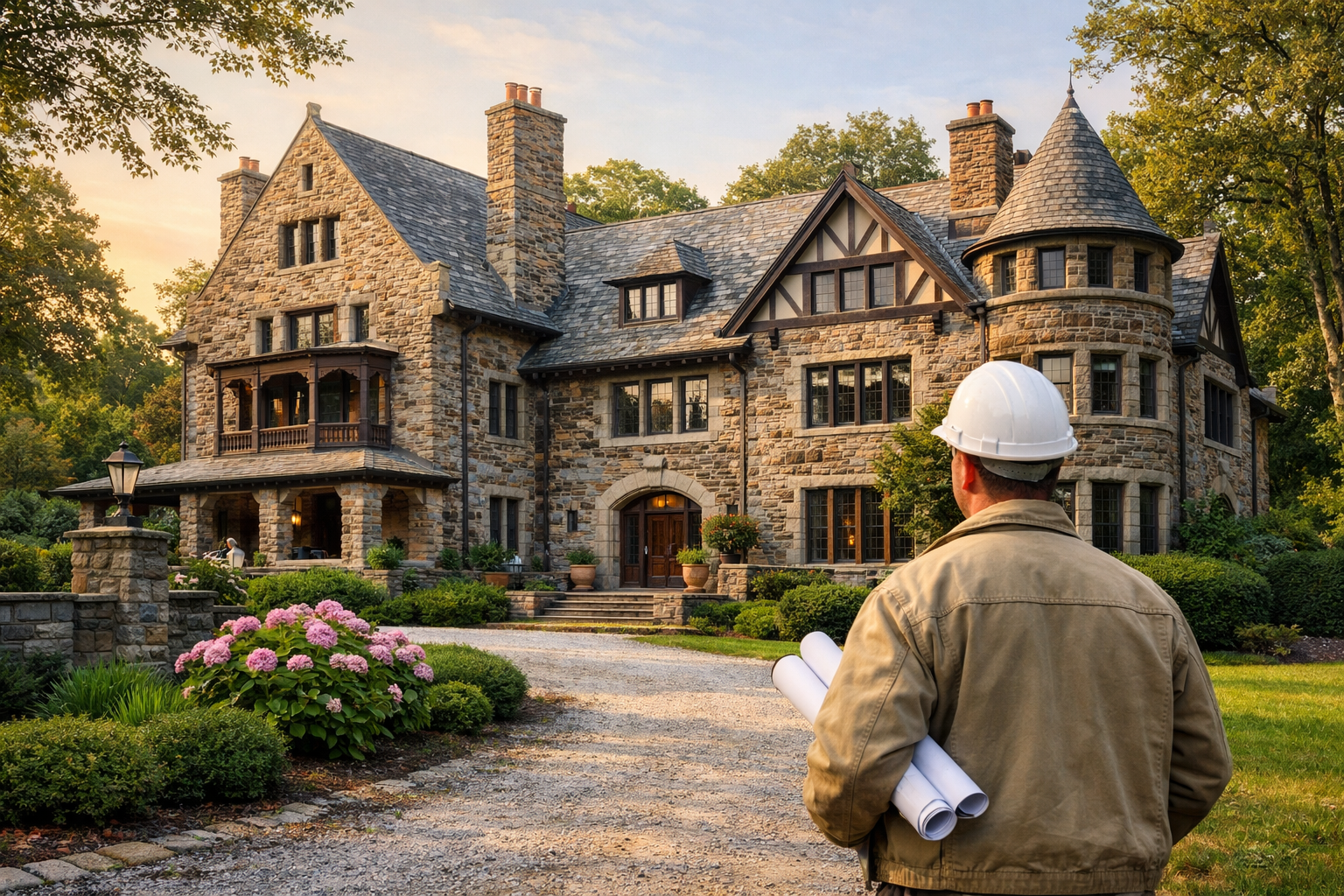
There is a stone manor on Crosby Brown Road in Gladwyne that was built between 1895 and 1905. It sits on 2.8 acres on a private lane, with a dramatic entry loggia, leaded glass doors, a 25-foot beamed ceiling in the formal living room, a marble wood-burning fireplace, and extensive stone terraces that look out over gardens that were once an arboretum. Pricey Pads The half-timbered exterior recalls an English country estate. The stonework is original. The property has been in continuous use for over a century and the families who have owned it have invested, each in their own generation, in maintaining it at the standard the house itself demands.
When that house needs a contractor, the owner does not go to Thumbtack. They do not type "contractor near me" and call whoever has the most five-star reviews from generic residential remodels in the Philadelphia suburbs. They call someone specific — someone whose name came from another owner of a comparable property, who has demonstrated through previous work that they understand what it means to work on a structure like this, who knows the materials, the history, the regulatory process, and the expectations that come with a house that is both a home and a piece of Lower Merion Township's built heritage.
That contractor is not easy to become. And for the contractor who has become it, this market is unlike anything else on the Main Line.
What makes the housing stock in Gladwyne different
Most residential contractors operate in a world of drywall and composite materials and standardized systems that have been installed and replaced in predictable ways since the 1970s. The housing stock in Gladwyne is not that world.
A walk through the Gladwyne Historic District reveals an amazing variety of residences: converted mill workers' houses, simple homes with Victorian, Stick Style and Gothic Revival embellishments, cottages and double houses from the 1920s, and small elegant estates. Lowermerionhistory Beyond the village center, the larger properties along roads like Youngsford, Mill Creek, Waverly, and Crosby Brown represent a different scale entirely — stone mansions and Tudor Revival estates built by Philadelphia's industrial and financial families in the decades following the Civil War, on lots that were deed-restricted early enough that they have never been subdivided and are unlikely ever to be.
Lower Merion Township's Historic Resource Inventory identifies over 1,000 significant historic properties. Lower Merion The township's Historical Architectural Review Board reviews applications for visible exterior alterations, new construction, demolition, and signage on properties within the local historic districts — and any work on these properties requires a Certificate of Appropriateness before it can proceed. Lower Merion The 2022 Design Guidelines document runs to dozens of pages covering the care and restoration of historic buildings in precise technical detail, aligned with the Secretary of the Interior's Standards for the Treatment of Historic Properties.
What this means in practice is that the contractor who shows up to a Gladwyne estate with standard residential methods and materials is not just doing the work wrong. They may be doing it illegally. The HARB process, the historic overlay district requirements, the preservation standards — these are not bureaucratic inconveniences. They are the framework within which every exterior alteration to a historic property in this township must be conducted. The contractor who doesn't know this framework, or who knows it and doesn't take it seriously, is a liability to the property owner rather than an asset.
What each trade actually faces in this market
For a general contractor or restoration specialist, the challenge is working with materials that haven't been manufactured to modern specifications in a century. Original Wissahickon schist stonework. Lime mortar that is fundamentally different in its behavior and repair requirements from modern Portland cement-based products. Millwork profiles that no longer exist in standard catalogs. Window types — leaded glass, steel casements, divided-light wood windows — that require restoration rather than replacement and that the HARB will scrutinize carefully if replacement is proposed. A contractor who does this work well is not applying general residential construction skills. They are applying a specialized knowledge of historic materials and methods that takes years to develop and that the market values accordingly.
For a landscaper or grounds professional, the scale and complexity of Gladwyne properties is the defining challenge. The estates on Crosby Brown Road and Waverly Road are not lawns with flower beds. They are designed landscapes — in some cases arboretums or formal gardens laid out by landscape architects in the early 20th century — where the maintenance standard is set by what the previous generation left behind. A mature specimen tree on a three-acre Gladwyne property is irreplaceable. The hardscape — stone walls, terraces, steps, garden structures — is often historic in its own right and requires the same care as the house itself. The grounds professional who understands this and can maintain a property at this standard is not competing on price. They are competing on knowledge and demonstrated capability.
For HVAC, plumbing, and electrical contractors, the challenge is working within historic fabric without damaging it. Routing new systems through walls and floors of original stone and plaster requires a completely different approach than standard residential work. The client is not accepting visible conduit or penetrations that compromise the historic material. They are expecting solutions that preserve the integrity of the structure while delivering modern performance — solutions that require ingenuity and restraint in equal measure, and a genuine respect for what the building is.
For architects and designers, Gladwyne represents the Main Line's highest-stakes residential commissions. A renovation or addition on a historic Gladwyne property requires navigating the HARB process, satisfying the Design Guidelines, working within deed restrictions that may prohibit certain alterations entirely, and meeting the expectations of an owner whose house is both a significant investment and, in many cases, a property they intend to steward for the next generation. The architect who has done this successfully before is worth significantly more to that client than one who hasn't — and the client knows it.
How the right contractor gets called
The trust network that drives contractor referrals in Gladwyne operates on the same principles as every other trust network in the community: slowly, through existing relationships, among people who have specific firsthand knowledge of quality. The difference from other markets is that the referral in Gladwyne carries more specific information than usual. It doesn't just say "this contractor is reliable." It says "this contractor understands the HARB process, knows how to work with Wissahickon stone, maintained the historic integrity of our 1905 exterior addition, and the township signed off without issue."
That level of specificity is only possible because the work itself is specific. And it is only possible to give because the recommender has direct experience — not of a generic pleasant contractor interaction, but of a contractor who demonstrated knowledge of a particular and demanding kind.
The contractors embedded in this referral network did not get there by marketing. They got there by doing the work correctly on one or two properties, impressing an owner who was paying attention, and being recommended to the next owner with the precision that this market's reputation economy demands. That process takes time. It requires excellent work on properties that are demanding enough to test it. And it produces a position that, once earned, is extraordinarily durable — because the knowledge and reputation that earned the position cannot be quickly replicated by a competitor.
Where the opening is — and what digital presence does here
The contractors embedded in the Gladwyne network are not being Googled. They are being called directly. Which means the search results for historic stone restoration, estate landscape maintenance, and high-end HVAC work in Lower Merion Township zip codes are largely uncontested by the best operators in the market.
That creates a specific and valuable opportunity for the contractor who has the skills and track record to serve this market but hasn't built the digital presence that makes them findable to the audience outside the existing network. The new resident who arrived from New York six months ago with a 1920s Tudor Revival property and a list of restoration priorities is not inside the Gladwyne referral network yet. They are going to search. And the contractor who shows up in that search with a profile that demonstrates genuine knowledge of historic Main Line properties — that mentions HARB, that references the specific material and regulatory context of this market, that has reviews from real clients in Lower Merion Township discussing specific work on specific property types — is not just findable. They are credible. They are, in the language of this market, appropriate.
Appropriate is the word that matters in Gladwyne. Not popular. Not the most reviewed. Not the most aggressive in their digital marketing. Appropriate — meaning their digital presence signals the same depth of knowledge and care that their work signals in person. That is a bar that is genuinely achievable for the contractor who already meets it in the field. It is simply a question of whether the people who need to find them can do so before they find someone else.
Ritner Digital builds digital presence for Main Line service businesses that are ready to be found by the clients who are already looking. If you work in this market and the right people can't find you, let's talk.
Frequently Asked Questions
What is the HARB process in Lower Merion Township and why does it matter for contractors?
The Historical Architectural Review Board is the body that reviews proposed exterior alterations, new construction, demolition, and signage on properties within Lower Merion Township's local historic districts — which includes the Gladwyne Historic District. Before any visible exterior work can proceed on a covered property, the owner must obtain a Certificate of Appropriateness from the HARB. This means a contractor working on a historic Gladwyne property needs to understand what the board will approve, what materials and methods are considered appropriate under the township's Design Guidelines, and how to document and present proposed work clearly enough to get through the review process without delays. A contractor who doesn't know this process exists is a significant liability to a property owner who does. A contractor who navigates it confidently is worth more than one who merely does good work.
What makes historic stone homes in Gladwyne and Lower Merion difficult to work on?
The primary challenge is materials. The original stone used in Gladwyne estates — much of it Wissahickon schist, the distinctive blue-gray stone that defines the visual character of the historic Main Line — behaves differently from modern masonry and requires different repair approaches. Lime mortar, which was standard in construction through most of the 19th and early 20th centuries, is softer and more flexible than modern Portland cement-based products. Using Portland cement to repoint historic lime mortar joints is a common mistake that accelerates deterioration of the stone itself. Beyond masonry, the millwork, windows, plaster, and structural systems in these houses are often irreplaceable in kind and require restoration rather than replacement. A contractor who treats a 120-year-old stone manor the way they'd treat a 1990s colonial is not just doing poor work — they are likely causing permanent damage to historic fabric that the HARB and the property owner will both notice.
How do contractors get recommended in the Gladwyne and Lower Merion estate market?
Through direct referral among property owners who have firsthand experience of specific work. The referral network in Gladwyne is not casual — it is information-dense. When an owner of a historic estate property recommends a contractor to a neighbor, they are not saying "they were nice and showed up on time." They are saying "they understood the HARB process, worked correctly with the historic materials, maintained the integrity of the exterior, and the township approved it." That level of specificity only develops through demonstrated performance on comparable properties. The contractors embedded in this network got there by doing the work correctly on one or two high-profile estates and being recommended with precision by owners who were paying close attention. It takes time to earn and is nearly impossible to shortcut.
Why should a contractor who is already busy through referrals in Lower Merion invest in digital presence?
Because the referral network is closed to everyone who hasn't been introduced to it yet — and new families arrive in Gladwyne every year from outside the Philadelphia region without a single local contact. A physician relocating from Boston, a finance partner moving from New York, an executive arriving from another market entirely — these households buy properties worth well over a million dollars and immediately need contractors, landscapers, HVAC specialists, and design professionals. They are not inside the network. They are going to search. The contractor who shows up in that search with a profile that reflects genuine knowledge of historic Main Line properties doesn't just get one new client. They get an introduction to someone who will eventually be inside the network — and who will refer accordingly once they are.
What should a contractor's Google Business Profile include to attract clients in the Gladwyne historic estate market?
It should reflect the specific work and market knowledge that distinguish a contractor in this space from generic residential competitors. That means service descriptions that reference historic property restoration, estate-scale work, and familiarity with Lower Merion Township's preservation requirements. It means reviews from real clients in zip code 19035 and the surrounding Lower Merion communities — ideally reviews that describe specific project types rather than generic praise. It means a website linked from the profile that demonstrates genuine understanding of the materials, regulatory context, and client expectations that define this market. The goal is not to look like the most popular contractor in the Philadelphia suburbs. It is to look like the most appropriate contractor for a historic Gladwyne estate — which is a different standard entirely and one that a well-executed digital presence can communicate clearly to the right audience.
Does Ritner Digital work with contractors and service businesses on the Main Line?
Yes. We work with Main Line service businesses that have the expertise to serve markets like Gladwyne and Lower Merion Township but haven't built the digital presence that makes them findable to the clients who are already searching. That means local SEO strategy calibrated to a low-population, high-expectation market — not a generic approach applied to a wealthy zip code, but a presence that reflects the specific knowledge and track record your business has actually built. If you're doing the right work in this market and the new residents who need you can't find you, that's a straightforward problem with a straightforward solution.