One Domain or Two? The SEO Tradeoffs Behind Parent Brands, Sub‑Brands, and Scaling Smarter
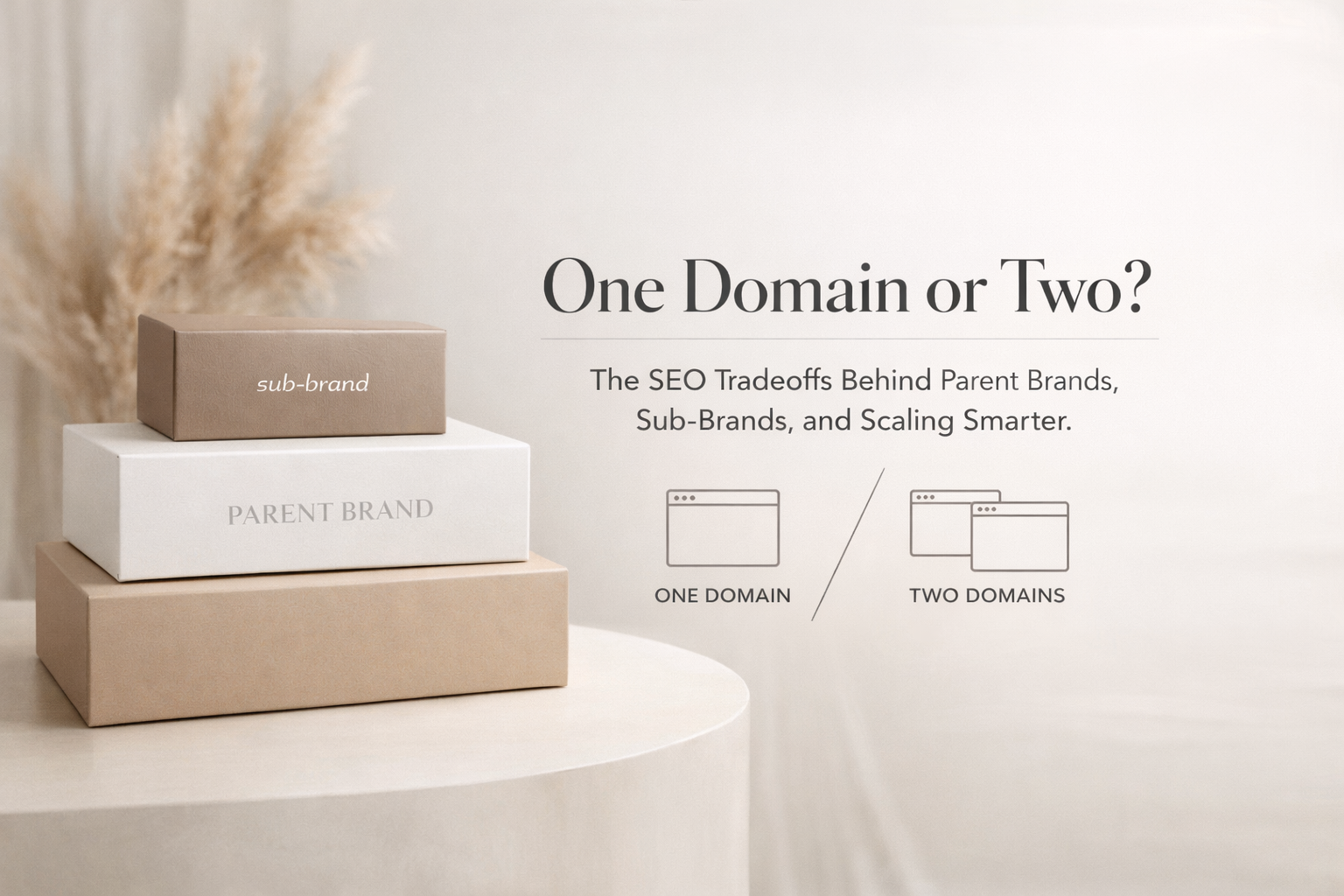
At some point, every growing company hits this fork in the road:
Do we keep everything under one domain… or spin up a second site?
Maybe you’re launching a new product line. Maybe you’re building a sub‑brand. Maybe sales wants a cleaner pitch, marketing wants flexibility, and SEO is sitting in the corner quietly screaming.
This decision matters more than it looks. The way you structure domains can either:
Compound your SEO power
Or quietly split it in half
Let’s break down the real pros and cons of running one domain vs. two — and when each strategy actually makes sense.
The Two Common Setups (Quick Definitions)
Before opinions, let’s define the options.
Option 1: One Domain (Everything Lives Together)
Example:
yourbrand.com/product-a
/product-b
/resources
/blog
One site. One authority. One SEO engine.
Option 2: Two Domains (Parent Brand + Separate Site)
Example:
yourbrand.com(parent brand)productbrand.com(separate product, vertical, or audience)
Two sites. Two identities. Two SEO strategies.
Now let’s talk consequences.
The Case for One Domain (AKA SEO’s Favorite Child)
If SEO had a bias — this would be it.
✅ Pros of One Domain
1. Authority compounds faster
Every blog post, backlink, landing page, and case study feeds the same domain authority.
SEO loves momentum. One domain builds it faster.
2. Content works harder
A blog post about Product A can indirectly help Product B rank.
Cross‑pollination > isolation.
3. Lower maintenance overhead
One site to update. One analytics setup. One technical stack.
Marketing teams stay sane longer.
4. Easier internal linking
Internal links pass authority cleanly when everything lives under one roof.
No hoops. No duct tape.
❌ Cons of One Domain
1. Messaging can get crowded
If you serve wildly different audiences, clarity can suffer.
One site trying to talk to everyone often resonates with no one.
2. Brand focus is shared
Sub‑brands don’t get to fully stand on their own.
This matters if perception and positioning are critical.
The Case for Two Domains (Power Move or Self‑Inflicted Wound?)
Two domains can work — but only when the strategy is intentional.
✅ Pros of Two Domains
1. Clear positioning for distinct audiences
If you sell to completely different buyers, separate sites can sharpen the message.
Less compromise. More relevance.
2. Brand insulation
A sub‑brand can experiment, pivot, or even fail without dragging the parent brand down with it.
Useful when risk tolerance is low.
3. Sales enablement
Dedicated domains can simplify sales conversations and funnels.
Sometimes focus converts better than authority.
❌ Cons of Two Domains (Read This Twice)
1. You split SEO authority
Google does not combine domain trust by default.
Two sites = two uphill climbs.
2. Content effort doubles
Each site needs its own:
Blog strategy
Backlinks
Technical SEO
Ongoing optimization
If you don’t double the effort, results get halved.
3. Slower time to traction
New domains start at zero.
Meanwhile, your main domain is already earning trust — and you’re choosing not to use it.
Scaling Reality Check (Where Most Teams Get This Wrong)
Here’s the quiet truth:
Most companies choose two domains because it feels cleaner, not because it’s smarter.
SEO doesn’t reward clean org charts. It rewards:
Depth
Authority
Consistency
Time
If your team can’t realistically support two full content and SEO engines, one domain will almost always outperform.
The Smarter Middle Ground (Often Ignored)
Instead of two domains, consider:
Subdirectories (
/solutions/,/industries/)Sub‑brands as sections, not sites
Dedicated landing hubs within one domain
You get:
Clear messaging
Shared authority
Faster SEO wins
Best of both worlds.
So… Which Should You Choose?
Choose one domain if:
SEO growth is a priority
Your audiences overlap
You want faster compounding results
Your team is lean
Choose two domains if:
Audiences are truly distinct
Brand separation is strategic (not aesthetic)
You can resource SEO twice
You’re playing a long game
If the answer feels fuzzy — that’s usually your signal.
Final Thought
This isn’t a branding decision.
It’s a scaling decision.
The wrong domain structure doesn’t break things overnight — it just quietly taxes every future growth effort.
Choose wisely.
If you’re debating domain structure and want an SEO‑first answer (not a design‑first one), that’s exactly what we do.
Ritner Digital
Strategy. Systems. Scale.
FAQs
Is it better for SEO to use one domain or two?
In most cases, one domain performs better for SEO. Keeping everything under a single domain allows authority, backlinks, and content to compound faster instead of being split across multiple sites.
When does it make sense to use two separate domains?
Two domains can make sense if you’re targeting completely different audiences, operating distinct business models, or need strong brand separation for strategic reasons. It only works well if you can resource SEO and content for both sites long-term.
Does Google combine SEO authority across multiple domains?
No. Google treats each domain separately. Even if two sites are owned by the same company, authority does not automatically transfer between them without deliberate linking and time.
Are subdomains better than separate domains for SEO?
Subdomains are still treated somewhat separately from the main domain. For most companies, subdirectories (not subdomains) are the better choice if the goal is shared SEO strength and faster growth.
Can I start with one domain and split into two later?
Yes — but it should be done carefully. Moving content or spinning off a brand later requires redirects, technical SEO planning, and realistic expectations around temporary traffic loss.
Will having two domains slow down growth?
It can. Two domains mean double the content, backlinks, analytics, and optimization work. If effort or budget doesn’t scale with it, growth usually slows instead of accelerates.
What’s the safest option if I’m unsure?
If you’re unsure, start with one domain. You can always segment content with subdirectories and spin off later once there’s proof, traction, and resources to support it.
Related Reads
〰️
Related Reads 〰️

Graduate Enrollment Isn’t a Brand Problem — Until It Is
Graduate enrollment marketing has long lived outside the university brand—optimized for leads, not trust. As universities segment more aggressively, misalignment is getting expensive. Here’s what’s breaking and how smarter institutions are fixing it.

How Many Pages Should Our Website Have?
"How many pages should our website have?" It's one of the most common questions we get from clients, and the honest answer is: it depends. But not in a vague, noncommittal way. There's a real framework for figuring out the right number of pages — and it has everything to do with what your business does, where you do it, and what your customers are actually searching for.

SEO Strategy for Companies with Long Sales Cycles
If your sales cycle takes months, SEO isn’t about quick wins—it’s about showing up early and staying relevant. This guide breaks down how companies with long sales cycles can use SEO to build trust, support sales, and win deals long after the first click.