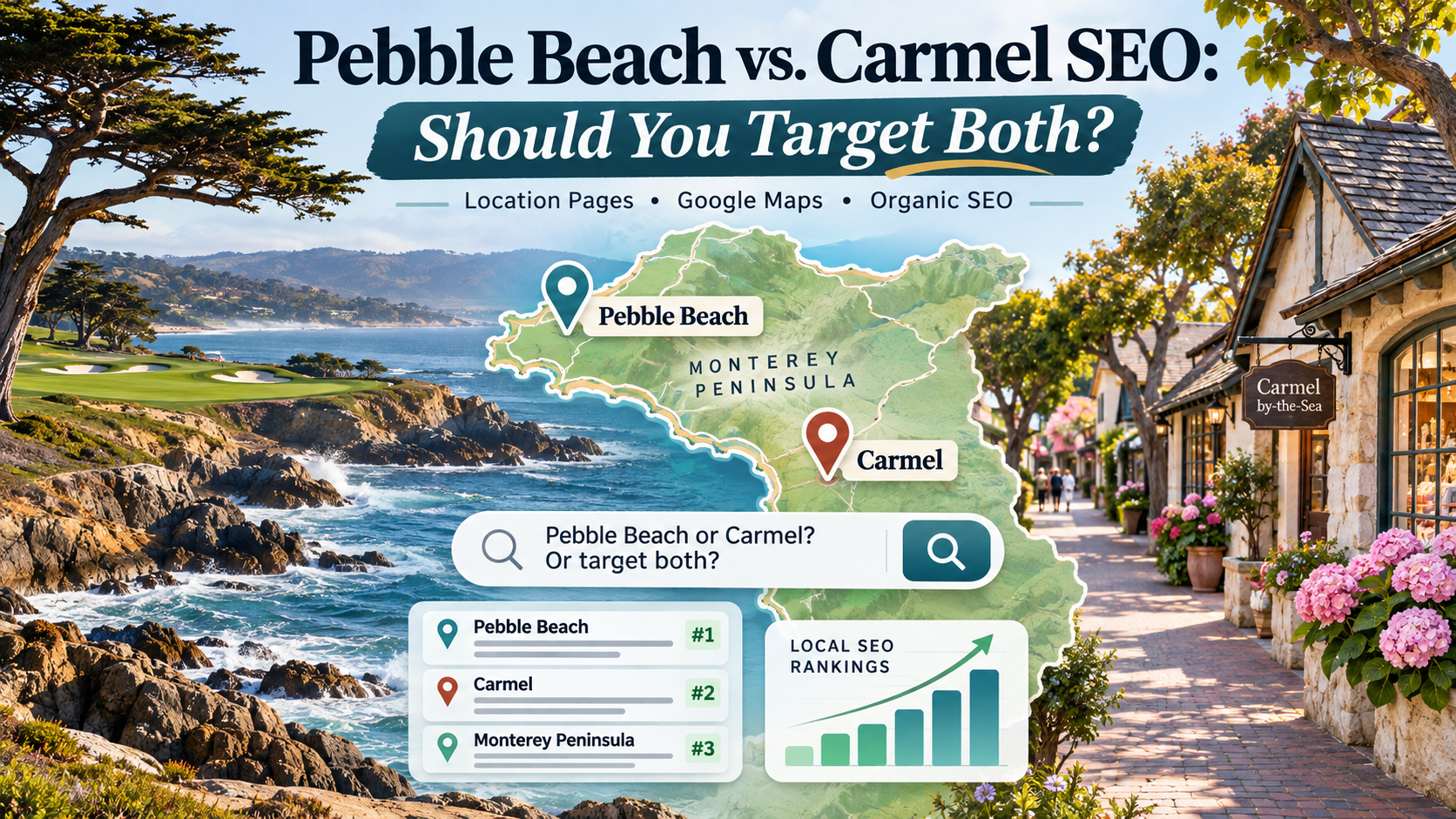
Pebble Beach and Carmel-by-the-Sea are neighboring communities on the Monterey Peninsula, but they're not identical search markets. For contractors, interior designers, property care companies, hospitality businesses, and other local service providers, knowing when to target both locations can make the difference between useful geographic SEO and a website full of repetitive pages.
Your business is based in Carmel-by-the-Sea.
You serve customers in Pebble Beach.
You also work with clients in Monterey, Pacific Grove, and other parts of the Monterey Peninsula.
When someone searches Google for your services in Carmel, you want to appear.
When someone searches for the same services in Pebble Beach, you want to appear there, too.
So what should you do?
Create a separate page for every city?
Add all the community names to your homepage?
Change your Google Business Profile service area?
Build a second website focused entirely on Pebble Beach?
Or simply trust that Google understands how close these places are?
The answer depends on where your business actually operates, what you offer, and whether customers searching in the two markets have meaningfully different needs.
That's the central challenge of geographic SEO.
A business can legitimately serve multiple communities without having a physical office in each one.
But serving an area and ranking prominently in its Google Maps results aren't the same thing.
Likewise, mentioning Pebble Beach on your website doesn't automatically make your business relevant to every Pebble Beach search.
And creating separate location pages doesn't guarantee better rankings.
For businesses serving the Monterey Peninsula, the strongest strategy starts with an honest evaluation of geographic coverage.
Then it asks a more useful question:
What information would help a Pebble Beach customer understand our services, and what information would help a Carmel-by-the-Sea customer?
If the answers are nearly identical, one well-developed service-area page may be sufficient.
If the customer needs, services, project examples, or practical considerations are meaningfully different, separate location pages may be justified.
The goal isn't to collect city names.
It's to help prospective customers discover a business that genuinely serves them.
This guide explains how to approach that decision, including local SEO, Google Business Profile, service-area pages, location-specific content, technical SEO, and measuring qualified inquiries.
First, Understand the Geographic Difference
Pebble Beach and Carmel-by-the-Sea sit near each other on the Monterey Peninsula.
They share regional connections, but they aren't the same municipality.
That's important for business information, local search, and the way websites describe their locations.
Pebble Beach is an unincorporated community
Pebble Beach is part of unincorporated Monterey County.
The county's Pebble Beach Historic Context Statement describes the area's relationship with the Del Monte Forest and surrounding communities.
Its boundaries adjoin Pacific Grove, Monterey, and Carmel-by-the-Sea.
Pebble Beach is also associated with golf courses, residential properties, coastal landscapes, and resort destinations.
But it is not a separate incorporated city government.
Carmel-by-the-Sea is an incorporated city
The City of Carmel-by-the-Sea identifies itself as an incorporated municipality with its own civic identity and local government.
The city was incorporated in 1916.
Its village character, commercial district, galleries, restaurants, and residential areas contribute to its distinct identity.
The city's official planning resources also provide boundary and property information.
Why this matters for SEO
A business located in Carmel-by-the-Sea shouldn't claim its street address is in Pebble Beach simply because it serves Pebble Beach customers.
A business operating from Monterey shouldn't invent a Carmel office.
And a company serving several communities shouldn't assume that one generic description makes its location clear.
The geographic distinction matters to customers.
It also matters to Google, which uses real-world business locations as part of local search ranking.
You can serve both markets without pretending they're one place.
Why Search Results Can Differ Between Pebble Beach and Carmel
Imagine two homeowners looking for landscape services.
One searches:
"Pebble Beach landscaping company."
The other searches:
"Carmel landscaping company."
The searches are similar.
But Google doesn't necessarily produce the same results.
The searcher's physical location may differ.
Google may interpret the place name differently.
The businesses closest to each search location may vary.
And some providers may have stronger relevance or prominence for one area than the other.
Google's local ranking guidance identifies three principal factors in local results.
Relevance: How well the business matches the search.
Distance: How far the business is from the searcher or the location associated with the query.
Prominence: How established or recognized the business appears through relevant signals.
Businesses can improve the accuracy and completeness of their information.
They can explain their services.
They can develop useful website content.
And they can build a genuine reputation.
But they cannot simply choose to rank in every location.
Google also states that businesses cannot pay for a better organic local ranking.
That distinction should shape expectations.
A company based in Carmel may be highly relevant to a Pebble Beach customer.
But Google Maps rankings can still vary because the business's real location remains part of the calculation.
This doesn't mean targeting both markets is pointless.
It means the strategy needs to recognize the difference between organic website visibility and local map visibility.
1. Start With Your Actual Service Area, Not a Keyword List
Before researching search phrases, define where your business genuinely works.
For a contractor, that means understanding where projects are accepted.
For an interior designer, it may involve the communities where the studio regularly serves residential clients.
A property care business should identify where it can reliably provide ongoing services.
A hospitality business has a physical location but may attract visitors researching several nearby destinations.
Those distinctions matter.
Ask practical questions
Where are your customers located?
Which communities do you actively serve?
Are there areas where you don't accept work?
Do travel requirements affect project eligibility?
Does your business offer the same services everywhere?
Are some locations more closely aligned with the projects you want?
What kind of geographic coverage can you communicate accurately?
The answers should guide the website.
A business shouldn't target a location simply because the area's name is associated with expensive properties.
A service area should reflect a real ability and intention to serve customers.
Example: A Carmel-based interior designer
A studio based in Carmel-by-the-Sea may regularly work on Pebble Beach residences.
In that situation, targeting both communities can be appropriate.
The website might identify the studio's actual location and explain its residential design service area.
It could also present authorized Pebble Beach project examples.
That's different from claiming to have two studios when only one exists.
Good geographic SEO begins with truthful business coverage.
2. Understand the Difference Between Google Maps SEO and Website SEO
One of the most common misunderstandings in local search is treating Google Maps rankings and ordinary website rankings as the same system.
They're related.
But they aren't identical.
Google Maps and local business results
These results are strongly influenced by real-world business information.
Google considers relevance, distance, and prominence.
A verified business location and appropriate Business Profile details matter.
Organic website results
These involve webpages that Google evaluates for relevance, usefulness, accessibility, and other search signals.
A business may have a useful page about serving Pebble Beach even if its physical office is in Carmel.
That page may be eligible to appear in relevant organic results.
But it won't eliminate geographic distance as a factor in Maps.
Why this matters
Imagine a contractor based in Monterey.
The business serves both Pebble Beach and Carmel-by-the-Sea.
It develops strong content explaining those services.
Its website may become more relevant for searches involving either community.
But Google could still display different nearby businesses in each area's map results.
That's not necessarily a failure of the website strategy.
It reflects the fact that the two search experiences consider different information.
A good SEO provider should explain which opportunity it is addressing.
A location page helps explain service relevance. It does not relocate your business on Google Maps.
3. Should You Put Both Cities on Your Homepage?
For some businesses, yes.
But it needs to feel natural.
A homepage can identify the core market the business serves.
For example:
"Residential interior design serving Carmel-by-the-Sea, Pebble Beach, and the Monterey Peninsula."
Or:
"Landscape renovation and property maintenance for homes across Pebble Beach, Carmel, and surrounding communities."
These are illustrative statements, not descriptions of specific companies.
Use language that accurately reflects the business.
The homepage shouldn't become a paragraph listing every town within driving distance.
That approach can look awkward.
It may also obscure what the company actually does.
Lead with your service
A visitor should first understand the business.
Then its geographic coverage.
A headline such as:
"Full-Service Residential Interior Design"
can be followed by a clear explanation of the areas served.
The location information supports the service.
It shouldn't replace it.
Avoid unnatural repetition
A homepage doesn't need to say:
"Pebble Beach interior design, Carmel interior design, Monterey interior design, Pacific Grove interior design, Carmel Valley interior design."
This type of repetition does little to explain the company.
A concise, accurate service-area statement is usually more useful.
The goal is clarity.
Not maximum keyword density.
4. When One Monterey Peninsula Service-Area Page Is Enough
Not every business needs a separate page for Pebble Beach and Carmel-by-the-Sea.
Sometimes one strong regional page is the better choice.
Imagine a residential cleaning company serving several nearby communities.
The services are the same.
The booking process is the same.
The customer questions are largely the same.
And the company doesn't have distinct project information or service requirements for each location.
Creating five nearly identical city pages may add little value.
Instead, the business could publish a useful page explaining:
Which communities it serves.
What services are available.
How scheduling works.
Whether there are geographic limitations.
What customers should know before requesting service.
And how to inquire.
The page can identify Pebble Beach and Carmel-by-the-Sea among the legitimate service areas.
This approach provides a clear explanation without manufacturing unnecessary content.
What makes a regional page valuable?
It gives customers enough information to determine whether they can hire the business.
It is easy to navigate.
It accurately represents the service area.
And it connects to relevant service pages.
A well-developed regional page can be more useful than several superficial location pages.
If the only difference between two pages would be the place name, you probably don't need both yet.
5. When Pebble Beach Deserves Its Own SEO Page
A separate Pebble Beach service page may be appropriate when the business has meaningful information specific to that market.
For example, a contractor may have completed several authorized projects there.
An interior designer may have relevant residential work that demonstrates a distinct project scope.
A property care company could provide legitimate services tailored to the needs of owners who are away from their residences for extended periods.
A landscaping business may have experience with relevant property conditions and project requirements.
The page should explain what matters to potential clients.
Not simply repeat the company's generic service description.
What a strong Pebble Beach page might contain
A clear explanation of the service.
The company's real geographic relationship to Pebble Beach.
Relevant, authorized project examples.
Specific service considerations supported by experience.
Accurate professional qualifications.
Appropriate local references.
Frequently asked questions.
And a clear inquiry pathway.
For a home services business, project-specific information may be especially valuable.
A prospective client may want to know whether the contractor has handled work similar to theirs.
For an estate care provider, the questions may involve communication, vendor coordination, service boundaries, and privacy.
The page should reflect the actual business.
What it shouldn't contain
Generic claims that Pebble Beach homeowners all have identical preferences.
Invented project histories.
False testimonials.
Unsupported pricing statistics.
Or statements implying the business has an office there when it doesn't.
A useful local page earns its existence by helping the customer.
6. When Carmel-by-the-Sea Deserves Its Own SEO Page
Carmel-by-the-Sea may justify distinct content for different reasons.
For a business with a physical storefront in the city, location information may be central.
Restaurants, galleries, shops, and accommodations need to communicate where visitors can find them.
For professional services, the value may come from relevant experience with projects or customers in the city.
A designer might discuss actual work associated with the built environment.
A contractor could explain the types of services it performs for local clients.
A hospitality provider can describe its real relationship to the village and surrounding destinations.
But avoid making regulatory claims without verification.
The City of Carmel's planning resources provide official information about zoning, maps, and property-related processes.
Requirements may vary by project.
A marketing page shouldn't imply that every property follows the same approval process.
What makes a Carmel page distinct?
For a storefront, accurate directions and business information may be especially useful.
For a service provider, actual projects, customer needs, and processes can differentiate the content.
A page should answer a question that the regional service page doesn't address as well.
Otherwise, it may be unnecessary.
7. The Biggest Mistake: Duplicate City Pages With Swapped Keywords
It's easy to create location pages.
An agency writes one template.
Then replaces the city name.
"Professional Landscaping Services in Pebble Beach."
"Professional Landscaping Services in Carmel."
"Professional Landscaping Services in Monterey."
The photographs stay the same.
The service descriptions stay the same.
The testimonials stay the same.
The page structure is identical.
Only the city name changes.
This may look like an efficient SEO tactic.
But it can create a poor user experience and search-quality concerns.
Google's spam policies describe doorway abuse as creating pages or sites to rank for similar searches while funneling visitors toward the same destination without providing meaningful value.
The examples include near-identical pages targeting different regions or cities.
Not every location page is doorway abuse.
A legitimate multi-location business may need separate pages.
And a service-area business may have genuinely useful information for different markets.
The distinction is whether each page provides a meaningful reason to exist.
A quick test
Remove the city name from the page.
Does the content still differ substantially from the neighboring location page?
If not, investigate whether the pages should be combined or improved.
That isn't an official Google test.
It's a useful editorial exercise.
Separate pages need separate value—not merely separate keywords.
8. Don't Create Fake Google Business Profiles for Each Community
A business serving both markets may be tempted to create two Google Business Profiles.
One for Carmel.
One for Pebble Beach.
But that's not how service-area eligibility generally works.
Google's Business Profile guidelines explain that service-area businesses ordinarily use a profile associated with their legitimate central business location.
Google does not permit businesses to use an ineligible virtual office or mailbox simply to create a local listing.
A co-working location also needs to meet specific eligibility requirements.
What about companies with multiple real offices?
A business may qualify for more than one profile when it has legitimate separate locations meeting Google's requirements.
The details depend on the business model and location arrangements.
A real staffed office is different from a rented mailing address.
And a second service area is not automatically a second business location.
Example
A Carmel-based contractor that visits Pebble Beach customers should not create a fake Pebble Beach storefront profile.
Instead, it can maintain an accurate eligible Business Profile and identify its legitimate service coverage.
The website can explain where the company works.
The two systems should be consistent.
A fake local address may create verification problems, policy violations, and reputational risk.
It's not worth the shortcut.
9. What Google's Service-Area Settings Actually Do
Google Business Profile allows eligible service-area businesses to specify the communities they serve.
According to Google's service-area documentation, businesses can enter up to 20 service areas using cities, postal codes, or other supported geographic areas.
Google generally recommends that the overall service coverage remain within about two hours of driving time from the business's location, although exceptions may apply.
The service area should be accurate and specific.
But here's the critical distinction.
Adding Pebble Beach as a service area does not guarantee a higher Maps ranking in Pebble Beach.
Google's local ranking system still considers relevance, distance, and prominence.
Changing a service-area setting doesn't mean the business physically moves closer to a searcher.
That setting communicates where the business provides services.
It is not a way to override Google's distance factor.
What should a contractor do?
Maintain the correct Business Profile.
Select appropriate categories.
Provide accurate service information.
Choose legitimate service areas.
Use real photographs.
Collect authentic reviews without prohibited incentives.
And make sure the website explains the services.
This creates a more credible foundation.
It doesn't guarantee a specific ranking in every community.
10. Understand the Difference Between Storefront and Service-Area SEO
Geographic strategy depends heavily on how a business operates.
Storefront businesses
Examples include restaurants, galleries, retail shops, and hotels.
Their actual location matters because customers visit them.
A restaurant in Carmel-by-the-Sea should generally focus on accurately representing that physical location.
It may attract guests staying in Pebble Beach.
But it doesn't need to pretend it has a second restaurant there.
Service-area businesses
Examples may include landscapers, cleaning companies, property care providers, and some contractors.
These businesses travel to customers.
Their coverage may extend across several communities.
A regional service-area strategy may therefore be appropriate.
Hybrid businesses
Some businesses receive customers at a staffed location and also provide services off-site.
Google has separate guidance for those arrangements.
The correct representation depends on how the business actually operates.
Why the distinction matters
A boutique hotel should prioritize accurate location and booking information.
A landscape design-build company may need service pages and project examples from several communities.
A home-watch business may need to explain geographic availability and its service process.
The same location-page template should not be applied indiscriminately to all three.
11. Build Your Website Around Services First, Locations Second
A useful geographic SEO structure often begins with the business's primary services.
Then it connects those services to appropriate geographic content.
For example, an interior design studio may have core pages explaining residential design, furnishing services, and its working process.
If the studio genuinely serves both Pebble Beach and Carmel-by-the-Sea, the website can explain that coverage.
Separate location pages may be added when they provide distinct value.
But the service pages remain the foundation.
A practical website structure
Homepage: Introduces the business and legitimate regional coverage.
Service pages: Explain what customers can hire the company to do.
Service-area overview: Identifies the communities served.
Distinct local pages: Provide meaningful additional information where justified.
Portfolio or case studies: Show authorized examples of completed work.
About page: Presents the company, experience, and qualifications.
Contact page: Makes it easy for suitable customers to inquire.
The site should also use clear internal links.
A Pebble Beach location page might link to the relevant residential design service.
A project story could link to its service page and the broader portfolio.
This helps visitors navigate.
It also helps search engines understand the relationship among pages.
Google's SEO Starter Guide encourages a logical structure and descriptive, useful content.
The goal is an organized website.
Not a separate URL for every combination of city and service.
12. Should You Create "Pebble Beach Landscaping" and "Carmel Landscaping" Pages?
Possibly.
But only when the distinction is meaningful.
Let's consider a hypothetical landscaping company serving both communities.
The company performs garden maintenance and larger residential landscape renovations.
Its website already has a general landscaping services page.
Should it create separate location pages?
When separate pages make sense
The company has legitimate project examples from both communities.
It can accurately explain how its work differs by project type or client requirements.
It has useful local information beyond generic descriptions.
The pages contain distinct photographs and relevant details, with permission.
And customers would benefit from the separate explanations.
When one regional page may be better
The services are identical.
There are no meaningful location-specific examples.
Both pages would use the same photographs and wording.
The business has limited content maintenance resources.
And the distinction offers little practical value.
In that situation, one strong service-area page may be sufficient.
You can still mention both communities naturally.
The choice should follow customer usefulness and available evidence.
It shouldn't be made solely because a keyword tool lists two phrases.
13. Real Estate and Interior Design Need a Different Geographic Approach
Geographic SEO becomes more nuanced when businesses serve clients making substantial property-related decisions.
An interior designer may work with owners throughout the Monterey Peninsula.
A real estate professional may represent buyers and sellers across several neighboring communities.
But those businesses shouldn't assume every customer is making the same decision.
For interior designers, potential clients may evaluate project style, scope, collaboration, and past work.
The distinction between Pebble Beach and Carmel may matter when the studio has genuine relevant experience.
For real estate professionals, specific neighborhoods and property considerations can make local expertise particularly important.
However, geographic pages should not contain unsupported claims about prices, demographics, appreciation, or buyer behavior.
Relevant market information should come from reliable, appropriately dated sources.
A real estate professional should also respect applicable licensing, MLS, and advertising requirements.
What makes a strong geographic page?
Original insight.
Accurate professional qualifications.
Relevant examples.
Clear service information.
And a genuine explanation of the market being discussed.
Don't claim neighborhood expertise simply by repeating a town name.
Demonstrate it through information a customer can evaluate.
14. Hospitality Businesses Should Focus on Where Guests Actually Stay
A hotel based in Carmel-by-the-Sea may attract travelers researching Pebble Beach.
That doesn't mean it should rename itself a Pebble Beach hotel.
The website should clearly communicate the property's actual location.
Then it can explain why that location may be relevant to guests exploring the wider peninsula.
A useful page might answer questions about accommodations, amenities, booking arrangements, and verified nearby destinations.
But it shouldn't invent transportation connections or imply official relationships with nearby resorts and golf courses.
Example
A Carmel inn may publish a guide for travelers planning to visit Pebble Beach.
The content should identify the inn's actual location.
It may explain relevant guest-planning considerations and link to official destination information.
But it shouldn't claim to be located inside Pebble Beach.
The distinction is important for trust.
A guest who books expecting one location and arrives somewhere else is unlikely to appreciate the SEO strategy behind the description.
Hospitality SEO should make travel planning clearer, not blur geographic boundaries.
15. Property Care and Concierge Services Can Benefit From Specific Local Content
Property care businesses may have a particularly strong reason to explain their geographic coverage.
A second-home owner considering ongoing property services may care about reliability, communication, access arrangements, and response capabilities.
A website can clarify which communities the company genuinely serves.
It can also explain the service process.
For example, a business may offer property checks, vendor coordination, or concierge assistance.
Those services should be described accurately.
Don't advertise regulated property-management or leasing activities without appropriate authorization.
And don't imply that all homes in Pebble Beach have identical access requirements.
A useful location page might explain what an owner should ask when evaluating a service provider for a property in the area.
But sensitive property information should remain private.
Avoid publishing client addresses, security details, access codes, or identifiable service arrangements without appropriate permission.
For property care companies, geographic SEO and trust should work together.
The website needs to explain where the business operates.
It also needs to show why someone should feel comfortable contacting it.
16. Create Location-Specific Project Stories Without Compromising Privacy
Project portfolios can be valuable for service-area SEO.
A completed project gives prospective clients evidence of the company's work.
It may also provide natural geographic context.
But that only works when the information is authentic.
Imagine a contractor that completed a substantial authorized project in Pebble Beach.
A useful case study might describe the work performed, the company's role, and relevant project considerations.
It can include photographs with appropriate rights and permission.
The content may help a prospective Pebble Beach customer understand the company's capabilities.
However, the business shouldn't disclose sensitive property details unnecessarily.
A general location may be sufficient.
There may be no reason to publish the exact address.
Likewise, a designer shouldn't claim responsibility for architecture or construction work performed by others.
Good case studies explain actual work
What was the project?
What services did the company provide?
What decisions mattered?
Which professionals contributed?
What can a prospective customer learn?
The description should reflect the real scope.
Don't invent homeowner motivations or customer outcomes.
A genuine project story is often more persuasive than a generic location page.
It's also a more credible way to demonstrate regional experience.
17. Avoid Keyword Stuffing in Page Titles and Headings
An SEO page doesn't need every possible geographic variation in its title.
For example:
"Pebble Beach Carmel Monterey Pacific Grove Best Interior Designer"
This is difficult to read.
It also does little to distinguish the actual business.
A clearer title could focus on the service and a primary location.
For example:
"Residential Interior Design in Pebble Beach"
The page could then explain the studio's genuine regional coverage.
Or a broader page might use:
"Interior Design Across Pebble Beach and the Monterey Peninsula"
The correct choice depends on the content.
What about "Carmel" versus "Carmel-by-the-Sea"?
These terms may appear in different search queries.
But the website should use language that accurately identifies the place being discussed.
"Carmel" can sometimes be used informally.
It can also create ambiguity when compared with Carmel Valley or other nearby areas.
Use the full name where clarity matters.
A relevant article may naturally use both forms, but keyword repetition isn't necessary.
The page should be written for readers first.
Not constructed around every possible permutation.
18. Don't Confuse Carmel-by-the-Sea With Carmel Valley
This distinction deserves its own section.
"Carmel" isn't always a precise geographic reference.
Carmel-by-the-Sea is a specific incorporated city.
Carmel Valley is a different area.
Carmel Highlands is also distinct.
Businesses may serve one, several, or all of these places.
But the website should not treat them as interchangeable simply because the names are related.
Example
A business that serves Carmel-by-the-Sea and Pebble Beach may not accept projects farther into Carmel Valley.
Its website should reflect that.
Another business may serve all three areas.
In that case, clear geographic language can help customers determine whether the company is appropriate.
Search research should also examine what people mean by a particular phrase.
A search for "Carmel contractor" may not reveal the searcher's precise intended community without additional context.
That uncertainty is a reason to investigate.
Not a reason to make unsupported assumptions.
For geographic SEO, precision is useful.
19. Can Schema Markup Help You Target Both Markets?
Structured data can help search engines understand certain details about a business.
Google supports LocalBusiness structured data.
Appropriate markup may communicate information such as business name, location, contact details, and opening hours.
But structured data should reflect the actual business.
It should not invent a second office.
A service-area company should not create false physical address information in markup.
And adding place names to schema does not guarantee local rankings.
What structured data can do
Help clarify certain machine-readable business facts.
Support accurate representation of eligible local business information.
Provide additional context when properly implemented.
What it cannot guarantee
First-place Google Maps rankings.
Prominent visibility in every service area.
A new physical location.
Or automatic inclusion in AI-generated recommendations.
Structured data is a supporting technical tool.
It doesn't replace legitimate business information, useful content, or real-world relevance.
20. What if Google Sees Your Location Pages as Duplicates?
Some businesses discover that multiple location pages receive little search traffic.
Others find that Google indexes only one of several similar pages.
This may happen for several reasons.
Duplicate or near-duplicate content is one consideration.
Google's canonicalization documentation explains how Google identifies representative pages when content is substantially similar.
However, similar pages aren't automatically considered spam.
The larger question is whether the pages have distinct value.
What to do during an audit
Review each location page.
Compare its information with the others.
Check indexing and canonicalization in Search Console.
Determine whether the pages address different customer needs.
Evaluate whether they have meaningful original content.
Then decide whether to improve, combine, or retire them.
Don't automatically canonicalize legitimate city pages together
If the pages genuinely serve different purposes, treating one as a duplicate of the other may prevent the intended page from being represented independently in search.
Canonical tags are not a universal solution for geographic SEO.
They should be used when appropriate to the content relationship.
A thoughtful audit is better than adding technical tags without understanding the problem.
21. Use Internal Links to Connect Services, Places, and Projects
A good geographic SEO website should be easy to navigate.
Visitors should be able to move naturally between the service they need and relevant local information.
For example, a contractor's main landscape renovation page could link to a useful Pebble Beach project story.
A regional service-area overview might connect to a dedicated Carmel page if the latter contains distinct information.
An interior designer's portfolio could link to the corresponding service page.
The links should make sense for readers.
Avoid adding long blocks of identical location links to every page simply to maximize internal linking.
Write descriptive link text
Instead of repeatedly using "click here," explain where the link leads.
For example:
"Explore our residential landscape renovation services."
Or:
"See a completed Pebble Beach project."
That's helpful to both visitors and search engines.
A simple, coherent site structure is often more effective than a complicated network of location pages.
The goal is to make information easy to find.
22. Use Reviews Ethically Across Your Service Area
Customer reviews can support local credibility.
They may also provide useful perspective about the work a company performs.
A contractor serving both Pebble Beach and Carmel might receive feedback from customers in either community.
That's legitimate.
But the business shouldn't pressure reviewers to include specific location keywords.
Nor should it offer discounts in exchange for positive reviews.
Google's review guidance prohibits incentives for posting, changing, or removing reviews.
A responsible review approach
Ask customers for honest feedback.
Make the process easy.
Don't selectively request only positive reviews.
Avoid sharing private customer information in responses.
And respond professionally.
If a review naturally mentions the service or location, that's the customer's choice.
Don't script testimonials to create geographic keyword coverage.
A genuine review is more useful than one that sounds engineered for search rankings.
23. Local Backlinks Should Reflect Real Relationships
Businesses sometimes try to build geographic relevance through directory links or paid placements in every nearby community.
But links should be evaluated for relevance and authenticity.
A genuine professional association may be useful.
A legitimate community partnership may create appropriate visibility.
An independent publication might reference a business because it contributed useful expertise.
Those relationships can make sense.
But buying large quantities of location-focused links solely to influence rankings can create problems.
Google's spam policies identify several forms of manipulative link building.
The best approach is to earn relevant recognition through real business activity, useful content, and appropriate relationships.
For a two-market strategy
A company should not assume it needs a separate set of paid backlinks for Pebble Beach and Carmel.
Instead, consider which organizations and publications genuinely relate to its services and geographic coverage.
The audience should matter more than the number of city names in the links.
24. How to Research Which Market Has Better SEO Opportunities
A common question is whether Pebble Beach or Carmel has greater search demand.
There is no universal answer.
It depends on the industry, service, and specific search phrase.
A restaurant may encounter a different search environment from an interior designer.
A hotel may compete with different types of websites than a home services contractor.
And an expensive project category doesn't necessarily have a large monthly search volume.
Start with actual data
Use Google Search Console to see which relevant queries already produce impressions and clicks.
Review current search result types.
Investigate whether searches trigger local business results, organic pages, advertisements, or other experiences.
Consider the business's real geographic relevance.
Then evaluate commercial intent.
A low-volume search for a specific professional service may be more valuable than a high-volume general destination query.
Be careful with keyword-volume estimates
Third-party tools provide estimates.
For small geographic markets, the numbers may be limited, aggregated, or uncertain.
A keyword with no reported volume may still represent real customer demand.
And a phrase with high estimated volume may attract people who aren't potential customers.
Don't make major business decisions based on one number.
The better market is the one that contains the right customers for the services you can deliver—not necessarily the one with the biggest keyword estimate.
25. Measure Pebble Beach and Carmel Performance Separately
If a business decides to target both markets, its reporting should reflect that decision.
Don't combine everything into one generic "Monterey Peninsula rankings" metric.
Look at the searches and outcomes associated with each market.
Search Console
Google Search Console allows filtering by queries and pages.
You can investigate terms containing Pebble Beach and Carmel, compare relevant URLs, and review changes over time.
Google's advanced filtering guidance explains how query and page filters work.
However, keep an important limitation in mind.
A query containing "Pebble Beach" doesn't prove that the person searching was physically located in Pebble Beach.
Likewise, a query containing "Carmel" doesn't always establish exactly which nearby area the customer intended.
Website analytics
Track relevant form submissions, calls, consultation requests, and other key actions where appropriately configured.
Customer records
When reliable information is available, evaluate which geographic areas produce suitable inquiries and actual projects.
Respect customer privacy and applicable data rules.
Quality of opportunities
A company might receive more inquiries from one area but find that the other produces a better fit for its services.
Both pieces of information matter.
Raw traffic alone is not enough.
The purpose of measurement is to guide resource allocation.
Not simply prove that a location page received impressions.
A Practical Example: One Contractor Serving Both Markets
Consider a hypothetical landscape renovation company based in Carmel-by-the-Sea.
It serves homeowners in Pebble Beach, Carmel, and selected surrounding communities.
The business wants more qualified inquiries for substantial residential projects.
Its current website has one generic services page and a basic contact form.
An agency proposes creating 15 location pages.
But many of the pages would use the same information.
A more focused approach might begin differently.
Step 1: Improve the core service page
Explain the company's real landscape renovation services, qualifications, process, and appropriate project scope.
Step 2: Develop an accurate service-area overview
Identify the communities where the company accepts projects.
Clarify any relevant geographic limitations.
Step 3: Create genuine project stories
Use authorized photographs and accurate descriptions of work completed in relevant areas.
Step 4: Evaluate separate local pages
If there is enough meaningful material about Pebble Beach and Carmel, create distinct pages.
If not, maintain the stronger regional overview.
Step 5: Review Google Business Profile
Ensure the company accurately represents its real business location and service area.
Don't create a fake second office.
Step 6: Measure inquiry quality
Track whether relevant searches lead to suitable conversations.
This is a hypothetical example, not an actual client case study.
It illustrates a useful principle.
A focused website with meaningful content may be more valuable than a much larger website filled with geographic repetition.
What About a Business With Two Legitimate Physical Locations?
The strategy changes when a company genuinely operates separate locations.
Imagine a business with one eligible staffed storefront in Carmel-by-the-Sea and another legitimate staffed location elsewhere on the peninsula.
Each location may have different contact information, hours, services, or staff.
Separate location pages can help customers understand those differences.
The business may also qualify for separate Google Business Profiles if each location meets Google's requirements.
However, the company should not assume that simply renting a mailbox creates an eligible location.
A genuine location page might include
Its accurate physical address.
Relevant location-specific contact information.
Actual operating hours.
Services available at that location.
Distinctive photographs.
Appropriate staff information.
And a clear explanation of what customers should expect.
That is different from a service-area page.
One describes a place where the business operates.
The other describes communities where it serves customers.
Both can be useful.
But they should not be confused.
A 90-Day Geographic SEO Plan for Pebble Beach and Carmel
A business considering both markets doesn't need to begin by publishing dozens of pages.
A structured audit and improvement process is a stronger starting point.
The following is an illustrative framework, not a guarantee of rankings or inquiries within three months.
Days 1–30: Audit locations, services, and existing visibility
Document the actual business location and service coverage.
Review Google Business Profile eligibility and information.
Evaluate the website's current service and location pages.
Check for near-duplicate content.
Review available Search Console queries.
Identify relevant customer needs in each market.
Determine whether distinct geographic pages would add value.
Days 31–60: Improve foundational content
Strengthen the main service pages.
Clarify the service-area overview.
Correct inaccurate geographic claims.
Improve website navigation.
Develop authentic project or service examples.
Create distinct local pages only where sufficient material exists.
Review internal links, metadata, and technical accessibility.
Days 61–90: Measure and refine
Review indexation and search performance.
Check which relevant queries produce impressions.
Evaluate inquiry quality.
Assess whether the website clearly communicates coverage.
Investigate any pages receiving little meaningful engagement.
Update or combine weak pages where appropriate.
Build a realistic plan for ongoing improvement.
The objective after 90 days is a clearer and more useful geographic search strategy.
Not an unsupported promise that the business will dominate every nearby Google Maps result.
Signs Your Current Geographic SEO Strategy Needs Work
Businesses should consider an audit when several common problems appear.
The website claims offices that don't exist.
The Google Business Profile uses an ineligible address.
Service areas are inaccurate.
Location pages are nearly identical.
The homepage contains long strings of city keywords.
Customers are confused about where the business operates.
Project examples lack context.
Google indexes only some of the location pages.
The site attracts irrelevant geographic inquiries.
Or reports emphasize rankings without connecting them to suitable customers.
These problems are often connected.
A business may be trying to appear everywhere without clearly explaining where it is and what it does.
The solution begins with better positioning.
Then better information architecture.
Then useful content.
And finally, appropriate technical implementation and measurement.
How Ritner Digital Approaches Geographic SEO
At Ritner Digital, local SEO begins with understanding how real customers search and whether the business is an appropriate answer.
That includes geographic relevance.
But it also includes service intent, website quality, local business information, and the customer's next step.
For businesses serving Pebble Beach and Carmel-by-the-Sea, we wouldn't recommend separate location pages solely because the communities have different names.
The business needs a reason for each page to exist.
That may involve genuine project work.
Meaningful differences in customer questions.
Actual service availability.
Or other useful local information.
Ritner Digital's SEO services focus on technical foundations, local visibility, site architecture, keyword research, content improvement, and performance measurement.
For a Monterey Peninsula business, an engagement may begin by investigating where the company currently appears, what its website communicates, and whether its geographic structure reflects the business.
Some companies need separate location pages.
Others need fewer, stronger pages.
Some need their Google Business Profiles corrected.
Others need better service content or project examples.
And some may need to address technical problems before expanding geographic targeting.
The right solution depends on the business.
Not a generic location-page package.
Your website should make it clear where you work, who you serve, and why the right customers should contact you.
Frequently Asked Questions
1. Should a Pebble Beach business target Carmel-by-the-Sea SEO keywords?
Potentially, if it genuinely serves customers in Carmel-by-the-Sea and the services are relevant. The website should explain its real coverage and provide useful information. The decision should be based on customer demand, service fit, and available resources—not simply the proximity of the two communities.
2. Can a Carmel-by-the-Sea business rank for Pebble Beach searches?
Yes, a Carmel business may be eligible to appear for relevant Pebble Beach organic searches, especially when it genuinely serves that market. Google Maps rankings can be more sensitive to physical distance. No agency can guarantee placement in either market.
3. Are Pebble Beach and Carmel-by-the-Sea the same city?
No. Carmel-by-the-Sea is an incorporated city. Pebble Beach is an unincorporated community within Monterey County. They are neighboring places on the Monterey Peninsula, but businesses should accurately distinguish their physical locations and geographic service coverage.
4. Does my business need separate websites for Pebble Beach and Carmel?
Usually not. A single well-organized website can explain service coverage across multiple communities. Separate domains may create unnecessary management and branding complexity, and near-identical city-targeted websites can raise search-quality concerns. The appropriate structure depends on the business's actual operations.
5. Should I create separate location pages for both communities?
Create separate pages when each provides meaningful value, such as relevant project examples, distinct service information, or useful local context. If the pages would be nearly identical except for place names, one stronger regional service-area page may be more appropriate.
6. Can I add Pebble Beach to my Google Business Profile service area?
Eligible service-area businesses can list communities they genuinely serve, subject to Google's requirements. However, adding Pebble Beach doesn't guarantee a higher ranking there. Distance, relevance, and prominence remain important factors in Google's local results.
7. Can I create a second Google Business Profile for Pebble Beach?
Only if there is a legitimate, eligible separate business location or another arrangement that meets Google's requirements. A company should not create a second profile using a fake office, rented mailbox, or ineligible virtual address simply to target another community.
8. What is the difference between local SEO and service-area SEO?
Local SEO broadly focuses on improving discoverability for relevant geographic searches. Service-area SEO is often used to describe strategies for businesses that travel to customers across multiple communities. Both may involve Google Business Profile, website content, local relevance, and technical optimization, but eligibility and location representation differ.
9. Does Google penalize duplicate city pages?
Google's spam policies identify doorway abuse, including substantially similar pages targeting different regions and funneling visitors to the same destination. Duplicate or similar content isn't automatically a violation, but repetitive location pages may add little value and can create indexing or quality problems.
10. Which market has more valuable SEO traffic: Pebble Beach or Carmel?
There is no universal answer. The value depends on the business category, search intent, competition, and customer fit. A specific service search with lower estimated volume may produce more useful inquiries than a popular general location search. Research actual queries and outcomes before choosing priorities.
11. Should I use the phrase "Carmel" or "Carmel-by-the-Sea" on my website?
Use whichever wording accurately describes the location and makes sense to readers. Carmel-by-the-Sea is the precise city name, while "Carmel" can sometimes be ambiguous in relation to nearby communities. Natural use of relevant variations is more helpful than repetitive keyword stuffing.
12. Is Carmel Valley part of Carmel-by-the-Sea for SEO purposes?
No. Carmel Valley and Carmel-by-the-Sea are distinct geographic areas. A business may serve both, but the website should describe that coverage accurately. They shouldn't be treated as interchangeable simply because they share the word "Carmel."
13. Do location pages need unique photographs?
Not every photograph must be different, but authentic location-relevant images can help make a page more useful. Project photographs should reflect actual work and be published with appropriate rights and permissions. Don't reuse images while falsely implying they represent projects completed in different communities.
14. Can local schema markup improve rankings in both markets?
Appropriate structured data can help search engines understand factual information about a business. It does not guarantee rankings or allow a company to claim nonexistent locations. Markup should accurately reflect the business's real address, operations, and eligible information.
15. How can I tell whether Pebble Beach keywords are generating leads?
Use Google Search Console to investigate relevant queries and landing pages. Combine that information with appropriately configured website analytics and reliable inquiry records. Keep in mind that a search query containing a location name does not necessarily reveal the searcher's physical location.
16. Is Google Maps or organic SEO more important for service-area businesses?
Both may matter. Google Maps helps customers discover relevant local providers, while organic website results can support deeper service research and inquiry decisions. The appropriate emphasis depends on the business, its current visibility, and how customers search. Distance remains relevant in Maps.
17. Can one service page rank for searches in several Monterey Peninsula communities?
Potentially. A useful service page may be relevant to searches involving multiple communities when the business genuinely serves them. However, search results vary by query, location, competition, and other factors. Separate pages aren't automatically required for every place name.
18. Can Ritner Digital help a business target both Pebble Beach and Carmel?
Ritner Digital offers local SEO, technical optimization, content strategy, and website improvements. Businesses can discuss their actual locations, service coverage, current pages, and inquiry goals to determine whether a regional strategy, distinct location pages, or a focused SEO audit makes sense.
The Best Geographic SEO Strategy Doesn't Pretend Every Town Is the Same
Pebble Beach and Carmel-by-the-Sea are close neighbors.
Many businesses legitimately serve customers in both communities.
And for some companies, targeting both markets in Google Search makes good business sense.
But proximity isn't the whole strategy.
The business still needs to communicate its actual location.
Its real service coverage.
Its professional capabilities.
And the information customers need before making contact.
Sometimes that means creating separate geographic pages.
Sometimes one strong regional page is enough.
Sometimes the first priority is fixing Google Business Profile.
And sometimes the problem has less to do with geography than with unclear services or a weak website.
The right approach should be based on evidence.
Not on how many city names an agency can add to the sitemap.
At Ritner Digital, we help businesses evaluate their local search visibility, website structure, and content so they can focus on the searches most relevant to their customers.
For Monterey Peninsula businesses, that often begins with a straightforward question.
Are we targeting the places where we genuinely serve customers—and are we giving those customers a useful reason to choose us?
If your business serves Pebble Beach, Carmel-by-the-Sea, or multiple nearby communities, it's worth reviewing whether your current SEO strategy reflects that reality.
A geographic SEO audit can help identify missing opportunities, repetitive pages, inaccurate location signals, and the improvements most likely to support more relevant inquiries.
You don't need to pretend your business is everywhere. You need to become easier to find where your services actually matter.
Sources and Further Reading
This article draws on official Monterey County and Carmel-by-the-Sea geographic information, Google Business Profile guidance, Google Search documentation, and Ritner Digital's published SEO services. Business scenarios are illustrative, not documented client results. Keyword-volume comparisons and ranking outcomes are not claimed without supporting business-specific data.
Monterey County — Pebble Beach Historic Context Statement. Official explanation of Pebble Beach and the Del Monte Forest as an unincorporated county planning area, including boundaries and regional context. Read the county document.
City of Carmel-by-the-Sea — Community. Official information about Carmel-by-the-Sea's municipal identity and incorporation. Visit the city page.
City of Carmel-by-the-Sea — Planning. Official property, mapping, zoning, and planning resources. Explore planning information.
Monterey County — Community Codes and Jurisdictions. County geographic dataset distinguishing incorporated cities and unincorporated communities, including Pebble Beach. Explore Monterey County GIS.
Google Business Profile — Tips to Improve Your Local Ranking. Google's explanation of relevance, distance, prominence, and accurate local business information. Read Google's guidance.
Google Business Profile — Guidelines for Representing Your Business. Eligibility rules for business addresses, storefronts, service-area businesses, and multiple locations. Read the guidelines.
Google Business Profile — Manage Your Service Areas. Instructions and limitations for setting geographic service coverage. Read Google's service-area guidance.
Google Search Central — Spam Policies. Google's policies concerning doorway abuse, scaled content abuse, and manipulative search tactics. Read the policies.
Google Search Central — Creating Helpful, Reliable, People-First Content. Recommendations for original, relevant content that provides genuine value to readers. Read the documentation.
Google Search Central — SEO Starter Guide. Best practices for useful website organization, service pages, internal links, and search visibility. Read the SEO guide.
Google Search Central — Local Business Structured Data. Technical guidance for marking up accurate business information. Read the structured data documentation.
Google Search Central — Canonicalization. Guidance on duplicate pages, representative URLs, canonical tags, and redirects. Read the documentation.
Google Search Console — Performance Report. Official information about search queries, impressions, clicks, and landing-page performance. Read the guidance.
Google Search Console — Advanced Filtering and Comparison. Instructions for analyzing search queries and pages using filters and regular expressions. Read the documentation.
Google Business Profile — Tips to Get More Reviews. Policies and recommendations for authentic customer feedback. Read Google's review guidance.
Ritner Digital — SEO Services. The practice's approach to local SEO, technical improvements, site architecture, geographic targeting, and search performance. Explore SEO services.
Ritner Digital — Website Design. Information about purposeful websites, clear content structures, mobile usability, and SEO foundations. Explore web design.
Ritner Digital — Contact. Direct inquiry page for businesses interested in geographic SEO, local visibility, or website improvements. Contact Ritner Digital.