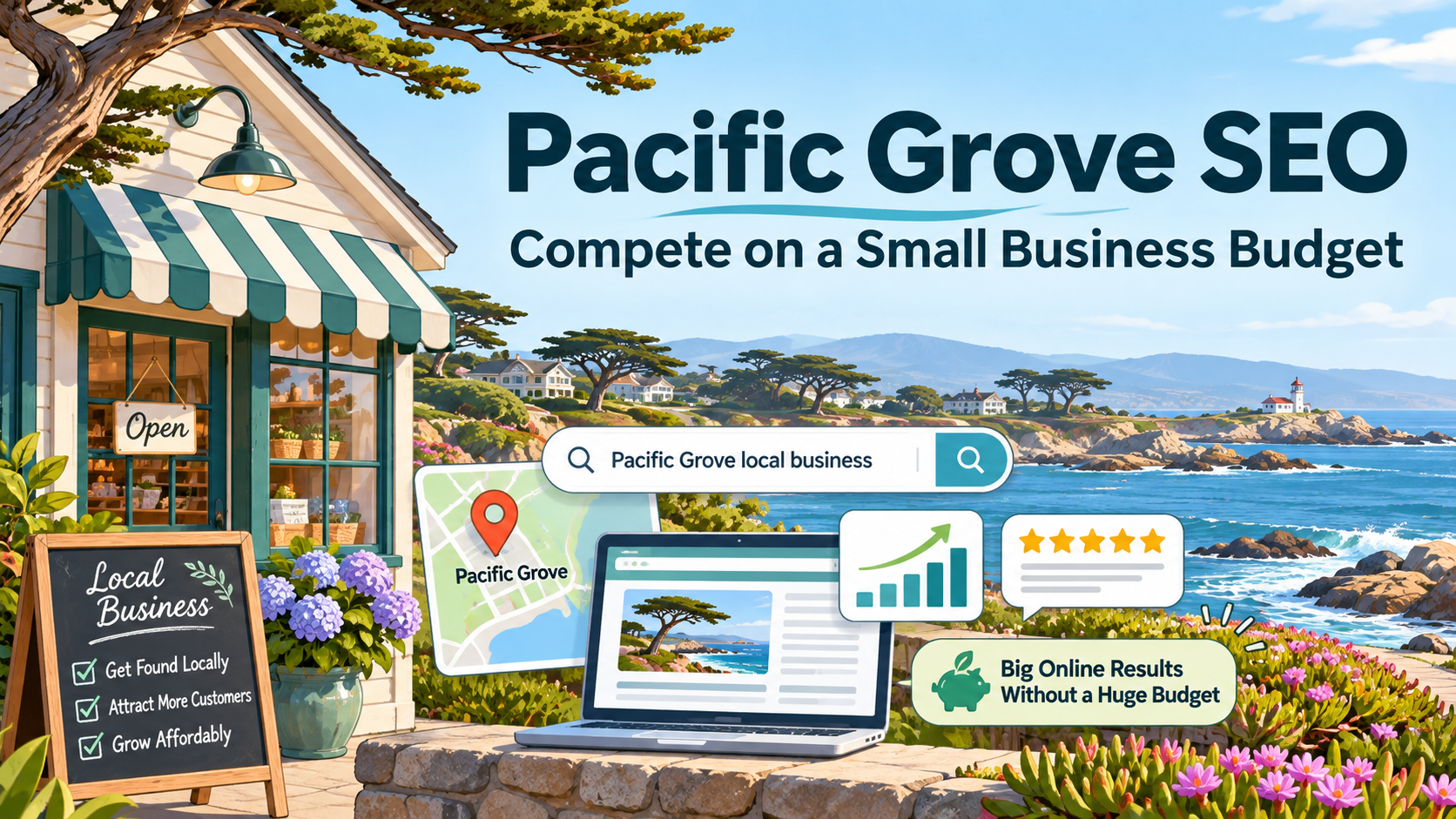
You don't need the largest advertising budget on the Monterey Peninsula to build a stronger online presence. For Pacific Grove restaurants, retailers, contractors, professional services, and other small businesses, the most effective starting point may be a handful of practical improvements: accurate Google information, useful website content, genuine customer reviews, and a clear way for customers to contact you.
You're running a small business in Pacific Grove.
You know your customers.
You understand your services.
You care about the quality of your work.
And you probably have a longer to-do list than you'd like.
Between customers, staffing, appointments, suppliers, and everyday operations, marketing can become one more responsibility competing for your attention.
Then you search Google for your business category.
You see established companies from Monterey.
Businesses serving Carmel-by-the-Sea.
Providers targeting Pebble Beach.
National directories.
Large booking platforms.
And competitors with websites that appear to have received substantial marketing investments.
It's easy to reach a discouraging conclusion.
How is a small Pacific Grove business supposed to compete with all that?
The instinct may be to spend more.
More advertising.
More social media posts.
A new website.
An expensive SEO package.
A service that promises better rankings.
Or a marketing agency offering a complicated monthly retainer.
But spending more isn't automatically the right starting point.
For many small businesses, the more useful question is:
What are the most important things we're not doing yet—and which of them can we improve without a large investment?
That's where a focused local SEO strategy becomes valuable.
Not because search optimization is free of effort.
And not because small businesses can guarantee first-page rankings by completing a checklist.
But because some of the most useful improvements don't require a large advertising budget.
An accurate Google Business Profile.
A website that clearly explains your services.
A working contact form.
Genuine customer feedback.
A well-written service page.
A strong photograph of your actual work.
A useful answer to a question customers ask repeatedly.
These are manageable improvements.
And together, they can help a small business become easier to discover and evaluate.
For businesses serving Pacific Grove, Monterey, Pebble Beach, Carmel-by-the-Sea, and nearby communities, the goal isn't necessarily to compete with every large company in the region.
It's to be relevant to the customers who need what you actually offer.
You don't have to outspend the Monterey Peninsula. You need to make it easier for the right people to find and choose your business.
Why Pacific Grove Small Businesses Face a Different Marketing Challenge
Pacific Grove has a distinctive identity within the Monterey Peninsula.
The Pacific Grove Chamber of Commerce describes the community as "Sanctuary by the Sea" and promotes its independent shopping, dining, lodging, attractions, and local experiences.
The community has a mix of businesses that serve residents, visitors, and customers from surrounding areas.
Its Chamber business directory includes categories ranging from restaurants, hotels, and galleries to home improvement, landscaping, professional services, and wellness businesses.
Those businesses don't all need the same kind of marketing.
A café may rely on people searching for somewhere to eat nearby.
An interior designer may be looking for a small number of substantial residential projects.
A property care company may need ongoing relationships with homeowners.
A retail shop may want visitors to discover its storefront.
A contractor may serve customers throughout the peninsula without having a public office in every community.
Each business has a different audience, customer journey, and definition of success.
Yet many small-business marketing packages treat them the same.
The standard proposal might promise a fixed number of social media posts, blog articles, keywords, or backlinks every month.
Those deliverables may be appropriate in some situations.
But they don't necessarily address the actual problem.
A restaurant with inaccurate hours doesn't need another generic blog post before fixing its business information.
A contractor whose contact form doesn't work may not benefit from additional traffic.
A boutique with no useful photographs may need stronger visual information before paid advertising.
And a service provider with a confusing website may need clearer positioning before expanding geographic SEO.
The first advantage a small business can create is focus.
Instead of attempting every marketing tactic, prioritize the improvements most relevant to how customers find and evaluate the business.
What Does It Mean to Compete for Monterey Peninsula Searches?
A Pacific Grove business may appear for searches containing several nearby place names.
For example, a prospective customer could search for a service in Pacific Grove.
Someone else might search in Monterey.
A Pebble Beach homeowner could be researching a service provider that works across the peninsula.
A Carmel visitor might be exploring businesses in the surrounding area.
But it would be a mistake to assume those searches all represent the same opportunity.
A person searching for "Pacific Grove coffee shop" may want somewhere physically located in Pacific Grove.
Someone searching for "Monterey Peninsula interior designer" may be open to working with a studio based in several neighboring communities.
And a search for "Pebble Beach property maintenance" may represent a homeowner looking for a company willing and qualified to travel to their property.
The intended customer matters.
So does the business model.
For storefront businesses
Restaurants, cafés, galleries, salons, hotels, and shops should make their real location easy to understand.
A business physically located in Pacific Grove shouldn't pretend to have a separate Monterey or Pebble Beach storefront.
For service-area businesses
Contractors, cleaning services, landscapers, and certain other providers may legitimately serve several communities.
Their websites should explain where they work and what services are available.
For specialized professional services
A business may want to attract clients from the entire region rather than only the closest neighborhood.
The website should demonstrate suitable expertise and geographic coverage.
That distinction leads to the first major lesson.
You don't need to rank for every Monterey Peninsula search. You need visibility for the searches connected to customers your business can actually serve.
1. Start With Google Business Profile Before Paying for Advertising
For many eligible local businesses, Google Business Profile is one of the most practical places to begin.
The profile helps people find information about the company through Google Search and Maps.
It can display details such as the business name, location, hours, category, photographs, website, and reviews.
Managing a Business Profile is free.
And for a small business with a limited budget, accurate information may be more immediately useful than an expensive promotional campaign.
Google's local ranking guidance explains that local results depend mainly on relevance, distance, and prominence.
A business can't pay Google for a better organic local ranking.
But it can improve the information within its control.
Verify your business
Make sure the correct owner or authorized representative controls the profile.
If someone else created it, determine how legitimate access should be handled.
Select accurate categories
Choose the category that best represents the business's main activity.
Don't add unrelated categories simply to appear for more searches.
Confirm your information
Review the business name, address, telephone number, website, and regular hours.
Add meaningful photographs
Use authentic images that help customers recognize the business and understand what it offers.
Describe your services clearly
Explain the actual products or services without keyword stuffing.
A good profile isn't a collection of marketing slogans.
It's a reliable representation of the business.
Keep it updated
Review business information when operating hours, services, locations, or contact details change.
A small business doesn't necessarily need an agency to complete these basic tasks.
But it does need someone responsible for maintaining the information.
If customers can't trust your basic business details, spending more to attract them may simply create more frustration.
2. Understand What Google Maps Can and Cannot Do
Google Maps visibility is valuable.
But it's important to understand its limitations.
Google considers the business's actual location as part of its local ranking system.
That means a Pacific Grove storefront may be more geographically relevant to a nearby searcher than a company located farther away, depending on the query and other signals.
However, proximity doesn't guarantee first place.
A competing business may have stronger relevance or prominence for a particular search.
And results can vary depending on where the searcher is located.
This is why checking a single ranking from your own phone can be misleading.
It shows one set of results in one context.
It doesn't establish how every prospective customer sees Google.
What you can reasonably improve
The accuracy of your profile.
The relevance of its categories.
The clarity of your website.
Authentic customer reviews.
Relevant business information.
And the consistency of your digital presence.
What you cannot guarantee
The top Maps result.
Visibility in every neighboring community.
A fixed number of calls.
Or a particular ranking within a specified number of days.
A small business should be wary of anyone promising those outcomes.
The goal is to improve the foundation and evaluate progress.
Not purchase an illusion of control over Google's results.
3. Stop Trying to Rank for Every City on the Peninsula
One common small-business SEO mistake is targeting too many locations at once.
A business owner wants customers from Pacific Grove, Monterey, Carmel, Pebble Beach, Seaside, Marina, and other nearby communities.
So an agency proposes separate pages for every town.
Then it creates pages that say almost the same thing.
"Professional Services in Pacific Grove."
"Professional Services in Monterey."
"Professional Services in Carmel."
The service descriptions are identical.
The photographs are repeated.
And the only substantial difference is the place name.
This may sound like an efficient way to build regional visibility.
But Google explicitly warns against certain forms of doorway abuse.
Its spam policies identify substantially similar pages or sites created primarily to target different regional searches while funneling visitors to the same destination.
Not every location page is problematic.
A business may have genuinely different information for different communities.
But creating numerous near-identical pages can add little value.
A better starting point
Identify your real service area.
Create clear pages for your main services.
Explain your geographic coverage naturally.
Then consider separate location pages only when they offer genuinely useful additional information.
For example, a Pacific Grove landscaping company may have authorized project examples from Pebble Beach.
Those could support a meaningful Pebble Beach service page.
But without distinct information, a strong regional service-area page may be sufficient.
A small business needs a clearer website, not necessarily a larger one.
4. Make Your Website Explain What You Actually Do
Some small businesses have attractive websites that communicate surprisingly little.
A homepage might say:
"Exceptional Quality. Personalized Service."
That's pleasant language.
But what does the business provide?
What problem does it solve?
Who is the intended customer?
Where does it work?
And what should someone do next?
A customer shouldn't have to investigate five pages to answer those questions.
A useful homepage should establish the business's main offering quickly.
Example: A hypothetical Pacific Grove contractor
Instead of:
"Transforming Spaces With Excellence."
Consider a more informative description:
"Residential painting and finishing services for homeowners in Pacific Grove and selected Monterey Peninsula communities."
That statement is illustrative, not a description of an actual contractor.
But it explains the service and geographic coverage.
Supporting text could describe the projects the company accepts.
The site could then link to project examples and an inquiry page.
The copy doesn't need to be overly promotional.
It needs to be clear.
The same principle applies to retailers
A store website should explain what the shop sells.
A restaurant should show useful dining information.
A professional service provider should communicate relevant expertise.
A wellness practice should explain services and qualifications accurately.
And a hospitality business should make accommodations and booking options understandable.
The best website is not necessarily the most elaborate.
It's the one that helps appropriate customers make informed decisions.
5. Fix Your Contact Page Before Trying to Double Your Traffic
A business may spend money improving search visibility while overlooking a basic problem.
The website isn't generating inquiries because contacting the company is unnecessarily difficult.
The phone number is buried.
The inquiry form asks for too much information.
The booking link is broken.
Or the customer doesn't know what happens after submitting a request.
More website visitors won't necessarily solve these issues.
Test your website like a new customer
Open it on a phone.
Find the main service.
Locate contact information.
Complete the inquiry process.
Check whether the message arrives.
Review the confirmation.
And make sure the next step is clear.
A contractor might use:
"Request a Project Consultation."
A professional services firm could use:
"Discuss Your Business Needs."
A restaurant may need:
"View Menu" and "Make a Reservation."
Use wording that matches the actual offering.
If the business charges for an initial consultation, don't advertise it as free.
If a service is unavailable, don't suggest customers can book it immediately.
The goal is a straightforward experience.
A working inquiry pathway is more valuable than extra traffic that has nowhere useful to go.
6. Use Google Search Console to Find Opportunities You're Already Close To
Many small businesses assume keyword research requires an expensive software subscription.
Paid tools can be useful.
But Google provides a resource that many business owners overlook.
Google Search Console allows verified website owners to understand how their sites appear in Google Search.
It provides information such as impressions, clicks, queries, and page performance.
What small businesses can learn
Which searches are already showing their pages.
Which pages receive relevant clicks.
Whether important pages are indexed.
Where search visibility may be developing.
And whether Google has detected certain technical issues.
This information can help prioritize improvements.
A practical example
Imagine a Pacific Grove service business discovers that its website is receiving impressions for a relevant service search but very few clicks.
That doesn't automatically prove the page title is the problem.
The search results and customer intent need investigation.
But it gives the business a specific question to explore.
Perhaps the page's title isn't clear.
Maybe competitors have more informative descriptions.
Or the page isn't answering the searcher's needs effectively.
That's more useful than choosing random keywords simply because they sound popular.
Start small
Review the most relevant queries.
Identify the pages associated with them.
Look at whether those pages communicate the service clearly.
Then make improvements.
You don't need a complicated reporting dashboard to begin.
You need to understand what the available data is telling you.
7. Improve One Important Service Page Instead of Publishing Ten Generic Blogs
Small-business SEO is often sold through content volume.
Four blog posts per month.
Eight pages per month.
Twenty new keywords.
But more pages don't automatically create more value.
Google's SEO Starter Guide emphasizes useful, original, well-organized content.
For a small business with limited resources, improving one important service page may be more sensible than producing a large number of generic articles.
What should the page answer?
Who is the service for?
What does it include?
What does the company actually do?
Where is the service available?
What qualifications or relevant experience matter?
What should a prospective customer prepare?
And how does the engagement begin?
Use authentic examples
A contractor might include photographs of authorized completed work.
An interior designer can explain the studio's real role in a project.
A cleaning service could clarify the scope of its regular offerings.
A property care provider may explain how communication and service coordination work.
These details help people understand the business.
They also provide context that generic marketing language often lacks.
One excellent page about a service people want may be worth more to your business than ten articles that attract unrelated readers.
8. Write Content Based on Questions Customers Already Ask
You don't need to invent a content calendar from scratch.
Your existing customers may already be giving you the topics.
Think about the questions you answer repeatedly.
How much does the service cost?
What is included?
How far in advance should someone book?
What happens during the first consultation?
Which areas does the company serve?
What preparation is required?
How does your service differ from a related service?
These questions can become useful website content.
For a Pacific Grove retailer
An article might explain how to choose among product categories the shop actually sells.
For a restaurant
A page could clarify reservations, menu options, and what guests should expect.
For a home services company
A guide may explain the project planning process and the questions customers should ask before hiring.
For a boutique lodging property
Content could explain room differences, amenities, and useful booking considerations.
For a professional services firm
An FAQ might describe the scope of an engagement and the information required to begin.
The content should reflect genuine expertise.
Don't invent legal, medical, financial, or technical advice outside the business's qualifications.
For regulated subjects, use appropriate professional review.
The strategy is simple.
Turn what your team already knows into information people can find.
9. Make Your Photos Work Harder Across Multiple Channels
Small businesses often struggle to produce enough marketing content.
But they may already have useful visual assets.
A restaurant has photographs of real dishes.
A gallery has authorized images of its collections.
A contractor has completed projects.
A retailer has product images.
A boutique hotel has photographs of guest rooms.
These assets can support the website, Google Business Profile, and social media.
The important thing is to organize them.
Build a simple photo routine
Capture relevant work when appropriate.
Confirm permission.
Select the strongest images.
Give files descriptive names.
Add useful captions.
And publish them in the places where customers need context.
For example, a landscaping project's photographs could support a website case study.
Selected images could also be shared on social media.
Google Business Profile might feature suitable business photographs.
Each platform can present the work for a different purpose.
Don't misuse photographs
Ensure appropriate usage rights.
Don't publish private property details without permission.
Don't imply that stock photography represents the company's actual work.
And don't reuse photographs in a way that misrepresents where a project was completed.
Google's image SEO documentation recommends useful alternative text, descriptive filenames, and relevant surrounding content.
You don't need an expensive production team for every photograph.
But your images should be authentic, informative, and appropriate for the business.
10. Ask for Genuine Reviews Without Paying for Them
Customer reviews can help small businesses establish credibility.
Someone unfamiliar with your company may want to know what actual customers experienced.
A legitimate review can provide that perspective.
Google recommends asking customers for honest feedback through a review link or QR code.
But its review guidance also prohibits offering incentives in exchange for reviews, review changes, or removal of negative reviews.
That includes discounts or free products offered for Google reviews.
A simple review process
After a legitimate customer interaction, provide an appropriate opportunity to share honest feedback.
Make the link easy to find.
Avoid pressure.
Don't ask only customers you believe will leave five stars.
And don't tell customers which keywords to include.
A useful request might be:
"If you'd like to share your experience, we'd appreciate your honest feedback."
That's enough.
Respond thoughtfully
Thank customers where appropriate.
Address legitimate concerns professionally.
Avoid revealing private customer information.
And use recurring feedback to identify things the business could improve.
The FTC's Consumer Reviews and Testimonials Rule also addresses deceptive review practices.
The FTC's rules and Google's platform policies aren't identical; Google's restrictions on incentivized reviews can be stricter.
For a small business, the safest practical starting point is straightforward.
Earn reviews from real experiences.
Don't buy them.
Trust built through genuine customer feedback is more valuable than a manufactured collection of perfect ratings.
11. Use the Pacific Grove Chamber as a Potential Local Visibility Resource
A small business doesn't need to work alone.
The Pacific Grove Chamber of Commerce provides business networking, promotional opportunities, educational resources, and a member directory.
Its membership benefits page describes options that may include directory visibility, newsletter features, networking, and participation in local promotional activities.
But there's an important distinction.
Chamber membership is paid.
It's not a free local SEO tool.
A business should evaluate whether the membership's actual benefits justify the expense.
For some companies, the opportunity to connect with local business owners or reach relevant audiences may be valuable.
For others, membership may not be an immediate priority.
What to evaluate
Does the directory reach relevant customers?
Would the networking opportunities benefit the business?
Are there events or programs the business can genuinely participate in?
Can the company take advantage of the available benefits?
Does the cost fit the marketing budget?
A directory listing should be accurate.
And the business shouldn't view membership solely as a way to purchase a backlink.
The stronger opportunity may be building legitimate local relationships.
Those relationships can support referrals, awareness, and community involvement.
Search visibility may be one part of the value.
It's not a guaranteed outcome.
12. Use No-Cost Business Advising Before Committing to a Large Marketing Retainer
Pacific Grove businesses have access to small-business support resources beyond commercial marketing agencies.
One particularly relevant option is the Monarch Small Business Development Center.
The center serves Monterey, San Benito, Merced, and Mariposa counties.
It provides no-cost advising and training to eligible entrepreneurs and small businesses.
Its current services include support related to marketing, business planning, financing, operations, and other business topics.
The Monterey County Business Council also identifies the center as a resource for local businesses.
Why this matters
An owner with a limited budget may benefit from developing a clearer business plan before hiring specialized marketing help.
For example, an adviser may help the business think through its customer base, budget, or growth priorities.
That can make a later marketing engagement more focused.
It doesn't mean SBDC advising replaces specialized technical SEO work.
But it can provide valuable business context.
The Pacific Grove Chamber's business-startup resources also reference PickPG, a local resource developed through city and chamber economic development efforts.
It helps businesses find information about licensing, zoning, financial resources, and other operational topics.
These resources can be worth investigating before paying for services the business may not yet need.
A limited budget isn't a reason to skip planning. It's a reason to make planning more important.
13. Build Local Relationships Instead of Buying Low-Quality Backlinks
Backlinks are links from other websites to your own.
They can help users discover relevant information and may contribute to search visibility.
But a small business shouldn't assume it needs to purchase hundreds of links.
Google's spam policies identify buying links for ranking purposes, excessive exchanges, and certain automated link practices as spam.
That makes many cheap link-building packages a poor investment.
A better approach is to focus on legitimate relationships.
What might produce relevant visibility?
Participation in an appropriate local business organization.
A genuine professional collaboration.
An authentic community project.
A useful educational resource.
Or relevant coverage from an independent publication.
None of these guarantees a backlink.
And not every local relationship should be evaluated through SEO.
A referral may be commercially useful even if it never creates a website link.
For a small business, the objective is to build a credible reputation among the people and organizations that matter.
That's more sustainable than purchasing low-quality link placements.
14. Don't Try to Outpublish Larger Competitors
A business with a marketing department may publish many articles.
It may produce professional videos.
It might maintain several social media channels.
A small Pacific Grove company may not have the resources to do all of that.
And it doesn't necessarily need to.
A smaller business can choose a narrower editorial strategy.
Instead of writing about everything, focus on the questions most relevant to your customers.
Example: A small home services company
Rather than publishing generic home improvement tips every week, the company could develop a focused library explaining:
Its actual services.
The project inquiry process.
Common questions customers ask.
Relevant qualifications.
Selected completed work.
And useful service-area information.
That material may be more valuable to prospective clients than a large collection of unrelated articles.
Example: An independent retailer
Instead of trying to compete with national shopping websites for broad product keywords, the shop may focus on its genuine specialties, in-store experience, and products.
The business can also make its physical location and opening hours clear.
The goal is not to defeat every large retailer in search.
It's to become a useful option for customers interested in what the shop actually offers.
Small businesses can compete through relevance and specificity—not only through content volume.
15. Use Social Media Without Letting It Consume the Entire Marketing Budget
Social media can support discovery and customer relationships.
But it can also become time-consuming.
A small business owner may spend hours creating posts without knowing whether the work contributes to relevant inquiries.
The answer isn't necessarily to abandon social platforms.
It's to assign them a clearer role.
A restaurant can share authentic food and atmosphere.
A contractor can show authorized work.
A boutique can introduce current products.
A local service provider can answer useful questions.
But the business should also maintain a website where customers can find more detailed information.
A manageable approach
Choose the platform most relevant to the business.
Create a sustainable posting routine.
Reuse appropriate visual assets across channels.
Direct interested customers to a relevant website page.
And evaluate whether the content attracts the audience you want.
Don't assume daily publishing is required.
For some businesses, a smaller number of useful posts may be more sustainable than a high-volume schedule.
The objective is consistency without unnecessary operational pressure.
A marketing plan should fit the business's capacity.
16. Consider Paid Advertising Only After Fixing the Fundamentals
Paid advertising can be useful.
But it isn't automatically the best first expense for a small business.
If the website is confusing, more advertising may simply send additional people into a poor experience.
If the phone number is wrong, paid clicks won't fix it.
If the business can't handle additional appointments, advertising may create operational problems.
Before paying for Google Ads or social advertising, ask:
What specific service or product are we promoting?
Who should see the offer?
Can the business fulfill the demand?
Does the landing page explain the offering clearly?
Is there a reliable next step?
How will we determine whether the campaign generated useful business?
A small test may be appropriate when these questions have clear answers.
But some companies will get more practical value from correcting existing information first.
Paid advertising also requires ongoing budget control and measurement.
It's not a substitute for accurate business information or strong customer service.
And a small budget doesn't guarantee meaningful results in every competitive category.
The right approach depends on the market.
17. Make Sure Your Website Works on a Phone
Small-business websites are often reviewed on desktop computers.
But customers may discover and evaluate them on mobile devices.
Someone looking for a nearby restaurant may be using a phone.
A homeowner could research contractors while away from home.
A visitor might look up a boutique's hours while exploring downtown.
The experience should be clear.
Important mobile tasks
Finding a phone number.
Opening the menu.
Reading service descriptions.
Viewing photographs.
Checking hours.
Submitting a form.
Or making a reservation.
Google's mobile-first indexing documentation explains that it primarily uses mobile website content for indexing.
That makes mobile usability relevant to both customer experience and search accessibility.
A small business doesn't need an elaborate animated website.
It needs one that functions.
Use free performance testing
Google PageSpeed Insights can help identify technical performance issues.
Not every recommendation will be easy to implement without development expertise.
But the report can help a business recognize major problems.
For example, extremely large photographs may be slowing the homepage.
Or a third-party widget could affect loading behavior.
The business can then decide which fixes are worth prioritizing.
18. Keep Business Information Consistent Without Obsessing Over Every Directory
Small businesses sometimes receive pitches for directory-submission services that promise hundreds of citations.
The sales message is often that every directory listing is essential for SEO.
That's an exaggeration.
Business information should be accurate across important public platforms.
But not every obscure directory is worth paying for.
Start with the places customers actually use.
Google Business Profile.
Your own website.
Relevant booking or reservation platforms.
Appropriate professional directories.
And genuine local organizations where the business participates.
Review important details
Business name.
Actual address or appropriate service area.
Phone number.
Website.
Hours.
And service descriptions.
Correct meaningful inconsistencies.
But don't spend an entire marketing budget chasing every outdated reference on an obscure website that customers are unlikely to use.
Directory work should serve an actual purpose.
A business should also avoid creating duplicate profiles or fictitious locations.
The goal is to make accurate information easier to find.
Not generate the largest possible number of listings.
19. Protect Your Business's Ownership of Its Digital Assets
Small businesses can become dependent on marketing vendors without realizing it.
An agency may create the website under its own account.
Someone else controls the domain.
Google Business Profile access is tied to a former employee's email.
The company doesn't know how to access analytics.
Or the advertising account belongs to a contractor.
Those arrangements can create problems later.
Basic ownership questions
Who controls the domain registration?
Who owns the website content and photographs?
Does the business have administrative access to its Google Business Profile?
Who can access Search Console?
Who controls advertising accounts?
Can the business change providers without losing access to essential assets?
What happens if a marketing contract ends?
The business should understand these arrangements before signing.
A marketing provider may need appropriate delegated access to perform its work.
But the company should retain legitimate control of its core business assets.
For an owner with a limited budget, avoiding unnecessary vendor dependence can be an important part of managing costs.
A website that is impossible to maintain without paying the same provider indefinitely may not be the most economical option.
20. Learn to Separate Marketing Costs From Marketing Value
The cheapest option isn't automatically the most affordable in the long run.
But an expensive package isn't automatically more valuable either.
A business might pay for hundreds of social posts without generating useful customer interest.
It could invest in a sophisticated website that doesn't explain its services.
Or it may purchase backlinks that offer little relevance.
The better question is what problem the spending solves.
Before purchasing a service, ask
What is the specific issue?
What work is included?
What can the business do itself?
What requires professional expertise?
How will progress be evaluated?
And what happens after the project is complete?
For example, an owner may be able to update business hours independently.
A technical SEO audit may require specialized knowledge.
A website redesign may be appropriate when the underlying platform is difficult to maintain.
Professional photography may be valuable for a business whose work is highly visual.
These aren't interchangeable expenses.
A limited marketing budget should be allocated according to the most important needs.
A good marketing investment removes a meaningful obstacle or creates a relevant opportunity. It doesn't simply produce more activity.
A Realistic Small-Business Marketing Budget: What to Prioritize
There isn't one correct monthly budget for every Pacific Grove business.
A new independent shop has different needs from a contractor with an established customer base.
And the cost of professional assistance varies by scope.
Rather than presenting arbitrary prices as universal market rates, consider three levels of investment.
Level 1: Do-it-yourself essentials
This approach prioritizes owner time and existing tools.
Verify Google Business Profile.
Set up Search Console.
Correct website contact information.
Improve one important service or product page.
Request genuine reviews appropriately.
And establish a manageable social posting routine.
There may be little direct software spending, but the owner's time still has an opportunity cost.
This can be a sensible starting point when cash is limited.
Level 2: Focused professional help
Hire a qualified specialist for one clearly defined problem.
That might be a technical website audit.
A local SEO review.
A homepage rewrite.
Booking-system troubleshooting.
Or improvements to service pages.
The scope and cost should be agreed upon in advance.
This approach can be more practical than committing to a broad retainer before the business understands its biggest problems.
Level 3: Ongoing marketing support
A business with clear goals, stable operations, and an appropriate budget may benefit from recurring work.
That could involve local SEO maintenance, content development, website improvements, or coordinated social publishing.
The provider should explain each deliverable and how it connects to the business's objectives.
An ongoing retainer should be justified by ongoing needs.
Not by a claim that every small business must purchase one to compete.
The Two-Hour-Per-Week Local SEO Routine
If your budget is very limited, a small recurring time commitment can provide a useful starting structure.
This is an illustrative workload, not a guarantee of results.
First 30 minutes: Check your business information
Review Google Business Profile for accuracy.
Update genuine changes.
Respond appropriately to customer questions or reviews.
Check that important links still work.
Next 30 minutes: Improve one website element
Refine a service description.
Update a photograph.
Answer a recurring question.
Correct inaccurate information.
Or improve the contact process.
Next 30 minutes: Create one useful piece of content
That could be a project photo with context, a short FAQ, or an appropriate social media post.
Avoid creating content simply to fill a schedule.
Final 30 minutes: Review basic results
Check relevant Search Console information.
Review inquiries.
Look for website problems.
And decide what deserves attention next week.
Some weeks will require different priorities.
The value comes from consistent review and improvement.
A small business doesn't need to behave like a full-time publishing company.
It needs a manageable process.
A 90-Day SEO Plan for a Pacific Grove Business With a Limited Budget
A structured first 90 days can help avoid scattered spending.
The following is an illustrative plan, not a promise of first-page rankings, qualified leads, or immediate revenue.
Days 1–30: Fix the information customers rely on
Verify Google Business Profile.
Confirm the actual business location or service area.
Check the website's phone number and contact details.
Test forms and booking links.
Review mobile usability.
Set up or verify Search Console.
Identify the main service or product categories.
Determine which searches and customer types actually matter.
At this stage, avoid adding unnecessary pages.
Fix the foundation first.
Days 31–60: Make the website more useful
Choose the most important service or product page.
Improve its explanation.
Add accurate supporting information.
Include authentic photographs where appropriate.
Clarify the service area.
Make the next step easy to understand.
Publish one or two useful FAQs based on actual customer questions.
Consider whether the Chamber, SBDC, or another relevant local resource would support the business.
Don't purchase memberships or services simply because they claim SEO benefits.
Days 61–90: Build consistency and measure relevance
Continue maintaining the Business Profile.
Develop a sustainable review request process.
Create useful content from real work.
Improve internal website links.
Review Search Console for relevant queries and pages.
Evaluate which inquiries are suitable.
Identify whether any technical problems require professional assistance.
Then establish the next priorities.
The objective is a clearer, more reliable digital presence.
Some businesses may begin seeing useful changes.
Others may need additional work.
Search performance depends on competition, customer demand, existing visibility, and many other factors.
No responsible SEO provider should guarantee a specific outcome in 90 days.
How Different Pacific Grove Businesses Can Prioritize SEO
The best starting point varies by industry.
Independent restaurants and cafés
Prioritize accurate hours, menus, location information, authentic photographs, reviews, and working reservation or ordering links.
A restaurant may gain little from publishing large amounts of generic food content while neglecting those basics.
Boutiques and specialty retailers
Make the product offering understandable.
Use authentic storefront and merchandise photography.
Keep hours accurate.
Develop useful descriptions of the shop's actual specialties.
And evaluate whether relevant local directories or community relationships provide value.
Interior designers and creative studios
Focus on a clear portfolio, real project descriptions, appropriate image rights, service information, and inquiry quality.
The business may not need enormous search volume.
It may need a small number of well-matched project opportunities.
Landscaping and home services companies
Explain services, qualifications, coverage, and the process of requesting work.
Use genuine project examples.
Avoid claiming offices that don't exist.
Prioritize searches connected to appropriate projects.
Property care and concierge businesses
Communicate the actual service boundaries, geographic coverage, communication process, and professional approach.
Protect client privacy.
Don't publish sensitive property information or unsupported guarantees.
Boutique lodging and hospitality properties
Clarify accommodations, amenities, booking information, and real geographic location.
Hotel-specific Google search and booking systems may need additional attention beyond ordinary local SEO.
Professional services firms
Explain the services, qualifications, client fit, and engagement process.
Use credible, useful information rather than unsupported claims.
The correct strategy depends on customer needs.
Not a universal list of marketing tactics.
Common Low-Budget SEO Mistakes That Waste Money
A small business can lose substantial time or money pursuing the wrong priorities.
Several mistakes are especially worth avoiding.
Buying guaranteed rankings
Google does not sell improved organic local rankings.
Be cautious about providers promising specific Maps positions.
Paying for dozens of duplicate location pages
Pages that provide no unique value may create search-quality problems.
Purchasing low-quality backlink packages
Links created primarily to manipulate search rankings can violate Google's policies.
Running paid ads to a broken website
Fix the contact or booking experience before sending additional traffic.
Paying for content nobody needs
A blog should answer useful questions.
Not simply produce a monthly word count.
Using fake or incentivized Google reviews
Reviews must reflect genuine experiences and follow platform policies.
Creating fake office locations
Represent your real business address and service coverage accurately.
Ignoring mobile usability
A website should work for customers on their phones.
Measuring only website traffic
More visitors aren't automatically more customers.
Outsourcing everything without understanding the work
Owners should know what services they're purchasing and how success will be evaluated.
Trying every platform at once
A limited budget benefits from prioritization.
Forgetting to update important information
Hours, services, phone numbers, and policies change.
An accurate website needs maintenance.
The common theme is simple.
Money is often wasted when marketing activity becomes disconnected from how customers actually find and choose the business.
How to Measure Local SEO Without an Expensive Dashboard
You don't need a complicated analytics platform to begin evaluating your digital presence.
Start with a few business-relevant questions.
Are people finding you through relevant searches?
Search Console can help show the queries associated with your website's search appearances and clicks.
Are important pages being discovered?
Review whether service and contact pages receive appropriate visibility.
Are customers contacting the business?
Track legitimate form submissions, phone inquiries, or bookings where reliable information exists.
Are those inquiries a good fit?
A landscaping company shouldn't judge success only by the number of calls.
The projects need to align with its capabilities.
A designer may benefit from fewer but better-matched inquiries.
Are marketing expenses justified?
Consider the cost of advertising, professional services, software, and owner time.
Are customers confused?
Recurring questions can reveal gaps in website information.
The numbers should help inform decisions.
But small businesses need to be careful about overinterpreting limited data.
A single month may contain seasonal changes or unusual events.
Not every inquiry can be attributed precisely to one channel.
And rankings naturally vary.
The goal is to develop a reasonable picture of performance.
Not produce a perfect-looking report.
When It Makes Sense to Hire an SEO Agency
There are situations where professional assistance can be useful.
Your website may have technical indexing problems.
The business could be struggling with duplicate location pages.
A redesign may have damaged existing search visibility.
Google Business Profile may have eligibility or verification issues.
Important pages may be difficult for search engines to access.
Or the business may simply need help developing a clearer regional SEO strategy.
In those situations, an experienced provider may save time and prevent unnecessary work.
But a good agency shouldn't begin by assuming the business needs its most expensive package.
It should ask questions.
What does the company do?
Who are its ideal customers?
Which communities does it serve?
How do inquiries currently arrive?
What has already been tried?
What budget can the business sustain?
And what would meaningful progress look like?
The answers should guide the recommendation.
Sometimes an audit is enough to identify the next steps.
Sometimes the website needs targeted improvements.
Other businesses may benefit from ongoing help.
The right SEO engagement should fit the business—not require the business to fit the agency's package.
Questions to Ask Before Paying for a Small-Business SEO Package
A Pacific Grove business evaluating marketing providers should look beyond promises of traffic or ranking improvements.
Ask what the provider will investigate first.
Find out whether it will review the website and Google Business Profile.
Request an explanation of the intended geographic targeting.
Clarify whether location pages will contain genuinely distinct content.
Ask who will write and approve service descriptions.
Determine whether technical problems are included in the scope.
Review reporting expectations.
Confirm that the company will retain access to its domain, website, and business accounts.
Ask about contract length and cancellation terms.
And find out what happens when the engagement ends.
Be cautious about providers that promise rankings before reviewing your business.
Also be cautious about proposals focused entirely on deliverable counts.
More posts, links, and pages do not automatically mean better marketing.
A small-business budget deserves a strategy that explains the purpose of the work.
How Ritner Digital Approaches SEO for Small Businesses
At Ritner Digital, the focus is on helping businesses become easier to find, understand, and choose.
That starts with the business itself.
What do you offer?
Who needs it?
Where do you legitimately operate?
What questions do customers ask?
And what happens after they discover your website?
For Pacific Grove businesses, those questions can help identify which SEO improvements are worth prioritizing.
The work might begin with Google Business Profile accuracy.
It could involve clearer service descriptions.
Better website structure.
More useful local content.
A mobile usability review.
Or an investigation into why appropriate searches aren't producing inquiries.
Ritner Digital's SEO services focus on local visibility, technical foundations, search research, content, and measurement.
Its web design services support websites organized around usability and business goals.
But not every small business needs a new website.
And not every company needs ongoing marketing support.
Sometimes a focused audit or improvement project is the more appropriate place to start.
The recommendation should depend on what the business actually needs and what it can reasonably invest.
We don't believe local SEO should be reduced to keyword stuffing, fake locations, or expensive promises that can't be guaranteed.
The purpose is to create a clearer, more useful digital presence.
One that helps the right people discover a real business offering relevant services.
Frequently Asked Questions
1. Can a Pacific Grove business compete in Google Search without a large marketing budget?
Yes, a smaller business can improve its digital presence without a large advertising budget. Accurate Google Business Profile information, useful website content, authentic customer reviews, clear services, and a functioning inquiry process are practical starting points. However, rankings and customer growth cannot be guaranteed.
2. What is the most affordable way to start local SEO?
Begin by verifying and updating an eligible Google Business Profile, correcting website information, testing contact links, and setting up Google Search Console. These steps may require owner time but don't necessarily require a paid marketing subscription. Prioritize the most important problems before purchasing additional services.
3. Is Google Business Profile free?
Yes. Eligible businesses can manage their Business Profiles without paying Google for the profile itself. Google also offers paid advertising products, but those are separate from organic local search visibility. Businesses should avoid providers suggesting that payment guarantees a higher Maps ranking.
4. Does a business need a website if it already has a Google Business Profile?
A Business Profile can help customers discover basic information, but a website provides more room to explain services, products, qualifications, projects, and the inquiry process. The appropriate website can be relatively simple. The goal is to provide information customers need rather than build an unnecessarily complicated platform.
5. Should Pacific Grove businesses target Monterey SEO keywords?
Potentially. A business that genuinely serves Monterey customers may have reason to explain that coverage. However, a shop physically located in Pacific Grove shouldn't claim to operate in Monterey. Geographic targeting should reflect actual customer needs and business operations, not simply a desire to rank for more place names.
6. Can a Pacific Grove contractor rank for Pebble Beach searches?
Possibly. A contractor based in Pacific Grove may legitimately serve Pebble Beach customers. Useful service pages and authentic project examples can support relevance. Google Maps rankings also consider physical distance, so adding Pebble Beach to a service area doesn't guarantee prominent Maps placement.
7. Should I create separate pages for Pacific Grove, Monterey, Carmel, and Pebble Beach?
Only when the pages provide meaningful, distinct value. Creating multiple near-identical pages that differ mainly by city name can be unhelpful and may raise doorway-abuse concerns under Google's spam policies. A strong regional service-area page may be better for some businesses.
8. How much does small-business SEO cost?
Costs vary based on the website's condition, the services needed, and the provider. Some foundational tasks can be completed by the business owner using free tools. More technical improvements, web design, content development, or ongoing support may require professional fees. Request a clear scope and evaluate whether the work addresses an actual business need.
9. How many blog posts does a small business need for SEO?
There is no universal requirement to publish a particular number of articles. A business may benefit more from improving important service and product pages before developing a blog. Useful content should address actual customer questions and reflect genuine expertise. Volume alone does not guarantee visibility.
10. Do Google reviews help local SEO?
Google identifies review information as one factor associated with local prominence. Authentic reviews may also help prospective customers evaluate a business. However, companies should not purchase reviews, offer incentives for Google reviews, or pressure customers to leave positive ratings.
11. Are Chamber of Commerce backlinks worth paying for?
A Chamber membership may offer business networking, directory visibility, education, and promotional opportunities. But it should be evaluated as a genuine business investment, not merely a way to buy a backlink. The Pacific Grove Chamber offers paid membership options with different benefits.
12. Are there free business marketing resources in Monterey County?
Yes. The Monarch Small Business Development Center provides no-cost advising and training for eligible small businesses in Monterey County and surrounding areas. The Pacific Grove Chamber also points entrepreneurs toward local business resources, including PickPG. Specific services and eligibility should be confirmed with the providers.
13. Do I need paid SEO software?
Not necessarily. Google Search Console provides useful information about search queries, clicks, impressions, and indexing. Google Business Profile and PageSpeed Insights also offer relevant information. Paid tools may provide additional research and monitoring capabilities, but they aren't automatically necessary for every small business.
14. How long does local SEO take to work?
There is no guaranteed timeline. Some errors can be corrected quickly, while organic visibility may change gradually. Results depend on competition, customer demand, existing website quality, business location, and other factors. A 90-day plan can help organize improvements, but it should not be treated as a ranking guarantee.
15. Should a small business spend money on Google Ads or SEO first?
The answer depends on its goals and existing digital presence. If the website is difficult to use or business information is inaccurate, correcting those issues may be a better first investment. Paid advertising can be useful for clear offers with functioning landing pages and suitable budgets. Neither channel guarantees customers.
16. What is the difference between local SEO and social media marketing?
Local SEO focuses on helping relevant customers discover businesses through search and local results. Social media can support brand awareness, visual storytelling, and customer relationships. The channels can complement each other, but they serve different purposes. Businesses should prioritize according to actual customer behavior.
17. How should small businesses measure whether SEO is working?
Review relevant search visibility, useful website interactions, qualified calls, form submissions, bookings, and acquired customers where reliable information is available. Traffic alone isn't sufficient. The goal is to understand whether the business is becoming easier to discover and whether that visibility supports meaningful opportunities.
18. Does my small business need a marketing retainer?
Not automatically. Some businesses need a one-time audit or targeted website improvement. Others have ongoing content, SEO, or marketing needs that justify recurring support. The decision should be based on business goals, available resources, and the work required—not a generic package recommendation.
19. Can I manage local SEO myself?
Many foundational tasks are manageable for business owners, including maintaining accurate Google Business Profile information, reviewing website content, and requesting honest customer feedback. Technical SEO, complex website issues, and strategic research may require specialized knowledge. The appropriate balance depends on time, skills, and budget.
20. Can Ritner Digital help a small Pacific Grove business with local SEO?
Ritner Digital provides SEO, website design, content strategy, and related digital marketing services. Pacific Grove businesses can discuss their existing website, geographic coverage, search visibility, and budget to determine whether a focused audit, improvement project, or ongoing engagement may be appropriate.
You Don't Need the Biggest Budget. You Need the Right Priorities.
Pacific Grove businesses have something valuable.
They are real businesses serving real customers in a distinctive Monterey Peninsula community.
Some have physical storefronts.
Others provide services throughout the region.
Some serve visitors.
Others build long-term relationships with local residents and property owners.
Their marketing needs aren't identical.
But they share an important challenge.
People need to discover them.
Understand what they offer.
Trust the information.
And know how to take the next step.
That doesn't always require a large marketing budget.
Sometimes it begins with correcting a Google Business Profile.
Sometimes it's improving one service page.
Making a phone number easier to find.
Adding genuine project photographs.
Answering a customer question.
Or fixing a booking form that hasn't been working properly.
Those improvements may seem small.
But they're part of building a better digital experience.
And when a business has limited resources, thoughtful prioritization matters.
At Ritner Digital, we help businesses investigate their SEO, website, and digital visibility so they can focus on improvements that make sense for their goals.
If your Pacific Grove business is struggling to compete for Monterey Peninsula searches, you don't need to begin by committing to an enormous marketing program.
Begin with the questions that matter.
What are customers searching for?
Can they find you?
Do they understand what you offer?
And what is preventing them from making contact?
The answers can help identify where your marketing investment belongs.
You don't have to outspend every competitor. You have to make it easier for the right customers to find, understand, and choose your business.
Contact Ritner Digital to discuss a focused local SEO review for your Pacific Grove business.
Sources and Further Reading
This article is based on Google Search and Business Profile guidance, official Pacific Grove business resources, and regional small-business support information available as of November 2026. The example businesses and marketing scenarios are illustrative, not documented client results. Specific prices, memberships, tools, and eligibility rules should be verified before purchasing or applying.
Google Business Profile — Tips to Improve Your Local Ranking. Official explanation of relevance, distance, prominence, and accurate local business information. Read Google's guidance.
Google Business Profile — Guidelines for Representing Your Business. Eligibility, real business locations, service-area rules, categories, and accurate profile information. Read the guidelines.
Google Business Profile — Manage Service Areas. Guidance for businesses that visit or deliver to customers across geographic areas. Read the service-area guide.
Google Business Profile — Tips to Get More Reviews. Recommendations for authentic reviews, ethical requests, and professional responses. Read the guidance.
Google Search Console — Official Overview. Free tools for understanding search performance, indexing, and website visibility. Explore Search Console.
Google Search Console — Measure Your Performance. Guidance on impressions, clicks, search queries, and important pages. Read the documentation.
Google Search Central — SEO Starter Guide. Official guidance on useful content, website organization, internal linking, and search visibility. Read the SEO guide.
Google Search Central — Spam Policies. Policies covering doorway abuse, scaled content abuse, and manipulative link practices. Read Google's policies.
Google Search Central — Image SEO Best Practices. Guidance on descriptive filenames, alternative text, relevant page context, and efficient image loading. Read the documentation.
Google Search Central — Mobile-First Indexing Best Practices. Guidance on accessible and useful mobile website content. Read the documentation.
Google PageSpeed Insights. Website performance evaluation tool for identifying potential loading and usability problems. Open PageSpeed Insights.
Federal Trade Commission — Consumer Reviews and Testimonials Rule. Federal guidance on fake reviews, incentives, and deceptive endorsement practices. Read FTC guidance.
Pacific Grove Chamber of Commerce — Official Website. Information about Pacific Grove's business community, visitor resources, and local activities. Visit the Chamber.
Pacific Grove Chamber of Commerce — Member Directory. Directory of local and regional businesses across hospitality, retail, professional services, home improvement, and other categories. Explore the directory.
Pacific Grove Chamber of Commerce — Membership Benefits. Current descriptions of paid business membership, directory exposure, networking, and promotional opportunities. Review membership benefits.
Pacific Grove Chamber of Commerce — Start Your Business. Information about PickPG and local business resources. Explore business resources.
Monarch Small Business Development Center — Official Website. No-cost advising, training, and small-business support serving Monterey and surrounding counties. Explore Monarch SBDC.
Monterey County Business Council — Monarch SBDC. Information about regional small-business consulting, market research, training, and resources. Read the program overview.
County of Monterey — Business Assistance. Information and links to business support programs, technical assistance, and local resources. Explore county assistance.
Ritner Digital — SEO Services. The practice's approach to local SEO, Google Business Profile, technical optimization, content, and search reporting. Explore SEO services.
Ritner Digital — Web Design. Information about website usability, content structure, SEO foundations, and business-focused website improvements. Explore web design.
Ritner Digital — Contact. Direct inquiry page for small businesses exploring local SEO, website improvements, or digital marketing strategy. Contact Ritner Digital.