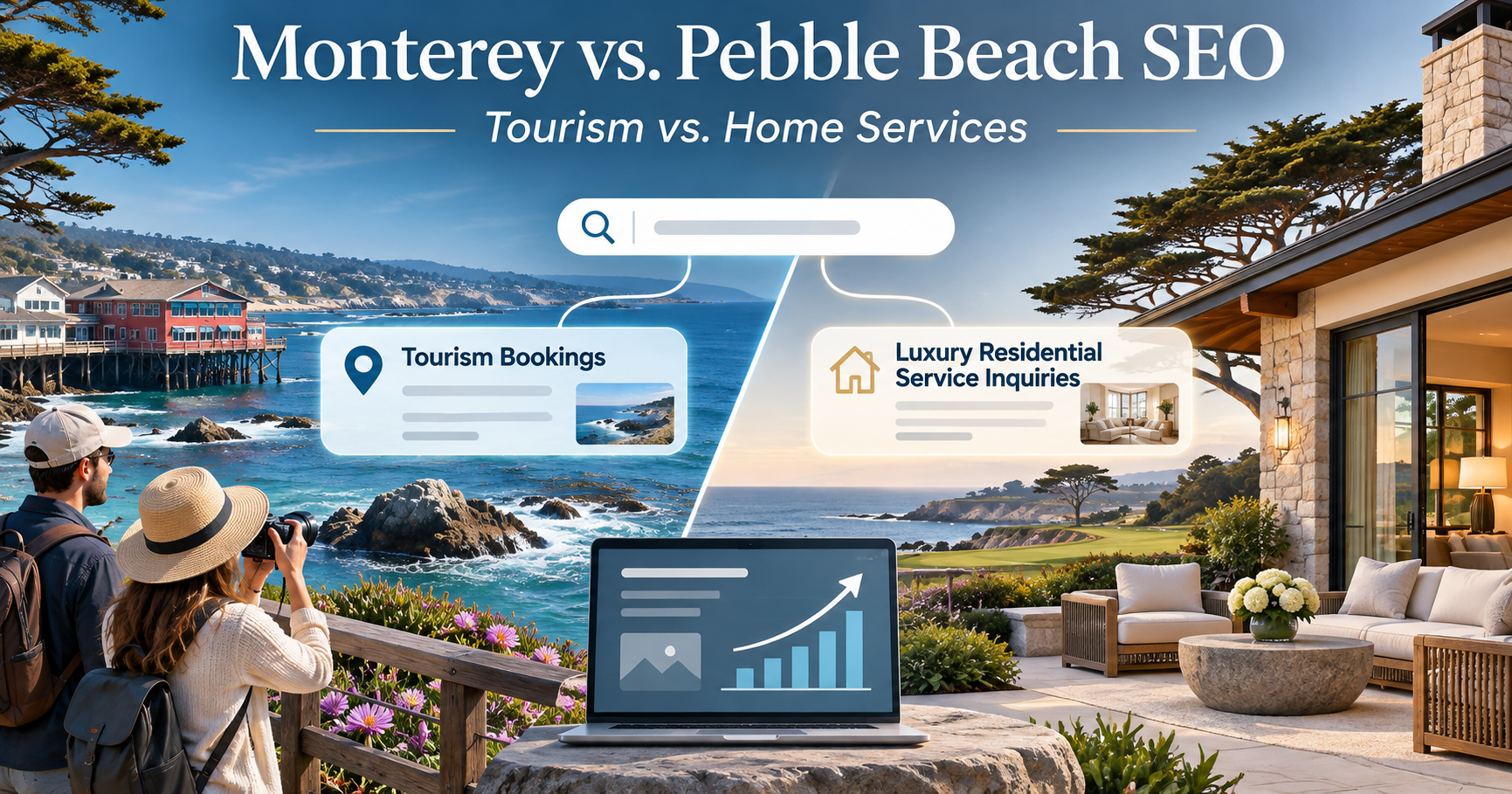
Two businesses can serve the same Monterey Peninsula and still need completely different SEO strategies. A traveler searching for something to do in Monterey isn't necessarily looking for the same information as a Pebble Beach homeowner researching an interior designer, estate manager, or landscaping contractor. Understanding the difference is how businesses turn geographic visibility into more relevant customer inquiries.
Imagine two people searching Google.
The first types:
"Things to do in Monterey this weekend."
They're planning a visit.
They may want recommendations for attractions, restaurants, activities, or local experiences.
They could be comparing options, checking hours, and deciding how to spend their time.
The second person types:
"Pebble Beach luxury property maintenance."
They're looking for something very different.
They may own a home.
They might need a company to care for the property while they're away.
They could be evaluating the provider's services, experience, reliability, communication process, and qualifications.
They may not be ready to contact anyone immediately.
But they're probably not searching for entertainment.
Both people are interested in the Monterey Peninsula.
Both searches include a geographic reference.
And both might ultimately lead to a local business.
But the decisions behind those searches are fundamentally different.
That's the distinction many geographic SEO strategies miss.
A marketing agency may group Pebble Beach, Monterey, Carmel-by-the-Sea, and Pacific Grove into one regional keyword strategy.
It adds the community names to website pages.
Creates a few location-specific articles.
And reports on impressions and rankings.
But it may never ask the most important question.
What is the person searching actually trying to accomplish?
For tourism businesses, the answer may involve planning, comparing, booking, or finding an experience.
For luxury home services, it may involve evaluating expertise, qualifications, privacy, project scope, and the risks of hiring the wrong provider.
Those needs should influence everything.
The keywords selected.
The pages created.
The photographs published.
The credibility signals emphasized.
The calls to action.
And the way success is measured.
For businesses serving Monterey, Pebble Beach, Carmel-by-the-Sea, Pacific Grove, and the surrounding communities, understanding search intent can help turn broad online visibility into more relevant customer opportunities.
The most valuable SEO strategy isn't the one that targets the most local searches. It's the one that understands why the right customer is searching.
Monterey and Pebble Beach Are Not Two Completely Separate Customer Worlds
Before comparing search intent, it's important to avoid an oversimplification.
Monterey is not exclusively a tourism market.
Pebble Beach is not exclusively a luxury residential market.
Both places contain multiple types of search demand.
Monterey is a real city with residents, businesses, neighborhoods, and professional services—not simply a collection of tourist attractions.
Pebble Beach is internationally known for golf, resorts, and 17-Mile Drive, but it also contains residential properties and associated service needs.
The distinction is therefore not:
"Monterey means tourists, and Pebble Beach means homeowners."
That would be inaccurate.
The more useful distinction is between different types of searches that commonly occur in these markets.
A search for "Monterey Bay Aquarium tickets" has a clear visitor-oriented purpose.
A search for "Monterey property manager" has a different purpose.
Likewise, "Pebble Beach golf vacation" is a travel-oriented search.
And "Pebble Beach interior designer" may indicate interest in a professional residential design engagement.
The place name provides context.
The service or question reveals more about intent.
A strong SEO strategy considers both.
Why Monterey Has a Major Tourism Search Environment
Monterey's visitor economy is well documented.
The official destination marketing organization, See Monterey, highlights the city's attractions, maritime history, restaurants, accommodations, and recreational opportunities.
Its destination content features places and activities such as Cannery Row, Old Fisherman's Wharf, the Monterey Bay Aquarium, whale watching, and coastal recreation.
Those attractions help explain why people search for visitor information.
There is also substantial regional travel activity.
According to the Monterey County Hospitality Association's May 2026 economic impact announcement, visitor spending reached approximately $3.3 billion across Monterey County in 2025.
That figure is countywide.
It is not a measurement of spending within the City of Monterey alone, and it should not be used to estimate the revenue of any individual business.
Still, it establishes the importance of travel to the broader region.
For tourism-related businesses, online discovery can involve several distinct stages.
A traveler may be exploring ideas.
Then narrowing options.
Then comparing availability and prices.
Finally, they may be ready to book.
SEO content should reflect those stages.
Example: A visitor researching Monterey
Someone might start with:
"What to do in Monterey."
Then search:
"Monterey whale watching tours."
Later, they may look for:
"Whale watching tour reservations Monterey."
Those queries represent different levels of specificity.
A broad destination article may help someone discover possibilities.
A detailed service page can explain a particular experience.
A booking page supports the decision to reserve.
The business shouldn't expect one generic homepage to perform every role.
Why Pebble Beach Also Creates High-Consideration Residential Searches
Pebble Beach's public identity is strongly associated with golf and hospitality.
The official See Monterey Pebble Beach destination page emphasizes championship golf, resorts, coastal experiences, and 17-Mile Drive.
But the area also has a substantial residential dimension.
Monterey County's Del Monte Forest planning information addresses residential land use, development, environmental protections, and visitor-serving uses in the Pebble Beach area.
Those documents demonstrate that residential services and property-related considerations are relevant to the community.
However, that doesn't establish the search volume or purchasing behavior associated with any particular service.
Those questions require separate research.
For a company serving residential clients, the most relevant searches might involve:
Interior design and home furnishings.
Landscape design and renovation.
Property care and home-watch services.
Residential construction and remodeling.
Estate-related services.
Real estate representation.
Specialized maintenance and repair.
The specific searcher's objective will depend on the service.
Someone looking for an interior designer may spend time evaluating aesthetics and completed projects.
A homeowner looking for ongoing property care may prioritize communication and trust.
A person planning a renovation may need information about qualifications, scope, and project processes.
These decisions can involve more research and consultation than a simple visitor activity booking.
But they should not all be grouped together under the label "luxury leads."
A good strategy recognizes the differences among the services themselves.
1. Search Intent Matters More Than Geographic Keywords Alone
Search intent is the purpose behind a search.
A person might want information.
They may want to find a particular website.
They could be comparing providers.
Or they may be ready to make a purchase, reservation, or inquiry.
The exact classification is a useful marketing framework rather than a perfect description of every individual searcher.
A single query can represent multiple intentions.
For example:
"Pebble Beach landscaping."
One searcher could be looking for landscaping inspiration.
Another may want local contractors.
Someone else could be researching a particular business.
Google's results may reflect several interpretations.
But if the search becomes more specific, the likely purpose may become clearer.
Consider:
"Pebble Beach landscape renovation contractor consultation."
This suggests a more specific service need.
That doesn't guarantee a qualified customer.
But it provides more context.
Geographic SEO should begin with the full query
Don't evaluate "Monterey" or "Pebble Beach" in isolation.
Consider the service, modifiers, and likely task.
"Monterey hotel" is different from "Monterey construction contractor."
"Pebble Beach golf package" is different from "Pebble Beach estate maintenance."
And "Carmel interior design inspiration" is different from "Carmel full-service residential interior designer."
The same place name can appear in searches with completely different commercial value.
The job of SEO is to help the right page answer the right question.
Not simply maximize how often a location appears on a website.
2. Tourism SEO Often Begins With Discovery and Convenience
Many travel-related searches begin before the person has selected a particular business.
The traveler may be assembling an itinerary.
They may not know which experiences are available.
They could be comparing locations, opening hours, costs, accessibility, or booking arrangements.
Consider a hypothetical visitor planning a Monterey weekend.
They might want to know:
Which activities are available?
What fits their schedule?
Are reservations necessary?
What are the operating hours?
Where is the experience located?
What should they bring?
How much will it cost?
What happens if the weather changes?
The relevant questions vary by business.
A hotel, restaurant, gallery, and tour provider shouldn't all publish the same information.
But they may share one important requirement.
Visitors often need enough practical information to make a decision without a lengthy conversation.
That means tourism-oriented websites should emphasize convenience.
Clear descriptions.
Relevant photographs.
Accurate hours.
Availability information.
Booking terms.
And obvious next steps.
A page that looks beautiful but hides the reservation button is unlikely to provide the best experience.
Likewise, a detailed article that never explains what the business actually offers may attract readers without generating meaningful customer interest.
3. Luxury Home-Service SEO Often Begins With Trust and Project Fit
A homeowner evaluating a professional service may have different concerns.
Consider someone searching for a property care company serving Pebble Beach.
They might ask:
What does the company actually do?
How often are property visits available?
What happens if a problem is identified?
How are updates communicated?
Which responsibilities are included?
What are the limitations of the service?
Who performs the work?
How does the business protect client privacy?
Those are not questions a generic luxury-themed homepage will necessarily answer.
A beautiful photograph of a Pebble Beach home may attract interest.
But it doesn't establish how the provider operates.
Different service, different trust signals
For an interior designer, trust may come from authentic projects, a clear creative perspective, and a well-explained process.
For a contractor, qualifications, licensed scope, real project examples, and communication practices may be especially relevant.
For a property care business, service boundaries, professional approach, confidentiality, and ongoing communication may matter.
For a real estate professional, verified experience, local expertise, representation services, and regulatory compliance can influence evaluation.
The website should communicate the factors relevant to the actual service.
Not simply use expensive-looking photography and call it luxury marketing.
A tourism website often helps someone choose an experience. A high-consideration service website helps someone decide whom to trust.
Both need credibility.
But the type of evidence visitors are seeking may differ.
4. The Same Keyword Volume Can Represent Very Different Business Opportunities
Businesses often become focused on keyword volume.
A search tool estimates that one term receives more monthly searches than another.
The business assumes the larger number is more valuable.
But search volume alone doesn't establish commercial value.
Imagine a hypothetical comparison.
One query attracts substantial interest from travelers exploring Monterey attractions.
Another receives far fewer searches but relates to a specialized residential service.
The tourism query might generate more website visits.
The professional-service query might lead to fewer but more substantial inquiries.
Neither outcome is guaranteed.
And without real keyword research and business data, it's inappropriate to assign exact values to either.
But the example shows why volume shouldn't be the only consideration.
Evaluate the business opportunity
How closely does the query match your service?
What kind of decision is the searcher making?
Is the searcher likely to become a suitable customer?
How much information do they need before contacting you?
Can the business actually fulfill the request?
What would a relevant inquiry be worth after considering costs and conversion likelihood?
Those questions are more useful than choosing keywords solely because they appear popular.
A practical example
A boutique hotel may find value in searches associated with room availability and relevant amenities.
A residential design studio may find greater value in a narrow search associated with comprehensive design services.
The appropriate strategy depends on the business model.
SEO should prioritize the right demand—not simply the largest audience.
5. Monterey Tourism Pages Should Help People Plan and Book
A tourism-related website needs to support the visitor's research process.
Imagine a hypothetical whale-watching tour operator in Monterey.
Its homepage contains beautiful marine photography.
But the website doesn't clearly explain the duration of tours, how reservations work, what guests should expect, or where to find current availability.
The visual presentation is strong.
The planning experience is weak.
A more effective website would organize important information into useful pages.
The main service page
Explain the actual experience offered.
Booking information
Provide an appropriate reservation pathway and current availability mechanism.
Guest preparation
Answer questions about arrival instructions, accessibility, cancellations, and other legitimate considerations.
Location information
Explain the operator's real departure location and provide verified directions where appropriate.
FAQs
Address the questions customers ask before booking.
These pages support different aspects of the decision.
The same structure applies to many hospitality businesses.
Hotels need useful accommodation pages.
Restaurants need menus and reservation information.
Retailers need accurate storefront details.
And attractions need current operating information.
The goal is to make planning easier.
6. Pebble Beach Home-Service Pages Should Help People Evaluate a Provider
Now consider a hypothetical landscape design-build company serving Pebble Beach.
Its website has dramatic photographs of residential landscapes.
But visitors cannot determine which services the company actually provides.
Does it handle design?
Construction?
Planting?
Ongoing maintenance?
Or only selected aspects of a project?
A prospective client may need that information before requesting a consultation.
A stronger website explains the scope
A detailed service page can describe the type of work the business performs.
The portfolio can show authorized completed projects.
An About page can introduce relevant experience and professional qualifications.
A process page can explain how inquiries and engagements work.
And the contact page can help determine whether a project is an appropriate fit.
For California contractors, regulated services also require attention to licensing.
The Contractors State License Board provides official license verification, and CSLB advertising guidance addresses license-number requirements in advertising.
A website shouldn't advertise work outside the company's lawful scope.
This is a practical example of how service-related trust information differs from general destination marketing.
A visitor booking an attraction may need logistical confidence.
A homeowner hiring a contractor may need evidence of qualifications and project suitability.
7. A Beautiful Website Needs Different Photography for Different Intent
Photography matters for both tourism and luxury home services.
But it plays different roles.
Tourism photography helps people imagine the experience
A hotel may photograph rooms, amenities, common spaces, and the property's setting.
A restaurant can show food, atmosphere, and real dining areas.
An attraction may use images that communicate what guests will experience.
The photographs should represent the actual offering.
A traveler shouldn't book an accommodation based on imagery that misrepresents the room category or amenities.
Luxury home-service photography helps demonstrate capability
A contractor can show actual completed work.
An interior designer may present detailed project stories.
A landscaping company can document real residential projects.
A property care company might show appropriate aspects of its professional operations without revealing private client details.
These images should help prospective clients understand what the company can do.
Privacy creates an additional consideration
Residential clients may not want their exact locations, personal belongings, or property security details published.
A service company needs appropriate permission before sharing photographs.
The business should also be accurate about its role.
An interior designer shouldn't imply responsibility for architecture completed by another professional.
A contractor shouldn't claim work performed by a different company.
Tourism imagery should make the experience understandable. Service imagery should make the company's expertise verifiable.
Both should be authentic.
8. Google Maps Is Important, but Its Role Changes With the Business
Google Maps can support tourism and home services.
However, the customer may use it differently.
A traveler looking for a restaurant may compare nearby options and choose somewhere convenient.
A visitor looking for a store may need accurate hours and directions.
For those businesses, physical proximity and immediate access can be especially important.
A homeowner seeking a specialized contractor may be willing to consider companies based in other nearby communities.
But distance remains relevant to Google's local ranking system.
According to Google Business Profile's local ranking guidance, local results depend primarily on relevance, distance, and prominence.
Those factors do not disappear simply because a business serves clients with expensive properties.
For storefront businesses
Keep the actual address accurate.
Make hours and contact details easy to verify.
Use relevant categories and authentic photographs.
For service-area businesses
Explain where services are legitimately available.
Maintain the correct Business Profile arrangement.
Don't invent a Pebble Beach office.
Google's service-area guidance distinguishes service-area businesses from storefront and hybrid businesses.
It also explains how eligible businesses can represent the communities they serve.
But entering Pebble Beach as a service area doesn't guarantee high rankings in Pebble Beach.
The business's real geographic context still matters.
9. Search Intent Should Determine Your Call to Action
A call to action should reflect the decision a customer is ready to make.
For some tourism businesses, the next step may be straightforward.
"Check Availability."
"View Menu."
"Book a Tour."
"Reserve a Room."
These actions can be appropriate when the business offers the corresponding service.
For luxury home services, a more considered inquiry may be necessary.
"Discuss Your Residential Project."
"Request a Property Care Consultation."
"Learn About Our Design Process."
"Start a Landscape Renovation Inquiry."
Those invitations can help someone begin an appropriate conversation.
But the wording should match the business's real process.
Don't describe a consultation as complimentary if the business charges for it.
Don't imply that every project will be accepted.
And don't promise a particular outcome.
Why this matters
A visitor trying to reserve an activity shouldn't have to complete a complicated consultation form.
A homeowner considering a substantial renovation may need more information than a generic "Book Now" button provides.
One conversion system doesn't fit every service.
The website should match the customer's likely stage of decision-making.
10. Don't Assume Every Pebble Beach Homeowner Wants "Luxury" Messaging
The word luxury is common in Pebble Beach marketing.
Sometimes it is appropriate.
But it's not a complete positioning strategy.
A homeowner may be researching a high-end interior designer.
Another may need reliable maintenance.
Someone else may be looking for a qualified specialist to address a specific property problem.
Those people may care about different things.
The marketing shouldn't assume that every property owner wants the same style, tone, or service.
More useful than generic luxury language
Explain the actual work.
Describe the process.
Identify the relevant qualifications.
Show authentic examples.
Make service boundaries clear.
And respect privacy.
A property care company saying "white-glove luxury service" hasn't necessarily explained what it does.
A more informative description might identify its actual inspection, reporting, or coordination offerings.
An interior designer may communicate a distinctive creative identity instead of relying on phrases such as "timeless elegance."
Luxury-oriented branding can support the experience.
But it shouldn't replace substance.
The higher the consideration involved in a service, the more important it becomes to communicate what the client is actually buying.
11. Don't Assume Every Monterey Searcher Is a Tourist
Monterey contains residential neighborhoods, businesses, professional services, and local institutions.
The City of Monterey's official financial reporting describes a community with residents, public services, neighborhood infrastructure, and significant visitor activity.
Tourism is an important part of the city.
It is not the whole city.
That matters for SEO.
Consider:
"Monterey kitchen remodeling."
"Monterey estate planning attorney."
"Monterey roof repair."
"Monterey property management."
These queries may represent residents or property owners seeking professional services.
Their information needs differ from those of someone researching the Aquarium.
A contractor based in Monterey shouldn't automatically develop a tourism content strategy.
It should focus on the actual services it provides.
Similarly, a Pebble Beach business shouldn't automatically ignore travel searches.
An accommodation or visitor-oriented business there may have a clear reason to target them.
Geography helps define relevance. The industry and query determine the strategy.
12. Build Separate Content Paths When You Serve Both Audiences
Some businesses genuinely serve visitors and property owners.
A hospitality-oriented concierge provider might support temporary guests and long-term residential clients.
A transportation company may provide services for visitors and local residents.
A design-focused retail business could serve tourists browsing its storefront while also working with homeowners on substantial purchases.
These businesses may need separate content paths.
Visitor-focused content
Explain services that can be arranged or purchased during a stay.
Provide accurate availability and booking information.
Clarify locations and logistical details.
Resident-focused content
Explain ongoing services, engagement processes, scope, and communication.
Provide relevant professional information.
Make the inquiry process suitable for the project or relationship.
Why separate paths can help
The same homepage may introduce the company.
But visitors should be able to find the information relevant to their needs.
A traveler shouldn't have to navigate an extensive property-management section to book a service.
A homeowner shouldn't be forced through a tourism-focused experience to request a consultation.
The distinction is organizational.
It doesn't necessarily require separate websites or domains.
One coherent website can support multiple audiences when the navigation is clear.
13. Use Service Pages Before Creating Dozens of Location Pages
It's tempting to create a separate page for every nearby market.
"Interior Design Monterey."
"Interior Design Pebble Beach."
"Interior Design Carmel."
"Interior Design Pacific Grove."
But this may be premature if the underlying services aren't explained well.
A stronger approach often starts with comprehensive service pages.
Then it adds geographic context where useful.
For example, an interior design studio might first explain full-service residential design.
Then develop a portfolio with authorized projects.
A regional service-area page can identify the communities served.
Separate local pages may be justified when there is meaningful information specific to those places.
Avoid doorway pages
Google's spam policies identify doorway abuse, including multiple substantially similar pages targeting different regions that funnel visitors to the same destination.
That doesn't mean businesses cannot have legitimate city pages.
It means pages should provide distinct value.
A Pebble Beach page with authorized local project stories may serve a different purpose from a Monterey tourism page.
But swapping city names in the same template doesn't create meaningful expertise.
The correct website structure follows actual customer needs.
Not the number of locations an agency wants to target.
14. Match Your Blog Topics to the Industry and the Searcher's Decision
A business blog should help readers make relevant decisions.
For tourism businesses, useful topics may involve planning and selecting an experience.
For home-service businesses, they may involve evaluating a provider or preparing for a project.
Monterey tourism content ideas
"How to Plan a Weekend in Monterey"
"What to Know Before Booking a Whale-Watching Tour"
"Choosing a Hotel for a Monterey Peninsula Visit"
"How to Compare Dining Options During a Busy Event Week"
These are illustrative topics, not verified high-volume keywords.
A business should only publish subjects it can address accurately.
Pebble Beach residential service content ideas
"What to Ask Before Hiring a Pebble Beach Property Care Company"
"How Full-Service Interior Design Works for a Residential Project"
"What to Know Before Planning a Landscape Renovation"
"Questions to Ask When Comparing Residential Contractors"
Again, these are content ideas, not claims about measured local search volume.
The business should choose subjects based on actual customer questions and qualified expertise.
A restaurant isn't necessarily the best source for construction regulations.
A contractor shouldn't provide hotel booking guidance just to attract visitor traffic.
The content should reflect the company's real role.
15. Trust Signals Must Match the Customer's Risk
Not all purchases carry the same perceived risk.
Someone choosing a café may care about its menu, location, reviews, and atmosphere.
A person hiring a professional to work on a private residence may need considerably more information.
That affects website design and copywriting.
Tourism trust signals
Accurate hours.
Current photographs.
Clear pricing and booking terms.
Authentic reviews.
Accessibility information.
Appropriate contact details.
And reliable availability.
Residential service trust signals
Professional identity.
Qualifications and licensing where applicable.
Clear service boundaries.
A defined process.
Relevant project examples.
Accurate testimonials.
Privacy-conscious presentation.
And an appropriate consultation pathway.
These aren't rigid categories.
A hotel stay can also involve substantial costs and require careful evaluation.
A small home-service job may be relatively straightforward.
The broader point is that the website should match the level and nature of the customer's decision.
Don't use the same checklist for every business.
16. Local Knowledge Should Be Demonstrated, Not Claimed
Every company can say it knows the Monterey Peninsula.
That statement alone doesn't establish expertise.
A stronger website demonstrates relevant knowledge.
A hospitality business can provide useful, current guest information about its own location and services.
A contractor may explain the specific types of projects it has completed, within appropriate privacy boundaries.
A property care provider can describe how it coordinates its real services.
An interior designer may show an understanding of relevant architecture, materials, and project processes through authentic work.
The goal is to make knowledge visible.
But businesses should also understand the limits of their expertise.
Pebble Beach and parts of the surrounding coastal area are subject to specific planning and environmental considerations.
Monterey County's Del Monte Forest planning resources illustrate the importance of official land-use and development information.
However, not every property follows identical requirements.
A marketing page shouldn't make sweeping claims about permits, water use, or construction approvals.
Those questions depend on the actual property, project, and jurisdiction.
Link to authoritative information where necessary.
And have technical claims reviewed by appropriately qualified professionals.
True local expertise is precise enough to acknowledge when an answer depends on the property or circumstances.
17. Organic Search, Maps, and AI Search May All Be Part of the Journey
A customer may discover a business through Google Maps.
They could find a service page through organic search.
Or they might use an AI-assisted search experience to research options.
These channels can support discovery, but they don't guarantee that a particular business will be recommended.
Google's AI search documentation explains that established SEO fundamentals continue to matter for AI Overviews and AI Mode.
Accurate information, accessible content, clear site structure, and useful pages remain relevant.
Google also states that no special AI-specific markup is required for inclusion in those features.
This matters for both tourism and home services.
A restaurant should maintain reliable information about what it offers.
A home-services firm should explain its qualifications, services, and process.
A hotel should make its room and booking information understandable.
An interior designer should publish meaningful project content.
The best starting point is not an invented "AI ranking secret."
It's a website that accurately answers the customer's questions.
No agency should promise guaranteed recommendations from Google AI features or other conversational assistants.
18. Use Paid Search Differently for Tourism and Home Services
Paid advertising can support both categories.
But campaign objectives should differ.
Tourism campaigns
A business might promote legitimate availability for a particular experience.
The landing page should explain what the customer can book and how to complete the reservation.
Relevant considerations include operating hours, inventory, pricing, and schedule.
Home-service campaigns
A company might promote a specific service to property owners within its legitimate coverage area.
The landing page may need to explain qualifications, project fit, and the consultation process.
Avoid mismatched traffic
A residential landscaping contractor may not benefit from paid clicks associated with tourists looking for public gardens.
An interior designer seeking substantial residential projects may not want to attract people searching for inexpensive decorating inspiration.
A hotel shouldn't pay to attract general property-maintenance inquiries.
Google Ads keyword and negative-keyword settings can help advertisers exclude certain irrelevant searches when configured appropriately.
But a paid campaign still needs testing and measurement.
Don't use location names as a substitute for audience research
Targeting Pebble Beach doesn't automatically mean reaching homeowners.
Targeting Monterey doesn't automatically mean reaching tourists.
The actual query, campaign settings, landing page, and customer behavior all matter.
Paid advertising should be structured around business goals.
Not merely regional prestige.
19. Measure Tourism and Luxury Service SEO Differently
A tourism business and a specialized service company may both track website traffic.
But their commercial outcomes can be very different.
Tourism businesses may focus on
Reservation activity.
Appropriate bookings.
Qualified phone calls.
Relevant website interactions.
Customer acquisition costs.
And the value of completed transactions.
High-consideration service businesses may focus on
Qualified inquiries.
Consultation requests.
Project type.
Geographic suitability.
Proposal opportunities.
Signed engagements.
And client relationships over time.
Not every business can measure every stage perfectly.
And attribution may be incomplete.
But the metrics should reflect the actual business model.
A misleading comparison
Imagine a tourism article receives substantial traffic.
Meanwhile, a specialist contractor's service page receives far fewer visits.
The tourism article might generate more bookings.
Or it might attract mostly informational readers.
The contractor's page might produce valuable inquiries.
Or it might attract people outside the service area.
Without conversion and customer-fit data, raw visit counts don't settle the question.
The important metric isn't which audience is bigger. It's whether the right people are taking the right next step.
20. Use Search Console to Investigate Intent Instead of Guessing
Google Search Console can help website owners understand which queries and pages appear in search results.
Its Performance report includes clicks, impressions, click-through rate, and average position.
A business can use that information to investigate how its website is being discovered.
For a tourism business
Look for queries involving the actual experience, accommodations, location, and booking-related questions.
For a home-service business
Examine relevant service terms, regional coverage, and more specific project-related queries.
Review the landing pages
Are the right pages appearing for the right types of searches?
Does a service inquiry land on a relevant service page?
Does a hotel search lead to clear accommodation information?
Is a blog post attracting readers who have little interest in the business?
Important limitations
Search Console doesn't identify the full intent of every individual searcher.
It also doesn't provide complete customer demographics or guarantee that a person searching for Pebble Beach was physically located there.
The query is a clue.
It isn't proof of the customer's identity, location, or purchasing plans.
Use the data to investigate.
Then compare it with inquiries and business outcomes where reliable records exist.
21. The Website's Voice Should Reflect the Buying Decision
The tone of marketing copy affects how a business is perceived.
But an effective style should support the service.
A visitor attraction may benefit from inviting language that helps customers imagine an experience.
A restaurant can communicate its atmosphere and dining concept.
A hotel may use more sensory language while still providing practical booking information.
A high-consideration residential service firm may need a different balance.
Warmth and personality still matter.
But clear explanations, credible qualifications, and an appropriate professional tone may be more important than highly promotional adjectives.
Example: Tourism copy
"Explore our guided experience and check current departure availability."
This helps a traveler understand an action.
Example: Residential service copy
"Learn how our residential design process works and what information to prepare before an initial consultation."
This supports evaluation.
Neither style is inherently superior.
Each is appropriate for a different customer need.
The strongest brand voice reflects the company's real identity while making the decision easier.
22. Don't Let Geographic Prestige Replace Competitive Positioning
Pebble Beach is associated with premium properties and resort experiences.
That makes the location attractive in marketing.
But simply attaching the name to a service doesn't establish a strong brand.
"Luxury Pebble Beach Services."
"Exclusive Pebble Beach Solutions."
"Premier Pebble Beach Experts."
These statements may sound sophisticated.
But they give little information about the company.
A homeowner may care more about whether the provider performs the required work and communicates reliably.
An interior design client may want to evaluate actual projects.
A property owner may need to understand service limitations.
The same issue affects tourism businesses using Monterey in generic headlines.
"Discover the Magic of Monterey" may be attractive copy.
But it doesn't explain why a particular hotel, restaurant, or attraction deserves attention.
Geographic identity can support positioning.
The business still needs its own distinctive offering.
A well-known place name attracts context. Your expertise and service experience create differentiation.
A Practical Example: Two Businesses, Two SEO Strategies
Consider two hypothetical businesses.
Neither represents a documented Ritner Digital client or a claim about actual local search performance.
Business A: A Monterey visitor-experience provider
The company offers a legitimate guided activity.
Its customers may be planning vacations, short trips, or weekend itineraries.
The business wants people to discover the activity and make appropriate reservations.
Its SEO strategy could prioritize:
A clear activity page.
Accurate scheduling and availability.
Guest preparation information.
An understandable booking process.
Authentic photographs.
Relevant destination context.
And reliable location information.
Its primary customer journey may move from discovery to comparison to booking.
Business B: A Pebble Beach residential property care provider
The company serves homeowners who need ongoing property-related services.
Its customers may be evaluating a longer-term professional relationship.
The SEO strategy could prioritize:
Detailed service descriptions.
Real geographic coverage.
The company's professional approach.
Relevant qualifications.
Privacy-conscious information.
A clear explanation of communication and reporting practices.
And an appropriate consultation inquiry.
Its customer journey may move from initial research to evaluation to a conversation about fit.
What would happen with a generic SEO package?
Both companies might receive the same number of blog posts and location pages.
But their most important customer questions would remain unanswered.
A visitor provider doesn't need an overly complicated consultation process for a straightforward booking.
A property care company doesn't need a tourism-style landing page focused primarily on colorful destination photography.
The work should reflect how each customer makes decisions.
That's what industry-specific SEO expertise looks like in practice.
What About Businesses That Serve Both Monterey and Pebble Beach?
A company doesn't necessarily need separate websites to serve the two markets.
The better approach depends on its offerings.
A Monterey-based contractor may legitimately serve Pebble Beach homeowners.
A Carmel-based design studio may accept projects in Monterey.
A Pacific Grove hospitality business may attract visitors who are planning activities in Pebble Beach.
The website should make those relationships clear.
But it shouldn't create false business locations.
Start with the actual service
Define what the company provides.
Then explain its real geography
Identify the physical location where relevant and the legitimate service area.
Build pages around distinct customer needs
Separate pages may be justified when they answer different questions.
Use genuine examples
A business with appropriate Pebble Beach project experience can present that work accurately.
Connect everything through clear navigation
The website should help customers find the relevant service or booking experience.
Google's policies discourage repetitive regional doorway pages created primarily to manipulate rankings.
A useful multi-market website needs meaningful content.
Not simply repeated city names.
How to Audit Your Own Website for Search Intent Problems
A business doesn't need to begin with an expensive research project.
A focused audit can reveal important mismatches.
First: Identify your ideal customer actions
Do you want reservations?
Consultation requests?
Project inquiries?
Store visits?
Or something else?
Be specific.
Second: Identify the searches associated with those actions
Look beyond broad location phrases.
Think about the service and the decision being made.
Third: Review the search results
Observe what types of pages Google displays.
Are results dominated by local profiles?
Travel directories?
Service companies?
Editorial guides?
Booking platforms?
The results can provide clues about how Google interprets the query.
But they can vary by location, device, and time.
Fourth: Review your own pages
Does the visitor land on an appropriate page?
Can they understand the service?
Is important information missing?
Are the trust signals relevant?
Fifth: Check the next step
Does the call to action match the decision?
Can the user complete the intended action?
Sixth: Evaluate customer quality
Are inquiries appropriate for the business?
Are the right projects or bookings coming through?
This process helps identify where a website is misaligned with the searcher's needs.
It may reveal content problems.
Or technical issues.
Or geographic targeting mistakes.
The appropriate solution depends on the findings.
Content Priorities for Monterey Tourism Businesses
For a tourism-oriented business, the strongest content often supports planning and booking.
Begin with the pages most closely connected to the offering.
Core experience information
Explain what the customer can actually purchase or reserve.
Practical planning guidance
Address relevant preparation questions.
Accurate location information
Help visitors find the business.
Pricing and booking clarity
State applicable terms and connect to current availability.
Appropriate destination context
Explain how the offering fits into a Monterey visit without copying generic tourism content.
Authentic visual presentation
Show the experience accurately.
Only then consider a broader editorial strategy.
A business may benefit from one excellent service page and a few useful FAQs more than dozens of general travel articles.
The purpose is not to compete with every destination website.
It's to help relevant visitors choose the company's actual offering.
Content Priorities for Pebble Beach Luxury Home Services
For a high-consideration residential service provider, the priorities are different.
Clear service descriptions
Explain the work, scope, and limitations.
Professional identity and qualifications
Provide accurate information about the company and relevant credentials.
Authentic projects
Show work performed, with appropriate permissions.
Process information
Explain how engagements begin and how the company operates.
Service-area clarity
Identify where the business genuinely accepts customers.
Relevant educational resources
Answer questions homeowners ask before hiring.
Privacy and trust
Avoid exposing client identities or sensitive property details.
Appropriate consultation pathways
Help suitable prospective clients make contact.
For a business seeking substantial projects, this content can be more relevant than broad destination traffic.
The strategy should help clients evaluate the company as a professional partner.
Not simply make the website look expensive.
How Ritner Digital Approaches Industry-Specific Search Intent
At Ritner Digital, SEO begins with the business and its customers.
Not simply a list of place names.
A restaurant in Monterey, an interior designer serving Pebble Beach, and a property care company working across the peninsula may all benefit from search visibility.
But they shouldn't receive identical strategies.
The right approach depends on the questions customers ask and the decisions they need to make.
For tourism businesses, that may involve clearer visitor information, stronger local search visibility, and a better booking experience.
For luxury home services, the priorities may involve professional positioning, trustworthy project content, geographic targeting, and qualified consultation inquiries.
Ritner Digital's SEO services emphasize understanding what people search for, correcting technical problems, improving relevant pages, and measuring performance.
Its content systems services help businesses organize content around useful subjects, customer questions, and sustainable publishing.
These capabilities can support both categories.
But the content and priorities should be different.
A useful engagement might begin by reviewing actual search queries.
Then examining which pages attract visitors.
Identifying mismatches between content and intent.
Improving the relevant service pages.
And building a clearer path from discovery to an appropriate customer action.
The work may involve local SEO.
Technical optimization.
Website content.
Business Profile accuracy.
Or a more substantial repositioning effort.
No agency can guarantee a particular Google ranking, AI recommendation, or number of qualified inquiries.
A responsible strategy should explain the work, its purpose, and how meaningful results will be evaluated.
The objective isn't to make a tourism business sound like a luxury contractor—or a luxury contractor sound like a tourist attraction. It's to match the marketing to the customer.
Frequently Asked Questions
1. What is search intent in local SEO?
Search intent is the likely purpose behind a search query. A person may be researching information, comparing businesses, looking for a particular location, or preparing to book or inquire. Understanding intent helps businesses create pages that answer relevant questions rather than simply repeating geographic keywords.
2. How does Monterey SEO differ from Pebble Beach SEO?
The difference depends on the industry and query. Monterey attracts significant visitor-related searches associated with dining, accommodations, and attractions, while Pebble Beach has both tourism-related demand and relevant residential service needs. Neither market has only one kind of customer. Effective SEO considers the service, location, and searcher's likely goal together.
3. Are all Monterey searches tourism-related?
No. Monterey is a city with residents, businesses, and professional services. Searches for contractors, attorneys, property services, healthcare, and many other categories may have little to do with tourism. Businesses should target queries connected to their own services rather than assuming every searcher is a visitor.
4. Are all Pebble Beach searches related to luxury homes?
No. Pebble Beach is also an internationally recognized golf and resort destination. Searches may involve accommodations, golf, 17-Mile Drive, dining, or events. Residential services represent another relevant category. A business should investigate the actual query before making assumptions about intent.
5. Which is more valuable: Monterey tourism SEO or Pebble Beach home-service SEO?
Neither is universally more valuable. The answer depends on the business model, customer fit, competition, booking or project value, and acquisition costs. Tourism searches may generate different volumes and conversion paths from specialized home-service inquiries. Real data is needed to evaluate opportunities.
6. Should a contractor serving Pebble Beach target Monterey keywords?
Potentially, if the company legitimately serves Monterey customers. The website should explain the actual service area and provide relevant service information. It shouldn't create false offices or repetitive location pages simply to target more geographic phrases.
7. Should a Monterey hotel target Pebble Beach searches?
It may be appropriate when the hotel's actual location and services are relevant to travelers visiting Pebble Beach. However, the hotel should not claim to be physically located there if it isn't. Useful content can explain genuine geographic context without misleading guests.
8. What kind of SEO content works for tourism businesses?
Useful content typically explains the actual experience, booking information, location, operating details, accessibility, and relevant visitor questions. Broader destination guides may be worthwhile when they provide genuine value and connect to the business's offering.
9. What kind of SEO content works for luxury home-service businesses?
Strong content may include detailed service descriptions, relevant professional qualifications, authentic project stories, process explanations, service-area information, and practical questions customers should ask before hiring. Trust and project fit may be especially important for substantial engagements.
10. Is Google Maps important for both tourism and home services?
Yes, but its role varies. A visitor may use Maps to find a convenient restaurant or attraction. A homeowner may use it to discover qualified local providers. Google's local results depend primarily on relevance, distance, and prominence. No agency can guarantee a particular Maps position.
11. Do Pebble Beach service providers need a physical office there?
Not necessarily. Eligible service-area businesses can legitimately serve customers in Pebble Beach while operating from another nearby community. They must accurately represent their real business location and follow Google's Business Profile rules. Adding Pebble Beach as a service area doesn't guarantee higher Maps rankings.
12. Should tourism businesses and luxury service providers use different calls to action?
Often, yes. A tourism business may prioritize actions such as checking availability or making a reservation. A specialized residential service provider may need a consultation or project inquiry process. The correct call to action should reflect the service and customer's likely stage of decision-making.
13. Does expensive-looking photography improve luxury service SEO?
Photography can help demonstrate relevant work and support the brand, but appearance alone doesn't establish expertise. Genuine project examples, accurate descriptions, qualifications, and useful service information are important. Image rights and residential client privacy should also be respected.
14. Can one website target both Monterey and Pebble Beach?
Yes. A single website can explain legitimate services across multiple communities. Separate pages may be useful when they provide meaningfully different content, but repetitive city pages can create search-quality concerns. The site's structure should follow actual business offerings and customer needs.
15. How do I know whether a keyword attracts tourists or homeowners?
Review the complete query, the types of Google results displayed, and the pages that currently appear. Use search research and actual inquiry data to investigate. A location name alone doesn't reveal the searcher's identity or intention, and a single keyword can represent several purposes.
16. Should I prioritize high-volume keywords or more specific service terms?
Prioritize keywords according to relevance and likely business value, not just estimated volume. A broad informational search may attract many readers without producing suitable inquiries. A narrower service query may be more directly connected to the company's offering. Actual results should guide decisions.
17. Can AI search change how Monterey Peninsula businesses are discovered?
Yes, AI-assisted search experiences can influence discovery and research. Google's current guidance emphasizes that foundational SEO, useful content, accurate business information, and accessible websites remain important. Inclusion or recommendations aren't guaranteed, and there is no special markup that automatically ensures visibility.
18. How should businesses measure search-intent SEO performance?
Review relevant search queries, landing pages, website actions, bookings, qualified inquiries, and business outcomes where reliable data exists. Compare traffic quality with actual customer fit. Search impressions and clicks are useful, but they don't automatically establish commercial value.
19. Do luxury home-service businesses need blog posts about local tourism?
Usually not unless the content genuinely connects to their audience or services. A property care company may be better served by explaining its service process than publishing generic attraction guides. Content should reflect relevant expertise and customer questions rather than chasing unrelated traffic.
20. Can Ritner Digital help identify the right search intent for my business?
Ritner Digital offers SEO, content strategy, technical optimization, and website improvements. Businesses can discuss their services, geographic coverage, current search visibility, and customer acquisition goals to determine which search intents and website improvements deserve priority.
The Monterey Peninsula Isn't One Search Market—and Your Business Isn't One Generic Result
Monterey and Pebble Beach are connected by geography.
They're part of the same wider region.
Both attract visitors.
Both include residential properties and businesses.
And customers may search across several nearby communities before making a decision.
But that doesn't mean every search represents the same opportunity.
A traveler researching Monterey attractions has different needs from a Pebble Beach homeowner considering property care.
Someone booking a hotel is making a different decision from someone hiring an interior designer.
A restaurant reservation isn't the same customer journey as a substantial renovation project.
The location matters.
But the question behind the search matters more.
For businesses serving the Monterey Peninsula, the strongest SEO strategy connects three things:
The actual service.
The geographic market.
The customer's reason for searching.
Then it creates the information needed to support that decision.
For tourism, that may mean practical planning and booking content.
For luxury home services, it may mean relevant expertise, authentic project examples, and a trustworthy inquiry process.
At Ritner Digital, we help businesses identify those distinctions so their SEO strategies focus on useful searches rather than simply more keywords.
If your website is attracting visitors but not the right inquiries, or if you're unsure which Monterey Peninsula searches deserve your attention, the next step is to investigate your current visibility and customer journey.
You may not need more pages.
You may need better-aligned pages.
You may not need more traffic.
You may need more relevant traffic.
And you may not need to target every community.
You may need to communicate your value more clearly within the markets that actually fit your business.
Don't optimize for a place name alone. Optimize for the person searching—and the decision they're trying to make.
Sources and Further Reading
This article draws on official destination information, Monterey County planning resources, Google Search documentation, and professional licensing guidance. Search-query examples and customer journeys are illustrative; they are not presented as verified keyword-volume findings or actual client case studies.
See Monterey — Monterey Destination Guide. Official information about the City of Monterey's tourism attractions, dining, coastal recreation, and visitor experiences. Read the guide.
See Monterey — Pebble Beach Destination Guide. Official information about Pebble Beach's golf, hospitality, coastal attractions, and 17-Mile Drive. Read the guide.
Monterey County Hospitality Association — Monterey County Tourism Reaches Record $3.3 Billion in 2025.May 2026 reporting on the countywide economic impact of tourism. Read the announcement.
Visit California — Monterey. State tourism information about Cannery Row, historic Monterey, the Aquarium, and regional travel experiences. Read the destination overview.
Pebble Beach Resorts — Accommodations. Official information about The Lodge at Pebble Beach, The Inn at Spanish Bay, and Casa Palmero. Explore accommodations.
Monterey County — Del Monte Forest Planning Resources. Official information about land use, development, and visitor-serving and residential uses in the Pebble Beach area. Explore county planning information.
Google Search Central — SEO Starter Guide. Official guidance on useful content, search terminology, website structure, and indexing. Read Google's guide.
Google Search Central — Creating Helpful, Reliable, People-First Content. Guidance on original information, firsthand expertise, and creating content for actual readers. Read the documentation.
Google Business Profile — Tips to Improve Local Ranking. Official explanation of relevance, distance, and prominence in local search results. Read the guidance.
Google Business Profile — Manage Service Areas. Requirements for legitimate geographic service coverage and accurate address representation. Read the documentation.
Google Business Profile — Guidelines for Representing Your Business. Rules concerning eligible business locations, profiles, and service-area arrangements. Read Google's guidelines.
Google Search Central — Spam Policies. Policies addressing doorway abuse and other manipulative search practices. Read the policies.
Google Search Central — Image SEO Best Practices. Guidance on descriptive image information, accessibility, and relevant page context. Read the documentation.
Google Search Console — Performance Report. Official documentation for analyzing queries, pages, impressions, and clicks. Read the guide.
Google Search Central — AI Features and Your Website. Official guidance on how established SEO practices apply to AI-assisted Google Search experiences. Read the documentation.
California Contractors State License Board — License Verification. Official tool for checking California contractor licensing information. Verify a license.
California Contractors State License Board — Advertising Requirements. Guidance concerning license numbers and contractor advertising, including online advertising. Read CSLB guidance.
Ritner Digital — SEO Services. Ritner Digital's approach to search research, technical optimization, local visibility, and useful content. Explore SEO services.
Ritner Digital — Content Systems. Information about creating sustainable content strategies grounded in real customer questions. Explore content systems.
Ritner Digital — Contact. Direct inquiry page for businesses exploring search-intent research, SEO improvements, or broader digital strategy. Contact Ritner Digital.