Powersports Buyers vs. Car Buyers: How the Digital Journey Is Different
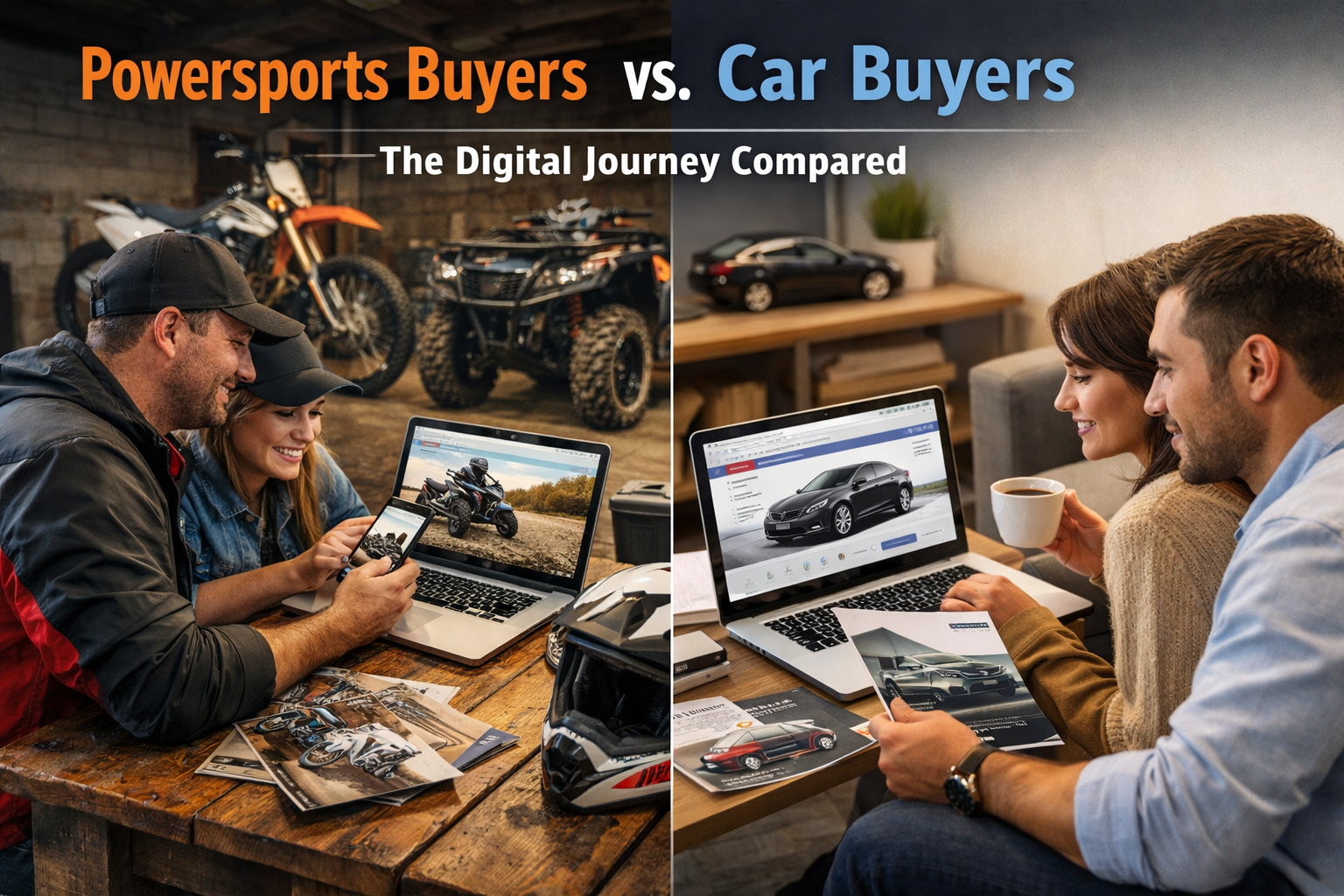
If you've ever tried to apply a standard automotive digital marketing playbook to a powersports dealership, you already know something is off. The leads behave differently. The timeline is different. The emotional temperature of the buyer is different. And the way people research — and ultimately decide — is different in ways that matter enormously for how you market to them.
Powersports is not automotive with a smaller price tag. It's its own world. And the dealers that treat it like a subset of the car business consistently leave money on the table.
So let's map it out honestly — where the digital buyer journey diverges, why it matters, and what powersports dealers need to do differently to meet their buyers where they actually are.
The Fundamental Difference: Need vs. Want
Start here, because everything else flows from it.
The vast majority of car purchases are driven by need. A lease ended. A car broke down. A family grew. A commute changed. The buyer may not love the process, but they have to buy a car. The purchase is, at its core, a practical decision with emotional elements layered on top.
Powersports purchases are almost always the opposite. Nobody needs a motorcycle. Nobody needs a side-by-side. Nobody needs a personal watercraft to get to work on Monday morning. These are desire-driven purchases — driven by passion, lifestyle identity, recreation, and the particular joy of owning something that exists purely to be fun.
That distinction changes everything about how the digital journey works.
A car buyer is motivated to complete the process. A powersports buyer is motivated by the dream of what ownership feels like. Car buyers want efficiency. Powersports buyers want to be inspired. Car buyers are often somewhat reluctant participants. Powersports buyers are enthusiasts who are genuinely excited — if you give them a reason to stay excited.
Your digital presence either feeds that enthusiasm or it doesn't. And if it doesn't, a competitor's will.
The Research Phase: Depth, Passion, and Community
Here's something that will ring true to anyone who has sold powersports for any length of time: powersports buyers research obsessively.
Not the kind of reluctant research a car buyer does because they feel like they should. Deep, passionate, hours-in-a-rabbit-hole research driven by genuine enthusiasm. They watch YouTube videos at midnight. They read forum threads from three years ago. They join Facebook groups dedicated to a specific model. They cross-reference owner reviews across multiple platforms. They ask questions in Reddit communities and get into debates about carburetor tuning and suspension setups.
By the time a serious powersports buyer walks into your dealership or submits a lead form on your website, they often know more about the specific unit they want than some of your sales staff does. They've done the work. They've made the emotional commitment. They just need the right purchase experience to convert.
Compare that to the car buyer, who is often still forming preferences well into the consideration phase. Who relies more heavily on the dealership experience to guide them toward a decision. Who is more open to being influenced by inventory, incentives, and salesperson relationship.
The implication for digital marketing is significant. Powersports buyers are not waiting to be educated by your website. They've already done the education. What your digital presence needs to do is confirm that you're the right dealer to buy from — that you understand their passion, that you have the right inventory, that you'll treat them like the enthusiast they are rather than just another transaction.
The Timeline: Longer, Non-Linear, and Emotionally Driven
Car buying has a relatively predictable timeline driven by circumstance. When someone needs a car, they generally buy one within a few weeks to a couple of months. The urgency is built in.
Powersports buying doesn't work that way.
A powersports buyer might spend six months — sometimes longer — in the consideration phase. They're not dragging their feet. They're enjoying the journey. The research itself is part of the fun. They're building anticipation, imagining the rides they'll take, the trips they'll go on, the experiences they'll have. The purchase is the culmination of a extended period of dreaming and planning.
This has real implications for digital marketing strategy.
For car dealers, retargeting windows of 30 to 60 days are standard. For powersports dealers, a buyer who visited your website two months ago and hasn't converted yet isn't a cold lead — they might be right at the peak of their consideration cycle. Retargeting windows need to be longer. Email nurture sequences need to be more patient and more passion-oriented. Content needs to sustain engagement over months, not just days.
The non-linear nature of the powersports journey matters too. A car buyer moves pretty steadily from research to consideration to decision. A powersports buyer loops. They get close to a decision, then a life event pushes the timeline back. They decide on one model, then fall in love with something else. They almost pull the trigger in November and then decide to wait until spring. They come back to your website repeatedly over a long period before they're ready to act.
Your digital strategy needs to account for this. Consistent presence, sustained content, and long-term nurture are not optional for powersports dealers. They're the core of how the business works.
The Role of Lifestyle and Identity
This one is hard to overstate.
When someone buys a car, they're acquiring transportation. Yes, there's an identity component — plenty of people care deeply about what they drive. But for most buyers most of the time, the car is a means to an end.
When someone buys a powersports vehicle, they're buying an identity. They're becoming a rider. A weekend warrior. An off-road adventurer. A water sports person. The purchase isn't just a transaction — it's an expression of who they are and who they want to be.
Your digital marketing needs to reflect that.
Car dealership websites are organized around inventory, pricing, financing, and specials. That makes sense for the car buying journey. A powersports dealership website that's organized the same way is missing the point almost entirely.
The powersports buyer wants to see the lifestyle before they see the price list. They want to feel the brand before they look at the specs. They want to know that you're a dealership run by people who actually ride, who actually get it, who are going to treat them as a fellow enthusiast rather than a customer to be processed.
Photos of your team on their bikes. Videos of local rides and events. Content that captures the feeling of ownership — the open road, the trail, the water. Social media that looks like it's run by people who love this stuff rather than a marketing department going through the motions.
None of that is decoration. It's the primary trust signal for a powersports buyer evaluating whether you're the right dealer to do business with.
Search Behavior: Different Queries, Different Intent
The way powersports buyers search is fundamentally different from car buyers, and understanding this changes your SEO and paid search strategy significantly.
Car buyers tend to search in fairly predictable, transactional patterns. Make, model, year, location, price. "2024 Honda CR-V Baltimore." "Used Toyota Camry under $20,000 near me." The queries are practical and the intent is relatively clear.
Powersports buyers search across a much wider spectrum — and a lot of their search activity happens well before they have any purchase intent at all.
They search for comparisons. "Kawasaki Ninja 400 vs Yamaha MT-03." They search for reviews and owner experiences. "Honda Talon long term review." They search for community and advice. "Best beginner trail bike for intermediate riders." They search for lifestyle content. "Best motorcycle roads in Maryland." They search for problems and solutions. "CFMoto CFORCE 600 common issues."
Most of these searches have zero transactional intent. The buyer isn't ready to buy. But they're deeply engaged with the category — and the dealers whose content shows up during these passion-driven research searches are the ones building brand familiarity and trust long before a purchase decision crystallizes.
A powersports SEO strategy that only targets high-intent transactional queries is leaving the vast majority of the buyer journey unaddressed. The dealers winning search aren't just showing up when someone is ready to buy. They're showing up throughout the entire passion journey — which means when that buyer is finally ready to act, there's only one dealer they feel like they already know.
Social Media: A Core Channel, Not an Add-On
For automotive dealers, social media is generally a supporting channel. Useful for brand awareness and some lead generation, but rarely the primary driver of the buyer journey.
For powersports dealers, social media is a core channel that sits at the heart of how buyers discover, evaluate, and connect with dealers.
Powersports communities live on social media. Facebook groups dedicated to specific brands and models have tens of thousands of active members. Instagram and TikTok are where riders share their experiences, show off their bikes, and discover new dealers. YouTube channels dedicated to specific powersports categories have massive, passionate audiences.
A powersports dealer with a compelling, authentic social media presence isn't just running ads — they're participating in the community their buyers belong to. They're demonstrating that they're one of the tribe. And in a category where trust and community membership are core buying criteria, that participation has enormous value.
The content that works on powersports social media looks nothing like automotive social media. Not "this week's featured inventory" and "stop by and see our great deals." Real rides. Real events. Real team members talking about the bikes they love. Useful content for enthusiasts — maintenance tips, trail recommendations, gear reviews. The kind of content that someone would follow even if they weren't currently in the market.
Because here's the thing about powersports buyers: they're always kind of in the market. The rider who just bought a new bike six months ago is already thinking about their next one, or an upgrade, or an accessory. The social media presence that stays relevant and engaging to existing customers is also the one that stays top of mind when the next purchase decision comes around.
The Lead: Quality Over Volume, and Handle With Care
Car dealership lead generation is often a volume game. More leads, more opportunities, more deals. The individual lead quality matters, but the pipeline math is relatively forgiving.
Powersports lead generation requires a different philosophy.
Powersports leads tend to be higher quality on average — more specifically intentioned, more researched, more emotionally invested. But they're also more sensitive to being handled poorly. A powersports buyer who has spent months researching and finally submits a lead form is not looking to be called five times in 24 hours by someone reading from a script. They're looking to have a conversation with someone who understands their passion and can speak to it intelligently.
The automotive BDC playbook — high-volume outreach, aggressive follow-up cadences, generic scripts — can actually damage the relationship with a powersports buyer rather than advance it. These buyers are enthusiasts. They can tell instantly whether the person calling them actually knows the product or is just dialing for appointments.
Digital marketing strategy for powersports dealers needs to account for this at every stage — from how lead forms are structured to what automated follow-up looks like to how leads are handed off to the sales team. The goal isn't just to generate leads. It's to generate leads that arrive already trusting you and to handle them in a way that honors the passion that brought them to your door.
Financing: A Different Conversation
In automotive, financing is central to the buying conversation from very early in the process. Monthly payment, trade value, interest rate — these are often the primary negotiating levers, and car dealer websites are built to surface financing information prominently.
Powersports financing is a different conversation — and a lot of powersports buyers are uncomfortable with how aggressively it's pushed.
Many powersports buyers are paying cash or planning to. Others are financing, but they came to your dealership because of the bike, not the payment plan. Leading with financing in your digital marketing and website experience can actually undermine the emotional connection that was driving the purchase in the first place.
This doesn't mean financing should be invisible. It means it should be appropriately positioned — available and clear, but not the centerpiece of a purchase experience that's fundamentally driven by passion. The best powersports dealer websites lead with lifestyle and product, keep the purchase process clean and straightforward, and present financing as a helpful option rather than the primary pitch.
Seasonality: Marketing Through the Off-Season
Automotive sales have some seasonality, but demand is relatively consistent year-round. People need cars in January just as much as they need them in July.
Powersports is dramatically more seasonal in most markets — and the digital marketing strategy needs to reflect that.
The instinct a lot of dealers have is to pull back on marketing spend during the off-season when nobody is buying. That instinct is understandable and almost completely wrong.
The off-season is when passionate buyers are doing their deepest research. When they're watching videos, reading reviews, and dreaming about next season. When they're most susceptible to falling in love with a new model or a new brand. The dealers who stay visible and engaging throughout the off-season — with content, with community building, with retargeting — are the ones whose names are at the top of buyers' minds when spring arrives and wallets open.
Going dark in the off-season is handing your competitors the most valuable relationship-building window of the year.
The Bottom Line: Powersports Needs Its Own Playbook
If there's one thing this comes down to, it's this: powersports dealers deserve a digital marketing strategy built for how their buyers actually think, feel, and decide — not a recycled automotive playbook that treats a motorcycle like a Mazda.
The buyers are different. The journey is different. The emotional dynamics are different. The content that resonates is different. The timeline is different. The community is different.
The dealers that understand and embrace those differences — that build digital strategies rooted in passion, community, and genuine enthusiasm for the category — are the ones that win the long game. They build the kind of brand presence that buyers seek out rather than stumble across. They generate the kind of leads that arrive pre-sold rather than skeptical. And they create the kind of customer relationships that turn one sale into a lifetime of repeat business and referrals.
That's what a powersports-specific digital strategy actually looks like. And it starts with understanding that you're not selling cars.
Ready to build a digital strategy that actually speaks the language of powersports buyers?
Ritner Digital specializes in digital marketing built specifically for powersports dealerships — the kind that understands the buyer, the community, and the journey. If you're ready to stop using a one-size-fits-all approach and start marketing in a way that actually connects, let's talk.
👉🏼 Get in Touch at ritnerdigital.com
Frequently Asked Questions
Why can't powersports dealers just use the same digital marketing strategy as car dealerships?
Because the buyers are fundamentally different — and a strategy built for one will consistently underperform for the other. Car buyers are largely need-driven, moving through a relatively predictable research and purchase timeline. Powersports buyers are passion-driven enthusiasts who research obsessively, buy on emotion, and belong to tight-knit communities that influence their decisions in ways that have no real automotive equivalent. A digital strategy that treats a motorcycle like a Mazda misses the entire psychology of how powersports purchases actually happen — and leaves significant revenue on the table as a result.
What is the biggest difference between a powersports buyer and a car buyer?
The most fundamental difference is need versus want. Almost every car purchase is driven by some practical necessity — a lease ended, a vehicle broke down, a life change created a new transportation requirement. Almost every powersports purchase is driven purely by desire. Nobody needs a dirt bike or a personal watercraft. They want one — deeply, passionately, sometimes for months or years before they actually buy. That distinction changes everything about how you market to them, how you structure your website experience, how you handle leads, and how long your nurture strategy needs to run.
How long does a typical powersports buyer take to make a purchase decision?
Significantly longer than a car buyer — and the timeline is far less predictable. A powersports buyer might spend six months or more in active consideration, looping back and forth between models, getting close to a decision and then pulling back, waiting for the right season or the right financial moment. This isn't hesitation — it's enthusiasm. The research phase is part of the enjoyment for a lot of powersports buyers. Digital strategies that assume a 30-day purchase window will miss a substantial portion of buyers who are genuinely interested but simply operating on a longer and more emotionally driven timeline.
How should a powersports dealer's website be different from a car dealership website?
A car dealership website is organized around inventory, pricing, financing, and transactional efficiency — and that makes sense for how car buyers shop. A powersports dealer website needs to lead with lifestyle, passion, and brand identity before it leads with price lists and payment calculators. Powersports buyers want to feel the culture of your dealership before they look at the specs. They want to see that you're run by people who actually ride, who understand the community, and who will treat them as a fellow enthusiast. The purchase infrastructure — inventory, financing, contact forms — needs to be there and needs to be clean. But it shouldn't be the first thing a passionate buyer encounters when they land on your site.
What kind of content actually works for powersports buyers during their research phase?
Content that speaks to the passion, not just the transaction. Comparison content between popular models. Owner experience and long-term review style content. Ride guides and local trail or route recommendations. Maintenance and gear advice. Event coverage and community content. Behind-the-scenes looks at your team and their own riding experiences. This kind of content works because it shows up during the deep, enthusiast-driven research that powersports buyers do long before they have any purchase intent — and it builds brand familiarity and trust over months of engagement. By the time that buyer is ready to act, they feel like they already know you.
Is social media actually important for powersports dealers, or is it just nice to have?
It's genuinely core to the powersports buyer journey in a way that it isn't for automotive. Powersports communities live on social media — dedicated Facebook groups, Instagram and TikTok riding content, YouTube channels with massive passionate audiences. A powersports dealer with an authentic, enthusiast-driven social media presence isn't just running brand awareness ads — they're participating in the community their buyers belong to. That community membership is a real trust signal for powersports buyers evaluating which dealer to do business with. A social media presence that looks like it's run by people who actually love this stuff converts differently than one that looks like a marketing checklist being ticked off.
How should powersports dealers handle leads differently than automotive dealers?
With more care and more expertise. Powersports buyers who submit a lead form have typically done extensive research and are emotionally invested in the purchase. They're not looking to be called repeatedly by someone reading from a generic script — they're looking to have a real conversation with someone who understands the product and shares their enthusiasm. The high-volume, aggressive follow-up cadences that work reasonably well in automotive can actively damage the relationship with a powersports buyer. Lead handling for powersports needs to prioritize expertise, genuine engagement, and respect for the buyer's knowledge level over speed-to-contact metrics alone.
How does search behavior differ between powersports buyers and car buyers?
Car buyers search in fairly transactional, intent-driven patterns — make, model, year, location, price. Powersports buyers search across a much broader spectrum that includes a huge amount of non-transactional, passion-driven activity. They search for model comparisons, owner reviews, riding routes, community advice, gear recommendations, and troubleshooting content — often months before they have any real purchase intent. A powersports SEO strategy that only targets high-intent transactional queries is addressing a small fraction of the actual search activity in the category. The dealers who show up throughout the full research journey — not just at the purchase finish line — are the ones building the kind of brand familiarity that drives real competitive advantage.
Should powersports dealers keep marketing through the off-season?
Absolutely — and this might be the most underutilized opportunity in powersports digital marketing. The instinct to pull back on spend when unit sales slow down is understandable but strategically costly. The off-season is when passionate buyers do their deepest research, fall in love with new models, and build the enthusiasm that turns into a purchase when spring arrives. Dealers who stay visible and engaging through the off-season with content, community building, and retargeting are the ones whose names are at the top of buyers' minds when the buying season opens. Going dark in the off-season is essentially handing your competitors the most valuable relationship-building window of the year.
How should financing be presented on a powersports dealer website?
As a helpful option rather than the centerpiece of the experience. Many powersports buyers are paying cash or have already figured out their financing before they ever contact a dealer — and leading with payment calculators and financing pitches can undermine the emotional connection that was driving the purchase in the first place. Financing information should be clearly available and easy to find, but the primary experience of your website should lead with the product, the lifestyle, and the brand. Save the financial conversation for when the buyer brings it up — which they will, when they're ready.
What makes Ritner Digital different when it comes to powersports dealer marketing?
Ritner Digital builds digital marketing strategies specifically for the powersports industry — not adapted from automotive playbooks, but built from the ground up around how powersports buyers actually think, research, and decide. That means SEO strategies that show up throughout the full enthusiast journey, social media content that participates authentically in the powersports community, website experiences that lead with passion before they lead with price, and lead handling strategies that respect the knowledge and enthusiasm of the buyer. If you're ready for a digital strategy that actually speaks the language of your customers, we'd love to talk.