SEO Will Cut Your Google Ads Bill. Just Not in Month One.
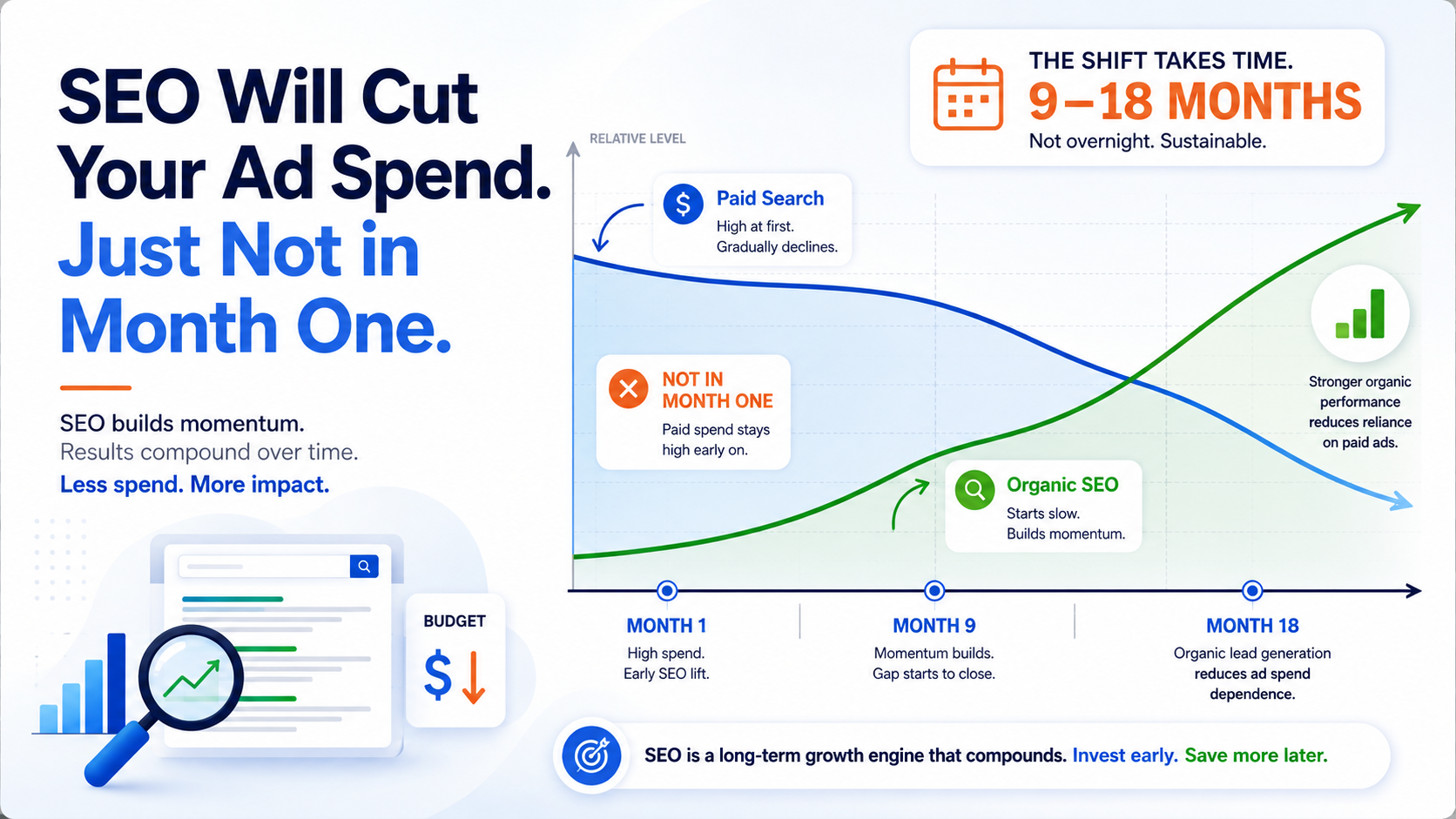
Every SEO pitch eventually arrives at the same promise: stop renting traffic, start owning it. Build organic visibility, and the Google Ads invoice shrinks. Own the page, and you stop paying a toll every time someone searches for what you sell.
The promise is real. We make some version of it ourselves, because the mechanism behind it is well documented and has been for over a decade.
The problem is what happens next. A founder signs the SEO contract, looks at a $14,000 monthly ad spend, and does the obvious math: if organic is going to replace this, why am I still paying for it? Month one, the budget gets cut by 40%. Month two, lead volume falls off a cliff. Month four, the SEO program gets blamed for a pipeline hole it didn't create and couldn't have filled yet.
We've watched this happen. We've been hired to clean it up. This piece is the long version of the conversation we have in month one, with the research behind it.
Short version: SEO does reduce paid dependency, the effect is measurable, and it is worth restructuring your budget around. But the substitution is gradual, keyword-by-keyword, and it does not begin at all until specific things are true about your rankings. Cutting spend before those things are true doesn't accelerate the transition. It just removes your safety net during the exact window when you need it most.
Part 1: The mechanism is real — and it's better documented than most agencies realize
Before the timeline, the mechanism. Understanding why organic reduces paid dependency tells you exactly when it starts to.
The best evidence doesn't come from an agency case study. It comes from Google's own research team, and it comes from a natural experiment run inside eBay.
Google's own numbers say organic ranking cuts ad incrementality roughly in half
In 2011, Google published a study built on more than 400 accounts where search ads had been paused. The finding, which the ad industry has quoted ever since: an average of 89% of paid clicks were not recovered by organic clicks when campaigns were switched off. A follow-up covering more than 5,300 cases put the figure for fully paused accounts at 85%, with 80% for advertisers who reduced spend and 78–79% for those who increased it or started fresh.
Taken alone, that number reads as an argument for never touching your ad budget. Sales teams have used it that way for fifteen years.
But Google published a second, far more interesting paper in 2012 that almost nobody quotes. A meta-analysis of 390 of those same pause studies asked a sharper question: does it matter whether the advertiser also ranks organically on the same query?
It matters enormously. On average, 81% of ad impressions and 66% of ad clicks occurred on queries where the advertiser had no associated organic result on page one at all. And where an organic listing did exist in the top position, incrementality collapsed: roughly 50% of those ad clicks were incremental, compared with 100% when no organic result was present.
Read that again, because it is the entire thesis of every "SEO reduces paid dependency" pitch, published by Google:
No organic ranking? Effectively 100% of your ad clicks are incremental. Every dollar buys traffic you would not otherwise get. The ad is doing all the work.
Ranking #1 organically? About half of your ad clicks are now redundant. You are paying for roughly half the traffic twice.
The famous 89% figure is an average across a population dominated by queries where the advertiser had no organic presence. It is not a universal law. It is a description of what happens to companies that never invested in organic. The substitution effect is not a theory. It is sitting inside Google's own data, and it is gated on one condition: you have to actually rank.
The eBay experiment: independent, and harsher
Google has an obvious interest in a high incrementality number. So the more credible test comes from outside.
In 2012, economists Thomas Blake and Chris Nosko, working with Steven Tadelis inside eBay Research Labs, ran a set of large-scale field experiments and published the results in Econometrica (working paper here). In the first, eBay switched off paid search on all branded queries on Yahoo and MSN while leaving Google running as a control.
The result: roughly 99.5% of the clicks eBay had been paying for arrived anyway through organic results. The authors concluded that for brand keywords, organic search is close to a perfect substitute for paid, making brand-term SEM ineffective for short-term sales. A broader experiment across roughly 30% of US traffic and more than 100 million managed keywords found returns from non-brand terms were a fraction of what attribution models reported, with new and infrequent users the only segment showing meaningful lift.
Two caveats matter, and we'd rather state them than have you find them later. First, eBay in 2012 was a household name with overwhelming organic dominance on its own brand. Most companies are not eBay. Second, the study measured short-term sales, not brand equity or long-term demand.
But the direction is unambiguous and it lines up with Google's own rank-one finding. The stronger your organic position on a query, the less your ad on that query is actually buying you.
And the cost of not fixing this keeps climbing
The urgency isn't only about efficiency. Paid search has gotten structurally more expensive.
LocaliQ and WordStream's 2026 Google Ads benchmarks, drawn from more than 13,000 search campaigns across 23 industries, put the cross-industry average CPC at $5.42 — more than double the $2.32 recorded when the series began in 2016. Average cost per lead sits at $66.69. There was genuine good news in the 2026 data: CPL fell for the first time in five years, driven by conversion rates improving in the large majority of industries. But the ten-year trend line is not ambiguous, and the spread is brutal at the top — legal services average $9.87 per click, home improvement $8.33, dentistry $8.00.
Some of that inflation was engineered. In Judge Amit Mehta's remedies opinion in the US antitrust case, the court described internal "pricing knobs" Google used to raise ad prices by 5% to 15% at a time, calibrated so advertisers would notice higher costs without identifying Google as the cause. Google's own surveys confirmed exactly that. During trial testimony, an ads executive had acknowledged raising auction prices without notifying advertisers. The court now requires Google to report material changes to its Search Text Ads auction monthly.
You are renting traffic from a landlord who has been found in court to have quietly raised the rent. That is a reasonable thing to want less exposure to. It is not a reason to move out before you've built somewhere else to live.
Part 2: Why month one is the single worst month to cut
So the mechanism is real and the incentive is strong. Why not start immediately?
Four reasons. The first is obvious. The other three are the ones that actually kill programs.
1. Nothing is ranking yet, and the data on that is grim
An SEO program in month one has produced strategy, a technical audit, maybe a few published pages. It has not produced rankings, because rankings are not something an agency produces. They are something Google concedes, slowly.
Ahrefs re-ran its landmark ranking-timeline study in 2025 and the numbers moved sharply in the wrong direction. Across 1.3 million random US keywords:
72.9% of pages in Google's top 10 are more than three years old, up from 59% in the 2017 version of the study.
The average #1-ranking page is now five years old, up from two years in 2017.
Only 13.7% of top-10 pages were under a year old, down from 22%.
And on new pages specifically: of one million random URLs first crawled in September 2023, only 1.74% reached the top 10 within a year. Filtered to non-empty English content, the figure rises to 6.11%, which Ahrefs suggests is the fairer number. Either way, the overwhelming majority of pages published today will not be in the top 10 twelve months from now.
The SERP is older, more entrenched, and harder to break into than it was during the era when "SEO takes 3–6 months" became conventional wisdom. That advice is a relic of a younger index.
There is one genuinely encouraging finding in the same data: 40.82% of pages that did reach the top 10 got there within their first month. Early momentum is real and it is predictive. Ahrefs also notes that after roughly six months without movement, a page's odds drop sharply unless it's substantially revised. That gives you a legitimate early read — but a read on page-level signal, not on revenue. It is not a green light to move budget.
2. You destroy your own measurement baseline
This is the failure mode we see most often, and it's the one that does lasting institutional damage.
Cut paid in month one and you have simultaneously changed two variables. Organic is climbing from near zero. Paid is falling from full spend. Total lead volume moves, and you now have no way to attribute the movement.
When leads drop in month three, the argument in the room is unwinnable. Paid says organic isn't delivering. SEO says paid was cut too fast. Nobody can prove anything, because the control condition was destroyed in week two. In practice, whoever has been in the building longer wins, and the SEO program is cancelled at month five — roughly two months before the research says it would have started paying for itself.
The correct posture in months one through six is boring and rigorous: hold paid flat and let organic be the only variable that moves. Flat spend is not caution. It is the control group. It is the only thing that will let you say, in month nine, organic click share on these 40 commercial queries went from 3% to 31% while paid spend was constant — which is a sentence a CFO can act on.
3. You break the feedback loop that makes SEO faster
Your Google Ads search terms report is the highest-quality commercial keyword dataset your company owns. Not estimated volume from a third-party tool. Actual queries, from actual buyers, with actual conversion data attached.
That dataset tells an SEO team which head terms convert and which merely attract traffic; which long-tail phrasings buyers really use; which landing page angles win on conversion rate; where lead quality collapses despite good volume. It compresses the guesswork phase of a content roadmap from months into weeks.
Cut spend in month one and you shrink that dataset at the exact moment it has the most value. You've made the SEO program slower in order to fund the SEO program. Ritner runs both channels under one strategy for precisely this reason: ad data should be setting SEO priorities, and organic wins should be reshaping the ad account. Severing that link in the first quarter is self-defeating.
4. In B2B, pipeline lags rankings by another full cycle
Even once a page ranks and converts, revenue doesn't follow immediately.
6sense's Buyer Experience Report put the average B2B buying cycle at 11.3 months, and found that 81% of buyers already have a preferred vendor by the time they make first contact with a seller, with 85% having largely established their requirements before reaching out. Forrester's benchmarks put enterprise technology purchases in the 11–17 month range, with the large majority of the journey completed before a vendor knows the buyer exists.
That's the real job SEO is doing in a B2B account: getting you into the consideration set during the anonymous research phase, months before a form fill. Which is exactly why the payoff lags. A page that starts ranking in month five is influencing deals that close in month twelve or later.
So the honest sequencing is: content published in months 1–3, rankings emerging months 3–6, organic conversions months 6–9, closed revenue months 9–15. Cutting paid in month one means you've removed your near-term lead source to fund a channel whose revenue contribution arrives, at the earliest, three quarters later.
Part 3: The complication nobody's timeline accounts for yet
There's a newer reason to be careful with the substitution math: a top-10 ranking buys fewer clicks than it did two years ago.
SparkToro's 2026 analysis of Similarweb clickstream data found that Google searches in the US ended without a click 68.01% of the time between January and April 2026, up from 60.45% in 2024. The share of searches generating any click fell 9.51 percentage points over two years, while the share leading to another Google search rose 7.2 points.
AI Overviews are the main accelerant. Pew Research's behavioral tracking found users clicked an organic result on 8% of searches where an AI Overview appeared, versus 15% where one didn't — and clicked a citation link inside the Overview about 1% of the time. Ahrefs measured the top organic result losing up to 58% of its clicks on AI Overview queries. Seer Interactive tracked organic CTR on those queries falling from 1.76% to 0.61%.
Two implications for anyone modeling a paid-to-organic transition:
First, don't model substitution on old CTR curves. If your projection says "position 3 on this term equals 400 sessions a month, so we can cut $X of ad spend," and that curve came from a 2021 benchmark, it is materially wrong on informational queries. Model with current, query-type-specific CTR, and pull real numbers from your own Search Console rather than a generic table.
Second, the substitution is now strongest exactly where it matters most. AI Overviews cluster on informational and research queries. Bottom-funnel commercial searches — the ones with buying intent, the ones you're actually bidding on — retain far more click behavior. That is a real advantage for a well-built SEO program, but it means the transition is uneven across your keyword set, and you have to taper query-type by query-type rather than by a single blended percentage.
It also means the definition of an organic "win" has widened. Being cited inside an AI Overview or named in a ChatGPT or Perplexity answer is now part of what reduces paid dependency, even when it produces no click at all, because it puts you in the consideration set that 81% of buyers arrive with already formed. Which is a genuinely harder thing to attribute — and another reason to keep paid running as a stable, measurable floor while you figure out how it's performing.
Part 4: So how long does it actually take?
Here is the realistic arc, with the caveat that domain authority, competition, and existing content inventory can shift every window by a quarter in either direction.
Months 1–3: Build. Change nothing about paid.
Technical fixes, information architecture, first content pushed live, the ad account's search terms report mined for the real commercial keyword map. Search Console shows impressions climbing on new pages. Some low-competition terms land quickly.
Paid budget: unchanged. Full spend, full measurement, and you should be actively tightening the ad account here — negatives, match types, landing page relevance — because that improves both channels at once.
Signals to watch: indexation, impression growth, average position on target queries. Not traffic. Not leads.
Months 4–6: First real movement, first real temptation
Pages start entering the top 20, then the top 10 on lower-competition and long-tail terms. Organic sessions become visible in analytics. This is when the first "can we start pulling back?" email lands.
The honest answer is: on a handful of specific queries, maybe. Not on the account.
Paid budget: still flat overall. The one legitimate move is keyword-level trimming, which we'll cover in the next section. This is also the checkpoint Ahrefs identified — pages that haven't moved by roughly month six need substantive revision, not more patience.
Months 7–9: Break-even, and the first defensible cut
First Page Sage's SEO ROI benchmarks, built on campaign data from 2021 through 2025, put positive ROI at a 6–12 month window with peak results in year two or three. Practitioner benchmarks aggregating that and similar data cluster break-even around months seven to nine, with B2B SaaS nearer seven and slower-moving categories nearer nine or beyond.
By now you should have stable top-5 positions on a meaningful set of commercial queries, and organic conversions with enough volume to compare against paid on cost-per-qualified-lead. This is the first point at which a paid reduction is defensible, and even here it should be keyword-level and tested, not a budget-line percentage.
Paid budget: first structured taper, on qualifying terms only.
Months 10–18: The real reduction window
Rankings mature, the content library compounds, and the overlap between your organic footprint and your ad spend gets wide enough to matter. This is where a well-run program produces the headline outcome: same or better lead volume at meaningfully lower blended acquisition cost.
Note the framing. Not lower spend. Lower blended cost per acquisition. Many of our clients don't reduce total search budget at all in this window. They redeploy it — out of terms they now own organically, into competitor conquesting, new geographies, new service lines, and mid-funnel plays that were unaffordable when brand and category terms were consuming the budget.
Months 18+: Structural independence
The end state is not zero paid spend. It's paid becoming discretionary — a lever you pull for launches, seasonality, expansion markets, and competitive defense, rather than a life-support system your pipeline collapses without.
Part 5: Cut on triggers, not on the calendar
The single biggest improvement most companies can make is to stop deciding this by date and start deciding it by condition. A keyword qualifies for reduced paid support when all five of the following are true:
1. You hold a top-3 organic position on that specific query. Not top 10. Google's own meta-analysis found the incrementality drop is tied to a top rank organic listing, and click distribution is steeply concentrated at the top. Position 7 does not substitute for an ad.
2. That position has been stable for at least 60 days. New rankings oscillate. Cutting the ad the week a page first touches position 3 means cutting it right before the rank correction.
3. The organic listing is genuinely visible on the live SERP. Open it. If an AI Overview, a map pack, a shopping carousel, and four ads sit above your "position 3," your effective visibility is far below what the rank tracker reports. Rank data is a proxy. The SERP is the reality.
4. Your organic page converts. Ranking is not the finish line. If the organic landing page converts at a third the rate of your ad landing page, replacing paid traffic with organic traffic is a downgrade in lead volume even at identical sessions. Fix the page first, then cut the ad.
5. No competitor is actively bidding on the term. If a rival's ad sits above your organic listing, your ad is doing defensive work that your ranking cannot do. This is the standing exception, and it applies especially to your own brand name.
What we never recommend cutting first
High-intent bottom-funnel terms where you don't yet rank. Highest commercial value, weakest organic coverage. Last to go, if ever.
Remarketing and audience campaigns. These are not substitutable by organic ranking at all. Different job entirely.
Competitor conquesting. You will never rank organically for a competitor's brand name.
Brand defense when rivals are bidding. The eBay result assumed nobody else was bidding on eBay's brand. When a competitor is, the calculus changes completely.
Anything during a seasonal peak. Test in a normal month.
Test it properly, or you'll learn nothing
The right way to validate a cut is a geo holdout, structured the way eBay's researchers structured theirs: pause the qualifying ad group in a set of matched markets, leave it running in comparable markets as the control, and run it for at least four weeks — longer in B2B, where the sales cycle means four weeks of data tells you nothing about revenue.
Measure total conversions from those markets, not paid conversions. Paid conversions will obviously fall. The question is whether total conversions fall, and by how much. If total holds within noise, the ad spend was buying traffic you already owned. If total drops meaningfully, the ad was incremental. Turn it back on and retest in a quarter.
One test, one variable, one keyword group at a time. It is slower than a budget-line cut. It is the only version that produces a defensible answer.
Part 6: The Airbnb story, told honestly
Airbnb is the case every SEO deck cites, and it's usually cited wrong.
The facts are real. In 2020, Airbnb cut brand and performance marketing 58%, from $1.14 billion to $482 million. Brian Chesky told investors traffic returned to 95% of 2019 levels with marketing effectively switched off, and that by Q4, more than 90% of traffic was direct or unpaid. The company said its marketing-to-revenue ratio would never return to pre-pandemic levels.
The SEO industry adopted this instantly. Chesky himself pushed back, noting publicly that SEO was not among Airbnb's top growth drivers and that most of the SEO they did have was branded search — people typing "Airbnb." Which is precisely the eBay finding, restated by a CEO: when your brand is a verb, brand-term ads buy you almost nothing.
And the story kept going. A close reading of Airbnb's SEC filings from 2020 through 2026 shows brand and performance marketing at $119 million in Q1 2021 and $512 million in Q1 2026. In raw dollars, spend passed 2019 levels by 2023 — the same year filings began itemizing search engine marketing increases. Skift's analysis found spending accelerating around 32% in the first half of 2026 against 17% revenue growth, explicitly attributed to paid growth initiatives in expansion markets.
Here's the part that matters, and it's the honest lesson rather than the convenient one: the dollars came back. The ratio didn't. Brand and performance marketing sits at roughly 13% of revenue against about 24% in 2019, because revenue more than doubled while spending grew far less.
That is the actual, achievable outcome of reducing paid dependency, and it is a good one. Not zero spend. Not "turn off Google Ads." A structurally lower ratio of paid spend to revenue, and paid dollars redeployed into growth rather than into defending ground you already own.
If the company most famous for quitting paid search is spending half a billion dollars a quarter on marketing, the goal was never zero. The goal was leverage.
What this actually looks like in practice
Reduce paid dependency. Don't reduce paid spend on a calendar.
The sequence that works:
Months 1–6: Hold spend flat. Let organic be the only variable. Mine the search terms report to accelerate the content roadmap. Track impressions and positions, not leads.
Months 6–9: Identify qualifying keywords using the five conditions. Run a geo holdout on the first small group. Measure total conversions, not paid conversions.
Months 9–18: Expand the taper keyword by keyword as more terms qualify. Redeploy freed budget into terms you'll never rank for rather than banking it, unless the goal is explicitly cost reduction.
Ongoing: Re-test annually. Rankings move. Competitors start bidding. AI Overviews appear on queries that didn't have them last quarter. A term that qualified in 2026 may not qualify in 2027.
And measure the right thing throughout. Not ad spend. Not organic sessions. Blended cost per qualified lead, and the percentage of pipeline that would survive a paid pause. Those two numbers tell you whether you're building an asset or just moving money between channels.
The companies that get this right almost never describe the outcome as "we cut our ad budget." They describe it as "we stopped bidding on our own name, we stopped paying for the top four category terms, and we put that money into three new markets."
That's what owning your traffic actually buys you. It takes the better part of a year to get there, and the fastest way to never arrive is to cut the budget in month one.
Frequently Asked Questions
How long does SEO take to reduce paid search spend?
Plan on nine to eighteen months before you can meaningfully reduce spend, with the first defensible cuts arriving around months seven to nine. First Page Sage's benchmark data puts positive SEO ROI in a 6–12 month window with peak returns in year two or three, and practitioner benchmarks cluster break-even around months seven to nine. Reductions before that point aren't accelerated substitution — they're just a budget cut with an SEO invoice attached.
Can I cut Google Ads as soon as my SEO program starts?
No, and month one is the worst possible timing. Nothing ranks yet, you destroy the measurement baseline that would let you prove the program worked, and you shrink the search terms dataset that makes the SEO roadmap faster. Hold spend flat through at least month six so organic is the only variable moving.
Does ranking #1 organically make my ad on that keyword redundant?
Partially. Google's own meta-analysis of 390 ad-pause studies found that roughly 50% of ad clicks were incremental when the advertiser held a top organic position, compared with 100% when no organic listing was present. So a #1 ranking cuts your ad's incremental value roughly in half. It doesn't eliminate it, which is why the right move is a tested taper rather than a switch-off.
What about the study that says 89% of paid clicks are incremental?
That figure comes from Google's 2011 Search Ads Pause research, and it's real — but it's an average across a population dominated by queries where the advertiser had no organic presence at all. Google's own follow-up work found that 81% of ad impressions and 66% of ad clicks occurred on queries with no associated page-one organic result. The 89% describes what happens to companies that never invested in organic. It's not a law of physics.
Should I stop bidding on my own brand name?
Only if no competitor is bidding on it. The eBay field experiment published in Econometrica found roughly 99.5% of branded ad clicks were retained through organic when the ads were switched off — but that test ran in a market where nobody was bidding against eBay's brand. If a rival's ad sits above your organic listing on your own name, your ad is doing defensive work that a ranking cannot do. Check the live SERP before you touch it.
When is it safe to reduce spend on a specific keyword?
When all five conditions hold: you're in the top three organically, that position has been stable for at least 60 days, your listing is genuinely visible on the live SERP (not buried under an AI Overview and four ads), your organic landing page converts at a comparable rate to your ad landing page, and no competitor is bidding on the term. Fewer than five conditions means it isn't ready.
How do I test whether an ad is actually incremental?
Run a geo holdout. Pause the qualifying ad group in a set of matched markets, leave it running in comparable markets as the control, and run it at least four weeks — longer for B2B. Measure total conversions from those markets, not paid conversions. Paid conversions will obviously fall; the question is whether total volume falls. If total holds within noise, the spend was buying traffic you already owned.
Why not just cut a percentage of the ad budget instead?
Because a blended percentage cut removes spend from terms you own and terms you don't in equal measure, and it changes two variables at once so you can't attribute the result. Substitution happens keyword by keyword, not budget-line by budget-line. Cut on triggers, not on a calendar or a percentage.
Does the goal have to be zero paid spend?
No, and for almost every company it shouldn't be. The realistic outcome is a structurally lower ratio of paid spend to revenue, with freed budget redeployed into competitor conquesting, new geographies, and mid-funnel plays you couldn't afford while brand and category terms ate the budget. Airbnb — the company most famous for quitting paid search — passed its 2019 marketing dollars again by 2023 and now spends around $512 million a quarter on brand and performance. The dollars came back; the ratio didn't. That's the win.
Do AI Overviews change the paid-to-organic math?
Yes, and most substitution models haven't caught up. Pew Research found users clicked an organic result on 8% of searches with an AI Overview present versus 15% without, and Ahrefs measured the top organic result losing up to 58% of its clicks on those queries. Don't project substitution using pre-2023 CTR curves. The useful nuance: AI Overviews cluster on informational queries, while bottom-funnel commercial searches — the ones you're actually bidding on — retain far more click behavior.
How long does it take a new page to rank in the first place?
Longer than most timelines assume. Ahrefs' 2025 study of 1.3 million US keywords found only 1.74% of newly published pages reached the top 10 within a year (6.11% when filtered to substantive English content), that 72.9% of current top-10 pages are more than three years old, and that the average #1-ranking page is now five years old. One useful signal: 40.82% of pages that did reach the top 10 got there within their first month, and pages showing no movement by roughly month six usually need revision rather than patience.
Why does the payoff take even longer in B2B?
Because rankings lead pipeline by a full buying cycle. 6sense's Buyer Experience Report puts the average B2B buying cycle at 11.3 months, with 81% of buyers already holding a preferred vendor at first contact and 85% having set their requirements before they ever speak to a seller. A page that starts ranking in month five is influencing deals that close in month twelve or later.
What should I be measuring during the transition?
Two numbers: blended cost per qualified lead, and the percentage of pipeline that would survive a paid pause. Ad spend and organic sessions in isolation tell you nothing about whether you're building an asset or just shuffling money between channels. In months one through six specifically, track impressions and average position rather than leads — leads are the wrong scoreboard that early.
Work with us
We run SEO, AI search visibility, and paid media under one strategy — which is the only way the transition described above actually works. Your ad data sets the content roadmap. Your rankings determine where spend gets pulled. Nobody's protecting a channel budget at the expense of the blended number.
We also publish our own Search Console data every month, wins and uncomfortable parts included, because we think you should be able to see how an agency performs before you hire one.
If you're currently carrying a paid search bill you'd like to make optional, start a conversation with us. We'll audit your overlap between paid spend and organic coverage and tell you honestly which terms are already redundant, which are years away, and what the realistic timeline looks like for your domain.
Sources
Blake, T., Nosko, C., & Tadelis, S. (2015). "Consumer Heterogeneity and Paid Search Effectiveness: A Large-Scale Field Experiment." Econometrica 83(1), 155–174. (NBER working paper)
Google Research, "Studies Show Search Ads Drive 89% Incremental Traffic" and "Search Ads Pause Studies Update."
Google Research, "Impact of Ranking of Organic Search Results on the Incrementality of Search Ads."
Ahrefs (2025), "How Long Does It Take to Rank in Google? And How Old Are Top Ranking Pages?"
WordStream / LocaliQ, "Google Ads Benchmarks 2026."
Search Engine Journal, "Google Quietly Raised Ad Prices, Court Orders More Transparency."
Search Engine Land, "How Google harms search advertisers in 20 slides" and "Google zero-click searches reach 68% in early 2026."
Similarweb, "Zero-Click Marketing: What the 2026 Data Means."
6sense, 2024 Buyer Experience Report.
First Page Sage, "SEO ROI Statistics 2026."
Campaign, "Airbnb slashes spend in permanent shift from performance marketing to brand."
Hospitality.today, "The direct-booking success story hotels were told to copy is buying traffic again."
Skift, "Airbnb Has Quietly Rebuilt the Marketing Engine It Was Famous for Cutting."