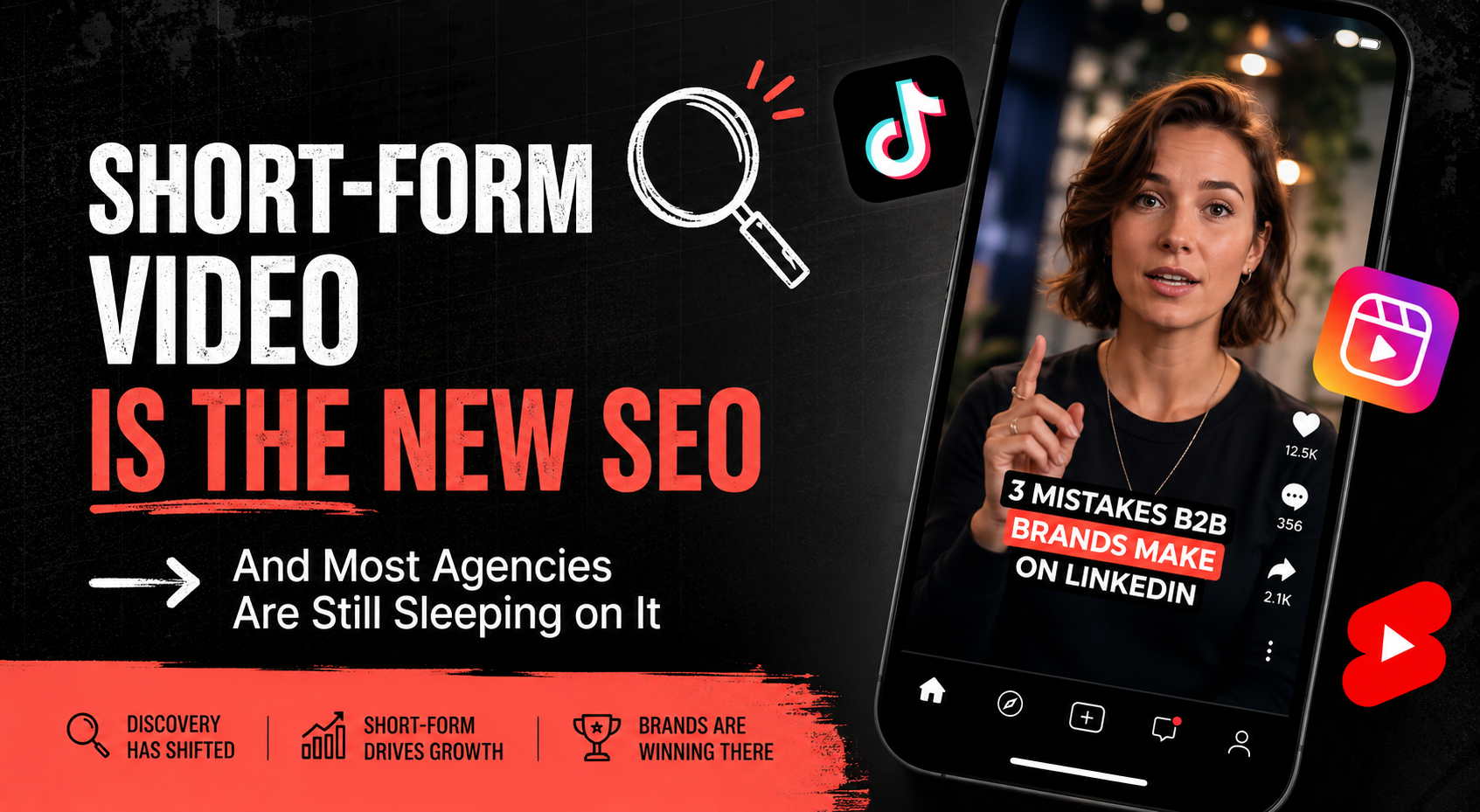
Short-Form Video Is the New SEO — And Most Agencies Are Still Asleep at the Wheel
The Hot Take That Isn't Actually That Hot Anymore
Here's something worth saying out loud: if someone on your team genuinely wants to run with TikTok, Reels, or short-form video, you should probably let them.
That might feel like a casual observation. But when you look at where discovery behavior is actually heading — and where most marketing agencies are still planting their flag — it becomes a pretty significant strategic call.
We recently went looking for marketing agencies doing short-form video well. Not just posting. Actually doing it well — platform-native content, real personality, genuine engagement. And honestly? It was harder to find strong examples than it should have been.
Meanwhile, brands outside the agency world — auto dealers, law firms, news organizations, SaaS tools — have figured it out. Which raises an uncomfortable question for anyone in the marketing business: why are the people who sell marketing so reluctant to do marketing where the audience actually is?
Discovery Has Left the Building
Let's start with what the data actually says, because this isn't anecdote — it's a structural shift in how people find things.
TikTok's global user base surpassed 1.7 billion, with engagement levels significantly higher than other platforms. 75% of TikTok users discover new brands through the app — a crucial advantage for marketers aiming to build awareness. Ondigitals
Nearly 70% of TikTok users report being likely to check out a brand after seeing it on the platform, reinforcing TikTok's power as a discovery engine. AmzScout
And it's not just passive scrolling. The platform has quietly evolved into a search destination. A HerCampus study reported that 74% of Gen Z used TikTok search, and 51% said they preferred TikTok over Google as their primary search tool. Even as those preference numbers have shifted slightly, 49% of consumers surveyed said they have used TikTok as a search engine, up 8 percentage points from 41% in Adobe's 2024 report. ALM CorpSearch Engine Journal
That's not a niche behavior. That's nearly half the country using a short-form video platform to find information that they previously would have Googled.
Over 40% of Gen Z users said they prefer using TikTok or Instagram for searching instead of Google, especially for product reviews, recommendations, and how-tos — Google has confirmed that TikTok is eating into their search business, particularly among younger audiences that value authenticity and community-validated content. Rise at Seven
And here's the kicker: brands with TikTok SEO strategies report 3.1x more organic impressions. Digital Applied Team
The audience has moved. The question is whether your brand moved with it.
Who's Actually Doing This Well (Outside of Agencies)
The most telling part of this exercise isn't just that short-form video is growing. It's who has figured it out — and what they have in common.
Auto Dealerships: Mount Holly Nissan
You wouldn't expect a New Jersey car dealership to be a case study in modern content marketing. But Mount Holly Nissan is a genuine example of a brand leaning into personality-driven, platform-native video in a way that actually works. They're not running polished TV spots repurposed for social. They're making content that belongs on TikTok — casual, specific, human, and consistent.
That's the template. Not budget. Not production quality. Personality and consistency.
Creator Tools: Rella
Rella has built a social presence that practices what it preaches. A platform built for creators, marketing itself through creator-style content. The alignment between the message and the medium is exactly what makes it land. It's native. It doesn't feel like advertising because it doesn't look like advertising.
Legal: James J. Sexton
A divorce attorney making short-form content that's insanely discoverable. This one is worth sitting with for a second, because if a law firm can make TikTok work — in a category that's traditionally dry, jargon-heavy, and cautious — there's no real excuse for any other industry to claim it can't be done.
James Sexton didn't dumb down his expertise. He translated it into the format people actually consume. That's the move.
Media: The Washington Post
The Washington Post became one of the definitive examples of personality-driven brand content on social media. Not by abandoning editorial standards — but by understanding that tone, humor, and platform-native presentation can coexist with serious journalism. Their TikTok presence made news feel approachable without making it feel cheap.
B2B Marketing: Refine Labs
One of the few B2B marketing agencies actually demonstrating fluency in modern buyer behavior and platform-native content. They're not just talking about demand gen strategy in podcasts and whitepapers — they're showing up where the conversation is happening. That's significant in an industry that largely hasn't made the jump.
SaaS: Semrush
Semrush has made SEO and social analytics feel accessible, even entertaining, through short-form video. That's a hard thing to do with technical content. They didn't wait for TikTok to prove itself as a "legitimate" B2B channel. They showed up and built an audience while everyone else was debating whether it was worth it.
The Pattern Here Is Not Complicated
Look at every example above. What they share isn't a massive budget. It isn't a dedicated content studio or a team of videographers.
What they share is this:
Someone decided to actually try it — and then kept going.
Brands that produce entertainment-aligned content calibrated to early engagement signals are the ones capturing dramatic organic growth. TikTok is where the most dramatic organic expansion is happening, for brands willing to adopt an entertainment-first content approach and commit real resources to the platform. ALM Corp
The word willing is doing a lot of work in that sentence. Because the barrier for most brands isn't capability. It's permission — internal permission to experiment, to look less polished, to let someone with genuine enthusiasm take the wheel.
Why Agencies Are Particularly Slow Here
This is the uncomfortable part of the conversation.
Marketing agencies should, in theory, be the fastest movers on emerging channels. They study this stuff. They advise clients on it. And yet, when it comes to actually practicing short-form video themselves, a lot of agencies are years behind the brands they're supposed to be leading.
A few reasons this probably happens:
Risk aversion by proxy. Agencies are used to being accountable for client results. That professional caution tends to bleed into how they manage their own brand presence. Experimental content feels risky even when it's low-stakes.
The "professional image" trap. There's a belief — rarely stated out loud — that short-form video is somehow beneath the sophistication of a B2B agency. That it works for car dealerships and pop stars but not for people who talk about strategy and ROI. This is wrong, but it's a real mental model that slows things down.
No one owns it internally. Short-form content requires a different kind of creator than what most agencies have hired for. A great copywriter isn't automatically a great on-camera presence. A social media manager isn't automatically a short-form video strategist. Without someone who genuinely wants to do it, it doesn't get done.
The measurement problem. Agencies love metrics. Short-form video at the top of the funnel — especially organic, discovery-driven content — is harder to tie to direct revenue in the short term. So it gets deprioritized in favor of things that produce cleaner reports.
None of these are good reasons to sit out. But they're real reasons, and naming them matters.
The Early SEO Parallel Is Real
Here's the analogy that keeps coming up — and it keeps coming up because it's accurate.
Short-form video right now feels a lot like SEO did in the early 2000s. The brands that took it seriously early — that built content, earned authority, and understood how the algorithm worked — developed compounding advantages that their competitors spent years trying to close.
The same dynamic is playing out on TikTok and Reels. TikTok's trajectory solidifies its position as a multifaceted platform crucial for B2B marketing, extending beyond entertainment to encompass search, news, and direct commerce. This aligns with TikTok's emergence as a visual search engine, where users actively seek product and service information. Accio
TikTok is no longer optional for brands targeting consumers under 45. Cross-platform strategy insight: TikTok delivers the highest engagement and discovery reach. Most brands allocating significant monthly budget to short-form video distribute 40% to TikTok, 35% to Reels, and 25% to Shorts. Digital Applied Team
The brands building audiences now — developing muscle memory for what works, accumulating followers, learning the platform's search dynamics — will have a structural advantage over brands that wait until short-form video feels "safe."
By the time it feels safe, the early movers will have a years-long head start. That's how this has always worked.
The Internal Creator Is Your Biggest Untapped Asset
Here's the most practical takeaway from all of this, and it's the one that gets ignored most often:
You almost certainly already have someone on your team who wants to do this.
Someone who watches Reels and knows what performs. Someone who has opinions about TikTok hooks and pacing. Someone who would genuinely enjoy being on camera — or behind the camera — if they were given the space and the permission to try.
That person is an asset. Probably an underutilized one.
Corporate scripting kills short-form content. You can feel it the second it's been through three rounds of legal review and a brand committee. Authenticity isn't a production value — it's a posture. And the fastest way to get there is to find the person who already has it and give them room to run.
B2B brands that can communicate value creatively are finding real opportunities to connect and convert through short-form video. The operative word there is creatively. Not cautiously. Ondigitals
What "Showing Up" Actually Looks Like
This doesn't have to be complicated. The brands winning on short-form video are largely doing a version of the same things:
Educating casually. Taking something they know deeply — a process, a framework, an industry insight — and explaining it like they're talking to a smart friend. No jargon. No deck. Just clarity and confidence.
Documenting over producing. Showing the work rather than staging a highlight reel. Behind-the-scenes content, honest takes, real moments from the day. This performs because it feels real — because it is real.
Having a point of view. The content that cuts through isn't neutral. It takes a position, challenges a common assumption, or says something that people in the industry are thinking but not saying. Opinions are discoverable in a way that safe content isn't.
Being consistent. Not viral. Consistent. The algorithm rewards frequency and signals over time. One great video doesn't build a channel. Showing up regularly does.
Letting it be imperfect. The production bar on short-form video is lower than most brands think — and that's a feature, not a bug. A well-lit talking head with good audio will outperform an over-produced corporate spot that looks like it was made in 2014.
The Bottom Line
Discovery behavior has changed. Your audience — even in B2B — is spending time on TikTok, Instagram Reels, and YouTube Shorts. They're searching there, learning there, and forming opinions about brands there.
The question isn't whether short-form video is a legitimate channel. That's been settled. The question is whether you're going to build presence there now, while the cost of entry is still low and the organic reach is still real — or whether you're going to wait until it's obvious and crowded.
If you have someone on your team who's excited about this, don't kill that energy with committee reviews and brand guidelines. Give them a brief, give them a direction, and give them room. Passion translates on camera in a way that no amount of scripting can manufacture.
The brands winning on short-form video aren't the most polished. They're the most willing.
Ready to Build a Short-Form Video Strategy That Actually Works?
At Ritner Digital, we help brands develop content strategies that meet their audience where they actually are — not where it's comfortable. If your team is ready to show up on short-form video and you want a strategic partner to help you do it right, let's talk.
Get in touch with Ritner Digital →
Sources: eMarketer 2024 Global TikTok User Report; Sprout Social TikTok Brand Awareness Data; HerCampus Media Gen Z Search Survey; Adobe Express Consumer Search Report (Jan 2026, via SurveyMonkey); Search Engine Journal TikTok Search Analysis (Feb 2026); Emplifi 2026 Social Media Benchmarks Report; Rise at Seven TikTok SEO Statistics 2025; Digital Applied TikTok Statistics 2026.
Frequently Asked Questions
Is TikTok actually relevant for B2B brands, or is it just a consumer platform?
It's both — and that distinction is becoming less meaningful every year. TikTok's global user base has surpassed 1.7 billion, with engagement levels significantly higher than other platforms, and B2B brands that can communicate value creatively are finding real opportunities to connect and convert. The platform isn't just for dance trends and product hauls. Decision-makers, procurement teams, and business buyers are on TikTok too — and they're forming impressions of brands there whether those brands show up intentionally or not. The question isn't whether TikTok is B2B-appropriate. The question is whether you want to be discoverable when your audience is there. Ondigitals
Do we need a big budget or a professional video team to make this work?
No — and that's actually one of the more counterintuitive things about short-form video. The production bar is deliberately low. Audiences on TikTok and Reels are conditioned to trust content that feels real over content that feels produced. A well-lit smartphone video with good audio and a genuine point of view will consistently outperform an over-produced corporate spot. The brands capturing the most dramatic organic growth are those producing entertainment-aligned content calibrated to early engagement signals — not necessarily those with the largest production budgets. What you need more than money is consistency, a clear voice, and someone who actually wants to create. ALM Corp
How do we measure ROI on short-form video content?
This is the question that stalls most organizations — and it's worth being honest about: short-form video at the top of the funnel doesn't always produce clean, last-click attribution. But that doesn't mean it isn't working. Metrics worth tracking include follower growth, reach, saves and shares (which signal genuine value to viewers), profile visits, and inbound link clicks. Over time, you can also track branded search volume and direct traffic as proxies for awareness lift. Brands with TikTok SEO strategies report 3.1x more organic impressions, which compounds over time in a way that paid media doesn't. Think of it less like a paid campaign and more like SEO — the returns are real, but they build gradually. Digital Applied Team
What kind of content actually performs for professional services or agency brands?
The formats that consistently work for knowledge-based businesses are simpler than most people expect. Educational content that demystifies your area of expertise performs strongly — taking something you know deeply and explaining it in plain language. Opinion-driven content that challenges a common assumption in your industry tends to be highly shareable. Behind-the-scenes content — showing how the work actually gets done — builds trust in a way that case studies can't always replicate. The throughline across all of it is having a real point of view and being willing to say something, rather than producing content that's safe and forgettable.
How often do we need to post to see results?
Consistency matters more than volume. Most brands trying to build organic reach on short-form video see meaningful traction starting at three to four posts per week, sustained over at least 60 to 90 days. The algorithm rewards accounts that post regularly and accumulate early engagement signals — watch time, comments, shares — over time. One viral video won't build a channel. Showing up reliably will. The good news is that once you develop a rhythm, content ideas compound — one good video tends to generate three more ideas. Starting is the hardest part.
Should we be on TikTok specifically, or focus on Instagram Reels and YouTube Shorts instead?
Ideally, all three — but if you're starting from zero, pick the platform where your team has the most natural fluency and comfort, and build there first. The content can be repurposed across platforms with minimal extra effort. Most brands allocating meaningful monthly budget to short-form video distribute roughly 40% to TikTok, 35% to Reels, and 25% to Shorts, but the right split for your brand depends on where your specific audience spends time. TikTok currently offers the strongest organic discovery reach. Reels has the lowest cost per impression for paid amplification. YouTube Shorts delivers the highest total view volume. A cross-platform approach eventually makes sense — but getting good at one platform first beats being mediocre on all three simultaneously. Digital Applied Team
What if our brand voice feels too formal or corporate for short-form video?
Then short-form video might be the thing that finally forces a useful conversation about your brand voice. The brands that struggle most on these platforms are the ones trying to translate corporate language into a casual medium — and the friction is immediately visible to viewers. The fix isn't dumbing down your expertise. It's finding a human way to express it. The primary reason Gen Z — and increasingly other demographics — favor short-form platforms for discovery is authenticity. They seek first-hand experiences, multiple perspectives, and visual storytelling. You don't have to be funny or informal. You do have to be genuine. That's achievable for almost any brand — it just requires letting go of the instinct to over-polish everything before it goes out the door. Revelinteractive
How do we find the right person internally to lead this?
Look for enthusiasm before credentials. The best internal short-form video creator isn't necessarily your most senior marketer or your most polished writer — it's the person who already watches a lot of this content, has opinions about what works, and genuinely wants to try it. That combination of platform fluency and personal motivation is far more valuable than someone who sees it as a task on their job description. Give that person a clear brief, some guardrails around brand and messaging, and then get out of the way. Passion translates on camera in a way no amount of coaching fully replicates. If you don't have that person internally, that's a hiring signal worth paying attention to.