You Shouldn't Have to Play 20 Questions With ChatGPT Just to Know If Your Brand Shows Up There
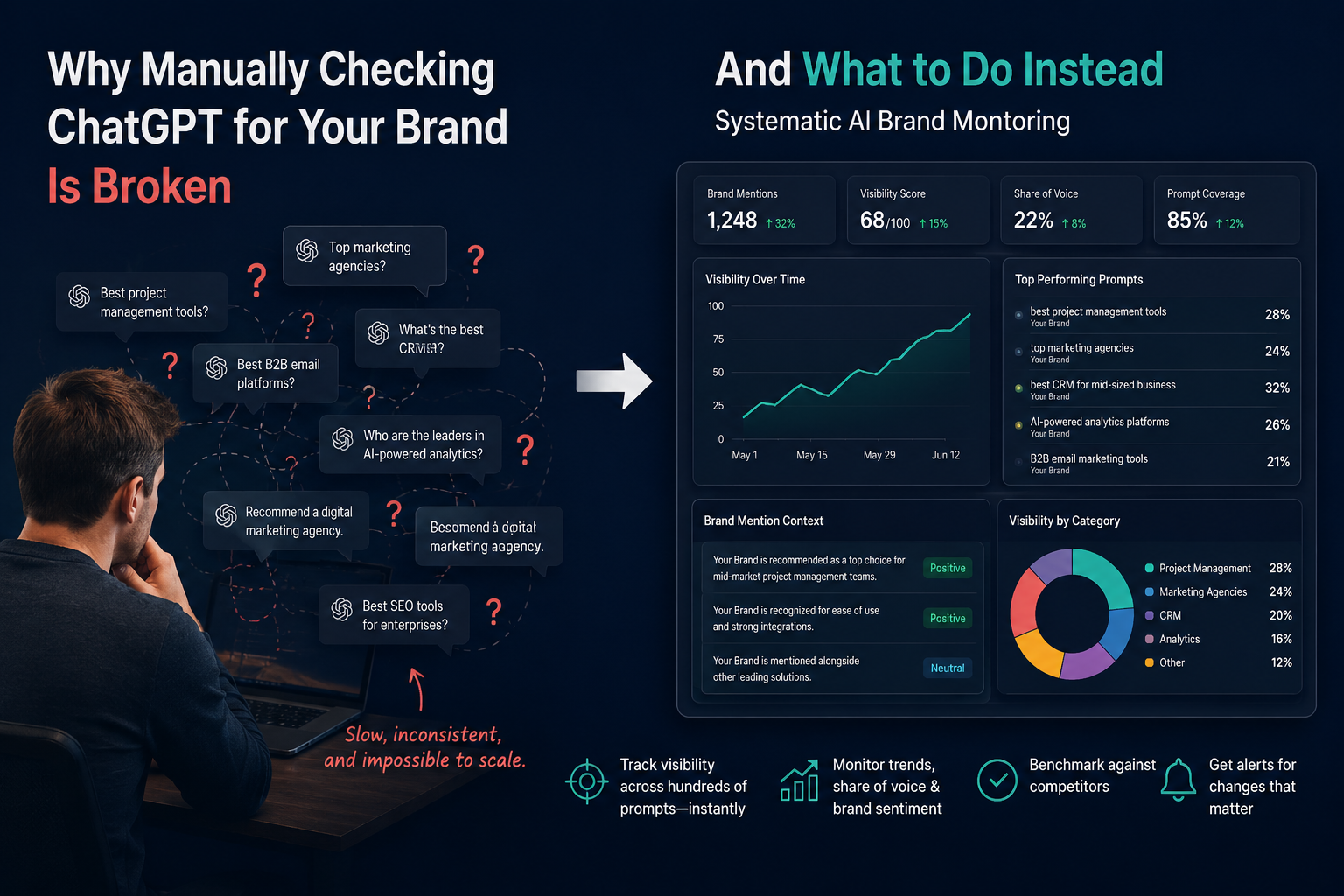
Here's something that happens in marketing teams every single week right now.
Someone on the team opens ChatGPT, types in "best [category] agencies in [city]" or "top tools for [thing their company does]" — and either finds their brand mentioned or doesn't. Then they try a different prompt. Then another. Then they switch to Perplexity and do it again. They write the results in a spreadsheet. They repeat the whole thing next month.
That's the current state of AI visibility monitoring for most brands. Manual. Inconsistent. Completely ungovernable at scale.
And here's the uncomfortable part: this is happening at companies with real marketing budgets, dedicated teams, and sophisticated reporting stacks. They're tracking keyword rankings to three decimal places in Ahrefs. They have GA4 dashboards with seventeen segments. They review Search Console weekly.
And then they're checking whether AI mentions their brand by opening a chat window and typing questions like a curious customer.
There's a significant gap here — between how seriously marketers have started taking AI search as a channel, and the tools and workflows they're actually using to understand their presence in it.
Why This Matters More Than Most People Realize
AI-generated search isn't a novelty anymore. It's load-bearing infrastructure for how buyers discover and evaluate brands.
ChatGPT processes over 2.5 billion queries daily. Google AI Overviews now trigger on roughly 48% of all searches. Perplexity is the fastest-growing research tool in enterprise. And 89% of B2B buyers consult generative AI during their purchasing journey. Getpassionfruit
When someone asks ChatGPT or Perplexity for a recommendation in your category, your brand either shows up in that answer or it doesn't. There's no page two. There's no "close enough." Your brand is either part of that answer or completely absent from the conversation. The mechanics are different from Google's blue links — AI systems synthesize information from multiple sources and present a single answer. Getpassionfruit
And here's the thing that should make every marketer uncomfortable: only about 20% of ChatGPT mentions include clickable citation links that show up in GA4. The other 80% — the brand recommendations, comparisons, and descriptions that shape purchasing decisions — are completely invisible to traditional analytics. Getpassionfruit
So right now, your brand could be getting mentioned in AI responses thousands of times a day — or getting actively excluded from answers in your category — and you would have no idea unless someone manually ran the prompts and checked.
The Manual Audit Problem
To be fair, starting with manual audits makes sense. Run your brand name and key product queries through ChatGPT, Perplexity, and Google AI Mode. Document where you appear and where competitors dominate. A manual audit takes about an hour and gives you a baseline before investing in tools. Getpassionfruit
That's reasonable advice as a starting point. The problem isn't doing a manual audit once. The problem is that a one-time manual audit tells you almost nothing useful on its own — and doing it consistently, at the volume required to actually understand your position, is not a scalable human activity.
Here's why:
AI responses are not deterministic. Ask ChatGPT the same question five times and you may get five slightly different answers. The useful metric isn't position in a single response — it's what percentage of relevant prompts mention your brand across multiple runs. A 40% visibility rate across 200 prompt runs is meaningful data. Being "ranked #2" in a single ChatGPT response means nothing. Getpassionfruit
Each platform behaves differently. You can be dominant in ChatGPT and completely invisible in Perplexity. Each platform uses different data sources and weights different signals. A brand that appears in 60% of ChatGPT responses for a category might appear in only 15% of Perplexity responses because Perplexity crawls the web live and your recent content is not optimized for citation. Getpassionfruit
The prompt set that matters is larger than you think. Your buyers aren't just searching your brand name. They're asking "what's the best agency for X," "who does Y well," "compare [you] vs [competitor]," "recommended tools for [problem]" — across dozens of variations. Manually tracking all of those, across multiple platforms, multiple times, on a weekly cadence is not a marketing function. It's a full-time job.
You can't catch what you're not monitoring. AI models can hallucinate about your brand. LLMs sometimes generate incorrect pricing, invent features, or misattribute capabilities. Without monitoring, you won't know when AI is actively misinforming your potential customers. The only way to catch that is systematic tracking — not occasional curiosity-driven searches. Siftly
What Marketers Actually Need
The gap in the market is straightforward to describe even if it's been slow to fill: marketers need to be able to enter a domain and get a clear, consistent picture of how that brand is showing up across AI platforms — without building the prompt library themselves, without running the queries manually, and without stitching together five different tools to get an incomplete answer.
Think about what that looks like in practice. You go to a tool. You put in your domain. You get back:
How often your brand is mentioned across ChatGPT, Perplexity, Gemini, and Google AI Overviews
What those mentions say — the sentiment, the framing, the context
How that compares to your three or four closest competitors
Which of your pages are being cited as sources (and which aren't)
How all of that has trended over the past 30, 60, 90 days
That's the product. Think less about where the brand ranks and more about how the brand is remembered. When someone asks ChatGPT or Perplexity who makes the best solution in your category, does your name appear? Is it linked? And does the model describe you the way you'd want a prospect to hear it? Mentions, citations, sentiment, and share of voice are the new positions of 2026 — invisible on a results page, but visible everywhere else that matters. HubSpot
The tools to do this are emerging. Platforms like OtterlyAI monitor when your brand appears in AI-generated answers and compare brand visibility against competitors, showing which AI engines mention you most often and how those brand mentions shift over time. Brands actively optimizing for AI search have seen a 34% increase in AI citation frequency within 90 days. And according to a February 2026 survey by Search Engine Journal, 67% of enterprise marketing teams now include AI visibility in their monitoring stack. Otterly + 2
But the majority of marketing teams — especially at the small and mid-size level — are still doing this manually, inconsistently, or not at all.
The Competitive Window Is Open Right Now
According to a 2025 Gartner study, 63% of B2B brands had zero presence in AI search engine responses for their primary keyword categories. That's not a minor SEO gap. That's an entirely new channel where your audience is making decisions without you in the room. NextUp Solutions
That number is striking. Two-thirds of B2B brands are invisible in the channel their buyers are increasingly using to make purchasing decisions — and most of them don't know it because they're not monitoring it.
Early adopters of AI visibility monitoring are gaining competitive advantages by understanding how their brand appears in AI-generated answers before their competitors do. A first-page Google ranking doesn't guarantee visibility in ChatGPT's responses, where the model might prioritize different signals entirely. Riff Analytics
This is the same window that existed with SEO in the early 2000s and with content marketing a decade later. The brands that understood the channel early, built presence systematically, and measured it consistently ended up with advantages that took competitors years to close. The same dynamic is playing out right now in AI search.
The difference is that this time, the tools to understand your position shouldn't require you to manually type prompts into a chatbot.
What You Should Actually Be Doing
If you're not yet systematically tracking your AI visibility, here's a practical starting point:
Run a baseline manual audit. Open ChatGPT, Perplexity, and Google AI Mode. Run 10 to 15 category-relevant queries — the kinds of questions your buyers actually ask. Note where you appear, where you don't, and who shows up instead. This takes an afternoon and gives you a reference point.
Build a prompt library that reflects real buyer intent. Not just your brand name — the questions buyers ask when they don't already know you exist. "Best agencies for X in Y city." "Compare [you] vs [competitor]." "Who's good at [specific service]." That's where the real visibility gaps show up.
Track visibility rate, not individual responses. The useful metric is what percentage of relevant prompts mention your brand across multiple runs. Run each prompt three to five times and track the rate, not the position. Getpassionfruit
Invest in a monitoring tool before you think you need one. The time to understand your AI visibility baseline is before a competitor has clearly lapped you, not after. The tools that exist today make this tractable. Using one now means you'll have trend data that's genuinely useful in six months.
Connect your content strategy to your citation gaps. 92% of successful AI Overview citations come from domains already ranking in the top 10 organic positions. Strong SEO creates the foundation that AI visibility builds upon. The content gaps you find in AI monitoring are the same gaps you should be filling with your editorial calendar. Getpassionfruit
The Bottom Line
Marketers have always had to figure out how to measure presence in channels that weren't built with measurement in mind. Social media went through this. Podcasts went through this. AI search is going through it right now.
The manual-prompt-in-a-chat-window approach is the equivalent of checking your website traffic by asking your friends if they've visited lately. It gives you a feeling, not a picture.
Your brand's AI presence is a business asset — one that influences how buyers discover you, how they characterize you to colleagues, and whether you show up at all in the moments that matter most. It deserves the same systematic attention you give your keyword rankings, your review profiles, and your social reach.
The good news is you don't have to figure this out alone — and you definitely don't have to keep doing it one prompt at a time.
Ready to understand where your brand actually stands in AI search — and build a strategy to improve it?
Frequently Asked Questions
What exactly is AI search visibility and why does it matter for my brand?
AI search visibility refers to how often and how accurately your brand appears when tools like ChatGPT, Perplexity, Gemini, and Google AI Overviews answer questions relevant to your business. Think less about where your brand ranks and more about how it's remembered — when someone asks an AI assistant who makes the best solution in your category, your brand is either part of that answer or completely absent from the conversation. Unlike traditional search where you can land on page two, AI-generated answers surface a handful of brands and move on. If you're not in the response, you don't exist for that user in that moment. HubSpot
How is this different from regular SEO tracking?
Traditional SEO tells you where your pages rank on a list of links. AI visibility tracking tells you whether your brand is included in a synthesized answer at all — which is a fundamentally different question. Traditional SEO measures a brand's position on a list of links, answering the question "where do I rank?" But answer engine optimization tracks whether a brand is included in the AI's conversation at all. Because answer engines control the narrative, a brand can lose visibility even if its traditional rankings remain stable. You can be ranking on page one of Google and still be completely invisible when a buyer asks Perplexity for a recommendation in your category. Campaigncreators
Can't I just check Google Analytics to see if AI platforms are sending traffic?
Only partially, and it significantly undercounts what's actually happening. Only about 20% of ChatGPT mentions include clickable citation links that show up in GA4. The other 80% — the brand recommendations, comparisons, and descriptions that shape purchasing decisions — are completely invisible to traditional analytics. Perplexity is the exception, since it cites sources with clickable links on every response. But for most AI platforms, your GA4 dashboard is only showing you a small fraction of the mentions and conversations that are influencing how buyers perceive your brand. Getpassionfruit
Is manual checking — just typing prompts into ChatGPT myself — good enough?
It's a fine starting point for a one-time baseline, but it breaks down quickly as an ongoing strategy. The core problem is that AI responses aren't consistent — ask the same question five times and you may get meaningfully different answers each time. The useful metric is what percentage of relevant prompts mention your brand across multiple runs. A 40% visibility rate across 200 prompt runs is meaningful data. Being ranked second in a single ChatGPT response means nothing. Doing that volume manually, across multiple platforms, on a weekly cadence, across the full range of prompts your buyers actually use — that's not a marketing workflow, it's a full-time job. Getpassionfruit
What platforms do I actually need to be tracking?
At minimum, ChatGPT, Perplexity, Gemini, and Google AI Overviews — and ideally all four simultaneously, since your visibility can vary dramatically between them. You can be dominant in ChatGPT and completely invisible in Perplexity. A brand that appears in 60% of ChatGPT responses for a category might appear in only 15% of Perplexity responses, because Perplexity crawls the web live and content not optimized for citation won't surface there. Each platform has different data sources, different citation behaviors, and different audiences. Tracking only one gives you a dangerously incomplete picture. Getpassionfruit
What if the AI is saying something inaccurate about my brand?
This is one of the most underappreciated risks of not monitoring at all. AI models can hallucinate about your brand — LLMs sometimes generate incorrect pricing, invent features, or misattribute capabilities. Without monitoring, you won't know when AI is actively misinforming your potential customers. A buyer who asks ChatGPT about your pricing and gets a wrong answer doesn't know the answer is wrong. They just form an incorrect impression and move on. Catching and correcting this requires systematic monitoring — you can't fix what you can't see. Siftly
How does my existing SEO affect my AI visibility?
It's the foundation, but it doesn't guarantee AI presence on its own. 92% of successful AI Overview citations come from domains already ranking in the top 10 organic positions — strong SEO creates the foundation that AI visibility builds upon. You can't shortcut your way to AI citations without the underlying domain authority. That said, traditional SEO strength doesn't automatically translate. A top-ranked article in Google can be entirely absent from AI answers if the model hasn't associated a brand with the entities or signals it trusts. The shift is more than theoretical — AI responses are zero-click by nature, and your brand either exists in that response or it doesn't exist for that user. Think of SEO as the prerequisite and AI optimization as the next layer on top. GetpassionfruitHubSpot
How often should we be monitoring our AI visibility?
A weekly cadence works well for checking mention rate and top competitor movements, a monthly full review covers all topics and identifies new gaps, and a quarterly strategic review helps assess whether you're trending up or down overall. The right frequency depends on how competitive your category is and how actively you're publishing new content. What matters most is consistency — a monthly check you actually do is worth more than a weekly cadence that falls apart after two weeks. The goal is trend data over time, not any single snapshot. GetMentioned
What's a realistic timeline to see improvement after we start optimizing?
Brands actively optimizing for AI search have seen a 34% increase in AI citation frequency within 90 days. That's a meaningful lift in a relatively short window — but it requires actually doing the work: identifying the content gaps your monitoring reveals, filling them with structured, answer-ready content, and building presence on the third-party sources AI platforms tend to trust. The monitoring tells you where the gaps are. Closing them is a content and authority-building exercise that compounds over time, much like traditional SEO did in its early years. NextUp Solutions