The DOJ Extended the ADA Title II Web Accessibility Deadline — Here's What Public Entities Actually Need to Do Now
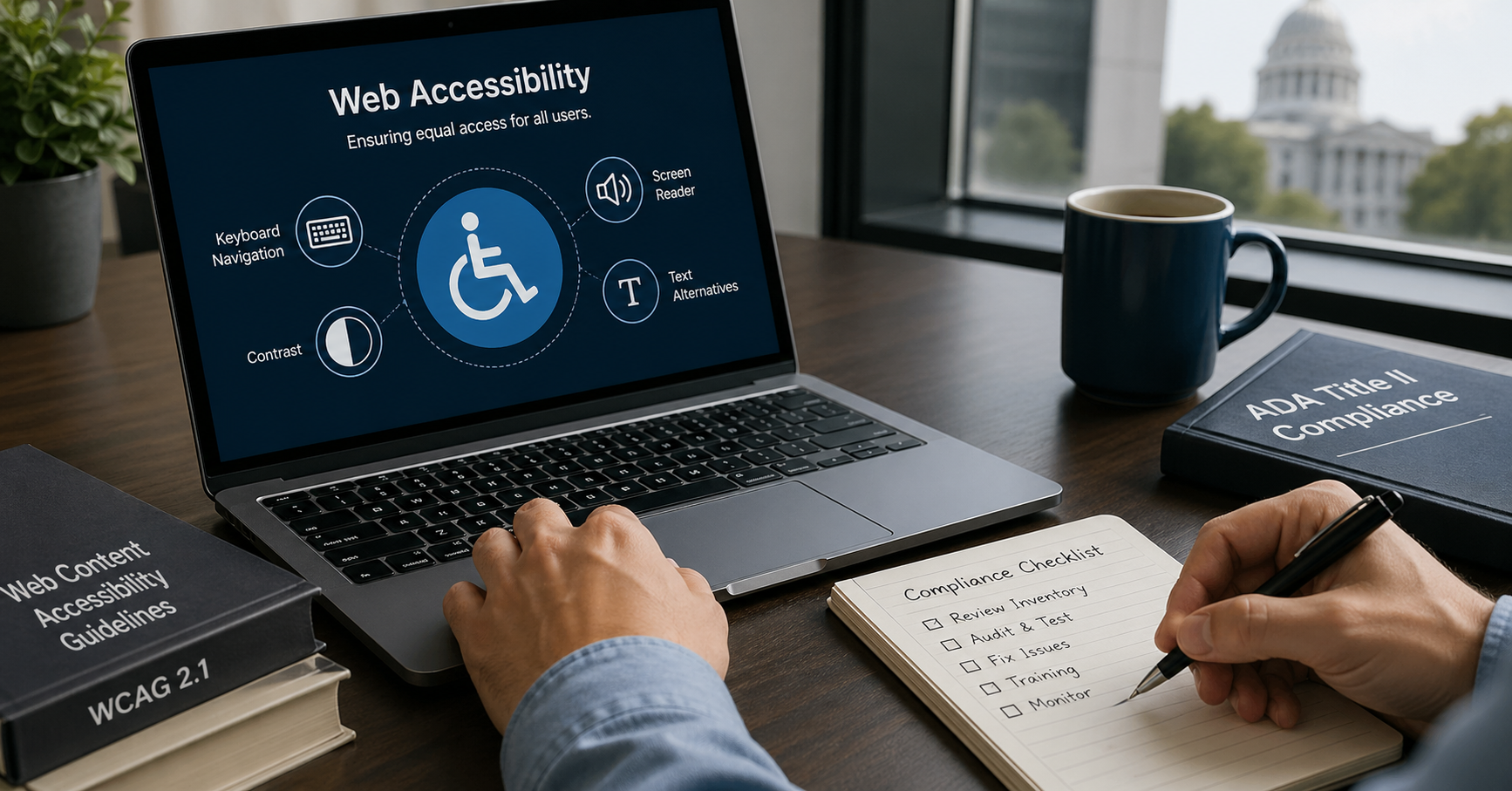
If your organization has been watching the ADA Title II web accessibility deadline with a mixture of urgency and dread, there is some news that changes your timeline — but not your obligation.
On April 20, 2026, the Department of Justice published an Interim Final Rule extending the compliance deadlines for its 2024 web and mobile app accessibility rule under Title II of the Americans with Disabilities Act. The compliance date for state and local government entities with a total population of 50,000 or more has been extended from April 24, 2026 to April 26, 2027. The compliance date for public entities with a total population of less than 50,000, or any special district government, has been extended from April 26, 2027 to April 26, 2028. Federal Register
That is one additional year across the board. The substantive requirements of the 2024 final rule remain unchanged — WCAG 2.1 Level AA is still the technical standard for web content and mobile app accessibility under ADA Title II. The only change is timing. Accessible
For organizations that were sprinting to meet the original April 2026 deadline, the extension provides breathing room. For organizations that had not yet started, it is a window — not a reprieve. The underlying legal obligation, the scope of what needs to be done, and the consequences of non-compliance have not shifted. Only the clock has.
This post explains what the rule requires, who it covers, what WCAG 2.1 Level AA actually means in practice, why the deadline extension does not eliminate legal risk in the interim, and what your organization should be doing right now to use this time productively.
What the Rule Covers and Who It Applies To
Title II of the ADA requires state and local governments to ensure their services, programs, and activities are accessible to people with disabilities. Title II applies to all services, programs, or activities of state and local governments, from adoption services to zoning regulation to public education — and this includes the services, programs, and activities state and local governments offer online and through mobile apps. Jackson Lewis
The scope of the digital rule is broader than many organizations initially assume. It covers not just the primary government website, but every piece of web content and every mobile app that the entity provides or makes available — including content delivered through third-party vendors under contractual or licensing arrangements.
The regulations apply to web content that a state or local government provides or makes available, including when a state or local government has an arrangement with another organization — such as a private web developer who provides or makes available web content for them. For example, if a county's web page lists the addresses and hours of operation for all county parks, that web page must meet WCAG accessibility criteria even if a local web design company made the web page and updates it for the county. Jackson Lewis
This vendor accountability provision catches many public entities off guard. Your payment portal, your parking app, your online permit system, your recreational registration platform — if your entity makes it available to the public, it falls under the rule, regardless of whether your team or a third-party company built it.
Limited, narrowly defined exceptions exist — including content that is not currently used, outdated, not needed, or repeated somewhere else that is accessible — but most active web content must be accessible. Jackson Lewis
One important exception that requires attention: documents that are currently being used to apply for, access, or participate in a state or local government's services, programs, or activities do not fall under the archival exception even if the documents were posted before the compliance date. For example, a state that posted a PDF version of a business license application in 2020 must make that application accessible if members of the public still use it to apply for a business license. ADA.gov
How to Determine Your Deadline
If your public entity is a county, municipality, township, or state agency, use your population from the 2020 decennial Census. If your public entity is an independent school district, use your school district's population in the 2022 Small Area Income and Poverty Estimates. If your public entity does not have a population calculated by the Census Bureau, use the Census population of the state or local government of which your entity is a part. ADA.gov
This means, for example, that a state university with 40,000 students that is part of a six-million-person state must comply by April 2027, not April 2028 — because the relevant population is the state's, not the student body's. A city police department in a town of 25,000 must comply by April 2028 because the relevant population is the city's. Special district governments — public entities that provide one function or a limited number of designated functions independently from general-purpose governments — have until April 2028 to comply regardless of size. ADA.gov
What WCAG 2.1 Level AA Actually Requires
The technical standard at the center of this rule — WCAG 2.1 Level AA — is a set of internationally recognized accessibility guidelines developed by the World Wide Web Consortium. Understanding what it actually requires is essential before any remediation work begins.
The WCAG 2.1 guidelines are organized around four core principles, known by the acronym POUR: Perceivable, Operable, Understandable, and Robust. Here is what each of those means in practice: NC DPI
Perceivable means that information and user interface components must be presented in ways that users can perceive regardless of their disability. This includes providing text alternatives for all non-text content — every image needs descriptive alt text, every video needs captions, every audio-only piece of content needs a transcript. Key criteria include text alternatives for non-text content, captions for live and prerecorded video, and sufficient color contrast — the rule requires a contrast ratio of at least 4.5:1 for text. NC DPI
Operable means that all functionality must be accessible through a keyboard, not just a mouse. Users who rely on keyboard navigation, switch controls, or other assistive input devices must be able to access everything a mouse-using user can. This principle also requires that users have enough time to read and use content, that content avoids flashing elements that could cause seizures, and that navigation is consistent and clear enough for users to understand where they are within the site. NC DPI
Understandable means that the information presented and the way the interface operates must be clear and predictable. This includes making text readable and understandable, ensuring web pages operate in predictable ways, and helping users avoid and correct mistakes — for example, form error messages must be specific enough to help the user understand what went wrong and how to fix it. NC DPI
Robust means that content must work reliably with current and future assistive technologies. This principle requires that content be robust enough to work with current and future technologies, including screen readers, voice recognition software, and other assistive tools. accessiBe
WCAG 2.1 Level AA conformance encompasses 50 success criteria in total — all 38 Level A criteria from WCAG 2.0 plus 12 additional criteria introduced in WCAG 2.1 to address newer technology, including considerations for mobile devices. Full conformance means meeting every one of these criteria across your covered web content and mobile apps — not just the high-visibility pages, but the entire digital estate your entity provides or makes available. Accessible
Why the Deadline Extension Does Not Eliminate Legal Risk in the Interim
This is the part that many public entities misread. The extension moved the regulatory compliance deadline. It did not suspend the underlying ADA obligation, and it did not create a safe harbor from lawsuits or complaints filed between now and the new deadline.
ADA Title II is a clarification of how the law applies to the web — it is not a "new" right. Constituents with disabilities still have a right to access government services today. Waiting until 2027 to fix a broken tax payment portal or a school registration form still leaves your organization vulnerable to private litigation and civil rights complaints. Accessible Web
The 2024 rule did not create accessibility obligations that did not previously exist. It created specific technical standards and enforceable compliance deadlines. The general ADA obligation to provide equal access to government services has been the law since 1990. Courts and the DOJ have long interpreted that obligation to extend to digital services and websites. The extension gives you more time to document compliance with the new technical standard — it does not give individuals with disabilities less standing to challenge inaccessible digital content in the interim.
Disability advocates were direct in their criticism of the extension, noting that state and local governments have known since at least the Obama administration that accessible websites were required under the ADA. The AAPD stated that delaying the compliance timeline only four days before the original deadline creates chaos and confusion for those entities working toward compliance, and further prevents people with disabilities from accessing government information, programs, and services they depend on. AAPD
The delay is not abstract. As more and more government services — from public benefits applications to emergency alert notifications to voter information — move exclusively online, inaccessible government websites are not a minor inconvenience. They are a barrier to the full participation of people with disabilities in society. AAPD
The risk calculus for public entities has not fundamentally changed. The deadline extension buys time for remediation. It does not buy immunity from the consequences of inaccessible digital services in the meantime.
What to Do With the Additional Time
The organizations that will arrive at April 2027 or April 2028 in the strongest position are the ones that treat this extension as additional runway for doing the work properly — not as an invitation to delay starting it.
Start With a Comprehensive Digital Inventory
You cannot remediate what you have not catalogued. Most public entities significantly underestimate the scope of their digital estate — the departmental subsites, the legacy PDFs linked from service pages, the third-party vendor portals, the standalone mobile apps, the interactive maps and scheduling tools and payment systems scattered across dozens of internal owners.
Begin by cataloguing every department site, school lunch menu system, property tax map, and athletic registration portal your entity provides or makes available. You cannot fix what you do not know exists. Accessible Web
This inventory is the foundation of every subsequent step. Without it, remediation efforts are reactive and incomplete. With it, you can prioritize based on user impact, assess vendor accountability, and build a realistic timeline for the work ahead.
Conduct a Real Accessibility Audit — Not Just an Automated Scan
Automated scanning tools can identify a portion of WCAG violations quickly and cheaply. They cannot identify all accessibility barriers, cannot test all types of digital experience, and cannot substitute for the judgment of accessibility experts and people with disabilities using real assistive technologies.
Reliable accessibility testing combines two methods: automated tools can quickly identify common accessibility issues but cannot yet detect all accessibility barriers or test all types of digital experiences. Accessibility experts — including people with disabilities — evaluate core pages, components, and key user flows using assistive technology, providing deeper insight than automated tools alone. Level Access
A real audit produces a documented list of specific violations, mapped to the WCAG success criteria they fail, with enough detail to assign remediation tasks to specific team members or vendors. That documentation also serves a secondary purpose: it demonstrates that your entity is making genuine, good-faith progress toward compliance — which matters both for managing legal risk and for any enforcement proceedings.
Hold Third-Party Vendors Accountable Now
The rule's reach into third-party content provided through contractual arrangements means that your vendors' accessibility failures are your compliance failures. Request a VPAT — Voluntary Product Accessibility Template — or an Accessibility Conformance Report from every vendor. Let them know that WCAG 2.1 AA conformance is a requirement for contract renewal. Accessible Web
Many vendors in the government technology space have not proactively made their products accessible. Some will respond to explicit contractual demands. Others may not be able to provide accessible alternatives on your timeline, which means you need to know that now — during the extension period — rather than in March 2027 when there is no time to procure a replacement.
Review every current contract for accessibility language and add it to any new contracts executed during the extension period. If a vendor cannot provide a credible remediation timeline, that is information you need to make procurement decisions.
Implement a Public Accessibility Feedback Mechanism
Every one of your websites should have an accessibility page with a clear way for users to report a barrier. Having a trained staff member ready to provide an alternative — like helping a constituent complete a form over the phone — is your best immediate defense against a lawsuit while digital remediation is underway. Accessible Web
A public feedback mechanism serves multiple purposes simultaneously. It gives users with disabilities a path to get help right now, regardless of where your remediation stands. It demonstrates organizational commitment to accessibility. It creates a record of reported barriers that can be used to prioritize remediation efforts. And it provides evidence of good faith that carries real weight if a complaint is filed during the extension period.
Build a Realistic Remediation Roadmap With Documented Progress
The volume of WCAG 2.1 AA compliance work across a full digital estate — 50 success criteria applied to websites, mobile apps, PDFs, third-party portals, and an archive of legacy content — is substantial. The extension gives you more time to do it right, which means building a documented, prioritized roadmap rather than rushing toward box-checking.
Prioritize content that is actively used to access government services: application forms, payment portals, emergency information pages, benefits enrollment systems, public meeting notices, and the like. These are both the highest-impact areas for users with disabilities and the highest-risk areas for legal exposure. Instead of aiming for perfect by a specific date, focus on documented progress — an accessibility program that demonstrates systematic movement toward conformance is a very different posture from an organization that has done nothing and is hoping no one notices. Accessible Web
A Note on What Comes Next
The Interim Final Rule is effective as of April 20, 2026, and a 60-day public comment period is open through June 22, 2026. The DOJ has also signaled that it may pursue further rulemaking during the extension period that could bring additional changes to the 2024 rule's substantive requirements. The DOJ cited compliance resource constraints and the limits of current technology, including generative AI, to automate accessibility remediation at scale, as factors in granting the extension. Federal RegisterEdTech Magazine
That signal is worth watching. Additional rulemaking could modify the technical standards, the scope of covered content, or the exceptions. Organizations that have been tracking the rule should continue to monitor developments through the public comment period and any subsequent rulemaking notices.
What will not change is the underlying obligation. The ADA's requirement that government services be equally accessible to people with disabilities is not contingent on a federal deadline. It predates the 2024 rule, it survived the extension, and it will outlast any future modifications to the technical standard.
The Extension Is a Gift. Use It.
One year is not a long time when the scope of work includes a full digital audit, vendor remediation, staff training, policy development, feedback mechanism implementation, and ongoing content governance. Organizations that start now and work systematically will arrive at April 2027 or April 2028 with documented conformance and a sustainable process for maintaining it. Organizations that treat the extension as permission to wait will find themselves in the same position they were in four days before the original deadline — except this time there will not be another extension to bail them out.
The disability community has been waiting for these standards to be enforceable for over fifteen years. The extension is a practical accommodation for implementation complexity, not a signal that accessibility is optional or that enforcement will be lax. The extension is not a pause on accessibility work. It is additional runway to do the work properly rather than rushing procedural box-checking. Accessible
Need Help Getting Your Digital Presence Compliance-Ready?
At Ritner Digital, we help public entities and the organizations that serve them assess their digital accessibility posture, develop remediation roadmaps, hold vendors accountable, and build the content governance processes that keep digital properties accessible on an ongoing basis.
If your organization is just beginning to understand what WCAG 2.1 Level AA compliance means for your website, your mobile apps, your documents, and your third-party vendor relationships — we would like to help you build a clear picture of where you stand and what it takes to get to where you need to be.
Reach the Ritner Digital team here →
Sources: Federal Register — DOJ Interim Final Rule Extending ADA Title II Compliance Dates (April 20, 2026); ADA.gov — Fact Sheet on Web Content and Mobile App Accessibility Rule; ADA.gov — First Steps Toward Compliance; Jackson Lewis — DOJ Extends Public Entities' Compliance Deadline; AAPD — Statement on DOJ Title II Web Rule IFR; Accessible.org — DOJ Extends ADA Title II Web Compliance Deadline; Accessible Web — The ADA Title II Deadline Shifted; CivicPlus — DOJ's Latest Rule on Web Accessibility; Inside Higher Ed — DOJ Extends Web Accessibility Deadline; Level Access — WCAG 2.1 AA Checklist; NC DPI — WCAG 2.1 Level AA; Accessible.org — Understanding WCAG 2.1 AA for ADA Title II Compliance.
Frequently Asked Questions
Does the deadline extension mean my organization does not have to comply at all, or that enforcement will be relaxed?
No on both counts. The extension moved the regulatory compliance deadline by one year — it did not change the underlying legal obligation, modify the technical standard, or create any period during which enforcement of the broader ADA is suspended. State and local governments have been required under Title II of the ADA to provide accessible services, programs, and activities since 1990. Courts and the DOJ have consistently interpreted that obligation to extend to digital services and websites long before the 2024 rule was published. The rule created specific, enforceable technical standards with firm deadlines. The extension adjusted those deadlines. It did not create a safe harbor from complaints or private litigation filed between now and April 2027 or 2028. If your parking payment portal is inaccessible to a screen reader user today, that user's right to equal access exists today — not starting on your compliance deadline.
My organization serves a population of 45,000. Does that mean we automatically get until April 2028?
Probably, but how you calculate your population depends on what kind of entity you are. If your public entity is a county, municipality, or township, you use your population from the 2020 decennial Census. If you are an independent school district, you use your district's population from the 2022 Small Area Income and Poverty Estimates. If your entity does not have a population calculated by the Census Bureau, you use the Census population of the state or local government of which your entity is a part. That last point catches many organizations off guard — a small city library, a municipal police department, or a county health department does not use the number of people it directly serves. It uses the population of the county or city of which it is a part. A neighborhood branch library in a county of 200,000 people must comply by April 2027, even if it only serves a few thousand patrons. ADA.gov
What exactly does WCAG 2.1 Level AA require? Is it just about screen readers?
It is much broader than screen readers. WCAG 2.1 Level AA encompasses 50 specific success criteria organized around four core principles — Perceivable, Operable, Understandable, and Robust — and addresses the needs of users across a wide range of disabilities including visual, auditory, motor, cognitive, and neurological. Practically speaking, compliance requires things like: descriptive alt text on every meaningful image; captions on all prerecorded and live video; a color contrast ratio of at least 4.5:1 for body text; all functionality being operable by keyboard without a mouse; no content that flashes more than three times per second; form fields being clearly labeled with specific, actionable error messages; navigation being consistent and predictable across pages; and all content being compatible with current assistive technologies including screen readers, voice control software, and switch access devices. It applies to your website pages, your PDFs, your mobile apps, and your third-party vendor tools that you make available to the public.
We use a third-party vendor for our online payment portal, permit system, and registration forms. Are those covered?
Yes, and this is one of the most commonly misunderstood aspects of the rule. The regulations apply to web content that a state or local government provides or makes available, including when a state or local government has an arrangement with another organization — such as a private vendor who provides or makes available web content for them. If your entity provides or makes the tool available to constituents — even if a private company built it, hosts it, and maintains it — it must meet WCAG 2.1 Level AA. Your compliance obligation does not transfer to the vendor. The vendor's inaccessible product is your compliance failure. This means you need to be actively reviewing vendor contracts now, requesting Voluntary Product Accessibility Templates or Accessibility Conformance Reports from every vendor whose tools are public-facing, and making WCAG 2.1 AA conformance a condition of contract renewal. Jackson Lewis
Are there any exceptions for older content we posted years ago?
A limited archival exception exists, but it is narrower than most organizations assume. Content that is genuinely outdated, no longer in use, or duplicated somewhere accessible may qualify. However, documents that are currently being used to apply for, access, or participate in a state or local government's services, programs, or activities do not fall under the archival exception even if the documents were posted before the compliance date. A business license application PDF posted in 2015 that people still actively use to apply for a license must be made accessible — the posting date does not matter, only whether the content is currently in active use. Additionally, if you update an older document for any reason after your compliance date, the exception no longer applies and the updated document must meet WCAG standards. In practice, most documents that matter to constituents are in active use, which means the archival exception covers less than many entities expect. ADA.gov
Can we use automated scanning tools to verify our WCAG compliance?
Automated tools are a useful starting point, but they cannot get you to verified compliance on their own. Automated scanners can identify a portion of WCAG violations — typically the ones that are detectable through code analysis, like missing alt text attributes or insufficient color contrast ratios — but they cannot evaluate whether alt text is actually descriptive and meaningful, whether keyboard navigation flows logically, whether error messages are genuinely helpful to a user who made a mistake, or whether content is understandable to someone with a cognitive disability. Reliable accessibility testing combines automated tools with manual evaluation by accessibility experts — including people with disabilities — who evaluate core pages, components, and key user flows using real assistive technology. Using automated tools alone and declaring compliance based on a passing scan creates documented liability rather than documented conformance. The audit you conduct needs to be thorough enough to withstand scrutiny if a complaint is filed. Level Access
What is a VPAT and why does it matter for vendor management?
A VPAT — Voluntary Product Accessibility Template — is a standardized document in which a technology vendor describes how their product conforms to accessibility standards, typically WCAG 2.1 or Section 508. An Accessibility Conformance Report is the completed version of a VPAT. These documents are how you verify, in writing, that a vendor's product meets the technical standard required by the rule before you make that product available to the public through your entity. Requesting VPATs from vendors accomplishes several things simultaneously: it establishes a documented record that you took accessibility seriously in procurement, it creates contractual leverage to demand remediation if a product is not accessible, and it surfaces compliance gaps early enough to make decisions about alternatives. A vendor that cannot provide a credible VPAT or that provides one showing significant conformance failures is telling you that their product will create compliance exposure for your entity. That is information you need now, during the extension period, not two weeks before your deadline.
We have an accessibility statement on our website. Does that satisfy the rule?
No. An accessibility statement is a communication tool that informs users about your accessibility posture and provides a mechanism for reporting barriers — it is not a substitute for actual conformance with WCAG 2.1 Level AA. A well-crafted accessibility statement that accurately describes your current conformance level, identifies known limitations, and provides a clear, responsive feedback mechanism is a valuable and genuinely important component of a compliance program. But it does not satisfy the technical requirements of the rule, and a statement that overstates your actual conformance level creates additional legal risk by misrepresenting your accessibility status to users. Build toward real conformance and let your accessibility statement accurately reflect where you actually stand.
Is it enough to make our main website accessible if we have other digital systems constituents use?
No. The rule applies to all web content and mobile apps that your entity provides or makes available — not just your primary homepage or main website. Digital content includes websites, PDFs, and mobile apps. Essentially, if your entity offers it digitally, it needs to meet WCAG 2.1 Level AA. That means your online permit system, your tax payment portal, your parks and recreation registration platform, your library catalog, your meeting agenda archive, your job application portal, your emergency notification system, and any other digital tool or piece of content you make available to the public. The scope of compliance work is determined by the scope of your digital estate — which is why conducting a comprehensive inventory of all your public-facing digital assets is the essential first step, before any remediation work begins. CivicPlus
What should we do starting today given the new deadlines?
Start the inventory, start the audit, and start the vendor accountability conversations — in that order, and all of them now. The extension gives you more time to do this work properly, not permission to wait until the new deadline is imminent. Organizations that conduct a thorough audit now, build a documented remediation roadmap prioritized by user impact, hold vendors contractually accountable for their products' conformance, implement a public accessibility feedback mechanism, and track progress systematically will arrive at their deadline with documented conformance and a sustainable governance process. Organizations that treat the extension as a delay rather than as runway will face the same compressed, expensive, reactive scramble in 2026 that they were trying to avoid in 2025. Ritner Digital can help your organization assess your current accessibility posture and build the roadmap to get where you need to be — reach out here.