The Marlton Circle Is Gone But the Businesses That Survived It Are Still Here
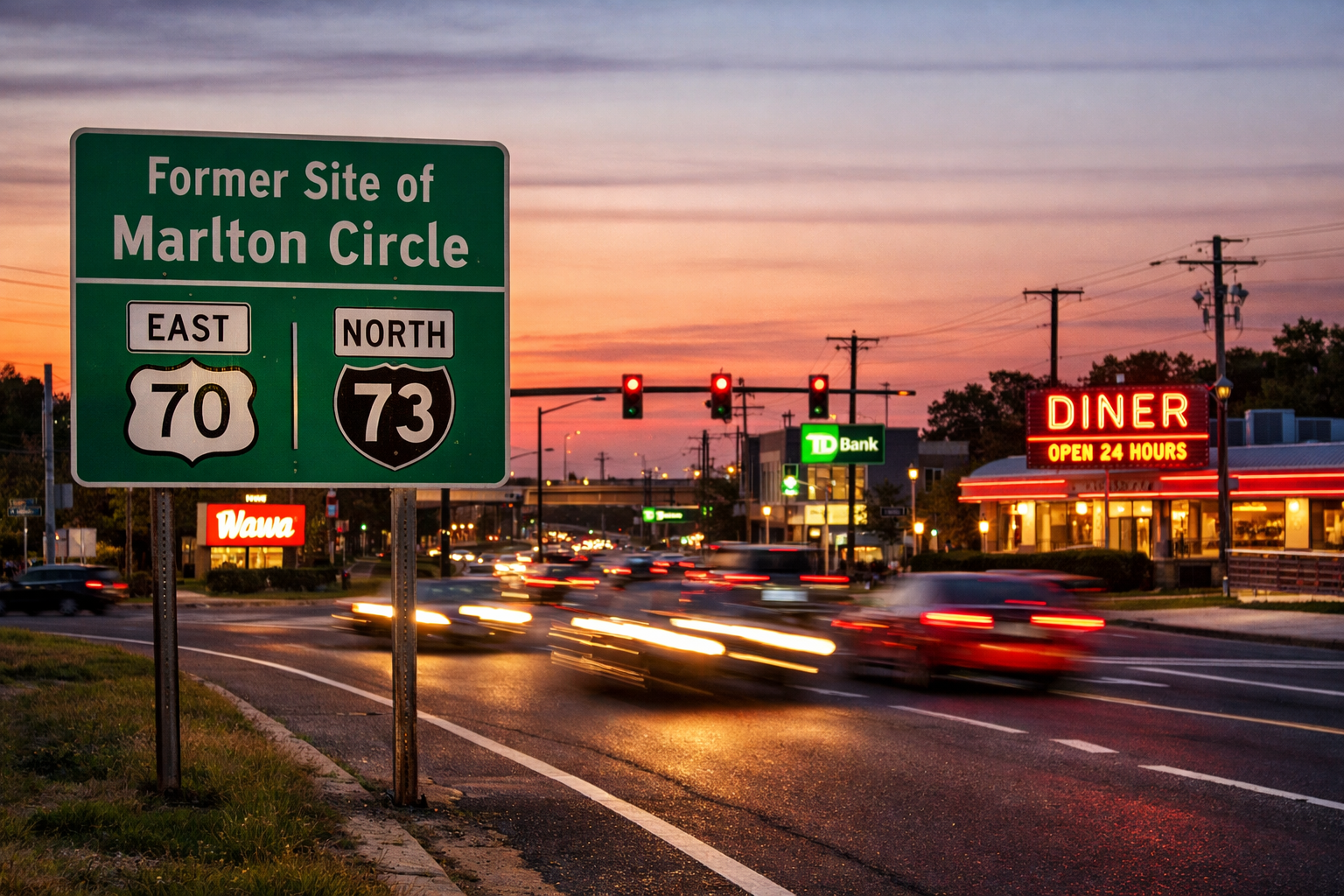
The Marlton Circle was built in the 1940s when Routes 70 and 73 were quiet enough that a single-lane rotary could handle everything coming through. For years after its construction, the area was a sparsely populated farming town. Wikipedia The circle sat at the center of it the way a town square sits at the center of a village — not grand, not architecturally interesting, just the place where the roads converged and the commerce followed.
Then the township grew. Then the suburbs arrived. Then the families started moving out from Philadelphia and Camden and the circle that had been perfectly adequate for a farming community became, in the words of one motorist, "not a traffic circle — a non-traffic circle." Wikipedia By the time anyone got serious about fixing it, congestion routinely backed up as far as a mile on summer afternoons Wikipedia and the intersection had earned a distinction no intersection wants: the third most dangerous intersection in the state. Wikipedia
A plan to eliminate the circle was announced in 2002. Wikipedia Construction didn't begin until 2009. The overpass opened in 2011. In between — across nearly a decade of announcements, studies, plans, counter-proposals, petitions, and the grinding two-year process of actually tearing the thing apart and rebuilding it from the ground — the businesses around the Marlton Circle had to decide what to do.
Some of them didn't survive the waiting. One of them became the cautionary tale that South Jersey still tells.
Olga's
Olga's Diner was a 400-seat magnet on the Marlton traffic circle for nearly 50 years. Its oversized red script sign was a beacon. The Philadelphia Inquirer It opened in Camden in 1946, moved to the circle in 1959, and became the kind of institution that people don't think of as a business so much as a fixture — part of the landscape, like the roads themselves, like the smell of the Pine Barrens when you get far enough east on Route 70.
Owner John Stavros, 77, a first-generation Greek American, said he felt under siege. The Philadelphia Inquirer And he had reason to. The diner's windows proclaimed the anxiety of its owner, who had scrutinized every piece of news about the overpass. "$50 mill??" asked one window. The Philadelphia Inquirer Stavros knew what was coming. He'd been watching the plans develop since the 1990s, when the state first started threatening to redo the intersection. "They say they're going to do the overpass; they're going to do this and they're going to do that," Stavros said. "We didn't know from day to day if we're going to have a driveway." The Philadelphia Inquirer
That uncertainty — not the construction itself, but the decade of not knowing — was what broke Olga's. The restaurant had been shuttered since October, when electricity was turned off after Stavros was cited for owing PSE&G $17,000. The diner also closed briefly over the summer after the state said Stavros failed to pay $37,000 in taxes. The Philadelphia Inquirer It was put up for sale in 2005 and finally closed in December 2008 Wikipedia — before a single shovel of dirt had been turned for the overpass project, before the circle was even officially condemned. The building sat empty for years. Making way for the elimination of the Marlton Circle, the building was razed in 2017. 70and73
Olga's didn't close because the construction destroyed it. It closed because the owner couldn't hold his business together through the uncertainty of what the construction might do. The disruption killed the diner before the disruption even started.
The businesses that waited it out
Not everyone broke. Some businesses along the Routes 70 and 73 corridor did what South Jersey businesses have always done when something threatens the infrastructure around them: they kept their heads down, kept the doors open, kept doing what they'd always done, and waited for the dust to settle.
Ponzio's — Cherry Hill's oldest restaurant, open since 1964 — not only survived the circle's long decline and elimination, it outlived the traffic circle it was built beside. Wikipedia The diner that had been serving the same community through every disruption the corridor had thrown at it since Lyndon Johnson was president kept serving the same community through two years of lane shifts, temporary traffic patterns, and construction equipment blocking the approaches. Its customers came anyway. They knew where it was. They always knew where it was.
Hutchinson, founded in 1948 with $35 in a cigar box Hutchinson by a family that grew their HVAC business one South Jersey neighborhood at a time, didn't stop answering phones because the intersection was under reconstruction. Their customers were in the houses, not on the road. The circle could close entirely and the furnaces would still need servicing in February.
Howard Hill Furniture, selling in Marlton for more than sixty years. Family & Co. Jewelers, in the community since the 1930s. The businesses that had built their customer relationships deep enough didn't need the circle to stay open to stay viable. They needed their customers to keep trusting them — and their customers did, because decades of consistent good service had created a loyalty that no construction project could interrupt.
What the circle actually disrupted — and what it didn't
Here's the thing worth understanding about the businesses that made it through: the Marlton Circle's elimination was not their first disruption and it was not their last. It was one chapter in a longer story of a commercial corridor that has been in continuous flux for eighty years.
In the summer of 1974, the circle was first modified when Route 73 was cut through and traffic signals were installed. Wikipedia That was a disruption. The suburban growth that doubled the township's population and turned the surrounding farmland into subdivisions was a disruption. The arrival of big-box retail along Route 73 was a disruption. The 2008 recession — which was happening simultaneously with the overpass announcements — was a disruption. The pandemic. The rise of online retail. Wegmans opening down the road and redefining what a grocery destination could look like. Disruption after disruption after disruption, each one requiring the same fundamental response.
The businesses that survived all of it didn't survive by being immune to disruption. They survived by being resilient to it — by having built something deep enough in the community that external changes to the infrastructure couldn't reach it. The relationship Ponzio's had with its customers wasn't stored in the driveway off Route 70. The trust Hutchinson had built across three generations of South Jersey households wasn't contingent on whether the circle was open or closed. The loyalty these businesses had earned was held by the people who used them, not by the roads that led to them.
That's the thing Stavros got wrong — not in any moral sense, because his fear was entirely rational and his situation was genuinely difficult — but strategically. He built his future on the infrastructure around him rather than the relationships inside it. When the infrastructure became uncertain, everything became uncertain. When businesses build on relationship depth instead of location convenience, the road can change and the business stays intact.
What this means for businesses operating in this corridor now
The circle is gone. The overpass has been there for fifteen years. The intersection that was once the third most dangerous in the state now sees a 74% reduction in crash frequency. Urbanengineers The corridor is not finished changing — it never is. New developments continue opening along Routes 70 and 73. The shopping centers that anchored one era are being renovated for the next. The retail landscape keeps shifting.
Every business operating in this market right now is, in some sense, in the same position the businesses near the circle were in during the 2000s: operating on a corridor that is going to keep changing, surrounded by competitors who come and go, serving a customer base that is itself in motion — new families arriving, longtime residents leaving, the demographics of the township evolving in ways that no one can fully predict.
The businesses that have been here for thirty and forty and sixty years figured out something important: the way to survive disruption is not to optimize for the current infrastructure. It is to build relationships that outlast whatever the infrastructure does next. Customer loyalty earned deeply enough doesn't care what the roads look like. It doesn't care whether the circle exists or not. It persists through construction and closures and competition and recessions because it is held by people, not by geography.
That lesson is exactly as true for a business that opened last year as it is for one that survived the Marlton Circle. The infrastructure around you will change. Your customer relationships are the only thing you can build that doesn't.
And now — unlike every era those older businesses navigated — you have a tool for building and extending those relationships that they didn't have: a digital presence that makes your reputation visible to every new resident who arrives in Evesham Township without a mental map of the corridor, who doesn't know yet that you've been here since before the circle was built, who is going to find whoever shows up in their search results at the moment they need something.
The businesses that survived the Marlton Circle built their durability on relationships. The businesses that will thrive for the next thirty years will build the same durability — and make sure it's findable.
Ritner Digital works with South Jersey businesses that are building something worth finding. If you're ready to make your reputation as durable as the businesses that have been here since before the circle was gone, let's talk.
Frequently Asked Questions
What happened to the businesses near the Marlton Circle when it was eliminated?
The businesses that survived the Marlton Circle's decade-long elimination process — the announcements in 2002, the construction from 2009 to 2011, the two years of lane shifts and temporary traffic patterns — were almost universally the ones whose customer relationships ran deeper than their physical location. Olga's Diner, which had been a landmark on the circle for nearly fifty years, didn't close because construction destroyed it. It closed because the owner couldn't hold the business together through a decade of uncertainty about what the construction might do. The businesses that made it through — the ones still operating on the Routes 70 and 73 corridor today — had built loyalty that didn't depend on the driveway staying open. That's the difference between a business built on location and a business built on relationship.
Why do some South Jersey businesses survive major disruptions while others don't?
The common thread among businesses that survive disruption — construction, economic downturns, new competition, shifting demographics — is that they built their customer relationships deep enough that external changes couldn't reach them. A business whose customers come because of habit, trust, and genuine loyalty doesn't lose those customers when the road changes or a competitor arrives or the infrastructure around them shifts. A business whose customers come primarily because of location convenience or price is vulnerable to anything that affects location or price. The Marlton corridor has been disrupted continuously for eighty years. The businesses that are still here after all of it built something more durable than a good spot on Route 73.
How does the Marlton Circle story apply to businesses that opened after 2011?
Directly. The circle is gone but the lesson isn't. Every business operating on Routes 70 and 73 today is working in a corridor that is still changing — new developments opening, shopping centers being redeveloped, demographics shifting as new residents arrive and longtime ones leave. The disruption that matters to your business isn't necessarily a construction project. It could be a major competitor arriving in your market, a platform change that affects how customers find you, or a generational shift in how your customer base makes decisions. The businesses that survive the next thirty years in this market will do it the same way the ones that survived the last thirty did: by building customer relationships deep enough that no external change can reach them.
What does business resilience actually look like in a South Jersey market like Marlton or Evesham Township?
It looks like Ponzio's still serving the same community through every infrastructure change the Route 70 corridor has thrown at it since 1964. It looks like Hutchinson, now in its third generation, still answering phones in South Jersey homes that their trucks first visited decades ago. It looks like a contractor whose schedule stays full through a recession because the relationship is deep enough that his customers don't shop around when times get hard. Resilience in this market isn't about being unaffected by disruption. It's about having built something — trust, loyalty, reputation — that outlasts whatever the disruption is.
Why do established South Jersey businesses still need to think about digital presence if their reputation is already strong?
Because the reputation only reaches the people who already know it exists. The families who have been in Evesham Township for twenty years know which businesses have earned their trust. The family that moved in six months ago from out of state doesn't — and they're starting every search from scratch. A business with sixty years of embedded community reputation and no digital presence is invisible to every new resident who arrives without a local network to tap. Digital presence doesn't replace what those businesses spent decades building. It builds a front door that gives new arrivals a way to find it. The businesses that survive the next generation of disruption will be the ones that have both — the relationship depth that creates durability, and the visibility that ensures new customers can discover it.
How should a small business in Marlton or the surrounding South Jersey area think about long-term survival?
Build on relationship, not on infrastructure. The roads will change. The shopping centers will be redeveloped. The big competitor you're worried about today will eventually be replaced by a different big competitor. The customer demographic will shift. None of that can touch a business that has built genuine trust with the community it serves — trust earned through years of consistent quality, honest dealing, and the kind of reliability that makes customers stop shopping around. That foundation is what every long-term survivor on the Routes 70 and 73 corridor has in common. Once it's built, the only question is whether enough people can find it — and in 2025, that's a question with a straightforward answer.