We Launched in January 2026. We're Already Outpacing a Company Founded in 1998. Here's the Data.
There's a belief baked into how most business owners think about SEO: that age wins. That the company with the longer history, the more established brand, the decades of existence automatically dominates search. That a brand new website can't possibly compete with a company that has been around since before Google even existed.
That belief is wrong. And we have the data to prove it.
Ritner Digital launched as a domain in January 2026. We are, as of this writing, roughly four months old. And over the past 90 days, we have generated more organic search traffic than a company that has been in business since 1998 — a 27-year-old organization that has had two and a half decades to build its web presence and simply chose not to invest in it.
This isn't a story about luck or a viral moment. It's a story about what intentional, strategic SEO and GEO — generative engine optimization, the emerging discipline of optimizing for AI-powered search — actually does when applied consistently from day one.
Let's look at the numbers.
The Data: 90 Days, Two Sites, One Stark Contrast
Both datasets cover the same window: February 12 through May 11, 2026. Ninety days. Same search environment, same Google algorithm, same competitive landscape.
The 1998 Company — 90 Days of Google Search Console Data:
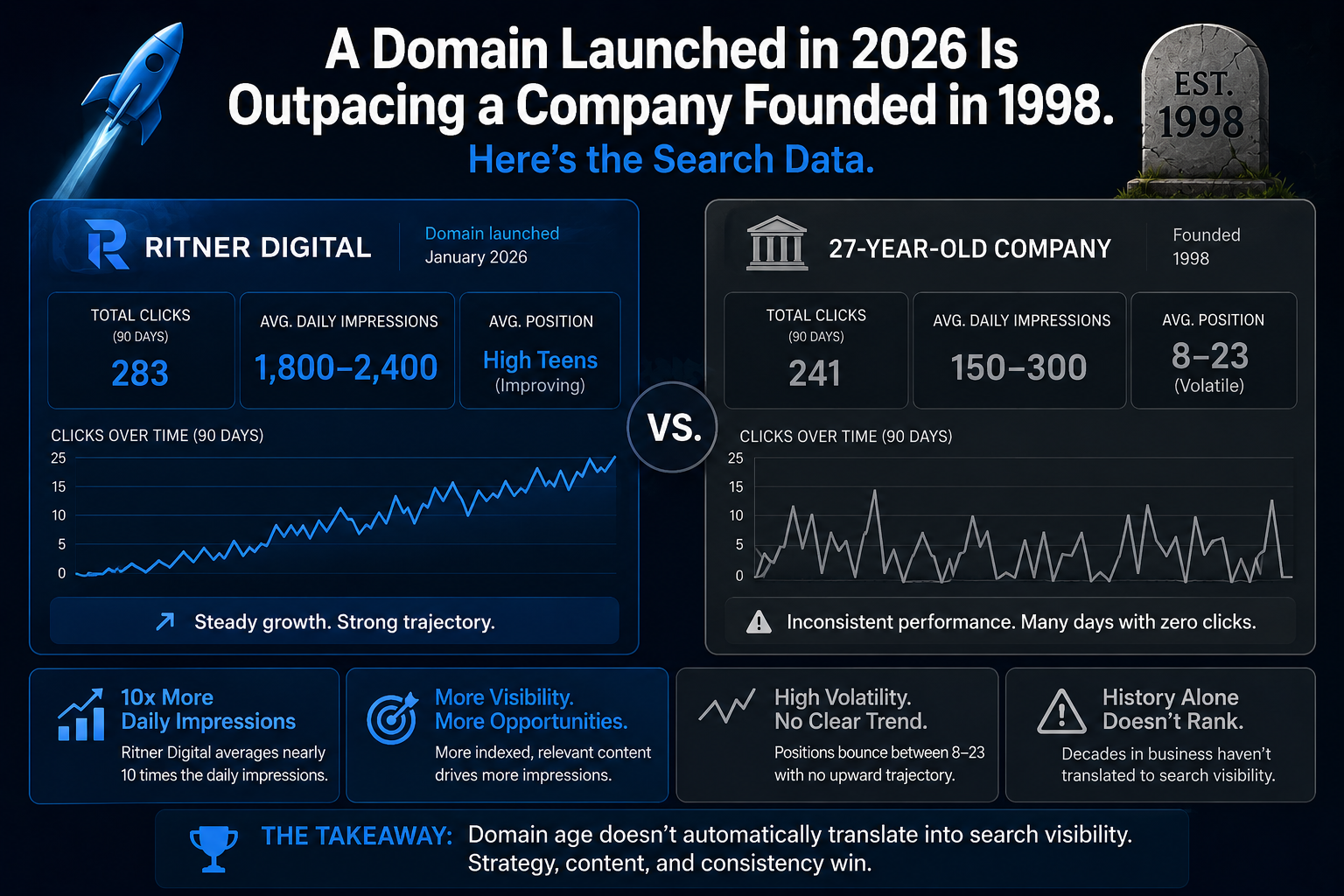
241 total clicks over 90 days. Daily impressions averaging roughly 150–300. Average position bouncing between 8 and 23, with significant volatility day to day. CTR spiking as high as 6% on some days — which sounds impressive until you realize a 6% CTR on 117 impressions is 7 clicks. On multiple days: zero clicks entirely.
Here's a sample of their recent week, May 5–11, 2026:
25 clicks last week. Under 300 impressions per day. For a company that has been operating for 27 years.
Ritner Digital — 90 Days of Google Search Console Data:
283 total clicks over the same 90-day window. Daily impressions that started in the 200–700 range in mid-February — when the domain was barely weeks old — and grew steadily to 1,800–2,400 by May. Average position improving dramatically from the 50s and 60s in early March all the way down to the high teens by May. A trajectory that is moving in exactly one direction.
Here's our same recent week:
43 clicks last week. Nearly 2,000 impressions per day. A domain that didn't exist five months ago.
The Number That Should Stop You Cold
Over the same 90-day window, Ritner Digital generated roughly 10 times more daily impressions than the 1998 company.
Read that again. A four-month-old domain is appearing in Google search results approximately ten times more often per day than a company with 27 years of history.
The 1998 company averages somewhere between 150 and 330 impressions per day. Ritner Digital is now averaging 1,800 to 2,400. On strong days we're approaching 2,500. On their strong days they're approaching 350.
That gap is not an accident. It's not because we got lucky with a viral piece of content. It's not because their industry has low search volume — a company founded in 1998 presumably operates in a market that has existed and been searched for years. It's because one organization has been systematically building search presence from day one, and the other has been largely invisible online for decades despite having every structural advantage — domain age, brand history, customer relationships, industry tenure — that should translate into search authority.
They have the history. We have the strategy. And in organic search, strategy wins.
What's Actually Happening Under the Hood
To understand why a brand new domain can outpace a decades-old company, you need to understand what Google is actually rewarding in 2026 — and it's not age.
Google rewards relevance and authority signals, not longevity. Domain age is a minor factor in Google's algorithm. What matters far more is whether your content comprehensively answers the questions people are actually searching for, whether your site is technically sound, and whether other credible sites reference and link to yours.¹ A 27-year-old company with thin, outdated content, poor technical SEO, and no inbound link strategy will consistently lose to a newer site that has invested in all three.
Impression volume is driven by content coverage, not company age. The reason Ritner Digital is generating 10x the impressions of the 1998 company is simple: we have content indexed and ranking for a far wider range of search queries. More relevant pages means more opportunities to appear. A company with a five-page website from 2014 simply cannot compete with a site actively publishing targeted, search-optimized content — regardless of how long the company has existed.
Position trajectory matters as much as current position. Look at Ritner Digital's average position data over 90 days: we started in the high 50s in early March — deep in search obscurity — and have steadily improved to the high teens by May. That's a 35–40 position improvement in roughly 60 days. The 1998 company, meanwhile, shows a position range of 6–23 with no consistent improvement trend. They have occasional strong days but no compounding trajectory. We have a clear upward arc.
GEO is the emerging multiplier. Beyond traditional SEO, Ritner Digital is also optimizing for generative engine optimization — the practice of structuring content so it surfaces in AI-powered search results like Google's AI Overviews, Perplexity, ChatGPT search, and other large language model-driven discovery tools.² As a growing percentage of search happens through AI interfaces rather than traditional blue-link results, organizations that optimize for both traditional SEO and GEO will compound their visibility advantage over those optimizing for neither. The 1998 company, with minimal traditional SEO investment, almost certainly has zero GEO strategy. That gap will widen as AI search continues to grow.
The Compounding Trajectory: Where Both Sites Are Headed
One of the most revealing things about this data is not just where both sites are today — it's the direction each is traveling.
The 1998 company's trajectory is essentially flat. Looking at their 90-day data, there's no meaningful trend toward more impressions, higher click volume, or improving position. Some days are better than others, but there's no compounding momentum. They're getting roughly the same 150–300 impressions per day in May that they were getting in February. They're bouncing between position 7 and position 23 without a clear directional improvement. This is what years of SEO underinvestment produces: a ceiling. Occasional good days, but no growth engine.
Ritner Digital's trajectory tells a completely different story. In mid-February, when our domain was barely a month old, we were generating 170–280 impressions per day with average positions in the high 20s. By early March, positions were in the 40s–60s as Google indexed more of our content and began testing where to rank it. Then, through March and April, positions improved steadily — from the 50s to the 40s to the 30s to the 20s — as Google's algorithm increasingly validated our content's relevance. By May, we're consistently in the high teens, with our best recent days showing positions of 15–17. Impressions grew from under 300 per day to over 2,000 per day in the same period.
That's the compounding effect of SEO in action. It doesn't move in a straight line — there are plateaus, dips, algorithm fluctuations — but the 90-day arc is unmistakable. And it's an arc the 1998 company simply doesn't have.
What 27 Years of Underinvestment Actually Costs
Let's be direct about what the 1998 company's data represents in business terms.
241 clicks over 90 days is roughly 2.7 clicks per day. At a generous 3% conversion rate, that's 0.08 leads per day — less than one lead per week from organic search, and possibly zero most weeks given how the data actually clusters. For a company that has been operating for 27 years with, presumably, an established customer base and real market credibility, this is an extraordinary amount of pipeline left on the table.
Consider what that same company could be generating with an active SEO strategy. If they were producing Ritner Digital's current impression volume — 2,000 per day — with their existing CTR profile (which actually runs higher than ours on a percentage basis, because their content is more targeted when it does rank), they could be generating 200+ clicks per week. At even a 2% conversion rate that's 4+ leads per week from organic alone.
Instead they're getting 25 clicks per week.
The compounding cost of SEO underinvestment isn't just the leads you're not getting today. It's the domain authority you haven't built, the content library you haven't created, the ranking positions you haven't earned — all of which take time to accumulate and all of which your competitors are building while you wait.
Every month a business delays investing in SEO is another month of compounding that a competitor — even a brand new one — is doing instead.
What This Means for Businesses Founded Before Google Existed
If your company was founded in the 1990s or early 2000s, you have something genuinely valuable that no new competitor can replicate: real history, real customer relationships, real industry credibility. Those things matter. In many sales contexts they matter enormously.
But they do not automatically transfer into search visibility. Google doesn't rank you higher because you've been in business longer. It ranks you higher because your content is more relevant, your site is more technically sound, and more credible sources point to you as an authority. All three of those things require active investment — not just existence.
The uncomfortable reality that this data illustrates is that a company launched four months ago, with no history and no brand recognition, can outpace a 27-year-old organization in organic search within a single quarter. Not because the new company is better at the actual business — they may not be — but because they took search seriously from day one and the established company never did.
That gap compounds. The new company's position improves every month. The established company's stays flat. In 12 months the impression gap won't be 10x — it could be 20x or 30x. In 24 months the established company may be functionally invisible in search while a competitor that didn't exist two years ago owns the first page for every relevant query in their market.
The GEO Factor: Why This Gap Will Accelerate
Traditional SEO is only part of the story. The search landscape is undergoing a structural shift driven by AI.
Google's AI Overviews, which now appear at the top of results for a growing percentage of queries, don't just pull from the highest-ranked pages — they pull from pages that are structured to be cited by large language models. Perplexity, ChatGPT search, and similar AI discovery tools are increasingly how buyers research vendors, compare options, and find service providers. According to research tracking AI search adoption, a meaningful and growing percentage of B2B research now begins in an AI interface rather than a traditional search engine.³
Generative engine optimization — GEO — is the practice of structuring your content so it gets cited, referenced, and surfaced in these AI-driven results. It involves things like clear factual statements, proper entity recognition, structured data, content depth, and the kind of authoritative sourcing that makes AI models treat your site as a credible reference.
A company that underinvested in traditional SEO for 27 years almost certainly has zero GEO infrastructure. No structured data, no AI-optimized content architecture, no presence in the emerging discovery channels where buyers are increasingly spending their research time.
The search visibility gap that exists today — 10x impressions in favor of a four-month-old domain — will look small compared to what the GEO gap produces over the next two to three years as AI search continues to displace traditional blue-link results.
The Honest Summary
We are four months old. We have 283 clicks over 90 days and an average position improving toward the high teens. We have no leads yet from organic search — we've been transparent about that in previous posts — but the trajectory is unambiguous and we know exactly what it will take to get there.
The 1998 company has 241 clicks over the same 90 days, a flat impression trend, and no clear improvement trajectory. They have something we don't — decades of business history, customer trust, and industry relationships. In a room full of their customers, they win. In a Google search result, right now, we're ahead.
Neither of these facts is permanent. But one of them is changing fast.
That is the power of SEO and GEO applied intentionally from the ground up. Not magic. Not shortcuts. Just a clear strategy, consistent execution, and the willingness to treat search visibility as a core business asset rather than an afterthought.
The companies that understand this in 2026 will look back in 2028 and be very glad they started when they did. The ones that don't will be looking at data that looks a lot like that 1998 company's dashboard — and wondering why a competitor they'd never heard of two years ago is now showing up everywhere their customers are searching.
Is your business leaving pipeline on the table because of years of SEO underinvestment? It's not too late to close the gap — but the best time to start is now.
Talk to the Ritner Digital team → ritnerdigital.com
Sources:
Google Search Central Documentation, "How Google Search Works" — overview of ranking signals including content relevance, technical quality, and authority.
Search Engine Journal, "What Is Generative Engine Optimization (GEO)?" — overview of GEO as an emerging discipline for AI-powered search visibility.
Forrester Research / SparkToro, "AI Search Adoption in B2B Research Behavior" — data on the growing percentage of B2B research activity beginning in AI-powered search interfaces.
Frequently Asked Questions
Can a brand new website really outrank a company that has been around for decades?
Yes — and the data in this post shows exactly that happening in real time. Domain age is a relatively minor factor in how Google determines rankings. What matters far more is whether your content comprehensively answers the questions people are searching for, whether your site is technically optimized, and whether you are actively building authority through content and links. A 27-year-old company with thin content, poor technical SEO, and no active strategy will consistently lose ground to a newer site that has invested in all three from day one.
Why does the 1998 company have a higher CTR percentage but fewer total clicks?
A higher click-through rate percentage sounds like a good thing, but it has to be read alongside impression volume. The 1998 company is generating CTRs of 2–6% on some days — but on only 100–330 daily impressions. Ritner Digital's CTR of 0.3–0.5% is lower by percentage, but applied to 1,800–2,400 daily impressions it produces far more actual clicks. A 6% CTR on 117 impressions is 7 clicks. A 0.5% CTR on 2,400 impressions is 12 clicks. Total impressions is the foundation. CTR percentage only matters once you have meaningful impression volume to apply it to.
What is GEO and how is it different from SEO?
SEO — search engine optimization — is the practice of optimizing your website and content to rank higher in traditional search engine results like Google's blue-link listings. GEO — generative engine optimization — is the emerging discipline of structuring your content so it gets cited, referenced, and surfaced by AI-powered search tools like Google's AI Overviews, Perplexity, ChatGPT search, and similar platforms. While SEO focuses on ranking signals like keywords, backlinks, and technical performance, GEO focuses on content clarity, factual authority, entity recognition, and structured data that makes AI models treat your site as a credible source worth citing. In 2026, a complete search strategy requires both.
How long did it take Ritner Digital to start outpacing the 1998 company in impressions?
Based on the data, Ritner Digital crossed the 1998 company's daily impression volume somewhere around late March to early April 2026 — roughly six to eight weeks after launching. By May the gap had grown to approximately 10x in favor of Ritner Digital. The trajectory from launch to competitive impression volume took less than two months, which reflects both the speed at which Google indexes and begins ranking new content when a site is built correctly from the start, and the compounding nature of position improvement as Google's algorithm increasingly validates content relevance.
Does this mean SEO is more important than brand reputation and business history?
Not in every context — but in search specifically, yes, active SEO investment outweighs passive brand history. A company's history, customer relationships, and industry reputation matter enormously in sales conversations, referrals, and direct outreach. Those advantages are real and shouldn't be dismissed. But Google's algorithm does not reward longevity automatically. It rewards content relevance, technical quality, and authority signals — all of which require active investment. A business with 27 years of history and no SEO strategy will lose in search to a business with four months of history and a strong SEO strategy. The solution isn't to choose one over the other — it's to combine genuine business credibility with intentional search investment.
What happens to the visibility gap between these two sites over the next 12–24 months if nothing changes?
If current trajectories hold, the gap grows significantly. Ritner Digital's impression volume has been roughly doubling every four to six weeks as new content gets indexed and positions improve. The 1998 company's impression volume has been essentially flat for the entire 90-day window. If Ritner Digital's growth rate continues even at a fraction of its current pace, the 10x impression gap visible today could become 20x or 30x within 12 months. More importantly, as AI-powered search continues to grow as a share of total search activity, the GEO gap — where the 1998 company almost certainly has no strategy at all — will compound on top of the traditional SEO gap. For the 1998 company, the cost of continued inaction increases every month.
Is it too late for an established business that has underinvested in SEO to catch up?
It is never too late, but the honest answer is that waiting longer makes it harder. Every month of inaction is another month of compounding that competitors — including brand new ones — are doing instead. The good news for established businesses is that they often have genuine advantages that a new domain doesn't: real customer relationships that can generate reviews and links, an established brand name with existing search queries, industry credibility that translates into earned media and citations, and potentially years of existing content that can be updated and optimized rather than built from scratch. An established business that finally commits to SEO can move faster than a new domain in many respects — but only if they actually commit. Continuing to treat SEO as an optional or future investment while competitors build compounding momentum is the most expensive decision most established businesses are currently making without realizing it.
Why does Ritner Digital publish data showing it has no leads yet from organic search?
Because we think the most useful thing we can do for business owners evaluating SEO is show them exactly what the journey looks like — including the parts that aren't yet a success story. The narrative that SEO agencies typically sell is all results and no process. We think that does business owners a disservice. The reality is that organic search is a compounding investment with a real timeline, real milestones, and a build phase before the payoff phase. We are in the build phase on our own site. We know what the data says, we know what it will take to move to the next milestone, and we're doing that work. Showing you our own dashboard — including the zero-lead weeks — is more useful to you than showing you only the wins.
Have a question about where your site stands and what it would take to close the gap? We're happy to look at your data.