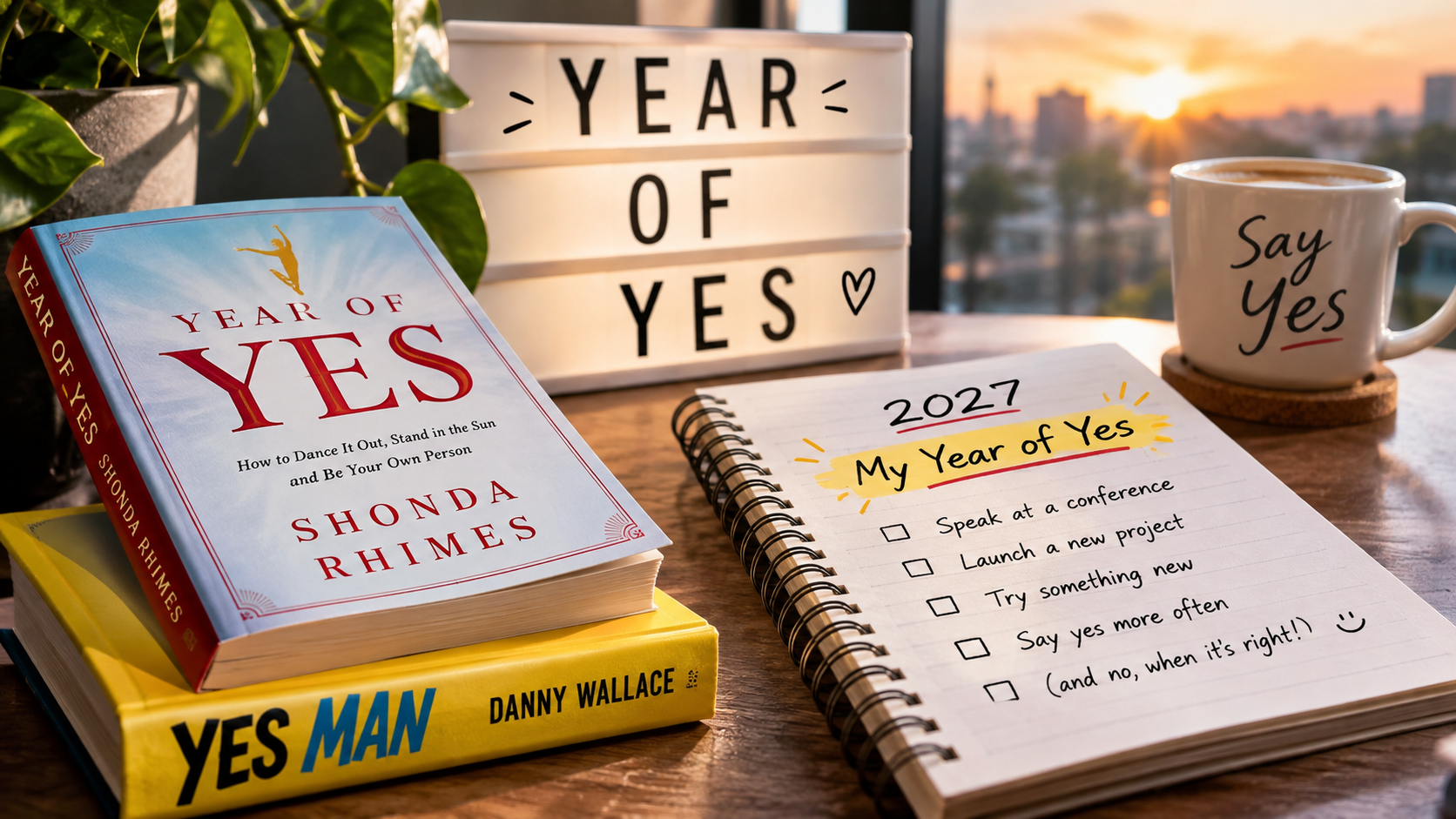
Apparently, the new personal development strategy is to stop automatically saying no to things that make you nervous. Shonda Rhimes wrote a bestselling book about it. A comedian turned the experiment into a movie. Entrepreneurs opened storefronts, professionals changed careers, and one travel blogger became so successful at saying yes that she eventually needed an entire year of saying no. So does a Year of Yes actually create momentum—or is this another attractive phrase we've decided to put on our vision boards?
I'm declaring 2027 a Year of Yes for Ritner Digital.
Which sounds wonderful.
Positive.
Ambitious.
Open to opportunity.
The kind of phrase that belongs on a beautifully designed graphic with a sunrise and perhaps a tasteful amount of leopard print.
But what does it actually mean?
Am I supposed to say yes to every invitation?
Every partnership?
Every podcast?
Every networking event?
Every idea that arrives in my inbox?
Because I would like to make it clear that the answer to “Would you be interested in purchasing 10,000 promotional pens?” is still no.
And if anyone is planning to invite me into a multilevel marketing opportunity disguised as a women's empowerment networking brunch, I'm going to need considerably more information.
Yet there's something genuinely appealing about the concept.
What if, for one year, you stopped automatically declining opportunities because they felt unfamiliar?
What if you reached out to the person you admired?
Accepted the interview?
Submitted the article?
Joined the conversation?
Tried something before deciding you weren't qualified?
What if the goal wasn't to become an entirely different person, but to give yourself more opportunities to become the person you were already trying to be?
That's the version of a Year of Yes I'm interested in.
Not reckless optimism.
Not abandoning boundaries.
Not filling every available hour with an activity simply because someone asked.
A deliberate year of taking opportunities seriously instead of dismissing them out of habit.
And it turns out, there's a surprisingly interesting history behind the idea.
There are also documented examples of people who used it to create meaningful changes in their professional lives.
Not just claims about attracting positive energy.
Actual actions.
Public appearances.
Books.
Businesses.
Career changes.
Professional connections.
And some very useful lessons about the difference between saying yes to opportunity and saying yes to burnout.
So let's investigate.
Because if Ritner Digital is going to spend 2027 calling itself our yes year, I'd like to know whether there's something more substantial behind the idea than a motivational caption.
First, What Exactly Is a Year of Yes?
A Year of Yes is a self-directed experiment in becoming more open to experiences, challenges, invitations, and opportunities that you might normally decline.
The classic version involves committing to say yes more often for approximately one year.
But there isn't one universally accepted set of rules.
Some people say yes to anything that frightens them.
Others focus on career development.
Travel.
New friendships.
Creative work.
Public speaking.
Trying new experiences.
Or making changes they've been postponing.
One person's Year of Yes might involve attending a professional conference.
Another's could mean finally applying for a job.
Someone else might start a business, take a class, or begin dating again.
The common thread is intentional openness.
The person recognizes that their default response to unfamiliar opportunities may be preventing them from trying things they genuinely want.
So they change the default.
Instead of immediately asking why something won't work, they ask whether it's worth exploring.
A Year of Yes is less about accepting everything and more about interrupting your automatic reasons for staying where you are.
Of course, that sounds much less dramatic than announcing:
2027: NO FEAR. NO LIMITS. ONLY YES.
Which would be an excellent slogan for someone trying to sell us a leadership retreat.
But it's also a good way to end up attending six events you don't enjoy while wondering how your calendar became a hostage situation.
A more thoughtful Year of Yes requires judgment.
And the best-known person associated with the concept learned that herself.
Where Did the Term “Year of Yes” Come From?
The phrase became widely recognizable through television producer and writer Shonda Rhimes.
In 2015, Rhimes published her memoir, Year of Yes: How to Dance It Out, Stand in the Sun and Be Your Own Person.
The book described a yearlong experiment that began after a conversation with her sister on Thanksgiving Day in 2013.
At the time, Rhimes was already extraordinarily successful.
She had created Grey's Anatomy and Scandal.
She was one of television's most influential producers.
Her work was highly visible.
But she was also turning down many opportunities outside the work itself.
Interviews.
Events.
Public appearances.
Situations that made her uncomfortable.
Her sister, Delorse, pointed out that she rarely said yes to anything.
Rhimes eventually decided to challenge that pattern.
For a year, she would accept opportunities that scared her.
Her experience became a memoir, a public conversation, and eventually a larger motivational movement.
Her publisher released a 10th-anniversary edition in 2025.
Shondaland also expanded the idea into a collection of stories about readers attempting their own versions.
Did Shonda Rhimes invent the concept?
It's more accurate to say she popularized a particularly influential version of it.
The idea of deliberately saying yes to unexpected opportunities predates her book.
In 2005, British writer and comedian Danny Wallace published Yes Man, documenting his own yearlong experiment with saying yes.
Other writers and self-development traditions had also explored openness, experimentation, and stepping beyond familiar routines.
I couldn't establish a definitive earliest use of the exact phrase Year of Yes, and it would be misleading to credit a single person with inventing the broader idea of saying yes more often.
But Rhimes's 2015 memoir gave the phrase much of its contemporary cultural recognition.
And unlike an abstract motivational slogan, her experiment left behind some unusually specific results.
Six Documented Year-of-Yes Stories With Actual Outcomes
Before we get into the examples, a clarification.
These are publicly documented accounts of people who embraced the idea and took consequential steps.
That doesn't prove saying yes caused every positive development.
Some were already established professionals.
Some had access to significant resources.
Some received outside help.
And all were operating within different personal circumstances.
A successful person's retrospective isn't a controlled experiment.
But we can still examine what people did.
And that's more useful than a vague claim that the universe rewarded their positivity.
1. Shonda Rhimes: From Avoiding Public Appearances to Actually Taking the Stage
<AsyncImageGroup query={["Shonda Rhimes Year of Yes book author portrait","Shonda Rhimes speaking at Dartmouth 2014 commencement"]} aspectRatio="5:4" layout="carousel"/>
Shonda Rhimes is the clearest example because the timeline is well documented.
Her 2014 Year of Yes included decisions that made her uncomfortable but aligned with opportunities she genuinely wanted to explore.
What she actually said yes to
A major television appearance. In April 2014, Rhimes participated in a Jimmy Kimmel Live! special connected to Scandal.
A commencement speech. In June 2014, she delivered Dartmouth College's commencement address.
Greater public visibility. She began accepting interviews and appearances she had previously avoided.
Personal priorities. Her memoir also discusses taking her health, family life, and personal interests more seriously.
Those aren't hypothetical opportunities.
They happened.
Dartmouth's official archive confirms her 2014 commencement address.
ABC News documented the public appearances and personal changes in November 2015.
And in February 2016, she delivered a widely watched TED talk titled “My Year of Saying Yes to Everything.”
What counts as success here?
Rhimes didn't need a Year of Yes to become a successful television writer.
She already was one.
The measurable shift was her participation in activities she'd previously avoided.
She accepted visible professional opportunities.
Developed a broader public voice.
Published a bestselling memoir about the experience.
And continued discussing the influence of the experiment years later.
Her 2025 anniversary edition made clear that she regarded the experience as transformative.
But there's another important lesson.
She also learned to say no.
In a 2024 interview, Rhimes discussed how the experiment eventually helped her become more comfortable refusing requests without guilt.
That's a surprisingly sophisticated outcome.
The woman who became famous for saying yes learned that having a meaningful life also requires saying no.
An excellent twist.
And an important warning for anyone considering a 2027 Yes Year without a functioning calendar.
2. Danny Wallace: The Earlier Yes Experiment That Became a Book and Movie
Long before Year of Yes became a bestselling memoir, Danny Wallace conducted a more extreme experiment.
He started saying yes to almost everything.
Invitations.
Requests.
Unexpected opportunities.
And occasionally things that probably deserved a considerably more skeptical response.
His experiences became the 2005 book Yes Man.
A 2005 profile in The Guardian documented how the experiment developed into a publishing project, a film deal, and changes in his personal life.
The book was later loosely adapted into the 2008 film Yes Man, starring Jim Carrey.
What actually happened?
Wallace turned the experience itself into publishable material.
He accepted unusual invitations.
Met new people.
Generated stories.
Published a book.
And saw that book become the basis for a feature film.
Those are concrete creative and commercial developments.
But there is a significant qualification.
Wallace was already working in media.
He had writing and entertainment experience.
His ability to turn the experiment into a book wasn't solely the result of saying yes.
He also had the professional skills to document and package what happened.
And his story illustrates why indiscriminate acceptance can become ridiculous.
Some opportunities genuinely deserve a no.
The useful takeaway
Openness can create experiences. Skills and follow-through can turn experiences into outcomes.
The year generated material.
His writing turned the material into a product.
A film adaptation expanded the reach.
That's a more useful business lesson than assuming the word yes magically creates opportunities.
3. Monique Outerbridge: A Baker Who Turned Her Yes Year Into Business Expansion
This is one of my favorite examples because it involves a small business rather than a celebrity.
Monique Outerbridge founded Velvet Cakes by Gwen in 2011.
Her business existed before her Year of Yes.
That's important.
We shouldn't rewrite the story as though she read a book and immediately manifested a cake company into existence.
She had already developed the product and the experience.
But she wanted to grow.
One opportunity involved participating in a wedding-industry showcase associated with MunaLuchi Bride.
She was nervous about whether her designs would meet the expectations.
After reading Rhimes's book, she decided to accept the opportunity.
She participated.
And the experience helped her feel more confident about pursuing additional work.
What followed?
According to a June 2025 Shondaland profile, she:
Participated in the bridal showcase.
Began offering monthly cake-sampler pop-ups.
Organized weekend mall boutique events several times a year.
Reported selling out at those mall events.
Improved business processes and automated order forms.
Pursued additional clients and vendor opportunities.
Secured a corporate conference dessert engagement.
These are unusually tangible examples of a Yes Year in practice.
Not every opportunity was glamorous.
Some involved event preparation.
Sales.
Operations.
Process improvements.
And the unromantic work of making sure customers could actually place orders.
The business lesson
The yes didn't replace operational work.
It created reasons to do more of it.
A public event led to additional customer-facing experiments.
Those experiments required ordering systems.
The company began exploring different ways to reach buyers.
That is momentum in a form small-business owners can recognize.
A Year of Yes becomes more powerful when each opportunity creates another practical capability.
It also illustrates why the value isn't simply in accepting invitations.
It's in what you build afterward.
Source note: These outcomes are documented in a Shondaland interview with Outerbridge. They are reported business experiences, not independently audited financial results.
4. Cathy Pearl: From Career Uncertainty to a Book and a Leadership Role at Google
<text>Read the Association for Women in Science account</text>.
Cathy Pearl's story is particularly relevant to people who have been away from an industry, changed careers, or feel hesitant about pursuing a professional opportunity.
In 2014, Pearl was concerned that her career had stalled.
She had spent time away from full-time work while raising her son and had lost confidence in her professional direction.
Over time, encouraged by a career counselor and other people, she began saying yes to opportunities that felt uncomfortable.
She started writing about relationships and data.
Interviewed experts.
Accepted an invitation to present work in Berlin.
Volunteered with Girls Who Code.
And agreed to write a book about voice user interfaces.
Concrete outcomes
Her book, Designing Voice User Interfaces: Principles of Conversational Experiences, was published by O'Reilly in 2017.
She later became a vice president of user experience at a healthcare startup.
In 2018, she joined Google, working in conversation design for Google Assistant.
She also developed a public-speaking career and contributed to professional discussions about voice technology.
Her account describes speaking before a large international audience in Madrid several years after her initial career uncertainty.
Why this example matters
Her story doesn't establish that every outcome happened within a single calendar year.
The career developments unfolded over multiple years.
And that distinction matters.
The Year of Yes was a change in approach.
The outcomes accumulated through subsequent work.
It wasn't a 12-month guarantee.
Sometimes a Year of Yes begins a professional trajectory whose most meaningful results appear later.
That's probably a more realistic way to think about career momentum.
An interview in January doesn't have to create an opportunity in February to have been worthwhile.
It might lead to a relationship that becomes important two years later.
Or it might simply help someone become more comfortable with the next conversation.
5. Deb Liu: A Year of Yes That Led to Speaking, Advising, and Becoming a Founder
This example is especially timely.
Deb Liu, a former technology executive and former CEO of Ancestry, published a first-person essay in January 2026 reflecting on her year of saying yes.
Her circumstances were more complex than an ordinary professional development challenge.
She had stepped down from her leadership role and was also dealing with serious personal and health circumstances.
Her Year of Yes involved reopening space for relationships, learning, and new professional directions.
What did she actually do?
According to her January 15, 2026 essay, Liu:
Accepted speaking opportunities. A new connection helped lead to a TEDx San Diego appearance.
Hosted professional gatherings. She described hosting three Women in Product events.
Expanded her advisory work. She began advising founders and consulting with organizations.
Joined a company board. She reported joining Poshmark's board.
Explored new technology. She took a class in AI-assisted software development.
Started a new venture. She described the class as part of the path that led her to become a founder.
Developed another book concept. She also began creating the framework for a new writing project.
Those are concrete steps.
They are not all equivalent measures of business success.
A speaking engagement isn't revenue.
An advisory relationship doesn't automatically become a thriving company.
And founding something doesn't establish its long-term commercial performance.
But the overall pattern is clear.
A year that could have been defined entirely by transition became a period of professional experimentation and new relationships.
The useful takeaway
A Year of Yes doesn't necessarily mean accelerating an existing career.
Sometimes it means allowing a different one to emerge.
For someone who has spent years following a defined professional path, that's a meaningful distinction.
6. Julissa Ceballos: Saying Yes to Training and Returning to Work
Not every Year of Yes has to involve a book deal or a conference stage.
In September 2026, CanCode Communities published the story of Julissa Ceballos.
After years away from the workforce, Ceballos was interested in pursuing a new opportunity but worried about her technology skills.
She began a teacher's aide training pathway.
Then she learned about digital-skills education through CanCode Communities.
She was nervous about returning to a classroom and learning unfamiliar tools.
But she decided that this would be her Year of Yes.
What happened?
She completed training in workplace technology skills.
The program covered tools such as Outlook and Microsoft Teams, professional email communication, résumés, and presentations.
According to CanCode's published account, she subsequently returned to the workforce.
That's a tangible outcome.
A person identified a gap.
Accepted support.
Developed relevant skills.
And took steps that helped her reenter employment.
The useful takeaway
Sometimes saying yes isn't a dramatic leap.
It's attending the first class.
Asking for help.
Practicing something unfamiliar.
Or allowing yourself to be a beginner.
And for people who are balancing family responsibilities, health limitations, or career transitions, that can be a substantial accomplishment.
The lesson isn't that everyone should take more risks.
It's that a meaningful yes can be appropriately sized for the person's circumstances.
The Counterexample: A Year of Yes Can Also Become a Year of Burnout
Now for the part motivational content tends to put in very small print.
What if the Year of Yes works?
What if opportunities increase?
What if people keep inviting you?
What if your business grows?
What if your calendar becomes absolutely unreasonable?
A 2019 retrospective from travel writer Lia Garcia of Practical Wanderlust offers a useful cautionary example.
Garcia described 2019 as a year of saying yes to extensive travel and business opportunities.
She reported significant business growth and extraordinary travel experiences.
But she also described burnout developing over the year.
By the end, she was exhausted.
And her plan for 2020 was strikingly different.
She wanted to travel less.
Spend more time at home.
And become more comfortable declining opportunities.
The lesson
Opportunity has a cost.
Sometimes in time.
Sometimes in money.
Sometimes in attention.
And sometimes in personal well-being.
A Year of Yes can create access to new experiences.
But without boundaries, it can also create an unsustainable workload.
The goal should not be to become available to everyone.
It should be to become more willing to pursue the opportunities that actually matter.
That's a very different philosophy.
And probably the one most useful for a small business.
So Does a Year of Yes Scientifically Work?
This is where I want to separate the stories from the evidence.
We have documented examples of people who made consequential decisions during a Year of Yes.
But I couldn't identify high-quality causal research proving that declaring a Year of Yes produces greater career success, business revenue, or personal happiness.
The stories are not randomized experiments.
They're accounts of people who tried something and later described what happened.
There may also be selection bias.
People with extraordinary outcomes are more likely to appear in motivational articles than people whose Year of Yes involved attending three mediocre networking events and discovering that they prefer staying home.
The success stories are still useful.
They demonstrate possibilities.
But they don't establish a guaranteed formula.
What research can help explain is why taking more intentional action may create opportunities.
7. The Psychology: A Goal Isn't the Same Thing as an Action Plan
One relevant research area involves implementation intentions.
These are specific if-then plans that connect an anticipated situation with an action.
For example:
"If I receive a relevant speaking invitation, I'll review the details and respond within two business days."
Or:
"If I find an interesting podcast, I'll identify the host and send a thoughtful pitch."
That is more actionable than simply declaring:
"I'm going to put myself out there."
In a 2006 meta-analysis, researchers Peter Gollwitzer and Paschal Sheeran reviewed 94 independent tests of implementation intentions.
They found a positive, medium-to-large average effect on goal attainment.
That doesn't prove that a Year of Yes is scientifically validated.
But it supports a relevant principle.
Specific plans can help people translate intentions into action.
So the useful version of the trend isn't:
"I manifest new opportunities."
It's:
"When an appropriate opportunity appears, I have a plan for deciding whether and how to pursue it."
Less glamorous.
Considerably more useful.
8. New Connections Can Lead to Real Opportunities
There's another relevant research area.
Professional networks.
In 2022, researchers published a major study examining the role of weaker professional connections in job mobility.
The analysis involved randomized experiments on LinkedIn affecting more than 20 million users over several years.
It found causal evidence that certain weaker social connections could improve access to job opportunities.
The relationship was nuanced.
Different kinds of ties were valuable in different contexts.
And the strongest results didn't simply come from collecting as many random connections as possible.
MIT's explanation of the research and the published study provide further details.
This helps explain why saying yes to relevant conversations can have value.
A podcast appearance might introduce a business owner to people outside their existing network.
An editorial collaboration could develop a new professional relationship.
A conference may connect someone with a future partner.
That doesn't guarantee a client.
But it can increase the number of appropriate connections through which future opportunities might emerge.
The distinction matters
A Year of Yes shouldn't become a competition to meet the most people.
It should create opportunities for relevant, genuine relationships.
The potential value is not merely in saying yes. It's in the people, skills, and experiences that become accessible afterward.
The Business Version: A Year of Yes Should Have a Strategy
Now let's bring this back to Ritner Digital.
Because I don't want 2027 to become a year of accepting random calendar invitations in the hope that momentum will eventually occur.
I want it to be deliberate.
At Ritner Digital, the core work involves SEO, AI search, digital PR, content strategy, social media, website design, and helping businesses become easier to find.
Those areas create natural opportunities for professional conversations.
A journalist may need a quote about AI search.
A podcast might be discussing the future of marketing agencies.
A business publication could need an explanation of Google Search Console.
An independent creator might want to collaborate on a useful research project.
A professional organization may be hosting a panel about digital visibility.
And an editor may be looking for a contributor who can explain marketing technology without making it sound like a quarterly software earnings call.
Those opportunities fit the practice.
They also fit my interests.
And they're the kinds of invitations I might have been too hesitant or too busy to pursue in the past.
So here's what a practical 2027 Yes Year could look like
Yes to being interviewed. When a journalist is researching a topic connected to my work, I'd like to participate where I can add something meaningful.
Yes to podcasts. Especially conversations about AI search, marketing, consumer psychology, digital media, and what small businesses actually need.
Yes to contributing articles. Not promotional filler, but useful original perspectives for relevant publications.
Yes to partnerships. Particularly collaborations where both parties contribute expertise and the resulting work provides value to an audience.
Yes to learning. New tools, changing search behavior, unfamiliar research topics, and professional skills worth developing.
Yes to community. Interesting discussions, events, and relationships that might otherwise be easy to overlook.
And yes to taking some chances. Including the occasional opportunity that feels slightly outside my usual comfort zone.
But not every invitation.
The point is to become more open.
Not less selective.
9. The Three Questions Every Business Should Ask Before Saying Yes
Here's a simple approach I'd use for Ritner Digital.
Does it align with what we're building?
A relevant marketing podcast could make sense.
A collaboration about an unrelated product category might not.
Being open to new opportunities doesn't mean abandoning the identity of the business.
Can we contribute something useful?
A good partnership should involve more than visibility.
Do we have relevant knowledge?
Can we offer a substantive perspective?
Will the audience actually benefit?
Do we have the capacity to do it well?
This is the part most motivational slogans omit.
Time matters.
Preparation matters.
Existing client responsibilities matter.
And accepting an invitation without being able to deliver is not a particularly inspiring form of professional growth.
If the answer to all three questions is yes, the opportunity deserves serious consideration.
If not, declining it may be the better decision.
The smartest Year of Yes still needs a very functional relationship with no.
10. Measure the Actions, Not Just the Outcomes
A Year of Yes can become frustrating if you judge it entirely by things other people control.
You can send a thoughtful pitch.
You cannot guarantee the editor publishes it.
You can agree to an interview.
You cannot guarantee it generates business.
You can join a professional conversation.
You cannot guarantee the people you meet become clients.
So I think a useful Year of Yes should track both actions and results.
Actions you can control
Relevant pitches sent.
Invitations answered.
Events attended.
Conversations initiated.
Articles submitted.
Courses completed.
Partnership proposals developed.
Follow-ups sent.
Outcomes you can observe
Accepted interviews.
Published expert quotes.
Podcast episodes released.
Editorial contributions published.
New professional relationships.
Qualified inquiries.
Partnerships completed.
Useful skills developed.
Outcomes you shouldn't invent
Guaranteed revenue.
Guaranteed brand authority.
Guaranteed AI search recommendations.
Guaranteed backlinks.
Guaranteed visibility.
The year can be successful even when not every opportunity produces a measurable commercial return.
But the results should be documented accurately.
Because otherwise, by December, you may be telling yourself a beautiful story about how transformative the year was without being able to identify what actually changed.
A very common problem in both self-development and marketing reporting.
11. The Yes-Year Momentum Audit
At the end of each quarter, I'd ask five questions.
What did I say yes to that I probably would have declined before?
What concrete action did I take afterward?
What happened as a result?
What did I learn, even if the outcome wasn't what I'd hoped?
What should I stop saying yes to?
That final question is especially important.
The goal is not for your commitments to grow indefinitely.
It's for your judgment to improve.
Perhaps an event wasn't useful.
Perhaps a collaboration demanded more time than anticipated.
Perhaps a project turned out to be a poor fit.
Those outcomes are valuable information.
The next time a similar opportunity appears, you can make a better decision.
A Year of Yes should make you more capable of choosing.
Not permanently obligated to accept.
The Unofficial Year-of-Yes Corporate Policy
Effective January 1, 2027, the following procedures will apply to all opportunities entering the Ritner Digital inbox.
Article I: Professional Invitations
Relevant podcast invitations shall receive thoughtful consideration.
Article II: Speaking Engagements
Interesting public-speaking opportunities may be accepted even when the principal experiences a moderate desire to hide beneath her desk.
Article III: Collaboration Requests
Partnerships that offer clear mutual value shall be reviewed.
Partnerships whose primary benefit is “exposure” shall be required to explain what exposure means and why it apparently cannot coexist with compensation.
Article IV: Unnecessary Meetings
A Year of Yes shall not supersede the organization's longstanding commitment to protecting everyone's calendar.
Article V: Promotional Merchandise
Requests involving 10,000 branded pens shall be evaluated individually, with a presumption of skepticism.
Article VI: Opportunities Described as “Life-Changing”
The term life-changing shall not be considered sufficient evidence of value.
Additional documentation may be requested.
Article VII: Saying No
A well-considered no shall remain valid.
A yes to meaningful work may require a no to unrelated obligations.
Article VIII: Pasta
Invitations involving an excellent Italian restaurant may receive expedited review.
This policy is fictional.
The scheduling concerns are very real.
How to Start Your Own Year of Yes in 2027
You don't need to be a celebrity, executive, or entrepreneur.
The idea can be adapted to almost any stage of life.
And you don't have to begin on January 1.
A personal Year of Yes can start whenever you're ready to make a more intentional commitment.
Step 1: Identify What You Keep Avoiding
Not everything uncomfortable is worth pursuing.
But some discomfort may indicate an opportunity for growth.
Ask yourself:
What have I wanted to try but kept postponing?
Which invitations do I decline because I don't feel ready?
Where am I waiting for someone else to give me permission?
What professional or personal experience would I regret never exploring?
The answers might reveal a pattern.
Maybe it's public speaking.
Networking.
Learning a new skill.
Applying for a different role.
Making new friends.
Or finally sharing your creative work.
You don't need a dramatic life transformation.
You need an area where greater openness might make sense.
Step 2: Choose a Few Types of Yes
A focused Year of Yes is easier to manage than an unlimited one.
For a business owner, the categories might be:
Relevant media opportunities.
New professional relationships.
Learning opportunities.
Thoughtful collaborations.
Experiments that support existing goals.
For someone outside business, the categories could be very different.
The important part is choosing intentionally.
Step 3: Define Your Non-Negotiables
A Year of Yes should not require ignoring safety, consent, health, family obligations, financial limits, or personal boundaries.
You can say no to something unsafe.
Something exploitative.
Something outside your capacity.
Something that conflicts with your values.
Or simply something you do not want to do.
The challenge is to distinguish a genuine boundary from an automatic avoidance response.
That distinction takes judgment.
It's one of the most important parts of the experiment.
Step 4: Make the First Yes Small
A meaningful Year of Yes doesn't have to begin with a major career decision.
You could introduce yourself to someone.
Attend one event.
Send a thoughtful pitch.
Register for a class.
Ask a question during a webinar.
Submit a piece of writing.
Or accept an invitation you would normally decline.
Smaller actions can help you learn what the experience is like without making an unnecessarily large commitment.
Step 5: Turn the Yes Into a Next Step
Here's where momentum actually develops.
Someone invites you onto a podcast.
You agree.
Then you prepare.
Participate.
Share the episode appropriately.
Thank the host.
Maintain the relationship.
And consider whether the conversation raised an idea worth exploring further.
The word yes opens the opportunity.
Everything that follows creates the result.
That's why the most impressive examples in this article aren't simply people accepting invitations.
They acted on them.
The baker developed new sales formats.
The technology professional wrote a book.
The career changer completed training.
The executive explored new work.
And the television producer actually showed up on stage.
Opportunity is the invitation. Momentum is what happens when you do something with it.
Frequently Asked Questions
1. What is a Year of Yes?
A Year of Yes is a personal or professional commitment to becoming more open to meaningful opportunities, experiences, and challenges for approximately one year. Different people establish different rules, but the common goal is to interrupt habitual avoidance and take more intentional action.
2. Who popularized the Year of Yes?
Shonda Rhimes popularized the modern phrase through her 2015 memoir, Year of Yes: How to Dance It Out, Stand in the Sun and Be Your Own Person. Her experiment began after a conversation with her sister on Thanksgiving Day in 2013.
3. Did Shonda Rhimes invent the concept?
She helped popularize it, but the broader idea of deliberately saying yes to new experiences predates her memoir. Danny Wallace documented a related yearlong experiment in his 2005 book Yes Man. The exact earliest use of the phrase Year of Yes is not definitively established here.
4. What did Shonda Rhimes accomplish during her Year of Yes?
Her documented 2014 activities included a major Jimmy Kimmel Live! appearance, the Dartmouth commencement address, and greater participation in public professional opportunities she had previously avoided. She later published her bestselling memoir and delivered a TED talk about the experience.
5. Did Shonda Rhimes become successful because she said yes?
No such causal claim is supported. Rhimes was already an exceptionally successful television producer before the experiment. Her Year of Yes is best understood as changing aspects of her participation, confidence, public visibility, and personal life rather than creating her original career success.
6. Is the movie Yes Man based on a true story?
The 2008 movie was loosely adapted from Danny Wallace's 2005 memoir, which described his real-life experiment with accepting invitations and requests. The film is a fictionalized adaptation rather than a documentary account of the original events.
7. Have business owners achieved measurable results from a Year of Yes?
Some have publicly documented concrete steps and outcomes. Baker Monique Outerbridge reported launching pop-ups, testing mall retail events, improving ordering processes, and gaining new client opportunities after embracing the concept. These are reported business outcomes, not independently audited evidence that a Yes Year caused revenue growth.
8. Are there career-change examples of a Year of Yes working?
Yes. Cathy Pearl described accepting new professional experiences, writing a book, and eventually joining Google in a conversation-design role. Julissa Ceballos, profiled by CanCode Communities in 2026, pursued digital-skills training and subsequently returned to the workforce. Their stories involved practical steps, support, and sustained effort.
9. Is there scientific proof that a Year of Yes works?
There is no well-established scientific evidence identified here proving that declaring a Year of Yes causes greater success. Related research does show that specific action plans can improve goal attainment and that certain new professional connections can create opportunities. Those findings support possible mechanisms, not guaranteed results.
10. Does a Year of Yes mean saying yes to everything?
No. A sustainable Year of Yes should respect safety, personal boundaries, financial realities, and existing commitments. Even Shonda Rhimes has discussed learning to say no as an important consequence of her experiment.
11. Can a Year of Yes lead to burnout?
It can if someone accepts too many commitments without considering their capacity. Travel writer Lia Garcia documented substantial activity and business growth during her 2019 Year of Yes but also described experiencing burnout and deliberately planning a more selective following year.
12. How does a Year of Yes help a small business?
It may encourage the owner to pursue relevant opportunities they would otherwise avoid, including interviews, partnerships, events, or professional development. The business impact depends on which opportunities are selected and how effectively they're pursued. Saying yes is not a substitute for strategy or execution.
13. What should I track during a professional Year of Yes?
Track actions you can control—such as pitches sent, meetings attended, and projects completed—alongside observable outcomes such as published contributions, new professional relationships, and qualified business inquiries. Avoid attributing results to the experiment without sufficient evidence.
14. Can I start a Year of Yes in the middle of the year?
Yes. There is no official calendar requirement. A Year of Yes is a self-directed commitment, so it can begin whenever a person wants to experiment with greater openness and more intentional action.
15. What's the difference between a Year of Yes and a New Year's resolution?
A traditional resolution often focuses on a particular outcome, such as learning a skill or reaching a goal. A Year of Yes focuses more broadly on a decision-making approach: becoming open to relevant opportunities and acting on them rather than automatically declining.
16. What is Ritner Digital saying yes to in 2027?
Ritner Digital is inviting relevant requests for expert quotes, podcast interviews, editorial contributions, educational collaborations, and partnerships related to SEO, AI search, digital marketing, content strategy, consumer psychology, and the changing online business environment.
17. Does a Year of Yes guarantee more clients or professional opportunities?
No. Greater openness may increase participation in relevant activities, but outcomes depend on circumstances, professional fit, execution, and external decisions. A Year of Yes should be treated as an experiment in intentional action, not a promise of commercial success.
18. How can I collaborate with Ritner Digital during its 2027 Year of Yes?
Journalists, podcast hosts, editors, organizations, and other creators can contact Ritner Digital with a proposed topic, audience, format, and relevant timing. Opportunities are considered based on fit, value, and availability.
So Here's to 2027: A Year of Yes With Actual Follow-Through
I like the idea of a Year of Yes.
Not because I expect the universe to deliver an extraordinary series of opportunities simply because I've announced I'm ready.
And not because I think the answer to every invitation should suddenly be yes.
But because there's something valuable about becoming aware of the ways we limit ourselves.
The interview we don't pursue.
The person we don't contact.
The event we decide isn't for us.
The idea we never submit.
The collaboration that sounds interesting but also slightly intimidating.
Sometimes the correct decision is still no.
And sometimes the hesitation is simply fear wearing a very convincing outfit.
The stories behind the Year of Yes suggest that meaningful changes often begin with ordinary decisions.
Shonda Rhimes agreed to public appearances.
Cathy Pearl agreed to explore unfamiliar professional opportunities.
Monique Outerbridge accepted an event that challenged her confidence, then built new sales experiences around what she learned.
Deb Liu made room for new professional directions.
Julissa Ceballos enrolled in training that helped her return to work.
These people didn't experience identical outcomes.
They didn't begin with identical resources.
And their success cannot be attributed to one motivational phrase.
But they did something that feels relevant.
They moved from considering opportunities to taking specific action.
That's the part I want to borrow for Ritner Digital.
More conversations.
More thoughtful outreach.
More learning.
More collaboration.
More willingness to participate.
Not an endless calendar.
Not a pile of commitments.
And definitely not an inbox full of opportunities that were never appropriate in the first place.
Just a deliberate effort to stop automatically dismissing the things that might be worth trying.
So if you're working on a podcast, article, newsletter, panel, research project, or collaboration involving digital marketing, AI search, consumer behavior, or internet culture, consider reaching out.
We may have something useful to contribute.
And if it's a good fit, I'd like 2027 to be a year when the answer is more often:
Yes. Let's talk.
Because opportunity doesn't become momentum simply by arriving.
Someone has to answer.
Then someone has to show up.
Then someone has to do the work.
And perhaps that's what a successful Year of Yes actually means.
Not saying yes to everything.
Saying yes to the things worth doing—and then actually doing them.
Contact Ritner Digital about 2027 interviews, podcasts, partnerships, and marketing collaborations.
Sources and Further Reading
The examples below are based on published interviews, memoir material, first-person accounts, organizational profiles, and research. Personal stories demonstrate documented decisions and reported outcomes; they do not establish that a Year of Yes independently caused success.
Simon & Schuster — Year of Yes by Shonda Rhimes. Publisher's description of the memoir and the events that inspired it.
Simon & Schuster — Year of Yes, 10th Anniversary Edition. Updated edition and retrospective on the original 2014 experiment.
ABC News — Shonda Rhimes on Overcoming Shyness and Her Year of Yes. November 2015 interview documenting public appearances and personal changes.
Dartmouth College — Words, Wit, and Wisdom From Past Commencement Speeches. Official confirmation of Rhimes's 2014 commencement speech.
TED — Shonda Rhimes: My Year of Saying Yes to Everything. February 2016 talk about the experiment.
The Guardian — Danny Wallace and the Origins of Yes Man. July 2005 profile of Wallace's earlier yearlong experiment and its outcomes.
Shondaland — Reading Year of Yes Inspired This Baker to Create a Thriving Business. June 2025 interview documenting Monique Outerbridge's business activities.
Association for Women in Science — Cathy Pearl: My Year of Saying, Yes!. First-person account of professional experimentation, publishing, and subsequent career development.
Deb Liu — Lessons From My Year of Yes. January 2026 first-person retrospective detailing speaking, advising, learning, and entrepreneurial steps.
CanCode Communities — Julissa's Year of Yes Opened the Door to a New Career. September 2026 account of a career changer pursuing training and returning to employment.
Practical Wanderlust — 2019 in Review: The Year of Yes. First-person account of professional activity, travel, business growth, and burnout.
Shondaland — A Year of Yes Message From Shonda. February 2025 anniversary initiative.
Gollwitzer and Sheeran — Implementation Intentions and Goal Achievement: A Meta-Analysis. Research on specific plans and their effects on goal attainment.
MIT News — The Power of Weak Ties in Gaining New Employment. Summary of experimental research on professional networks and job opportunities.
Ritner Digital — SEO Services.
Ritner Digital — Content Systems.
Ritner Digital — Contact.
Editorial Note: A Little Parody, a Lot of Actual Follow-Through
This article combines documented Year-of-Yes stories, relevant behavioral research, personal commentary, and satire.
The fictional corporate policy and jokes about networking invitations are original parody.
The examples of Shonda Rhimes, Danny Wallace, Monique Outerbridge, Cathy Pearl, Deb Liu, Julissa Ceballos, and Lia Garcia reflect published accounts.
Reported business outcomes are not necessarily independently audited, and the article does not claim that adopting a Year of Yes causes success.
A thoughtful Year of Yes should preserve personal boundaries and consider health, safety, time, family responsibilities, and financial realities.
Published in November 2026 as part of Ritner Digital's planning for 2027.