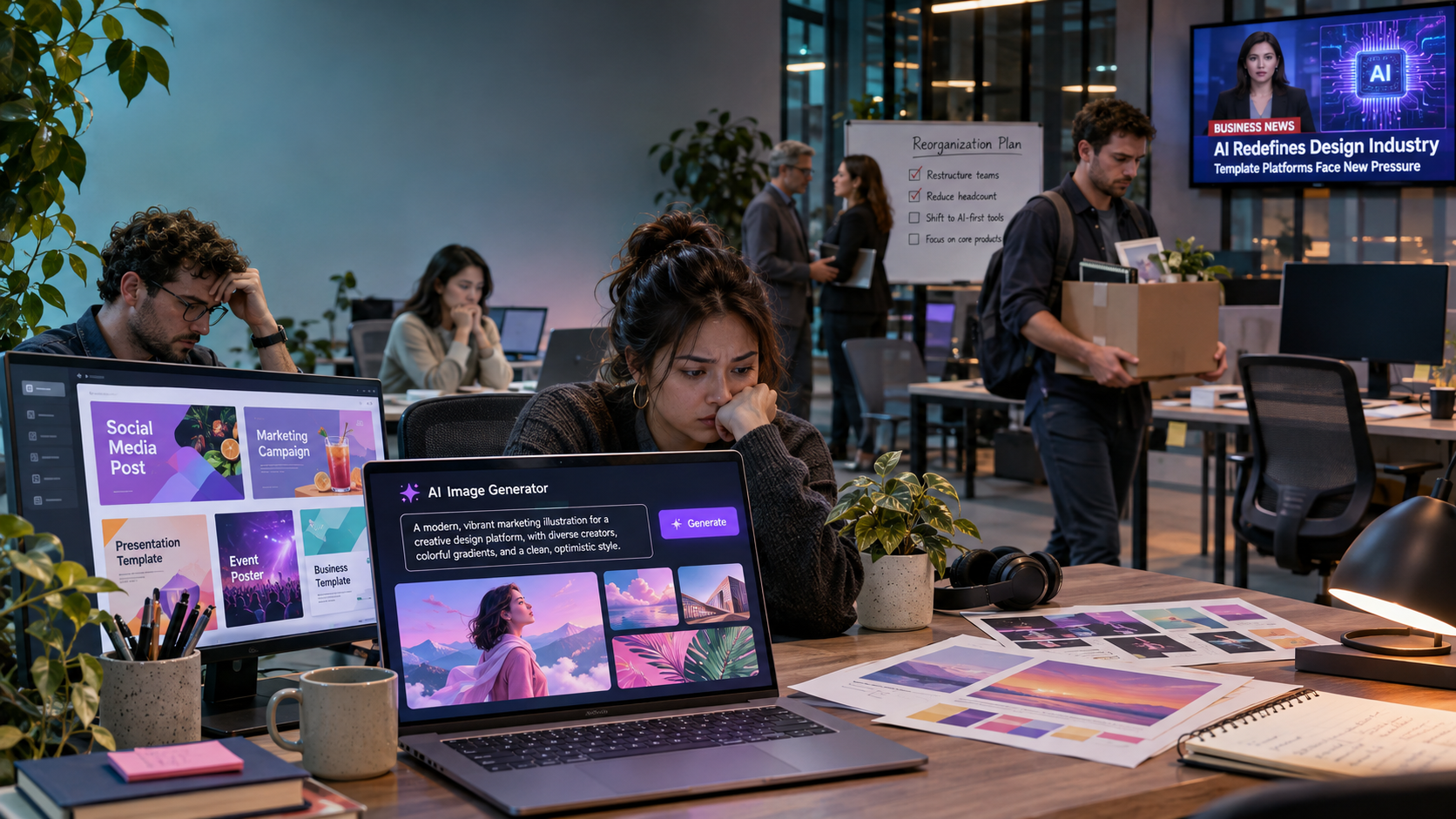
Canva was the tool. The moment. The revolution. It liberated ordinary people from the terrifying world of Photoshop layers and gave every small-business owner the ability to create a reasonably attractive flyer without emailing a graphic designer. Then generative AI arrived, and suddenly even dragging a text box into position started feeling like an unreasonable amount of work. Now Canva is restructuring 22% of its workforce. So what happened to the company that made everybody a designer?
Canva.
Babe.
What happened?
You were it.
You were the tool.
The girl who changed everything.
You were the reason small-business owners could suddenly create Instagram graphics without spending three hours trying to figure out what a layer mask was.
You were the reason every school fundraiser had a cute flyer.
Every real estate agent had a branded social post.
Every entrepreneur had a mood board.
Every business owner who had absolutely no formal graphic design experience could open a browser and produce something that looked, if not professionally designed, at least reasonably presentable.
And we loved you for it.
Truly.
Before Canva, creating graphics was an entirely different experience for a lot of ordinary people.
You had an idea.
You wanted a flyer.
You wanted a website banner.
You wanted a social media graphic.
And your options were somewhat limited.
You could open Microsoft Paint and create something deeply concerning.
You could try PowerPoint, which occasionally produced acceptable results if you possessed a surprising amount of patience.
You could learn Photoshop or Illustrator.
A noble ambition.
Right up until the software presented you with 47 panels, 19 menus, and something called a clipping mask.
Or you could contact a graphic designer.
Explain what you wanted.
Wait for a draft.
Request changes.
Pay for the work.
And eventually receive a beautiful, professionally developed asset.
For important projects, that was often exactly the right approach.
But for a quick social media announcement?
A weekend sale?
A reminder that your business would be closed on Monday?
It could feel like an enormous process for a relatively small task.
Then Canva arrived.
And suddenly, the ordinary person could make the graphic.
Pick a template.
Change the words.
Upload a photograph.
Move some elements around.
Export.
Done.
A little awkward sometimes.
Perhaps a font pairing that should have been reconsidered.
But done.
Canva made design accessible to people who didn't want to become designers.
And that was a massive achievement.
Then artificial intelligence introduced a rather inconvenient follow-up question.
What if people don't want to design at all?
What if I don't want to choose a template?
What if I don't want to change the font?
What if I don't want to move the image?
What if I don't want to learn which menu contains the background remover?
What if I simply want to type:
"Make me an elegant promotional image for a boutique wellness business, with soft pink lighting, beautiful typography, and a premium editorial feel."
And receive an image that already looks like someone spent hours making it?
Because that is increasingly the expectation.
And suddenly, Canva's greatest advantage—that ordinary people could do the work themselves—starts looking a little different.
The company that eliminated the need to hire someone for every simple design is now competing with tools that eliminate much of the need to perform the design process.
Which makes Canva's November 2026 restructuring particularly interesting.
Not because the company is dead.
It isn't.
Not because AI has replaced professional designers.
It hasn't.
And not because every Canva image looks worse than every ChatGPT image.
That's subjective, task-dependent, and certainly not an established universal fact.
But because the company that helped define one generation of creative software is now confronting a generation that may expect something fundamentally different.
Let's talk about it.
First, What Actually Happened With the Canva Layoffs?
On November 3, 2026, Canva announced a major organizational restructuring.
According to an official memo from CEO and co-founder Melanie Perkins, the changes affect 1,271 employees, representing 22% of the company's workforce.
That's a substantial portion of the organization.
But there's an important distinction in the numbers.
Not all 1,271 employees were necessarily laid off.
Canva said the group included people losing their jobs, people whose roles were changing, and others being asked to relocate.
The company had not publicly disclosed the exact breakdown.
So headlines stating that Canva fired 1,271 employees oversimplify what the company actually announced.
Still, the scale of the restructuring is significant.
Perkins described the period as Canva's most difficult in its 13-year history.
She also acknowledged that the company's growth had slowed for the first time in a decade.
The restructuring involves combining Product, Growth, and Platform into a more unified organization.
Canva is simplifying management structures.
Broadening responsibilities.
Consolidating certain teams.
And moving some work toward centralized locations, particularly Sydney.
The company also announced changes to its hybrid work arrangements.
Beginning in January 2027, most hybrid employees are expected to work in an office approximately two to three days per week, depending on their role.
What about the employees losing their jobs?
This isn't a development that deserves to be treated entirely as a corporate punchline.
Real people are losing their jobs.
Some may face difficult choices about relocation.
Others are experiencing significant uncertainty after helping build one of Australia's most successful technology businesses.
Canva announced support for departing employees, including at least six months of salary, continued healthcare where applicable, career assistance, and the option to keep their company MacBooks.
The company also established a fund offering eligible departing employees opportunities to apply for $10,000 grants to pursue entrepreneurial or community projects.
Those measures don't eliminate the disruption.
But they're relevant to understanding how the company is managing it.
ABC News Australia and Reuters covered the restructuring.
So why is Canva making these changes?
The company points to slowing growth, organizational complexity, and a major change in the technology landscape.
Perkins did not announce that ChatGPT had personally destroyed the business.
Nor did she say all affected roles were being directly replaced by AI.
But the wider competitive context is difficult to ignore.
Generative AI is changing how people create images, presentations, advertising assets, and other visual content.
And Canva is trying to reinvent itself around that shift.
The company is not simply cutting costs. It is attempting to change what kind of company it is.
That's the much bigger story.
1. We Need to Remember How Revolutionary Canva Actually Was
Canva officially launched on August 26, 2013.
Its original proposition was wonderfully straightforward.
Make graphic design easier for everyone.
The company introduced a browser-based, drag-and-drop design experience alongside a large collection of photographs, illustrations, fonts, and layouts.
At launch, the idea was significant enough that TechCrunch covered the company and its $3 million in seed funding.
Canva's original announcement emphasized accessibility.
Instead of asking ordinary users to learn complex professional software, the product would bring the components together in a simpler interface.
And here's something important.
Canva didn't eliminate the need for creativity.
It reduced the technical skill required to execute an ordinary visual idea.
That is a meaningful distinction.
A business owner could still have terrible taste.
A person could still use an unfortunate collection of fonts.
Someone could still place bright yellow text over a white background.
Canva could not prevent every aesthetic emergency.
But it made those emergencies considerably easier to produce.
And in many cases, it helped people create useful, attractive graphics quickly.
The platform became a practical solution for an enormous range of everyday needs.
Social media.
Presentations.
Menus.
Flyers.
Business cards.
Invitations.
School projects.
Marketing materials.
And countless small design tasks that had previously required more time, skill, or assistance.
For ordinary users, it was a revelation.
2. Before Canva, Graphic Design Had a Gatekeeper
To appreciate the shift, you have to remember what creative production often looked like before easy browser-based design became normal.
Professional design software was powerful.
It still is.
But programs such as Adobe Photoshop, Illustrator, and InDesign require users to understand tools, workflows, and concepts that don't always feel intuitive.
Layers.
Masks.
Vectors.
Typography.
Artboards.
Bleeds.
Export settings.
Resolution.
Color profiles.
And the ever-present possibility of accidentally selecting the wrong object and moving an entire layout somewhere it was never intended to go.
There were simpler alternatives before Canva.
Microsoft Publisher, PowerPoint, Paint, early online editors, and template-based services all helped nonprofessionals create visual materials.
So it wouldn't be accurate to say ordinary people had no way to design anything.
But Canva made a particular combination of simplicity, templates, collaboration, accessibility, and scale unusually compelling.
Imagine a small-business owner in 2010
They want a nice promotional graphic.
They don't have formal design training.
They don't want to hire someone for a $20 weekend announcement.
They open a professional design tool.
Immediately, the application asks them to establish a document size.
Then a resolution.
Then a color mode.
Somewhere, the word rasterize appears.
The owner begins reconsidering the entire promotion.
Perhaps the sale should not happen.
Perhaps customers will simply sense the discount intuitively.
Then imagine the same owner in 2016
They open Canva.
Search for a sale flyer.
Find a template.
Change the wording.
Export it.
Done.
The entire problem has become dramatically smaller.
That was Canva's genius.
It took work that often required specialized knowledge and made a useful version accessible to everyone.
The business opportunity wasn't merely providing another creative tool.
It was eliminating friction.
And for years, Canva was exceptionally good at that.
3. Canva Didn't Replace Graphic Designers. It Changed Which Jobs Needed One.
This is worth clarifying because technology narratives love exaggeration.
Canva did not make professional graphic designers obsolete.
Professional design involves much more than arranging a few visual elements.
Brand identity systems.
Typography.
Information hierarchy.
Art direction.
Visual communication.
Accessibility.
Print production.
Original illustration.
Complex campaigns.
Packaging.
And many other specialized disciplines.
A Canva user creating a reasonably attractive Facebook graphic is not necessarily performing the same work as a professional designer developing an entire brand system.
But Canva absolutely changed the economics of routine design production.
Some tasks that previously might have been outsourced became manageable internally.
The marketing assistant could make the post.
The business owner could create the flyer.
The teacher could build the presentation.
The nonprofit could prepare the fundraiser graphic.
For certain kinds of work, people no longer needed a specialist every time.
And that reduced the amount of friction between having an idea and publishing something.
It also created a new expectation.
Visual content should be easy to make.
Canva helped establish that standard.
Which is precisely why the next technological shift poses such a challenge.
Once people become accustomed to easy design, they become very interested in even easier design.
4. Then ChatGPT Image Generation Arrived, and the Definition of Easy Changed
Generative AI image tools existed before ChatGPT's major image-generation upgrade.
But March 2025 marked an important change in the everyday accessibility of high-quality visual generation.
OpenAI introduced native image generation in GPT-4o, including improved instruction following, text rendering, and conversational editing.
The company's March 25, 2025 announcement demonstrated creating and revising images through natural-language instructions.
This created a different kind of user experience.
You didn't necessarily need to start with a template.
You could start with an idea.
You could describe an aesthetic.
A scene.
A composition.
A mood.
A marketing concept.
And the system could produce a visual response.
Then you could keep talking.
"Make it warmer."
"Change the background."
"Add more space around the headline."
"Use a more editorial look."
"Make it feel like a luxury wellness campaign."
The creative process increasingly resembled giving direction rather than operating design software.
And for many routine tasks, that was a profound shift.
The old Canva workflow
Find a template.
Replace the images.
Change the words.
Choose colors.
Adjust spacing.
Move the text.
Export.
The generative AI workflow
Describe what you want.
Review what appears.
Request changes.
Save the image.
Obviously, the second workflow isn't always better.
AI-generated images can contain errors.
They can misunderstand instructions.
Text can still require corrections.
A result may be visually impressive but unusable for an exact brand specification.
And static generated images may not provide the editable structure a business needs.
But the user experience is different enough to change expectations.
Canva reduced the difficulty of designing. Generative AI is reducing the amount of designing some users have to do.
That is the disruption.
5. I Don't Want a Template Anymore. I Want the Result.
This may be the most important shift in user behavior.
Canva taught us to make our own graphics.
And for years, that felt empowering.
But now the question has changed.
Why am I still making my own graphic?
I don't mean that literally in every situation.
Professional designers still perform valuable work.
Business teams still need precise layouts.
And there are many reasons to control individual design elements.
But for a person who just needs one attractive image?
The idea of choosing a template, swapping a stock photograph, adjusting typography, and aligning elements may suddenly seem unnecessary.
Not difficult.
Unnecessary.
That's worse for a software product.
Because if a task feels difficult, the company can improve the interface.
But if a task feels unnecessary, the company may need to rethink the entire workflow.
A hypothetical 2026 conversation
Canva: Choose from thousands of beautiful templates.
Me: Could you just make the thing?
Canva: Absolutely! First, select your design format.
Me: I have described the thing.
Canva: Would you like to customize your brand colors?
Me: I would like to customize my level of participation in this process to zero.
ChatGPT: Here's an image. Would you like to change anything?
Me: Yes, make it pinker.
This is an intentionally exaggerated comparison.
Canva itself now offers conversational design tools, and the actual performance of either product depends on the task.
But the fictional exchange captures a real expectation.
People increasingly want finished outcomes.
Not instructions for completing work.
And that expectation is spreading far beyond image creation.
6. Canva Was Built for the First DIY Revolution. AI Is Creating the Second.
This is the business pattern I find fascinating.
The first major shift was from specialist-led production to accessible self-service tools.
The second is from self-service tools to systems that perform more of the work from instructions.
For ordinary visual marketing, the progression looks something like this:
Era One: Hire the person
You need a design.
You explain the requirement.
A trained professional creates it.
You review and request revisions.
Era Two: Use the software
You need a design.
You open Canva.
You choose the components.
You create it yourself.
Era Three: Describe the outcome
You need a design.
You tell an AI system what you're trying to produce.
It generates a starting result.
You refine or approve it.
The lines between these eras aren't absolute.
They overlap.
Professionals use Canva.
Designers use AI.
Businesses combine AI-generated visuals with professional editing.
And some work still demands specialist judgment.
But the direction is significant.
Every generation of creative technology tries to reduce the distance between the idea and the finished result.
Canva was extraordinarily successful at reducing that distance.
Now other tools are trying to reduce it further.
And Canva has to compete in a world where the task it simplified may be increasingly automated.
7. The Layoffs Arrive at a Particularly Difficult Moment
Canva's November restructuring is significant partly because it follows years of extraordinary growth.
The company became one of Australia's most prominent private technology businesses.
At the end of 2025, Canva reported more than 265 million monthly active users and over 31 million paid users.
Its annual recurring revenue run rate reached approximately $4 billion, according to TechCrunch's February 2026 reporting.
Those are enormous numbers.
This is not a tiny startup suddenly discovering that customers prefer a competitor.
Canva has an extensive customer base.
Strong brand recognition.
Significant subscription revenue.
Enterprise relationships.
And years of product development behind it.
But growth expectations have changed.
In 2026, reporting indicated that Canva reduced its annual revenue growth forecast from approximately 30% to 20%.
The Australian Financial Review reported in November that internal data showed an annualized revenue run rate around $3.69 billion in late October, with user activity under pressure.
That reporting is based on purported internal figures, not a complete publicly audited financial statement.
It also uses financial measures and dates that shouldn't be casually treated as identical to earlier company-reported figures.
But the overall concern is supported by Canva's own acknowledgment that growth has slowed.
The real issue
A company can be large and still face a serious strategic challenge.
It can generate billions in recurring revenue and still struggle with changing customer expectations.
It can be widely loved while competitors reshape the category.
And it can remain commercially important even while investors reconsider its future growth.
Canva isn't necessarily collapsing. But its old growth story is no longer enough.
That's the distinction.
And it's what makes the case so interesting.
8. The Most Dangerous Competitor Isn't Always Another Design Platform
For years, Canva could be compared with other design software.
Adobe Express.
Photoshop.
PowerPoint.
Template editors.
Presentation tools.
Social media content platforms.
Those comparisons made sense.
They were products helping users create visual materials.
But AI changes the competitive landscape.
Now the person who wants a marketing image may not open a design product at all.
They may begin in ChatGPT.
Or Gemini.
Or another conversational AI tool.
The conversation might start with something unrelated to visual design.
"Help me write a promotional email."
Then:
"Actually, turn that concept into an Instagram graphic."
And:
"Make a matching story image."
Suddenly, image generation is simply another part of the conversation.
The user may not think of themselves as entering a creative-design workflow.
They're asking the tool they already have open to finish a related task.
That's a major distribution advantage.
The product-category problem
Canva has spent years teaching customers to think:
"I need to make a graphic. I'll open Canva."
Conversational AI encourages a different habit:
"I need something done. I'll ask my assistant."
If the assistant can generate an acceptable visual, the customer may never reach the design platform.
For Canva, the strategic question becomes larger than whether its editor is easier to use.
Why should someone leave the tool they're already using to open a separate design application?
That's not an impossible question to answer.
But it is a serious one.
Especially when general-purpose AI systems continue expanding what they can produce.
9. Canva Has AI. Quite a Lot of It, Actually.
Here's where we need to be fair.
Canva is not sitting around pretending artificial intelligence doesn't exist.
Far from it.
The company introduced Magic Studio in 2023.
It later expanded AI-powered creative tools across its platform.
And at Canva Create in April 2026, the company introduced Canva AI 2.0.
That experience moves beyond the traditional template workflow.
Canva describes it as conversational, agentic design.
Users can begin with a prompt.
Request a design.
Generate multiple elements.
Edit the result through conversation.
And maintain the ability to modify individual design components.
The company also emphasizes brand intelligence, integrations, automation, and persistent context.
So it would be inaccurate to write that Canva still requires everyone to manually build every graphic while competitors generate images with prompts.
Canva is actively addressing that problem.
Then why does the competitive threat remain?
Because introducing AI features doesn't automatically mean users perceive them as equivalent to alternatives.
A user might prefer the visual style produced by one model.
Another may value editable layers.
A business might prioritize predictable brand consistency.
Someone else may care only about getting an attractive image quickly.
And a large team could prefer the collaboration and asset-management features that a general-purpose image generator doesn't provide.
Different customers evaluate the products differently.
I can describe my own preference for ChatGPT-style image generation.
But that preference is not a verified, universal benchmark showing Canva AI is inferior.
The more important question is whether Canva's AI experience becomes compelling enough to preserve its role in the creative workflow.
Because customers do not award loyalty points for having launched AI features.
They use the product that gets them the result they want.
10. Canva's Best Defense May Be the Thing Generative Images Still Struggle With
And now we reach the interesting counterargument.
Maybe Canva's future isn't simply competing to create the prettiest single image.
Maybe its advantage is what happens after that image exists.
A generative model can produce an attractive visual.
But a business may need to turn that visual into a consistent campaign.
A social post.
A story.
A presentation.
A digital advertisement.
A printed flyer.
An email banner.
A sales document.
All with approved fonts.
Correct logos.
Consistent messaging.
Usable dimensions.
Editable copy.
And a process that allows different people to collaborate.
That's a different problem.
And Canva has spent years building tools around it.
The company is now positioning itself as a more comprehensive creative and marketing platform.
Its Creative Operating System announcement includes editable AI designs, video tools, brand management, campaign creation, and performance-related workflows.
It also introduced Magic Layers, technology designed to turn static AI-generated images into editable elements.
Think about the strategic implication.
Canva is effectively saying:
"Fine. AI can generate the image. But what happens when you need to use it for actual business operations?"
That's not a bad argument.
A flat image is useful.
An editable, coordinated, on-brand asset can be more useful.
Especially to a marketing team.
But there's still a challenge
If users become accustomed to asking an assistant to do everything, Canva may eventually need to provide its tools inside that assistant's workflow.
And the company is already moving in that direction through integrations with AI platforms.
That could be a smart strategic response.
Or it could gradually make Canva less visible as an independent destination.
Which raises a fascinating question:
Can a company remain indispensable if customers no longer realize they're using it?
11. The AI Image Isn't Always Perfect. But “Good Enough” Is a Powerful Competitor.
We should also resist the idea that generative AI reliably produces a perfect commercial asset from one sentence.
Sometimes it does something spectacular.
Sometimes it produces a beautiful image with an awkward headline.
Sometimes the composition is wrong.
Sometimes an object appears in the wrong place.
Sometimes the brand colors drift.
Sometimes editing one detail unintentionally changes another.
And sometimes the result looks extraordinary until you examine the small text.
Generative AI is powerful.
It isn't infallible.
But that doesn't necessarily weaken the competitive threat.
Because for many routine tasks, the customer doesn't require perfection.
They require something suitable.
A business owner might accept an image that meets their needs without wanting to spend another 20 minutes perfecting it.
This is familiar territory.
It's exactly the kind of tradeoff that helped Canva become popular.
Professional design software offered enormous control.
Canva offered a simpler path to an acceptable result.
Now generative AI offers a potentially faster path.
The cruel irony
Canva helped convince people that they didn't need professional-level control for every graphic.
Generative AI is now convincing some of those same people that they don't need Canva-level control for every graphic.
The disruption is moving up the chain.
And the customer keeps asking the same question:
Can you make this easier?
12. Canva's Brand Loyalty Is an Asset—But It Isn't a Moat Against Every Competitor
Canva has something many startups would love to possess.
Recognition.
Familiarity.
A large customer base.
And years of goodwill.
People know the product.
They know where to find templates.
They've built presentations and marketing systems around it.
Teams have saved brand assets there.
Businesses have employees trained to use it.
Those are meaningful advantages.
Switching tools can involve time, uncertainty, and organizational effort.
But loyalty doesn't eliminate the need for relevance.
A person can love Canva and still create their next graphic somewhere else.
A business can maintain its Canva subscription while shifting certain tasks to AI tools.
A team can use Canva for collaboration while generating initial concepts in ChatGPT.
And a user can stop opening Canva as often without deciding they dislike the brand.
This is an important form of competitive pressure.
Customers don't always leave dramatically.
Sometimes they simply develop a new habit.
They open another tool first.
Then a second time.
Then a third.
Eventually the old product becomes something they use only when necessary.
The danger may not be customers suddenly hating Canva. It may be customers loving Canva while needing it less often.
That's a much quieter problem.
And potentially a more difficult one to solve.
13. Was Canva Actually Built for This AI Moment?
This is the question that makes the whole situation so interesting.
From one perspective, Canva should have been perfectly positioned.
It already had users.
It understood visual creation.
It had a recognizable brand.
It had templates and assets.
It had relationships with businesses and teams.
It had the infrastructure for publishing and collaboration.
And its mission was already focused on making design accessible.
If any design company was going to thrive in an AI-driven creative economy, Canva seemed like an obvious candidate.
But being well positioned for a technological change doesn't guarantee that the transition will be easy.
The capabilities that made a company successful in one era may become less important in the next.
Canva's original advantage was making manual design simple.
Its next advantage may need to be making AI-generated creative work controllable, consistent, and operationally useful.
That's a different proposition.
It may require different technology.
Different teams.
Different pricing.
Different product experiences.
And a different explanation of why customers should choose Canva.
The company is attempting that transition now.
The restructuring is part of the story.
But the outcome remains uncertain.
14. It's Not Just Canva. AI Is Coming for Every DIY Software Workflow.
Here's where the story becomes larger than one design company.
A generation of software businesses grew by making complicated tasks accessible to ordinary users.
Website builders.
Video editors.
Email marketing platforms.
Presentation tools.
Social media schedulers.
No-code app builders.
Analytics dashboards.
And countless specialized business applications.
The pitch was often similar.
You don't need to hire an expert.
You can do it yourself.
That was compelling.
And in many cases, it still is.
But AI introduces a new proposition.
You don't necessarily need to perform every step yourself.
You can describe what you want.
Then a system can generate a draft, execute parts of the workflow, or complete certain tasks.
The potential disruption isn't limited to creative software.
Website builders
Why manually assemble every section if an AI can generate a starting website?
Presentation software
Why position every text box if an AI can produce a deck from a brief?
Email marketing
Why construct each campaign from scratch if the system can draft, design, and prepare it?
Social media
Why manually resize every asset if a tool can adapt the content automatically?
Analytics
Why navigate multiple reports if an assistant can answer specific questions using the underlying data?
Of course, automation introduces new problems.
Accuracy.
Control.
Security.
Data quality.
Accountability.
And the difficulty of making generated work dependable.
So specialized software isn't automatically doomed.
But the user's expectations are changing.
And every company selling a self-service workflow may need to answer the same question Canva is facing.
Why should your customer keep doing the work if another product can perform more of it?
15. The Biggest Marketing Lesson: Your Feature Can Become Someone Else's Baseline
This is a classic business challenge.
A company introduces something remarkable.
Customers love it.
Competitors imitate it.
Technology improves.
And eventually the feature that made the company special becomes an ordinary expectation.
At one point, creating a social graphic through drag-and-drop software felt revolutionary.
Now many people simply expect to create graphics easily.
And an increasing number expect to generate them through natural language.
The differentiator changes.
Businesses need to recognize when that happens.
A service that once felt premium may become standard.
A technical advantage may become widely accessible.
A process that once justified a high price may become inexpensive to automate.
The response doesn't necessarily have to be adding more features.
It may involve identifying the next problem customers need solved.
Canva's challenge isn't simply that other products can generate images.
It's that the definition of a convenient creative workflow is shifting.
And when the standard changes, the company has to explain its value again.
16. Can Canva Actually Recover Its Momentum?
Absolutely possible.
But not guaranteed.
There's a reason I wouldn't describe Canva as a failed company.
It remains a major business with hundreds of millions of users.
Its brand is widely recognized.
It has significant recurring revenue.
And it has already developed technology intended to address the new AI-driven market.
The restructuring may help it simplify decision-making.
Its AI products may improve.
Its enterprise customers may value integration, editability, and brand control.
And its partnerships with general-purpose AI platforms could extend its usefulness.
Those are plausible strengths.
But there are meaningful risks.
The AI cost problem
Generative AI can be expensive to develop and operate.
A subscription business needs to ensure the economics of providing new capabilities remain sustainable.
The interface problem
Canva has to make its conversational design experience feel genuinely competitive, not simply add AI to an interface people increasingly want to skip.
The distribution problem
Users may generate assets directly inside broader AI assistants.
The complexity problem
As Canva expands into more products, it must avoid becoming the kind of complicated software suite it originally set out to simplify.
The organizational problem
A major restructuring can create disruption even if the strategic direction is sound.
The differentiation problem
Other tools can imitate features.
Canva needs a durable reason for customers to choose its ecosystem.
None of these problems has a simple answer.
And no one can responsibly declare the company's future based on one restructuring announcement.
But the pressure is real.
17. My Prediction for Canva in 2027
I don't think the central question will be whether Canva can generate AI images.
It already can.
I think the question will be whether Canva can make complete creative workflows easier than the alternatives.
That means more than generating a graphic.
It means taking an idea through creation, editing, branding, collaboration, publishing, and measurement.
For individual users, the challenge may be simpler.
Can Canva generate exactly what they want, with very little effort?
For teams, the challenge may be more complex.
Can Canva produce consistent work at scale while preserving control?
Those are different customers.
And Canva may need to serve both without creating a confusing product experience.
Three plausible scenarios
Scenario One: Canva becomes the preferred creative operating system for teams.
Its editable AI, collaboration, brand management, and marketing tools become a compelling integrated solution.
Scenario Two: Canva remains useful but becomes a secondary tool for more individuals.
People generate their initial creative work in ChatGPT, Gemini, or similar products, then use Canva mainly for adjustments and publishing.
Scenario Three: Canva becomes infrastructure inside broader AI workflows.
Customers access Canva capabilities through assistants and integrations without necessarily beginning at Canva's homepage.
These scenarios are not mutually exclusive.
Different customer segments may behave differently.
But they illustrate the real strategic question.
Will Canva own the creative experience, or become one of the systems other AI products use to deliver it?
That's what I'd be watching in 2027.
An Open Letter to Canva From Everyone Who Ever Made a Flyer
Dear Canva,
We need to talk.
First, thank you.
You were there for us.
When we needed a birthday invitation, you were there.
When we needed a business card, you were there.
When we needed an Instagram graphic, you were there.
When we needed a presentation that looked slightly more impressive than the amount of preparation we'd actually done, you were absolutely there.
You gave us templates.
You gave us fonts.
You gave us confidence.
Occasionally, you gave us approximately six different places to change a background color.
But overall, you were wonderful.
We learned to drag things.
We learned to drop things.
We learned to align things.
We learned that some fonts should never be used together.
And we developed extremely strong opinions about whether a graphic needed more white space.
Then AI arrived.
And, Canva, we have to tell you something.
We've become very lazy.
Not in a moral sense.
In a software-expectations sense.
We no longer want to spend 15 minutes making a reasonably nice graphic.
We want to describe a graphic.
We want it created.
We want to say "make it more expensive looking."
We want the system to understand what that means.
And then we want to go make coffee.
We recognize that this is unfair.
You spent years empowering us to design.
And we've responded by deciding we no longer want to participate in the design process.
It's not you.
Well.
It's partly the changing economics of software.
And partly the extraordinary rise of conversational AI.
And perhaps partly you.
We don't know yet.
But we hope you figure it out.
Because we'd genuinely prefer not to add "the downfall of Canva" to the growing collection of things we miss about the internet.
Sincerely,
Everyone Who Once Considered Themselves a Graphic Designer Because They Successfully Changed the Text on a Template
This letter is satire. Canva remains a large operating business, and its future commercial performance is not yet determined.
What Small Businesses Should Actually Do About the AI Design Shift
If you're a business owner, the Canva story isn't necessarily a reason to cancel your subscription.
It's a reminder to examine what you're trying to accomplish.
Different tools solve different problems.
And the cheapest or most exciting option isn't automatically the best one.
If you need a one-off editorial image
A generative AI tool may be a good fit.
You can describe the image and refine the result.
Review it carefully for accuracy, rights, and appropriateness.
If you need a consistent series of branded assets
Canva's templates, Brand Kits, and editable designs may offer meaningful advantages.
If you need professional brand identity
A qualified designer may still be the right investment.
Strategy, typography, accessibility, originality, and long-term consistency often require specialized judgment.
If you need a campaign across several platforms
An integrated creative workflow may save time, provided the actual output meets your requirements.
If you need product photographs or accurate representations
Be especially careful with AI-generated visuals.
A beautiful synthetic image is not automatically an accurate representation of the product you're selling.
If you need high-stakes or regulated marketing material
Accuracy, review, and appropriate professional oversight matter more than convenience.
The objective isn't to pick one tool and use it for everything.
It's to choose the workflow that produces the best result for the actual business need.
How Ritner Digital Thinks About AI, Design, and Marketing Tools
At Ritner Digital, I think the changing creative software landscape illustrates a broader principle.
Businesses don't really want software. They want outcomes.
They want a website that helps customers understand their services.
Content that brings relevant visitors.
Creative assets that communicate their brand.
Advertising that supports business goals.
And reporting that explains what's working.
Sometimes a design tool is the best way to get there.
Sometimes generative AI can accelerate the process.
Sometimes professional design expertise is necessary.
And often, the strongest solution combines different approaches.
The important thing is not becoming loyal to a particular production method simply because it used to be the easiest available option.
Marketing changes.
Technology changes.
And customer expectations change.
A useful digital strategy should adapt without abandoning quality or judgment.
Ritner Digital works across SEO, content systems, web design, and social media strategy.
That work increasingly involves understanding when AI can make production more efficient and when a business needs greater control, expertise, or review.
Because the goal isn't to create more graphics simply because creation has become easier.
It's to create marketing that actually serves the business.
And that was, in a different technological era, exactly the kind of problem Canva helped solve.
Frequently Asked Questions
1. Is Canva laying off employees in November 2026?
Yes. Canva announced a major restructuring on November 3, 2026, affecting 1,271 employees, or 22% of its workforce. The changes include layoffs, role changes, and relocation requests. Canva did not publicly disclose how many of the 1,271 employees would ultimately lose their jobs.
2. Why is Canva laying off workers?
Canva cited slowing growth, organizational complexity, and changes in technology and customer expectations. Its restructuring combines certain functions, reduces management layers, broadens responsibilities, and centralizes some teams. AI competition is part of the broader market context, but the company did not attribute every affected position directly to AI replacement.
3. Is Canva going out of business?
There is no evidence from the November 2026 announcement that Canva is shutting down. The company remains a major software business with hundreds of millions of users and substantial recurring revenue. It is undergoing a significant restructuring during a period of slower growth and stronger competition.
4. How many Canva employees are being laid off?
The exact number of layoffs has not been publicly specified. Canva reported that 1,271 employees are affected by the restructuring, including people whose jobs are ending, whose roles are changing, or who are being asked to relocate. Reporting the entire affected group as confirmed layoffs would be inaccurate.
5. Is AI replacing Canva?
AI is changing the competitive environment for design tools, but it hasn't eliminated Canva's business. Generative systems can create images from prompts, while Canva provides editable design tools, brand management, collaboration, and marketing workflows. The long-term effect on usage and revenue remains uncertain.
6. Is ChatGPT better than Canva for image generation?
It depends on the task and the user's preferences. ChatGPT can generate visual concepts from natural-language instructions, while Canva offers its own AI capabilities alongside editable design structures and business workflows. No universal head-to-head conclusion is established simply because one user's preferred output comes from ChatGPT.
7. Does Canva have an AI image generator?
Yes. Canva provides AI image generation and conversational design capabilities. Its April 2026 Canva AI 2.0 launch introduced more advanced prompt-based design generation, iterative editing, brand intelligence, and editable outputs.
8. What is Canva AI 2.0?
Canva AI 2.0 is an expanded conversational creative system introduced in 2026. It allows users to describe creative tasks and generate designs through prompts while retaining editable elements and access to the company's broader creative platform.
9. When did Canva launch?
Canva officially launched on August 26, 2013. It was developed to make graphic design easier and more accessible through a browser-based drag-and-drop interface, templates, and visual assets.
10. Who founded Canva?
Canva was founded by Melanie Perkins, Cliff Obrecht, and Cameron Adams. Perkins and Obrecht had previously worked on Fusion Books, a simplified school-yearbook design business that helped inspire Canva's approach.
11. Did Canva replace graphic designers?
Canva made many routine design tasks accessible to nonprofessionals, which changed how certain creative work was produced. It did not eliminate the need for professional designers, particularly for complex branding, original visual systems, specialized production, and high-stakes commercial work.
12. Why do people prefer generating images with AI?
For some users, prompt-based image generation reduces the need to choose templates, manipulate design elements, or learn software workflows. But preferences vary, and generated images can require correction or further editing before commercial use.
13. What is the difference between an AI-generated image and an editable Canva design?
An AI-generated image may be delivered as a flattened visual file. An editable design maintains separate objects, text, layout elements, and other components that users can adjust individually. Canva is developing AI features intended to bridge that distinction.
14. What is Canva Magic Layers?
Magic Layers is Canva technology designed to convert certain flat images, including AI-generated visuals, into editable, layered designs. It is part of Canva's strategy to combine generative AI with creative control.
15. How much revenue does Canva generate?
Canva reported an annual recurring revenue run rate of approximately $4 billion at the end of 2025. Later reporting in 2026 indicated pressure on growth and different run-rate estimates. These figures should be interpreted according to their dates and financial definitions rather than treated as directly interchangeable audited results.
16. Is Canva still worth using for small businesses?
Potentially. Canva remains useful for branded templates, social graphics, presentations, and coordinated creative work. For some one-off visual tasks, generative AI may be faster. Businesses should evaluate quality, cost, consistency, editability, and their actual needs.
17. Will AI eventually replace all design software?
There is no established timeline or evidence that all design software will disappear. AI is changing how work begins and how much manual production is necessary, but businesses still need control, review, collaboration, accuracy, and specialized capabilities. Future tools may combine conversational creation with editable design systems.
18. What can marketers learn from Canva's restructuring?
A company's original competitive advantage may become less distinctive as technology advances. Businesses need to evaluate changing customer expectations, emerging alternatives, and which parts of their service remain valuable. Canva's situation also illustrates the importance of separating real financial developments from premature claims of corporate failure.
19. Is Canva's decline confirmed?
Canva has acknowledged a significant slowdown in growth, and independent reporting has described pressure on revenue and usage. That supports the conclusion that the company faces serious challenges. It does not establish that Canva is destined to fail or that its business has entered an irreversible decline.
20. Can Ritner Digital help businesses decide when to use AI versus design software?
Ritner Digital works with businesses on digital marketing, content strategy, websites, and creative workflows. The appropriate approach depends on whether the business needs rapid image generation, consistent branded materials, professional design, or a more integrated production process.
Final Thoughts: Canva Made Everyone a Designer. AI Is Asking Whether We Still Want the Job.
I have a lot of affection for Canva.
I think many people who work in marketing do.
It changed the way ordinary businesses created visual content.
It made the process more accessible.
It reduced dependence on specialized tools for routine tasks.
And it helped an enormous number of people communicate ideas that might otherwise have remained stuck in their heads.
That's a meaningful contribution.
But technology doesn't stop changing simply because a company helped create the last major change.
Canva made a difficult task easier.
Now generative AI is making parts of that task unnecessary.
And the customers who once felt empowered by being able to do the work themselves may increasingly expect their tools to do more of the work for them.
That's the challenge.
Not simply making better templates.
Not just adding another AI button.
But understanding how the customer's relationship with design has changed.
The restructuring affecting 22% of Canva's workforce is a serious development.
The slowdown in growth is significant.
The competition from generative AI is real.
And the company's future is far from certain.
But Canva is not a dead unicorn.
It is a category-defining company attempting to reinvent itself while the category changes around it.
That may be one of the most difficult positions a technology business can occupy.
Especially when it helped teach customers to expect the simplicity competitors are now trying to surpass.
For marketers, the broader lesson is worth remembering.
Your product can be beloved.
Your brand can be familiar.
Your customers can be loyal.
And you can still face a future in which the problem you solved no longer looks the same.
The goal isn't to preserve the old workflow forever.
It's to understand what customers are trying to accomplish now.
Because at the end of the day, most people never wanted to become graphic designers.
They wanted a good graphic.
Canva helped them make one.
AI is increasingly offering to make one for them.
And the next generation of creative software will be defined by what happens after that.
Canva, babe, you changed the game.
Now the game is changing you.
And I'll be watching to see what you do next.
At Ritner Digital, we help businesses navigate changing technology without losing sight of what marketing is supposed to accomplish: making the business easier to find, understand, remember, and choose.
Whether that involves AI-generated creative, professional design, SEO, content strategy, or a more efficient digital workflow, the goal should always be the same.
Use the tools that help you do better work.
Not simply the tools you've always used.
Sources and Further Reading
The factual reporting below was reviewed in November 2026. The article distinguishes announced layoffs and restructuring from commentary about Canva's future. Personal observations comparing creative tools are opinion, not controlled product benchmarks.
Canva — An Important Update on Our Team. November 2026. CEO Melanie Perkins's statement about the restructuring, the 1,271 employees affected, organizational changes, and support for departing staff. Read Canva's official announcement.
Reuters — Australia's Canva to Restructure, Affecting 22% of Workforce. November 2026. Independent reporting on the scale of the changes and slowing growth. Read Reuters.
ABC News Australia — Design Giant Canva Announces Restructure Affecting 22% of Global Workforce.November 4, 2026. Reporting on employee impacts, organizational changes, and competitive pressures. Read ABC News.
TechCrunch — Canva Lays Off Over 1,200 People Amid Slowing Growth. November 4, 2026. Reporting on AI costs, competition, and revenue forecasts. The headline uses the total affected workforce number; Canva's original statement distinguishes job cuts from role changes and relocation. Read TechCrunch.
The Australian Financial Review — Canva Revenue Stuck in Mud, Confidential Data Shows; Job Cuts Loom. November 3, 2026. Reporting based on internal figures concerning annualized revenue and user activity. Read AFR.
Canva — Canva Makes Graphic Design Amazingly Simple for Everyone. August 26, 2013. Original launch announcement describing the accessible, browser-based design proposition. Read the announcement.
TechCrunch — Canva Launches a Graphic Design Platform Anyone Can Use. August 26, 2013. Contemporary coverage of Canva's launch, funding, and early market positioning. Read TechCrunch.
Canva — The Canva Timeline: 10 Years of Empowering the World to Design. Historical account of Canva's product development and early growth. Explore the timeline.
OpenAI — Introducing 4o Image Generation. March 25, 2025. Product announcement describing native image generation, instruction following, text rendering, and conversational revisions. Read the announcement.
Canva — Introducing Magic Studio. Historical announcement of Canva's AI creative tools. Read Canva's announcement.
Canva — Introducing Canva AI 2.0. April 2026. Announcement describing prompt-based design generation, editable outputs, and conversational creative workflows. Read the launch details.
Canva — Introducing Magic Layers. 2026. Canva's announcement of technology to convert certain static images into editable design layers. Read about Magic Layers.
Canva — Introducing the Creative Operating System. Overview of Canva's design AI, brand management, video, and marketing workflow capabilities. Read Canva's product overview.
TechCrunch — Canva Gets to $4 Billion in Revenue as LLM Referral Traffic Rises. February 18, 2026. Reporting on Canva's 2025 annual recurring revenue run rate, user base, and enterprise growth. Read TechCrunch.
Ritner Digital — SEO Services. Explore SEO.
Ritner Digital — Content Systems. Explore content strategy.
Ritner Digital — Web Design. Explore web design.
Ritner Digital — Contact. Contact Ritner Digital.
Editorial Note: A Little Canva Nostalgia, Some Business Analysis, and a Necessary Reality Check
This article uses satire to discuss the changing creative software industry.
The fictional dialogue and open letter are original parody.
The restructuring affecting 1,271 Canva employees is a serious matter involving real people, families, and careers. The humor is directed at changing software expectations and the absurdities of the creative technology market—not at employees losing their jobs.
Canva has not been established as a failed company.
The article's discussion of potential decline refers to documented slowing growth and reported competitive pressures, not a prediction of inevitable bankruptcy or closure.
Similarly, comparisons between Canva AI and ChatGPT image generation reflect differences in workflows and subjective user preferences. They are not presented as a controlled benchmark demonstrating universal superiority.
Research current through November 14, 2026. Financial and product developments should be updated as new information becomes available.