What Is the Jimothy Meme? The Raccoon, the Marketing Joke, and Why Both Went Viral
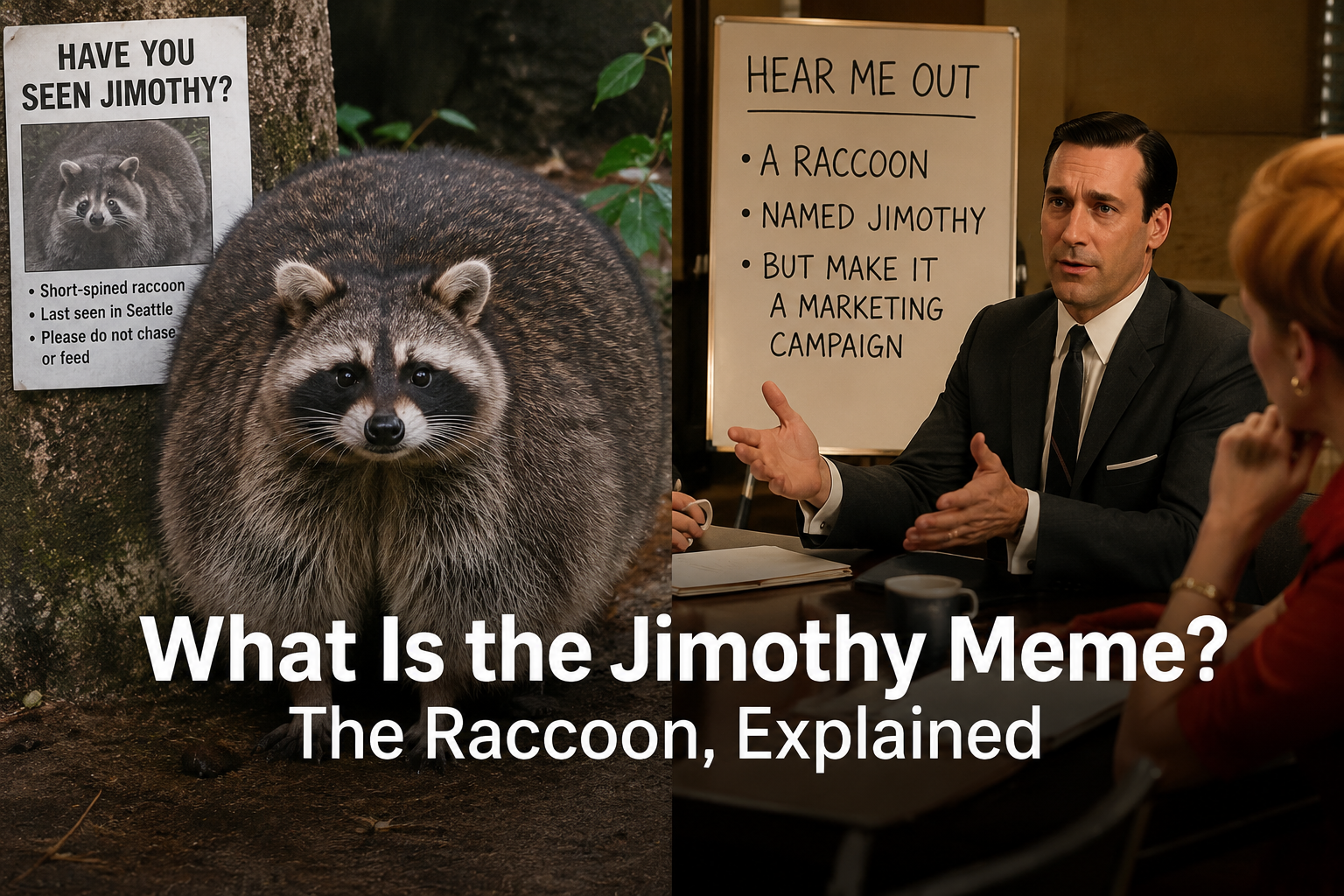
Jimothy is a short-spined raccoon from Seattle who became the internet's favorite animal in July 2026 — and the seed of a marketing meme that accidentally explains the entire industry. Here's the full story of both.
If you've seen the name "Jimothy" attached to a round raccoon, or to a Mad Men screenshot with a social media manager saying "hear me out," and you're wondering what any of it means — you're in the right place. There are actually two Jimothy stories tangled together here: the animal, and the marketing joke he inspired. This covers both.
Who Is Jimothy the Raccoon?
Jimothy is a real, wild raccoon living in Seattle. He lives in the Ballard neighborhood on the city's northwest side, and residents there sometimes catch him wandering through yards and alleys looking for food. Meme
What makes him special is his shape. Jimothy has short spine syndrome — a rare deformity that happens when an animal's vertebrae are fused or compressed during development — which makes him appear particularly round and short compared to a normal raccoon. His truncated body, near-absent neck, and hunched posture read as almost cartoonish, and that shape is a big part of why sighting videos of him took off online. Know Your MemeMeme
He wasn't new to the neighborhood, either. Residents of Ballard claimed Jimothy had lived in the area for years, and one user posted footage from June 2025 of what appeared to be a very young Jimothy alongside his mother and two sibling raccoons. He'd just never gone viral yet. Wikipedia
Where Did the Name Come From?
This is the part people love, because there's no elaborate origin — it's pure whimsy.
On July 14th, 2026, Instagram user Kiana Hall posted a video of the raccoon running through her yard. Her caption read: "For our 13th anniversary, my partner and I were graced with the presence of Jimothy the raccoon with short spine syndrome. Praise Jimothy!!" The video gained over 398,000 likes in six days. Know Your Meme
Why "Jimothy"? Hall gave the only explanation the internet needed. "He just looked like a Jimothy to me," she told The New York Times. She'd initially thought it was a cat — "I love cats, so I decided to take a video" — before realizing what she was actually filming near the Ballard Goodwill. The HillBored Panda
That's it. A raccoon looked like a Jimothy, so he became Jimothy. If it looks like a Jimothy and walks like a Jimothy, it's probably a Jimothy.
How Jimothy Took Over the Internet
Once the first video hit, the pile-on was fast and enormous.
On July 17th, an X account posted another sighting video that garnered over 25,000 likes and 1,600 reposts in three days, while another user's clip of Jimothy as a baby pulled in over 162,000 likes. Artists began creating fan art — one widely shared illustration portrayed Jimothy as a police sketch — and a viral post compared a comically short truck at an airport to the raccoon with the caption "Everything reminds me of him." Know Your MemeYahoo!
The institutional embrace is where it tipped from viral animal to full phenomenon. Blizzard Entertainment posted a tribute rendering him in the style of World of Warcraft. Jagex made a similar tribute in the style of Old School RuneScape. D&D Beyond released a Dungeons & Dragons stat block of Jimothy for use in the tabletop game, and modders created add-ons putting him into Skyrim and Stardew Valley. The Seattle Times called him a "scrappy hometown hero." WikipediaWikipedia
A quick, responsible note the local authorities kept making: Public Health – Seattle & King County urged people not to travel to find him, reminding everyone that all wildlife needs distance from humans and that raccoons can carry bacteria and roundworms and, like other wild animals, can bite. The Washington Department of Fish and Wildlife similarly urged people not to approach him. Admire Jimothy from the safety of your phone. The HillWikipedia
The Second Jimothy: The Marketing Meme
Here's where it branches. Once "Jimothy" was firmly lodged in the internet's brain as the absurdly specific, weirdly beloved animal, marketers grabbed him for a joke that had nothing to do with raccoons and everything to do with their jobs.
The format goes like this:
them: our social content should tell our brand story, include key messages, and increase sales
social media managers: hear me out
Below it: Don Draper from Mad Men, mid-pitch, arms spread. Beside him an easel holding a presentation board that reads, in huge confident letters, JIMOTHY — with a photo of the raccoon underneath.
The joke is a collision. The setup is corporate abstraction — brand story, key messages, increase sales — the kind of brief that sounds like a requirement but can't actually be executed. The punchline is the opposite: maximally specific, gloriously dumb, a raccoon named Jimothy. And the social media manager delivering it says "hear me out," conceding it sounds insane while insisting it's correct.
Why the Marketing Version Actually Lands
The reason this particular meme spread through marketing circles instead of dying as a one-off is that the punchline is right, and everyone in the industry knows it.
The Jimothy post would outperform the brand-values post. It would get more reach, more engagement, and more actual memory than a carefully-approved statement about company mission — and every social media manager staring at their analytics knows this in their bones. The humor isn't absurdity. It's recognition: the specific laugh of someone saying the quiet part out loud.
There's a real framework underneath, too. Marketing effectiveness researchers Les Binet and Peter Field spent years analyzing 996 campaigns and found that brands perform best splitting spend roughly 60% toward long-term brand building and 40% toward short-term sales activation — because brand building expands future demand by creating memory structures and associations, while activation converts existing demand into immediate sales. Both are necessary, but they work through different mechanisms on different timescales. Deep MarketingSubverse
In those terms, the raccoon is brand building. Distinctive, memorable, attention-earning — doing legitimate work, just not the this-quarter-pipeline work the executive asked to see. The executive isn't wrong to want sales; the social media manager isn't wrong to propose a raccoon. Neither has named the framework they're both standing inside. That's the actual joke, and we broke it down in full in our piece on why the Jimothy marketing meme is so accurate.
Frequently Asked Questions
What is the Jimothy meme?
Two connected things. First, Jimothy is a real raccoon with short spine syndrome from Seattle's Ballard neighborhood who went viral in July 2026 because of his unusually round, squat shape. Second, a marketing meme built on his fame: a Mad Men image where a social media manager pitches "JIMOTHY" (the raccoon) in response to an executive asking for content that tells the brand story, stays on message, and drives sales all at once.
Who named Jimothy the raccoon?
Seattle resident Kiana Hall, who filmed him and posted the video that went viral. When asked why she chose the name, she said, "He just looked like a Jimothy to me." The Hill
Why does Jimothy look like that?
He has short spine syndrome, a rare condition where the vertebrae are fused or compressed during development, giving him a round, foreshortened body. Despite his appearance, Jimothy appears healthy for his species with no obvious issues with mobility or pain, though experts have noted the shape could make climbing to escape predators harder. Know Your MemeWikipedia
Is Jimothy okay? Can I go see him?
He appears healthy and is living his life in Seattle. But officials have repeatedly asked people not to travel to find or approach him — health authorities warn that wild raccoons can carry bacteria and roundworms and can bite, and wildlife officials say he's doing fine without human intervention. Enjoy the memes; leave the raccoon alone. The Hill
What does the marketing version of the meme mean?
It captures the gap between what executives ask marketing to do — build the brand, maintain messaging, and drive sales simultaneously — and what actually performs on social media, which is distinctive, attention-grabbing content. The "hear me out" framing acknowledges that the effective option (the raccoon) sounds unserious but works, while the "serious" corporate brief tends to get ignored.
Is posting a raccoon actually good marketing?
On attention channels like Instagram, distinctiveness genuinely does outperform polish — so in a sense, yes. But it only works inside a system where something else captures the demand that attention creates. Attention with no conversion path attached is just entertainment. We wrote about how to balance the two in our breakdown of the marketing meme.
From Meme to Method
The Jimothy meme is funny because it's true: attention-grabbing content beats corporate throat-clearing, and everyone in marketing knows it. But attention is only half the equation. The brands that actually grow pair the reach that gets them noticed with the search and conversion infrastructure that turns that attention into pipeline.
If your content is being asked to do everything at once, we build the version where each piece has one job and they're measured on the clocks they actually run on.
Thirty minutes, no pitch, clear next steps either way.
Sources
Who is Jimothy, the short-spined raccoon taking over social media — The Hill
Who Is 'Jimothy' And Why Is He Everywhere Online? — Yahoo/Know Your Meme
23 Memes That Capture the Obsession With Jimothy — Bored Panda
Jimothy The Raccoon: Seattle's Viral Short-Spine Raccoon — Meme.com
The 60/40 Rule: Binet & Field on Brand Building vs Activation — Subverse