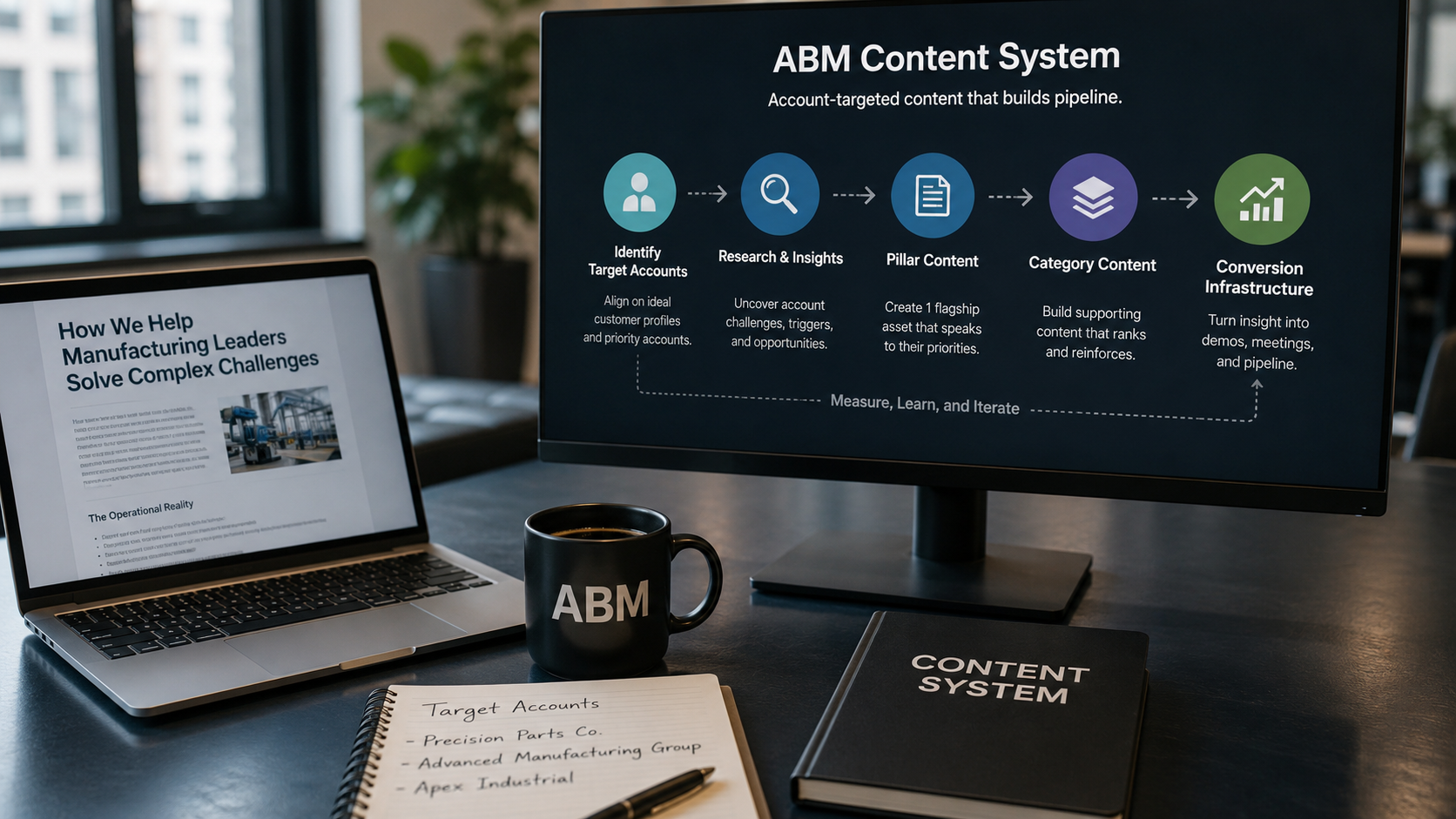
Most B2B companies are running one of two broken motions: content that ranks for nothing, or outbound that buyers actively resent. Ritner Digital builds the thing in between — an account-targeted publishing system that produces pipeline instead of impressions.
There's a specific failure pattern we see on nearly every discovery call.
A company has a blog. It publishes maybe once a month, sometimes less. The posts are competent, generic, and invisible — written for a persona that doesn't exist, targeting keywords nobody buys on. Meanwhile the sales team runs cold sequences into an audience that has learned to ignore them.
Both motions are underfunded, disconnected from each other, and producing nothing. As one outbound agency put it bluntly in their own analysis of this problem, the worst position to be in is half-committed to both — a blog updated monthly that ranks for nothing, and an outbound motion run from the founder's inbox between calls. Each channel has a minimum effective dose, and below it you're paying full tuition and getting no degree. LeadHaste
That's the honest diagnosis. Here's what we build instead.
What an ABM Content System Actually Is
Three components, and it only works when all three run together.
1. Account-level targeting. We don't write for "B2B marketing leaders." We identify the specific companies you want as clients, research the structural problem each faces, and write the definitive public resource on that problem. Named accounts, real research, specific theses.
2. A publishing cadence, not a campaign. Content compounds only if it accumulates. One brilliant post is a lottery ticket. Twenty-four connected pieces over a year is an asset base — one that keeps producing after the spend stops.
3. Conversion infrastructure underneath it. Traffic that has nowhere to go is a vanity metric. Every piece connects to a page designed to convert, tracked well enough to prove it did.
Most agencies sell one of these three. The gap between a content retainer and a content system is that a retainer delivers deliverables and a system delivers pipeline.
Why "System" Is the Operative Word
The data on cadence is unambiguous, and it's the reason we don't sell one-off posts.
Companies publishing 16 or more posts per month generate 3.5x more traffic and leads than those posting zero to four times. Blogs contribute to 434% more indexed pages. Long-form content of 2,000+ words generates 2x more leads and 77.2% more backlinks than shorter posts, and marketers who prioritize blogging are 13x more likely to report positive ROI. Revenue Memo
Budget allocation tells the same story. Content Marketing Institute data shows the highest-performing B2B companies dedicate 11–30% of total marketing budget to content, with a median around 18% — and companies investing at the high end (25–30%) generate roughly 3x more inbound leads than those investing below 10%. Meet Lea
Notice what these numbers describe. They're not measuring content quality. They're measuring commitment. The differentiator isn't whether you publish — it's whether you publish enough, consistently enough, for long enough that the asset base reaches critical mass.
This is why we structure engagements as content systems on a steady cadence rather than project work. Below the minimum effective dose, content spending is genuinely wasted. Above it, the returns compound in a way no paid channel can match.
The Economics Behind It
The financial case for content-led acquisition is well documented, and it's worth stating plainly because it's what justifies the patience the model requires.
Cost per lead. Inbound methods cost 62% less per lead than outbound. Practical benchmarks put inbound at roughly $45–90 per lead, outbound prospecting at $100–250, and paid channels at $75–400. LandbaseMeet Lea
Lead quality. Inbound produces a 14.6% close rate versus 1.7% for cold outbound, and 59% of marketers say inbound delivers higher-quality leads compared to just 16% for outbound. Landbase
Downstream survival. Tracked B2B funnel data shows MQL-to-SQL conversion ranging from 26% for PPC traffic up to 51% for SEO traffic — meaning organic leads are roughly twice as likely to survive sales qualification. A cheap paid lead that dies at qualification was never cheap. Serpsculpt
Durability. Unlike paid media, which stops producing the moment spend stops, content generates returns for years after publication. Digital Applied Team
And the influence you can't see on a dashboard: 55% of B2B buyers say thought leadership significantly influenced their purchasing decisions. Revenue Memo
The Architecture: Three Tiers of Content
Here's how we actually structure a program. Every piece we publish sits in one of three tiers, and the ratio matters as much as the content.
Tier 1 — Account-targeted pillars
The ABM layer. Deep, researched, 2,500–3,500-word analyses written for five to fifteen named accounts facing an identical structural problem.
Critically, we don't name the target account. Naming them turns analysis into a pitch, makes the piece unusable for everyone else in the category, and destroys its search value. Left unnamed, the same words read as objective industry work that happens to describe their situation with uncomfortable precision. The reaction we're engineering isn't "this agency is selling to us" — it's "how do they understand our business this well?"
The result is an asset that works four ways at once: it's sendable to the target accounts, it ranks for the category, it functions as sales enablement for years, and it builds the entity authority that determines whether AI models name you later.
Cadence: 1–2 per month.
Tier 2 — Category support
The pieces that capture the specific questions buyers ask on the way to a decision: specification questions, use-case guides, comparison pages, cost breakdowns, process explanations.
Individually these are low-volume. In aggregate they're the majority of qualified traffic, because they're where genuine expertise creates separation from competitors publishing surface-level content. They also feed Tier 1 — internal linking between them is what turns a pile of posts into a topical cluster search engines recognize as authority.
Cadence: 2–4 per month.
Tier 3 — Conversion assets
Service pages, comparison pages, ROI tools, and the connective tissue that turns a reader into a lead. Companies with 40 or more landing pages generate 12x more leads than those with five or fewer — more targeted destinations means more paths to conversion. Martal Group
This tier is where most content programs quietly fail. Publishing without it produces traffic reports and no pipeline. That's why conversion-focused copywriting and site structure sit inside the system rather than beside it.
Cadence: built early, refined continuously.
How We Run It
1. Account and problem research. We build the target list with you, then research each account's actual structural situation — their site, their positioning, their competitors, their reviews, their job postings. The output is a thesis specific enough to write 3,000 words about, not a pain point generic enough to fit anyone.
2. Query and gap mapping. What is the category actually searching for, what do competitors already own, and where is genuine unclaimed territory? This produces the Tier 2 roadmap.
3. Production. Researched, sourced, verifiable. Every claim linked. Not because it looks rigorous, but because long-form content earns 77.2% more backlinks and citation-worthy work is what earns links and AI mentions in the first place. Revenue Memo
4. Technical implementation. Schema markup, internal linking architecture, indexation, page performance. Content models can't parse doesn't get cited — see schema and structured data and technical SEO.
5. Amplification. Digital PR and earned link acquisition put the work in front of the publications your target accounts already read. Third-party validation is what converts a blog post into a consensus signal.
6. Measurement and iteration. Account-level engagement, category capture, assisted pipeline. Monthly reporting in the language your CFO budgets in, built on clean analytics.
What Compounds
Three things accumulate that a campaign never produces.
Search authority. Topical clusters outrank isolated posts. Each new piece strengthens the ones already published, which is why month twelve outperforms month six by more than double.
Entity authority. Language models select brands based on mention frequency across relevant sources, entity clarity, contextual relevance, and third-party validation. A consistent body of published expertise in a defined niche is the only mechanism that reliably moves those signals. We've documented the full framework in our guide to getting found in AI search and our entity SEO guide.
Sales leverage. Every Tier 1 piece becomes a reference asset your team uses in conversations for years. That's real value that never appears in a traffic report.
The Honest Timeline
We'd rather lose a deal than misrepresent this.
Inbound requires upfront SEO and content investment that takes 6 to 12 months to pay back. The pattern is consistent: near-zero pipeline for the first two or three quarters, then a falling cost per lead that eventually undercuts outbound, sometimes dramatically, in year two and beyond. LandbaseLeadHaste
Realistically: indexing and impressions in the first 60–90 days, early account engagement and initial leads in months three to six, and meaningful compounding from months six to twelve.
We publish our own numbers against that curve rather than asking you to take it on faith — including our first 90 days on a brand-new domain and monthly benchmark reports where we grade our own work, uncomfortable parts included.
If you need pipeline in 30 days, this isn't the right system. Run paid, and start this in parallel.
How We Measure It
Three metrics, reported monthly.
Account-level engagement. Are your named target accounts reading the work? This is the direct ABM signal and the one that matters first.
Category capture. Rankings, impressions, and AI citations for the problems you've claimed. This is the compounding half — it accrues whether or not any specific account converts.
Assisted pipeline. Which deals touched the content anywhere in the journey, not just last click. Content influences buying journeys but is rarely the last touch before conversion, which means its ROI is systematically under-measured when teams only count final-click attribution. Meet Lea
We also build a 12-month forecast translating projected clicks into expected leads, CAC, and payback period — because search should be a line item your finance team can plan around, not a hopeful expense.
Who This Is For
Good fit: B2B companies with a defined set of high-value target accounts, deal sizes that justify a 6–12 month build, genuine subject-matter expertise to draw on, and the patience to let an asset base accumulate. Manufacturers, professional services, SaaS, financial institutions, and specialized B2B categories where expertise is the differentiator.
Poor fit: Companies needing pipeline this quarter, businesses with no meaningful differentiation to document, or teams that want deliverables rather than outcomes. We'd rather say so on the first call than six months in.
Frequently Asked Questions
How is this different from a normal content marketing retainer?
A retainer produces deliverables — four posts a month, invoiced. A system produces pipeline, which requires targeting specific accounts, building conversion infrastructure, amplifying the work, and measuring against revenue rather than word count. The practical difference shows up in the brief: retainer content starts with a keyword, account-based content starts with a company and a problem.
How many accounts should we target?
Five to fifteen per Tier 1 piece. Benchmark data shows ABM lifts tier-1 engagement roughly 3.4x, but that collapses to 1.6x once lists exceed 200 accounts — list discipline is consistently the dominant driver of results, ahead of budget or headcount. If a piece describes 200 companies precisely, it isn't describing any of them precisely. Digital Applied Team
Does this replace our outbound program?
No — sequence them. Buyers avoid vendor contact until roughly 70% through their process, so content owns the long anonymous research phase and outbound owns the active-buying window. The failure mode isn't running outbound; it's running only outbound and being invisible during the phase where the decision gets made. 6sense
How much content does this actually require?
Our standard cadence is four to six pieces monthly across the three tiers. That's below the 16+ posts per month associated with 3.5x traffic gains, but weighted toward long-form, account-targeted work rather than volume. In 2026, depth outperforms frequency in B2B — the ceiling on thin content has dropped sharply. Revenue Memo
What does it cost?
It varies with scope, competitiveness, and target account count. For orientation, high-performing B2B companies allocate a median of 18% of marketing budget to content, and inbound leads typically land in the $45–90 range versus $100–250 for outbound. We'll model your specific numbers on the call rather than quote a package. Meet Lea
What if we don't have anyone internally to work with you?
That's normal and workable. We run the research, writing, technical implementation, and amplification. What we need from you is access to subject-matter expertise — an hour or two monthly with someone who actually knows the work. That expertise is the raw material; without it, content is generic and generic content doesn't rank or get cited anymore.
How do we know it's working before leads arrive?
Leading indicators appear well before pipeline: indexation, impression growth, keyword coverage expanding, target accounts appearing in engagement data, and AI citations beginning to surface. We report all of it monthly. If those indicators aren't moving by month three, something is wrong and we'll say so.
Let's Look at Your Accounts
Tell us which companies you're trying to win, and we'll show you what currently stands between you and them in search — who owns the queries they're asking, where the unclaimed territory sits, and what a realistic 12-month build looks like in clicks, leads, and pipeline.
Thirty minutes, no pitch, clear next steps either way.