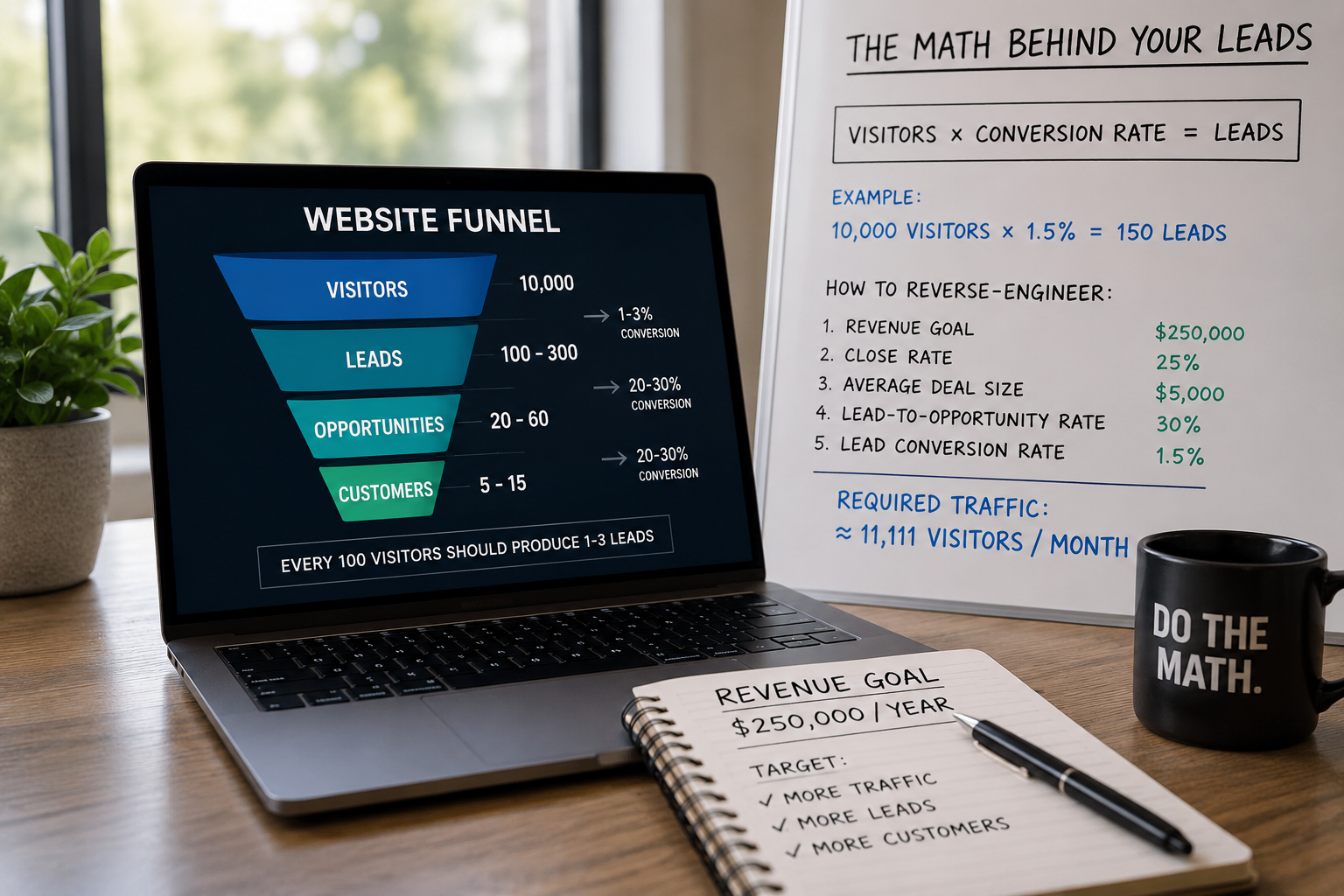
Short answer: for every 100 visitors, a typical B2B website produces one to three leads. Here's how to turn that rule of thumb into a real number for your business — and how to work backwards from a revenue goal to the traffic you actually need.
It's the most common question we get on a first call, and it's almost always asked the wrong way. "How many leads should our website get?" has no answer without three other numbers: how much traffic you have, what industry you're in, and what a customer is worth to you.
But there is a starting point, and it's simpler than most agencies let on.
The 100-Visitor Rule
Start here: out of every 100 people who visit a B2B website, roughly 1 to 3 become leads.
The average conversion rate across all industries sits at 2–3%, with B2B sectors typically performing at the lower end. Ruler Analytics' dataset of more than 100 million data points across 14 industries puts the cross-industry B2B median at 2.9% visitor-to-qualified-lead. Martal Groupprospeo
So the arithmetic is straightforward:
If you're getting 1,000 visitors a month and 4 leads, you're at 0.4% and something is broken. If you're getting 1,000 visitors and 25 leads, you're at 2.5% and your problem isn't conversion — it's traffic.
That distinction is worth more than any benchmark, because it tells you which of two completely different problems to spend money on.
Why That Range Is Probably Wrong for You
The 1–3% rule is a useful default and a terrible target, because industry variation is enormous.
Visitor-to-lead rates by industry run from 7.4% for legal services down to 1.1% for B2B SaaS — roughly a 6.7x gap. HVAC services convert at 3.1%, industrial IoT at 2.6%, manufacturing at 2.2%, IT and managed services at 1.5%, and software development at 1.1%. Cybersecurity sits around 1.0%. prospeoMartal Group
The driver isn't website quality. It's buyer intent at the moment of arrival.
Someone searching for a commercial HVAC contractor has a broken rooftop unit and a budget. They're ready to talk today. Someone reading a B2B SaaS blog post about workflow automation may be nine months from a purchase decision, or may be a competitor, or may be a student. Same website quality, entirely different physics.
The same pattern shows up inside a single sector: HR tech reaches 3–6% visitor-to-lead because buyers often arrive with strong demo intent, while cybersecurity averages 1–2% because buyers move through longer, risk-heavy evaluations with more stakeholders. SaaS Hero
So the first correction: benchmark against your industry, not against a global average. A 1.5% rate is a crisis for a law firm and a solid result for a managed services provider.
The Full Funnel Math: From 100 Visitors to Revenue
Leads aren't the goal. Revenue is. So let's run the whole chain.
Take 100 visitors and apply realistic B2B rates at each stage:
Step 1 — Visitors to leads. At a 2% conversion rate, 100 visitors → 2 leads.
Step 2 — Leads to sales-qualified. First Page Sage's tracked B2B funnel shows MQL-to-SQL ranging from 26% for PPC traffic to 51% for SEO traffic, averaging around 38% — and this is typically the biggest leak in the funnel. At 38%: 2 leads → 0.76 SQLs.Serpsculpt
Step 3 — Qualified to closed. SQL-to-close conversion averages 20–25% across B2B, with top performers exceeding 30%. At 25%: 0.76 → 0.19 customers.SaaS Hero
So:
100 visitors → 2 leads → 0.76 qualified → 0.19 customers
Flip it and you get the number that actually matters for planning:
You need roughly 526 visitors to produce one customer.
Now attach money. If your average deal is $25,000:
$25,000 ÷ 526 visitors = $47.53 in revenue per website visitor
That single figure changes how a finance team hears the conversation. You're no longer asking for budget to "improve SEO." You're pointing out that each additional monthly visitor is worth roughly $47 in eventual revenue, and asking what it costs to add a thousand of them.
Worth noting the sanity check on all of this: measured stage by stage, fewer than 4 in 100 leads typically become customers. If someone promises you a 30% lead-to-customer rate, they're either counting something else or selling something. Serpsculpt
Now Reverse It: Start From the Revenue Goal
This is the version worth building for your own business, because it converts a vague growth target into a specific traffic requirement.
Worked example — B2B services firm, $25K average contract
That's the whole model. A $500,000 goal requires about 1,500 monthly visitors and 29 leads a month at those rates.
Notice how modest that traffic number is. Most B2B companies badly overestimate the traffic they need and badly underestimate the conversion discipline required. 1,500 highly relevant monthly visitors will outperform 15,000 poorly targeted ones every time.
Worked example — high-intent local services, $8K average job
Different business, different physics, same method. High intent and shorter sales cycles mean far less traffic is required — which is exactly why local SEO delivers such disproportionate returns for service businesses.
Run this model with your own numbers before you set a traffic target. If you don't know your close rate or average deal value, that's the first thing to fix — not your website.
Four Reasons Your Real Number Looks Worse Than It Is
Before concluding your site is underperforming, check whether you're measuring it correctly. Most companies aren't.
You're not counting phone calls
Ruler's 2026 data shows 56% of legal conversions and 53% of professional-services conversions happen by phone. A high-call business that only tracks form fills is under-reporting its true conversion rate by roughly half. Serpsculpt
If you sell anything where people prefer to talk, and you're only counting form submissions, your dashboard is wrong by a factor of two. Call tracking isn't a nice-to-have in those categories — it's the difference between an accurate number and a fictional one.
You're averaging traffic sources with wildly different value
Unbounce data shows email traffic converting at 19.3% while paid search converts at 10.9%, and for mid-market B2B running targeted campaigns, expect 4–6% on that traffic while cold organic might convert at 1–2%. Grey Matter
A blended site-wide conversion rate mixes people who arrived on your homepage from a newsletter with people who landed on a blog post from a broad informational search. Those are not the same audience and shouldn't share a benchmark. Segment before you judge.
Source quality shows up downstream too. Website-generated leads convert at 31.3%, referrals at 24.7%, and webinars at 17.8%. And MQL-to-SQL runs from 26% for PPC up to 51% for SEO — meaning organic leads are roughly twice as likely to survive sales qualification as paid ones. A "cheap" paid lead that dies at qualification isn't cheap. SaaS HeroSerpsculpt
You're comparing your website to landing page data
Unbounce's benchmark report analyzing over 57 million conversions across 41,000 landing pages found a median conversion rate of 6.6%. Grey Matter
That number gets quoted constantly as a website benchmark, and it isn't one. A landing page is a single-purpose destination receiving pre-qualified traffic from a specific campaign. A website is a multi-purpose property receiving everything. Holding your site to landing page benchmarks will make a healthy site look broken.
Mobile is dragging your average down
Mobile converts at roughly half the rate of desktop — around 2.0% versus 4.1% — due to friction, smaller screens making trust signals less visible, and slower page loads. Greetnow
If your traffic is 65% mobile and your forms were designed on a desktop, you've capped your ceiling before any content decision. This is a technical SEO and site performance problem wearing a conversion problem's clothing.
Fixing measurement first is not a stalling tactic. It's the only way to know which lever to pull, which is why we start every engagement with clean analytics and tracking.
Which Multiplier to Pull First
Look back at the chain: traffic × conversion rate × qualification rate × close rate × deal value. Every one of those is a multiplier, and improving any one improves the whole result. But they're not equally easy to move.
Conversion rate is usually the cheapest win. Only 17% of marketers actively A/B test landing pages, and teams that test consistently see 37–49% average conversion gains. Companies with 40 or more landing pages generate 12x more leads than those with 5 or fewer, and companies running 10+ test variations see 86% better results than those running single tests. Going from 1.5% to 2.5% doesn't require more traffic, more budget, or more headcount — it requires more targeted pages and the discipline to test them. That's conversion-focused copywriting and site design doing real financial work. Martal Group
Speed to lead is nearly free and absurdly high-leverage. The MIT/InsideSales Lead Response Management Study found that contacting a web lead within 5 minutes rather than 30 makes you 21x more likely to qualify it and 100x more likely to make contact. That's not a marketing fix at all. It's an operations decision you could implement this week. Serpsculpt
Traffic is the slowest and most durable. Organic growth compounds over months, not days — we publish our own monthly Search Console data and our first 90-day results from a brand-new domain precisely so people can see the real shape of that curve rather than a sales projection. But it's the only multiplier that keeps paying after you stop spending, which is why a content system on a steady cadence is the foundation rather than the flourish.
Traffic quality beats traffic volume. A 0.8% conversion rate generating 50 enterprise opportunities worth $25M in pipeline dramatically outperforms a 3% rate generating 200 mid-market opportunities worth $10M. Never optimize the percentage at the expense of the pipeline. Grey Matter
Frequently Asked Questions
How many leads should a website get per month?
For a typical B2B site, expect 1 to 3 leads per 100 visitors — so roughly 10 to 30 leads per month at 1,000 monthly visitors. The cross-industry B2B median is 2.9% visitor-to-lead, but the realistic range by industry runs from about 1.1% for B2B SaaS to 7.4% for legal services. Multiply your monthly traffic by your industry's rate to get your baseline expectation. prospeo
What is a good website conversion rate?
The average across industries sits around 2–3%, with lead generation sites typically at 3–5% and high-intent service businesses reaching 8–15%. But the only benchmark that reliably matters is your own trend line. Beating your prior quarter is meaningful; beating a global average that blends legal services with cybersecurity is not. Framer Websites
How much traffic do I need to hit my revenue goal?
Work backwards through five steps: revenue goal ÷ average deal value = deals needed; deals ÷ close rate = qualified leads needed; qualified ÷ qualification rate = total leads needed; leads ÷ conversion rate = visitors needed. Using common B2B rates — 2% conversion, 38% qualification, 25% close — a $500,000 goal at a $25,000 deal size requires roughly 1,500 visitors and 29 leads per month.
How many visitors does it take to get one customer?
At standard B2B rates, roughly 500 to 550. The chain is 100 visitors → 2 leads → 0.76 qualified → 0.19 customers, which works out to about 526 visitors per closed deal. At a $25,000 average deal, that's approximately $47 of eventual revenue per visitor.
Why are we getting traffic but no leads?
Four common causes, in order of frequency. First, intent mismatch — your traffic is arriving on informational content with no path to a commercial page. Second, measurement gaps, particularly untracked phone calls in industries where over half of conversions happen by phone. Third, mobile friction, since mobile converts at roughly half the desktop rate. Fourth, too few conversion opportunities — companies with 40+ landing pages generate 12x more leads than those with 5 or fewer. Serpsculpt + 2
Should I focus on more traffic or better conversion?
Calculate both. If your conversion rate is below your industry benchmark, fix conversion first — it's faster, cheaper, and improves the return on every future traffic investment. If your rate is at or above benchmark, your constraint is traffic. Doubling a 3% conversion rate is very hard; doubling traffic to a site already converting at 3% is a known, repeatable process.
How long until a new website produces leads?
Early indexing and impression movement typically appear within 60–90 days, with meaningful lead volume building from there. Search visibility compounds, which means the curve is slow at first and steepens. Anyone promising significant lead flow in the first month is describing paid traffic, not organic growth.
Do leads from AI search convert differently?
Early data suggests they convert better, likely because a buyer who arrives via an AI-generated recommendation has already had their evaluation partly done for them. This is a fast-moving area worth tracking separately in your analytics rather than blending into general organic — see our guide to AI search optimization for how that channel behaves.
Get Your Actual Numbers
Every figure in this article is a benchmark. Benchmarks are useful for orientation and useless for planning.
Give us your domain and we'll build the real model: your current traffic and conversion rate, what your industry's ceiling looks like, a 12-month projection of organic clicks, and the leads and pipeline those clicks should produce at your close rate and deal size. Numbers your finance team can plan around, not a percentage from someone else's dataset.
Thirty minutes, no pitch, clear next steps either way.