Why Deleting Old Content Didn't Kill Your Google Impressions (And What That Actually Tells You)
You Built Something Real. Now You're Terrified to Touch It.
If you've spent years building a content library — case studies, service pages, blog posts, resource guides — and you're consistently pulling strong numbers in Google Search Console, you know the feeling.
Impressions are healthy. Clicks are coming in. Rankings feel earned. And somewhere along the way the whole thing starts to feel fragile, like one wrong move could send those numbers into a freefall you'd spend months trying to recover from.
So when it's time to clean house — to finally delete the case study from a client relationship that ended three years ago, the service page for an offering you no longer provide, the blog post that was relevant in 2021 and hasn't aged well — the anxiety is real. What if removing it breaks something? What if Google was using that page for something you couldn't see? What if impressions drop?
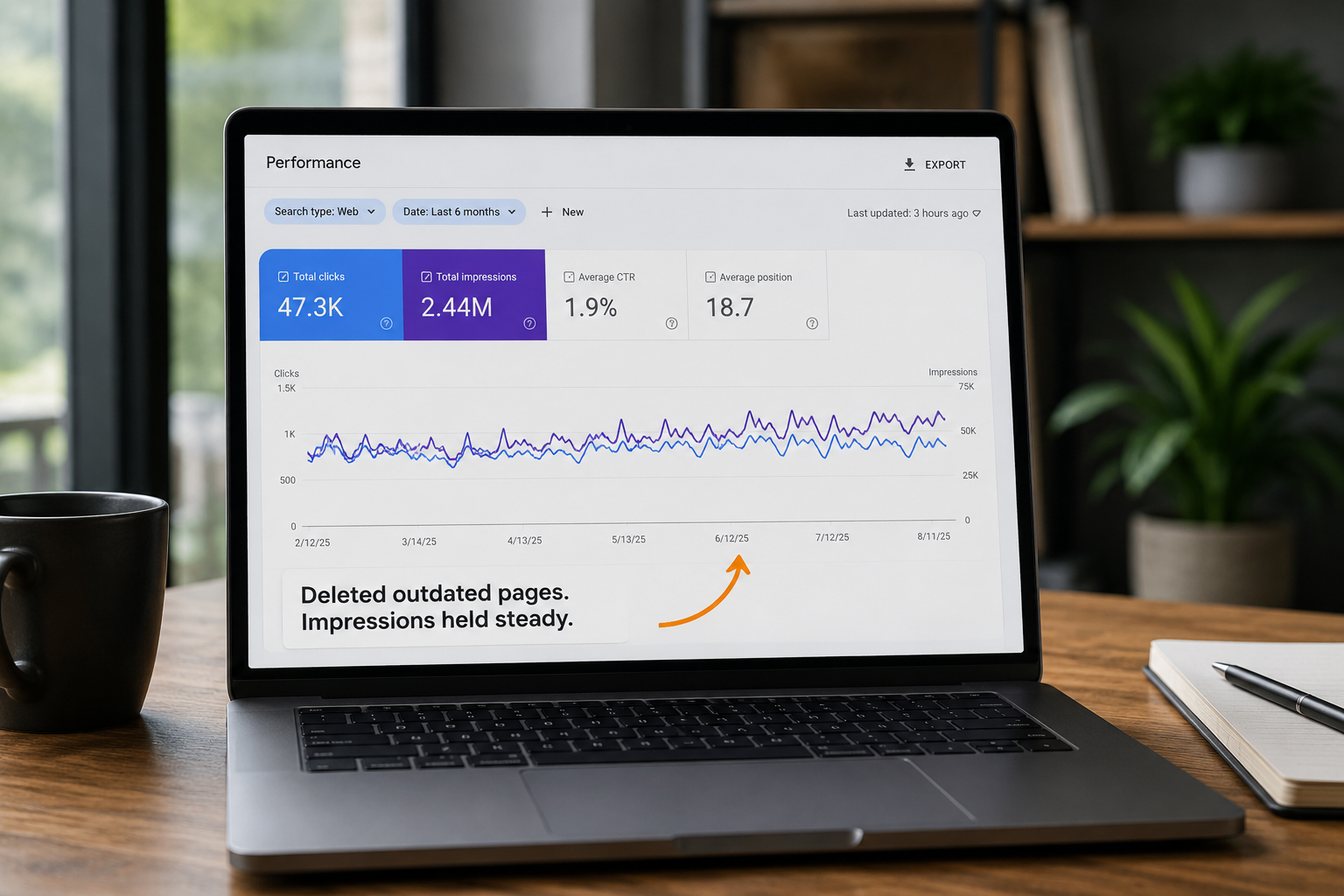
You hold your breath. You delete the pages. You check Search Console obsessively for the next two weeks.
And then impressions hold. Maybe they even tick up slightly.
If that's happened to you, you probably felt a mix of relief and confusion. The relief makes sense. The confusion is worth unpacking — because understanding why that happened will change how you think about your content library permanently.
First, Let's Acknowledge Why the Fear Is Rational
The anxiety around deleting content isn't irrational. It comes from a reasonable place.
You've watched impressions correlate with content volume over time. You added pages and impressions grew. The logical inference is that removing pages will cause impressions to shrink. It feels like a direct relationship: more content equals more surface area equals more visibility.
And for a while, especially in the earlier stages of building a content library, that relationship is real. Publishing more relevant, well-structured content does expand the number of queries you can show up for. The growth you saw was real and it was connected to what you built.
But at a certain point — once you've built a genuinely strong content library with real topical authority — the relationship between raw page count and search visibility becomes more complicated than a simple addition problem. And that's where most people's mental model stops being accurate.
What Google Is Actually Doing With Your Content
Google doesn't treat every page on your site as an independent asset with its own isolated contribution to your visibility. It treats your site as a whole — evaluating the overall quality, relevance, and authority of your content as a signal of how much to trust and surface your domain across a broad range of queries.
When you have a large content library, Google is continuously making judgments about the quality of your site's content ecosystem. Pages that are outdated, thin, irrelevant, or disconnected from your core topical focus don't just sit neutrally — they can dilute the overall signal your site sends about what it's genuinely authoritative on.
This is the concept SEOs often refer to as content quality signals at the domain level. It's not just about whether an individual page is good. It's about what the totality of your indexed content says about the depth and relevance of your expertise.
When you delete a handful of pages that no longer reflect what your business does — an old case study for a service you discontinued, a blog post targeting a keyword that's no longer relevant to your audience — you're not just removing content. You're tightening the signal. You're telling Google, more clearly, what your site is actually about and what it's genuinely authoritative on.
Why Impressions Hold After the Delete
Here's the mechanism that explains why impressions held when you expected them to drop.
The pages you deleted were almost certainly not the pages driving your meaningful impressions. In most well-developed content libraries, the vast majority of impressions and clicks concentrate in a relatively small percentage of pages — the ones with strong topical relevance, good internal linking, authoritative backlinks, and clear alignment with queries that have real search volume.
The old case study for the client who left in 2022? It was probably generating impressions for branded or highly specific queries that don't represent real traffic opportunity anyway. The service page for the offering you sunset? It may have been ranking for terms so peripheral to your core focus that removing it has no meaningful effect on the queries that actually drive value.
More importantly, by removing those pages you may have done something quietly beneficial: you reduced the amount of crawl budget Google was spending on content that wasn't contributing to your authority, and you strengthened the topical coherence of what remained. Google's understanding of what your site is genuinely an authority on gets cleaner and more concentrated when you remove the noise.
The result is that the pages actually doing the work — the ones earning your real impressions and clicks — continue doing that work uninterrupted. Sometimes they do it slightly better, because the overall quality signal of your domain improved when the weaker content was removed.
The Crawl Budget Piece Nobody Talks About Enough
Crawl budget is the amount of time and resources Googlebot allocates to crawling your site in a given period. For large content libraries, this matters more than most people realize.
When Google crawls your site, it makes ongoing decisions about how to allocate that crawl activity based on what it finds. Pages that are stale, thin, or returning poor quality signals can consume crawl budget that would be better spent on your most important, freshest content. This is particularly relevant for sites with hundreds or thousands of pages.
By removing pages that no longer serve a purpose, you're effectively streamlining where Googlebot spends its time on your site. Your most important pages get crawled more frequently, which means updates and improvements to those pages get picked up and reflected in search results faster. It's a quiet but meaningful efficiency gain that doesn't show up dramatically in any single metric but compounds over time.
What This Tells You About Content Quality vs. Content Volume
The experience of deleting outdated content and watching impressions hold is one of the clearest demonstrations of a principle that takes most content-focused teams years to fully internalize: beyond a certain threshold, content quality and topical coherence matter far more than raw content volume.
There's a phase in building a content library where volume is genuinely important. Publishing consistently, covering your topic space comprehensively, building internal link structures that establish topical depth — all of that matters enormously in the early and middle stages of a content strategy.
But there's a later phase where the marginal value of adding more content starts to diminish, and the value of maintaining the quality and coherence of what you already have becomes more important. Most teams get stuck in the volume mindset long past the point where it stopped being the primary lever.
The brands and agencies with the strongest, most durable search visibility aren't necessarily the ones with the most pages. They're the ones whose content libraries are the most relevant, the most current, and the most coherent in terms of what they're actually about.
The Right Way to Think About Content Auditing
If your impressions held after deleting a handful of outdated pages, that's not a reason to go on a deletion spree. It's a reason to build a more deliberate content auditing process that helps you make the right call on every page rather than guessing.
Not every underperforming page should be deleted. Some should be updated and consolidated. Some should be redirected to a more current, authoritative version of the same topic. Some should be left alone because they're generating impressions or backlinks that aren't visible in your primary dashboards. And some — the ones that are genuinely outdated, irrelevant, and disconnected from your current business — should be removed cleanly.
The framework for making those decisions looks something like this:
Delete when a page has no meaningful impressions, no valuable backlinks, is no longer relevant to your business, and there's no updated version worth redirecting to. Old case studies for discontinued services, blog posts targeting keywords you've moved away from, and pages for offerings you no longer provide typically fall into this category.
Update and consolidate when a page covers a topic you still care about but the content is outdated, thin, or outperformed by a newer page on the same topic. Two mediocre pages on the same subject are almost always weaker than one strong, comprehensive one.
Redirect when a page is being removed but has meaningful backlinks or is the target of internal links throughout your site. A proper 301 redirect preserves the link equity and avoids creating dead ends that hurt crawlability and user experience.
Leave alone when a page is quietly earning impressions, clicks, or backlinks even if it doesn't feel like a priority. Search Console data is your friend here — check actual performance before making assumptions.
The Broader Lesson: Strong Authority Absorbs Structural Changes
Here's the thing that the impressions-held experience is really telling you about your content library: you've built something with genuine authority. And genuine authority is more durable than most people think.
A site with real topical depth, a strong backlink profile, consistent publishing history, and content that has genuinely earned its rankings doesn't collapse because a handful of peripheral pages were removed. The core of what makes your site authoritative is distributed across the content that's actually doing the work — and that core remains intact when you clean up around the edges.
This is the reward for building deliberately over time. You've created a foundation strong enough to withstand the normal maintenance that any real content library requires. The fragility you feared isn't as real as it felt.
What is real: the risk of not auditing. Letting outdated, irrelevant content accumulate indefinitely — because deleting anything feels too scary — is a slow drag on the quality signal your site sends to Google. The brands that maintain strong visibility over years aren't the ones who never touch anything. They're the ones who tend their content library like something worth maintaining.
Not Sure What to Keep, Update, or Cut?
Content auditing done well is part data analysis, part strategy, and part knowing your business well enough to make the right call on pages that look ambiguous in a spreadsheet. If you've built up a substantial content library and you're not sure where to start — or you want a second set of eyes on what's earning its place and what's dragging on your authority — that's exactly the kind of work we do at Ritner Digital.
Your content library took years to build. It deserves a strategy for keeping it sharp.
Frequently Asked Questions
Will deleting old content hurt my Google rankings?
Not necessarily — and often the opposite is true. If the pages you're removing are outdated, irrelevant to your current business, or disconnected from your core topical focus, deleting them can actually strengthen the overall quality signal your site sends to Google. The pages that are genuinely earning your impressions and clicks tend to be unaffected by the removal of peripheral content that wasn't contributing meaningful authority in the first place. The key is making sure you're deleting the right pages — ones with no meaningful impressions, no valuable backlinks, and no relevance to what your business does today.
Why did my impressions stay the same after I deleted pages?
Because the pages you deleted almost certainly weren't the ones driving your meaningful visibility. In most well-developed content libraries, the vast majority of impressions and clicks concentrate in a relatively small percentage of pages — the ones with strong topical relevance, solid internal linking, and clear alignment with queries that have real search volume. Removing outdated or peripheral pages doesn't touch that core. In some cases it strengthens it, because the overall quality signal of your domain becomes more coherent when the noise is removed.
How do I know if a page should be deleted, updated, or redirected?
Start with the data. Pull the page's performance in Google Search Console and check impressions, clicks, and average position over the last 12 months. Then check whether it has any meaningful backlinks pointing to it. If a page has no impressions, no clicks, no backlinks, and no longer reflects what your business does, deletion is usually the right call. If it covers a topic you still care about but the content is outdated or thin, update and consolidate it into a stronger version. If it has backlinks or is heavily linked internally, redirect it with a 301 to the most relevant current page rather than leaving a dead end.
What is crawl budget and why does it matter for content auditing?
Crawl budget is the amount of time and resources Googlebot allocates to crawling your site in a given period. When your site has a large number of pages — especially ones that are stale, thin, or low quality — Googlebot can end up spending crawl time on content that isn't contributing to your authority, at the expense of your most important pages. By removing content that no longer serves a purpose, you streamline where that crawl activity goes. Your best pages get crawled more frequently, updates get picked up faster, and the overall efficiency of how Google indexes your site improves. For large content libraries this compounds meaningfully over time.
Is it ever a mistake to delete old content?
Yes — and the most common mistake is deleting pages without checking performance data first. A page that feels outdated or unimportant might be quietly earning impressions for a query you didn't know you ranked for, or sitting on a valuable backlink from an authoritative domain. Both of those have real SEO value that disappears if you delete without checking. Always pull Search Console data and run a backlink check before removing any page. If a page has either, a redirect or an update is almost always the better move than a clean delete.
Should I consolidate pages that cover similar topics?
In most cases, yes. Two mediocre pages targeting similar keywords are almost always weaker than one comprehensive, well-structured page covering the topic thoroughly. Google tends to reward depth and clarity of topical coverage, and having multiple thin or overlapping pages can create internal competition where your own content competes against itself for the same queries. Consolidating them into a single authoritative resource — and redirecting the old URL to the new one — typically results in stronger rankings than maintaining both separately.
How often should I audit my content library?
For most businesses with an active content program, a meaningful content audit once or twice a year is a reasonable cadence. That doesn't mean reviewing every page in exhaustive detail every six months — it means having a process for flagging pages that have gone stale, lost rankings, or are no longer relevant to your current business focus, and making deliberate decisions about what to do with them. For larger sites with hundreds of pages, a rolling audit process where a portion of the library gets reviewed each quarter tends to work better than trying to evaluate everything at once.
What's the difference between a page that's underperforming and one that should be deleted?
An underperforming page is one that covers a relevant topic but isn't earning the visibility it should — because the content is thin, outdated, poorly structured, or under-optimized. That page has potential and is worth updating. A page that should be deleted is one where the topic itself is no longer relevant to your business, the content has no realistic path to earning meaningful impressions, and there's no SEO value — backlinks, internal link equity, or existing rankings — worth preserving. The distinction matters because updating and deleting require completely different responses, and treating an underperformer like a lost cause means leaving recoverable rankings on the table.
Does deleting content affect domain authority?
Not directly — domain authority is primarily a function of the quality and quantity of backlinks pointing to your site, not your page count. However, removing pages that hold valuable backlinks without redirecting them properly can cause you to lose that link equity, which would have an indirect negative effect. As long as you're redirecting pages with meaningful backlinks and only cleanly deleting pages with no backlink value, your domain authority should be unaffected. In fact, improving the overall quality signal of your content library can have a positive downstream effect on how Google evaluates your site's authority over time.
How can Ritner Digital help with a content audit?
We work with businesses that have built up substantial content libraries and need a clear, data-driven framework for deciding what to keep, what to update, and what to cut. That means pulling the actual performance data, assessing backlink profiles, evaluating topical relevance against your current business focus, and building a prioritized action plan — not just a spreadsheet full of URLs with no clear direction. If your content library has grown to a point where it feels unwieldy or you're not sure what's earning its place, get in touch and let's take a look.