Why “Last Day to Register!” Doesn’t Work on Pebble Beach Executives

Let’s say you’re an event company trying to attract senior executives.
Your audience lives in or around Pebble Beach, works at the highest levels of their industry, and has a calendar booked six weeks out.
So you send an email blast:
“🚨 LAST DAY FOR EARLY BIRD PRICING 🚨 Buy now before it’s too late!”
It feels urgent.
It feels familiar.
And it quietly fails.
Pebble Beach Executives Don’t Buy on Urgency
Executives in Pebble Beach aren’t impulse buyers. They’re not scanning their inbox for discounts or countdown timers.
They’re filtering for:
Relevance
Credibility
Peer alignment
Urgency-based email marketing is designed to trigger fear of missing out. But executives don’t fear missing out on events—they fear wasting time.
If your message sounds like it could’ve been sent to 5,000 people at once, it’s already lost.
What Actually Moves Executive Audiences Here
In executive-heavy markets like Pebble Beach, social proof beats urgency every time.
What works instead:
“Private, invitation-only forum for senior leaders”
“Attended by executives from [recognized companies]”
“Trusted by partners, founders, and C-suite teams”
“Designed for leaders navigating [specific, high-level challenge]”
This is why Pebble Beach–based consulting firms, advisory groups, and professional services companies don’t rely on loud email blasts.
Their marketing is quieter—but far more effective.
Because it answers the only question executives care about:
“Who else like me is paying attention to this?”
Why Email Blasts Miss the Mark in Executive Markets
Traditional urgency-driven email marketing sends the wrong signals to executive audiences:
It feels generic – Executives assume it wasn’t written specifically for them.
It feels transactional – Senior leaders think in long-term outcomes, not quick wins.
It competes with higher-stakes priorities – And gets deprioritized instantly.
Executives don’t respond to pressure.
They respond to positioning.
Executive Marketing Requires a Different Playbook
Marketing to executives—especially in places like Pebble Beach—means:
Leading with credibility, not countdowns
Showing who your audience already is
Using channels where trust already exists (LinkedIn, referrals, thought leadership)
Making the offer feel exclusive, intentional, and aligned
When the message is right, executives don’t ask:
“Is there still early bird pricing?”
They ask:
“Is this something I should be part of?”
The Takeaway
If your marketing relies on urgency to get executives to act, you’re using a consumer tactic in an executive market.
And in Pebble Beach, that gap shows fast.
At Ritner Digital, we help brands and event companies design marketing that actually resonates with executive audiences—especially in high-credibility, relationship-driven markets.
If you’re marketing to executives and not getting traction, it might be time to change the strategy.
Reach out to Ritner Digital to build executive marketing that works.
FAQs
Why doesn’t urgency-based email marketing work for executives?
Executives don’t make decisions based on pressure tactics like countdown timers or “last chance” messaging. They’re trained to ignore noise and prioritize relevance, credibility, and long-term value. Urgency often signals low targeting—which causes executives to disengage, not act.
Do executives in Pebble Beach respond to email marketing at all?
Yes—but only when it’s highly targeted and positioned correctly. Executives are more likely to engage with emails that feel personal, relevant to their role, and supported by social proof (who else is involved, why it matters, and what level it’s designed for).
What kind of marketing works best for Pebble Beach executives?
Marketing that emphasizes:
Social proof and peer validation
Exclusivity and intentionality
Thought leadership over promotion
Clear alignment with executive-level challenges
This often includes LinkedIn strategy, selective outreach, credibility-driven content, and refined messaging—not mass email blasts.
Why is social proof so important in executive marketing?
Executives evaluate risk differently. Social proof reduces that risk by signaling credibility, trust, and relevance. Seeing that other respected leaders, firms, or organizations are already involved answers the most important question: “Is this worth my time?”
How is executive marketing different from traditional B2B marketing?
Traditional B2B marketing often focuses on volume, urgency, and lead capture. Executive marketing focuses on:
Precision over scale
Positioning over promotion
Reputation over response rates
It’s less about getting clicks and more about earning attention.
Can event companies successfully market to executives?
Absolutely—but only if the strategy matches the audience. Executive-focused events should be marketed as access-driven and peer-aligned, not discount-driven. The messaging should feel curated, not broadcasted.
What industries benefit most from executive-focused marketing in Pebble Beach?
Professional services, consulting firms, investment groups, private events, luxury brands, and B2B companies targeting senior leadership all benefit from executive-aligned marketing—especially in relationship-driven markets like Pebble Beach.
How can Ritner Digital help with executive marketing?
Ritner Digital helps brands reposition their messaging, channels, and strategy to align with executive psychology—so marketing feels credible, intentional, and effective instead of promotional or generic.
Related Reads
〰️
Related Reads 〰️
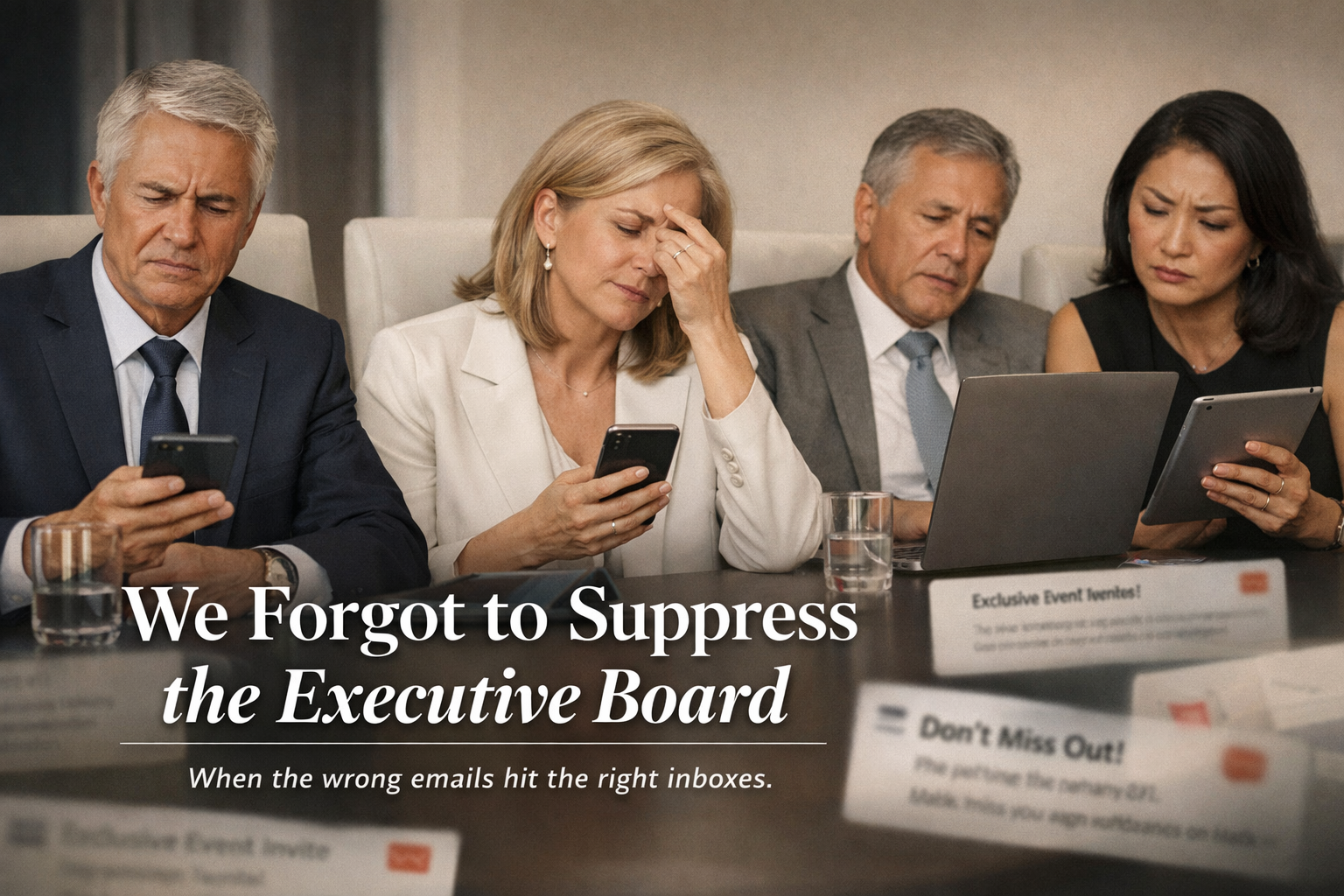
We Forgot to Suppress the Executive Board
You can build the perfect event campaign and still mess it up by forgetting one thing: executive suppression. When board members and senior stakeholders receive promotional emails meant for your marketable audience, it doesn’t just feel awkward—it signals a lack of judgment. This post breaks down why it happens, why it matters, and how smarter campaign architecture prevents it.

It’s Not Just Hiring a Marketing Agency — It’s Trusting Someone With Your Campaign Architecture
Most companies think they’re hiring an agency to run campaigns. In reality, they’re trusting someone with their campaign architecture—from data integrity and personalization to suppression logic and automation rules. Here’s why that distinction matters.

They Don’t Like Those AI Images
AI images are everywhere—but not everyone’s buying in. While some brands embrace sleek, generated visuals, others stick with old-school stock photos because they signal trust and authenticity. This post breaks down why visual preferences aren’t about trends—they’re about what your audience believes when they see your brand.