We Forgot to Suppress the Executive Board
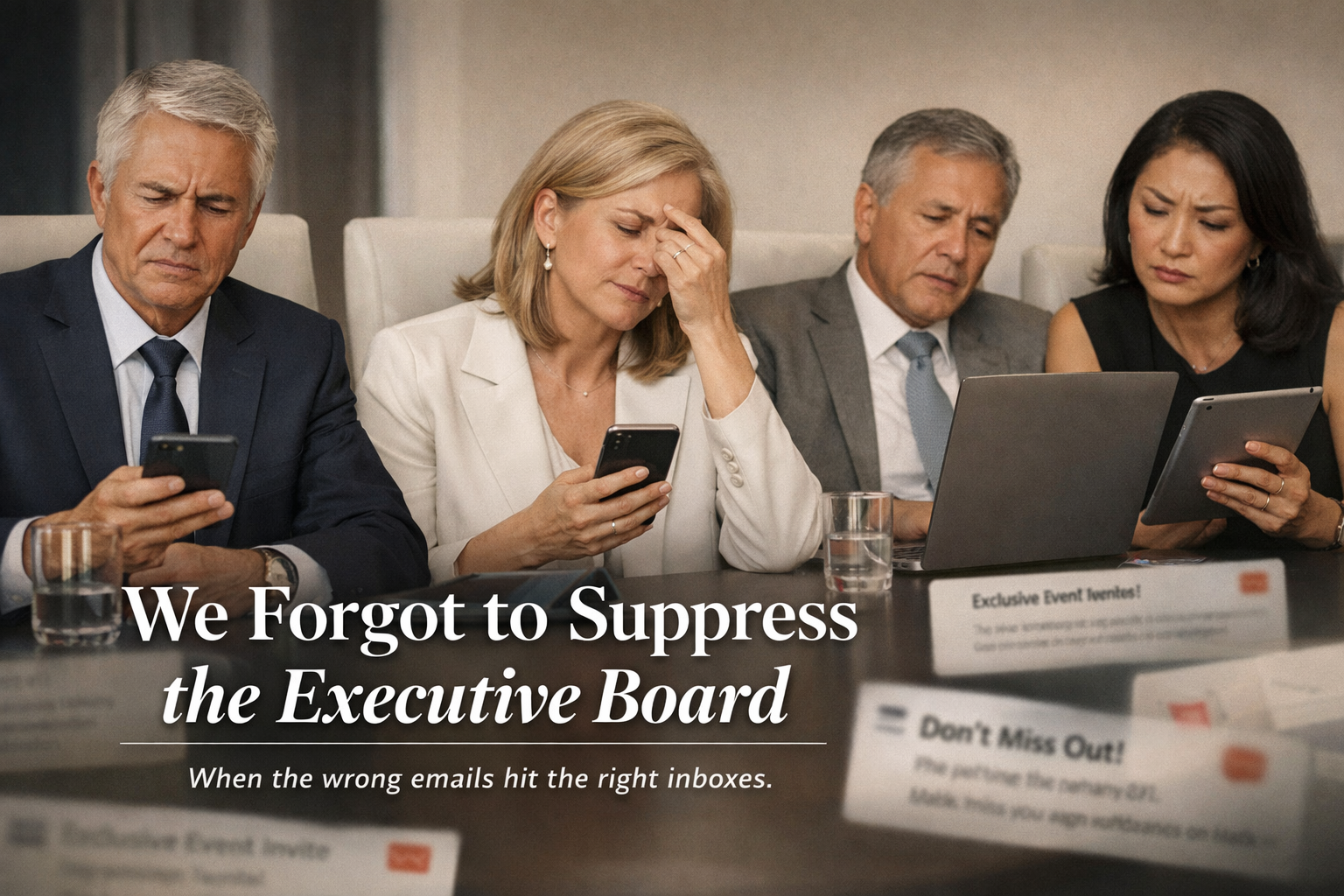
Nothing will humble a marketing team faster than realizing the CEO just got the same reminder email for the fifth time.
Not because they’re attending the event.
Not because they opted in.
But because someone forgot to suppress the executive board.
How This Usually Happens
You’re promoting an event. Webinar. Roundtable. Breakfast. Whatever.
You do the right things:
Email your marketable universe
Suppress people who already registered
Segment by role, industry, geography
Everything looks clean.
Except one thing.
No one thought about the executive board.
So now:
Board members are getting reminder emails
Advisors are seeing “Only 3 spots left!” copy
Someone senior wonders why marketing is emailing them at all
And then it happens.
Someone unsubscribes.
Why This Is Worse Than It Sounds
An unsubscribe from a random prospect? Fine.
An unsubscribe from your executive board? That’s not just awkward — it’s reputational.
Because now:
You look disorganized
You look spammy
You look like you don’t know who your audience actually is
And worse? It signals that no one is thinking defensively about trust.
Executives don’t complain loudly.
They quietly lose confidence.
The Root Problem Isn’t the Email
This isn’t an ESP issue.
It’s not a HubSpot problem.
It’s not “oops, human error.”
It’s a suppression logic problem.
Most marketing teams think in terms of:
“Who do we want to send this to?”
Very few think in terms of:
“Who should never receive this — no matter what?”
Executive boards, internal stakeholders, partners, investors, donors, faculty, advisors — these groups often live inside your CRM but outside your marketing logic.
Which is how they end up treated like leads.
The Use Case Most Teams Forget to Plan For
Event promotion is where this shows up fastest.
Typical setup:
Marketable universe → send
Registered attendees → suppress
What’s missing:
Executive board
Internal leadership
VIP stakeholders
People who should only hear about outcomes, not promotions
When those groups aren’t proactively segmented and excluded, you’re one campaign away from an uncomfortable conversation.
Or worse — silence.
How We Solve for This at Ritner Digital
This exact scenario is something we actively plan for.
Not after it happens.
Before the first email goes out.
We:
Build permanent suppression lists for executives and VIPs
Tag contacts by relationship, not just lifecycle stage
Pressure-test campaign logic with “who should never see this?”
Design event workflows that respect hierarchy, not just attendance
Because good marketing isn’t just about reach.
It’s about judgment.
Final Thought
Most marketing mistakes don’t look dramatic.
They look small. Routine. Easy to miss.
Until the wrong person gets the wrong email — and now your credibility is doing damage control.
If your campaigns assume everyone in your database is fair game, you’re not being aggressive.
You’re being careless.
Want campaigns that don’t embarrass you internally?
At Ritner Digital, we design campaign architecture that accounts for real-world relationships — not just lists and filters.
If you want event promotion, email strategy, and automation that protects trust as much as it drives results, let’s talk.
👉🏼 Work with Ritner Digital and build campaigns that know who not to email.
FAQs
Why shouldn’t executive board members receive event promotion emails?
Because they’re not your audience — they’re your stakeholders. Executives, board members, and advisors should receive outcomes, insights, or direct invites, not drip reminders and scarcity copy.
Isn’t suppressing executives overkill?
It only feels like overkill until one unsubscribes. Then it feels obvious. Suppression isn’t about hiding information — it’s about respecting relationship context.
What’s the difference between suppressing attendees and suppressing executives?
Attendee suppression is tactical. Executive suppression is reputational. One protects inbox fatigue; the other protects trust.
Should executive contacts be marked as non-marketable?
Usually, yes. Or at the very least, they should live in a permanently excluded segment that never receives promotional campaigns without manual approval.
What if an executive actually wants to attend the event?
Then they should be invited intentionally — through a direct, personalized message. Not a “Last chance to register!” email sent to thousands of people.
Where do teams usually mess this up?
During list building. Most teams focus on who to include and forget to define who should always be excluded, regardless of lifecycle stage or opt-in status.
Is this a HubSpot issue or a process issue?
It’s a process issue that shows up in HubSpot. The tools work — but only if your suppression logic reflects real-world relationships.
What other groups should usually be suppressed?
Common ones:
Executive board members
Internal leadership
Investors or donors
Partners and vendors
Faculty or advisors
If someone would raise an eyebrow at receiving a promo email, they belong on a suppression list.
How does Ritner Digital handle this differently?
We design campaign architecture with trust in mind. That means building permanent suppression logic, relationship-based tagging, and pressure-testing campaigns against “who should never receive this?”
What’s the worst-case scenario if you don’t fix this?
You don’t get yelled at. You just quietly lose confidence from the people who matter most — and that’s much harder to recover.
Related Reads
〰️
Related Reads 〰️

How to Check a List Against Your HubSpot Database (Before You Accidentally Email Your Own Contacts)
Sending to a new list? Before you hit send, make sure you’re not emailing people already in your HubSpot database. Here’s the simplest way to suppress existing contacts and keep your campaigns clean.

It’s Not Just Hiring a Marketing Agency — It’s Trusting Someone With Your Campaign Architecture
Most companies think they’re hiring an agency to run campaigns. In reality, they’re trusting someone with their campaign architecture—from data integrity and personalization to suppression logic and automation rules. Here’s why that distinction matters.

Lead Scoring: Who It’s Actually For (and Who Can Skip It)
Lead scoring sounds impressive, but it’s not always necessary. In this guide, we break down who lead scoring is really for, when inbound or outbound scoring makes sense, and why lead volume matters more than most businesses think.