Why "Near Me" Searches Work Differently in Affluent Suburbs Like Southlake — and What It Means for Your Reviews Strategy
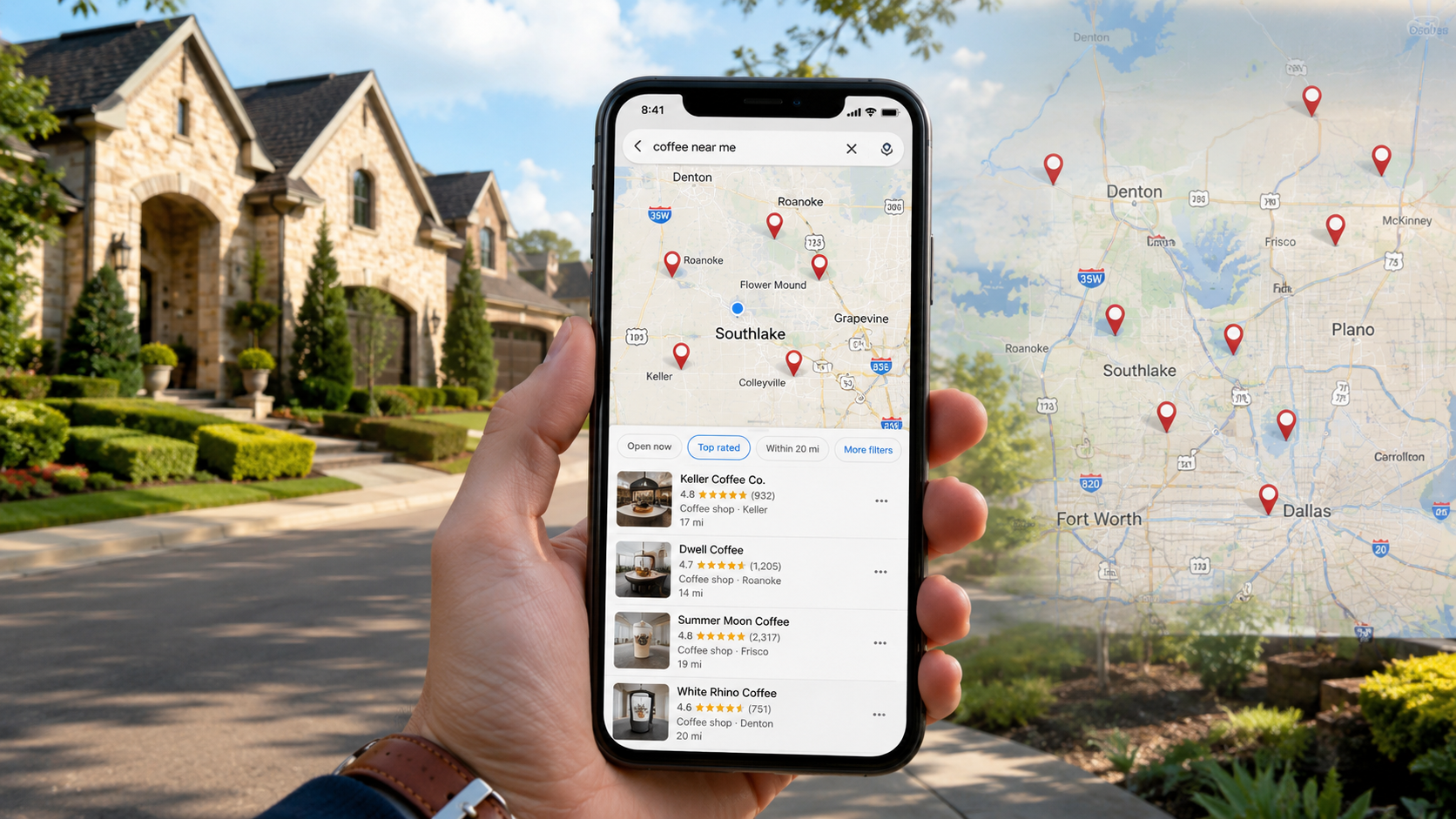
Here's a thought experiment. Stand in the middle of downtown Fort Worth and search "coffee near me." Google has forty options within a ten-minute walk, and proximity does most of the deciding — the closest handful of decent shops win, and being 400 feet closer than a competitor genuinely matters.
Now run the same search from a driveway in Southlake.
There is no ten-minute walk. Southlake spreads roughly 31,000 people across almost 22 square miles — about 1,426 people per square mile, which the census classifies as low density. Over 94% of the housing stock is detached single-family homes, most of it on generous lots, and nearly everyone drives — an average of two cars per household. "Near me" in Southlake doesn't mean "within walking distance." It means "within a comfortable drive" — a radius that casually sweeps in Grapevine, Colleyville, Keller, Westlake, and Trophy Club.
That one geographic fact quietly rewires how local search works. When everything is a drive, proximity stops being the tiebreaker — and something else has to break the tie. In affluent suburbs, that something is overwhelmingly reviews. And in 2026, with 45% of consumers now using AI tools to discover local businesses, the reviews that break the tie are increasingly being read not by a human scrolling a map, but by a machine deciding which one or two businesses to recommend at all.
This post walks through the mechanics — how Google actually ranks "near me" searches, why those mechanics behave differently in a place like Southlake than in a dense city, what the affluent-suburb customer does differently, and then the part you can act on: a reviews strategy built for this specific environment. We work in this corridor — our Southlake vs. Westlake vs. Trophy Club breakdown covers the entity side of the same territory — and the reviews playbook below is the other half of that equation.
First, the mechanics: what actually decides a "near me" search
Google is unusually transparent about this one. Its own documentation states that local results are based primarily on three factors: relevance, distance, and prominence — how well your listing matches the query, how far you are from the searcher, and how well-known and trusted your business appears to be.
The detail most business owners miss is in Google's own phrasing: the algorithm may decide that a business farther from the searcher is more likely to have what they're looking for, and rank it higher than a closer one. Distance is a signal, not a verdict. And prominence — the trust factor — is built largely from reviews, links, and mentions across the web. Reviews sit at the center of it: their quantity, their quality, their recency, and what they actually say.
So every local pack you've ever seen is the output of a three-way negotiation between those factors. The question that matters for your business is: in your specific market, which factor does the heavy lifting? And that's where geography changes everything.
Why the math flips in a low-density, high-income suburb
When everything is a drive, distance stops discriminating
In a dense urban core, distance is a powerful sorter because it meaningfully separates candidates — there might be thirty relevant businesses inside a one-mile circle, and the algorithm needs some way to cut the list. In Southlake, the same one-mile circle might contain three relevant businesses, or zero. To return a useful set of results, Google has to widen the radius until it captures enough candidates — and at Southlake's density, a useful radius crosses town lines almost immediately.
The practical consequence: in Southlake, you are never competing only against Southlake businesses. Every "med spa near me," "orthodontist near me," or "landscaper near me" fired from a 76092 driveway puts you in the ring with Grapevine, Colleyville, Keller, and the Trophy Club–Roanoke cluster. Once several businesses all fall within that widened radius, proximity stops deciding and relevance and trust signals take over — which is a formal way of saying: the reviews decide.
This cuts both ways, and that's the opportunity. A Grapevine business with a stronger review profile can win Southlake searches from outside the city limits. And a Southlake business with a dominant review profile can own "near me" queries across five towns. In dense markets, review strength buys you a few blocks of reach. In markets like this one, it buys you a corridor.
The search doesn't start where you think it does
There's a second geographic quirk. Southlake's commercial life clusters along a couple of corridors — Southlake Boulevard and the Town Square area, with SH 114 running the northern edge. But the searches don't originate there. They originate from neighborhoods, because that's where people are when they search: 29% of Southlake's workforce works from home, among the higher rates you'll find anywhere, and the rest are searching from the kitchen counter before or after a commute.
That means the "distance" Google measures is from residential streets to your storefront — and every business on the same commercial strip is functionally equidistant from most of the town. One more reason distance can't break the tie, and one more reason the profile — the reviews, the photos, the completeness — has to.
The affluent customer isn't shopping on proximity anyway
The algorithm is only half the story; the human is the other half. Southlake's median household income tops the Census Bureau's scale at $250,001 — more than double the DFW metro median — and that changes what a "near me" search is actually asking.
A price-sensitive searcher in a dense market is often asking "what's the closest acceptable option?" An affluent suburban searcher is usually asking "who's the best option within a drive I'm willing to make?" Convenience matters, but it's table stakes, not the decision. The decision is trust — and for high-consideration purchases (the med spa, the pool builder, the orthodontist, the wealth manager, the remodeler), the stakes are high enough that nobody defaults to nearest-first.
The review data backs this up as general behavior, amplified here: 97% of consumers read reviews when evaluating a local business, and the share who always read them jumped from 29% to 41% in a single year. 85% say positive reviews make them more likely to use a business, and consumers increasingly cross-reference an average of six review platforms before deciding. In a market where the average customer is educated, deliberate, and spending real money, assume the diligent end of every one of those distributions.
There's a social layer too, and anyone who's lived in a town like Southlake knows it: reputation here is a small-town phenomenon wearing a suburb's clothes. The Facebook mom groups, the Nextdoor threads, the school-parent networks — recommendations travel through them constantly, and your online reviews are the public, checkable version of that word of mouth. When someone gets your name from a neighbor, the very next thing they do is look you up. Your review profile either confirms the recommendation or kills it.
The AI layer compresses everything
Now add the newest force. BrightLocal's 2026 Local Consumer Review Survey recorded the sharpest shift in its sixteen-year history: AI tools leapt from 6% to 45% of local business discovery in one year, making AI the #3 discovery channel while Google's share fell from 83% to 71%. Among consumers aged 30 to 44 — which is to say, the prime Southlake household — 64% have asked an AI for a business recommendation, and 42% now trust AI recommendations as much as written reviews.
Here's why that matters specifically for reviews. A map pack shows a searcher three options plus a "more places" link; an AI answer typically names one to three businesses, full stop. And when ChatGPT or Gemini decides who to name, review signals — the rating, the volume, the recency, and crucially the text of what reviewers wrote — are among the strongest inputs it can retrieve. The AI is doing what your most diligent customer does: reading the reviews and summarizing a verdict. Except its verdict becomes the answer for thousands of searches, and there's no page two.
We've measured what this looks like on the ground. When we asked ChatGPT, Gemini, and Claude the same local buying question 30 times, the businesses that got named consistently were the ones whose trust signals — reviews prominent among them — were legible to a machine. In an affluent, spread-out suburb where distance was never going to decide anyway, reviews aren't just a ranking factor for AI answers. They're the closest thing to the whole ballgame.
The reviews strategy for this environment
Everything above converges on one conclusion: in a market like Southlake, your review profile is your proximity. It determines the radius you win. Here's how to build it deliberately — six practices, in priority order.
1. Build velocity, not a monument
A wall of five-star reviews from 2023 is a monument; search engines and customers both want a pulse. Recency expectations rose across the board in the 2026 survey data, consumers scan newest-first, and a steady flow of genuine reviews reads as more trustworthy than sudden spikes — to Google's spam systems and to a skeptical Southlake reader alike.
The fix is operational, not motivational: make the ask a step in your process, not a thing you remember occasionally. The request goes out at the moment of peak satisfaction — the project walkthrough, the follow-up visit, the delivery — by text, with a direct link, from the person who served them. One ask, one polite reminder, never more. A business that closes twenty customers a month and converts even a quarter of asks builds sixty fresh reviews a year — enough velocity to outrun almost any competitor in the corridor.
2. Engineer for review content, because machines read the words
This is the most underused lever in local search. Star ratings are a filter; the text is the ranking signal. Google's own relevance factor draws on user-generated content, including what reviews say — and AI engines lean on review text even harder, because text is what they're built to read.
You can't write your customers' reviews (and legally must not — more on that below), but you can shape what they mention simply by how you ask. "Would you mind sharing what we helped you with?" produces "Great service!" Asking "would you share a bit about your patio project and how it went?" produces "They rebuilt our pool deck and outdoor kitchen in Southlake and finished two weeks early." That second review contains a service keyword, a project type, and a town name — it's simultaneously social proof for humans, a relevance signal for Google, and retrievable evidence for an AI deciding who to recommend for "outdoor kitchen builder Southlake."
In a multi-town corridor, the geographic mentions matter doubly: reviews that name Southlake, Trophy Club, or Colleyville are teaching machines your true service area — the same disambiguation work we covered in the entity SEO guide, done for you by your customers.
3. Respond to everything, because the audience is the next customer
89% of consumers read businesses' responses to reviews, and 56% say a thoughtful response to a negative review improved their perception of the business. Read that second number again: a good response to a bad review is a trust asset.
This matters more in a small, socially connected market than almost anywhere else. In Southlake, the reviewer might be someone your other customers know personally — and everyone watching how you respond understands that. The formula for negatives: acknowledge specifically, never argue, take it offline, and let the response demonstrate the professionalism the review questioned. The formula for positives: brief, warm, specific, and occasionally reinforcing the useful details ("glad the Trophy Club install went smoothly"). Every response is also crawlable text on your most important listing.
4. Diversify beyond Google — the affluent customer already has
Google still leads, but its share of review reading dropped twelve points in a year while Apple Maps usage nearly doubled and the average consumer consults six platforms. The cross-referencing behavior — check Google, verify on a second source, maybe a third; consistency multiplies trust, contradiction evaporates it — is strongest among exactly the deliberate, high-stakes buyers this market is full of.
Priorities for a Southlake-corridor business: Google first, always. Apple Maps second — an affluent suburb is iPhone country, and CarPlay "near me" searches run through Apple. Then the platform your category lives on: Healthgrades for practices, Houzz for design-build, Zillow for agents, Avvo for attorneys, Yelp where it still carries weight. And don't ignore the unofficial platforms — when your name comes up in the local Facebook groups, that's a review surface too, and AI engines increasingly read community discussion as evidence.
5. Stay strictly legit — the FTC and the algorithms are both watching
The temptation to shortcut is real and the penalty structure has teeth. The FTC's Consumer Review Rule is now in active enforcement, banning fake reviews, purchased reviews, and review suppression — and consumer sentiment is even harsher, with 97% saying businesses caught faking reviews should be punished. Beyond the legal exposure: don't gate (asking only happy customers while diverting unhappy ones violates Google's policies), don't incentivize, don't bulk-solicit in bursts that trip spam filters. In a market this socially connected, getting caught gaming reviews isn't just an algorithmic penalty — it's a story that travels through every group chat in town. Slow and real wins here, the same way it wins everywhere: we've published the honest timeline before, and reviews follow it too.
6. Measure it like a channel, because it is one
If reviews are your proximity, track them like you'd track rankings. Monthly, at minimum: review count and average rating versus your three closest corridor competitors (not just Southlake — remember, the radius crosses town lines); review velocity (new reviews per month, yours and theirs); the keywords and towns appearing in your review text; and — the piece almost nobody checks — what AI engines say when asked for a recommendation in your category, in your town and each neighboring one. Run those prompts monthly and log the answers. That's the scoreboard the next 45% of your customers are looking at, and it's exactly the discipline we apply to our own numbers every month, dips included.
The short version
"Near me" was never really about distance — it's about the best answer within an acceptable radius. In dense markets the radius is small and proximity does the sorting. In Southlake — 22 square miles, low density, two cars per household, money that shops on trust rather than convenience — the radius is wide, five towns deep, and proximity sorts almost nothing. Reviews sort everything: they're the prominence signal that breaks Google's tie, the diligence layer your affluent customer actually reads, and the evidence AI engines weigh when they compress your whole market into a one-name answer.
Which means the businesses that treat reviews as an operating system — steady velocity, content-rich asks, responses to everything, presence beyond Google, strictly clean practices, measured monthly — aren't just polishing their reputation. They're expanding the physical territory they win. In this corridor, that's the whole game.
Frequently Asked Questions
Does proximity still matter at all for "near me" searches in Southlake?
Yes — it sets the candidate pool, it just rarely picks the winner. Google's algorithm uses distance as one signal among three, and in a low-density market it has to widen the radius until enough relevant businesses qualify. Once several candidates sit inside that radius — which in Southlake routinely spans Grapevine, Colleyville, Keller, Westlake, and Trophy Club — relevance and prominence decide the order. You can't move your building, but you can absolutely out-review the businesses that happen to sit closer to the searcher.
How many Google reviews does a Southlake business need to compete?
There's no magic number — the benchmark is your corridor competitors, not a universal threshold. Pull up the top three businesses that appear for your main "near me" query (including the ones in neighboring towns) and note their count, rating, and how recently their last ten reviews arrived. Your target is to match their rating, beat their recency, and close the count gap at a steady pace. Velocity and freshness beat raw totals: consumers scan newest reviews first, and expectations for recency rose sharply in the 2026 data.
Do reviews really affect whether ChatGPT recommends my business?
They're among the strongest signals it has. AI engines answering "who's the best [category] in Southlake" retrieve and read trust evidence from across the web — and review ratings, volume, and especially review text are the richest trust evidence that exists for a local business. With 45% of consumers now using AI tools for local discovery and 42% trusting AI recommendations as much as written reviews, your review profile is being read by machines as much as people. Our 30-prompt visibility test showed the pattern directly: the consistently-named businesses were the ones with machine-legible trust signals.
Can I ask customers to mention Southlake or my services in their review?
You can shape the prompt; you can't script the answer. Asking an open question like "would you share what project we did for you and how it went?" naturally produces reviews that mention services and locations — that's legitimate. Telling customers what to write, offering incentives for reviews, or soliciting only from happy customers crosses into territory that violates Google's policies and, since the FTC's Consumer Review Rule entered active enforcement, potentially federal rules. Ask better questions, and let real customers say real things.
Should I respond to positive reviews or just negative ones?
Both — because the real audience for every response is the next prospect reading it, not the reviewer. 89% of consumers read owner responses, and a thoughtful reply to a negative review improves perception for 56% of readers. Keep positive-review responses short and specific; treat negative ones as a public demonstration of how you handle problems. In a socially tight market like Southlake, that public demonstration travels.
My business is in Grapevine but I want Southlake customers. Can reviews get me there?
This is exactly the environment where they can. Because Southlake's "near me" radius crosses town lines by necessity, a Grapevine or Colleyville business with superior prominence signals routinely appears in — and wins — Southlake searches. Reviews that mention serving Southlake customers, service-area settings that include Southlake, and Southlake-specific content on your site all reinforce the same claim. The entity side of that play — making your service area unmistakable to machines — is covered in our Southlake–Westlake–Trophy Club disambiguation guide.
How long before a better reviews strategy shows up in rankings and AI answers?
Reviews are one of the faster-moving signals in local search, but "faster" still means months for the full effect. Individual reviews are crawled within days and can influence map-pack behavior within weeks; the compounding effects — velocity trends, text-content relevance, AI engines updating who they name — build over one to two quarters of consistent execution. Anyone promising overnight movement is selling something; here's the honest timeline we give every client.
Want to know the radius you're actually winning?
The free visibility check answers it directly: we test what Google and the AI engines return for your category across Southlake and every neighboring town, compare your review profile against the competitors actually beating you (wherever they're located), and send a plain-English read on what we'd fix first. Real reply from the founder, within one business day, no pitch deck.
Get your free visibility check →
Sources: Google Business Profile Help — How to improve your local ranking · BrightLocal — Local Consumer Review Survey 2026 · BrightLocal — Google's Local Algorithm and Ranking Factors · Digital Applied — Online Review Statistics 2026 · GBPPromote — LCRS 2026 Key Stats · TaylorScher SEO — Local SEO Statistics · Jasmine Directory — Review Behaviors and Directory Trends · CCC — LCRS 2026 Insights · GMB Management USA — Local Ranking Factors Explained · Search Engine Journal — Relevance, Distance & Prominence · Census Reporter — Southlake, TX · Data USA — Southlake, TX · Point2Homes — Southlake Demographics