Southlake vs. Westlake vs. Trophy Club: How AI Engines Confuse Similar-Sounding Texas Towns — and How to Make Sure You're the One It Means
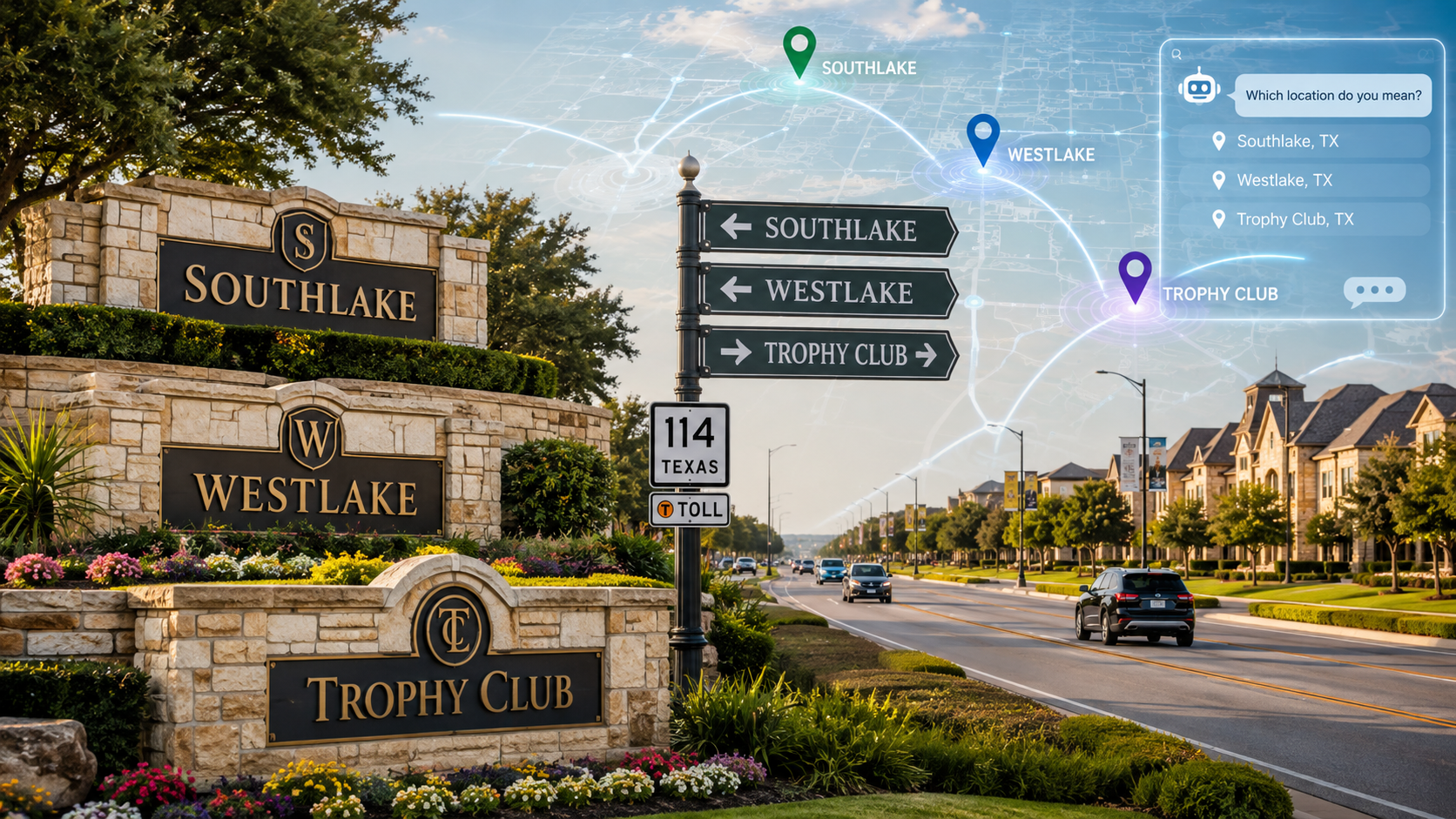
Ask ChatGPT to recommend "a good med spa in Westlake" and watch what happens.
Sometimes you get Westlake, Texas — the tiny Tarrant County town where Charles Schwab and Fidelity keep their campuses. Sometimes you get Westlake, Ohio. Sometimes Westlake Village, California. And sometimes — this is the fun one — you get the Westlake area of Austin, three and a half hours south, because when Austinites say "Westlake" they mean the hills around West Lake Hills, and there's twenty years of internet content backing that usage up.
Now ask about Southlake, and the model has to decide whether you mean Southlake, Texas, or whether you fat-fingered "South Lake Tahoe." Ask about Trophy Club and it usually gets the town right — there's only one Trophy Club in America — but then it starts pulling in businesses from Roanoke and Keller, because they all share a ZIP code and the model can't always tell where one town ends and the next begins.
This isn't a hypothetical problem. We run AI visibility tests for a living — asking ChatGPT, Gemini, and Claude the same local question dozens of times and logging every answer. When we ran that test for a truck dealership, the pattern was unmistakable: the business dominated its hometown queries and vanished the moment the geography got fuzzy. In the Southlake–Westlake–Trophy Club triangle, the geography is always fuzzy. Three affluent towns, minutes apart on the same highway corridor, two of them sharing names with a dozen other American places, all three tangled together in a ZIP code map that doesn't respect town lines.
If you run a business in any of these three towns, this post is for you. We'll cover what's actually true about each town (because the models get the basics wrong more often than you'd think), why AI engines confuse them at a mechanical level, what that confusion costs you, and — the part you can act on — how to build the entity signals that make sure when someone asks an AI about your town, you're the answer it gives.
First, the ground truth: three towns the models keep blending
Before we talk about how AI engines mangle these towns, it helps to have the real numbers in front of us — partly because they matter for local marketing, and partly because these facts are exactly the kind of thing an AI engine will state confidently and incorrectly.
Southlake: the big one
Southlake is the anchor of the three. Roughly 31,000 residents across about 22 square miles in Tarrant County, with a median household income that the Census Bureau literally can't measure precisely — it reports as $250,001, the top of the survey's scale, more than double the Dallas–Fort Worth metro median. Median home values crossed the $1 million mark, the homeownership rate sits near 95%, and the poverty rate is under 2%.
Southlake has the retail gravity of the trio: Town Square is a regional destination, Carroll ISD's Dragons are one of the most recognizable high school brands in Texas, and the town's ZIP code — 76092 — is essentially coterminous with the city itself. That last detail matters more than it sounds, and we'll come back to it.
Westlake: tiny town, Fortune 500 address
Westlake is the strangest municipality in North Texas, and possibly in the state. The resident population is a little more than 2,000 people — it was just 992 at the 2010 census. But its daytime population is enormous relative to that, because Westlake is home to Charles Schwab's corporate headquarters (a campus built for over 6,000 workers), Fidelity Investments' 300-acre campus with over 5,000 employees, Deloitte University's 750,000-square-foot training facility, and the Solana business park with dozens of companies.
So when Schwab lists its headquarters as 3000 Schwab Way, Westlake, TX 76262, a town of two thousand residents ends up generating a Fortune 500 company's worth of internet mentions. Household income data reflects the same distortion — reported average household income in Westlake runs to several hundred thousand dollars, among the highest of any town in America.
Here's the twist: Westlake, Texas barely registers in the training data compared to its name-twins. Westlake, Ohio has ~32,000 people. Westlake Village, California is a well-known LA suburb. Austin's "Westlake" has a nationally famous high school. A language model that sees the bare word "Westlake" is choosing among all of them.
Trophy Club: one name, no collisions — different problem
Trophy Club is the youngest of the three and has the best origin story in Texas suburbia: it was developed in the 1970s around a golf course designed by Ben Hogan — reportedly the only course he ever designed — and named for the plan to house Hogan's trophy collection at the country club. It was originally part of Westlake before incorporating in 1985, which is a fact worth savoring: the town most often confused with Westlake used to be Westlake. The town bills itself as Texas's first master-planned community, grew from 3,922 residents in 1990 to 13,688 at the 2020 census, and today straddles Denton and Tarrant counties along the SH 114 corridor.
Trophy Club's name is genuinely unique — there's no Trophy Club, Ohio to steal its queries. Its problem is the opposite one: boundary blur. Which brings us to the ZIP code.
The 76262 problem
Southlake gets its own ZIP. Westlake and Trophy Club don't. Both share 76262 with Roanoke, parts of Fort Worth, Keller, Northlake, and Flower Mound — a ZIP that covers 45 square miles, spans two counties, and holds about 45,000 peopleacross at least seven municipalities. The USPS's primary name for 76262 is Roanoke, with Westlake and Trophy Club listed as "acceptable alternatives."
Read that again from a machine's point of view. For decades, businesses and homes physically located in Westlake and Trophy Club have had "Roanoke, TX" printed on their mail, their invoices, their old directory listings, and — critically — their early web presence. Real estate listings for homes in Trophy Club neighborhoods still routinely display Roanoke addresses. Every one of those documents is a training example teaching AI models that these places are interchangeable.
They are not interchangeable. A Southlake household and a Roanoke household differ in median income by more than $150,000 a year. A med spa, a wealth manager, a custom home builder, or a luxury car dealer targeting these towns is targeting meaningfully different customers. But the paper trail the models learned from says otherwise.
Why AI engines actually confuse these towns
"The AI gets confused" is a description, not an explanation. If you want to fix the problem, it helps to know the three specific mechanisms behind it. We covered the general framework in our complete guide to entity SEO; here's how it plays out on the SH 114 corridor specifically.
Mechanism 1: Name collision and probability mass
Language models don't look up "Westlake" in a gazetteer. They predict what "Westlake" most plausibly means given everything around it. When the surrounding context is thin — "best financial advisor in Westlake" — the model leans on which Westlake dominates its training data. Westlake, Ohio and Westlake Village, California have decades of accumulated content, local news, reviews, and Wikipedia depth. Austin's Westlake has a famous football program and two Super Bowl-winning quarterbacks' worth of sports coverage. Westlake, Texas has… Schwab press releases and a couple thousand residents' worth of content.
Even adding "TX" doesn't fully solve it, because Austin's Westlake is also in Texas. A user typing "Westlake TX" might mean either, and the model knows it. The result is answer roulette: run the same prompt ten times and you'll get different Westlakes.
Southlake fares better — Southlake, Texas is the dominant "Southlake" in American web content — but it still bleeds into "South Lake" queries and occasionally gets treated as a generic descriptor rather than a place name.
Mechanism 2: Boundary blur in the training data
Even when the model picks the right region, it struggles with where one town stops. AI models learn geography from co-occurrence: Southlake appears near Grapevine, Colleyville, Keller, Westlake, and Trophy Club in thousands of documents — real estate roundups, school district pages, "best DFW suburbs" listicles, chamber of commerce directories. That's how the model learns these places are related. It's also why the model happily recommends a Keller business when you asked about Trophy Club: to the model, they're points in the same fuzzy neighborhood of meaning, not polygons with legal boundaries.
The 76262 mess pours gasoline on this. When Trophy Club businesses have Roanoke mailing addresses and Westlake's biggest employer generates content datelined three different ways, the co-occurrence signal gets even blurrier. The model isn't wrong to be confused — the source material is genuinely ambiguous.
Mechanism 3: Retrieval inherits the same ambiguity
Modern AI search doesn't rely purely on training data — ChatGPT, Perplexity, and Google's AI Overviews retrieve live web results and synthesize from them. That helps, but the retrieval step has its own version of the problem: the query "plumber Westlake TX" fetches a mixed bag of Austin-area and Tarrant County results, and the model synthesizes an answer from whatever came back. If your business's pages don't make your geography unmistakable to a machine skimming them in milliseconds, you lose the coin flip even when you were in the retrieved set.
This is also why the formats you publish in matter as much as the facts you publish. In our analysis of the content formats AI search actually cites, the pattern across client sites was consistent: clearly structured, specific, verifiable pages get pulled into answers; vague brochure pages don't.
What the confusion costs a local business
It's tempting to file this under "annoying but harmless." It isn't, for three reasons.
You lose queries you should own. When a Southlake resident asks ChatGPT for a landscape architect and the model serves up a Grapevine firm because the geography blurred, that's a lead that never knew you existed. There's no ranking report that shows you this loss. Nothing "dropped" — you were simply never in the answer. This is the invisible half of search we talk about constantly: your buyers ask AI first, and if it isn't naming you, you don't see the miss on any dashboard.
You get attributed to the wrong market. The reverse error hurts too. A Westlake wealth-management practice that gets lumped in with Roanoke pricing expectations, or a Trophy Club boutique that AI describes as being "in the Roanoke area," is being repositioned by a machine — downmarket, upmarket, or just elsewhere — without its consent. In towns where the entire brand is the address, that's not cosmetic.
Wrong answers compound. AI answers get quoted, screenshotted, pasted into emails, and republished. A model that confidently tells one user your business is in the wrong town has, in a small way, published that error — and AI-generated content increasingly feeds the next generation of training data and retrieval. Errors left uncorrected don't stay the same size. Neither, fortunately, do corrections: entity signals compound in your favor the same way, which is why we're calling 2026 the year of search-everywhere optimization.
How to make sure you're the one it means
Here's the actionable part. Everything below is standard practice in our client work, and none of it is exotic — it's disciplined entity SEO applied to a specific, local disambiguation problem. If you only do five things, do these.
1. Say your full geography, in text, on every page that matters
The single highest-leverage fix is embarrassingly simple: stop assuming context. Machines reading your site don't know which Westlake you mean unless you tell them, every time, in plain text.
Use the full construction — "Southlake, Texas," "Westlake, TX (Tarrant County)," "Trophy Club, Texas" — in your homepage H1 or opening paragraph, your title tags, your footer, and your about page. Not just once on a contact page.
Anchor yourself to unambiguous neighbors. "Serving Southlake, Trophy Club, Westlake, and the greater Northeast Tarrant County area along SH 114" is a sentence a model can't misread. "Serving Westlake and surrounding areas" is a sentence it absolutely can.
If you're in Westlake specifically, actively disambiguate: a line like "located in Westlake, Texas — the DFW-area town, not the Austin neighborhood" feels clunky to a human copywriter and reads like a gift to a retrieval system. You don't need it everywhere; you need it somewhere crawlable.
Name the landmarks that only exist in your town: Southlake Town Square, Carroll ISD, Solana, Westlake Academy, Trophy Club Country Club, Byron Nelson High School. Landmarks are disambiguation anchors — no model associates the Ben Hogan course with Ohio.
2. Fix your structured data so machines don't have to guess
Plain text helps models infer; schema markup lets them know. At minimum, your site should carry LocalBusiness structured data implemented per Google's local business documentation, with three fields treated as non-negotiable:
address — the full postal address with addressLocality set to your actual town, addressRegion as TX, and the correct postal code. Yes, even if that means addressLocality: "Westlake" with postal code 76262. The structured pairing is what teaches machines that this specific combination is a real, distinct place-business relationship.
areaServed — list the towns you serve by name, ideally with GeoNames or Wikipedia URLs as identifiers. This is where you tell machines explicitly: Southlake, Trophy Club, Westlake, Colleyville, Keller. Machine-readable, no inference required.
geo — latitude and longitude coordinates. Coordinates are the one signal that cannot be confused with Ohio. A model or retrieval system that sees 32.94, -97.15 knows exactly which Westlake it's dealing with.
While you're in the code: sameAs links connecting your site to your Google Business Profile, your chamber listing, your Facebook and LinkedIn pages, and any Wikipedia/Wikidata presence knit your entity together across the web. This is the core of what entity SEO does — we wrote the long version here — and it's precisely the machinery that resolves ambiguity in your favor.
3. Make your Google Business Profile the tiebreaker
AI engines lean heavily on Google's local data (and Bing's, for ChatGPT) when answering "near me" style questions. Your GBP is often the single source that settles which town you're in:
The address on your GBP, your website, and every directory must match exactly — same town name, same formatting. If your legal mailing address says Roanoke but you're in Trophy Club, this is where the 76262 curse bites hardest. Use the town name consistently everywhere you control, and clean up legacy listings that say otherwise.
Set your service area deliberately. If you're a Southlake business that genuinely serves Trophy Club and Westlake, list all three — that's how you show up when the AI blurs the boundary in your favor instead of against you.
Reviews that mention your town by name are underrated disambiguation gold. You can't script customers, but you can ask happy ones to mention where they found you. "Best facial in Southlake, worth the drive from Trophy Club" is a review that teaches machines two towns at once.
4. Publish content only a local could publish
Generic service pages don't disambiguate; hyper-specific local content does. The businesses that win AI citations in our client data publish pages that could not possibly be about any other town:
A guide to "what it actually costs to landscape a Southlake acre lot" is unmistakably about 76092.
A mortgage broker's explainer on "buying in Trophy Club vs. Roanoke: what the shared ZIP code means for your property taxes and schools" directly attacks the confusion — and becomes the page AI retrieves when users ask the confused question.
A Westlake-adjacent business writing "Westlake, TX vs. Westlake, Austin: which one are you actually searching for?" is doing the model's disambiguation work for it. Models cite pages that resolve ambiguity, because that's literally the job the model is trying to do.
This is the content-systems point we make everywhere: one-off posts don't build authority, but a deliberate cluster of locally-specific, citation-worthy pages does. And expect it to take months, not days — here's the honest timeline, because anyone promising faster is selling something.
5. Get vouched for by sources that are unambiguously local
Models trust you're in Southlake when Southlake says you are. Backlinks and citations from town-anchored sources — the local chamber, the town's own business directory, Community Impact and Star-Telegram coverage, Southlake Style, school booster pages, the Metroport Chamber for the 114 corridor — carry disambiguating weight far beyond their raw link value, because the linking domain itself is geographically unambiguous. When we audited a client's backlink profile, the geographic anchoring of who linked mattered as much as the count.
6. Test it — the same way we test everything
You cannot manage what you refuse to measure, and AI visibility is measurable in an afternoon. Open ChatGPT, Gemini, and Claude and run each of these prompts several times each (answers vary run to run — that variance is the data):
"Recommend a [your category] in [your town], Texas."
"Recommend a [your category] in [your town]" — no state. Watch which Westlake or which region it picks.
"Recommend a [your category] near [neighboring town]" — do you appear in the spillover?
"Where is [your business name] located?" — does it get your town right, or does it say Roanoke?
"What's the difference between Southlake, Westlake, and Trophy Club?" — see whose businesses get mentioned as examples.
Log every answer: who got named, which town the model assumed, what it got wrong. That log is your baseline, and re-running it quarterly tells you whether the entity work is landing. It's exactly the methodology behind our 30-prompt visibility test, and we publish our own numbers monthly — dips included — because measured claims are the only kind worth making.
The short version
Southlake, Westlake, and Trophy Club are three distinct towns that the internet — and therefore AI — has spent decades smearing together: colliding names, a seven-town ZIP code, a shared highway corridor, and a paper trail full of Roanoke addresses. The models aren't malicious; they're mirrors. They reflect ambiguity back at you until you give them something unambiguous to reflect instead.
The fix is not a trick. It's full geographic names in crawlable text, airtight structured data with coordinates and areaServed, a consistent Google Business Profile, content only a local could write, citations from unambiguously local sources, and a testing habit that tells you whether any of it is working. Do that, and the next time someone on the 114 corridor asks an AI who to hire, the machine doesn't have to guess which town — or which business — the answer lives in.
Frequently Asked Questions
Why does ChatGPT confuse Southlake, Westlake, and Trophy Club?
Three reasons stack on top of each other. First, name collision: "Westlake" alone could mean towns in Ohio, California, Louisiana, or the Austin area, so the model has to guess — and it guesses based on which Westlake dominates its training data. Second, boundary blur: the three towns co-occur in thousands of documents (real estate roundups, "best DFW suburbs" lists, school district pages), so models learn they're related without learning where one ends and the next begins. Third, the shared ZIP code: Westlake and Trophy Club both sit inside 76262, whose primary USPS name is Roanoke, so decades of addresses, listings, and directories have taught machines these towns are interchangeable when they aren't.
Is "Westlake, TX" in ChatGPT the DFW town or the Austin one?
It depends on the run — and that inconsistency is exactly the problem. Both are legitimately "Westlake" and both are in Texas: the Tarrant County town where Charles Schwab is headquartered, and the West Lake Hills area that Austinites universally call Westlake. Adding "TX" to a query doesn't resolve it, because both candidates match. If your business is in the DFW-area Westlake, your website needs to say so explicitly — county, neighboring towns, landmarks, and coordinates in your structured data — so retrieval systems don't have to flip a coin.
My business is in Trophy Club but my mailing address says Roanoke. Does that hurt my AI visibility?
Yes, if you leave it inconsistent. The USPS lists Roanoke as the default name for 76262, but "Trophy Club, TX 76262" is an accepted address — so use the town name consistently on your website, your Google Business Profile, your schema markup, and every directory listing you control. When some listings say Roanoke and others say Trophy Club, machines see two conflicting entities and either split your signals or file you under the wrong town. Pick the real one and enforce it everywhere.
What's the fastest fix if I can only do one thing?
Structured data with coordinates. Add LocalBusiness schema to your site with your full address, an areaServed list naming the towns you serve, and a geo field with latitude and longitude. Plain text can be misread; coordinates can't — there is no version of 32.94, -97.15 that lands in Ohio. It's a one-time technical change, and it's the closest thing to a direct answer key you can hand an AI engine. The full playbook is in our entity SEO guide.
How do I check what AI engines currently say about my business?
Run the five-prompt test in this post: ask ChatGPT, Gemini, and Claude for recommendations in your category and town, ask where your business is located, and ask about neighboring towns — several times each, since answers vary run to run. Log who gets named and which town each model assumes. That's your baseline. We run a more rigorous version of this — 30 prompts across three engines, published in full — as the free visibility check for every prospect.
How long until AI engines get my town right?
Months, not days — the same honest timeline as everything else in search. Structured data and Google Business Profile fixes can influence retrieval-based answers (ChatGPT with browsing, Perplexity, Google's AI Overviews) within weeks of being crawled, because those systems read the live web. Answers drawn from a model's training data move slower, updating only as models retrain on a web that now describes you correctly. That's why the fix is a system, not a one-time edit — and why we tell every client the real timeline up front.
Does this matter if I already rank #1 on Google Maps for my town?
More than ever — because your buyers are increasingly not looking at Google Maps. A #1 map ranking wins the searchers who still search the old way; it does nothing for the growing share who ask ChatGPT or Perplexity for a recommendation and take the first answer. Those engines use different signals, and geographic ambiguity hits them harder. The good news: strong local rankings mean your foundation is solid, and the entity work described here builds on it rather than replacing it.
Not sure which town the AI thinks you're in?
We'll tell you — for free. The visibility check is the same test we run for every prospect: we ask ChatGPT, Gemini, and Claude about your market, log what they say about you (and your competitors, and your town), and send you a plain-English read on where you stand and what we'd fix first. No pitch deck, no pressure, and a real reply from the founder within one business day.
Get your free AI visibility check →
Sources: Census Reporter — Southlake, TX profile · Data USA — Southlake · World Population Review — Southlake · Town of Westlake — Demographics · Town of Westlake — Economic Development · Charles Schwab Investor Information· Texas State Historical Association — Trophy Club · Town of Trophy Club — History · Town of Trophy Club — About · Wikipedia — Trophy Club, Texas · City-Data — ZIP 76262 · United States ZIP Codes — 76262 · Income By Zip Code — 76262 · Google — Local Business structured data · Schema.org — LocalBusiness