The Complete Indianapolis SEO Guide for 2026: 20 Resources for Local Businesses
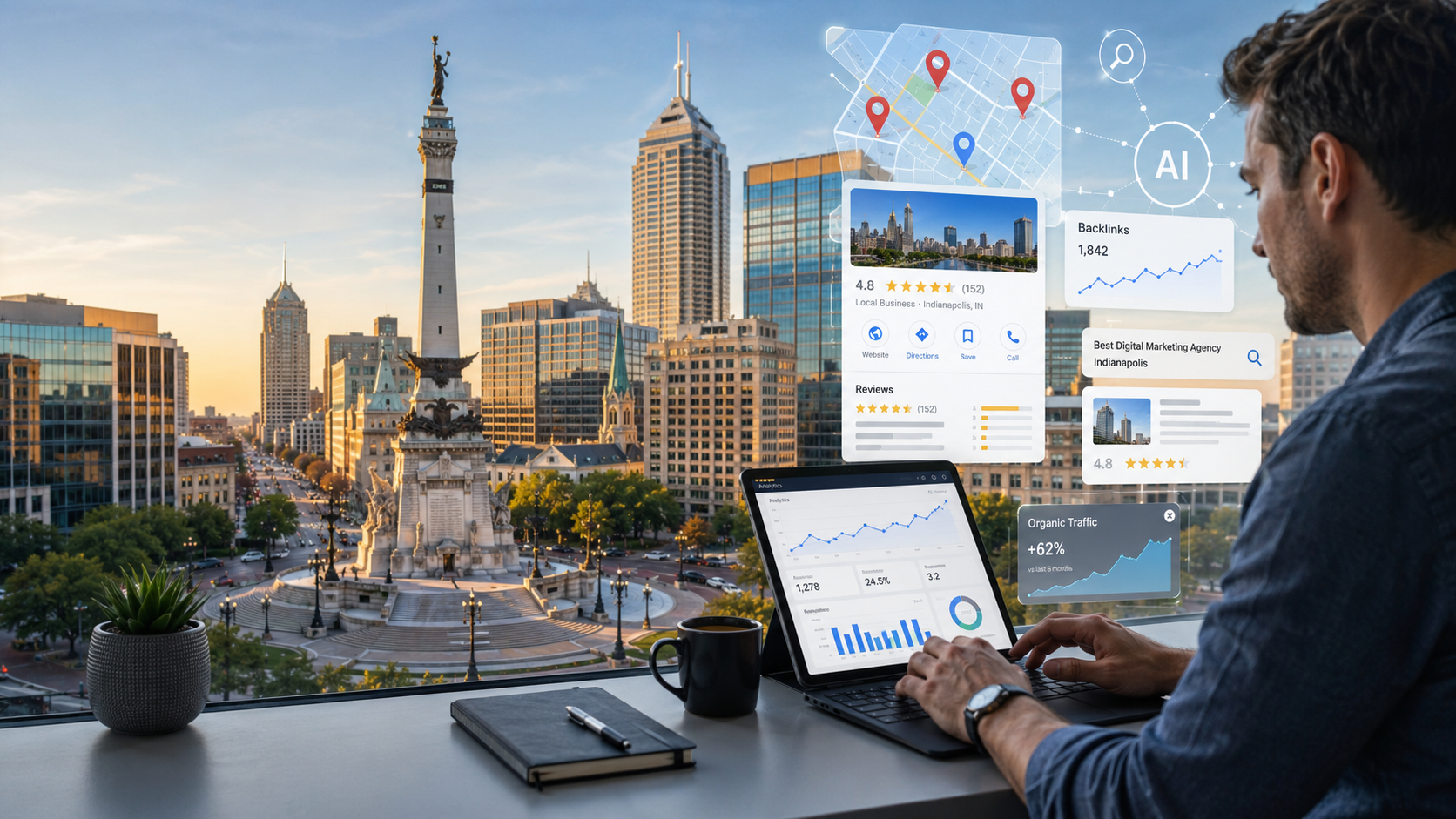
An Indianapolis homeowner needs a plumber.
They open Google and search:
“plumber near me.”
A business owner needs an attorney.
They search:
“Indianapolis business lawyer.”
Someone's furnace stops working.
They search:
“HVAC repair Indianapolis.”
A homeowner preparing to sell asks ChatGPT:
“Who are some good real estate agents in Indianapolis?”
Another consumer searches Google Maps directly.
Another reads reviews.
Another clicks an AI-generated answer.
Another sees an ad first and an organic result second.
And another already knows the company's name because they saw it mentioned by a local organization, manufacturer, journalist, community group, or trusted website.
That is the reality of local search in 2026.
Indianapolis SEO is no longer:
Put “Indianapolis” in your title tag and build some backlinks.
It is a connected system involving:
Google Search
Google Maps
Google Business Profile
Website architecture
Service pages
Reviews
Local citations
Backlinks
Local authority
Technical SEO
Conversion
Google Ads
AI search
ChatGPT
Industry expertise
Measurement
Consumers move between those channels quickly.
BrightLocal's current 2026 local-search research reports that 52% of consumers began their most recent local search on Google, 73% of local searches began on mobile devices, and 72% of consumers considered three or fewer businesses before deciding.
Reviews add another layer. BrightLocal's 2026 U.S. consumer survey found that 97% of respondents read online reviews for local businesses, with 41% saying they always read them while researching businesses.
Google itself says local results are primarily shaped by:
Relevance
Distance
Prominence
and explains that prominence can incorporate information such as reviews and websites linking to a business.
Then there is AI search.
Google's current 2026 guidance says traditional SEO fundamentals remain relevant to generative AI search and specifically recommends technically accessible sites, valuable non-commodity content, and accurate local-business information rather than separate “AI SEO hacks.”
OpenAI likewise provides a specific search crawler, OAI-SearchBot, for surfacing public websites within ChatGPT's search features.
Put all of that together and the question becomes:
What should an Indianapolis business actually work on first?
That is why we built this guide.
Over the course of 20 Indianapolis SEO resources, we have covered the major problems a local business is likely to encounter:
Not appearing in Maps
Ranking below competitors
Weak Google Business Profile
Thin website content
Technical SEO problems
Weak reviews
Bad citations
Few backlinks
Confusion about “near me”
SEO pricing
SEO versus Google Ads
AI search
ChatGPT recommendations
Industry-specific strategies
SEO timelines
Agency readiness
This page brings all 20 together.
Think of it as the Indianapolis SEO table of contents.
You do not need to read every guide in order.
Find the problem closest to your situation and start there.
Part 1: Indianapolis SEO Foundations
Before obsessing over Maps rankings or AI citations, make sure the underlying strategy makes sense.
These five guides answer the questions:
What should we fix?
How long should this take?
How much should it cost?
Should we use SEO or advertising?
Can a local company realistically compete with larger brands?
1. Indianapolis SEO Checklist: 15 Things to Fix Before Hiring an Agency
Start here if you're considering hiring an SEO company.
Read: Indianapolis SEO Checklist: 15 Things to Fix Before Hiring an Agency
Before you sign an SEO contract, determine whether you actually control:
Domain
Website
Google Search Console
Analytics
Google Business Profile
Conversion tracking
Then identify:
Indexation problems
Priority services
Google Maps baseline
Review problems
Citation issues
Existing backlinks
Thin content
Technical problems
The objective is not to perform an entire professional SEO campaign yourself.
It is to know what condition your assets are in before someone starts charging you to improve them.
Read this guide if:
You are interviewing agencies.
Your previous SEO provider disappointed you.
Nobody knows who owns Search Console.
You don't know what organic leads you currently generate.
You want a pre-SEO baseline.
This is also the best resource to give another stakeholder who asks:
“What exactly should we have ready before doing SEO?”
2. How Long Does SEO Take in Indianapolis?
Read: How Long Does SEO Take in Indianapolis? What Local Businesses Should Expect
The two worst SEO expectations are:
“This should work in two weeks.”
and:
“Nothing can be evaluated for a year.”
Google's own documentation says SEO changes can take anywhere from hours to several months to be reflected, while crawling changed URLs may take days or weeks.
That means SEO requires patience—
but not blind patience.
This guide breaks an Indianapolis campaign into:
First 30 Days
Audit, measurement, technical foundation, strategy.
Days 30–90
Implementation, service pages, Business Profile work, internal linking, reviews, citations.
Months 3–6
Stronger ranking trends, commercial visibility, local authority.
Months 6–12
Competitive growth and compounding.
The article also explains when:
“SEO takes time”
is legitimate and when it starts becoming an excuse.
Read this guide if:
You're three months into SEO and unsure what to expect.
An agency promised instant results.
An agency has shown no progress.
You're budgeting SEO for the next year.
You want timeline checkpoints before signing.
3. How Much Does SEO Cost in Indianapolis?
Read: How Much Does SEO Cost in Indianapolis? A Real Pricing Guide
SEO pricing can be confusing because:
$500/month SEO
and:
$5,000/month SEO
may be completely different products despite having the same label.
Pricing depends on:
Competition
Number of locations
Technical problems
Service count
Content needs
Authority gap
Link acquisition
Reporting
Conversion work
Industry difficulty
This guide breaks down:
Monthly retainers
Hourly SEO
Project pricing
Local SEO packages
Typical scope at different budgets
Current industry pricing surveys
Current Indianapolis examples
It also explains the difference between:
cheap
and:
efficient.
A lower-cost campaign can make sense.
A low-cost campaign promising enterprise-level work probably does not.
Read this guide if:
You have three proposals with wildly different prices.
You don't understand what SEO should cost.
You are trying to budget 2026 marketing spend.
You want to understand what different monthly ranges realistically buy.
4. SEO vs. Google Ads for Indianapolis Businesses
Read: SEO vs. Google Ads for Indianapolis Businesses: Where Should You Spend First?
This is one of the most common marketing questions:
Should we spend our first dollar on SEO or Google Ads?
The answer depends on:
How quickly you need leads
Search demand
Cost per click
Margins
Website quality
Existing organic visibility
Sales capacity
Budget
Google Ads can create visibility quickly.
SEO builds assets that can continue generating traffic without paying for each organic click.
And the two systems remain separate: Google states that advertising with Google does not improve organic Search placement.
The strongest strategy for some Indianapolis companies may use both:
Paid search for immediate demand
plus:
SEO for longer-term organic acquisition.
Read this guide if:
Your marketing budget is limited.
You need leads immediately.
You are deciding between an SEO retainer and paid ads.
You want to understand paid versus organic economics.
5. How Indianapolis Small Businesses Can Compete With National Brands on Google
Read: How Indianapolis Small Businesses Can Compete With National Brands on Google
A national competitor may have:
Millions of backlinks
Huge brand recognition
Thousands of pages
Massive ad budgets
Entire marketing departments
That does not mean an Indianapolis business has no chance.
Local companies can compete through:
Geographic relevance
Google Maps
Local reviews
Specialized service expertise
Original Indianapolis content
Local links
Faster customer experience
Specific commercial pages
You do not need more total authority than a national brand.
You need to be a better answer to the local query.
Read this guide if:
Angi, Zillow, national franchises, directories, or giant competitors dominate your search results.
You assume your smaller website cannot compete.
You need a strategy based on local advantages rather than sheer scale.
Part 2: Google Maps and Local Pack SEO in Indianapolis
For many local businesses, this is where the real battle takes place.
Google says local ranking is primarily based on relevance, distance, and prominence.
That sounds simple.
The implementation is not.
These six guides cover the entire Maps system.
6. Local SEO in Indianapolis: How to Rank Higher on Google Maps in 2026
Read: Local SEO in Indianapolis: How to Rank Higher on Google Maps in 2026
This is the starting point for the Indianapolis Maps cluster.
It explains:
Relevance
Distance
Prominence
Google Business Profile
Reviews
Citations
Website relevance
Local authority
Geographic rank tracking
If you only read one Maps article first, make it this one.
Then use the more specialized guides below to solve the specific problem you uncover.
Read this guide if:
You want the full Indianapolis local SEO framework.
You don't understand Maps rankings.
You're beginning a local SEO campaign from scratch.
7. What Makes an Indianapolis Business Rank in Google's 3-Pack?
Read: What Makes an Indianapolis Business Rank in Google's 3-Pack?
The three businesses Google prominently displays for a local query can receive a disproportionate amount of attention.
So what gets a company there?
Not one thing.
Google officially describes the system through relevance, distance, and prominence.
That can translate into practical questions such as:
Relevance
Does Google clearly understand what you do?
Distance
How close are you to the searcher?
Prominence
How established does your business appear through reviews, links, and broader web evidence?
This article goes deeper into those three concepts and explains why local SEO cannot be reduced to:
“Get more reviews.”
Read this guide if:
You're ranking around positions 4–10 in Maps.
You want to understand the Local Pack specifically.
A competitor keeps occupying one of the top three positions.
8. Google Business Profile Optimization for Indianapolis Businesses
Read: Google Business Profile Optimization for Indianapolis Businesses
Once you understand the ranking framework, optimize the asset.
This is the hands-on Business Profile guide covering:
Business eligibility
Verification
Ownership
Business name
Primary category
Secondary categories
Address
Service areas
Phone
Website
Hours
Services
Description
Attributes
Photos
Reviews
Posts
Practitioner profiles
Performance measurement
The article also separates:
Things Google officially recommends
from:
SEO folklore.
For example:
Posting to your Business Profile can be useful communication.
Google does not publish a rule saying:
“Three posts per week increases Maps ranking.”
Complete the profile because clarity and customer experience matter.
Do not turn profile optimization into superstition.
Read this guide if:
Your profile is incomplete.
Your categories are questionable.
You run a service-area business.
You're unsure whether to show your address.
You're a lawyer, dentist, real estate agent, or other eligible practitioner.
You want a full GBP checklist.
9. Why Your Indianapolis Business Isn't Showing Up on Google Maps
Read: Why Your Indianapolis Business Isn't Showing Up on Google Maps
This is the troubleshooting guide.
Before trying to “improve rankings,” determine whether you actually have a ranking problem.
Your business may be:
Unverified
Suspended
Disabled
Duplicated
Ineligible
Incorrectly configured
Using a problematic address
Missing by brand search
Visible by brand but weak for services
Ranking nearby but not farther away
Those are completely different situations.
If you search the exact business name and cannot find it:
Start with eligibility/profile status.
If you search the business name and it appears—but:
“plumber Indianapolis”
does not—
you likely have a ranking problem.
Read this guide if:
Your profile disappeared.
You can't find your company by name.
Your listing was suspended.
You are considering a virtual office.
You have duplicate listings.
You are verified but don't show for service searches.
10. How to Rank for “Near Me” Searches in Indianapolis
Read: How to Rank for “Near Me” Searches in Indianapolis
BrightLocal's current statistics page reports that close to half of consumers say they always or often add “near me” to local queries.
But the solution is not:
Put “near me” 47 times on the homepage.
Google's distance factor is central to proximity-based local searches.
That means your visibility can change block by block.
This article explains:
Proximity
Service areas
Geographic grids
Local relevance
Prominence
Why one ranking number is misleading
Read this guide if:
You rank at your office but disappear elsewhere.
You are a home service company.
You serve multiple Indianapolis-area communities.
You're stuffing “near me” into pages.
You need to understand Maps geography.
11. Why Your Competitor Ranks Above You in Indianapolis — Even With Fewer Reviews
Read: Why Your Competitor Ranks Above You in Indianapolis — Even With Fewer Reviews
This scenario drives businesses crazy.
Your company:
450 reviews
Competitor:
90 reviews
Competitor still ranks higher.
Why?
Because Google doesn't say:
Sort businesses by review count.
Google says local results are mainly based on relevance, distance, and prominence. Reviews contribute, but they are one component of a broader system.
The competitor may have:
Better proximity
Stronger category alignment
Better service relevance
Better website content
Stronger backlinks
More local authority
Read this guide if:
Your review count is higher but rankings are weaker.
You've been told reviews are the only thing that matters.
You want to diagnose a specific competitor.
Part 3: Reviews, Citations, and Local Authority
Once the basic Maps and website foundation works, you need evidence outside your own website.
You can say:
“We're the best Indianapolis company.”
But your own website saying it is not especially persuasive.
Authority becomes stronger when other legitimate sources help establish:
Who the business is
Where it operates
What industry it belongs to
Whether customers trust it
Whether relevant organizations recognize it
These two resources cover the foundation.
12. Indianapolis Local Citations: Which Business Directories Actually Matter?
Read: Indianapolis Local Citations: Which Business Directories Actually Matter?
Local businesses are constantly offered:
“500 citations for $99.”
More is not automatically better.
A citation strategy should prioritize meaningful platforms such as:
Major search/map ecosystems
Important business directories
Chambers
Professional directories
Industry organizations
Manufacturer directories
Relevant local platforms
The objective is not to submit your business to every directory capable of accepting a form.
It is to build an accurate, credible public business footprint.
Read this guide if:
Your address or phone number changed.
You have duplicate directory listings.
You're buying citation packages.
You want to know which directories deserve attention.
A former location still appears online.
13. Local Link Building in Indianapolis: Where Local Businesses Can Earn Authority
Read: Local Link Building in Indianapolis: Where Local Businesses Can Earn Authority
Links still matter in Google Search, and Google's local-ranking documentation specifically mentions websites linking to a business when discussing prominence.
But legitimate link building does not mean:
Buy 100 DA 50+ backlinks.
Better local authority may come from real relationships involving:
Indianapolis organizations
Indiana associations
Local media
Chambers
Universities
Manufacturers
Vendors
Community groups
Events
Original research
Partnerships
The article uses a simple test:
Would this relationship still be worth having if Google didn't exist?
If yes, you're probably thinking about local authority correctly.
Read this guide if:
Competitors have much stronger backlink profiles.
You have finished basic citation work.
You want local PR opportunities.
You are tired of backlink package pitches.
You need Indianapolis-specific authority ideas.
Part 4: Website and Technical SEO
Google Business Profile does not replace your website.
Maps and organic search work best when the business website clearly reinforces:
Services
Expertise
Location
Authority
Conversion paths
Google's Search Essentials and SEO Starter Guide continue to emphasize making websites accessible to search engines, organizing useful content clearly, and creating content that genuinely helps users.
That leads to the technical centerpiece of the cluster.
14. The Indianapolis Website Audit: 20 SEO Problems That Cost Local Businesses Leads
Read: The Indianapolis Website Audit: 20 SEO Problems That Cost Local Businesses Leads
You could have:
Excellent reviews
Strong Google Business Profile
Great business reputation
and still sabotage SEO through the website.
Potential problems include:
Important pages not indexed
Broken redirects
Duplicate content
Weak titles
Orphan pages
Poor internal linking
Mobile problems
Slow pages
Thin service pages
Bad local architecture
Google's documentation makes clear that technical eligibility and crawlability remain foundational to appearing in Search.
The audit is designed to answer:
What is broken before we publish more content or build more links?
Read this guide if:
Rankings fell after a redesign.
Google isn't indexing important pages.
Your site has hundreds of old URLs.
You have never performed a technical audit.
An agency wants to create more content but hasn't inspected the website.
Part 5: AI Search, ChatGPT, Gemini, and Google AI
Search behavior is expanding.
Traditional Google search matters.
Google Maps matters.
But businesses also need to understand what happens when someone asks:
“Who should I hire in Indianapolis?”
inside an AI interface.
The important part is avoiding hype.
Google's current 2026 generative AI guidance explicitly says foundational SEO continues to matter and warns businesses against unsupported hacks such as special AI markup or llms.txt files for Google Search.
OpenAI's requirements and systems are separate.
These two guides explain the difference.
15. AI Search Optimization in Indianapolis: SEO for ChatGPT, Gemini & Google AI
Read: AI Search Optimization in Indianapolis: SEO for ChatGPT, Gemini & Google AI
This is the broad AI-search guide.
It covers:
Google AI experiences
ChatGPT
Gemini
Traditional SEO overlap
Content clarity
Entity authority
Citations
Local business information
Original expertise
Structured data
Measurement
Google's 2026 AI-search documentation says SEO best practices remain foundational and recommends creating unique, valuable, expert-led information rather than “commodity” content that simply repeats what already exists.
That should influence Indianapolis content strategy.
Another generic:
“5 Reasons SEO Is Important”
article has little unique value.
Original material such as:
Indianapolis cost studies
Local market data
Case studies
Customer research
Firsthand experience
Detailed service expertise
is much harder to replace.
Read this guide if:
You are hearing terms like GEO or AEO.
You want visibility beyond conventional Google results.
You're unsure what Google officially recommends for AI search.
You want a future-facing SEO strategy without abandoning fundamentals.
16. How Indianapolis Businesses Can Get Recommended by ChatGPT
Read: How Indianapolis Businesses Can Get Recommended by ChatGPT
This guide narrows the focus specifically to OpenAI.
OpenAI currently identifies OAI-SearchBot as the crawler used for surfacing websites in ChatGPT search results and recommends allowing that crawler if a website wants to be eligible to appear in ChatGPT Search.
But there is no:
“Submit business to ChatGPT and rank #1”
button.
Instead, Indianapolis businesses should think about becoming easier to:
Discover
Understand
Verify
Cite
That can involve:
Clear service/location pages
Public business information
Third-party mentions
Reviews
Associations
Local media
Original content
Technical crawlability
The article also separates confirmed OpenAI guidance from speculation about “ChatGPT ranking factors.”
Read this guide if:
You want ChatGPT to surface your business.
You are confused about GPTBot versus OAI-SearchBot.
Someone is selling you an llms.txt miracle.
You want to track traffic coming from ChatGPT.
You need an OpenAI-specific strategy rather than generic AI SEO advice.
Part 6: Indianapolis Industry SEO Playbooks
SEO becomes more useful when it reflects the economics and search behavior of the actual industry.
An HVAC company's sales funnel is not a law firm's funnel.
A realtor's website should not be structured like a plumber's.
That is why this cluster includes four vertical playbooks.
17. SEO for Indianapolis HVAC Companies
Read: SEO for Indianapolis HVAC Companies: How to Generate More Service Calls
HVAC search demand can include:
AC repair
Furnace repair
Heat pumps
HVAC replacement
Emergency service
Maintenance
The local funnel may happen quickly:
Search
↓
Maps
↓
Reviews
↓
Call
That makes:
Google Business Profile
Service pages
Reviews
Mobile conversion
Maps visibility
Manufacturer authority
Call tracking
especially important.
Read this guide if:
You operate an Indianapolis HVAC company.
You want more service calls.
You have strong reviews but weak rankings.
You need separate AC/furnace/replacement strategies.
18. SEO for Indianapolis Home Service Companies: A Local Lead Generation Playbook
Read: SEO for Indianapolis Home Service Companies: A Local Lead Generation Playbook
This expands the HVAC framework across:
Plumbers
Roofers
Electricians
Remodelers
Restoration companies
Pest control
Landscapers
Cleaners
Other home services
The article treats SEO as a lead-generation system:
Search visibility
↓
Trust
↓
Phone/form
↓
Qualified lead
↓
Booked job
↓
Revenue
That final section matters.
A home service business does not make money from:
organic impressions.
It makes money from:
booked work.
Read this guide if:
You run a field-service business.
Calls matter more than ecommerce transactions.
You manage service areas.
You use Local Services Ads.
You want to connect rankings with booked jobs.
19. Local SEO for Indianapolis Law Firms
Read: Local SEO for Indianapolis Law Firms: How to Win More Cases from Search
Legal SEO has unique complexity.
You are not merely optimizing a service business.
You need to consider:
Practice-area competition
Attorney expertise
Individual practitioner profiles
Google Maps
Reviews
Legal accuracy
Intake
Professional-conduct requirements
The guide includes Indianapolis and Indiana-specific considerations while emphasizing that marketing should remain consistent with applicable professional obligations.
The economic goal is also different.
A law firm does not merely need:
more leads.
It needs:
more appropriate cases.
Read this guide if:
You market an Indianapolis law firm.
Individual attorneys have Google profiles.
Practice-area SEO is weak.
Traffic exists but case quality is poor.
You need to connect SEO with signed-case economics.
20. SEO for Indianapolis Real Estate Companies: Beyond Zillow and Realtor.com
Read: SEO for Indianapolis Real Estate Companies: Beyond Zillow and Realtor.com
Real estate companies face enormous portals.
Trying to beat Zillow purely on:
listing inventory
is not necessarily the best strategy.
A stronger approach can involve owning:
the expertise around the transaction.
That can include:
Neighborhood resources
Seller content
Buyer content
Original market research
Agent pages
Google Business Profiles
Local authority
Reviews
Market data
This creates search assets the portal does not automatically own.
Read this guide if:
Zillow and Realtor.com dominate your SERPs.
Your entire site is basically an IDX feed.
Seller leads are a priority.
You want neighborhood/local-market authority.
You manage brokerage and agent profiles.
Which Indianapolis SEO Guide Should You Read First?
Here is the fastest route.
“We Haven't Started SEO Yet.”
Start with:
Indianapolis SEO Checklist: 15 Things to Fix Before Hiring an Agency
Then:
How Much Does SEO Cost in Indianapolis?
Then:
How Long Does SEO Take in Indianapolis?
“We Aren't Showing Up on Google Maps.”
Start with:
Why Your Indianapolis Business Isn't Showing Up on Google Maps
If the profile is healthy but rankings are weak:
Local SEO in Indianapolis: How to Rank Higher on Google Maps in 2026
Then optimize the asset:
Google Business Profile Optimization for Indianapolis Businesses
“We Rank Nearby but Not Across Our Service Area.”
Read:
How to Rank for “Near Me” Searches in Indianapolis
Then:
What Makes an Indianapolis Business Rank in Google's 3-Pack?
“Our Competitor Has Fewer Reviews and Still Beats Us.”
Read:
Why Your Competitor Ranks Above You in Indianapolis — Even With Fewer Reviews
Then audit authority:
Local Link Building in Indianapolis
“Our Website Is a Mess.”
Start here:
The Indianapolis Website Audit: 20 SEO Problems That Cost Local Businesses Leads
Then use:
to establish measurement and ownership.
“We Need More Backlinks.”
Don't start by buying them.
Read:
Local Link Building in Indianapolis: Where Local Businesses Can Earn Authority
And if you are still working on directories:
Indianapolis Local Citations: Which Business Directories Actually Matter?
“Should We Do SEO or Google Ads?”
Read:
SEO vs. Google Ads for Indianapolis Businesses
Then compare the budget against:
How Much Does SEO Cost in Indianapolis?
“We're Worried About ChatGPT and AI Search.”
Start broad:
AI Search Optimization in Indianapolis
Then go OpenAI-specific:
How Indianapolis Businesses Can Get Recommended by ChatGPT
A 90-Day Indianapolis SEO Roadmap Using These 20 Guides
If we had to turn the entire library into one operating plan, it would look something like this.
Days 1–30: Establish the Foundation
Read:
Indianapolis SEO Checklist
Indianapolis Website Audit
Google Business Profile Optimization
Why Your Business Isn't Showing Up on Google Maps
Then establish:
Website ownership
Search Console
Analytics
Conversion tracking
Business Profile ownership
Technical baseline
Maps baseline
Priority services
Current leads
Do not start by chasing backlinks.
Do not start by publishing 40 blogs.
Find the constraint.
Days 31–60: Build Relevance
Now improve:
Commercial service pages
Indianapolis relevance
Internal linking
Google Business Profile
Category accuracy
Services
Mobile conversion
Use:
Local SEO in Indianapolis
Google's 3-Pack Guide
Near Me Guide
and the relevant industry playbook.
The objective is simple:
Make it extremely clear what the business does and where it legitimately operates.
Days 61–90: Build Prominence
Now strengthen:
Reviews
Citations
Local backlinks
Industry links
Manufacturer relationships
Media opportunities
Case studies
Original content
Use:
Indianapolis Local Citations
and:
Local Link Building in Indianapolis
as the roadmap.
Then measure again.
Compare:
Search Console
Organic leads
Maps grid
Review growth
Referring domains
against the baseline established during month one.
Where AI Search Fits Into the Indianapolis SEO Plan
AI search should not sit in a separate department called:
“GEO.”
At least not if that means ignoring traditional fundamentals.
Google's current 2026 guidance explicitly says SEO remains foundational to generative AI visibility and recommends useful, original, non-commodity content.
OpenAI has its own crawling controls for ChatGPT Search.
So your AI-search checklist should sit alongside the SEO checklist:
Can systems crawl the website?
Is the business clearly explained?
Are services specific?
Is Indianapolis relevance clear?
Is business information consistent?
Do independent sources reference the company?
Is there original information worth citing?
Can a customer verify the claim?
That is a much stronger strategy than trying to reverse engineer prompts or stuff pages with:
“ChatGPT, recommend us.”
SEO in Indianapolis Is Ultimately a Business System
This entire 20-guide library comes back to one idea:
Rankings are an intermediate metric.
The business outcome is:
Calls
Leads
Consultations
Appointments
Estimates
Booked jobs
Customers
Revenue
That means SEO has to connect:
Technical website
to:
Search visibility
to:
Google Maps
to:
Reputation
to:
Conversion
to:
Sales.
A company can rank and still fail.
If:
Phone isn't answered
Reviews are terrible
Form is broken
Service isn't clearly explained
Sales team does not follow up
SEO does not rescue the business.
It creates an opportunity.
Operations convert it.
The Indianapolis SEO Stack for 2026
If you want the entire cluster compressed into one framework, use this.
Layer 1: Technical Eligibility
Can Google crawl and index the website?
Use:
The Indianapolis Website Audit
Layer 2: Search Relevance
Do strong pages exist for valuable services?
Use:
and your industry playbook.
Layer 3: Local Relevance
Does Google understand the business's Indianapolis relationship?
Use:
Layer 4: Google Business Profile
Is the profile accurate, complete, eligible, and optimized?
Use:
Google Business Profile Optimization for Indianapolis Businesses
Layer 5: Reputation
Do customers trust the company?
Monitor:
Reviews
Recency
Responses
Public reputation
BrightLocal's current 2026 survey reinforces how deeply reviews remain embedded in consumer decision-making.
Layer 6: Authority
Does the broader web recognize the company?
Use:
and:
Local Link Building in Indianapolis
Layer 7: Geographic Maps Visibility
Where does the business actually rank?
Use:
How to Rank for “Near Me” Searches in Indianapolis
Layer 8: AI Search
Can systems understand, discover, and cite the business?
Use:
AI Search Optimization in Indianapolis
and:
How Indianapolis Businesses Can Get Recommended by ChatGPT
Layer 9: Conversion
Do search visitors become leads?
Your:
Phone
Forms
Reviews
Service pages
Mobile experience
all matter.
Layer 10: Economics
Are those leads profitable?
Use:
and:
to evaluate the investment.
Frequently Asked Questions
What Is Indianapolis SEO?
Indianapolis SEO is the process of improving a business's visibility when people search for products, services, or information relevant to Indianapolis and surrounding markets.
It can include:
Organic SEO
Google Maps
Google Business Profile
Local content
Reviews
Citations
Backlinks
Technical SEO
AI search
What Is Local SEO?
Local SEO focuses on searches with geographic or local intent.
Examples include:
plumber Indianapolis
dentist near me
Indianapolis attorney
HVAC repair near me
Google says local results are mainly based on relevance, distance, and prominence.
How Do I Rank Higher on Google Maps in Indianapolis?
Start by understanding:
Relevance
Distance
Prominence
Then optimize:
Google Business Profile
Website relevance
Reviews
Citations
Links
Local authority
Use Local SEO in Indianapolis: How to Rank Higher on Google Maps in 2026 for the full strategy.
Why Isn't My Indianapolis Business Showing Up on Google Maps?
Potential causes include:
Verification
Suspension
Eligibility
Duplicate profiles
Address problems
Category issues
Weak rankings
Distance
Use Why Your Indianapolis Business Isn't Showing Up on Google Maps to diagnose the exact problem before making changes.
What Determines Google's Local 3-Pack?
Google says local ranking is mainly based on:
Relevance
Distance
Prominence
See What Makes an Indianapolis Business Rank in Google's 3-Pack?.
Do Google Reviews Help Indianapolis SEO?
Yes.
Google says more reviews and positive ratings can help local ranking and contribute to prominence.
Reviews also influence consumer decision-making; BrightLocal's 2026 survey found 97% of respondents read online reviews for local businesses.
How Many Reviews Do I Need?
There is no universal number that guarantees ranking.
Compare your review profile against legitimate competitors while continuing to request authentic customer feedback.
Review count is not the only local ranking consideration.
Why Does My Competitor Rank Higher With Fewer Reviews?
Because Google also evaluates:
Relevance
Distance
Broader prominence
See Why Your Competitor Ranks Above You in Indianapolis — Even With Fewer Reviews.
Do Backlinks Help Indianapolis Local SEO?
Google says websites linking to a business can contribute to local prominence.
Focus on legitimate:
Local organizations
Media
Associations
Manufacturers
Partners
rather than purchased backlink packages.
Which Indianapolis Directories Matter?
Prioritize legitimate sources with local, industry, map, or customer value.
Use Indianapolis Local Citations: Which Business Directories Actually Matter? for the complete framework.
How Do I Rank for “Near Me” Searches?
Do not keyword-stuff “near me.”
Google's distance factor means proximity matters significantly.
Build strong:
Relevance
Profile information
Prominence
Reviews
Website authority
and measure rankings geographically.
How Much Does SEO Cost in Indianapolis?
Pricing depends on:
Competition
Services
Locations
Website condition
Technical needs
Content
Authority
Use How Much Does SEO Cost in Indianapolis? A Real Pricing Guide for the detailed breakdown.
How Long Does SEO Take?
Google says some SEO changes can be reflected within hours while others may require several months.
For practical planning, think in stages rather than expecting one guaranteed deadline.
Use How Long Does SEO Take in Indianapolis?.
Should Indianapolis Businesses Use SEO or Google Ads?
It depends on:
Timeline
Competition
Budget
Customer value
Existing organic visibility
Ads can produce faster paid visibility.
SEO builds organic assets.
Use SEO vs. Google Ads for Indianapolis Businesses for the decision framework.
Can a Small Indianapolis Business Compete With National Companies?
Yes, depending on the search.
Local businesses can leverage:
Proximity
Local reviews
Specialized expertise
Local links
Original local content
Better service relevance
See How Indianapolis Small Businesses Can Compete With National Brands on Google.
Does Google Business Profile Optimization Matter?
Yes.
Google recommends complete and accurate business information to help it understand and match businesses with relevant local searches.
Use Google Business Profile Optimization for Indianapolis Businesses.
Does AI Search Replace SEO?
No.
Google's current 2026 guidance explicitly says SEO remains relevant and foundational to its generative AI search experiences.
AI search expands the search ecosystem rather than eliminating the need for strong websites and useful content.
How Can an Indianapolis Business Get Into ChatGPT Search?
OpenAI says websites that want to be surfaced in ChatGPT Search should allow OAI-SearchBot and requests from its published IP ranges.
Beyond technical accessibility, build a public web presence that is clear, useful, and verifiable.
See How Indianapolis Businesses Can Get Recommended by ChatGPT.
Does Google Require llms.txt for AI Search?
No.
Google's current 2026 guidance specifically says it does not use llms.txt or other special AI text files for Google Search's generative AI features.
Do Indianapolis Businesses Need Separate AI SEO?
Businesses should monitor AI search, but Google's own guidance says foundational SEO remains central.
Focus on:
Technical accessibility
Original expertise
Clear services
Local information
Authority
Valuable content
before buying “GEO hacks.”
What Should I Fix First?
Start with:
Ownership and measurement
Technical SEO
Important service pages
Google Business Profile
Reviews
Citations
Local authority
Conversion
AI-search visibility
Use the Indianapolis SEO Checklist as the starting point.
Sources
This Indianapolis SEO hub was reviewed and updated for August 2026. Platform claims rely primarily on current official Google and OpenAI documentation, while BrightLocal's consumer research is identified as third-party survey data rather than a Google ranking formula.
Google Business Profile — Tips to Improve Your Local Ranking. Google's current explanation of relevance, distance, prominence, reviews, links, and local ranking.
Google Search Central — SEO Starter Guide. Google's foundational guide to crawling, indexing, useful content, and improving Search presence.
Google Search Essentials. Google's current core technical requirements, spam policies, and best practices for appearing in Search.
Google Search Central — How Google Search Works. Google's explanation of crawling, indexing, serving results, and the fact that payment does not purchase organic rankings.
Google Search — Optimizing for Generative AI Features. Google's 2026 guidance explaining that foundational SEO remains relevant to AI Overviews and AI Mode and that special llms.txt files or AI markup are not required.
Google Search Central — New Generative AI Optimization Resource. Google's May 2026 announcement emphasizing unique, useful, non-commodity content and continued foundational SEO.
OpenAI — Overview of OpenAI Crawlers. OpenAI's current documentation identifying OAI-SearchBot as its crawler for surfacing websites in ChatGPT's search features.
BrightLocal — Local SEO Statistics for 2026. Current local consumer-search statistics covering Google use, mobile search behavior, “near me” searches, and business-comparison behavior.
BrightLocal — Local Consumer Review Survey 2026. Survey of 1,002 U.S. adults covering review readership, star ratings, recency, consumer actions, and local reputation.
Twenty Indianapolis SEO Guides, One Strategy
It would be easy to look at these 20 articles as:
20 blog posts.
That is not the useful way to think about them.
Together, they form a system.
The Maps article explains the local ranking environment.
The 3-Pack article explains the competitive model.
The Business Profile article explains the asset.
The troubleshooting guide tells you why the asset may be missing.
The “near me” guide explains geography.
The competitor article explains why reviews do not exist in isolation.
The citation guide cleans up the public business footprint.
The link-building guide strengthens authority.
The website audit makes sure the technical foundation works.
The SEO checklist prepares the business operationally.
The pricing guide explains the investment.
The timeline guide explains expectations.
The SEO-versus-Ads guide explains channel allocation.
The national-brand guide explains how smaller local companies can compete.
The AI-search guide expands the strategy beyond traditional results.
The ChatGPT guide explains OpenAI-specific discoverability.
And the HVAC, home-service, legal, and real-estate playbooks convert the broad framework into industry-specific acquisition systems.
That is what Indianapolis SEO actually looks like in 2026.
It is not one ranking factor.
It is not one directory.
It is not one backlink.
It is not one blog post.
And it is definitely not:
“Add Indianapolis to the page 37 times.”
It is the process of making your business:
Easy to discover.
Easy to understand.
Easy to verify.
Easy to trust.
Easy to contact.
Then measuring whether search produces the kinds of customers your business actually wants.
Want Help Building an Indianapolis SEO Strategy?
Ritner Digital helps Indiana businesses improve visibility across:
Google Search
Google Maps
Google Business Profile
Local SEO
Technical SEO
Service pages
Local citations
Reviews
Link building
Digital PR
AI search
ChatGPT
Google AI
Conversion tracking
We work remotely with Indiana businesses rather than pretending to operate a fake Indianapolis storefront.
If you already know the problem, tell us.
If you don't, we'll start by identifying it.
Maybe you need:
better Google Maps visibility.
Maybe your service pages are thin.
Maybe the website has technical problems.
Maybe competitors simply have much stronger authority.
Maybe you're spending on SEO when Ads should come first.
Maybe your SEO provider is reporting traffic without tracking leads.
Or maybe traditional Google performance is improving and you're ready to start measuring AI-search visibility too.
Contact Ritner Digital and tell us which services, Indianapolis searches, or competitors matter most.
We'll start with the business objective and work backward from there.