SEO for Indianapolis HVAC Companies: How to Generate More Service Calls
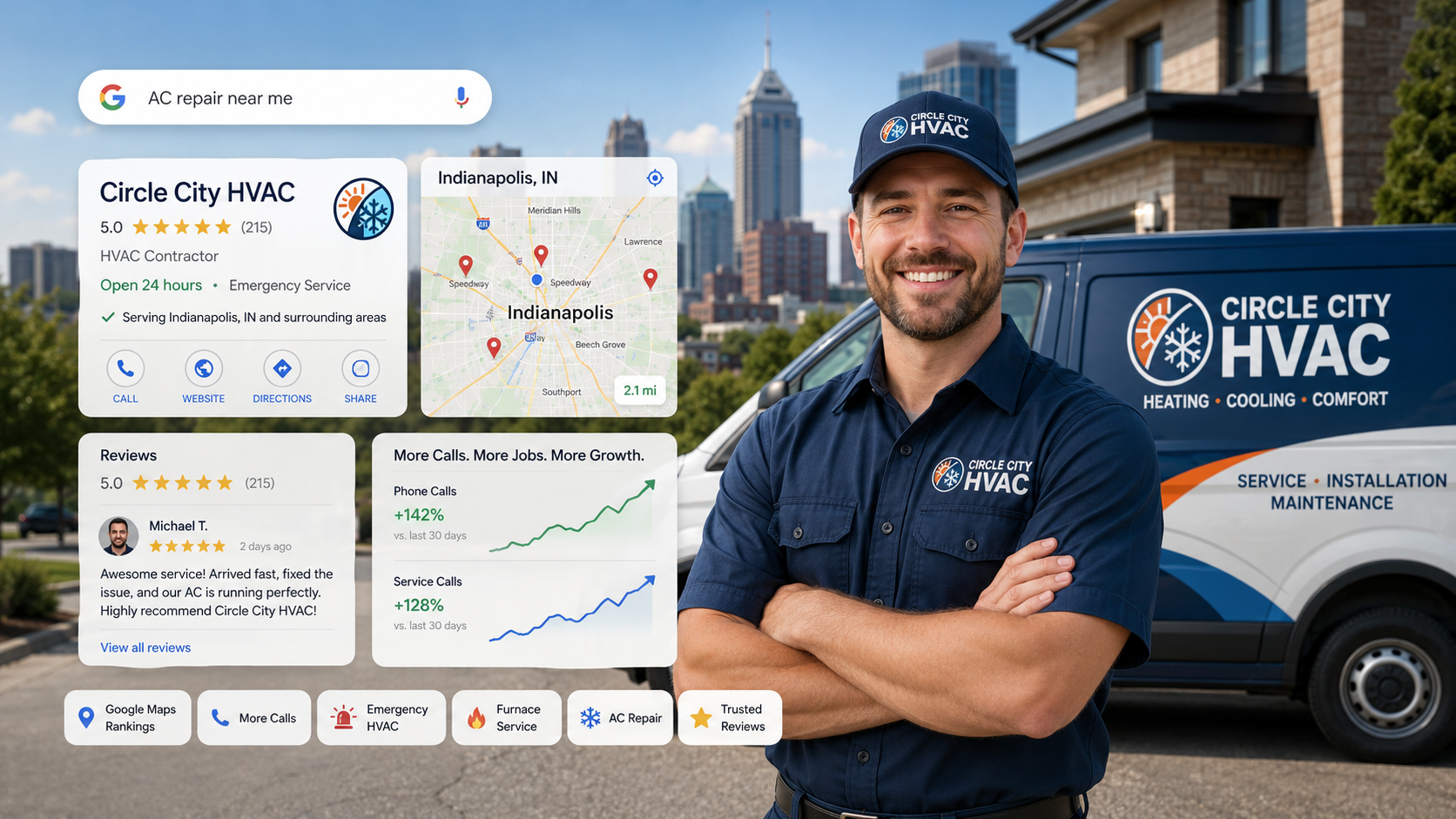
The air conditioner stops working.
It is hot inside the house.
The homeowner is not interested in reading 14 articles about the history of air conditioning.
They grab their phone.
They search:
“AC repair near me.”
Or:
“HVAC repair Indianapolis.”
Or:
“emergency AC repair Indianapolis.”
Then they start making decisions quickly.
Who appears in Google Maps?
Who has strong reviews?
Who looks like they actually repair the problem?
Who answers the phone?
Who can come out soon?
That is the reality Indianapolis HVAC companies should build their SEO strategy around.
The goal is not:
More traffic.
The goal is:
More qualified service calls.
Those are not automatically the same thing.
An HVAC website can attract thousands of visitors reading broad informational articles and still produce fewer calls than a competitor attracting a fraction of the traffic from searches such as:
AC repair Indianapolis
furnace repair Indianapolis
HVAC company near me
heat pump installation Indianapolis
emergency HVAC Indianapolis
commercial HVAC Indianapolis
Local search behavior makes that distinction even more important.
BrightLocal's current 2026 local-search data reports that 75% of consumers decide which local business to use in under 30 minutes, while 72% compare three or fewer businesses before making that decision. It also reports that 73% of local searches start on mobile devices.
That means an Indianapolis HVAC company's real SEO funnel can look something like this:
Search
↓
Google Maps / search result
↓
Reviews
↓
HVAC service page
↓
Phone call
↓
Booked service appointment
If any part of that path is weak, rankings alone may not generate the revenue you expect.
Google's own local-search documentation says local visibility is primarily determined by three broad concepts:
Relevance.
Distance.
Prominence.
Google defines relevance as how well the Business Profile matches the search, distance as how far the business is from the searcher, and prominence as how well-known the business appears. Google also says reviews and links can contribute to prominence.
For an Indianapolis HVAC contractor, that framework translates into a practical strategy:
Make it obvious that you provide the HVAC service being searched.
Build strong visibility around the geographic market you legitimately serve.
Create enough reviews, website authority, local evidence, and third-party credibility that Google and customers have reasons to trust the company.
Then make calling you ridiculously easy.
Here's how to build that system.
Why SEO for HVAC Companies Is Different
HVAC is not an ordinary purchase.
Demand frequently involves urgency.
A system fails.
A home becomes uncomfortable.
A commercial building has a mechanical problem.
A furnace stops heating.
An AC unit stops cooling.
A property manager needs a technician.
The customer does not necessarily want to become an HVAC expert.
They want a solution.
That creates several characteristics that make HVAC search especially interesting.
Search Intent Can Be Extremely Commercial
Consider the difference between:
“how does an air conditioner work”
and:
“AC repair Indianapolis.”
The first person may be curious.
The second may be trying to hire someone.
Your SEO strategy should understand the difference.
Location Matters
Most HVAC companies serve a defined geographic market.
You do not need calls from Portland, Oregon.
You need calls from Indianapolis and the parts of Central Indiana your technicians can profitably serve.
Google's local system explicitly considers the searcher's distance from potential businesses.
Reviews Matter Immediately
A homeowner may see several HVAC companies within seconds.
Reviews help them decide which companies deserve further investigation.
BrightLocal's 2026 survey found that 97% of consumers read reviews for local businesses, and 41% say they always read them when browsing businesses.
Mobile Conversion Matters
Someone whose AC just failed may be searching from a phone.
BrightLocal reports that 73% of local searches begin on mobile devices.
If your website makes the phone number difficult to find, you have a conversion problem.
Seasonality Changes Search Demand
The services customers care about can change throughout the year.
That means HVAC websites need enough service depth to capture demand across:
Cooling
Heating
Maintenance
Replacement
Indoor comfort
Commercial systems
Other services the company actually provides
You should not rely on one generic “HVAC Services” page to capture every one of those needs.
The Indianapolis HVAC SEO Strategy
Let's work through the system in the order we'd typically investigate it.
1. Start With Google Business Profile
For an HVAC company, your Google Business Profile can become one of the most commercially valuable properties you control.
When Indianapolis customers search:
HVAC company near me
AC repair near me
furnace repair Indianapolis
Google may display local businesses prominently through Maps and Local Pack results.
Google says verified service businesses can provide information including their website, phone number, operating hours, reviews, and services through Business Profile.
Your profile should therefore be treated as a customer-acquisition channel.
Audit:
Business name
Primary category
Additional categories
Address or service-area configuration
Phone number
Website
Hours
Services
Reviews
Photos
Business information
If important details are inaccurate, correct them before worrying about obscure SEO tactics.
For the complete Maps framework, use:
Local SEO in Indianapolis: How to Rank Higher on Google Maps in 2026
2. Get the Primary Business Category Right
Business categories help Google understand what your company actually is.
Google's current Business Profile documentation says businesses should choose the specific category that best represents the main business and warns against using categories merely as keywords.
That distinction is important.
Your categories are not a place to list every service you've ever performed.
They're classification.
If HVAC is the core business, the profile should communicate that clearly through the most accurate eligible category.
Then use appropriate additional categories only when they genuinely describe the company.
Do not add unrelated categories because a competitor uses them.
Do not turn category selection into keyword stuffing.
The objective is better relevance.
3. Understand the Proximity Problem
An Indianapolis HVAC business may ask:
Why do we rank first around our office but disappear ten miles away?
Because local search is geographic.
Google says distance is one of its primary local ranking factors and calculates how far businesses are from the customer performing the search.
That means your HVAC company probably does not have one universal Google Maps position.
You may be:
#1 near the business location
#3 farther away
#8 in another section of the metro
outside the Local Pack elsewhere
That is normal.
This is why we recommend thinking about geographic visibility, not a single ranking.
For a deeper explanation, read:
How to Rank for “Near Me” Searches in Indianapolis
4. Configure Service Areas Accurately
Many HVAC contractors are service-area businesses or hybrid businesses.
Google defines a service-area business as one that travels directly to customers but does not serve them at its business address.
Google allows businesses to identify cities, ZIP codes, and other areas they actually serve.
But understand what service areas do not mean.
Adding:
Indianapolis
Carmel
Fishers
Greenwood
Noblesville
Avon
Plainfield
does not create seven physical locations.
It does not erase Google's distance factor.
It communicates where you perform work.
Set service areas because they're accurate.
Not because you believe adding more cities guarantees rankings in them.
5. Don't Create Fake HVAC Offices Around Indianapolis
This deserves its own section because local service businesses are regularly tempted by proximity manipulation.
You want more visibility in Carmel.
Someone suggests renting a mailbox.
You want Greenwood rankings.
Someone offers a virtual office.
You want broader Indianapolis coverage.
Someone suggests creating several Google Business Profiles.
Be careful.
Google requires businesses to accurately represent real-world locations and operations. Service-area businesses should generally maintain the appropriate legitimate profile rather than manufacturing locations.
Do not risk a valuable Business Profile for a short-term proximity trick.
If the business legitimately expands and opens an eligible staffed location, that's different.
Reality first.
SEO second.
Build Separate Pages for Your Most Important HVAC Services
This is one of the biggest website opportunities we see in service industries.
A company offers seven meaningful HVAC services.
The website has one page called:
Services
Every service receives 100 words.
That's weak.
Google's SEO Starter Guide emphasizes creating sites that help search engines understand content and help users find the information they need.
Important services often deserve their own pages.
An Indianapolis HVAC website might legitimately need pages for services such as:
AC repair
AC installation or replacement
Furnace repair
Furnace replacement
Heat pumps
HVAC maintenance
Commercial HVAC
Indoor air quality
Ductwork
Emergency HVAC service
Only create pages for services you actually provide.
But don't force ten different customer needs into one generic page.
Your AC Repair Page Should Be About AC Repair
Imagine someone searches:
“AC repair Indianapolis.”
They land on your website.
The page should immediately confirm:
Yes, we repair air conditioners.
Then answer the questions a real customer cares about.
For example:
What AC problems do you repair?
What symptoms indicate a problem?
Which systems do you service?
Do you offer emergency or same-day options if applicable?
Which areas do you serve?
What happens after someone calls?
What influences repair cost?
When might replacement make more sense?
How does the customer schedule service?
Then show proof:
Reviews
Technician experience
Certifications where relevant
Project examples
Guarantees if genuinely offered
Contact information
That's significantly stronger than:
We offer comprehensive cooling solutions.
Your Furnace Repair Page Needs the Same Depth
Repeat the principle.
Don't repeat the copy.
A furnace customer has different concerns from an AC customer.
They may want to know:
Why isn't the furnace heating?
Why does it keep turning off?
Is the furnace safe to operate?
Can it be repaired?
How old is too old to repair?
How quickly can someone come?
Do you work on their equipment type?
Build the page around that customer's problem.
That creates a better resource for both users and search engines.
Heat Pump SEO Deserves Its Own Strategy If You Sell Heat Pumps
If heat pumps are strategically important to your company, don't bury them in a paragraph.
Create meaningful pages around:
Heat-pump repair
Heat-pump installation
Replacement
Maintenance
Heat pump vs. furnace decisions
This gives you room to answer specific customer questions.
And it gives the website another commercially important service topic.
Commercial HVAC Should Not Be an Afterthought
If you serve businesses, your commercial pages should look like they were written for commercial buyers.
Not homeowners.
A property manager or facility manager may care about:
Preventive maintenance
Equipment downtime
Emergency response
Rooftop units
Multi-site service
Service agreements
Building types
Scheduling
Documentation
Commercial experience
Your commercial page should communicate commercial expertise.
One sentence saying:
We also serve commercial customers.
is not much evidence.
Build a Strong Indianapolis HVAC Page
If Indianapolis is a primary market, your website should clearly demonstrate that relationship.
A strong local page can include:
HVAC services offered in Indianapolis
Areas served
Local project examples
Local testimonials
Indianapolis-specific customer questions
Real service photographs
Team information
Contact options
Links to major HVAC services
Avoid writing:
Looking for HVAC in Indianapolis? We are the best Indianapolis HVAC company serving Indianapolis HVAC customers throughout Indianapolis.
That's keyword stuffing.
The city should be present where useful.
But the page should earn its existence through actual local value.
This is the same strategy we outlined in:
How Indianapolis Small Businesses Can Compete With National Brands on Google
National companies may publish hundreds of generic location pages.
A local or regional HVAC contractor can often publish far better information about the markets it actually serves.
Should You Build Pages for Indianapolis Suburbs?
Potentially.
But only when you can do it well.
Maybe you genuinely serve:
Carmel
Fishers
Greenwood
Noblesville
Avon
Plainfield
Brownsburg
Zionsville
That does not automatically mean you should copy your Indianapolis page eight times.
Create a separate market page when you can provide meaningful information such as:
Local project examples
Area-specific testimonials
Service coverage
Relevant customer questions
Unique geographic information
Real experience in the market
Avoid swapping one city name for another while leaving everything else identical.
Google's SEO guidance emphasizes useful content over content created merely to manipulate search visibility.
Emergency HVAC SEO Can Be Extremely Valuable
Urgency changes search behavior.
Compare:
“how to maintain an air conditioner”
with:
“emergency AC repair near me.”
Very different customer.
If you legitimately offer emergency service, make it easy for search engines and users to understand.
You may need a strong emergency HVAC page explaining:
When customers should call
Which emergency services you offer
Whether service is available after hours
Which areas you cover
How to contact the company
What happens after the call
Do not advertise 24/7 emergency service unless you genuinely provide it.
But if urgency is part of your offer, don't hide it.
Create HVAC Cost Content That Attracts Buyers
One of the most valuable SEO content categories is pricing.
Businesses sometimes avoid price content because:
“It depends.”
Of course it depends.
Explain what it depends on.
Examples:
How Much Does AC Repair Cost in Indianapolis?
How Much Does Furnace Replacement Cost in Indianapolis?
How Much Does a New HVAC System Cost in Indianapolis?
How Much Does Heat-Pump Installation Cost in Indianapolis?
You don't have to promise one universal price.
Explain the variables.
For example:
Equipment
System size
Repair type
Labor complexity
Installation requirements
Accessibility
Additional work
Warranty considerations
Then explain how your estimating process works.
Price content attracts customers who are farther down the decision funnel.
They're not merely learning what HVAC stands for.
They're trying to budget.
Create Repair-vs.-Replace Content
Another high-value customer decision is:
Should I repair this system or replace it?
Your technicians probably discuss that question constantly.
Turn the knowledge into useful website content.
Examples:
Repair or Replace Your AC? What Indianapolis Homeowners Should Consider
Should You Repair or Replace an Older Furnace?
Heat Pump Replacement: When Repair Stops Making Sense
Discuss:
Equipment age
Repair frequency
Repair cost
Comfort
Reliability
Efficiency considerations
Customer plans
Do not force every article toward replacement.
Trust matters.
Explain how you help the customer evaluate the decision.
Create Content Around Symptoms
Customers often search for the symptom before they know the solution.
Examples:
AC running but not cooling
furnace blowing cold air
AC keeps turning on and off
HVAC making loud noise
thermostat says one temperature but house feels different
Those searches may lead to future service calls.
A strong article can explain:
Common causes
Safe homeowner checks
When professional service may be needed
What not to do
How your company diagnoses the issue
This is where technician knowledge becomes SEO content.
Your content writer should talk to the people doing the work.
Your HVAC Technicians Are a Content Gold Mine
Ask technicians:
What do customers ask you every week?
You'll probably get enough content ideas for a year.
Questions may include:
Why is my AC freezing?
Why does my furnace smell?
How often should I replace filters?
Why is one room hotter?
Why is the system constantly running?
Should I close vents?
What does this noise mean?
How often should HVAC maintenance happen?
Why did my utility bill increase?
What size system do I need?
These are useful because they're based on real customer demand.
Google's SEO guidance is fundamentally about helping search engines understand content while helping people find useful information.
Real expertise makes that easier.
Reviews Can Generate More HVAC Calls Before the Website Is Even Opened
Search results are competitive comparison environments.
Imagine an Indianapolis homeowner sees:
Company A
4.9 stars
500+ reviews
Company B
4.8 stars
300 reviews
Company C
3.6 stars
42 reviews
Company C may still get calls.
But it has created an additional objection before the customer even reaches the website.
Google says more reviews and positive ratings can help a business's local ranking.
BrightLocal's 2026 consumer research also found:
97% of consumers read local-business reviews
41% always read them
31% will only use businesses with at least 4.5 stars
68% require at least four stars
Those are consumer findings—not a Google ranking formula.
But they demonstrate why reputation matters commercially.
Build Reviews Into the Service Process
Do not rely on:
“Hopefully customers review us.”
Create a process.
After a completed service appointment, provide a simple way for legitimate customers to leave honest feedback.
Google explicitly allows businesses to ask customers for reviews through a review link or QR code.
What Google does not allow is manipulating the review system.
Google prohibits incentives such as free or discounted services in exchange for reviews. It also prohibits selectively soliciting only positive reviews and other forms of rating manipulation.
So:
Ask.
Don't bribe.
Don't filter.
Don't require five stars.
Don't tell customers what to write.
Build real reputation.
Respond to HVAC Reviews
Customers notice whether a company responds.
Especially when something went wrong.
A thoughtful response tells the next homeowner:
Someone is accountable.
You don't need a 400-word response.
You do need professionalism.
For positive reviews:
Thank the customer.
Acknowledge the experience.
For negative reviews:
Stay calm.
Avoid arguing.
Avoid revealing private customer information.
Offer an appropriate route to resolve the issue.
BrightLocal's 2026 research found review responses remain an important part of consumer evaluation.
Don't Obsess Over Review Count Alone
Your competitor has 150 reviews.
You have 600.
They rank above you.
Possible?
Absolutely.
Google does not say local businesses are sorted by review count.
It says rankings primarily consider:
Relevance
Distance
Prominence
The competitor may have:
Better proximity
Better category alignment
Stronger service pages
Better website authority
Better backlinks
More geographic relevance
We've already gone deep on that exact issue in:
Why Your Competitor Ranks Above You in Indianapolis — Even With Fewer Reviews
Don't diagnose rankings from one metric.
HVAC Citations Still Matter—But Don't Buy 500 of Them
Your company probably appears in business directories and mapping systems around the web.
Some matter.
Some barely deserve your attention.
Prioritize accurate information across meaningful sources.
For an HVAC company, that can include major search platforms, mapping platforms, data providers, trusted business organizations, legitimate trade associations, manufacturer directories, and other industry-relevant sources.
Your fundamental business information should be accurate:
Name
Address where appropriate
Phone
Website
Hours
Google itself says complete and accurate business information helps local visibility.
For the full Indianapolis priority list, read:
Indianapolis Local Citations: Which Business Directories Actually Matter?
The objective isn't:
largest citation count.
It's:
clean, credible business data where it matters.
Earn HVAC Backlinks Through Real Relationships
Backlinks remain part of the authority side of local SEO.
Google explicitly mentions websites linking to a business when explaining prominence.
Potential HVAC link opportunities include:
Equipment manufacturers
Distributors
Industry associations
Local chambers
Indianapolis organizations
Community sponsorships
Home-service partners
Builders
Remodelers
Commercial partners
Local media
Your existing business relationships may already contain link opportunities.
Ask:
Which legitimate organizations are connected to our company but don't currently reference our website?
That's much better than buying hundreds of random backlinks.
Manufacturer and Dealer Pages Can Be Valuable
If your HVAC company is legitimately an authorized dealer, certified contractor, or recognized partner for a manufacturer, determine whether that relationship includes a public directory or partner profile.
Those listings can help customers verify:
Manufacturer relationship
Credentials
Contact information
Location
Services
They may also create a relevant third-party business mention or link.
Again:
Don't invent certifications.
Use relationships you've actually earned.
Local Community Involvement Can Become SEO Authority
Suppose your HVAC company sponsors:
A local sports team.
An Indianapolis charity event.
A school fundraiser.
A neighborhood project.
An industry event.
Those activities may generate legitimate:
Mentions
Links
Sponsor pages
Brand searches
Referral traffic
This is where local marketing and local SEO overlap.
The best local links frequently exist because the business did something worth mentioning offline.
Not because an SEO specialist sent 5,000 cold emails.
Mobile SEO Is HVAC Conversion Optimization
Google uses the mobile version of site content for indexing and ranking under mobile-first indexing.
But the business argument is even stronger.
A homeowner whose furnace stopped working may be searching from their phone.
They don't want to pinch and zoom.
They don't want to click through four menus.
They want help.
Your mobile website should make these things immediate:
What do you do?
Do you serve my area?
Can you solve this problem?
How do I call?
Audit your website on an actual phone.
Not just a desktop browser made narrow.
Your Phone Number Should Be Easy to Tap
This sounds laughably basic.
And yet websites still get it wrong.
The phone number should be easy to find.
Especially on:
Homepage
Major service pages
Indianapolis page
Emergency page
Mobile header
Contact page
For high-intent HVAC visitors, the primary conversion may be:
tap → call
Don't make that difficult.
Don't Let Pop-Ups Block Emergency Customers
A homeowner arrives at the site.
Before they can read anything:
JOIN OUR NEWSLETTER!
Then:
ACCEPT COOKIES.
Then:
CHAT WITH US!
Then:
GET 10% OFF!
The website has created more obstacles than the HVAC problem.
Use conversion tools carefully.
Your site should help the person complete the task.
Speed Matters Because HVAC Customers Are Impatient
Google recommends mobile-friendly experiences and uses the mobile version of content for indexing.
From a conversion perspective, a faster and simpler site also reduces friction.
Compress huge images.
Remove unnecessary scripts.
Use sensible video.
Avoid overloaded page builders.
Keep contact options responsive.
Don't turn an HVAC service page into a cinematic experience requiring 25 MB to load.
Customers are trying to book service.
Technical SEO Problems Can Quietly Destroy HVAC Visibility
Local SEO frequently gets reduced to Business Profile work.
Meanwhile, the website has serious problems.
Examples:
AC repair page is noindexed
Furnace page redirects incorrectly
Indianapolis page canonicalizes to another URL
Important pages are orphaned
Internal links are broken
Mobile content is missing
Sitemap is outdated
Old URLs create duplicate content
Google's SEO Starter Guide makes clear that crawlability and indexability remain foundational to search visibility.
Before building 40 new service pages, make sure the website works.
Use:
The Indianapolis Website Audit: 20 SEO Problems That Cost Local Businesses Leads
as a starting checklist.
Internal Linking Can Turn an HVAC Website Into a Search System
Imagine these pages:
Indianapolis HVAC
AC Repair
Furnace Repair
Heat Pumps
HVAC Maintenance
AC Repair Cost Guide
Repair vs. Replace AC
Furnace Repair Cost
Indianapolis HVAC Case Study
They should support one another.
The AC cost guide can link to AC repair.
The AC repair page can link to replacement when relevant.
The Indianapolis page can link to core services.
The furnace article can link to furnace repair.
The case study can link to the service performed.
Google says its crawlers discover pages through links and its SEO guidance emphasizes making site content easy for users and search engines to navigate.
Do not leave your best HVAC content isolated.
Build Topic Clusters Around Commercial Services
A powerful HVAC content cluster might look like this.
AC Repair
Supported by:
AC not cooling
AC freezing
AC making noise
AC repair cost
repair vs. replace
maintenance checklist
Furnace Repair
Supported by:
furnace blowing cold air
furnace short cycling
furnace repair cost
furnace replacement
repair vs. replace
Heat Pumps
Supported by:
heat-pump cost
repair
replacement
maintenance
heat pump vs. furnace
The informational articles support the commercial pages.
The commercial pages create conversion opportunities.
That's a real SEO system.
Don't Publish HVAC Blogs Just to “Keep the Website Fresh”
You do not need to publish every Tuesday because someone said Google likes fresh websites.
Publish because the content has a strategic purpose.
Ask:
What customer question does this answer?
Which service does it support?
Which search intent does it capture?
Which internal page should it strengthen?
Can we say something useful that competitors aren't saying?
If you can't answer those questions, you may not need the article.
Use Real HVAC Projects as SEO Content
Your completed work is unique.
Turn it into case studies.
For example:
Furnace Replacement for an Indianapolis Home
Explain:
Problem
Existing system
Customer concerns
Diagnosis
Recommendation
Installation
Result
Or:
Commercial Rooftop HVAC Repair in Indianapolis
Explain:
Facility problem
Operational impact
Diagnosis
Repair
Result
Use legitimate photos when permitted.
Avoid exposing customer information without consent.
Case studies create:
Local relevance
Service relevance
Original content
Proof
Conversion material
National brands cannot duplicate your actual projects.
Track HVAC Rankings by Geography
A single ranking report can mislead you.
You search:
“AC repair near me.”
from your office.
You're number one.
Great.
A homeowner ten miles away searches.
You're number six.
Both can be true.
Google says distance influences local results.
Use geographic grid tracking for your commercially important searches.
For example:
AC repair Indianapolis
HVAC company near me
Furnace repair
Heat pump installer
Commercial HVAC
Then see where the company is:
Top 3
Positions 4–10
Weak
Missing
This is the same geographic strategy covered in:
How to Rank for “Near Me” Searches in Indianapolis
Measure Service Calls, Not Just Rankings
Imagine an agency reports:
“We moved you from position 12 to position 5.”
Okay.
How many additional HVAC jobs were booked?
SEO reporting should connect visibility to commercial outcomes.
Track:
Organic impressions
Organic clicks
Local rankings
Maps visibility
Phone calls
Contact forms
Schedule requests
Qualified leads
Booked jobs
Revenue where practical
A ranking is an input.
A booked technician schedule is the outcome.
Use Call Tracking Carefully
HVAC is naturally phone-heavy.
So call attribution matters.
You want to understand:
Which pages generate calls?
Which services produce calls?
Which marketing channels generate qualified calls?
Which calls become booked jobs?
Which calls are spam or wrong-number leads?
Use call tracking in a technically responsible way that does not create inconsistent permanent business information across citations.
The objective is measurement without turning your core business phone data into a mess.
Build Pages Around Revenue, Not Search Volume Alone
Suppose:
“what is HVAC”
has enormous search volume.
And:
“commercial HVAC repair Indianapolis”
has much less.
Which would you rather rank for?
The answer depends on your business.
But a commercial HVAC company should probably care more about the second visitor.
Search volume is useful.
Revenue intent is better.
Prioritize pages around:
High-value services
High-margin work
Repeatable jobs
Strategic equipment categories
Commercial relationships
Customer lifetime value
SEO should reflect the business model.
HVAC SEO and Google Ads Can Work Together
Search demand can be urgent.
That makes paid search attractive for HVAC companies.
But paying for Google Ads does not buy stronger organic rankings.
SEO and Google Ads are separate acquisition systems.
A useful combination might be:
Google Ads
Capture urgent demand now.
SEO
Build organic visibility over time.
Maps
Capture local discovery.
Reviews
Increase trust.
Service Pages
Convert demand.
We've broken down the broader budget decision in:
SEO vs. Google Ads for Indianapolis Businesses: Where Should You Spend First?
For many HVAC companies, choosing one forever is unnecessary.
The better question is how the channels should work together.
Local Services and Paid Leads Do Not Replace Organic SEO
Even if your company is investing heavily in paid lead generation, organic visibility still has value.
Why?
Because customers don't use one channel.
BrightLocal reports that 75% of consumers used more than one channel during their most recent local-business search.
A homeowner might:
See your ad.
Search your company name.
Read your reviews.
Open your website.
Compare another company.
Return later.
Organic visibility strengthens the entire digital footprint surrounding the brand.
HVAC SEO Can Help Smaller Companies Compete With National Brands
A national HVAC brand may have:
Massive backlink profile
Huge marketing budget
Thousands of pages
National advertising
Strong brand recognition
But the Indianapolis customer still needs local service.
Your smaller company can compete through:
Proximity
Better local reviews
More Indianapolis-specific proof
Better service pages
Local backlinks
Local case studies
Faster communication
Better conversion
We've covered this strategy in depth here:
How Indianapolis Small Businesses Can Compete With National Brands on Google
You don't have to become bigger than the national company.
You have to become a better answer for the local customer.
Google's 3-Pack Can Be One of Your Most Valuable HVAC Battlegrounds
For highly local searches, appearing in the Local Pack can put your company directly into the customer's initial comparison set.
BrightLocal's 2026 local-search statistics say 72% of consumers look at three or fewer businesses before deciding which one to use.
That does not prove everyone chooses directly from the 3-Pack.
But it illustrates why early visibility matters.
To improve Local Pack competitiveness, focus on the broader Google framework:
Relevance
Distance
Prominence
Then strengthen the signals within those areas.
Use:
What Makes an Indianapolis Business Rank in Google's 3-Pack?
for a complete explanation.
AI Search Is Becoming Another HVAC Discovery Channel
A homeowner can now ask:
“Which HVAC companies serve Indianapolis?”
or:
“Who should I call for furnace repair near me?”
through AI-powered interfaces as well as traditional Google Search.
That does not mean abandoning SEO.
It means strengthening the information AI and search systems may encounter:
Clear service pages
Accurate business information
Reviews
Citations
Local authority
Structured data
Original content
External mentions
If AI visibility matters to your HVAC marketing roadmap, read:
AI Search Optimization in Indianapolis: SEO for ChatGPT, Gemini & Google AI
Traditional local SEO remains the foundation.
A 90-Day SEO Plan for an Indianapolis HVAC Company
If your search visibility is weak, don't change everything randomly.
Sequence the work.
Days 1–30: Fix the Foundation
Audit:
Google Business Profile
Check:
Eligibility
Categories
Address/service area
Phone
Website
Hours
Services
Reviews
Website
Check:
Indexation
Technical issues
Mobile usability
Service pages
Indianapolis relevance
Internal links
Contact forms
Call functionality
Measurement
Establish:
Search Console
Analytics
Call tracking
Lead tracking
Current geographic rankings
You need a baseline.
Days 31–60: Build Service Relevance
Improve your highest-value pages.
Depending on the business:
AC repair
Furnace repair
HVAC replacement
Heat pumps
Maintenance
Commercial HVAC
Emergency service
Then improve your Indianapolis page.
Build strong internal links.
Add real reviews and proof where appropriate.
Publish one useful customer-decision resource.
For example:
AC Repair vs. Replacement in Indianapolis
or:
What Does Furnace Replacement Cost in Indianapolis?
Days 61–90: Strengthen Prominence
Now work on external authority.
Build a legitimate review workflow.
Clean important citations.
Pursue industry and local backlinks.
Create a case study.
Develop manufacturer or association profiles where legitimate.
Look for Indianapolis community opportunities.
Then re-run geographic rankings.
Compare:
Maps visibility
Organic visibility
Calls
Leads
The goal is evidence of improvement.
Common HVAC SEO Mistakes
Building One Generic Services Page
Customers search for individual services.
Give important services enough depth.
Creating 50 Thin City Pages
Location pages need real value.
Not city-name swapping.
Fake Google Business Profile Locations
Do not gamble your Business Profile on proximity manipulation.
Buying Reviews
Google prohibits incentivized and manipulated reviews.
Publishing Generic AI Blogs at Scale
Volume is not a substitute for expertise.
Use real technician knowledge.
Ignoring Mobile Call Experience
A service-call business should make calling easy.
Tracking Traffic Instead of Jobs
More visitors are not automatically more HVAC revenue.
Overlooking Existing Website Problems
A technical SEO problem can undermine every other strategy.
Ignoring Reviews Because You Already Have “Enough”
Consumer expectations continue changing, and recent customer experiences matter commercially.
Build an ongoing process.
Chasing Every Directory
Prioritize meaningful local and industry citations.
The Indianapolis HVAC SEO Flywheel
The strongest strategy compounds.
A useful model looks like this:
Better service pages
lead to:
Stronger search relevance
which creates:
More qualified visibility
which generates:
More service calls
which creates:
More customers
which creates opportunities for:
More legitimate reviews
More case studies
More local proof
More referrals
More brand searches
which strengthens the company's overall search presence.
That's the flywheel.
SEO is not one keyword.
It's the digital system surrounding the business.
Frequently Asked Questions
What Is HVAC SEO?
HVAC SEO is the process of improving an HVAC company's website and local online presence so potential customers can more easily find the business through search engines when they need heating, cooling, maintenance, installation, or related HVAC services.
For an Indianapolis contractor, that typically includes:
Google Business Profile
Google Maps SEO
Service pages
Indianapolis SEO
Reviews
Technical SEO
Local citations
Backlinks
Content
Conversion optimization
Does SEO Work for HVAC Companies?
Yes, when customers actively search online for the HVAC services the company provides.
The business value depends on ranking for commercially relevant local searches and converting that visibility into qualified calls and bookings.
SEO should therefore be measured against:
Leads
Calls
Booked work
Revenue
not traffic alone.
What Are the Best SEO Keywords for an Indianapolis HVAC Company?
The right keywords depend on the services you provide.
Common high-intent categories may include searches around:
HVAC repair
AC repair
Furnace repair
Heat pumps
HVAC replacement
Maintenance
Commercial HVAC
Emergency HVAC
“Near me” searches
Add Indianapolis or other genuinely relevant geographic context where appropriate.
The best keyword is not always the phrase with the highest search volume.
It is often the phrase most closely connected to profitable customer demand.
How Do HVAC Companies Rank Higher on Google Maps?
Google says local rankings primarily consider relevance, distance, and prominence.
An HVAC company can strengthen the factors it controls through:
Accurate Business Profile information
Appropriate categories
Strong reviews
Website service relevance
Backlinks
Local citations
Authority
Distance remains dependent on where the customer searches.
For the full Indianapolis Maps strategy, read Local SEO in Indianapolis: How to Rank Higher on Google Maps in 2026.
How Important Is Google Business Profile for an HVAC Company?
Very important for local visibility.
Google says verified service businesses can use Business Profile to show information including phone number, website, operating hours, reviews, and services.
HVAC companies should keep this information accurate and current.
Which Google Business Profile Category Should an HVAC Company Use?
Choose the most specific eligible category that accurately describes the company's primary business.
Google advises businesses to choose categories based on what the business actually is rather than using categories merely as keywords.
Additional categories can be used when they legitimately apply.
Can an HVAC Company Rank Across All of Indianapolis?
Potentially for some searches, but local Maps visibility typically varies geographically.
Google says distance is one of its primary local ranking factors.
An HVAC company may therefore perform extremely well near its location and less strongly farther away.
Track rankings using a geographic grid rather than one manual search.
Do Google Business Profile Service Areas Improve HVAC Rankings?
Service areas tell customers where a service business operates.
Google allows service businesses to specify relevant cities, ZIP codes, and geographic areas.
However, service-area settings should not be treated as a substitute for physical proximity.
Google's official local-ranking guidance still identifies distance as a primary factor.
Should an HVAC Company Hide Its Address?
If the company is a service-area business that does not receive customers at its business address, Google says it can remove the public address and display service areas instead.
Follow Google's eligibility rules based on how the business actually operates.
Can I Use a Virtual Office to Improve HVAC Maps Rankings?
Do not create an ineligible location solely to manipulate local rankings.
Google requires Business Profiles to accurately represent real-world operations and locations.
If your company legitimately opens another eligible staffed location, that is different from creating a fake office.
How Many Service Pages Should an HVAC Website Have?
There is no universal number.
Create dedicated pages for important services when:
Customers search for them independently
They matter commercially
You can provide genuinely useful information
An HVAC company might legitimately need separate pages for AC repair, furnace repair, installation, heat pumps, maintenance, commercial HVAC, and other core services.
Do not create pages merely to inflate the website.
Does My HVAC Company Need an Indianapolis Page?
If Indianapolis is a primary market, a dedicated page can make sense.
Make the page useful.
Include:
Services
Local proof
Customer questions
Projects
Testimonials
Geographic information
Contact options
Avoid creating a thin page where Indianapolis is simply repeated over and over.
Should HVAC Companies Create Pages for Every Suburb?
Only when you can provide unique value for the location.
If you have genuine customers, projects, testimonials, or market-specific information for Carmel, Fishers, Greenwood, or another area, a dedicated page may be justified.
Avoid copying the same page and changing only the city name.
Are HVAC Blogs Important for SEO?
They can be valuable when they support actual customer demand.
Useful HVAC topics include:
Repair costs
Replacement costs
Repair vs. replace
System symptoms
Maintenance questions
Heat-pump decisions
Local HVAC considerations
Don't publish generic blogs solely to hit a monthly quota.
What HVAC Blog Topics Generate Leads?
Decision-stage topics can be particularly valuable.
Examples include:
How Much Does AC Repair Cost in Indianapolis?
How Much Does Furnace Replacement Cost in Indianapolis?
Should I Repair or Replace My AC?
Why Is My Furnace Blowing Cold Air?
Heat Pump vs. Furnace for an Indianapolis Home
These topics connect informational search behavior to commercial HVAC services.
Do Google Reviews Help HVAC SEO?
Google says more reviews and positive ratings can help local rankings.
Reviews also strongly influence consumers.
BrightLocal's 2026 survey found that 97% of consumers read local-business reviews.
HVAC companies should therefore treat reputation as both an SEO and conversion asset.
How Many Google Reviews Does an HVAC Company Need?
There is no universal number.
Competition varies by:
Market
Service
Company age
Rating
Competitors
Location
Build a steady stream of legitimate customer reviews rather than targeting one arbitrary threshold.
Can I Give Customers a Discount for Leaving a Google Review?
No.
Google prohibits offering discounts, free services, or other incentives in exchange for reviews.
You can ask genuine customers for honest reviews.
Do not manipulate what they say or incentivize them.
Can I Ask Only Happy HVAC Customers for Google Reviews?
Google's policies prohibit selectively soliciting positive reviews as a way of manipulating ratings.
Build a consistent process for genuine customer feedback instead.
Why Does an HVAC Competitor With Fewer Reviews Rank Higher Than Me?
Because reviews are only part of local search.
The competitor may have:
Better proximity
Better relevance
Better category alignment
Stronger website SEO
Better backlinks
Greater prominence
Google says local rankings primarily depend on relevance, distance, and prominence.
Read Why Your Competitor Ranks Above You in Indianapolis — Even With Fewer Reviews.
Do Local Citations Help HVAC SEO?
Accurate citations contribute to a clear local business footprint.
Prioritize important platforms and legitimate industry or Indianapolis sources instead of buying hundreds of random directory listings.
See Indianapolis Local Citations: Which Business Directories Actually Matter?.
Do Backlinks Matter for HVAC Companies?
Backlinks can contribute to website and local authority.
Google specifically mentions links when explaining local prominence.
Useful HVAC backlink opportunities can come from:
Manufacturers
Trade organizations
Indianapolis organizations
Vendors
Local media
Community partnerships
Legitimate sponsorships
Avoid bulk spam-link packages.
Does Mobile SEO Matter for HVAC Companies?
Yes.
Google uses the mobile version of site content for indexing and ranking.
Local customers also frequently search from mobile devices; BrightLocal reports that 73% of local searches begin on mobile.
For HVAC companies, mobile usability is also critical because phone calls can be one of the primary conversion actions.
Should an HVAC Website Have Click-to-Call Buttons?
For a service business where phone calls are a major customer action, clear tap-to-call functionality can reduce friction on mobile devices.
Place phone access prominently on high-intent pages such as:
AC repair
Furnace repair
Emergency service
Indianapolis HVAC
Contact
The goal is to make booking service easy.
How Do I Track SEO Service Calls?
Use a combination of:
Analytics
Search Console
Call tracking
Form tracking
CRM data
Booking data
Then distinguish between:
calls
and:
qualified service calls
and ultimately:
booked jobs.
Rankings and clicks are useful diagnostics.
Revenue is the business outcome.
Should an HVAC Company Use SEO or Google Ads?
Often both can make sense.
Google Ads can capture urgent demand quickly.
SEO can build longer-term Maps and organic visibility.
The correct budget depends on:
Current rankings
Available capacity
Margins
Competition
Cost per lead
Website quality
Read SEO vs. Google Ads for Indianapolis Businesses: Where Should You Spend First?.
How Long Does HVAC SEO Take?
There is no universal timeline.
Google says some search changes may be reflected relatively quickly while others can take several months, and generally recommends allowing at least a few weeks to evaluate the impact of SEO changes.
The timeline depends on:
Existing website
Competition
Reviews
Location
Authority
Technical health
Content
Backlinks
Avoid guaranteed ranking timelines.
Can AI Search Generate HVAC Leads?
Potentially.
Consumers are increasingly using AI tools during local-business discovery, while traditional Google and Maps searches remain important.
An HVAC company should build clear information around:
Services
Location
Reviews
Authority
Website
Citations
See AI Search Optimization in Indianapolis: SEO for ChatGPT, Gemini & Google AI for the broader strategy.
What Is the Most Important Thing an Indianapolis HVAC Company Should Fix First?
Audit before assuming.
If the Business Profile is inaccurate, fix it.
If important pages aren't indexed, fix technical SEO.
If AC and furnace services have no dedicated pages, improve relevance.
If reviews are poor, strengthen reputation.
If the website generates traffic but no calls, fix conversion.
There is no one-size-fits-all first move.
The biggest constraint should determine the priority.
Sources
This article was researched and updated for August 2026. Google's official documentation is used as the primary authority for statements about Google Business Profile, local rankings, service-area businesses, reviews, mobile indexing, and SEO.
Google Business Profile Help — Tips to Improve Your Local Ranking on Google. Google's official explanation of relevance, distance, prominence, reviews, links, and local ranking.
View source
Google Business Profile Help — Business Profile for Service Businesses Overview. Google's documentation covering service-area and hybrid businesses and the information shown through Business Profiles.
View source
Google Business Profile Help — Edit Your Business Profile. Google's current guidance covering categories, service areas, addresses, phone numbers, websites, hours, and other profile information.
View source
Google Business Profile — Guidelines for Representing Your Business on Google. Google's official requirements for business eligibility, legitimate locations, business names, and service-area companies.
View source
Google Business Profile Help — Tips to Get More Reviews. Google's official guidance on requesting legitimate reviews and its prohibition on incentivized feedback.
View source
Google Maps — Prohibited and Restricted Content. Google's policies covering rating manipulation, incentivized reviews, selective review solicitation, and fake engagement.
View source
Google Business Profile Help — Manage Your Business Address. Google's guidance for service-area businesses that should hide their physical address.
View source
Google Search Central — SEO Starter Guide. Google's official guidance explaining SEO, crawlability, indexing, site organization, and how long some changes may take to affect Search.
View source
Google Search Central — Mobile-First Indexing Best Practices. Google's documentation confirming that the mobile version of website content is used for indexing and ranking.
View source
BrightLocal — Local Consumer Review Survey 2026. Current research covering consumer review behavior, star-rating expectations, recency, and local-business evaluation.
View source
BrightLocal — Local SEO Statistics for 2026. Current research covering local search behavior, mobile searches, customer decision speed, Maps, reviews, and local-business selection.
View source
Whitespark — 2026 Local Search Ranking Factors. Survey of 47 local-search practitioners covering 187 potential ranking, conversion, and AI-search visibility factors. The report represents expert research and testing rather than Google's disclosed algorithm.
View source
HVAC SEO Should Fill the Schedule, Not Just a Ranking Report
An Indianapolis HVAC company does not need SEO because ranking reports look impressive.
It needs SEO because customers are searching.
They are searching when:
The AC stops cooling.
The furnace stops heating.
The old system needs replacement.
The property manager needs commercial HVAC service.
The homeowner wants a heat pump.
The customer needs maintenance.
Your job is to make sure the business is visible during those moments.
That means building a search presence around the entire customer journey.
The Google Business Profile establishes the local presence.
Your categories help explain what the business is.
Your physical location affects where you're geographically competitive.
Your service pages prove what you do.
Your Indianapolis content strengthens local relevance.
Your reviews build trust.
Your citations clarify business information.
Your backlinks build authority.
Your case studies prove experience.
Your mobile website makes calling simple.
Your analytics tell you whether the strategy actually generates jobs.
That's HVAC SEO.
Not:
“We published four blogs this month.”
Not:
“We added 600 keywords.”
Not:
“Your domain authority increased two points.”
The scoreboard is much simpler.
Are more qualified Indianapolis customers finding the company?
Are more of them calling?
Are those calls becoming booked HVAC jobs?
If not, the strategy needs work.
Want More HVAC Service Calls From Indianapolis Search?
Ritner Digital helps service businesses build search strategies around qualified demand and revenue, not vanity metrics.
For an HVAC company, that can include:
Indianapolis HVAC SEO
Google Business Profile optimization
Google Maps SEO
Local Pack optimization
Geographic rank tracking
AC repair SEO
Furnace repair SEO
Heat-pump SEO
Commercial HVAC SEO
Service-page optimization
Indianapolis landing pages
Technical SEO
Mobile conversion optimization
Review strategy
Local citation cleanup
Internal linking
Backlink and authority building
HVAC content strategy
AI search optimization
Call and lead measurement
If your HVAC company already has trucks, technicians, reviews, and a strong reputation—but Google still sends more Indianapolis service calls to competitors—we'll help identify where the search gap actually is.
Contact Ritner Digital today and tell us which HVAC services and Indianapolis areas you want to grow.
We'll look at your Google Business Profile, Maps visibility, service pages, reviews, technical SEO, citations, backlinks, competitors, mobile experience, and conversion path—and identify what we'd prioritize first.