SEO vs. Google Ads for Indianapolis Businesses: Where Should You Spend First?
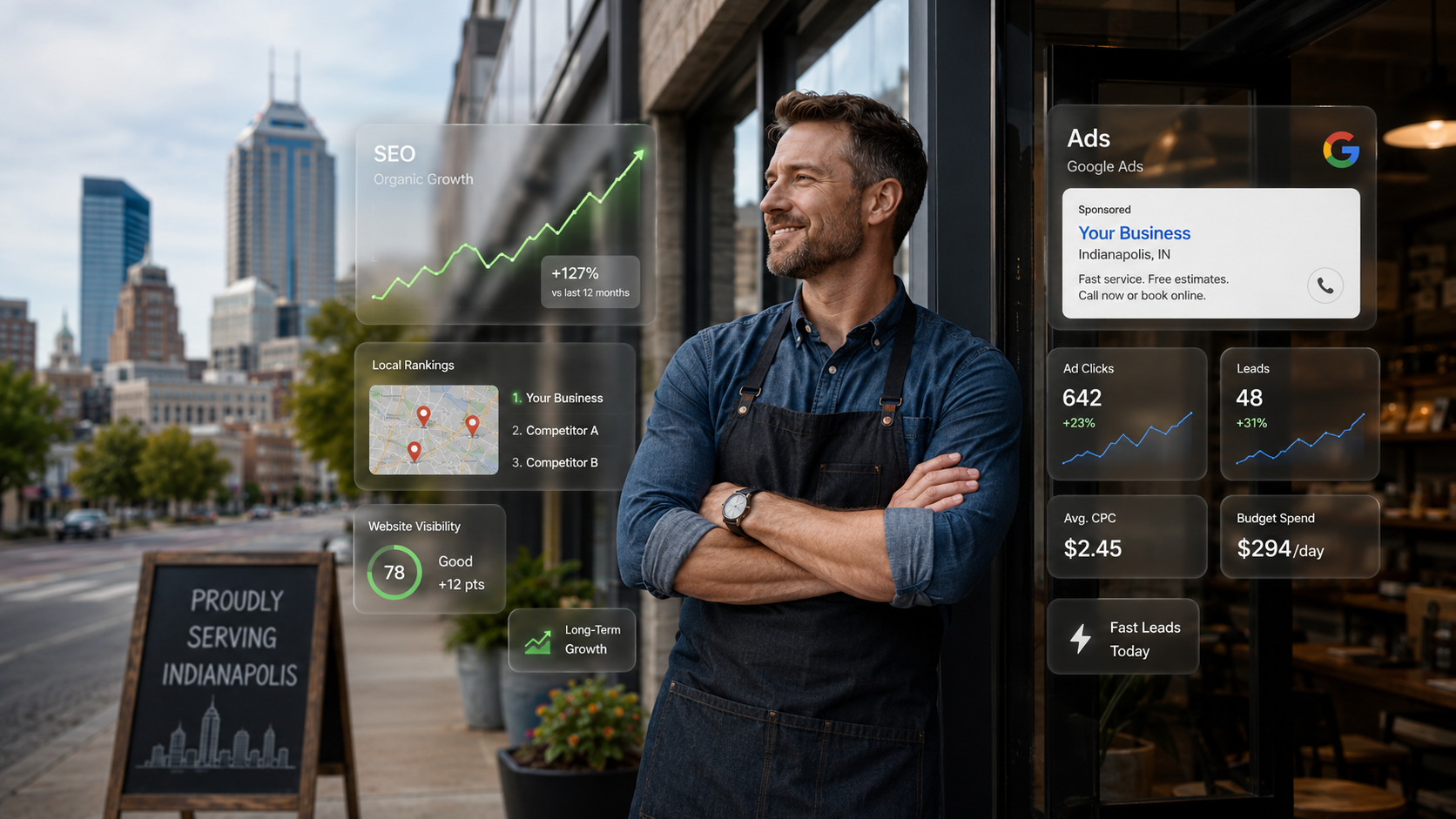
You have $5,000 to invest in marketing.
Where should it go?
SEO?
Google Ads?
Half and half?
Do you spend the money getting your Indianapolis business to rank organically?
Or do you pay Google to put your company in front of customers searching right now?
This is one of the most common—and most poorly answered—questions in local digital marketing.
Ask an SEO agency and you'll often hear:
“SEO is better because you don't have to pay for every click.”
Ask a PPC agency and you'll hear:
“Google Ads is better because SEO takes too long.”
Neither answer is particularly useful.
The correct answer depends on your business.
An Indianapolis plumbing company with empty technician schedules has a very different problem from a law firm already generating leads but paying increasingly high acquisition costs.
A new HVAC company launching next month has different priorities from a 25-year-old Indianapolis contractor with an established domain and hundreds of reviews.
A company selling a $20,000 service can tolerate advertising economics that would destroy the margins of a company selling a $75 service call.
So the useful question isn't:
“Is SEO better than Google Ads?”
It's:
“Given our current position, where will the next marketing dollar create the most business value?”
And sometimes the answer is SEO.
Sometimes it's Google Ads.
Often, it's both—but not necessarily in equal amounts or at the same time.
Google itself makes one important distinction very clear: paying for Google Ads does not improve your organic Google rankings. Google says advertising with Google has no effect on a site's presence in organic search results, and it does not accept payment to rank sites organically. (Google Search Central)
So you should think about SEO and Google Ads as two different ways of capturing search demand.
Google Ads rents visibility.
SEO builds visibility.
Both can generate customers.
But they behave very differently.
Let's break down where Indianapolis businesses should spend first.
What Is the Difference Between SEO and Google Ads?
Before comparing them, define what we're actually discussing.
SEO
SEO—or search engine optimization—is the process of improving your website and broader online presence so search engines can better understand your business and potentially show your pages in unpaid search results.
Google describes SEO as helping search engines understand content while helping users find your site and decide whether they should visit it. (Google Search Central)
For an Indianapolis business, SEO can include:
Technical SEO
Website architecture
Service pages
Indianapolis landing pages
Google Business Profile optimization
Local SEO
Reviews
Internal linking
Content
Backlinks
Local citations
Structured data
Page experience
Conversion optimization
SEO can affect several types of visibility, including traditional organic listings and, through local SEO efforts, your broader ability to compete in Google's local ecosystem.
Google says local results are primarily based on relevance, distance, and prominence. (Google Business Profile Help)
For the complete Indianapolis local-search framework, read Local SEO in Indianapolis: How to Rank Higher on Google Maps in 2026.
Google Ads
Google Ads is Google's paid advertising platform.
For this article, we're primarily talking about Search campaigns—the ads businesses can use to reach people actively searching for products or services.
Google describes Search campaigns as a way to place ads across search results and show advertisements to people actively searching for the products and services a business provides. (Google Ads Help)
Unlike SEO, you aren't earning organic placement.
You're entering an advertising auction.
Google uses Ad Rank to determine whether eligible ads appear and where they're shown. Ad Rank incorporates factors that can include bids, auction-time ad quality, search context, thresholds, and the expected impact of ad assets. (Google Ads Help)
You set budgets.
You target demand.
You pay for advertising interactions according to the campaign's bidding model.
And when you stop funding the campaigns, that paid traffic does not continue indefinitely.
SEO vs. Google Ads at a Glance
Here is the simplest comparison.
Neither column automatically wins.
The correct choice depends on what the business needs.
The Biggest Difference: Renting Demand vs. Building an Asset
Imagine your Indianapolis business spends $5,000 on Google Ads this month.
The campaign generates clicks.
Some clicks turn into leads.
Some leads turn into customers.
Great.
Next month, if you stop spending, the advertising campaign no longer has the same budget available to continue buying that visibility.
Now imagine you spend $5,000 improving:
Technical SEO
Service pages
Indianapolis content
Internal linking
Google Business Profile
Local citations
Backlinks
You aren't guaranteed rankings.
But you're building assets that remain on your website and across your search footprint after the month ends.
That's one of SEO's most attractive characteristics.
A strong service page can continue generating organic traffic.
A backlink can continue pointing to your site.
A well-optimized Google Business Profile can continue being discovered.
An Indianapolis pricing guide can continue ranking.
That does not mean SEO is free.
SEO requires ongoing investment.
Websites change.
Competitors improve.
Search results evolve.
Content ages.
Technical problems appear.
But the work can accumulate into assets rather than disappearing whenever the daily ad budget reaches zero.
The Biggest Advantage of Google Ads: Speed
Now flip the argument.
Suppose you opened an Indianapolis roofing company last month.
Your website has:
Almost no backlinks
Little domain history
Few reviews
Minimal organic visibility
You can do everything correctly with SEO and still need time for Google to crawl pages, process changes, evaluate signals, and for the site's visibility to develop.
Google explicitly says SEO changes can take time to appear in Search. Some changes may be reflected in hours, while others can take months, and Google generally recommends allowing at least several weeks before evaluating whether changes had a beneficial effect. (Google Search Central)
Meanwhile:
Payroll is Friday.
The trucks are available.
You need leads.
Google Ads can give you a path to compete for searches without waiting for organic rankings to mature.
That makes paid search especially attractive when speed has economic value.
When Indianapolis Businesses Should Spend on Google Ads First
There are situations where we'd seriously consider putting paid search ahead of a major SEO investment—at least initially.
1. You Need Leads Now
You have capacity today.
Technicians aren't fully booked.
Sales representatives need opportunities.
A new location needs customers.
Waiting months for organic visibility may be economically irrational.
This doesn't mean ignoring SEO.
It means recognizing that the company has a short-term demand problem.
Google Search campaigns are specifically designed to reach people actively searching for products and services. (Google Ads Help)
For high-intent queries such as:
emergency plumber Indianapolis
AC repair Indianapolis
Indianapolis personal injury lawyer
roof repair near me
commercial electrician Indianapolis
paid search can potentially put your offer in front of people already expressing demand.
If you need customers this month, that speed matters.
2. You're Launching a Brand-New Business
A new business often has almost no search authority.
It may have:
New domain
New Google Business Profile
Few reviews
Few links
Little content
Limited brand recognition
SEO should still begin immediately.
But expecting organic search to carry the entire launch may create unrealistic pressure.
Paid search can act as a bridge.
While you're building:
Service pages
Reviews
Local citations
Backlinks
Indianapolis content
Organic rankings
Google Ads can help generate demand sooner.
Think of it as:
Ads fund the present.
SEO builds the future.
3. You're Launching a New Service
Maybe the business is established but the offer is new.
An Indianapolis HVAC company adds:
Commercial refrigeration.
A law firm launches:
Estate planning.
A marketing agency launches:
AI search optimization.
You don't yet know exactly which queries generate strong leads.
Google Ads can help test.
You can learn:
Which search terms attract clicks
Which offers convert
Which landing pages work
Which geographic areas respond
Which calls become real customers
That information can later influence SEO strategy.
Paid search becomes research.
4. You Know Your Customer Economics
Google Ads works best when the business understands what a lead is worth.
Suppose:
Average customer value = $8,000
Lead-to-customer close rate = 25%
Then the rough expected value of a qualified lead is significantly higher than a company where:
Average sale = $100
Margin = $30
Understanding your numbers helps determine how aggressively you can pay for demand.
You should know:
Average sale value
Gross margin
Lead-to-sale conversion rate
Customer lifetime value where relevant
Acceptable customer acquisition cost
Lead quality
Without those numbers, advertisers often optimize toward cheap clicks instead of profitable customers.
Cheap traffic isn't the goal.
Profitable acquisition is.
5. Your Website Already Converts Well
Buying traffic for a bad website is expensive.
Before increasing paid spend, ask:
What happens after the click?
If the landing page has:
Clear service
Strong offer
Testimonials
Reviews
Easy form
Click-to-call
Relevant Indianapolis information
Fast mobile experience
great.
If it has:
Generic homepage
Broken forms
Slow loading
No trust
No pricing context
Confusing navigation
you may be paying Google to send people into a conversion problem.
Before scaling ads, use The Indianapolis Website Audit: 20 SEO Problems That Cost Local Businesses Leads.
6. You Have Conversion Tracking Set Up Correctly
Do not spend serious money on Google Ads without knowing what happens after people click.
Google Ads provides conversion measurement designed to connect ad interactions with meaningful business actions, including leads and sales. (Google Ads Help)
Depending on the business, track:
Phone calls
Contact forms
Quote requests
Appointment bookings
Purchases
Qualified leads
Offline conversions where practical
A campaign producing 100 conversions sounds great.
But what if 92 are low-value actions and eight are real leads?
Measurement quality directly affects decision quality.
When Indianapolis Businesses Should Invest in SEO First
Google Ads is fast.
That doesn't automatically make it the best first investment.
There are many situations where strengthening organic search should come first.
1. Your Website Is Technically Broken
If Google struggles to crawl, index, or understand important pages, that's foundational.
Examples include:
Important pages noindexed
Broken URLs
Incorrect canonicals
Major redirect problems
Poor internal linking
Duplicate pages
Broken mobile experience
Fix that.
Why send more paid traffic to a website with structural problems?
Why publish more campaigns while your organic assets remain dysfunctional?
Our Indianapolis Website Audit covers the 20 issues we'd look for first.
2. People Already Search for Your Services Consistently
If Indianapolis customers repeatedly search for what you sell, organic visibility can become an extremely valuable asset.
Examples:
plumber Indianapolis
HVAC repair Indianapolis
dentist Indianapolis
personal injury attorney Indianapolis
roofer Indianapolis
These aren't temporary trends.
They're recurring categories of demand.
That creates an argument for owning more organic visibility instead of renting all of it indefinitely.
3. Your Paid Acquisition Costs Are Becoming Difficult to Sustain
Google Ads operates through auctions.
You aren't paying a fixed universal price for a click.
Google's Ad Rank system considers bids, ad quality, context, and other factors, and the competitive landscape can influence what advertisers need to bid to compete. (Google Ads Help)
In competitive industries, paid acquisition can become expensive.
If your entire lead-generation system depends on Google Ads, rising acquisition costs can create vulnerability.
SEO provides another demand-capture channel.
Not free demand.
But demand where you aren't paying Google directly for every organic click.
4. You Want More Google Maps Visibility
Google Ads does not buy better organic local rankings.
Google explicitly says businesses cannot request or pay for better organic local ranking. (Google Business Profile Help)
If your primary problem is:
“We're invisible in Google's Local Pack.”
that's an SEO/local SEO problem.
You need to investigate:
Relevance
Distance
Prominence
Categories
Reviews
Website relevance
Backlinks
Citations
Local authority
Use What Makes an Indianapolis Business Rank in Google's 3-Pack? for the complete framework.
5. Your Competitors Depend Heavily on Paid Ads but Have Weak Organic SEO
This can be a major opportunity.
Search your important Indianapolis terms.
Maybe competitors dominate the sponsored positions.
But their websites have:
Thin service pages
Weak Indianapolis content
Poor internal linking
Few useful articles
Weak organic rankings
Instead of trying to outbid them forever, build organic assets they haven't.
Long-term, that can create a more diversified acquisition system.
6. Your Customer Research Process Is Long
Not every Indianapolis buyer searches once and immediately calls.
Some purchases involve weeks or months of research.
Examples:
Large commercial projects
Legal services
Major remodeling
Financial services
B2B technology
Expensive medical procedures
Enterprise services
Customers may search:
problem
then:
solutions
then:
cost
then:
companies
then:
reviews
then finally:
provider near me
SEO gives you the ability to appear throughout that research journey.
A paid ad focused only on the final commercial keyword may miss much of the process.
7. You Want to Build Search Authority Around a Market
This is where content clusters become valuable.
Your Indianapolis SEO cluster, for example, can contain:
Maps
Website audits
Reviews
Citations
Local Pack rankings
Competitive strategy
Google Ads vs. SEO
Near-me search
Each article supports a different search intent.
Together, the site develops a larger body of useful information around Indianapolis search marketing.
A paid campaign can't replicate that asset.
Why “SEO Is Free Traffic” Is Misleading
SEO clicks don't carry a direct Google Ads charge.
That doesn't mean SEO is free.
Strong SEO may require investment in:
Strategy
Research
Writing
Web development
Technical fixes
Design
Photography
Digital PR
Backlinks
Tools
Agency support
Internal staff
The relevant comparison isn't:
Free vs. paid.
It's:
Investment model A vs. investment model B.
Google Ads spends directly into an auction.
SEO spends into assets and optimization designed to increase organic visibility.
Both require money or labor.
Why “Google Ads Gets Instant Results” Is Also Too Simple
Google Ads can produce visibility much faster than SEO.
But visibility isn't the same as profitability.
A campaign still needs:
Correct targeting
Useful keywords
Negative keywords
Geographic targeting
Strong ad copy
Appropriate bidding
Landing pages
Conversion tracking
Budget
Optimization
Google's Ad Rank system also considers ad quality and landing-page experience—not simply which company bids the most. Google notes that higher-quality ads can sometimes lead to lower cost per click. (Google Ads Help)
Launching Google Ads today does not guarantee profitable leads tomorrow.
It gives you a faster testing mechanism.
That's different.
How Much Do Google Ads Cost in Indianapolis?
There is no single Indianapolis Google Ads price.
Anyone telling you:
“Google Ads costs $4.72 per click in Indianapolis.”
without knowing your industry, keywords, bidding strategy, competition, and campaign is oversimplifying.
Google defines average cost per click as total click cost divided by the number of clicks. (Google Ads Help)
But actual advertising costs vary.
Your campaigns may depend on:
Industry
Keyword competition
Geography
Search intent
Ad quality
Landing page
Bids
Campaign goal
Device
Time
Competition in each auction
Google lets advertisers establish average daily budgets and adjust them over time. (Google Ads Help)
So don't begin with:
“How much does Google Ads cost?”
Begin with:
“How much can we afford to pay to acquire a profitable customer?”
Then work backward.
How Much Does SEO Cost in Indianapolis?
The answer is equally variable.
SEO can involve dramatically different scopes.
One business may need:
Technical cleanup
Google Business Profile work
Five service pages
Basic citation cleanup
Another may need:
Full website migration
100 service/location pages
Content program
Backlink campaign
Technical development
Conversion work
Digital PR
Price follows scope.
The useful question isn't:
“What's the cheapest SEO package?”
It's:
“What work is required to close the gap between our current visibility and our competitors?”
If nobody has audited the site, start there.
SEO vs. Google Ads for Indianapolis Home Service Businesses
Home services are a good example because both channels can work extremely well.
Imagine an Indianapolis HVAC company.
Google Ads Can Capture
emergency AC repair
furnace repair near me
HVAC repair Indianapolis
These searches can carry urgent intent.
Speed matters.
SEO Can Build
Maps rankings
Furnace Repair page
AC Repair page
Indianapolis HVAC page
Cost guides
Review authority
Local backlinks
Service-area visibility
For many home service companies, the best system is not SEO or Ads.
It's:
Ads capture immediate demand while SEO reduces long-term dependence on paid acquisition.
SEO vs. Google Ads for Indianapolis Law Firms
Legal search can be intensely competitive.
Paid search can provide faster access to high-intent terms.
But organic authority can become exceptionally valuable because legal prospects often research extensively.
An SEO strategy might include:
Practice-area pages
Indianapolis pages
Attorney bios
Legal FAQs
Case results where ethically appropriate
Indiana legal resources
Backlinks
Reviews
Google Maps
Paid search can then focus on the most valuable commercial opportunities.
Again:
Different jobs.
Same funnel.
SEO vs. Google Ads for Indianapolis B2B Companies
B2B businesses often have lower search volume but much larger deal values.
A single qualified lead may be worth tens of thousands—or more.
Google Ads can work well for precise high-intent searches.
But SEO is powerful when buyers research:
Problems
Solutions
Comparisons
Pricing
Vendors
Implementation
Case studies
For B2B, content depth may matter more than raw traffic.
Ten highly qualified visitors can be more valuable than 10,000 generic sessions.
SEO vs. Google Ads for a New Indianapolis Business
For a new business, we'd rarely recommend:
“Forget SEO until later.”
That's exactly when SEO should begin.
But we'd also hesitate to say:
“Spend everything on SEO and hope the phone rings.”
A balanced launch might look like:
Paid Search
Generate early demand and learn which queries convert.
SEO
Build:
Website architecture
Service pages
Google Business Profile
Reviews
Citations
Local pages
Content
Authority
That gives the company both a short-term acquisition channel and a long-term foundation.
The Hidden Advantage of Running SEO and Google Ads Together
SEO and Ads can improve decision-making when they share data—even though paying for ads does not improve organic rankings.
Google is explicit that advertising does not affect organic search presence. (Google Search Central)
But the marketing insights can still inform each other.
For example:
Google Ads reveals that:
“commercial roof repair Indianapolis”
converts exceptionally well.
That can influence your SEO priorities.
Maybe that query deserves:
Better service page
Stronger internal links
Case study
Local content
Backlinks
Likewise, SEO data may show a query where you're already ranking first organically.
Depending on campaign economics, you might decide paid budget is better allocated elsewhere.
The channels don't manipulate each other's rankings.
They can improve each other's strategy.
Google Ads Can Tell You Which SEO Keywords Actually Make Money
SEO keyword research often starts with:
Search volume
Competition
Relevance
Intent
Useful.
But nothing beats conversion data.
Suppose you assumed:
“Indianapolis roofing company”
would be your best term.
Ads reveal that:
“commercial roof leak repair Indianapolis”
produces much stronger leads.
Now you have business evidence.
That should affect:
SEO content
Service pages
internal linking
Case studies
Calls to action
Paid search can act as a testing lab for organic strategy.
SEO Can Lower Your Dependence on Google Ads
Imagine Google Ads currently generates 80% of your leads.
What happens if:
CPC rises
Competition increases
A campaign gets disrupted
Your budget gets cut
Conversion rate falls
You have a concentration risk.
SEO creates another channel.
Your future lead mix might look more like:
Google Ads
Organic search
Google Maps
Referrals
Direct traffic
AI search
Partnerships
Diversification is healthy.
The goal isn't necessarily eliminating paid search.
It's avoiding a situation where turning off one campaign shuts off your pipeline.
How Google Maps Changes the SEO vs. Ads Decision
Local businesses have an advantage that purely national businesses don't:
Maps.
Google's organic local rankings cannot be purchased.
Google says local results are based primarily on relevance, distance, and prominence and explicitly states there is no way to pay for better organic local ranking. (Google Business Profile Help)
That makes local SEO a separate asset.
If Indianapolis customers frequently choose companies from Maps or the Local Pack, ignoring organic local SEO can be expensive.
You want to strengthen:
Google Business Profile
Categories
Reviews
Website relevance
Links
Citations
Indianapolis authority
Read What Makes an Indianapolis Business Rank in Google's 3-Pack? for the complete breakdown.
What If Your Competitor Is Running Ads and Outranking You Organically?
This situation can feel overwhelming.
They appear:
Sponsored result.
Then:
3-Pack.
Then:
Organic result.
That's powerful search-result coverage.
But don't assume they're unbeatable.
Break the problem into channels.
Paid
Are they running effective campaigns?
Local
Why do they rank in Maps?
Organic
Which pages are outranking yours?
Then audit the gaps.
They may have:
Better categories
More backlinks
Stronger service pages
Better location relevance
Better reviews
Better technical SEO
Use Why Your Competitor Ranks Above You in Indianapolis — Even With Fewer Reviews to diagnose the local side.
Can Small Indianapolis Businesses Compete With National Advertisers?
Yes—but don't compete blindly.
National brands may have huge PPC budgets.
That does not mean every campaign is efficient.
Google's auction doesn't simply give first place to the advertiser spending the most overall.
Ad Rank considers multiple factors, including bid, ad quality, search context, and expected asset impact. (Google Ads Help)
Local companies can improve competitiveness through:
Tighter geographic targeting
Better service specificity
Better landing pages
Better ad relevance
Stronger local proof
Better conversion experiences
For the organic side, see How Indianapolis Small Businesses Can Compete With National Brands on Google.
Don't Send Google Ads Traffic to Your Homepage by Default
This is one of the easiest ways to waste budget.
Someone searches:
“commercial HVAC Indianapolis.”
Your ad lands them on:
Homepage
where they have to click:
Services → Commercial → HVAC → Contact.
Why?
Build a landing experience matching the search.
A strong page should immediately communicate:
Service
Indianapolis relevance
Value proposition
Proof
CTA
Relevance matters in paid search too.
Google says landing-page experience contributes to ad quality and Ad Rank. (Google Ads Help)
Better landing pages can therefore support both:
conversion performance
and:
advertising efficiency.
Don't Spend on SEO Without Fixing Conversion Problems Either
The same logic works in reverse.
Suppose SEO increases traffic by 100%.
Great.
But the website still has:
Broken contact form
Hidden phone number
Weak service pages
No testimonials
No calls to action
Congratulations.
You doubled the number of people experiencing your bad website.
Traffic isn't the objective.
Demand capture is.
SEO and PPC both depend on conversion.
What Should You Track for Google Ads?
At minimum:
Spend
Clicks
CPC
Conversions
Conversion rate
Cost per conversion
Qualified leads
Cost per qualified lead
Customers
Revenue
Acquisition cost
Google Ads conversion measurement exists specifically to help advertisers understand which interactions lead to meaningful business actions. (Google Ads Help)
Do not optimize only for:
click volume.
Clicks are inventory.
Customers are the outcome.
What Should You Track for SEO?
Track:
Impressions
Clicks
Rankings
Organic landing pages
Google Maps visibility
Google Business Profile interactions
Leads
Calls
Forms
Qualified opportunities
Revenue
Don't judge SEO exclusively by traffic.
An Indianapolis cost guide receiving 200 visitors and producing ten qualified leads can be substantially more valuable than a generic blog receiving 10,000 visits and producing none.
Which Channel Has Better ROI?
There is no universal answer.
SEO might produce extraordinary ROI for one Indianapolis company.
Google Ads might outperform for another.
The answer depends on:
Margins
Competition
Current organic authority
Search demand
Website
Landing pages
Sales process
Conversion rate
Customer value
Time horizon
Paid competition
SEO competition
Anyone promising:
“SEO always has higher ROI.”
or:
“Google Ads always generates better leads.”
is oversimplifying.
Measure your business.
When the Best Answer Is Both
For many established Indianapolis businesses, SEO vs. Google Ads is the wrong framing.
The better strategy is:
Google Ads + SEO
with each doing a different job.
Google Ads
Capture demand now.
SEO
Build organic visibility over time.
Google Business Profile
Capture Maps demand.
Reviews
Increase trust.
Content
Capture research intent.
Backlinks and Citations
Strengthen authority.
That's a diversified search acquisition strategy.
An Illustrative Budget Strategy
There is no universal allocation.
But here are examples of how businesses might think about it.
These are illustrative strategy examples, not industry benchmarks or guarantees.
Scenario 1: Brand-New Indianapolis Company
Priority:
Generate early leads while building the foundation.
Possible approach:
60–70% paid search
30–40% SEO foundation
Over time, the percentage can shift toward SEO as organic assets mature.
Scenario 2: Established Company With Weak SEO
The business already has:
Revenue
Reviews
Domain history
Customers
but poor organic visibility.
Possible approach:
Heavier SEO investment initially
while maintaining enough Google Ads to protect lead flow.
Scenario 3: Company With Strong SEO but Immediate Capacity
You already rank.
But three crews suddenly have availability.
Increase Google Ads temporarily to capture more immediate demand.
SEO doesn't have an on/off volume knob.
Paid search does.
Scenario 4: Company With Tiny Marketing Budget
Don't automatically split $1,000 across:
SEO
Google Ads
Facebook
Instagram
email
YouTube
until every channel receives too little investment to learn anything.
Concentration can be smarter.
Pick the channel with the clearest path to measurable return.
Then expand.
A Simple Decision Framework
Ask these questions.
Do You Need Leads in the Next 30 Days?
Yes: Consider Google Ads heavily.
No: SEO has more room to mature.
Is Your Website Technically Healthy?
No: Fix the website before aggressively scaling either channel.
See The Indianapolis Website Audit.
Do You Know Which Services Are Most Profitable?
No: Ads can help test demand, but fix your business measurement too.
Are Customers Repeatedly Searching for Your Services?
Yes: Organic visibility deserves investment.
Are Your Google Maps Rankings Weak?
Yes: Local SEO is necessary.
Ads cannot purchase better organic local rankings.
Do You Have Strong Reviews?
No: Build reputation alongside either strategy.
Review strength affects both visibility and conversion.
Are You Already Spending Heavily on Ads?
Yes: SEO can help diversify acquisition.
Are You Already Ranking Organically?
Yes: Ads can extend coverage, test new terms, or increase volume.
The Indianapolis Search Strategy We'd Usually Prefer
For many established local businesses, the healthiest long-term system is:
Phase 1: Fix
Repair:
Website
Tracking
Google Business Profile
Major conversion problems
Phase 2: Capture
Use Google Ads where immediate demand and economics justify it.
Phase 3: Build
Invest consistently in:
Service pages
Indianapolis content
Maps
Reviews
Backlinks
Citations
Internal linking
Phase 4: Measure
Compare:
Cost per lead
Cost per qualified lead
Customer acquisition cost
Organic growth
Maps visibility
Revenue
Phase 5: Reallocate
Put more money toward the channels producing profitable customers.
Strategy isn't ideological.
It's economic.
Where Your Indianapolis Local SEO Cluster Fits
If you're deciding whether SEO deserves more budget, examine whether you've already built the foundation.
Start with:
Google Maps
Local SEO in Indianapolis: How to Rank Higher on Google Maps in 2026
Technical SEO
The Indianapolis Website Audit: 20 SEO Problems That Cost Local Businesses Leads
Competitive Rankings
Why Your Competitor Ranks Above You in Indianapolis — Even With Fewer Reviews
Citations
Indianapolis Local Citations: Which Business Directories Actually Matter?
Local Pack
What Makes an Indianapolis Business Rank in Google's 3-Pack?
Competing Against Large Brands
How Indianapolis Small Businesses Can Compete With National Brands on Google
Those six areas collectively tell you whether your organic foundation is strong enough—or whether competitors are capturing demand you're currently forced to buy.
Frequently Asked Questions
Is SEO Better Than Google Ads for Indianapolis Businesses?
Neither channel is universally better.
SEO is generally stronger for building long-term organic search assets, while Google Ads offers greater speed and direct control over paid search campaigns.
The best choice depends on:
How quickly you need leads
Your marketing budget
Current rankings
Website quality
Customer value
Competition
Business margins
Search demand
Many Indianapolis businesses benefit from using both.
Should a New Indianapolis Business Start With SEO or Google Ads?
Usually, both deserve consideration.
SEO should begin early because authority, content, reviews, backlinks, and organic visibility take time to develop.
Google Ads can help a new company capture demand while those organic assets are being built.
If the budget cannot support both meaningfully, prioritize based on how urgently the business needs customers and how strong the website foundation is.
How Long Does SEO Take to Work?
There is no universal timeline.
Google says some SEO changes may be reflected within hours while others can take months, and generally recommends waiting at least several weeks before determining whether changes had a beneficial impact. (Google Search Central)
Competitive Indianapolis industries may require sustained work across content, technical SEO, reviews, links, and local authority.
How Quickly Can Google Ads Generate Leads?
Google Ads can create search visibility substantially faster than organic SEO because advertisers can enter paid auctions rather than waiting to earn organic rankings.
Google describes Search campaigns as a way to reach users actively searching for relevant products and services. (Google Ads Help)
However, visibility does not guarantee profitable leads.
Campaign structure, targeting, budget, ads, landing pages, conversion tracking, and sales performance still matter.
Does Paying for Google Ads Help My SEO Rankings?
No.
Google explicitly says advertising with Google does not affect a site's organic search presence and that it does not accept money to include or rank websites in organic results. (Google Search Central)
Paid and organic search are separate systems.
Does Running Google Ads Help My Google Maps Ranking?
Paying Google Ads does not purchase better organic local ranking.
Google explicitly says businesses cannot request or pay for improved organic local rankings. (Google Business Profile Help)
Organic Maps visibility is primarily influenced by relevance, distance, and prominence.
Is SEO Free?
No.
Organic clicks don't have a direct CPC paid to Google, but SEO requires resources.
That can include:
Strategy
Content
Technical development
Website work
Digital PR
Backlinks
Tools
Staff
Agency fees
“Unpaid search” does not mean “zero-cost marketing.”
Do I Pay Every Time Someone Clicks a Google Search Ad?
Many Google Search campaigns use cost-per-click models in which advertisers pay for clicks, although Google Ads supports multiple bidding approaches.
Google defines average CPC as total click cost divided by total clicks. (Google Ads Help)
The campaign's bidding strategy and objective determine how costs are managed.
How Much Should an Indianapolis Business Spend on Google Ads?
There is no universal budget.
Budget should be based on:
Industry
Search demand
Competition
Customer value
Profit margin
Lead close rate
Acceptable acquisition cost
Google lets advertisers set and modify average daily campaign budgets. (Google Ads Help)
Start with business economics rather than an arbitrary monthly number.
How Much Should an Indianapolis Business Spend on SEO?
It depends on the competitive gap and scope of work.
An SEO campaign may need:
Technical fixes
New service pages
Indianapolis pages
Content
Google Business Profile optimization
Citations
Reviews
Authority building
Links
A small business with a healthy established website needs a different budget from one requiring a complete rebuild.
Which Generates Better Leads: SEO or Google Ads?
Either can generate high-quality or low-quality leads.
Lead quality depends on:
Search intent
Targeting
Landing page
Offer
Service
Geography
Keyword
Sales process
A high-intent organic search can produce an excellent lead.
A high-intent paid search can produce an excellent lead.
Judge using qualified-lead and revenue data rather than channel stereotypes.
Is SEO Better for Long-Term Growth?
SEO can be especially valuable for long-term growth because the assets created—pages, links, content, local authority, and technical improvements—can continue supporting organic visibility after the initial work is completed.
That doesn't mean rankings are permanent or SEO becomes maintenance-free.
Competition and search results continue evolving.
Is Google Ads Better for Immediate Leads?
Google Ads is often better suited to immediate demand capture because Search campaigns can place paid listings in front of people actively searching for relevant products and services. (Google Ads Help)
That makes paid search particularly useful when a business has available capacity and needs leads sooner.
Should Indianapolis Home Service Companies Use SEO or PPC?
Often both.
Paid search can help capture urgent searches such as:
emergency plumber
AC repair
roof repair
while SEO builds longer-term visibility across:
Google Maps
Service pages
Organic search
Pricing guides
Local content
The right mix depends on economics and capacity.
Should Indianapolis Law Firms Use SEO or Google Ads?
Both can be effective.
Paid search can target high-intent legal queries quickly.
SEO can create broader organic visibility through practice-area pages, local pages, reviews, authority, and informational resources.
Because legal advertising economics can vary significantly by practice area, firms should evaluate qualified cases and signed-client acquisition costs rather than raw clicks.
Can Google Ads Help Me Test SEO Keywords?
Yes, strategically.
Paid search data can reveal which queries produce clicks and conversions.
That information can help prioritize:
SEO pages
Content
Internal links
Landing pages
This does not mean Ads directly improve organic rankings.
It means paid data can inform organic decision-making.
Should I Bid on Keywords Where I Already Rank Organically?
Sometimes.
Reasons might include:
Greater search-result coverage
Competitor defense
Testing offers
Controlling ad messaging
Capturing additional demand
Other times, budget may be better spent on keywords where organic visibility is weak.
Test based on incremental conversions and profitability rather than assuming one answer applies to every keyword.
Can I Stop SEO Once I Rank?
Usually not if the rankings matter to your business.
Competitors continue improving.
Websites change.
Search results evolve.
Content becomes outdated.
Technical problems can emerge.
SEO should be treated as an ongoing acquisition asset, though the required intensity may change over time.
Can I Stop Google Ads Once SEO Starts Working?
You can reduce or stop campaigns if the economics no longer make sense, but strong SEO doesn't automatically make paid search unnecessary.
Ads may still provide value through:
Incremental lead volume
New service testing
Seasonal campaigns
Competitor terms
Geographic expansion
Immediate capacity filling
Use performance data to decide.
What If My Indianapolis Competitors Are Doing Both?
Then competing through one channel alone may limit your search visibility.
A competitor appearing:
In paid results
In the 3-Pack
Organically
has multiple opportunities to capture the same customer.
That doesn't mean blindly matching their spend.
Analyze where they're strongest and where they're vulnerable.
Start with Why Your Competitor Ranks Above You in Indianapolis — Even With Fewer Reviews.
How Do I Know If My Website Is Ready for Google Ads?
Before spending heavily, verify:
Mobile experience works
Forms work
Calls are trackable
Services are clear
Landing pages match ads
Website loads properly
Trust signals are present
CTA is obvious
Conversion tracking works
Use The Indianapolis Website Audit as a starting framework.
How Do I Know If My Website Is Ready for SEO?
Start by ensuring Google can:
Crawl important pages
Index them
Understand site structure
Access mobile content
Then evaluate:
Service pages
Search intent
Titles
Internal links
Indianapolis relevance
Technical health
Authority
Google's SEO Starter Guide recommends focusing first on making content accessible, useful, and understandable. (Google Search Central)
What's the Best Marketing Strategy for an Indianapolis Business With a Limited Budget?
Choose the channel with the clearest path to measurable results rather than spreading a small budget across too many tactics.
If immediate leads are critical and the website converts, paid search may deserve priority.
If the business already has customers and can invest for longer-term growth, SEO may deserve more budget.
If the foundation is broken, fix the foundation first.
What Should I Spend on First: SEO, Google Ads, or My Website?
If the website is broken, confusing, or unable to convert visitors, fix the website first.
Both SEO and paid advertising ultimately send people somewhere.
Improving traffic without improving the destination can multiply wasted opportunity.
What's the Best Overall Strategy?
For many Indianapolis businesses:
Build SEO while using Google Ads selectively to capture demand.
That creates:
Short-term lead generation
Long-term organic growth
More search-result coverage
Better keyword data
Less dependence on one acquisition channel
The exact allocation should be based on business economics rather than a standard percentage.
Sources
This article was researched and updated for August 2026. Official Google documentation is used as the primary authority for statements about Google Search, organic SEO, Google Ads, conversion tracking, campaign budgets, Ad Rank, and organic local rankings.
Google Search Central — Do You Need an SEO? Google's current guidance on SEO providers, organic search, and the explicit separation between Google advertising and unpaid organic rankings.
View source
Google Search Central — SEO Starter Guide. Google's official guidance explaining SEO, crawlability, indexing, content, links, titles, and how long some SEO changes may take to affect Search.
View source
Google Business Profile Help — Tips to Improve Your Local Ranking on Google. Google's official explanation of relevance, distance, prominence, reviews, links, and the fact that businesses cannot pay for better organic local rankings.
View source
Google Ads Help — Create a Search Campaign. Google's official overview of Search campaigns and reaching people actively searching for products or services.
View source
Google Ads Help — About Ad Rank. Google's documentation explaining how ad eligibility and placement are determined and how ad quality can affect paid-search costs.
View source
Google Ads Help — About Conversion Measurement. Google's official guidance for measuring customer actions after ad interactions.
View source
Google Ads Help — Average Cost Per Click. Google's definition and calculation of average CPC.
View source
Google Ads Help — Set and Change an Average Daily Budget. Google's current guidance for setting and modifying campaign budgets.
View source
Google Ads Help — About Ad Quality. Google's guidance on ad relevance, landing-page experience, bidding, and paid-search quality.
View source
So, Where Should Your Indianapolis Business Spend First?
If you need a one-sentence answer:
Spend first where your biggest constraint is.
If your biggest problem is:
“We need leads immediately.”
Google Ads may deserve priority.
If your biggest problem is:
“We pay for every lead because nobody finds us organically.”
SEO deserves investment.
If your biggest problem is:
“Our website barely works.”
Neither channel should receive your next major dollar until you fix the website.
If your biggest problem is:
“We're invisible on Google Maps.”
Invest in local SEO.
If your biggest problem is:
“We don't know what customers actually search before buying.”
Google Ads can provide useful testing data.
If your biggest problem is:
“We depend almost entirely on Ads.”
SEO can diversify acquisition.
And if you're an established Indianapolis company with enough budget to fund both properly?
The answer is often:
Stop choosing.
Use each channel for what it does best.
Let Google Ads capture high-intent demand today.
Build SEO so your business owns more of that demand tomorrow.
Strengthen your Google Business Profile so customers find you in Maps.
Build reviews so they trust you.
Build content so you appear throughout their research.
Build authority so you're not dependent on one algorithm, one campaign, or one source of leads.
That creates a search marketing system.
Not a channel.
Not Sure Whether Your Next Dollar Should Go to SEO or Google Ads?
Ritner Digital helps businesses evaluate search strategy based on actual demand, competition, economics, and opportunity—not whichever service happens to be easiest to sell.
That includes:
Indianapolis SEO
Local SEO
Google Maps optimization
Technical SEO
Website audits
Google Business Profile strategy
Search demand analysis
Competitor analysis
Service-page optimization
Content strategy
Internal linking
Review strategy
Local citations
Backlink and authority building
AI search optimization
Conversion-focused SEO
Search performance measurement
If you're deciding whether to spend your next marketing dollar on SEO, paid search, or fixing the foundation first, we'll help identify where the biggest opportunity actually is.
Contact Ritner Digital today and tell us what you're currently spending, where your leads come from, and where you want to grow.
We'll look at the search landscape, your website, Indianapolis visibility, competitors, and current acquisition mix—and identify what we'd prioritize first.