Why Your Competitor Ranks Above You in Indianapolis — Even With Fewer Reviews
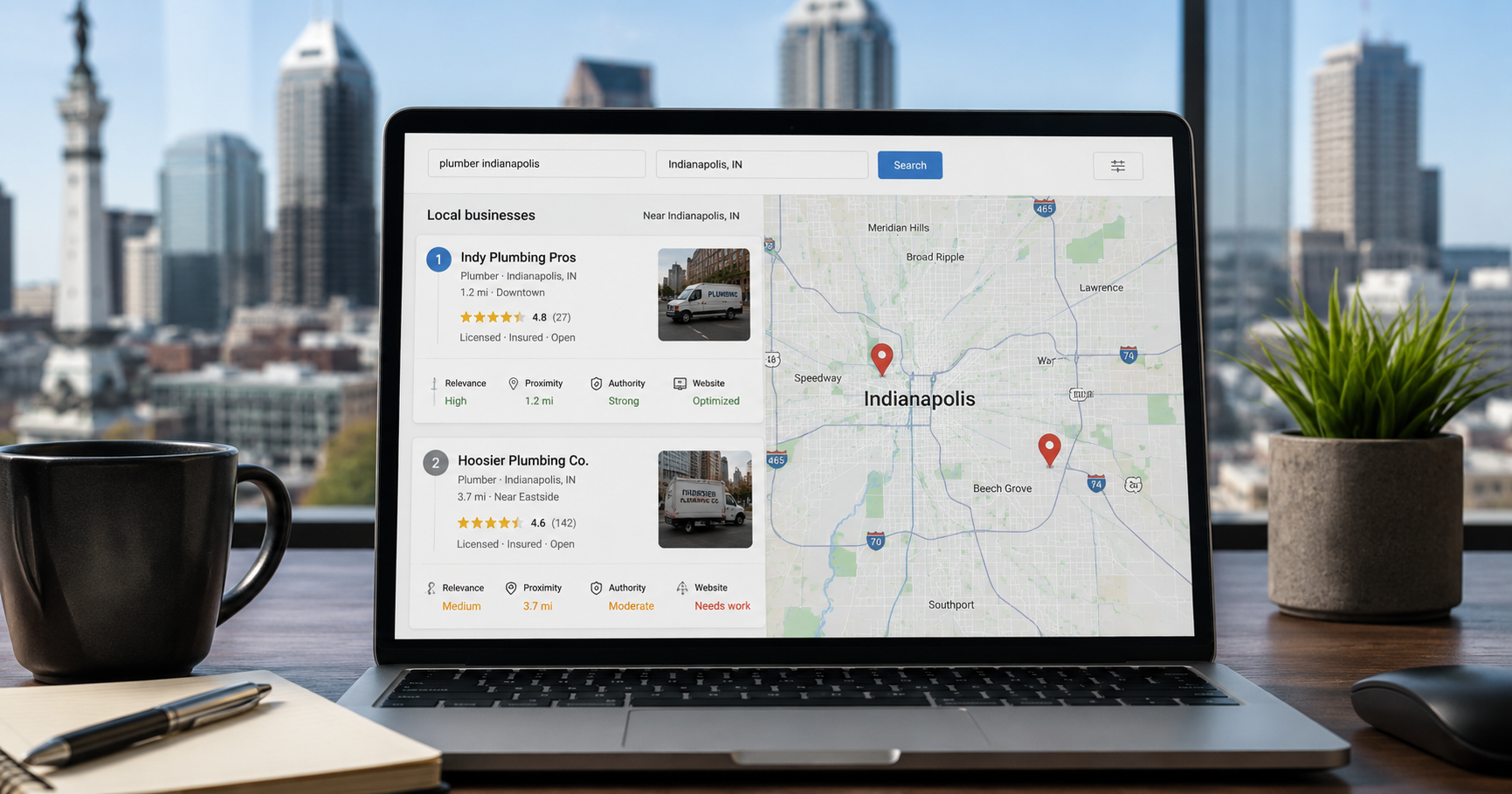
You have 437 Google reviews.
Your Indianapolis competitor has 86.
You have a 4.8-star rating.
They have a 4.7.
You've been operating for 18 years.
They've been around for five.
So you search:
“plumber Indianapolis.”
Or:
“HVAC repair near me.”
Or:
“Indianapolis roofing company.”
And there they are.
Above you.
Again.
For a business owner, few local SEO problems are more frustrating.
You did what everyone told you to do.
You asked customers for reviews.
You provided good service.
You built a legitimate reputation.
Your customers clearly like you.
Yet the company with a fraction of your review count keeps appearing above you on Google Maps.
That can make local SEO feel arbitrary.
It isn't.
The mistake is assuming Google ranks local businesses by placing everyone in a spreadsheet and sorting the Reviewscolumn from highest to lowest.
Google doesn't describe its local-ranking system that way.
Google says local results are primarily determined using three broad factors:
Relevance.
Distance.
Prominence.
Reviews contribute to the equation, and Google specifically says more reviews and positive ratings can help local rankings. But they are not the entire equation.
That means a competitor with fewer reviews can still outrank your Indianapolis business if Google sees that competitor as:
More relevant to the specific search
Closer to the searcher
Better aligned with the requested service
More prominent online in other ways
Better supported by its website
Better categorized
More authoritative for that particular query
And there's another important distinction.
Ranking and conversion are not the same thing.
Your competitor may outrank you with fewer reviews.
But your stronger review profile may still cause more searchers to choose you once they compare both listings.
Reviews influence trust tremendously. BrightLocal's 2026 Local Consumer Review Survey found that 97% of surveyed consumers read reviews for local businesses, while 92% said star ratings affect their decision. But the same research found that consumers evaluate more than raw review volume: recency, consistent sentiment, rating, owner responses, and other evidence all shape trust.
So the question isn't:
“Why doesn't Google care about my 437 reviews?”
Google does care about review signals.
The better question is:
“What is my competitor doing—or what advantage do they have—that is outweighing my advantage in review count?”
That's what we're going to diagnose.
If you're starting from scratch with Indianapolis Maps visibility, read Local SEO in Indianapolis: How to Rank Higher on Google Maps in 2026 first. It explains the broader local-ranking system and how Business Profiles, websites, reviews, content, backlinks, and geographic signals work together.
First: Reviews Absolutely Matter
Before we explain why fewer reviews can win, don't misunderstand the argument.
Reviews matter.
A lot.
Google explicitly says review count and positive ratings can help local ranking.
Reviews also have enormous value after a business appears in the results.
BrightLocal's 2026 consumer study found:
97% of surveyed consumers read local business reviews.
47% said they wouldn't use a business with fewer than 20 reviews.
74% primarily cared about reviews written within the previous three months.
31% said they would only use businesses with ratings of at least 4.5 stars.
85% said positive reviews make them more likely to use a business.
Those numbers make reputation management an important part of local marketing.
But they also reveal why obsessing over total review count is too simplistic.
Imagine two Indianapolis contractors.
Company A
437 reviews
4.4 stars
Most recent reviews are six months old
Company B
91 reviews
4.8 stars
Receives several new reviews every month
Which profile looks healthier?
You can't answer that by comparing review quantity alone.
And neither can you determine Maps rankings that way.
Your review profile should be evaluated as one component of a larger local search system.
Google Local Rankings Are Not a Popularity Contest
Google's own explanation of local ranking is the best place to start.
Its three major factors are:
Relevance
How well does the business match what someone searched?
Distance
How far is the business from the searcher or the geographic location specified in the query?
Prominence
How well-known or established does the business appear?
Google says prominence can draw on information from around the web, including links, articles, directories, reviews, and organic web results.
That creates a critical reality for Indianapolis businesses:
Your review advantage exists inside a much larger competition.
You can dominate one factor and lose others.
You may have substantially more reviews but be farther from the searcher.
You may have more reviews but a weaker primary category.
You may have more reviews but poor service-page relevance.
You may have more reviews but substantially weaker backlinks.
You may have more reviews but a website Google barely associates with the service being searched.
You may have more reviews but an Indianapolis competitor's location lines up almost perfectly with the searcher's position.
None of that means your reviews don't matter.
It means local rankings aren't determined by a single metric.
1. Your Competitor May Be Closer to the Searcher
This is the factor business owners dislike most because it can't be solved by writing another blog post.
Geography matters.
Google says distance is one of the primary factors in local rankings. If someone doesn't specify a location in the query, Google says it may calculate distance based on what it knows about the searcher's location.
Imagine your business is located on one side of Indianapolis.
Your competitor is six miles east.
A customer near the competitor searches:
“electrician near me.”
Your 600 reviews do not physically move your business six miles closer to that person.
This is why local rankings can change block by block.
You may rank extremely well near your actual location and gradually disappear as the search point moves farther away.
Meanwhile, a competitor with 40 reviews may dominate a pocket of Indianapolis where they're geographically better positioned.
Stop Checking One Search From Your Office
This creates a common measurement problem.
The business owner sits at the company office and searches:
“Indianapolis HVAC company.”
Then assumes those rankings represent the entire metro.
They don't necessarily.
Someone searching from Downtown Indianapolis can see a different Maps order than someone in another part of the city.
That's why useful local rank tracking should look geographically at the areas where you actually want customers.
Ask:
Where are we visible?
Not simply:
What position are we?
Your competitor may not actually outrank you everywhere.
They may outrank you in specific geographic zones.
That distinction changes the strategy.
2. Their Primary Google Business Profile Category May Be Better
Google asks businesses to choose categories that accurately describe what they do.
Its Business Profile guidelines specifically recommend using the fewest categories needed to describe the company's overall core business.
Categories matter because relevance matters.
Suppose you run an Indianapolis HVAC company.
Your primary category is:
Air Conditioning Contractor
Your competitor's primary category is:
HVAC Contractor
Someone searches for a query much more closely aligned with the competitor's category.
Depending on the query and surrounding signals, their profile may be a stronger match.
The same issue appears across industries.
A legal practice may be categorized too broadly.
A remodeling company may choose a general contractor category when most searches concern kitchen remodeling.
A dentist may have a category setup that doesn't reflect its core specialty.
A commercial cleaning company may be using a category inherited from years ago that no longer represents its primary revenue stream.
More Reviews Can't Fix Incorrect Relevance
This is a recurring local SEO pattern.
The business asks:
“How can we get another 200 reviews?”
But the more urgent problem might be:
“Google doesn't have the clearest possible understanding of what this business actually is.”
Before building more review volume, audit your primary and additional categories.
Do they accurately represent the company today?
Do they correspond to the services producing the most revenue?
Are competitors ranking for your important searches categorized differently?
Don't add irrelevant categories just because competitors use them.
Google's guidelines emphasize accurately representing the business.
But absolutely examine whether your own profile is under-optimized.
3. Their Google Business Profile May Be More Complete
Two profiles can have dramatically different review counts and still provide Google with very different amounts of information.
Your competitor may have:
Accurate business hours
Correct holiday hours
Appropriate categories
Detailed services
Updated business information
Current website link
Strong photography
Accurate service areas
Active review management
While yours may have:
Wrong hours
Old services
Missing categories
Outdated photographs
Incomplete information
An old website URL
Incorrect service areas
Google's local-ranking guidance recommends complete and accurate Business Profile information and specifically tells businesses to keep information up to date, respond to reviews, and add photos and videos.
Again, none of these is a guaranteed “ranking hack.”
The bigger principle is relevance and clarity.
Google shouldn't have to piece together what your business does from incomplete information.
Your customers shouldn't have to either.
4. Their Website May Be Far Better Optimized Than Yours
Business owners often separate Google Maps from website SEO.
Google doesn't describe local search that way.
Google says prominence incorporates information from the web and notes that a business's position in organic web results can factor into local ranking.
That means your competitor's website matters.
A lot.
Consider two Indianapolis roofing companies.
Your Website
Homepage
About
Services
Contact
The services page contains 400 words covering everything the company does.
Competitor Website
Indianapolis Roofing
Roof Replacement
Roof Repair
Storm Damage
Commercial Roofing
Residential Roofing
Metal Roofing
Insurance FAQs
Project Case Studies
Roof Replacement Cost Guide
Indiana Storm Damage Resources
Customer Reviews
Financing
Which website gives Google more information about the company's roofing expertise?
Which gives a customer more useful information?
Which creates more internal-linking opportunities?
Which has more pages capable of earning organic rankings and backlinks?
Your 500 Google reviews don't automatically erase a major website-quality gap.
Audit the Website Behind the Profile
This is exactly why we published The Indianapolis Website Audit: 20 SEO Problems That Cost Local Businesses Leads.
That audit covers the technical and on-page problems that can weaken search performance, including indexation, page speed, mobile usability, titles, content, internal linking, structured data, local relevance, and conversion tracking.
If your competitor keeps outranking you, don't stare only at their Business Profile.
Audit the website attached to it.
5. Their Service Pages May Match the Search Better
Relevance isn't just about whether you technically offer a service.
It's about whether your digital presence clearly demonstrates that you offer it.
Imagine both companies provide emergency plumbing.
Your website mentions emergency service once on the homepage.
Your competitor has:
Indianapolis Emergency Plumbing
as a dedicated page containing:
Emergency services offered
Common problems
Availability
Process
Service area
FAQs
Customer proof
Contact options
Someone searches:
“emergency plumber Indianapolis.”
Which business has built the stronger relevance case?
Google's SEO guidance recommends useful, well-organized content and advises site owners to think about the words users may search for when looking for their content.
This doesn't mean creating a separate page for every slight keyword variation.
It means giving meaningful services enough depth to stand on their own.
If a service represents a major revenue source and customers search for it independently, it often deserves more than one sentence on your homepage.
6. Their Indianapolis Relevance May Be Stronger
Your company may have operated in Indianapolis for 25 years.
But does your website prove that?
Search engines cannot interview the owner.
They evaluate what's available online.
Your competitor might have:
An Indianapolis service page
Indianapolis case studies
Local testimonials
Indiana project examples
Indianapolis-specific FAQs
Locally relevant content
Local organization memberships
Indianapolis backlinks
Consistent city and service-area information
Meanwhile, your website says:
“Proudly serving Central Indiana”
once in the footer.
Your real-world history may be stronger.
Their digital evidence may be stronger.
That's an important distinction.
Local SEO Is About Making Reality Legible
You don't need to manufacture geographic signals.
You need to publish legitimate ones.
If you have completed hundreds of projects in Indianapolis, show some.
If Indianapolis customers have reviewed you, feature appropriate testimonials on your site.
If you've worked with recognizable local organizations and have permission to discuss it, create case studies.
If different parts of the Indianapolis market have legitimate service considerations, answer those questions.
Build useful evidence around the work you already do.
7. Their Backlink Profile May Be Stronger
You can have 800 Google reviews and still have almost no authoritative websites linking to yours.
Your competitor may have 100 reviews but links from:
Indianapolis organizations
Indiana industry associations
Manufacturers
Suppliers
Local media
Chambers of commerce
Sponsorship partners
Community organizations
Professional associations
High-quality industry publications
Google specifically includes links among the information it can use when determining prominence.
This is one of the most invisible competitive advantages.
You can look at their Business Profile and think:
“They have nothing.”
But the advantage may live somewhere you aren't looking.
Reviews and Links Measure Different Things
Reviews provide evidence of customer experiences.
Backlinks can provide evidence of external authority and relationships.
Both can matter.
A roofing contractor with 150 legitimate reviews and authoritative links from manufacturers, trade organizations, local publications, and community partnerships may have a stronger overall digital authority profile than a contractor with 600 reviews and almost no web authority.
Don't reduce prominence to a review count.
8. Their Organic Rankings May Be Stronger
Search:
“Indianapolis personal injury lawyer.”
Your competitor appears:
In the Local Pack
In the organic results
Through a useful guide
Through another authoritative website mentioning the firm
Your business appears only in Maps.
That's a much broader search footprint.
Google specifically says a business's position in web results can contribute to prominence and recommends standard SEO practices for local ranking.
This is why local SEO and traditional SEO should not be treated as completely separate departments.
Strong organic SEO can reinforce the same company you're trying to rank locally.
Improve:
Service pages
Location pages
Technical SEO
Content
Internal linking
Backlinks
Site architecture
The result isn't only more traditional organic visibility.
You're strengthening the broader digital entity behind the Business Profile.
9. Their Reviews May Be More Recent
Now we get back to reviews—but from a different angle.
You may have 500 reviews.
Your competitor has 120.
But what if 450 of yours were written between 2017 and 2023?
What if your competitor receives five to ten new reviews every month?
From a consumer perspective, those profiles tell different stories.
BrightLocal's 2026 survey found that 74% of respondents primarily cared about reviews from the previous three months, while 44% listed a review posted within the last month as an important trust factor.
That's a powerful reminder:
Review count is cumulative. Trust is current.
Your 2019 customers may have loved you.
A prospect wants to know whether customers still love you in 2026.
Build Review Velocity, Not Review Campaigns
Many companies collect reviews like this:
January:
Management decides reviews are important.
February:
Everyone asks every customer.
March:
Company earns 60 reviews.
April through December:
Nobody asks again.
That's not a review strategy.
Build review requests into operations.
Depending on your business, that could happen:
After a completed service
After project delivery
After an appointment
After a purchase
After a support resolution
In a post-service email
Through a legitimate review request link or QR code
Google provides businesses with tools for sharing review request links or QR codes and recommends requesting feedback from customers without offering prohibited incentives.
Consistency beats occasional panic.
10. Their Average Rating May Be Stronger
Imagine:
You: 612 reviews, 4.2 stars
Competitor: 139 reviews, 4.8 stars
The review count advantage looks less decisive now.
Google says positive ratings can help local ranking.
Consumers care too.
BrightLocal found that 31% of surveyed consumers in 2026 said they would only use a business with at least a 4.5-star rating, while 68% required at least four stars.
So review quantity without review quality isn't automatically a competitive moat.
Don't Try to Manipulate the Rating
The solution isn't:
“Only ask happy customers.”
And definitely isn't:
“Offer people $20 for a five-star review.”
Google's current Maps policies prohibit incentivized or biased reviews, including reviews influenced by payments, discounts, free goods, services, or other benefits.
The sustainable fix is operational.
Look at negative-review themes.
Are customers repeatedly mentioning:
Slow communication?
Late arrivals?
Unexpected fees?
Poor cleanup?
Scheduling?
Billing?
Staff attitude?
Follow-through?
Sometimes your SEO problem is actually an operations problem showing up in public.
Fixing customer experience can improve the review profile naturally.
11. Their Review Sentiment May Be More Consistent
Two businesses can both have 4.7 stars and still have very different review narratives.
One has repeated praise for:
Responsiveness
Professionalism
Quality
Communication
Specific services
The other has polarized reviews:
Many five-star ratings
A meaningful number of one-star complaints
Repeated concerns about the same issue
Consumers notice patterns.
BrightLocal's 2026 study found that the most important review factor among respondents was whether a review was supported by other reviews expressing similar sentiment.
This is significant because it moves reputation beyond:
How many stars do we have?
toward:
What story do our customers repeatedly tell about us?
That story can influence whether somebody chooses you.
It may also increasingly matter to systems that summarize review themes for consumers.
12. They're Responding to Reviews and You Aren't
You earned 500 reviews.
Then ignored all 500.
Your competitor has 95 reviews and responds thoughtfully to almost every one.
From a customer standpoint, that difference can be meaningful.
Google recommends responding to reviews and says doing so shows that you value customer feedback.
BrightLocal's 2026 consumer research goes even further on the conversion side: 80% of respondents said they were likely to use a business that responded to all reviews, while 42% said they were unlikely to use a business that never responded. Half said generic or templated responses could make them less likely to choose a business.
Don't Write the Same Response 300 Times
Avoid:
“Thank you for your review! We appreciate your business!”
copied endlessly.
Respond like a person.
Acknowledge the customer's experience.
Reference relevant details when appropriate.
Stay professional.
And respond to negative reviews too.
Your response isn't only for the original reviewer.
Future customers are reading it.
13. Their Business Information May Be More Accurate
Local SEO isn't glamorous when the problem is:
Your phone number is wrong.
But accuracy matters.
Google recommends keeping Business Profile information complete and current.
Audit:
Business name
Address
Phone
Website
Hours
Special hours
Service areas
Categories
Then compare that information with important external sources.
An established Indianapolis business can accumulate years of outdated data.
Maybe:
You moved.
Your old phone number remains online.
You changed domains.
You rebranded.
You acquired another business.
Old directories haven't caught up.
Your competitor may simply have a cleaner digital footprint.
14. Their Business Name May Contain a Keyword Legitimately
This is an awkward part of local SEO.
Google's Business Profile guidelines say businesses should use the name they're consistently known by in the real world.
So imagine two legitimate businesses:
Smith & Sons LLC
and:
Indianapolis Garage Door Repair
If the second company's real-world legal/brand name legitimately describes both geography and service, its name may naturally align more closely with relevant searches.
That does not mean you should change:
Smith & Sons
into:
Smith & Sons Indianapolis Garage Door Repair Best Garage Doors Near Me
inside Google Business Profile.
Keyword stuffing a business name in violation of Google's representation guidelines is not the solution.
The point is simply that competitors can possess structural advantages.
Local SEO isn't always a perfectly level playing field.
You need to maximize the legitimate signals you actually control.
15. Their Location May Simply Be Better
This is similar to proximity, but worth addressing separately.
Your competitor may be physically located in a part of Indianapolis containing more of the customers you're targeting.
You can't backlink your way into moving your building.
You can't earn enough reviews to teleport your office.
This is where business strategy and SEO strategy sometimes intersect.
If a company is expanding and considering a legitimate additional staffed location for operational reasons, the geographic implications can be meaningful.
But don't reverse-engineer fake offices purely for Maps rankings.
Google's guidelines require businesses to accurately represent real locations and service areas.
If you're a service-area business, follow the service-area rules instead of inventing addresses.
16. Your Competitor May Have Better Internal Linking
This advantage is almost invisible from Google Maps.
Their website may systematically connect:
Indianapolis page → service page → supporting article → case study → contact page
while yours contains dozens of disconnected pages.
Internal links help users navigate and help search engines understand how pages relate to one another. Google's SEO Starter Guide recommends descriptive, crawlable links and logical site organization.
Suppose your competitor publishes:
How Much Does Furnace Replacement Cost in Indianapolis?
That article links naturally to:
Furnace replacement
Financing
Indianapolis HVAC services
Contact
Then ten other related resources reinforce those pages.
Your version may be a blog post with no internal links anywhere.
Same topic.
Very different architecture.
Build Clusters, Not Orphans
Your Indianapolis SEO content should reinforce the pages that generate business.
For example, this article belongs in the same cluster as:
Local SEO in Indianapolis: How to Rank Higher on Google Maps in 2026
and:
The Indianapolis Website Audit: 20 SEO Problems That Cost Local Businesses Leads
The Maps guide explains the broad local search system.
The website audit diagnoses technical and on-page weaknesses.
This article diagnoses why a competitor can beat you despite an apparent review disadvantage.
Together, those pages create significantly more topical depth than three unrelated blog posts.
17. Their Content May Answer Better Local Questions
Your blog might contain:
Happy Thanksgiving From Our Team
Employee Spotlight: Jeff
5 Reasons Quality Matters
Welcome to Our New Website
Why Choose a Professional?
Your competitor publishes:
How Much Does AC Replacement Cost in Indianapolis?
Furnace vs. Heat Pump for Indiana Homes
What to Do After Hail Damage in Indianapolis
Indiana Roof Insurance Claim Questions
How Long Does Sewer Line Replacement Take?
Emergency Plumber vs. Standard Service Call
Which content is more aligned with customer searches?
The purpose of local content isn't to prove that your company owns a blog.
It's to answer questions people search before buying.
Google's SEO guidance emphasizes creating useful content for people rather than producing pages primarily to manipulate rankings.
Your competitor may simply be publishing more useful information.
18. They May Have Better Local Authority
Authority doesn't only come from backlinks.
A competitor may have genuine Indianapolis market visibility through:
Community events
Sponsorships
Local press
Charitable work
Business organizations
Industry memberships
Local partnerships
Public speaking
Awards
Vendor relationships
Professional associations
When those activities create legitimate online references, they strengthen the broader evidence surrounding the business.
This is why local SEO sometimes looks less like “SEO” and more like good marketing.
Do things worth mentioning.
Then make sure the web reflects them.
A company deeply involved in its market naturally creates more opportunities for:
Links
Mentions
Searches
Citations
Brand recognition
Referral traffic
Your competitor's 80 reviews may be only the most visible part of a much larger authority footprint.
19. Your Review Count May Be Strong—but Your Website Loses the Click
Suppose Google puts both companies in front of the searcher.
Your profile has 450 reviews.
Theirs has 110.
The searcher compares both and visits your website.
Now what?
If your website has:
Slow loading
A dated design
Difficult mobile navigation
No clear services
No Indianapolis proof
A broken form
No clear CTA
No pricing context
No testimonials
No project examples
No useful information
your review advantage may get you the click without getting you the lead.
BrightLocal found that 54% of surveyed consumers visited a business's website after reading positive reviews, and 66% performed additional research rather than immediately buying or booking.
That should change how you think about reviews.
Reviews aren't necessarily the final step.
They're often the bridge to deeper research.
Your website needs to finish the job.
Again, our Indianapolis Website Audit covers the issues that can cause a site to lose visitors after they arrive.
20. You May Be Comparing Rankings Incorrectly
Business owners sometimes conclude a competitor “always outranks us” based on:
One search
One device
One location
One keyword
One day
That's not enough data.
Local results can vary by:
Searcher's location
Query wording
Device and context
Geography specified
Competitor relevance
Distance alone guarantees that Maps visibility can differ across the Indianapolis market.
Instead of manually searching once, evaluate:
Multiple important keywords
Multiple geographic points
Local Pack visibility
Organic rankings
Search Console impressions
Search Console clicks
Google Business Profile activity
Leads
Maybe your competitor outranks you for:
“furnace repair Indianapolis”
but you outrank them for:
“AC repair Indianapolis.”
Maybe they own one side of the city and you own another.
Maybe their Maps visibility is stronger while your organic visibility is substantially better.
Diagnosis comes before strategy.
Review Count vs. Review Quality vs. Review Recency
One of the most useful ways to rethink reviews is to stop treating them as one metric.
Your review profile has several dimensions.
Review Quantity
How many reviews do you have?
Quantity provides social proof and can contribute to local prominence.
Average Rating
How positively have customers rated you?
Consumers increasingly use rating thresholds when evaluating businesses.
Review Recency
Are customers still reviewing you?
A giant review profile that hasn't changed in a year can feel stale.
Review Velocity
Are new reviews arriving steadily over time?
Consistency makes your reputation look current rather than campaign-driven.
Review Sentiment
What themes repeatedly appear?
Do customers consistently praise or criticize the same elements?
Review Responses
Does the business acknowledge customers?
BrightLocal's 2026 research found substantial consumer preference for businesses that respond to reviews.
This is a much more useful framework than simply asking:
“How many reviews do we need?”
How Many Google Reviews Do You Need to Rank in Indianapolis?
There is no universal number.
Not 50.
Not 100.
Not 500.
Not “one more than the competitor.”
Google does not publish a review threshold that guarantees a Maps position.
Google says more reviews and positive ratings can help local ranking, but local results remain primarily based on relevance, distance, and prominence.
The appropriate benchmark depends heavily on the market.
An Indianapolis personal injury firm may compete in a completely different review environment from:
A commercial electrician
A specialist physician
An accountant
A roofer
A B2B cleaning company
A restaurant
A niche industrial supplier
Review expectations are contextual.
Instead of asking:
“How many reviews do we need?”
ask:
“What does a healthy, competitive review profile look like for the businesses winning the searches we actually care about?”
Then evaluate:
Count
Rating
Recency
Velocity
Responses
Sentiment
And compare those alongside every other local SEO factor.
What Should You Fix First If a Competitor With Fewer Reviews Outranks You?
Don't immediately launch another review campaign.
Start with diagnosis.
Step 1: Map the Actual Ranking Gap
Identify:
Queries they outrank you for
Geographic areas where they outrank you
Queries you already win
Whether the gap is Maps, organic, or both
Step 2: Compare Google Business Profiles
Review:
Primary category
Additional categories
Business information
Services
Hours
Website
Location
Service area
Reviews
Rating
Review recency
Review responses
Photos
Step 3: Compare Websites
Audit:
Service-page depth
Indianapolis relevance
Organic rankings
Content
Internal linking
Technical health
Mobile experience
Structured data
Conversion paths
Our 20-point Indianapolis SEO website audit gives you a framework for this comparison.
Step 4: Compare Authority
Investigate:
Backlinks
Local mentions
Industry links
Citations
Associations
Sponsorships
Media coverage
Step 5: Compare Reputation Quality
Don't stop at review count.
Compare:
Rating
Recent reviews
Consistency
Customer themes
Responses
Step 6: Prioritize the Biggest Gap
If the competitor is physically closer to a specific searcher, you may not be able to solve that.
But if your service pages are terrible?
Fixable.
Wrong category?
Fixable.
No Indianapolis content?
Fixable.
Broken internal linking?
Fixable.
Weak backlinks?
Fixable.
No new reviews in nine months?
Fixable.
Bad mobile site?
Fixable.
Good SEO strategy separates constraints from problems you can actually solve.
Don't Respond by Buying Reviews
Seeing a competitor outrank you can create desperation.
Desperation creates bad decisions.
Do not buy Google reviews.
Do not offer money, discounts, free goods, or free services in exchange for positive reviews.
Do not ask employees to manufacture customer reviews.
Do not create fake accounts.
Do not offer someone compensation to change or remove a negative review.
Google's current Maps policies specifically prohibit incentivized or biased reviews and describe them as rating manipulation.
Build a real reputation system instead.
Ask legitimate customers.
Make the process easy.
Keep asking consistently.
Respond professionally.
Use negative feedback to identify real customer-experience problems.
A strong reputation is an asset.
Don't turn it into a liability by trying to manufacture one.
Reviews Get You Considered. The Rest of Your Marketing Gets You Chosen.
This distinction matters.
Imagine a customer searches:
“Indianapolis roofing contractor.”
Three companies appear.
The customer compares:
Company A
4.8 stars
482 reviews
Company B
4.9 stars
173 reviews
Company C
4.6 stars
691 reviews
Do they automatically select Company C because 691 is the largest number?
Of course not.
They may:
Read several reviews
Check recent feedback
Read negative reviews
Look at company responses
Visit websites
Compare projects
Check services
Look at warranties
Evaluate professionalism
Call two businesses
BrightLocal's 2026 research found that most consumers continued researching after reading positive reviews, with websites serving as the most common next destination in its study.
That's why the winning local strategy isn't:
Get the most reviews.
It's:
Become the strongest overall option.
That means combining:
Search visibility
Reviews
Website quality
Authority
Local proof
Clear services
Strong conversion paths
Customer experience
Review count is one piece.
Build the whole system.
What Indianapolis Businesses Should Do Over the Next 90 Days
If competitors with weaker-looking review profiles keep outranking you, use the next three months systematically.
Days 1–30: Diagnose
Audit:
Priority keywords
Geographic visibility
Google Business Profile
Primary category
Competitor categories
Reviews
Rating
Review recency
Website technical health
Indianapolis relevance
Service pages
Backlinks
Organic rankings
Do not make major assumptions before establishing the baseline.
Days 31–60: Fix Relevance
Improve:
Business Profile accuracy
Category alignment
Service information
Indianapolis landing pages
Individual service pages
Page titles
Headings
Internal links
Local content
Technical problems
Make the business easier to understand.
Days 61–90: Build Prominence
Work on:
Consistent legitimate reviews
Review responses
Backlinks
Citations
Local partnerships
Industry mentions
Case studies
Original content
Community authority
Then measure again.
Did geographic visibility improve?
Did organic visibility improve?
Did calls and forms increase?
If nothing changed, reassess the hypothesis.
SEO should operate like a feedback loop—not a superstition.
Frequently Asked Questions
Why Does a Competitor With Fewer Google Reviews Rank Above My Business?
Because review count is only one part of Google's local-ranking system.
Google says local rankings are primarily based on relevance, distance, and prominence. Reviews can contribute to prominence, but so can other signals.
Your competitor may have:
Better proximity
More appropriate categories
Stronger service relevance
Better website SEO
Better backlinks
Stronger Indianapolis signals
Better organic rankings
More complete business information
Compare the entire local SEO footprint rather than only review count.
Does Google Use Review Count as a Ranking Factor?
Google says more reviews and positive ratings can help local ranking.
However, Google does not say that the business with the most reviews automatically ranks first.
Reviews operate alongside relevance, distance, prominence, website signals, and other factors.
Can a Business With 50 Reviews Outrank a Business With 500 Reviews?
Yes.
A smaller review profile does not automatically prevent a company from ranking higher.
For example, the business with 50 reviews could be:
Much closer to the searcher
More relevant to the query
Better categorized
Better supported by its website
More prominent through backlinks and other signals
That is why raw review count should never be used as the sole measure of local SEO strength.
Is Proximity More Important Than Reviews?
Google does not publish a simple formula assigning a fixed percentage to each local ranking factor.
It does explicitly identify distance as one of the three major local-ranking concepts alongside relevance and prominence.
As a result, proximity can explain why businesses with relatively few reviews sometimes perform extremely well near their location.
Does My Google Business Profile Category Affect Indianapolis Rankings?
Categories help describe what your business is and therefore contribute to Google's understanding of relevance.
Google's Business Profile guidelines recommend choosing the fewest categories necessary to describe your core business accurately.
If your primary category poorly represents your main service, reviewing your category strategy should be part of a local SEO audit.
Do Website Rankings Affect Google Maps?
Google explicitly states that prominence can include a business's position in web results and says standard SEO best practices apply to local ranking.
That means website SEO and Maps visibility should be treated as connected strategies.
Strong service pages, technical SEO, internal links, content, and backlinks can strengthen the broader search presence surrounding your business.
Do Backlinks Matter for Local SEO?
Google specifically mentions links as one of the sources of information used when evaluating prominence.
For an Indianapolis business, legitimate links might come from:
Local organizations
Indiana industry associations
Community partnerships
Media
Manufacturers
Vendors
Sponsorships
Professional associations
Quality and relevance matter more than accumulating random links.
Does Review Recency Matter?
Review recency matters considerably to consumers.
BrightLocal's 2026 Local Consumer Review Survey found that 74% of surveyed consumers primarily cared about reviews written within the previous three months.
Google does not provide a simple published formula showing exactly how review recency is weighted in local rankings, so it should not be presented as a guaranteed ranking lever.
Regardless, maintaining a steady flow of genuine recent reviews is valuable for customer trust.
Is a 4.9 Rating Better Than Having Hundreds More Reviews?
Those metrics measure different things.
A higher rating indicates more positive average feedback.
A larger review count indicates greater review volume.
Consumers may care about both.
BrightLocal found that 31% of surveyed consumers in 2026 required at least 4.5 stars before using a business, while 47% wouldn't use a business with fewer than 20 reviews.
The strongest reputation strategy aims for healthy volume, strong ratings, recent reviews, genuine sentiment, and professional responses rather than optimizing only one number.
Should I Respond to Every Google Review?
Responding to reviews is generally a strong reputation-management practice.
Google recommends replying to reviews to demonstrate that you value customer feedback.
BrightLocal's 2026 survey found that 80% of respondents said they were likely to use a business that responds to all reviews, while generic responses could reduce trust for some consumers.
Personalize responses where reasonable rather than pasting the same sentence repeatedly.
Can I Give Customers a Discount for Leaving a Google Review?
Google's policies prohibit reviews influenced by incentives such as payments, discounts, free goods, free services, or other benefits.
Ask customers for genuine reviews without conditioning the request on positive sentiment or offering prohibited incentives.
Should I Ask Customers to Mention Indianapolis or My Service in Their Reviews?
The safest approach is to ask customers for an honest review of their genuine experience rather than scripting what they should write.
Natural customers may mention services, staff members, neighborhoods, products, or problems they had solved.
Don't manipulate review language simply to insert keywords.
Authentic feedback is the objective.
How Many Google Reviews Do I Need to Rank in Indianapolis?
There is no published universal number that guarantees rankings.
Your competitive benchmark depends on:
Industry
Search query
Location
Competitors
Rating
Website authority
Business Profile optimization
Proximity
Broader prominence
Some Indianapolis industries may routinely show businesses with hundreds of reviews.
Others may have substantially lower review counts.
Evaluate the real competitive landscape instead of targeting an arbitrary number.
Why Do My Google Maps Rankings Change Across Indianapolis?
Because distance is one of Google's stated local ranking factors.
A customer searching near your business may see a different order than someone searching from another part of Indianapolis.
This is why local ranking should be evaluated geographically rather than through one manual search.
Should I Create More Indianapolis Location Pages to Beat My Competitor?
Only if those pages have a legitimate purpose and provide useful information.
Creating thin, duplicated location pages isn't a substitute for real local relevance.
Strong pages should contain meaningful elements such as:
Services
Local project examples
Testimonials
FAQs
Geographic information
Unique customer questions
Useful local context
If you're unsure whether website issues are holding you back, use The Indianapolis Website Audit: 20 SEO Problems That Cost Local Businesses Leads as a starting point.
Can Better Website SEO Help Me Beat a Competitor With Fewer Reviews?
Potentially.
If your competitor currently has stronger organic relevance, content, internal linking, authority, or technical SEO, improving those areas can strengthen your overall search presence.
Google explicitly connects organic web results with local prominence.
However, website improvements cannot completely eliminate a legitimate proximity advantage.
Local SEO requires understanding which competitive gaps can actually be changed.
Should I Report a Competitor Because They're Outranking Me?
Not simply because they outrank you.
Report content or Business Profile activity only when you have a legitimate reason to believe it violates Google's policies.
A competitor ranking above you with fewer reviews is not itself evidence of wrongdoing.
They may simply have stronger relevance, proximity, prominence, or overall SEO.
What Should I Do If a Competitor Is Using Fake Reviews?
If you believe reviews violate Google's policies, use Google's available reporting processes rather than attempting to retaliate.
Google allows businesses to report reviews that violate policy, and its current policies prohibit incentivized, biased, and manipulative review activity.
Focus your own review strategy on genuine customer experiences.
What's the Most Important Thing to Fix First?
The biggest measurable gap.
There is no universal answer.
For one Indianapolis business, the primary problem might be:
Proximity
Categories
Website relevance
Technical SEO
Backlinks
Thin content
Review recency
Poor rating
Weak local authority
Audit first.
Prioritize second.
Fix third.
Then measure whether visibility and leads actually change.
Sources
This article was researched and updated for August 2026. Google's current documentation is used as the primary authority for statements about Google Business Profile rules and Google's local-ranking framework.
Google Business Profile Help — Tips to Improve Your Local Ranking on Google. Google's official guidance describing relevance, distance, prominence, reviews, links, Business Profile completeness, and local search visibility.
View source
Google Business Profile Help — Guidelines for Representing Your Business on Google. Google's rules for accurate business names, locations, service areas, profiles, and categories.
View source
Google Business Profile Help — Manage Customer Reviews. Google's documentation for reading and responding to customer reviews.
View source
Google Business Profile Help — Tips to Get More Reviews. Google's official guidance for requesting legitimate customer reviews.
View source
Google Maps User-Generated Content Policy — Incentivized or Biased Reviews. Google's current policy prohibiting rating manipulation involving payments, discounts, free goods, services, and other incentives.
View source
Google Search Central — SEO Starter Guide. Google's guidance on useful content, website organization, internal links, search intent, and helping Google understand website pages.
View source
BrightLocal — Local Consumer Review Survey 2026. 2026 consumer research covering review usage, review counts, star ratings, recency, sentiment, owner responses, websites, and purchasing behavior. The study used a representative panel of 1,002 U.S. adults.
View source
Ritner Digital — Local SEO in Indianapolis: How to Rank Higher on Google Maps in 2026. Ritner Digital's Indianapolis guide to relevance, distance, prominence, Google Business Profile optimization, reviews, content, backlinks, and Maps visibility.
Read the Indianapolis Local SEO guide
Ritner Digital — The Indianapolis Website Audit: 20 SEO Problems That Cost Local Businesses Leads. Ritner Digital's technical and on-page audit framework for Indianapolis businesses.
Read the Indianapolis Website Audit
Ritner Digital — You Have 400 Reviews. They Have 50. They're Still Outranking You. Ritner Digital's earlier analysis of why review count alone doesn't determine local search rankings.
Read the original review-ranking article
Your Competitor Doesn't Need More Reviews Than You to Beat You
That's the lesson.
You can have:
More reviews.
And still have weaker relevance.
You can have:
More reviews.
And still be farther from the searcher.
You can have:
More reviews.
And still have a weaker website.
You can have:
More reviews.
And still have fewer authoritative links.
You can have:
More reviews.
And still have outdated categories, thin service pages, weak Indianapolis content, or poor organic visibility.
That doesn't make your reviews worthless.
Quite the opposite.
A strong review profile can be one of your biggest competitive assets.
But expecting review count to compensate for every other local SEO weakness is like expecting one great salesperson to carry an entire broken company.
The businesses that consistently win local search tend to make a stronger overall case:
We're relevant to this search.
We're legitimately connected to this location.
Customers trust us.
Other websites recognize us.
Our website demonstrates expertise.
Our Business Profile accurately represents what we do.
And when a customer finds us, we make it easy to take the next step.
That's the system you need to build.
Tired of Watching Smaller Indianapolis Competitors Rank Above You?
If your company has more reviews, more experience, or a stronger real-world reputation—but competitors keep beating you on Google Maps—the problem may not be your reputation.
It may be everything surrounding it.
Ritner Digital helps businesses identify the gaps affecting local search visibility, including:
Google Business Profile optimization
Indianapolis local SEO
Competitive analysis
Review strategy
Technical SEO
Service-page optimization
Local content
Internal linking
Backlink and authority strategy
Structured data
AI search optimization
Conversion-focused SEO
Search performance measurement
We'll look beyond the obvious numbers and determine why the competitor is winning.
Contact Ritner Digital today and tell us which competitors keep outranking you.
We'll look at the rankings, the Business Profiles, the websites, the authority signals, and the local search gaps—and identify what we'd prioritize first.