Indianapolis Local Citations: Which Business Directories Actually Matter?
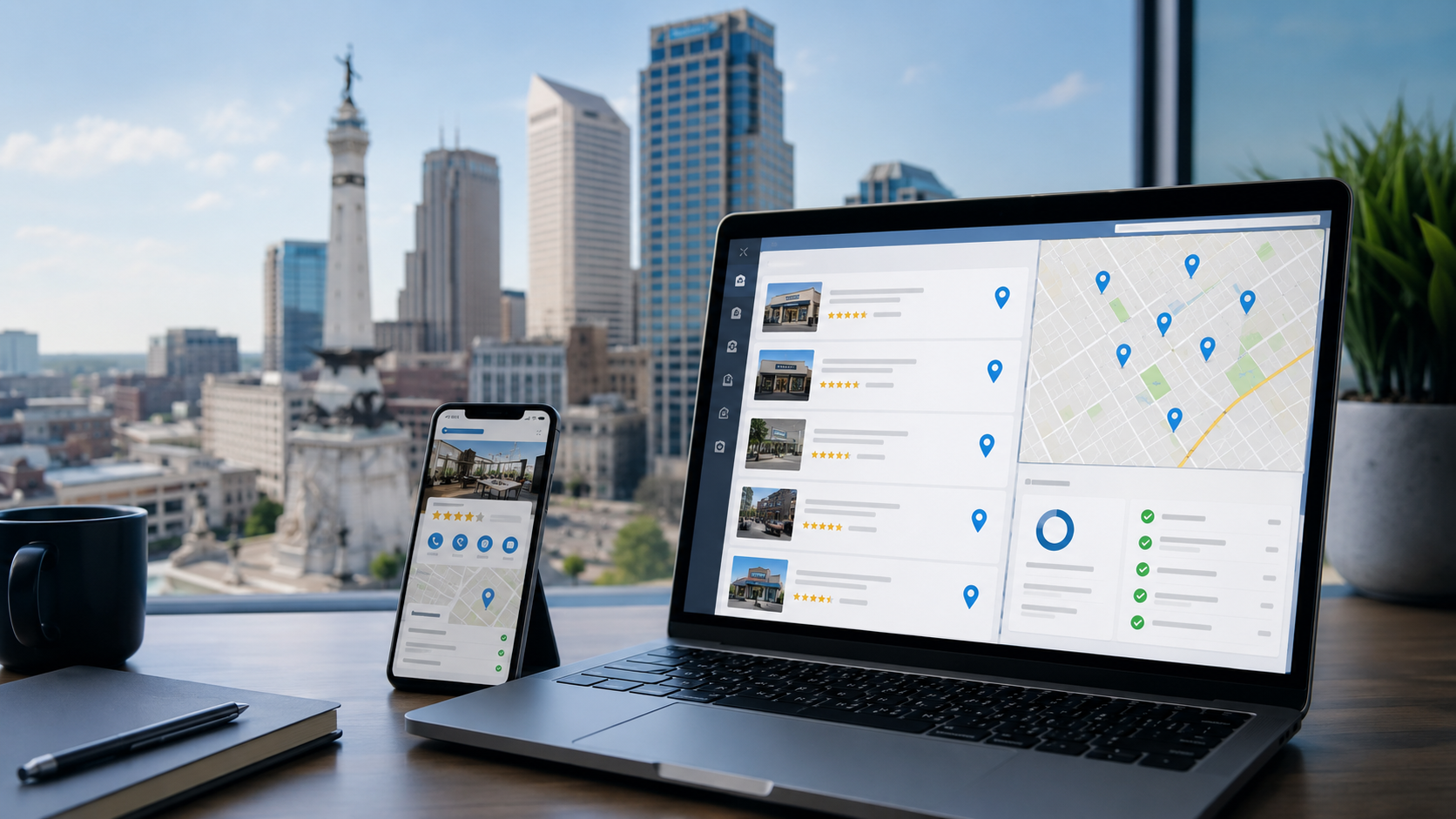
Search for almost any Indianapolis business and you'll find information about that company scattered across the internet.
Google has an address.
Apple Maps has another listing.
Yelp has a phone number.
Facebook has business hours.
The Better Business Bureau may have a profile.
An industry association may list the company.
The Indy Chamber may have a member page.
A directory you've never heard of might still have an address the company stopped using six years ago.
Those mentions are known in local SEO as citations.
And for years, citation building was treated like a numbers game.
The advice sounded something like this:
Submit your business to 100 directories. Then submit it to 200 more.
That isn't how we'd approach local citations for an Indianapolis business in 2026.
Google still explicitly says information about a business from across the web—including links, articles, and directories—can contribute to how it understands prominence in local search.
But that does not mean every directory carries equal value.
It doesn't mean having 500 citations guarantees better Google Maps rankings than having 50.
And it definitely doesn't mean your company should pay to appear on every random “Top Indianapolis Businesses” directory somebody emails you about.
Industry research reflects that distinction. Whitespark's 2026 Local Search Ranking Factors report still includes citation signals as a component of local search, but its survey of 47 local-search practitioners suggests citations now carry less relative ranking weight than several other signal groups. Whitespark also explicitly notes that the survey reflects expert observation and testing—not privileged access to Google's algorithm.
That's the right way to think about citations.
Foundational? Yes.
Worth maintaining? Absolutely.
A substitute for a strong Google Business Profile, website, reviews, backlinks, and real local authority? No.
For Indianapolis businesses, the goal should be to create a clean, credible, relevant business footprint across the places customers and search systems actually use.
This guide explains which directories deserve priority, which ones depend on your industry, which local Indianapolis citations can be especially valuable, and which citation-building tactics are probably wasting your time.
If you're working on your broader Indianapolis Maps visibility, start with Local SEO in Indianapolis: How to Rank Higher on Google Maps in 2026.
What Is a Local Citation?
A local citation is an online mention of identifying information about a business.
At minimum, that frequently means some combination of:
Business name
Address
Phone number
This is often abbreviated as NAP:
Name. Address. Phone.
A citation may also contain:
Website URL
Business category
Business description
Hours
Email
Photos
Services
Social profiles
Reviews
Service-area information
BrightLocal defines local citations as third-party mentions of business information and identifies name, address, and phone information as their core components.
There are also two broad citation types worth understanding.
Structured Citations
These are traditional business listings where information appears in predefined fields.
Examples include:
Google Business Profile
Yelp
BBB
Chamber directories
Industry directories
Mapping platforms
The listing might have separate fields for:
Business Name: Smith Heating & Cooling
Address: 123 Main Street
Phone: 317-555-1234
Website: example.com
That's a structured citation.
Unstructured Citations
An unstructured citation is a business mention occurring naturally inside other content.
For example:
Smith Heating & Cooling sponsored an Indianapolis community event this weekend.
That could appear in:
News articles
Sponsorship pages
Blog posts
Event websites
Local organization pages
Community resources
There isn't necessarily a traditional directory listing.
But the business is still being mentioned and associated with a geographic market.
Those mentions can be valuable too.
Why Do Local Citations Matter for Indianapolis SEO?
There are several reasons.
And only one of them is “Google rankings.”
Citations Help Search Systems Understand the Business
Google says prominence can be influenced by information it has about businesses from across the web, specifically mentioning directories alongside links and articles.
If your business repeatedly appears across legitimate sources with the same fundamental identity, that creates corroborating information.
You're establishing:
This company exists.
This is its name.
This is where it's located.
This is how customers contact it.
This is what type of company it is.
For an Indianapolis business, relevant citations can also reinforce geographic relationships.
Directories Can Generate Their Own Visibility
Some directories rank in Google themselves.
BrightLocal's research has found that directory sites occupy a meaningful share of organic results for local-intent searches. Its citation research also points out that directories can expose businesses directly to consumers rather than functioning only as indirect SEO signals.
Search:
“best contractor Indianapolis”
and you may see:
Actual contractor websites
Review websites
Business directories
Local publishers
Industry resources
That creates another opportunity to be discovered.
Customers Use Listings to Verify Businesses
A prospect may discover you on Google, then investigate elsewhere.
They may look at:
Yelp
BBB
Facebook
Apple Maps
Industry websites
Professional licensing sites
Chamber memberships
Your citations therefore aren't only search-engine data.
They're part of the due-diligence trail surrounding your business.
Incorrect Citations Can Lose Leads Directly
Forget rankings for a moment.
Suppose a customer finds your company and sees:
Phone number: disconnected.
Or:
Address: your old office.
Or:
Hours: says you're open when you're closed.
That's not an abstract SEO issue.
That's potentially a lost customer.
Data Axle's current listing-management materials emphasize distributing details such as business locations, phone numbers, websites, and hours across search, directory, navigation, and virtual-assistant systems.
Local data accuracy is conversion optimization too.
Do You Need Hundreds of Local Citations in 2026?
No universal number exists.
You don't automatically need:
100 citations.
200 citations.
500 citations.
Or one more citation than the company ranking above you.
Citation quantity is only one dimension.
The better questions are:
Is the listing source reputable?
Does it serve Indianapolis or Indiana?
Is it relevant to your industry?
Do customers use it?
Does it rank for searches your customers perform?
Does it distribute information elsewhere?
Can you accurately maintain the listing?
Does your competitor have a meaningful listing there?
Would the listing make sense even if SEO didn't exist?
That last question is especially useful.
Imagine Google vanished tomorrow.
Would appearing in the Indy Chamber member directory still have potential business value if you're actually a member?
Probably.
Would an attorney benefit from appearing in reputable legal directories customers use?
Potentially.
Would a restaurant benefit from major restaurant and travel platforms?
Absolutely.
Would an Indianapolis electrician benefit from being listing number 4,871 on BestRandomBusinessesDirectory.biz?
Probably not.
Quality, relevance, and legitimacy beat raw volume.
Which Indianapolis Business Directories Actually Matter?
The easiest way to prioritize citation work is by tiers.
Not every company needs every listing below.
But this gives you a practical order of operations.
Tier 1: Google Business Profile
Yes, Google Business Profile is more than a traditional directory citation.
But if you're building a local-listing strategy, it belongs at the top.
For most Indianapolis businesses, this is your most important local listing.
Google Business Profile can control information shown across Google Search and Maps, including:
Business name
Address
Service area
Hours
Phone
Website
Categories
Services
Reviews
Photos
Google recommends complete and accurate information and says local results are primarily based on relevance, distance, and prominence.
Before spending hours submitting to obscure directories, make sure Google has the right information.
Check:
Is the profile verified?
Is the business name legitimate?
Is the primary category accurate?
Is the address accurate?
Should the address be publicly displayed?
Is the phone number correct?
Does the website link work?
Are hours current?
Are service areas accurate?
Are duplicates present?
Your 100th directory submission is not more important than correcting the phone number customers see in Google Maps.
For a complete Indianapolis Google Maps strategy, see Local SEO in Indianapolis: How to Rank Higher on Google Maps in 2026.
Tier 1: Apple Business Connect and Apple Maps
Google isn't the only mapping ecosystem your customers use.
Apple Business Connect allows companies to manage how their businesses appear across Apple services, including Apple Maps. Apple's current Business Connect platform lets businesses control and enrich business information across Apple experiences.
If your Indianapolis company serves consumers, Apple deserves attention.
At minimum, check:
Business name
Address
Phone
Hours
Website
Category
Location accuracy
Think beyond “SEO ranking factor.”
If an iPhone user asks for directions to your business and Apple Maps contains an outdated address, that's a customer-experience problem.
A citation strategy should account for the systems customers actually use.
Apple Maps is one of them.
Tier 1: Bing Places for Business
Bing should also be part of your core listing cleanup.
Bing's business-listing ecosystem allows companies to manage business information for visibility through Microsoft's search products. Its Bing Places service has historically provided free business listing management and now routes through Microsoft's broader Bing for Business experience.
Will Bing drive the same local volume as Google for most Indianapolis businesses?
Usually not.
Does that mean you should ignore it?
Also no.
Claiming and maintaining major search-engine listings is basic digital housekeeping.
Especially when the work required is modest compared with the cost of having wrong information distributed to potential customers.
Tier 1: Yelp
Whether you personally use Yelp doesn't determine whether your customers do.
Yelp maintains a substantial consumer-facing business directory and allows business owners to claim existing pages or add businesses through Yelp for Business.
Yelp can be particularly relevant for:
Restaurants
Home services
Automotive companies
Beauty businesses
Health-related providers
Retail
Other consumer-facing local services
Check:
Is there already a Yelp page?
Is it claimed?
Is the phone number correct?
Is the website correct?
Is the address correct?
Are categories accurate?
Are duplicate pages present?
You don't necessarily need to buy advertising simply because you've claimed the page.
Listing accuracy and advertising are separate decisions.
Tier 1: Facebook
Facebook isn't generally what people mean when they say “citation directory.”
But a properly maintained business Page is still a prominent third-party source of local company information.
Meta's business documentation specifically allows Pages to contain information such as:
Location
Contact details
Hours
Service areas
Website
Your Facebook Page shouldn't say you close at 5:00 p.m. when Google says 7:00 p.m.
It shouldn't point to a domain you stopped using.
And it shouldn't show an office you left in 2022.
If the Page exists, maintain it.
Tier 1: Data Axle
Data aggregators work differently from ordinary directories.
Instead of thinking only:
“Will customers visit this directory?”
think:
“Where can this data travel?”
Data Axle currently offers free local-listing management for businesses with one to ten listings and says verified information can be distributed to search engines, online directories, public-library databases, navigation systems, apps, and virtual assistants.
That's why a business-data source can matter even if your customers aren't manually searching Data Axle.
It operates upstream in the local-data ecosystem.
For Indianapolis businesses, checking the information held by major business-data providers can be especially useful after:
Moving
Changing phone numbers
Rebranding
Acquiring a company
Opening additional locations
Changing websites
One incorrect record can have more consequences when that information is distributed elsewhere.
Tier 2: Indianapolis and Trust-Based Citations
Once the major platforms are clean, start looking closer to home.
These citations can sometimes provide both geographic relevance and real business value.
Indy Chamber
If your business is genuinely an Indy Chamber member, make use of the listing you've earned.
The Indy Chamber represents businesses across the ten-county Indianapolis region and maintains a public member directory. Its current membership materials specifically include online directory listings among member benefits.
That's exactly the type of citation we like.
Why?
Because it has a reason to exist beyond SEO.
It reflects a legitimate relationship between:
Your business
and:
The Indianapolis business community.
That's much more interesting than creating another generic directory profile solely because an SEO checklist told you to.
Make sure your member information is complete and accurate.
If membership allows:
Business description
Website
Logo
Contact information
Category
Additional company information
complete the relevant fields.
But don't join an organization only for a backlink or citation.
Evaluate the actual business benefits.
Better Business Bureau
BBB maintains a searchable business directory covering local companies and allows businesses to claim a free BBB Business Profile or request creation of a new one. Accreditation is a separate program.
That distinction matters.
You don't necessarily need paid accreditation simply to have an accurate business profile.
For industries where customers frequently research trust, complaints, ratings, and business history, a BBB profile can be particularly important.
Examples may include:
Contractors
Home services
Financial companies
Large-ticket services
Professional services
Again, think beyond backlinks.
A prospective customer may genuinely investigate your BBB record before hiring you.
That's reason enough to make sure the information is correct.
Indianapolis Neighborhood and Business Associations
Indianapolis isn't one giant undifferentiated market.
Depending on where you operate, there may be legitimate:
Neighborhood organizations
Merchant associations
Local development organizations
Business districts
Community organizations
Economic development groups
If your company legitimately belongs to one and the organization maintains a member directory, profile, sponsor page, or partner page, that can be a highly relevant local citation.
The key word is:
Legitimately.
Don't join 17 neighborhood organizations purely to create 17 backlinks.
Participate where the relationship makes sense.
Local SEO is strongest when the digital signal reflects something real offline.
Local Sponsorships and Community Organizations
A citation doesn't have to come from a business directory.
Suppose your company sponsors:
Youth sports
Community festival
Nonprofit event
Neighborhood cleanup
Indianapolis charity
Local fundraiser
and the organization includes your company on its sponsor page.
That's an unstructured local citation.
It may include a link too.
Those mentions can reinforce your association with the local market while also creating brand exposure and goodwill.
This is one reason some of the best local SEO work doesn't look like “SEO.”
It's marketing.
It's PR.
It's community involvement.
SEO benefits can follow.
Tier 3: Industry-Specific Directories
After your foundational listings are accurate, industry relevance should usually beat random directory volume.
BrightLocal maintains separate citation resources by industry precisely because the useful citation landscape differs by business type.
An attorney and a restaurant should not have identical citation strategies.
Neither should a dentist and a roofing company.
Legal Directories
For Indianapolis law firms, relevant legal directories may include established lawyer-discovery and professional platforms.
Depending on practice area and eligibility, examples can include:
Avvo
FindLaw
Justia
State and local bar directories
Legal association directories
Don't create profiles everywhere simply because the word “lawyer” appears on the website.
Ask whether:
Clients use it
It ranks for your target searches
Competitors have strong profiles there
It's reputable in the legal industry
The information can be maintained
Healthcare Directories
Medical providers may need a completely different citation stack.
Examples could include:
Healthgrades
Zocdoc
Insurance-network directories
Hospital or health-system directories
Professional association directories
Relevant licensing sources
For healthcare, accuracy becomes particularly important.
Patients need correct:
Phone numbers
Locations
Provider names
Specialties
Appointment information
The best citations are often those directly involved in how patients discover and evaluate care.
Home Service Directories
For Indianapolis contractors and home-service businesses, relevant platforms might include:
Angi
Houzz
Manufacturer directories
Dealer locators
Trade associations
Certification directories
Supplier partner pages
But don't automatically pay for every lead-generation marketplace.
A citation opportunity and a paid-lead program are two different decisions.
Evaluate the economics separately.
Restaurant and Hospitality Directories
Restaurants, hotels, attractions, and hospitality businesses often benefit from consumer platforms that other industries barely need.
Examples can include:
TripAdvisor
OpenTable
Restaurant platforms
Travel directories
Tourism organizations
Delivery platforms where applicable
The question remains:
Where does the customer actually look?
Citation strategy should follow buyer behavior.
B2B and Professional Service Directories
For B2B businesses, mass consumer directories may be less valuable than:
Industry associations
Partner directories
Certification organizations
Professional memberships
Vendor directories
Local chambers
Trade organizations
If you sell a highly specialized commercial service, appearing in a trusted industry directory may be far more meaningful than appearing on 50 generic consumer directories.
Tier 4: Data Sources, Navigation Platforms, and Mapping Ecosystems
Some citations deserve attention not because a customer is likely to visit the website directly, but because business information can be used across mapping, navigation, data, and discovery systems.
This category is increasingly important.
Data Axle, for example, says its listings can feed search engines, directories, navigation applications, and virtual assistants.
That illustrates a larger principle:
Your business information no longer lives only on webpages.
It can appear through:
Vehicle navigation
Voice search
Mobile maps
AI interfaces
Business databases
Search engines
Citation management in 2026 should therefore be thought of as entity-data management, not only link building.
Could Citations Matter for AI Search Too?
Potentially, yes—but avoid exaggerated claims.
AI search systems need information from somewhere.
Clear, corroborated information across reputable sources can make businesses easier to identify and distinguish.
BrightLocal's updated citation research specifically highlights growing interest in citations as inputs to AI and LLM-oriented visibility, while Whitespark added an AI-search visibility category to its 2026 Local Search Ranking Factors survey.
That doesn't mean:
“Get 200 directory citations and ChatGPT will recommend you.”
There is no defensible universal formula like that.
It means businesses should care about creating a consistent, credible entity footprint across the open web.
Your own website plays a role too.
Google's Organization and LocalBusiness structured-data documentation provides mechanisms for supplying machine-readable information about organizations and local businesses.
For Ritner Digital, that's why SEO and AI search visibility are increasingly connected rather than treated as completely separate marketing disciplines.
Which Business Directories Should Indianapolis Businesses Skip?
Now the fun part.
You do not need every citation opportunity you find.
Several types deserve skepticism.
Generic Directories With No Audience
Ask:
Would a real customer ever use this website?
If the answer is obviously no, why are you there?
A directory may still have some data-distribution or niche value, but if it has:
No recognizable audience
No meaningful rankings
No industry relevance
No local relevance
No editorial standards
Thousands of thin pages
it probably deserves low priority.
Directories That Exist Mainly to Sell Backlinks
Be especially suspicious of messages like:
Guaranteed DA 72 Indianapolis business listing with dofollow backlink! Only $79!
That's not a customer acquisition strategy.
That's somebody selling a metric.
Don't confuse:
high third-party SEO tool score
with:
real business authority.
Google doesn't rank your business based on the “Domain Authority” number an unrelated SEO platform assigns to the directory.
Massive Directory Packages
Be cautious when an SEO company sells:
500 citations for $199
without explaining where they'll be created.
Ask:
Which sites?
Are they relevant?
Who owns the accounts?
Can the listings be edited later?
Are duplicates created?
What happens if we move?
Which information is submitted?
Are the sites indexed?
Are they legitimate?
More is not automatically better.
Directories That Require Fake Information
Never modify legitimate business details simply to qualify for another listing.
Do not create:
Fake Indianapolis addresses
Fake suites
Alternate business names
Fake phone numbers
Fake locations
Fake offices
Your citation footprint should describe the business that actually exists.
Google's Business Profile guidelines similarly require businesses to accurately represent real-world identity and location information.
Duplicate Listings on the Same Platform
Creating multiple profiles for one location usually isn't “more SEO.”
It's more mess.
Before creating a listing, search for:
Business name
Old business name
Phone number
Current address
Old address
You may already have one.
BrightLocal's current citation guidance recommends watching for duplicate listings and inaccurate business data rather than simply generating additional profiles.
Claim and correct whenever possible.
Don't automatically create another duplicate.
NAP Consistency: How Exact Does Your Business Information Need to Be?
This topic gets unnecessarily dramatic.
Yes, your business information should be consistent.
But focus first on accuracy.
These differences matter:
317-555-1234
vs.
317-555-9876
That's a real discrepancy.
So is:
123 Main Street
vs.
789 Oak Avenue
So is an old website.
So is a previous company name.
Variations such as:
Street
vs.
St.
are far less alarming when they clearly refer to the same legitimate address.
BrightLocal notes that modern search systems can generally understand common abbreviations, while still recommending consistent formatting where practical.
So don't spend three hours panicking because one listing says:
Suite 200
and another says:
Ste 200
while ignoring the directory still sending customers to the office you left five years ago.
Prioritize meaningful accuracy.
What Information Should Be Consistent Across Citations?
Create a master business-information document.
For each location, establish the official:
Business Name
Use the real-world business name.
Address
Use the actual eligible business location.
Service-area businesses need to respect the individual platform's address and service-area rules.
Phone Number
Prefer a stable number customers can actually reach.
Website
Link to the correct live website or appropriate location landing page.
Hours
Keep normal and holiday hours accurate.
Categories
Categories differ across platforms, so identical wording may not always be possible.
Choose the closest accurate category.
Business Description
Descriptions don't have to be word-for-word identical everywhere.
They do need to accurately describe the same company.
Logo and Photos
Use current brand assets and legitimate business photography where supported.
Services
Add real services where the platform allows them.
This master record becomes your source of truth.
When something changes, update the master first.
Then work through the citation ecosystem.
What Should You Do If Your Indianapolis Business Moves?
Moving creates one of the biggest citation-cleanup projects.
Don't simply create new listings everywhere and abandon the old ones.
Build a migration list.
Update:
Website
Google Business Profile
Apple Maps
Bing
Yelp
Facebook
Data providers
BBB
Chamber listings
Industry directories
Important local organizations
Major partner/vendor listings
Also search for:
Old address
Old phone number
Old business name
You may discover listings you forgot existed.
If the website itself is changing during the move or rebrand, that's a larger SEO project involving redirects, indexing, internal links, and technical cleanup.
Use The Indianapolis Website Audit: 20 SEO Problems That Cost Local Businesses Leads to check the website side of that migration.
Should Service-Area Businesses Hide Their Address on Directories?
Follow the rules of each platform and accurately represent how your company operates.
Google's guidelines distinguish between businesses that serve customers at a location and businesses that travel to customers. Businesses that don't serve customers at the address may need to hide that address on Google Business Profile.
Other citation platforms have different capabilities.
BrightLocal even maintains a separate citation resource for service-area businesses because not every directory handles hidden addresses or service areas the same way.
Do not expose a private residential address solely because an SEO checklist told you every citation needs to display one.
Accuracy includes representing the business model correctly.
How to Find Citation Opportunities Your Indianapolis Competitors Have
Your competitors can be one of your best citation-research tools.
Search the businesses consistently outranking you.
Then investigate where they appear.
Look for:
Chambers
Associations
Local organizations
Industry directories
Sponsorships
Dealer directories
Vendor directories
Community partnerships
News coverage
Professional memberships
The question isn't:
How do we copy every citation they have?
It's:
Which legitimate opportunities are we missing?
If five strong Indianapolis competitors all belong to a respected industry association and you're eligible but absent, investigate it.
If they all appear on a directory you've never heard of, determine whether actual customers use it before blindly submitting.
Competitive analysis helps separate meaningful citation patterns from random noise.
And remember: if a competitor outranks you with fewer reviews, citations may be only part of the explanation.
Our guide Why Your Competitor Ranks Above You in Indianapolis — Even With Fewer Reviews explains how categories, proximity, website SEO, backlinks, local authority, and other factors can outweigh a review-count advantage.
A Practical Indianapolis Citation Priority List
If we were auditing an Indianapolis company today, we'd generally think about citations in this order.
Priority 1: Search and Mapping Platforms
Audit:
Google Business Profile
Apple Business Connect / Apple Maps
Bing
Major map/search ecosystems relevant to customers
Fix accuracy before expanding.
Priority 2: Major Consumer and Business Platforms
Depending on industry:
Yelp
Facebook
BBB
Other major platforms customers actually use
Claim existing listings before creating new ones.
Priority 3: Business Data Sources
Audit major data providers such as Data Axle.
These can matter because information may be distributed beyond one website.
Priority 4: Indianapolis Sources
Look for legitimate relationships with:
Indy Chamber
Neighborhood associations
Business organizations
Community organizations
Economic development groups
Local relevance is more meaningful when it's real.
Priority 5: Industry Sources
Build profiles where customers or professionals in your vertical genuinely look.
For example:
Legal directories
Healthcare directories
Trade associations
Dealer directories
Manufacturer networks
Hospitality platforms
Priority 6: Competitor Gaps
Compare citations from businesses performing well for the searches you care about.
Look for legitimate opportunities you've missed.
Priority 7: General Directories
Only after the higher-value foundation is handled should generic business directories become a significant focus.
And even then:
Be selective.
How to Audit Your Existing Indianapolis Citations
Before building new citations, clean what you already have.
Step 1: Create Your Master NAP Record
Document:
Correct name
Correct address
Correct phone
Correct website
Correct hours
Step 2: Search Your Business Name
Look beyond the first page.
Step 3: Search Your Phone Number
Phone searches can uncover forgotten listings.
Step 4: Search Your Address
Look for:
Old business names
Duplicate listings
Previous occupants
Incorrect business information
Step 5: Search Your Old Information
If you've moved or rebranded, search:
Previous phone number
Previous address
Previous business name
Previous domain
Step 6: Prioritize Errors by Visibility
Fix the inaccurate listing on a major Maps platform before worrying about a tiny directory nobody uses.
Step 7: Document Login Ownership
Your business should know:
Which email owns the account
Who has admin access
Where credentials are stored
Which agency or employee controls it
Do not let important business profiles live permanently inside an ex-employee's personal email account.
Local Citations Should Support Your Website, Not Replace It
One citation strategy mistake is believing directory submissions can compensate for a weak website.
They can't.
You still need:
Indexable service pages
Strong Indianapolis relevance
Technical SEO
Internal links
Useful content
Backlinks
Conversion paths
Structured data
Clear service information
Your citations support the entity.
Your website explains the entity in depth.
Google's LocalBusiness structured-data documentation allows websites to explicitly provide information such as business details and hours in a machine-readable format.
That creates a useful consistency loop:
Website says who you are.
Structured data reinforces it.
Google Business Profile reflects it.
Major citations reflect it.
Local organizations corroborate it.
Industry sources corroborate it.
Customers review it.
Other websites mention and link to it.
That's much stronger than:
“We submitted to 300 directories.”
Citation Building Is Not a Substitute for Backlinks
Citations and backlinks overlap, but they aren't identical.
A citation can mention your business without linking to you.
A backlink links to your website.
Some directory listings provide both.
Google explicitly references both directories and links when explaining prominence.
Your Indianapolis SEO strategy should therefore include both:
Citation Building
Create accurate business information across trusted, relevant sources.
Authority Building
Earn legitimate links and mentions through:
Partnerships
Sponsorships
Research
PR
Community participation
Industry involvement
Useful resources
Media coverage
One shouldn't replace the other.
How Much Time Should You Spend Building Citations?
Enough to establish and maintain the foundation.
Not enough to ignore everything else.
Once you've cleaned:
Google
Apple
Bing
Yelp
Facebook
Data providers
Local organizations
Core industry directories
the incremental value of finding directory number 127 probably falls dramatically.
At that point, your next hour might produce more growth by:
Improving a service page
Getting a legitimate customer review
Earning a quality backlink
Fixing an indexing problem
Publishing a useful Indianapolis resource
Building a local case study
Improving conversion tracking
The 2026 Whitespark expert survey illustrates this broader point: citation signals remain part of local SEO, but experts assign greater relative importance to several other categories of local-ranking signals.
Citations belong in the strategy.
They should not become the strategy.
Frequently Asked Questions About Indianapolis Local Citations
What Is a Local Citation in SEO?
A local citation is an online mention of identifying information about a business.
It commonly includes the company's:
Name
Address
Phone number
and may also include website URL, hours, category, services, photos, or other business information.
BrightLocal identifies NAP information as the core component of local citations.
Do Local Citations Still Matter for SEO in 2026?
Yes, but they should be understood as one component of a broader local SEO system.
Google explicitly says information from directories can contribute to prominence in local search.
At the same time, the 2026 Whitespark Local Search Ranking Factors expert survey suggests citation signals carry less relative ranking weight than several other signal categories.
The practical takeaway is to build a strong citation foundation without treating directory volume as the primary ranking strategy.
What Are the Most Important Business Listings for an Indianapolis Company?
For many Indianapolis businesses, we'd start by reviewing:
Google Business Profile
Apple Maps / Apple Business Connect
Bing
Yelp
Facebook
Data Axle
BBB where relevant
Indy Chamber if you're genuinely a member
Major industry-specific directories
Relevant professional associations
The exact priority depends on the industry.
A restaurant, attorney, dentist, HVAC contractor, and B2B manufacturer should not have identical citation strategies.
Is Google Business Profile a Citation?
Google Business Profile is more sophisticated than a conventional business directory, but it contains the same core business-identity information found in local citations.
For practical citation management, it should be treated as the highest-priority local listing for businesses dependent on Google Search and Maps.
Does Apple Maps Matter for Local SEO?
Apple Maps deserves attention because Apple users rely on it for business discovery and navigation.
Apple Business Connect allows companies to control information about how their locations appear across Apple services.
Even apart from SEO, correct information is essential if customers use Apple Maps to call or navigate to your company.
Does Bing Places Still Matter?
Bing's business-listing ecosystem remains worth maintaining as part of basic local-search coverage.
It may not generate the same volume as Google for many Indianapolis companies, but maintaining correct business information across major search platforms is sensible digital housekeeping.
Is Yelp Still Worth Claiming?
For many consumer-facing local businesses, yes.
Yelp still maintains a large consumer business directory and lets owners claim or add business pages.
Whether you should invest in paid Yelp products is a separate question from whether your basic business information should be correct.
Is the Indy Chamber Directory Worth It for SEO?
If you're genuinely an Indy Chamber member, you should maintain an accurate member listing.
The Chamber currently serves businesses across the ten-county Indianapolis region and includes online directory visibility among its membership benefits.
However, we wouldn't recommend purchasing a membership solely for a backlink.
Evaluate the networking, business-development, advocacy, visibility, and other membership benefits too.
Does My Indianapolis Business Need a BBB Listing?
It depends on your industry and customer behavior.
BBB allows businesses to claim a free Business Profile or request a new listing, while BBB Accreditation is separate.
Businesses in trust-sensitive or high-ticket industries may find BBB profiles particularly relevant because prospective customers can research ratings, complaints, reviews, and accreditation status.
What Is NAP in Local SEO?
NAP stands for:
Name. Address. Phone number.
These are the core pieces of identifying information traditionally associated with local citations.
The most important requirement is that this information accurately represents the real business.
Does My NAP Have to Be Exactly the Same Everywhere?
Your fundamental business information should be accurate and reasonably consistent.
However, don't treat harmless formatting differences as equal to genuinely incorrect information.
For example, Street versus St. is much less important operationally than having an entirely wrong phone number or old address.
BrightLocal notes that search engines can understand common abbreviations while still recommending consistent business data where practical.
Can Wrong Business Directory Information Hurt My Leads?
Absolutely.
Even setting SEO aside, inaccurate information can cause customers to:
Call the wrong number
Visit an old address
Arrive when you're closed
Use an old website
Become confused about which listing is legitimate
That's why citation cleanup should be treated as a customer-experience issue, not merely a ranking tactic.
How Many Local Citations Does My Business Need?
There is no universal number.
Build the citations that matter for:
Search platforms
Mapping systems
Customer discovery
Your industry
Indianapolis
Professional credibility
Data distribution
Once those are handled, directory volume becomes increasingly less important.
You do not need hundreds of low-quality listings merely to hit a quota.
Should I Buy a Package of 500 Business Directory Listings?
Usually we'd be skeptical.
Before buying any bulk citation package, ask which directories are included and why those sources matter.
You should know:
Where listings will be created
Whether sites are relevant
Who owns the accounts
Whether information can be updated
Whether duplicates will be created
Whether the sites have real users
Whether they make sense for your industry
Citation volume without strategy is mostly activity.
Are Free Business Directories Good for SEO?
Some are valuable.
Some aren't.
Whether a directory is free or paid is not the important distinction.
Evaluate:
Reputation
Relevance
Audience
Geography
Industry connection
Search visibility
Data distribution
Customer usage
A free profile on a legitimate platform may be valuable.
A paid listing on an irrelevant directory may not be.
Are Paid Directories Bad for SEO?
Not inherently.
Some legitimate:
Chambers
Associations
Industry organizations
Professional directories
require membership or fees.
The question is whether you're paying for a real business relationship or audience versus merely buying a backlink.
Never judge a directory only by whether it charges money.
Are Industry Directories Better Than General Business Directories?
Often, they can be more relevant.
An Indianapolis lawyer may benefit more from a respected legal directory than from a generic directory with no meaningful audience.
A dentist may benefit from healthcare-related sources.
A contractor may benefit from manufacturer, dealer, and trade association directories.
BrightLocal maintains different citation recommendations by industry because relevant sources vary significantly across business categories.
Can Citations Help Me Rank Higher on Google Maps?
Citations can contribute to the broader prominence signals surrounding a business.
Google specifically says information from directories can contribute to prominence.
However, Google also says local rankings are primarily based on relevance, distance, and prominence.
Citations cannot erase:
Poor proximity
Wrong categories
Weak reviews
A bad website
Weak authority
Poor service relevance
For the complete Maps framework, read Local SEO in Indianapolis: How to Rank Higher on Google Maps in 2026.
Can More Citations Help Me Outrank a Competitor With Fewer Reviews?
Potentially, citations could contribute to a stronger overall prominence profile—but they are only one piece.
If a competitor with fewer reviews consistently outranks you, investigate:
Proximity
Categories
Website SEO
Backlinks
Local authority
Review quality
Service relevance
Citations
Our full breakdown is here: Why Your Competitor Ranks Above You in Indianapolis — Even With Fewer Reviews.
Should I Create a New Directory Listing If One Already Exists?
Usually, claim and correct the existing listing first.
Creating another profile can cause duplicates and make it more difficult to determine which record is authoritative.
Search by:
Business name
Phone
Address
Previous business name
before creating something new.
What Should I Do With Citations After My Business Moves?
Update the most visible and authoritative sources first.
Start with:
Website
Google Business Profile
Apple Maps
Bing
Yelp
Facebook
Major data providers
BBB
Local organizations
Industry directories
Then search the old address and phone number to discover outdated citations that still need correction.
Do Service-Area Businesses Need Citations?
Yes, but service-area businesses should follow each platform's rules regarding addresses.
Not every directory handles hidden addresses properly.
Google specifically distinguishes service-area businesses from companies that serve customers at a storefront.
Never publish a private or ineligible address solely for citation consistency.
Can Local Citations Help With AI Search Visibility?
They may contribute to the broader digital evidence AI systems can use to identify and understand businesses, but there is no universal formula guaranteeing AI recommendations.
Current local SEO research is increasingly examining how citations and entity information intersect with AI search.
The sensible strategy is to build accurate, credible business information across legitimate sources rather than chasing speculative “AI citation hacks.”
What's More Important: Citations or Backlinks?
Both can contribute different forms of value.
Citations reinforce business identity, local information, and discovery.
Backlinks can strengthen website authority and prominence.
Google references both links and directories when discussing local prominence.
A mature Indianapolis local SEO strategy should address both rather than choosing one.
How Do I Know Which Citations My Competitors Have?
Search competitor:
Business names
Phone numbers
Addresses
Website domains
You can also use local SEO tools designed to compare citation profiles.
Whitespark's Local Citation Finder, for example, is specifically designed to compare a business's citations with those of competing companies and identify missing opportunities.
The goal isn't to copy every listing.
It's to identify legitimate opportunities that competitors have discovered and you haven't.
Sources
This article was researched and updated for August 2026. Google's own documentation is used as the primary authority for statements about Google Business Profile and local ranking, while official platform sources were used where available for individual listing services.
Google Business Profile Help — Tips to Improve Your Local Ranking on Google. Google's official explanation of relevance, distance, prominence, reviews, links, directories, and local rankings.
Google Business Profile Help — Guidelines for Representing Your Business on Google. Google's rules covering accurate business names, locations, addresses, and service-area businesses.
Google Search Central — LocalBusiness Structured Data. Google's technical documentation for communicating local business information through structured data.
Google Search Central — Organization Structured Data. Google's guidance on using structured data to help identify and disambiguate organizations.
Apple Business Connect. Apple's official platform for managing how businesses appear across Apple services, including Maps.
Bing Places / Bing for Business. Microsoft's business-listing platform for Bing search visibility.
Yelp for Business. Yelp's official tools for finding, adding, and claiming business pages.
Meta Business Help Center. Meta's official guidance for adding local business details such as contact information, location, website, hours, and service areas to Facebook Pages.
Data Axle — Local Listings. Current information about business-data verification and distribution to search engines, directories, navigation systems, and virtual assistants.
Better Business Bureau. BBB's official business directory and free Business Profile submission/claim process.
Indy Chamber. Current Indianapolis regional business organization information and public member-directory resources.
Whitespark — 2026 Local Search Ranking Factors. Survey of 47 local search practitioners evaluating 187 potential local ranking and visibility factors; Whitespark explicitly notes that participants do not have privileged access to Google's algorithm.
BrightLocal — Local Citations Handbook. Updated 2025 guidance covering citations, directories, NAP data, citation benefits, data accuracy, and industry-specific listing sources.
Stop Collecting Directory Listings. Start Building a Credible Local Footprint.
Indianapolis businesses don't need to be everywhere.
They need to be in the right places with the right information.
That means:
Google should be correct.
Apple Maps should be correct.
Bing should be correct.
Major consumer platforms should be correct.
Your business-data sources should be correct.
Your Indianapolis memberships and associations should reflect real relationships.
Your industry directories should match how customers actually search.
And your website should reinforce the same company identity everywhere else is describing.
That's a citation strategy.
Submitting the same information to 400 websites nobody uses isn't.
The goal isn't to create the largest possible number of mentions.
It's to create a digital footprint that makes your business easy to:
Find.
Verify.
Understand.
Trust.
And ultimately:
Hire.
Not Sure Which Indianapolis Listings Are Helping—or Hurting—Your Business?
Ritner Digital helps businesses identify and clean up the local search signals affecting visibility across Google, Maps, traditional search, and AI-driven discovery.
That includes:
Local citation audits
Citation cleanup
Google Business Profile optimization
Indianapolis local SEO
NAP and entity consistency
Competitor citation analysis
Local authority building
Technical SEO
Internal linking
Structured data
Location and service-page optimization
Review strategy
Backlinks
AI search optimization
Search performance measurement
If your company's information is scattered across the web—or you don't know which directories are actually worth maintaining—we'll help separate the citations that matter from the ones that are mostly noise.
Contact Ritner Digital today and tell us where you want to improve your Indianapolis visibility.
We'll look at your business listings, website, Google Maps presence, competitors, and local authority footprint—and identify what we'd prioritize first.