What Makes an Indianapolis Business Rank in Google's 3-Pack?
Search Google for:
“plumber Indianapolis.”
“Indianapolis HVAC company.”
“roof repair near me.”
“personal injury attorney Indianapolis.”
“dentist near me.”
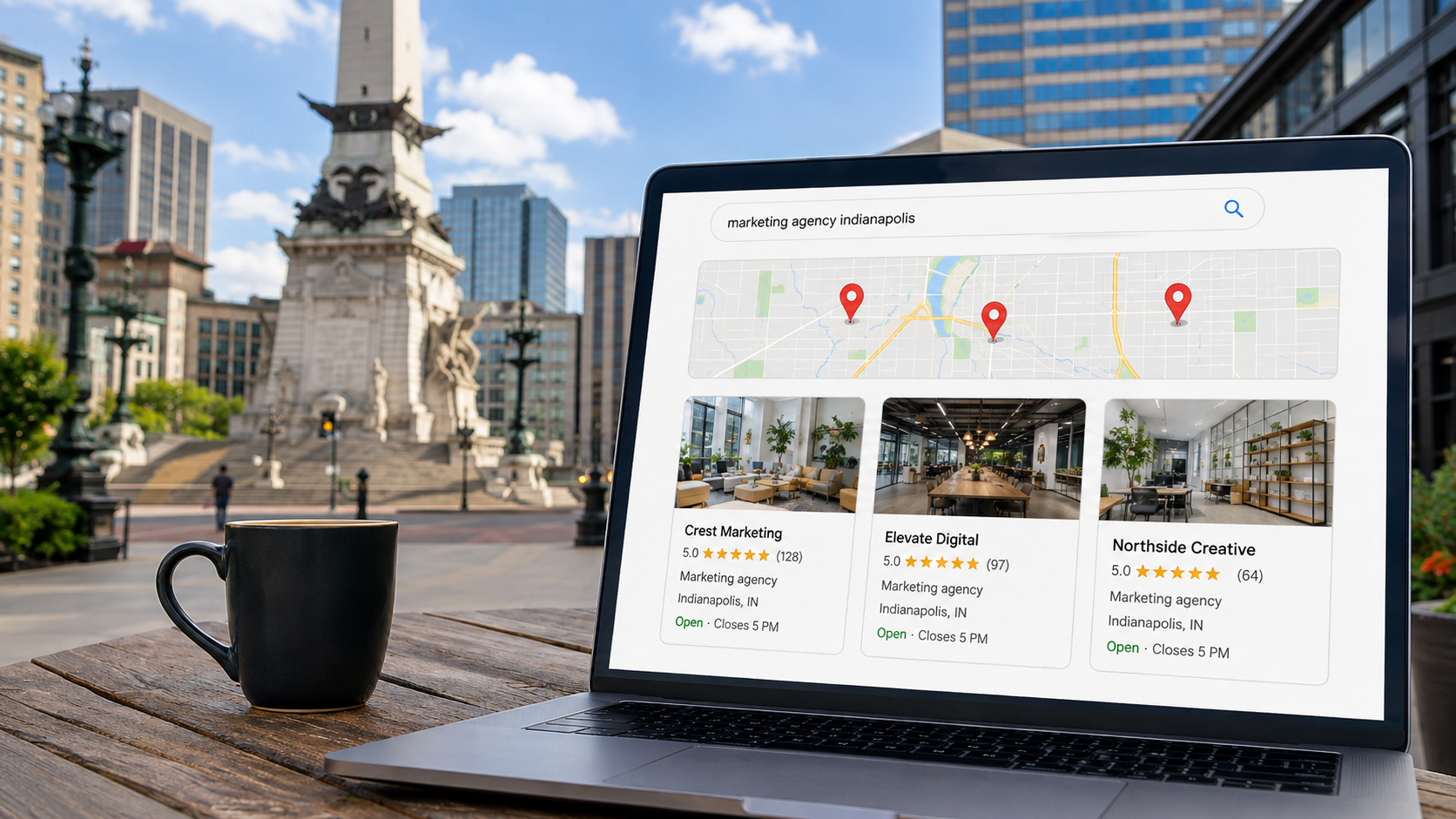
Depending on the query and your location, Google may place a map near the top of the search results with a small group of local businesses underneath it.
That is commonly called the Google 3-Pack, Local Pack, or Map Pack.
For many local searches, Google typically displays three prominent business listings alongside a map, business ratings, hours, location information, and other details.
For an Indianapolis company, earning one of those positions can be extremely valuable.
Why?
Because the customer doesn't need to scroll through ten websites before finding you.
Your business can appear directly in the part of Google designed to answer a local question:
Who nearby provides what I need?
But getting there creates one of the biggest frustrations in local SEO.
Your competitor may have fewer reviews.
Their website may look worse.
They may have been in business for less time.
You may spend more on marketing.
And somehow they still occupy one of those three positions while your company sits below them—or doesn't appear at all.
The mistake is assuming there must be one ranking factor responsible.
There isn't.
Google says local rankings are mainly based on three broad concepts:
Relevance.
Distance.
Prominence.
Google also says there is no way to request or pay for a better organic local ranking.
Everything else we discuss—categories, reviews, website content, backlinks, citations, service pages, business information, authority—fits somewhere inside or around those three concepts.
That's what makes Google's 3-Pack difficult.
There isn't one trick.
There is a local search system.
And if you want your Indianapolis business appearing among those three listings, you need to understand how the pieces work together.
What Is Google's 3-Pack?
The Google 3-Pack is the group of prominent local business results Google can display for searches with local intent.
It is also commonly called:
The Local Pack
Map Pack
Google Local Pack
Local 3-Pack
BrightLocal defines the Local Pack as a Google feature that displays a map along with three local businesses relevant to the searcher's query and location.
A 3-Pack result may show information including:
Business name
Average rating
Review count
Business category
Address
Hours
Map location
Website
Directions
Phone or call options
Other profile information
The exact interface can vary by query, device, business type, and Google's current layout.
Sponsored listings may also appear around local results.
The important distinction is that the organic Local Pack is not the same thing as ranking your website first in Google's traditional organic results.
You can have:
Strong Maps rankings and weak organic rankings.
Or:
Strong organic rankings and weaker Maps visibility.
The best Indianapolis SEO strategies try to strengthen both.
If you want a deeper explanation of the entire Maps ecosystem, read Local SEO in Indianapolis: How to Rank Higher on Google Maps in 2026.
Why the Google 3-Pack Matters So Much
Three is a small number.
That's the point.
Imagine 25 Indianapolis HVAC contractors are reasonably relevant to a search.
The Local Pack doesn't give all 25 equal visibility.
A handful get the premium placement.
Everyone else competes for attention after that.
BrightLocal's 2026 local-search statistics report that 72% of consumers in its underlying research look at three or fewer businesses before deciding which companies to consider. The same resource reports that 73% of local searches begin on mobile devices.
That combination matters.
Someone searching from a phone may not conduct a forensic analysis of every contractor in Indianapolis.
They may evaluate:
Business one.
Business two.
Business three.
Then call one.
That doesn't mean position four is worthless.
It means being visible in the first local comparison set can create a major advantage.
Google's Three Core Local Ranking Factors
Google gives us the clearest framework itself.
According to Google's current Business Profile guidance, local results are mainly based on:
Relevance
Distance
Prominence
Let's break down what each means for an Indianapolis business.
1. Relevance: Does Your Business Match the Search?
Relevance measures how closely your Business Profile matches what someone is searching for.
Google recommends providing complete and detailed business information so it can better understand the company and match it with relevant searches.
Consider these searches:
“Indianapolis roofer”
“commercial roofing Indianapolis”
“roof leak repair near me”
“metal roofing contractor Indianapolis”
A company may provide all four services.
But Google still has to determine how relevant that company is to each specific query.
That relevance can be supported by:
Google Business Profile category
Additional categories
Services
Business information
Website content
Service pages
Page titles
Headings
Internal links
Local content
Reviews
Other references to the business
The stronger and clearer those signals are, the easier it becomes for a search system to understand what the company actually does.
2. Distance: How Close Is the Business to the Searcher?
Distance is the factor you cannot completely optimize away.
Google says distance considers how far each potential result is from the person searching. When a searcher doesn't explicitly provide a location, Google can estimate location using other information it has.
That means the 3-Pack for:
“plumber near me”
can change dramatically depending on where the search occurs.
Someone searching Downtown Indianapolis may see different businesses from someone performing the same search elsewhere in the Indianapolis metro.
This is why one manual ranking check tells you very little.
Your company doesn't have one universal Indianapolis Maps position.
It has a geographic visibility pattern.
You may rank:
#1 near your physical location
#3 a few miles away
#7 farther out
outside the visible pack elsewhere
That can happen even if nothing about your website changes.
The searcher's location changed.
3. Prominence: How Established Does Your Business Appear?
Prominence is about how well-known or established a business appears to be.
Google says prominence can be influenced by information it finds about a business across the web. Its documentation specifically mentions:
Links
Reviews
Websites linking to the business
General web information
Google also says more reviews and positive ratings can help local ranking.
This is where many local SEO activities converge:
Reviews
Backlinks
Local citations
Media coverage
Community involvement
Industry directories
Organic search visibility
Website authority
Prominence helps explain why two equally close businesses with similar services can still rank differently.
So What Actually Makes an Indianapolis Business Reach the 3-Pack?
Google does not publish its exact local algorithm.
Any agency claiming to know a secret percentage assigned to every factor should be treated cautiously.
Industry studies can give us useful observations, but they are not Google's algorithm.
For example, Whitespark's 2026 Local Search Ranking Factors report surveyed 47 local-search practitioners about 187 potential factors. Its respondents gave the greatest overall influence for Local Pack/Maps rankings to Google Business Profile signals, followed by reviews and on-page signals. Whitespark explicitly presents this as expert research rather than privileged knowledge of Google's systems.
So we can use industry studies to prioritize.
But Google's official framework still comes first.
With that distinction established, here are the factors we'd examine when an Indianapolis company wants to break into the 3-Pack.
1. Your Primary Google Business Profile Category
If we were auditing a weak Maps listing, category selection would be near the top of the list.
Google's own Business Profile documentation says the categories you select can affect local ranking.
Your primary category should describe the core business as accurately as possible.
Examples:
An HVAC company may choose an HVAC-related primary category.
A roofing contractor should use the category most closely aligned with its actual core roofing business.
A dental practice should select the appropriate dental category.
An attorney may have category choices related to the firm's actual practice area.
The goal isn't to choose the category with the most search volume.
The goal is to tell Google:
This is what our business actually is.
Why Categories Matter
Consider two companies.
Both repair furnaces.
Company A has a profile centered around:
HVAC Contractor
Company B is categorized as something substantially broader and less aligned.
For a furnace-related local search, Company A may provide Google with a clearer relevance signal.
Reviews can't fully compensate for poor categorization.
Neither can keyword stuffing.
Start with accurate classification.
2. Proximity to the Searcher
This deserves repeating because it's one of the strongest realities of Maps visibility.
A competitor with:
68 reviews
can outrank you with:
468 reviews
if they're significantly closer to the searcher and otherwise relevant.
That's why we wrote Why Your Competitor Ranks Above You in Indianapolis — Even With Fewer Reviews.
Review count isn't a leaderboard.
Geography still exists.
What You Can and Can't Do
You can:
Improve relevance
Improve prominence
Strengthen your website
Build reviews
Build authority
Create stronger local content
You cannot ethically:
Invent fake offices
Use mailboxes as fake storefronts
Create fraudulent Indianapolis locations
Pretend a staff-free virtual office is a genuine location
Google's Business Profile guidelines require businesses to accurately represent real-world locations and business models.
Work with geography.
Don't fabricate it.
3. Complete and Accurate Business Information
Incomplete profiles create unnecessary ambiguity.
Google specifically recommends entering complete business information and keeping it accurate so the company can appear for relevant searches.
Audit:
Business name
Address
Phone number
Website
Hours
Holiday hours
Categories
Service areas
Services
Other applicable attributes
If a customer finds conflicting information, that's already bad.
If Google finds conflicting information, you've also created unnecessary entity confusion.
Accuracy should be foundational.
4. A Legitimate Address and Correct Service-Area Setup
Local search is tied to geography.
That makes address configuration extremely important.
Google distinguishes between:
Storefront businesses
and:
Service-area businesses
and:
Hybrid businesses.
Google says businesses that don't serve customers at their address should remove that address from the public Business Profile and manage the service area appropriately.
For Indianapolis contractors, this matters.
A plumber, electrician, roofer, cleaning company, landscaper, or HVAC company may travel to customers rather than receive them at an office.
Don't expose an address simply because you think displaying it will improve rankings.
Don't create fake locations.
Configure the business the way it genuinely operates.
5. Your Review Count
Yes, review quantity matters.
Google explicitly says more reviews can help local ranking.
But that sentence does not say:
Most reviews = #1.
Review count is one part of prominence.
Consider:
Company A
742 reviews
Weak website
Farther from searcher
Poor category relevance
Company B
185 reviews
Excellent query relevance
Closer to searcher
Strong website and authority
Company B can still win.
That's the whole premise behind Why Your Competitor Ranks Above You in Indianapolis — Even With Fewer Reviews.
6. Your Average Review Rating
Google also says positive ratings can help local ranking.
Ratings matter for a second reason:
Humans see them.
BrightLocal's 2026 Local Consumer Review Survey found that consumers continue to use star ratings as a meaningful screening mechanism when evaluating local businesses.
Imagine this 3-Pack:
Business A — 3.6 stars
Business B — 4.8 stars
Business C — 4.7 stars
Even if Business A technically ranks first, it may not receive the most calls.
This is the distinction between:
ranking
and:
winning the customer.
You need both.
7. Review Recency and Ongoing Reputation
Google publicly confirms that review count and rating matter to local ranking, but it does not publish a simple formula for review recency.
So we should not pretend:
“Five reviews this week will move you two positions.”
That's invented precision.
What we can say confidently is that recent reviews matter enormously to customers.
BrightLocal's 2026 consumer research found continued sensitivity to how recent reviews are when evaluating local businesses.
A profile with 600 reviews but no new review in a year can look stale compared with a competitor receiving genuine customer feedback every week.
Build a review process.
Don't run a once-a-year review campaign.
8. Responding to Reviews
Google recommends replying to reviews and says helpful responses can help your business stand out.
That matters even if the ranking impact of individual responses is not publicly quantified.
Review responses tell prospective customers:
Someone is paying attention.
That is especially important for negative reviews.
Don't attack customers.
Don't reveal private details.
Don't copy the exact same sentence onto 300 reviews.
Respond professionally.
Your response is written for the next customer reading the exchange as much as for the person who left the review.
9. Your Website's Organic SEO
One of the biggest misconceptions about the 3-Pack is that Maps SEO happens only inside Google Business Profile.
Google's own local-ranking guidance ties prominence to the broader web, including links to your business.
A strong website can provide deep evidence about:
Services
Expertise
Location
Authority
Business identity
Customer questions
Google's general SEO documentation also emphasizes clear site organization, useful content, crawlable links, and making pages understandable to search engines and users.
Your Website and Business Profile Should Agree
If your primary category is:
Roofing Contractor
but your website devotes two sentences to roofing and twenty pages to unrelated services, that's weak alignment.
If your profile emphasizes emergency plumbing but your website barely mentions emergency plumbing, that's weak alignment.
Your profile makes the claim.
Your website should substantiate it.
10. Your Indianapolis Landing Page
If Indianapolis is an important market, your website should demonstrate that.
Not by repeating:
Indianapolis Indianapolis Indianapolis
throughout the page.
By showing legitimate local relevance.
A strong Indianapolis page could include:
Services offered
Geographic coverage
Indianapolis projects
Local case studies
Customer testimonials
Relevant photographs
Indianapolis FAQs
Local business relationships
Contact options
The page should exist because Indianapolis customers benefit from it.
Not because an SEO template required a city name.
11. Individual Service Pages
One generic services page often isn't enough for a company offering multiple major services.
Suppose an Indianapolis HVAC company offers:
Furnace repair
Furnace replacement
AC repair
AC replacement
Heat pumps
Commercial HVAC
Maintenance
If every service is buried inside one page, Google has less page-level depth to work with.
Separate pages can make sense when:
Customers search for the service independently
The service is commercially important
You can provide unique and useful information
Google's SEO guidance encourages site owners to think about the words users might search and to organize content in ways that help visitors find what they need.
You aren't creating pages for robots.
You're creating better answers.
12. Internal Linking
Your service pages shouldn't live alone.
Internal links help search engines and users discover relationships between pages.
Imagine this Indianapolis content structure:
Indianapolis HVAC Services
links to:
AC Repair
Furnace Repair
Heat Pumps
Commercial HVAC
Then:
How Much Does Furnace Replacement Cost in Indianapolis?
links back to:
Furnace Replacement
Financing
Indianapolis HVAC Services
That's a content cluster.
Google's SEO Starter Guide recommends descriptive, crawlable links and logical site organization.
Internal links help your website explain itself.
13. Technical SEO
The best local landing page in Indianapolis doesn't help much if Google can't properly access or index it.
Technical problems can quietly undermine the website supporting your Google Business Profile.
Examples include:
Accidental noindex
Broken internal links
Wrong canonical tags
Redirect problems
Missing important pages
Slow mobile pages
Crawl problems
Duplicate URLs
That's why we built a separate guide:
The Indianapolis Website Audit: 20 SEO Problems That Cost Local Businesses Leads
Before publishing fifty new local pages, make sure your current website works.
14. Mobile Experience
Local searches and mobile behavior naturally overlap.
BrightLocal's 2026 local SEO statistics report that 73% of local searches begin on mobile devices.
Google also uses mobile-first indexing, meaning it primarily uses the mobile version of site content for indexing and ranking.
Your mobile website needs to answer four questions quickly:
Who are you?
What do you do?
Do you serve me?
How do I contact you?
Audit:
Page speed
Navigation
Buttons
Click-to-call
Forms
Text size
Pop-ups
Images
Contact information
Ranking in the 3-Pack is pointless if customers click through and immediately leave.
15. Backlinks
Google specifically mentions websites linking to a business when explaining local prominence.
That makes backlinks part of the local equation.
Strong backlink opportunities for Indianapolis companies may include:
Local media
Indianapolis organizations
Indiana industry associations
Manufacturers
Vendors
Business partners
Community sponsorships
Chambers
Professional organizations
A legitimate editorial link from a relevant source does more than create “SEO juice.”
It reinforces:
This business exists.
This business participates in its industry or market.
Other reputable entities recognize it.
16. Local Citations
Google also draws prominence information from directories and other sources around the web.
That makes business citations part of your local footprint.
But don't turn citation building into:
“Submit us to 500 websites.”
We recently published an entire Indianapolis citation guide explaining which listings deserve priority:
Indianapolis Local Citations: Which Business Directories Actually Matter?
The short version:
Prioritize:
Major search platforms
Mapping ecosystems
Data sources
Indianapolis organizations
Industry directories
Sources customers actually use
Quality beats directory volume.
17. Business Information Consistency
Imagine Google sees:
Website: 123 Main Street
Facebook: 500 Oak Road
Major directory: previous phone number
Google Business Profile: a third variation
That creates avoidable confusion.
The important issue isn't whether one citation uses:
Street
and another says:
St.
The meaningful problems are:
Wrong address
Wrong phone
Old website
Old business name
Duplicate profiles
Closed locations
Maintain accurate business information.
Customers benefit too.
18. Local Authority Beyond Directories
Some of the best prominence signals don't come from directories at all.
They come from real Indianapolis activity.
Examples:
Sponsoring a local event
Joining a relevant business organization
Supporting a nonprofit
Providing expert commentary to local media
Participating in professional associations
Publishing original Indianapolis data
Building legitimate partnerships
Those activities can generate:
Brand mentions
Backlinks
Citations
Referral traffic
Recognition
Searches for your business name
Good local marketing can become good local SEO.
19. Structured Data
Structured data gives search engines machine-readable information about page content and entities.
Google says structured data can help it understand information about the web and the entities described on webpages.
Google specifically supports LocalBusiness structured data for communicating details about a local business.
Depending on the business and page, useful markup might include:
LocalBusiness
Organization
BreadcrumbList
Article
Other applicable supported types
But don't misunderstand schema.
Adding LocalBusiness schema does not mean:
“We rank in the 3-Pack tomorrow.”
Structured data is a clarity layer.
Not a magic ranking button.
20. Search Intent
An Indianapolis business doesn't rank equally for every query simply because the keywords seem related.
Consider:
“roofer Indianapolis”
versus:
“commercial flat roof repair Indianapolis”
versus:
“roof inspection near me.”
Those searches reveal different needs.
Your business may be more relevant to one than another.
Your website should therefore reflect distinct important services instead of trying to force every search into one page.
Ask:
What is the customer actually trying to find?
Then build the best legitimate answer.
What Does the 2026 Local SEO Research Say?
Google does not publish an exact weighting formula.
Industry research can still help prioritize testing.
Whitespark's 2026 Local Search Ranking Factors survey asked 47 local SEO practitioners to evaluate 187 factors.
For Local Pack/Maps rankings, the grouped results emphasized:
Google Business Profile signals
Review signals
On-page signals
Behavioral signals
Links
Citations
Personalization
Social signals
Again:
This is expert survey research, not Google's disclosed algorithm.
That distinction is critical.
But it reinforces something useful.
If your Indianapolis Maps strategy currently consists of:
“Get more reviews.”
you're under-optimizing.
A complete local strategy needs:
GBP
Reviews
Website
Local content
Links
Citations
Technical SEO
Authority
Conversion
Why Having More Reviews Doesn't Guarantee the 3-Pack
This misconception deserves its own section because we see it constantly.
Imagine:
Your Business
4.8 stars
480 reviews
Competitor
4.7 stars
125 reviews
The competitor ranks above you.
Why?
Possible reasons include:
They are closer to the searcher
Their category better matches the query
Their website better matches the service
They have stronger backlinks
Their Indianapolis relevance is stronger
Their organic visibility is better
Their overall prominence is stronger
Google never says:
Sort businesses by number of reviews.
It says local ranking considers relevance, distance, and prominence.
Reviews contribute.
They don't override everything.
We've gone deeper into this exact issue in Why Your Competitor Ranks Above You in Indianapolis — Even With Fewer Reviews.
Why Your 3-Pack Ranking Changes Across Indianapolis
One day you search and see yourself first.
Your employee searches and sees you fourth.
A customer searches and can't find you.
Nobody is necessarily wrong.
Distance changes results.
Google says it considers how far each potential result is from the searcher.
So your Maps visibility may look like:
Near office: Excellent
Five miles away: Strong
Ten miles away: Moderate
Other side of metro: Weak
That's normal.
Track a Geographic Grid
Instead of measuring:
“We're #3.”
measure:
“We appear in the top three across 41% of the geographic points we care about.”
That gives you a more realistic visibility model.
Then monitor changes over time.
You Cannot SEO Your Way Out of Geography
This is worth saying directly.
If your company is physically located far from the searcher, there may be queries where a closer competitor has a natural advantage.
That doesn't mean you give up.
It means you strengthen what you control:
Relevance
Prominence
Organic SEO
Reviews
Content
Links
Brand
Authority
And accept the geographic constraint.
Don't Create Fake Indianapolis Offices
Google requires businesses to represent locations accurately.
Do not solve proximity problems by:
Renting mailboxes
Creating fake suites
Using unstaffed addresses
Listing employee homes improperly
Creating duplicate profiles
A short-term spam tactic can create much bigger problems than position four.
How to Audit Why You're Not in the Indianapolis 3-Pack
If your company is stuck outside the pack, don't start randomly changing things.
Diagnose.
Step 1: Identify Which Queries Matter
Don't audit one keyword.
Create a list of:
Core services
High-revenue services
Emergency services
Location-modified queries
“Near me” queries
Industry-specific searches
Example for an HVAC company:
HVAC company Indianapolis
AC repair Indianapolis
Furnace repair Indianapolis
HVAC near me
Commercial HVAC Indianapolis
Heat pump repair Indianapolis
Different queries can have different winners.
Step 2: Map Geographic Visibility
Check multiple locations across the market.
Identify:
Where you're top three
Where you're 4–10
Where you disappear
Which competitors dominate particular zones
Now you know whether the primary problem is citywide or geographic.
Step 3: Compare Google Business Profiles
Audit:
Primary category
Additional categories
Business information
Services
Hours
Review count
Rating
Review freshness
Review responses
Website
Address
Service area
Look for meaningful differences.
Step 4: Compare Websites
Evaluate:
Indianapolis landing pages
Individual services
Titles
Content
Internal linking
Organic rankings
Technical SEO
Mobile experience
Structured data
Use The Indianapolis Website Audit: 20 SEO Problems That Cost Local Businesses Leads as your framework.
Step 5: Compare Authority
Investigate:
Backlinks
Industry links
Local media
Organizations
Citations
Sponsorships
Partnerships
Your competitor may have a much stronger prominence footprint than their Business Profile alone suggests.
Step 6: Compare Citations
Check whether competitors appear on meaningful:
Indianapolis directories
Chambers
Industry platforms
Data sources
Professional associations
Our Indianapolis Local Citations guide explains which listings deserve priority.
Step 7: Prioritize Fixable Gaps
Separate:
Constraints
Physical location
Competitor location
Genuine category differences
from:
Fixable Problems
Weak website
Wrong category
Thin content
No local page
Poor review process
Weak backlinks
Inaccurate citations
Technical SEO issues
Bad internal linking
Work on what can actually change.
A 90-Day Indianapolis 3-Pack Strategy
If your business isn't appearing consistently in the Local Pack, use a structured process.
Days 1–30: Fix Relevance
Audit and improve:
Primary category
Additional categories
Business information
Service information
Website alignment
Indianapolis landing page
Core service pages
Titles
Headings
Internal linking
Technical indexability
Your goal:
Make it easier for Google to understand exactly what the company does.
Days 31–60: Strengthen Reputation and Local Proof
Work on:
Legitimate review generation
Review responses
Local customer proof
Case studies
Testimonials
Project examples
Indianapolis content
Business information accuracy
Your goal:
Make it easier for customers and search systems to trust the company.
Days 61–90: Build Prominence
Focus on:
Backlinks
Local citations
Indianapolis organizations
Industry directories
Partnerships
Sponsorships
Earned mentions
Digital PR
Original resources
Your goal:
Make the business harder to ignore across the web.
Then measure again.
What Not to Do When Trying to Rank in the 3-Pack
Local SEO frustration creates bad tactics.
Avoid these.
Don't Stuff Keywords Into Your Business Name
Google requires businesses to use the real-world name customers actually recognize.
Don't turn:
Smith Roofing
into:
Smith Roofing Best Roof Repair Indianapolis Metal Roofing Roofer Near Me
unless that absurd phrase is genuinely your business name.
Don't Buy Reviews
You want real customers describing real experiences.
Fake or manipulated reputation is not a sustainable local SEO strategy.
Don't Create Fake Locations
A proximity problem doesn't justify a fraudulent address.
Don't Build 100 Thin Indianapolis Pages
Indianapolis.
Carmel.
Fishers.
Greenwood.
Noblesville.
Avon.
Plainfield.
Speedway.
Creating location pages can be completely legitimate.
Creating identical pages and changing only the city name isn't useful.
Google's SEO guidance emphasizes useful, people-first content.
Create a location page when you have something meaningful to say.
Don't Buy 1,000 Random Citations
Build credible listings.
Not directory volume.
See Indianapolis Local Citations: Which Business Directories Actually Matter?.
Don't Ignore the Website
Your Business Profile isn't your entire local SEO strategy.
Don't Judge Performance From One Search
A single search reflects one location at one moment for one query.
Measure broader visibility.
The Indianapolis 3-Pack Is Also a Conversion Competition
Ranking is only the first battle.
Imagine you enter the Local Pack.
Great.
Now the customer sees:
You
4.1 stars
37 reviews
No recent photos
Website looks broken on mobile
Competitor
4.8 stars
214 reviews
Recent project photos
Professional website
Clear contact options
You technically achieved the ranking goal.
They may still get the lead.
BrightLocal's 2026 consumer review research shows that reviews remain a major part of how consumers evaluate local businesses.
That's why 3-Pack optimization needs two goals:
Be visible.
and:
Be chosen.
You need:
Reviews
Professional profile
Strong website
Clear services
Current information
Social proof
Easy contact
Local rankings generate opportunity.
Your business still has to convert it.
How AI Search Fits Into the Indianapolis 3-Pack Strategy
The 3-Pack still matters.
But local discovery is expanding beyond traditional Google Search.
Consumers increasingly use AI tools to ask questions like:
“Who is the best HVAC company in Indianapolis?”
“Find a highly rated roofer near me.”
“Which Indianapolis lawyer handles truck accidents?”
BrightLocal's 2026 AI and local-business research found substantial consumer adoption of AI tools for local recommendations among its survey population.
That doesn't replace local SEO.
It makes your underlying digital footprint even more important.
The same assets useful for Google Maps can also help create clearer business understanding elsewhere:
Accurate entity information
Strong website
Service pages
Structured data
Reviews
Citations
Backlinks
Local mentions
Authority
At Ritner Digital, we treat traditional SEO, Local SEO, and AI search visibility as connected systems because they increasingly rely on overlapping evidence about the same business.
Frequently Asked Questions About Ranking in Google's 3-Pack in Indianapolis
What Is Google's 3-Pack?
Google's 3-Pack—also called the Local Pack or Map Pack—is a Google Search feature that typically displays three prominent local business listings alongside a map for searches with local intent.
Listings can include information such as:
Business name
Rating
Reviews
Address
Hours
Map location
Other business details
The exact layout can vary depending on the search and device.
How Does Google Decide Which Indianapolis Businesses Appear in the 3-Pack?
Google says local results are primarily based on:
Relevance
Distance
Prominence
Relevance measures how well the business matches the search.
Distance considers proximity to the searcher or specified location.
Prominence considers how established or well-known the business appears.
Those broad concepts can be supported by Business Profile information, reviews, website SEO, backlinks, citations, and other signals.
Can I Pay Google to Rank in the Organic 3-Pack?
No.
Google explicitly says businesses cannot request or pay for a better organic local ranking.
Google does offer paid advertising products that can appear around local results, but sponsored visibility is different from earning an organic Local Pack position.
What's the Most Important Factor for Ranking in the Indianapolis 3-Pack?
Google does not publish a single “most important” factor or exact weighting formula.
It says local ranking is based primarily on relevance, distance, and prominence.
Industry research such as Whitespark's 2026 survey places significant emphasis on Google Business Profile signals, reviews, and on-page SEO, but those results represent expert observations rather than Google's disclosed algorithm.
Does My Google Business Profile Category Affect 3-Pack Rankings?
Yes.
Google's own documentation says the categories you select affect local ranking.
Choose the category that most accurately represents the core business and use additional categories only where they legitimately apply.
Do More Google Reviews Help Me Get Into the 3-Pack?
Google says more reviews and positive ratings can help local rankings.
However, review count alone does not determine the 3-Pack.
A business with fewer reviews can outrank you because of:
Better proximity
Better relevance
Stronger categories
Stronger website
Better backlinks
Greater prominence
See Why Your Competitor Ranks Above You in Indianapolis — Even With Fewer Reviews for the full explanation.
How Many Reviews Do I Need to Rank in the Indianapolis 3-Pack?
There is no universal review threshold.
Google does not publish a minimum number of reviews required to rank.
Competitive expectations vary by:
Industry
Query
Location
Competitors
Rating
Business authority
Proximity
Rather than targeting an arbitrary number, build a steady stream of genuine customer reviews.
Can a Business With 50 Reviews Outrank One With 500?
Yes.
Review count is one signal.
Google still evaluates relevance, distance, and prominence.
A business with 50 reviews may be closer to the searcher, more relevant to the query, better categorized, or supported by stronger website and authority signals.
Does My Physical Location Affect Whether I Rank in the 3-Pack?
Yes.
Distance is one of Google's three stated local-ranking factors.
A business may rank strongly near its location and progressively weaker as the searcher moves farther away.
That's why local rankings should be measured across a geographic area instead of from one computer.
Can a Service-Area Business Rank in the Indianapolis 3-Pack?
Eligible service-area businesses can have Google Business Profiles and appear in local search.
Google requires companies that don't receive customers at their address to configure the profile appropriately and remove the public address where required.
Do not create fake Indianapolis locations solely to improve proximity.
Does My Website Affect Google 3-Pack Rankings?
Your website can support the broader relevance and prominence surrounding your Business Profile.
Google's local-ranking guidance references links to your business when describing prominence, while its broader SEO documentation explains how useful content, site organization, and links help Google understand webpages.
A strong local SEO strategy should therefore include both Google Business Profile optimization and website SEO.
Should My Website Have an Indianapolis Page?
If Indianapolis is genuinely a major market for your business, a dedicated local page can make sense.
A useful page might contain:
Indianapolis services
Geographic information
Local projects
Testimonials
FAQs
Case studies
Local proof
Clear contact information
Avoid thin city pages that exist only to repeat the location keyword.
Do Backlinks Help Google Maps Rankings?
Google includes websites linking to a business when explaining prominence.
Strong local backlink sources may include:
Indianapolis organizations
Indiana industry associations
Local publications
Manufacturers
Vendors
Community partnerships
Professional organizations
Prioritize legitimate authority over bulk link buying.
Do Local Citations Help With 3-Pack Rankings?
Directories can contribute to the broader information search systems have about a business.
But citations should be treated as one part of the local SEO system rather than a standalone ranking strategy.
For a detailed breakdown, read Indianapolis Local Citations: Which Business Directories Actually Matter?.
Does Schema Markup Help Me Rank in the 3-Pack?
Structured data can help Google better understand information about a business and webpage. Google supports LocalBusiness structured data for communicating local business information.
However, schema is not a guaranteed Maps-ranking factor that automatically moves a company into the 3-Pack.
Use it for clarity—not as a shortcut.
Why Does My 3-Pack Ranking Change When I Drive Across Indianapolis?
Because Google considers distance.
The location of the searcher influences which businesses may be considered most relevant locally.
Your visibility can therefore change neighborhood by neighborhood.
How Should I Track Indianapolis 3-Pack Rankings?
Track your important queries across multiple geographic points.
Instead of asking:
“What rank are we?”
ask:
“Where are we visible in the top three across our target service area?”
Then monitor the geographic pattern over time.
Can I Rank in Indianapolis If My Business Is Outside Indianapolis?
Potentially, depending on the query, business location, relevance, prominence, and competition.
However, distance remains a ranking factor, which can make strong Maps visibility more difficult as the search point moves away from your real location.
Organic website rankings may sometimes provide additional visibility in areas where Maps proximity creates limitations.
Should I Create Multiple Google Business Profiles to Cover Indianapolis?
Only if each profile represents a legitimate, eligible business location under Google's guidelines.
Do not create duplicate or fake profiles simply to cover more geographic territory.
Google's Business Profile rules require businesses to accurately represent real-world operations.
Why Did My Indianapolis Business Drop Out of the 3-Pack?
There can be many possible causes.
Examples include:
Competitor improvements
Changes in searcher location
Category changes
Review changes
Website problems
Business Profile changes
Increased competition
Algorithmic changes
Relevance changes
Technical problems
Don't assume the cause.
Audit the entire local search footprint.
Our Indianapolis Website Audit is a useful place to start when the website may be contributing to the decline.
How Long Does It Take to Reach the Google 3-Pack?
There is no universal timeline.
A company with an established Indianapolis location, strong website, hundreds of legitimate reviews, quality backlinks, and an optimized Business Profile starts from a completely different position than a new business.
Competition also matters.
The appropriate approach is:
Establish a baseline.
Fix the largest gaps.
Measure visibility over time.
Avoid agencies promising guaranteed top-three rankings by a specific date.
Is Ranking in the 3-Pack More Important Than Ranking Organically?
Both can be valuable.
Local Pack visibility can capture customers looking for nearby businesses.
Organic results can reach users conducting deeper research and can give you additional visibility beyond your immediate Maps radius.
The strongest Indianapolis SEO strategy aims to build both.
What's the Fastest Way to Improve My Indianapolis 3-Pack Visibility?
There is no guaranteed shortcut.
Start with the highest-impact problems you can control:
Verify that the Business Profile is eligible and accurate.
Audit the primary category.
Complete important profile information.
Build legitimate reviews.
Improve the website.
Strengthen Indianapolis and service relevance.
Fix technical SEO problems.
Improve internal linking.
Build legitimate citations.
Earn relevant backlinks.
Then measure whether visibility actually changes.
Sources
This article was researched and updated for August 2026. Google's own documentation is used as the primary authority for statements about local ranking, Google Business Profile, business categories, service-area businesses, mobile indexing, and structured data.
Google Business Profile Help — Tips to Improve Your Local Ranking on Google. Google's official explanation of relevance, distance, prominence, reviews, links, business information, and local ranking.
Google Business Profile Help — Manage Your Business Category. Google's official documentation confirming that Business Profile category selection affects local ranking.
Google Business Profile Help — Guidelines for Representing Your Business on Google. Google's current rules for business identity, locations, addresses, and profile eligibility.
Google Business Profile Help — Manage Service Areas. Google's guidance for service-area and hybrid businesses.
Google Business Profile Help — Manage Customer Reviews. Google's official documentation on customer reviews and review responses.
Google Search Central — SEO Starter Guide. Google's guidance on useful content, site organization, links, crawlability, and helping search engines understand webpages.
Google Search Central — Mobile-First Indexing Best Practices. Google's current mobile indexing guidance.
Google Search Central — Introduction to Structured Data. Google's explanation of how structured data helps search engines understand entities and webpage content.
Google Search Central — LocalBusiness Structured Data. Google's technical documentation for LocalBusiness markup.
Whitespark — 2026 Local Search Ranking Factors. Survey of 47 local SEO practitioners covering 187 potential local search factors. The study is industry research and does not represent Google's disclosed algorithm.
BrightLocal — What Is the Google Local Pack? Overview of the Local Pack and how Google's map-based local results appear.
BrightLocal — 2026 Local SEO Statistics. Current statistics covering local search behavior, mobile usage, consumer consideration sets, and local SEO research.
BrightLocal — Local Consumer Review Survey 2026. Current consumer research into reviews, ratings, trust, and local business selection.
Getting Into Google's 3-Pack Is Not About Finding One Trick
The Indianapolis businesses that consistently appear in Google's 3-Pack aren't necessarily the companies with:
The most reviews.
The biggest website.
The oldest domain.
The largest advertising budget.
Google is trying to answer a local customer's question.
Which businesses are the best match for this search from this location?
That is why the framework keeps coming back to:
Relevance.
Distance.
Prominence.
Relevance tells Google:
We provide what this person wants.
Distance tells Google:
We are geographically connected to this search.
Prominence tells Google:
There is enough evidence across the web that this is an established business worth considering.
Your job is to strengthen everything you legitimately can within that framework.
That means:
Accurate categories
Complete Business Profile information
Strong reviews
Strong ratings
A technically healthy website
Individual service pages
Indianapolis relevance
Internal linking
Local citations
Backlinks
Structured data
Community and industry authority
And then you measure what changes.
Because the goal isn't merely to say:
“We did local SEO.”
The goal is to put your business in front of more Indianapolis customers when they're actively looking for what you sell.
Want to Know What's Keeping Your Business Out of the Indianapolis 3-Pack?
Ritner Digital helps businesses diagnose and improve the signals affecting Google Maps, Local Pack, organic search, and AI-driven visibility.
That includes:
Google Business Profile optimization
Indianapolis local SEO
Local rank tracking
Competitor analysis
Review strategy
Website SEO
Technical audits
Indianapolis landing pages
Service-page optimization
Internal linking
Local citation strategy
Backlink building
Structured data
Authority development
AI search optimization
Conversion-focused SEO
If your competitors keep occupying Google's top three local positions while your business sits outside the pack, we'll help identify why.
Contact Ritner Digital today and tell us which Indianapolis searches you want to win.
We'll look at your Business Profile, geographic visibility, reviews, website, citations, backlinks, competitors, and local authority—and identify what we'd prioritize first.