How Indianapolis Small Businesses Can Compete With National Brands on Google
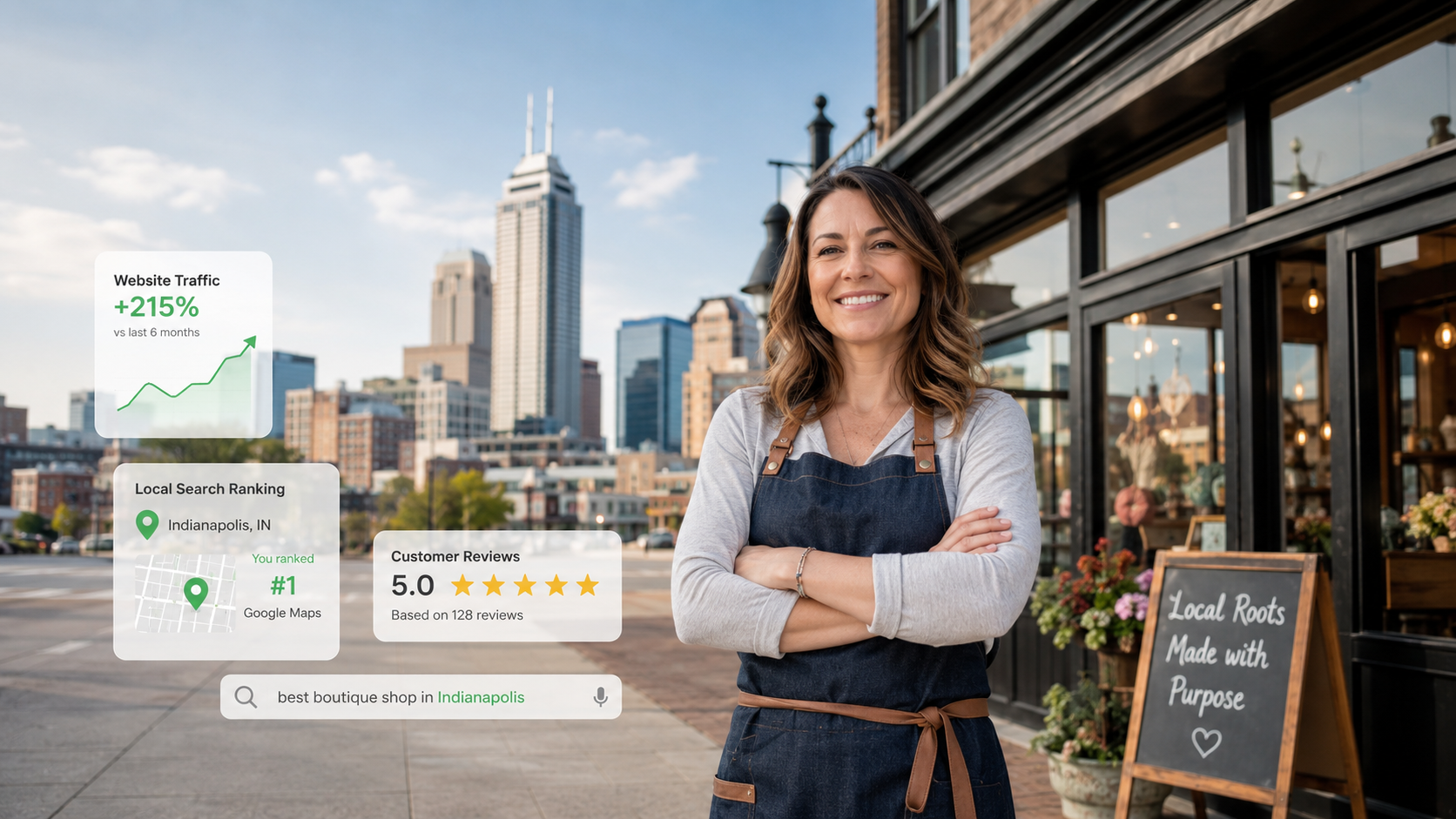
You search Google for the service your Indianapolis business provides.
And there they are.
The national brands.
Again.
They have websites with thousands of pages.
Marketing teams with more employees than your entire company.
Millions of dollars in advertising.
Domains that have existed for decades.
Links from major publications.
Brand names almost everyone recognizes.
Meanwhile, your Indianapolis company may have:
One marketing employee
A modest website
A limited SEO budget
One real location
A handful of service pages
No national media coverage
An owner who still answers customer calls
So how are you supposed to compete?
By understanding that you do not need to beat a national company everywhere on Google.
You need to beat them where your Indianapolis customers are actually searching.
That distinction changes the strategy.
Google's local search system does not simply rank the company with the largest marketing department.
For local results, Google says it primarily evaluates relevance, distance, and prominence. Google also explicitly says businesses cannot request or pay for better organic local rankings.
In traditional organic search, Google emphasizes useful, reliable, people-first content, clear site organization, descriptive links, and language that reflects how people actually search.
Those systems create opportunities for small Indianapolis businesses.
A national company may have substantially more overall authority.
But you may be:
More relevant to Indianapolis.
Closer to the customer.
More specific about the service.
Better reviewed locally.
More trusted in the community.
More responsive.
More knowledgeable about the exact local problem.
More convincing when the customer finally reaches your website.
Those are real advantages.
The goal isn't to make your 25-person Indianapolis company look like a Fortune 500 corporation.
The goal is to make Google and potential customers understand why your business is the better answer to a specific Indianapolis search.
Here's how.
Why National Brands Usually Have an SEO Advantage
Before talking about how to beat large companies, acknowledge what you're competing against.
National brands often have structural SEO advantages.
They may have:
Older domains
Thousands of backlinks
National press coverage
Large content teams
Dedicated SEO departments
Significant advertising budgets
Huge brand-search volume
Strong domain-level authority
Sophisticated technical infrastructure
Large customer databases
Thousands of reviews across locations
If you operate one Indianapolis location, trying to outperform a national company for an enormous broad query like:
“insurance”
or:
“mattress”
or:
“home improvement”
may be a terrible use of resources.
But your customer probably doesn't always search that broadly.
They search things like:
“emergency plumber Indianapolis”
“commercial HVAC repair Indianapolis”
“roof leak repair near me”
“Indianapolis estate planning attorney”
“furnace replacement Indianapolis”
“local accountant near me”
Now geography and service relevance become more important.
Google's official local ranking guidance explicitly says distance and relevance are core parts of determining which businesses appear locally.
That's the battlefield where a small business can become dangerous.
Small Businesses Should Not Try to Beat National Brands at Their Own Game
Imagine a national HVAC corporation publishes:
The Complete Guide to Air Conditioning
It's 12,000 words long.
The domain has 80,000 backlinks.
Trying to create:
The Even More Complete Guide to Air Conditioning
may not be your smartest move.
Instead, publish:
How Much Does AC Replacement Cost in Indianapolis in 2026?
or:
Heat Pump vs. Furnace: Which Makes More Sense for an Indianapolis Home?
or:
Why Is My Indianapolis Home's Second Floor So Hot?
Now you're competing on:
Geographic relevance
Firsthand expertise
Local climate context
Local customer problems
Specific purchase intent
National brands frequently optimize for scale.
Small businesses can optimize for specificity.
And specificity is one of your greatest SEO advantages.
20 Ways Indianapolis Small Businesses Can Compete With National Brands on Google
1. Target Local Search Intent Instead of Massive National Keywords
Start by choosing battles you can actually win.
A national plumbing company may dominate:
“plumbing services.”
That doesn't mean it automatically dominates:
“emergency plumber Indianapolis.”
Or:
“water heater repair Indianapolis.”
Or:
“plumber near me.”
Local-intent searches give Google geographic context.
Google says local rankings consider relevance, distance, and prominence.
That means your Indianapolis location isn't merely something to put in the footer.
It's a competitive signal.
Look for Searches With Local Purchase Intent
Examples include:
Service + Indianapolis
Service + near me
Service + neighborhood
Problem + Indianapolis
Emergency service + Indianapolis
Cost + Indianapolis
Best + service + Indianapolis
Local service + Indianapolis
Instead of asking:
“What is the biggest keyword in our industry?”
ask:
“What does an Indianapolis customer search immediately before hiring someone like us?”
Those are often better targets.
2. Treat Google Business Profile Like a Customer Acquisition Channel
A national competitor may have an enormous website.
But for local searches, your Google Business Profile can put you beside—or above—them.
Google says local ranking is based primarily on relevance, distance, and prominence and recommends keeping Business Profile information complete and accurate.
Audit your:
Primary category
Additional categories
Business name
Address
Service area
Phone number
Website
Hours
Holiday hours
Services
Photos
Reviews
Review responses
Your profile shouldn't be treated as:
“That listing somebody set up in 2019.”
It is part of your digital storefront.
If a national competitor has a generic local presence but you have a deeply optimized, accurate, active Indianapolis profile, you can create an advantage.
For a full Maps strategy, read Local SEO in Indianapolis: How to Rank Higher on Google Maps in 2026.
3. Use Proximity as an Advantage
A national company may have more authority.
But if its nearest location is significantly farther from the searcher, geography can work in your favor.
Google says distance is one of its primary local ranking factors.
That's something a national domain cannot completely overpower.
Their corporate website may be substantially stronger.
Their physical Indianapolis presence may not be.
This Is Why Local SEO Isn't Just Traditional SEO With a City Name
Traditional organic rankings can reward sites with huge authority.
Maps adds geography.
That creates opportunities for smaller companies physically connected to the market.
You shouldn't attempt to manipulate that advantage with:
Fake offices
Virtual addresses
Mailboxes
Fake suites
Duplicate Business Profiles
Google requires companies to represent their real-world business accurately.
Use your legitimate local presence.
It's already an advantage.
4. Build a Better Indianapolis Landing Page Than the National Brand
Visit the location pages of large companies.
You'll often find something like:
Welcome to our Indianapolis location. We proudly provide SERVICE to Indianapolis and the surrounding community. Contact us today.
Then the exact same page exists for:
Chicago.
Denver.
Nashville.
Charlotte.
Phoenix.
Only the city changes.
That's scale.
It's also your opportunity.
You can build an Indianapolis page containing:
Actual Indianapolis projects
Local customers
Local testimonials
Real team members
Local photos
Local service questions
Local pricing considerations
Local geographic information
Indiana-specific requirements where relevant
Local case studies
Neighborhood knowledge
Indianapolis FAQs
The national brand can generate 500 city pages.
You only need to make your important market page excellent.
Google says its ranking systems are designed to prioritize helpful, reliable content created primarily to benefit people.
Don't outscale them.
Out-localize them.
5. Build Deeper Service Pages
Small businesses frequently make this mistake:
Homepage
About
Services
Contact
And the Services page contains every service in 600 words.
Meanwhile, the national competitor has individual pages for every meaningful service.
That's a gap you can fix.
Suppose you're an Indianapolis HVAC company.
You may need dedicated pages for:
AC repair
AC replacement
Furnace repair
Furnace replacement
Heat pump installation
Commercial HVAC
Preventive maintenance
Google's Search Essentials recommends using the words people search for in prominent page locations such as titles and headings, while Google's SEO Starter Guide encourages logical organization and useful content.
A dedicated service page gives you enough room to actually answer the customer's question.
Go Deeper Than the National Template
Discuss:
Symptoms
Solutions
Process
Pricing factors
Timing
Indianapolis context
FAQs
Customer examples
Relevant warranties
What happens next
You know your service better than a national content writer creating 75 location templates.
Use that expertise.
6. Publish Content a National Brand Cannot Easily Fake
One of the easiest ways to compete against scale is to publish information requiring actual local knowledge.
For an Indianapolis roofing company:
What Indiana Homeowners Should Know After a Major Hailstorm
For an HVAC contractor:
What Indianapolis Homeowners Actually Pay for Furnace Replacement
For a landscaper:
Indianapolis Clay Soil: What Homeowners Should Know Before a Drainage Project
For an attorney:
What Happens After a Car Accident on I-465?
For a commercial cleaning company:
How Indianapolis Office Managers Should Budget for Commercial Cleaning
These topics create a natural moat.
A national company can imitate the title.
But you can bring:
Local experience
Local data
Local photos
Real projects
Local customer questions
Firsthand insight
That's substantially harder to manufacture at scale.
7. Turn Your Size Into a Trust Advantage
National brand:
Call 1-800-SOMETHING.
Press 1.
Press 2.
Press 4.
Wait.
Local business:
Hi, this is Sarah.
That difference matters.
Small businesses sometimes try to hide their size because they assume bigger automatically means more trustworthy.
Not necessarily.
Your small-company advantages may include:
Direct access to owners
Faster decisions
Familiar employees
Local accountability
Personalized service
Consistent teams
Local reputation
Your website should communicate those advantages.
Don't write generic corporate copy such as:
We leverage innovative solutions to exceed stakeholder expectations.
Tell customers what working with you is actually like.
8. Build a Better Review Profile
A national company may have 40,000 reviews nationwide.
That doesn't necessarily mean its Indianapolis location has the strongest local reputation.
Reviews matter locally.
Google says more reviews and positive ratings can help local ranking.
Consumer behavior makes them even more important.
BrightLocal's 2026 research reports that 97% of surveyed consumers read reviews for local businesses and 71% use Google for local-business reviews.
Your goal isn't to collect more reviews than the national company has across America.
Your goal is to become one of the most trusted choices in your Indianapolis competitive set.
Focus on:
Review volume
Rating
Recency
Consistency
Genuine customer experiences
Review responses
If a national location has:
3.8 stars and 58 reviews
and your Indianapolis business has:
4.8 stars and 375 reviews
your size disadvantage may suddenly look very different.
9. Respond to Customers Like a Local Business
Big organizations often struggle to sound human.
You don't have to.
Respond to reviews thoughtfully.
Answer questions clearly.
Handle complaints professionally.
Show customers that someone accountable is actually listening.
This is a conversion advantage even when it isn't a direct ranking lever.
BrightLocal's 2026 review research continues to show that reviews and reputation heavily influence local-business selection.
Avoid endless responses like:
Thanks for your feedback! We appreciate your business!
Personalize when reasonable.
A small business should sound like people.
That's one of the reasons customers choose one.
10. Earn Local Backlinks National Brands Don't Naturally Have
National brands may have more backlinks overall.
But you can earn links specifically tied to Indianapolis.
Potential sources include:
Indianapolis organizations
Indiana industry associations
Local media
Community nonprofits
Sponsorships
Vendors
Suppliers
Local business partners
Chambers
Neighborhood organizations
Local events
Google explicitly says links to a business contribute to its understanding of prominence in local results.
Do Things Worth Linking To
Instead of emailing 500 websites asking:
Will you link to us?
create legitimate reasons to be mentioned.
Examples:
Sponsor an event
Publish local research
Create an Indianapolis resource
Provide an expert quote
Partner with a nonprofit
Join relevant industry organizations
Develop a useful local tool
Publish original data
National brands win on raw scale.
You can win on local connection.
11. Build Better Indianapolis Citations
Your company should appear accurately in the business-information ecosystems that matter.
That may include:
Google
Apple Maps
Bing
Yelp
Facebook
BBB
Data providers
Indy Chamber
Industry directories
Local organizations
But don't confuse citation building with submitting to every directory on the internet.
Google says directory information can contribute to the broader prominence signals surrounding a local business.
Your objective should be:
Accuracy + relevance + legitimacy.
Not:
Maximum listing count.
We built the full Indianapolis checklist here:
Indianapolis Local Citations: Which Business Directories Actually Matter?
12. Dominate the Questions National Brands Answer Generically
National brands often produce broad educational content.
You can answer the next question.
Not:
What Is Roof Replacement?
Instead:
How Much Does Roof Replacement Cost in Indianapolis?
Not:
When Should You Replace a Furnace?
Instead:
Should You Repair or Replace a 15-Year-Old Furnace in Indianapolis?
Not:
How Do Business Lawyers Charge?
Instead:
How Much Does an Indianapolis Business Attorney Cost?
These queries may have smaller search volumes.
But the people searching them can be much closer to making a decision.
That's often more valuable.
13. Publish Real Case Studies
A national company may tell customers:
We've helped thousands of businesses.
Okay.
Show what you've done in Indianapolis.
A local case study can include:
Customer problem
Location
Starting condition
Service provided
Challenges
Process
Timeline
Result
Photos
Customer quote
For privacy-sensitive industries, anonymize details appropriately.
Case studies provide several SEO and conversion advantages.
They create:
Unique content
Local relevance
Service relevance
Proof
Internal-linking opportunities
Sales assets
And they're extremely difficult for competitors to duplicate because the work belongs to you.
14. Turn Firsthand Experience Into Content
Google's helpful-content guidance encourages creators to consider whether content demonstrates firsthand expertise and depth of knowledge.
Small businesses have enormous raw material for this.
Your team knows:
What customers misunderstand
What problems happen repeatedly
What expensive mistakes people make
What questions customers ask before buying
What solutions actually work
What jobs become complicated
What price factors matter
What Indianapolis-specific conditions affect the work
Turn those conversations into content.
Your next 50 blog ideas may already exist inside:
Sales calls
Customer emails
Estimates
Support tickets
Technician notes
Consultation questions
The national brand may have more writers.
You have access to the people actually doing the work.
Use them.
15. Build Strong Internal Linking Around Indianapolis
A national site may have enormous authority but messy architecture.
Your smaller website can be extremely intentional.
Imagine this cluster:
Indianapolis HVAC Services
supported by:
AC Repair Indianapolis
Furnace Repair Indianapolis
Heat Pumps Indianapolis
Commercial HVAC Indianapolis
HVAC Replacement Cost Indianapolis
Furnace vs. Heat Pump in Indiana
Indianapolis HVAC Maintenance Checklist
Every supporting article links logically to relevant service pages.
The service pages link to useful informational resources.
Google says links help it discover pages and can act as relevance signals.
That's why the Indianapolis content you're building should work as a cluster rather than individual blog posts.
For example:
Local SEO in Indianapolis: How to Rank Higher on Google Maps in 2026
The Indianapolis Website Audit: 20 SEO Problems That Cost Local Businesses Leads
Why Your Competitor Ranks Above You in Indianapolis — Even With Fewer Reviews
Indianapolis Local Citations: Which Business Directories Actually Matter?
What Makes an Indianapolis Business Rank in Google's 3-Pack?
Each page answers a different question.
Together, they establish far more topical depth around Indianapolis local search.
Apply the same model to your industry.
16. Make Your Website Faster and Easier to Use
National websites can become bloated.
Huge scripts.
Personalization systems.
Tracking platforms.
Corporate plugins.
Chat systems.
Video.
Animations.
Tag-management stacks.
Your smaller website can be simpler.
Use that.
Google's Core Web Vitals measure real-world loading performance, responsiveness, and visual stability, and Google recommends good Core Web Vitals for search success and user experience.
But don't chase performance scores merely to brag about them.
Focus on the person trying to become a customer.
Can they:
Understand what you do?
Find the service?
Read the page?
Call you?
Complete the form?
Find your location?
Get a quote?
National-brand authority won't matter if the customer's experience on your site is better.
If you're unsure where your website is failing, run through The Indianapolis Website Audit: 20 SEO Problems That Cost Local Businesses Leads.
17. Write Better Titles for Local Intent
A national company may have a page titled:
Plumbing Services | National Brand
Your page could be:
Emergency Plumbing in Indianapolis | Company Name
if that's genuinely the page's focus.
Google says title links help users understand what a result contains and recommends descriptive, concise titles rather than vague or repetitive wording.
Use titles to communicate:
Service
Location where relevant
Business name
Search intent
Don't stuff them.
Bad:
Indianapolis Plumber Plumbing Indianapolis Best Plumber Near Me Cheap Plumbing
Good:
Emergency Plumber in Indianapolis | Smith Plumbing
Clarity wins.
18. Compete on Conversion Rate, Not Only Ranking
This is one of the most overlooked advantages a small business has.
Imagine a national brand ranks second.
You rank fourth.
But your website converts 12% of qualified visitors and theirs converts 3%.
Who's actually winning?
SEO agencies can become obsessed with ranking positions.
Businesses should care about leads.
Improve:
CTA placement
Click-to-call
Quote forms
Testimonials
Reviews
Pricing context
Guarantees
Certifications
Case studies
Team photos
Contact options
Mobile usability
Your site should answer:
Why should I choose you instead of the company whose logo I already recognize?
Give customers a reason.
19. Use Your Indianapolis Identity Instead of Hiding It
National brands spend enormous amounts of money trying to look local.
You're already local.
Use it.
Feature:
Local team
Indianapolis work
Community involvement
Indiana expertise
Local organizations
Local projects
Neighborhood familiarity
Customer stories
This isn't permission to force Indianapolis into every sentence.
It's permission to demonstrate the reality of operating in the market.
A national company may say:
“We proudly serve Indianapolis.”
You can show:
“Here's what we actually did for an Indianapolis customer last month.”
Evidence beats adjectives.
20. Measure Leads and Revenue Instead of Trying to “Beat” the Brand Everywhere
This may be the most important point.
You do not need your business to outrank a national competitor for every query.
Suppose they rank above you for 200 informational searches.
You outrank them for five searches that generate $500,000 in annual revenue.
Who won?
Track:
Search impressions
Organic clicks
Maps visibility
Form submissions
Phone calls
Quote requests
Appointments
Qualified leads
Sales
Revenue where attribution is practical
At Ritner Digital, we publish ongoing search performance instead of treating rankings as the only KPI. Our July 2026 SEO Benchmark Report tracks clicks, impressions, CTR, position, technical performance, and client results rather than relying on isolated ranking screenshots.
Your goal isn't:
Beat National Brand X.
It's:
Acquire more profitable Indianapolis customers through search.
Those are not necessarily the same objective.
Where Small Indianapolis Businesses Have an Advantage
Let's simplify the competitive picture.
National Brands Usually Win on Scale
They may have:
Bigger domains
More backlinks
Larger budgets
More content
More brand recognition
More staff
More historical authority
Trying to beat them purely on scale is difficult.
Indianapolis Businesses Can Win on Specificity
You can be more specific about:
Service
Customer
Problem
Geography
Pricing
Process
Local conditions
Specificity can create stronger relevance.
Indianapolis Businesses Can Win on Proximity
A national website is national.
The customer is standing in Indianapolis.
Distance can matter in local results.
Indianapolis Businesses Can Win on Reputation
Your local profile can potentially outperform the reputation of a national brand's individual location.
Customers evaluate the location they're hiring.
Not necessarily the corporation's entire national review count.
Indianapolis Businesses Can Win on Personality
You can show:
Owners
Employees
Customers
Projects
Personality
Accountability
The national company may have a brand guide.
You have people.
Indianapolis Businesses Can Win on Speed
Not just website speed.
Business speed.
Faster quotes.
Faster responses.
Faster decisions.
Fewer handoffs.
If you deliver those advantages, make them visible on the website.
How to Find National Brand SEO Weaknesses
Don't assume every national competitor is unbeatable.
Audit them.
Look for gaps.
Search Their Indianapolis Page
Does it contain real Indianapolis information?
Or is it obviously a location template?
If it's generic, that's an opportunity.
Review Their Service Coverage
Maybe they rank broadly but have thin pages for a high-value service you specialize in.
Opportunity.
Read Their Reviews
Customers may repeatedly complain about:
Communication
Scheduling
Call centers
Inconsistent technicians
Pricing
Slow response
Lack of personal service
Those complaints tell you what to emphasize.
Examine Their Google Business Profile
Compare:
Rating
Review count
Review recency
Photos
Categories
Responses
You may discover the “massive competitor” is surprisingly weak locally.
Examine Their Content
Do they answer Indianapolis customer questions?
Or only broad national ones?
Opportunity.
Examine Their Local Backlinks
They may have enormous national authority but very few genuine Indianapolis links.
You may be able to build stronger local relationships.
Build an Indianapolis Content Moat
A content moat is a collection of useful information that's difficult for competitors to reproduce quickly.
For a small local business, the moat shouldn't be:
“We published 500 AI-generated articles.”
It should be depth around your actual market.
Suppose you're an Indianapolis roofer.
Your moat could include:
Core Commercial Pages
Indianapolis Roofing
Roof Replacement
Roof Repair
Commercial Roofing
Storm Damage
Cost and Decision Content
Roof Replacement Cost in Indianapolis
Repair vs. Replacement
Metal vs. Asphalt Roofs in Indiana
Insurance and Hail Damage
Local Expertise
Indiana Weather and Roofing
Indianapolis Storm Preparation
Local Project Case Studies
Common Roof Problems in Central Indiana
Reputation and Proof
Testimonials
Case studies
Project galleries
That content collectively becomes difficult for a generic national location page to match.
Your Google Maps Strategy May Be More Important Than Beating National Organic Results
For many local service companies, this is critical.
You may never outrank a national domain organically for an ultra-competitive broad keyword.
But the Local Pack creates another path.
Google's local-ranking framework emphasizes relevance, distance, and prominence rather than national brand size alone.
That makes Maps a potentially valuable equalizer.
Your strategy should include:
Accurate Business Profile
Correct categories
Legitimate address/service area
Review generation
Review responses
Local website relevance
Backlinks
Citations
Local authority
For a deeper breakdown, read What Makes an Indianapolis Business Rank in Google's 3-Pack?.
Reviews Can Neutralize Brand Recognition
National brands have one enormous advantage:
People recognize their name.
Reviews can help a local business overcome that.
A customer may think:
“I've heard of National Company.”
Then they see:
National Company Indianapolis location:
3.7 stars
Local Indianapolis Company:
4.9 stars
Suddenly brand recognition isn't the entire decision.
BrightLocal's 2026 consumer research reports strong continued reliance on local reviews and star ratings during customer decision-making.
Build a reputation strong enough that the customer thinks:
“I haven't heard of them—but clearly Indianapolis customers have.”
That's powerful.
And remember that review quantity alone doesn't guarantee rankings.
We break down that issue in Why Your Competitor Ranks Above You in Indianapolis — Even With Fewer Reviews.
Don't Copy the National Brand's Content Strategy
This is an easy trap.
The national competitor has:
“10 Benefits of Professional HVAC Maintenance.”
So you write:
“11 Benefits of Professional HVAC Maintenance.”
They write:
“What Is a Furnace?”
You write:
“What Exactly Is a Furnace?”
You're following them into the battlefield where they already have the advantage.
Instead, ask:
What can we know that they don't?
What can we show that they can't?
What can we answer more specifically?
What Indianapolis questions are they ignoring?
That's where your content strategy becomes differentiated.
Do Not Create Fake Local Signals to Look More Competitive
National brands have multiple locations.
You may only have one.
That's okay.
Do not manufacture:
Fake Indianapolis offices
Fake neighborhood pages
Fake reviews
Fake local sponsorships
Fake employees
Fake addresses
Fake case studies
Google's Business Profile guidelines require accurate real-world representation of businesses.
And Google's search guidance emphasizes helpful, reliable content rather than material primarily created to manipulate rankings.
Build around reality.
If reality isn't impressive enough yet, improve the business and create more real proof.
Use Structured Data to Make the Business Easier to Understand
Structured data isn't a weapon that automatically defeats national brands.
But clarity helps.
Google says structured data gives it explicit information about webpage content and entities.
For eligible local businesses, Google supports LocalBusiness structured data that can communicate details such as business information and operating hours.
Depending on the website, appropriate markup may include:
Organization
LocalBusiness
BreadcrumbList
Article
Product
Other supported types
Think of structured data as:
Making your business easier for machines to interpret.
Not:
An instant ranking hack.
Local SEO and AI Search Are Starting to Overlap
Customers increasingly have another way to find companies:
They can ask AI.
Questions like:
“What's a highly rated HVAC company in Indianapolis?”
“Find me an Indianapolis roofer with good reviews.”
“Which local company should I use instead of a big chain?”
BrightLocal reported in June 2026 that AI is increasingly part of local-business discovery in its consumer research.
That creates another reason to strengthen the information surrounding your company.
AI systems can potentially encounter:
Your website
Reviews
Business profiles
Citations
Local mentions
News coverage
Industry directories
Structured data
Other authoritative sources
Again, there is no magic formula guaranteeing AI recommendations.
But a business with clear, consistent, credible information across the web is building a stronger entity footprint than one that exists only on a homepage.
That's why Ritner Digital treats SEO, local search, authority building, and AI search visibility as increasingly connected disciplines.
A 90-Day Plan for Competing With National Brands in Indianapolis
Don't try to implement everything this week.
Sequence it.
Days 1–30: Build the Foundation
Audit:
Google Business Profile
Core service pages
Indianapolis landing page
Indexing
Technical SEO
Mobile experience
Reviews
Competitor rankings
Local citations
Backlinks
Conversion tracking
Identify the biggest weaknesses.
Our Indianapolis Website Audit provides a 20-point framework for the website side.
Days 31–60: Strengthen Local Relevance
Improve:
Indianapolis landing page
Major service pages
Titles
Headings
Internal linking
Local proof
Testimonials
Case studies
Review-generation workflow
Google Business Profile information
Then publish one or two genuinely useful Indianapolis resources.
Not generic content.
Something customers might actually search before buying.
Days 61–90: Build Local Authority
Now work externally.
Pursue:
Indianapolis backlinks
Industry links
Local organizations
Sponsorship opportunities
Supplier links
Partnerships
Local PR
Business citations
Professional associations
Use Indianapolis Local Citations: Which Business Directories Actually Matter? to prioritize listings rather than submitting everywhere.
Then measure again.
How to Measure Whether You're Actually Winning
Don't measure success by asking:
“Did we outrank the national brand for everything?”
Measure:
Search Visibility
Are impressions increasing for relevant Indianapolis queries?
Google Maps Visibility
Are you appearing more often across your target service area?
Organic Clicks
Are more qualified users visiting?
Leads
Are more people:
Calling?
Filling forms?
Booking?
Requesting quotes?
Conversion Rate
Are the visitors you're earning more likely to become leads?
Revenue
Where tracking allows it, are organic and local-search leads becoming actual customers?
That's the scoreboard.
Your competitor's domain authority doesn't pay your payroll.
Customers do.
Frequently Asked Questions
Can a Small Indianapolis Business Really Outrank a National Brand on Google?
Yes, for some searches.
A small business does not need greater overall domain authority than a national corporation to outperform it for every possible local query.
Google says local results are primarily based on relevance, distance, and prominence.
An Indianapolis business may therefore be more competitive for local-intent searches when it has stronger geographic relevance, proximity, reviews, service relevance, local authority, or website content.
That does not mean a small company can easily outrank major brands for every broad national keyword.
Choose the right battles.
Why Do National Brands Usually Rank So Well?
National brands often have substantial SEO advantages, including:
Established domains
Large backlink profiles
Brand awareness
National media coverage
Large websites
Extensive content
Dedicated SEO resources
Those assets can make them difficult competitors in traditional organic search.
Local search introduces other factors—including distance and local relevance—that can create opportunities for Indianapolis businesses.
Is Local SEO Easier Than National SEO?
Not necessarily.
Local SEO can be extremely competitive.
An Indianapolis plumber, attorney, dentist, or HVAC contractor may compete against dozens of sophisticated local companies in addition to national brands.
The advantage is that local search narrows the competitive context.
You aren't trying to become the world's most authoritative plumber.
You're trying to become one of the best local search results for a customer in your market.
Does Google Favor Big Brands Over Small Businesses?
Google's published local-ranking guidance does not say that large companies receive an automatic ranking advantage because they're large.
For local results, Google says it primarily uses relevance, distance, and prominence.
Large companies can still possess advantages because they often have more links, recognition, reviews, and web authority.
Small businesses need to strengthen the signals they can compete on.
What Is the Biggest SEO Advantage an Indianapolis Small Business Has?
Usually specificity.
A small business can build highly targeted content around:
Indianapolis
Specific services
Local customer problems
Pricing
Firsthand experience
Local projects
Local FAQs
A national brand often has to create content that scales across dozens or hundreds of markets.
You don't.
Can Google Maps Help Me Beat a National Brand?
Yes, Maps can create significant opportunities for legitimate local businesses.
Google's local-ranking framework considers relevance, distance, and prominence.
That means a smaller Indianapolis business can potentially outrank a larger national company's local location for certain searches.
For a detailed breakdown, read What Makes an Indianapolis Business Rank in Google's 3-Pack?.
Do Google Reviews Help Small Businesses Compete With Large Brands?
Yes.
Google says more reviews and positive ratings can help local ranking.
Reviews also influence consumer trust. BrightLocal's 2026 research reports widespread use of reviews when consumers evaluate local businesses.
A strong local review profile can help a smaller company compete against the name recognition of a national brand.
Do I Need More Reviews Than the National Brand?
No.
Review count is not the sole local ranking factor.
Google uses relevance, distance, and prominence, and a competitor with fewer reviews can still rank higher.
The same principle works in your favor.
You do not necessarily need more reviews than every large competitor to beat them for a specific Indianapolis query.
Read Why Your Competitor Ranks Above You in Indianapolis — Even With Fewer Reviews for the full explanation.
Should I Put Indianapolis in My Website Title Tags?
When Indianapolis is genuinely relevant to the page and search intent, including the location in a descriptive title can make sense.
Google recommends clear, descriptive titles that help users understand what a result contains.
Do not stuff the city name into every title merely because you want local rankings.
The page itself should genuinely serve Indianapolis intent.
Does My Small Business Need an Indianapolis Landing Page?
If Indianapolis is a meaningful market for your company, a dedicated page can be useful.
Make it substantive.
Include:
Services
Local proof
Indianapolis projects
Testimonials
Geographic information
FAQs
Useful local context
Clear contact options
Avoid creating a generic city page where only the location name differs from dozens of other pages.
Should I Create Pages for Every Indianapolis Suburb?
Only when each page has a legitimate reason to exist.
You may serve:
Indianapolis
Carmel
Fishers
Greenwood
Noblesville
Plainfield
Avon
Brownsburg
Zionsville
That doesn't automatically mean you need nine nearly identical pages.
Build location pages when you can provide unique, useful information relevant to customers in that market.
Are Local Backlinks Better Than National Backlinks?
There isn't a universal rule that a local link is always better.
Authority, relevance, placement, legitimacy, and context all matter.
However, Indianapolis-specific links can provide useful local context and authority that a national competitor may not naturally possess.
Possible sources include:
Local organizations
Industry associations
Indianapolis media
Community groups
Partners
Sponsorships
Google explicitly references links when discussing local prominence.
Do Indianapolis Business Directories Help Me Compete?
Relevant citations can contribute to a stronger local business footprint.
Prioritize important search platforms, mapping systems, business-data sources, Indianapolis organizations, and industry directories rather than chasing raw listing volume.
Read Indianapolis Local Citations: Which Business Directories Actually Matter? for the complete citation strategy.
Does Website Speed Matter When Competing Against a Large Brand?
Website experience matters for both users and search.
Google recommends good Core Web Vitals and identifies them as useful measurements of real-world loading, responsiveness, and visual stability.
For a small business, speed can also become a conversion advantage if a national competitor's website is bloated or difficult to use.
Should Small Businesses Publish More Blog Posts Than National Brands?
No.
Publishing more content does not automatically mean stronger SEO.
Google emphasizes helpful, reliable, people-first content rather than content produced primarily to manipulate rankings.
A small business is usually better served by publishing fewer high-quality resources built around actual customer needs than hundreds of generic posts.
What Kind of Content Should an Indianapolis Small Business Publish?
Prioritize topics connected to real customer questions and commercial decisions.
Examples include:
Local pricing guides
Service comparisons
Indianapolis-specific problems
Indiana regulations where relevant
Case studies
Common mistakes
Maintenance guides
Frequently asked questions
Local project examples
Use firsthand knowledge wherever possible.
How Important Is Internal Linking?
Internal linking helps users and search engines discover related content and understand page relationships.
Google says links can help it find pages and determine relevance.
Small websites can use intentional internal linking to create tightly organized topic clusters around services and locations.
Can Better SEO Make Up for a Smaller Advertising Budget?
SEO can help reduce dependence on paid acquisition over time, but it should not be treated as “free advertising.”
Effective SEO still requires investment in:
Strategy
Content
Website development
Technical work
Reviews
Authority
Measurement
The advantage is that strong organic assets can continue creating visibility after the initial work rather than requiring payment for every click.
How Long Does It Take to Compete With a National Brand?
There is no universal timetable.
It depends on:
Your current website
Competition
Local authority
Review profile
Domain history
Search intent
Content
Backlinks
Location
Technical SEO
A well-established Indianapolis company may already have significant offline authority that simply hasn't been translated online.
A brand-new business starts from a different position.
Measure progress over months rather than expecting one page to erase years of competitor authority.
Should I Hire an Indianapolis SEO Agency or a National Agency?
The agency's physical location alone should not determine the decision.
Evaluate whether the provider understands:
Local search
Google Business Profile
Technical SEO
Content
Indianapolis market relevance
Reviews
Citations
Backlinks
Measurement
Your actual business model
Ask for evidence of work and measurable results rather than simply choosing based on office location.
Ritner Digital outlines its work with businesses across the state on our Indiana SEO and AI Search Agency page.
Can Small Businesses Compete in AI Search Too?
Potentially.
AI-powered discovery is becoming another way consumers research businesses.
BrightLocal reported increased use of AI for local-business recommendations in its 2026 consumer research.
Businesses can strengthen their overall digital footprint through clear website content, reviews, structured data, citations, authority, and consistent entity information.
There is no guaranteed formula for getting recommended by an AI system.
Focus on becoming a genuinely well-documented, authoritative local business.
What's the First Thing an Indianapolis Small Business Should Fix?
It depends on the current problem.
Start with an audit.
If important pages aren't indexed, fix technical SEO first.
If the website has no useful service pages, fix relevance.
If Maps visibility is poor, audit Google Business Profile.
If reviews are weak, build a legitimate review process.
If authority is weak, investigate backlinks and citations.
Use The Indianapolis Website Audit: 20 SEO Problems That Cost Local Businesses Leads to establish a baseline before randomly creating more content.
Sources
This article was researched and updated for August 2026. Google's official documentation is used as the primary authority for statements about local ranking, organic search, content, links, structured data, and page experience.
Google Business Profile Help — Tips to Improve Your Local Ranking on Google. Google's official explanation of relevance, distance, prominence, reviews, links, and local search visibility.
Google Business Profile Help — Guidelines for Representing Your Business on Google. Google's current requirements for accurately representing real-world businesses, addresses, locations, and Business Profiles.
Google Search Central — SEO Starter Guide. Google's official guidance covering website organization, content, links, search visibility, and fundamental SEO practices.
Google Search Central — Search Essentials. Google's technical and content requirements and best practices for participating in Google Search.
Google Search Central — Creating Helpful, Reliable, People-First Content. Google's guidance on useful content, firsthand expertise, user value, and content created primarily to help people.
Google Search Central — Link Best Practices. Google's documentation explaining how links help it discover pages and understand relevance.
Google Search Central — Influencing Title Links. Google's current guidance for descriptive page titles and search-result title links.
Google Search Central — Core Web Vitals. Google's current guidance on loading performance, interactivity, visual stability, and page experience.
Google Search Central — Introduction to Structured Data. Google's explanation of how structured data helps it understand webpage content and entities.
Google Search Central — LocalBusiness Structured Data. Google's official technical documentation for LocalBusiness markup.
BrightLocal — Local Consumer Review Survey 2026. Current consumer research covering review use, star ratings, reputation, and local business selection.
BrightLocal — Local SEO Statistics for 2026. Current research covering review use and local search behavior.
BrightLocal — AI and Local Business Recommendations. June 2026 research covering consumer use of AI during local-business discovery.
You Don't Need a National Budget to Win an Indianapolis Customer
A national brand can have:
More employees.
More backlinks.
More website pages.
More marketing budget.
More name recognition.
And still lose the Indianapolis customer to you.
Because the customer isn't necessarily asking:
“Which company has the largest marketing department?”
They're asking:
“Who can solve my problem?”
“Who is nearby?”
“Who do people trust?”
“Who understands what I need?”
“Who looks like they'll actually answer the phone?”
That's where small businesses compete.
You don't beat national brands by trying to become smaller versions of national brands.
You beat them by building the digital advantages they struggle to manufacture at scale:
Real Indianapolis relevance.
Specific expertise.
Local reviews.
Local projects.
Local relationships.
Fast communication.
Useful content.
A website built around actual customer questions.
Then you make those advantages easy for Google and customers to see.
Want to Compete With Bigger Brands in Indianapolis Search?
Ritner Digital helps businesses build search strategies designed around demand—not vanity metrics.
That includes:
Indianapolis local SEO
Google Business Profile optimization
Technical SEO
Website audits
Competitor analysis
Service-page optimization
Indianapolis content strategy
Internal linking
Local citations
Review strategy
Backlink and authority building
Structured data
Google Maps optimization
AI search optimization
Conversion-focused SEO
Search performance measurement
You don't need to outrank a national corporation for every keyword.
You need to own more of the searches that turn Indianapolis customers into revenue.
Contact Ritner Digital today and tell us which national or local competitors keep beating you.
We'll look at where they're stronger, where they're vulnerable, and which search opportunities give your business the best chance to win.