AI Search Optimization in Indianapolis: SEO for ChatGPT, Gemini & Google AI
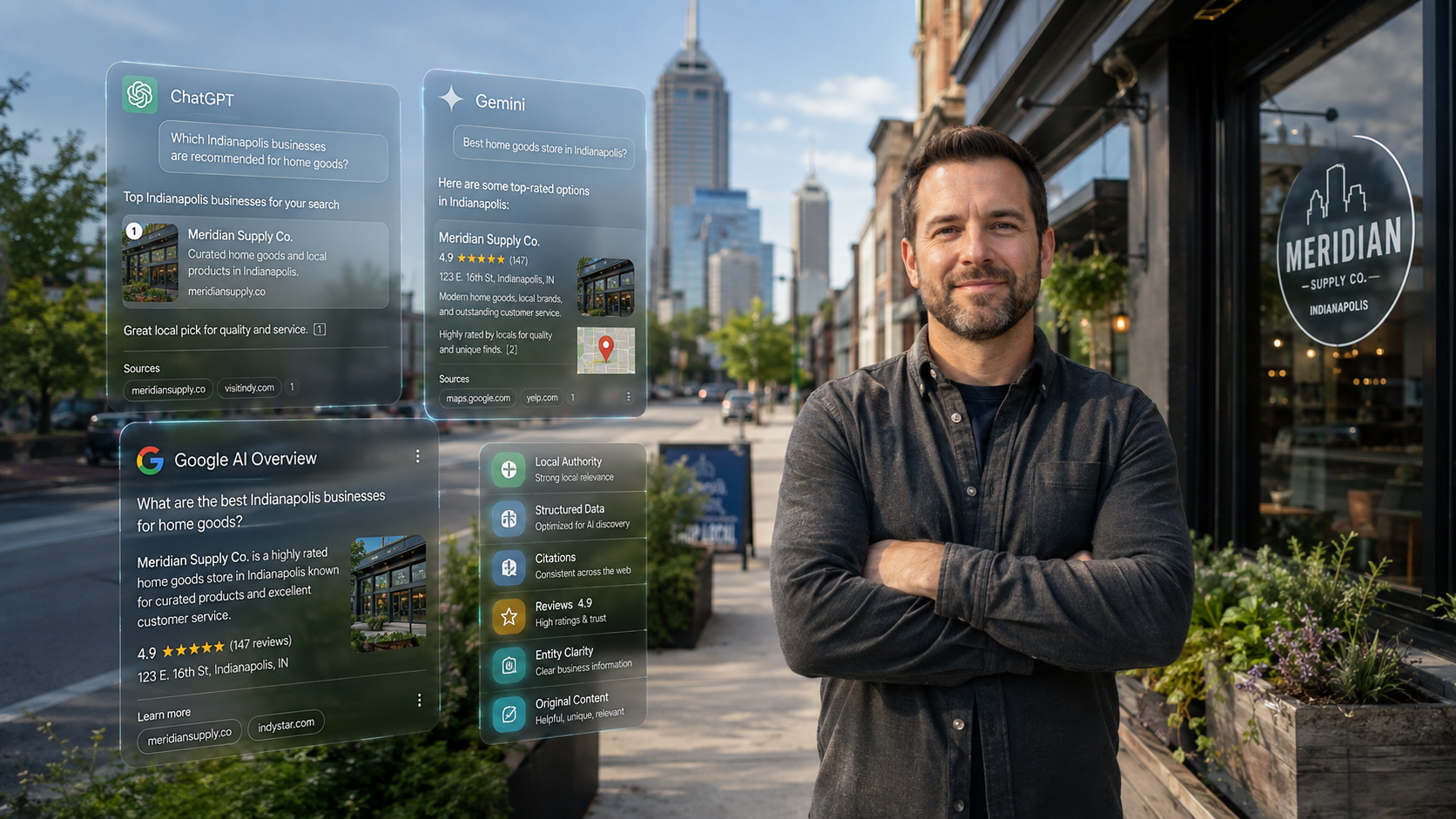
An Indianapolis customer needs exactly what your business sells.
Five years ago, the search journey probably started with something like:
“Indianapolis HVAC company.”
“personal injury lawyer Indianapolis.”
“best roofer near me.”
“commercial cleaning Indianapolis.”
Those searches still happen.
But now there's another path.
A customer can open ChatGPT and ask:
“Who are some reputable HVAC companies in Indianapolis?”
They can ask Gemini:
“Which Indianapolis roofing companies should I compare?”
They can use Google AI Mode to ask:
“I need a highly rated Indianapolis plumber who handles older homes. What should I look for and which companies appear relevant?”
The interface changes.
The underlying business problem does not.
Will your company be part of the answer?
That's the new question Indianapolis businesses need to start asking.
AI-powered search does not mean traditional SEO suddenly became irrelevant.
In fact, Google's current guidance for generative AI search says almost exactly the opposite.
Google says its AI search experiences—including AI Overviews and AI Mode—are rooted in its existing Search ranking and quality systems. Its official 2026 optimization guide tells website owners to continue focusing on foundational SEO, clear technical structure, original and useful content, local business information, and traditional website quality rather than chasing special “AEO” or “GEO” hacks.
OpenAI has also published clearer guidance for businesses that want their websites to appear through ChatGPT Search. OpenAI says OAI-SearchBot is used to surface websites in ChatGPT's search features, and sites that opt out of OAI-SearchBot won't appear in ChatGPT search answers except potentially as navigational links. OpenAI also says there is no way to guarantee top placement because ChatGPT Search ranking uses multiple factors intended to surface reliable and relevant information.
So AI search optimization isn't:
“Put the word ChatGPT on your website 200 times.”
It isn't:
“Install one magic schema type.”
It isn't:
“Create an llms.txt file and wait for leads.”
And it isn't:
“Publish 5,000 AI-generated pages before your competitors do.”
For Indianapolis businesses, AI search optimization is better understood as a new layer of search visibility, entity clarity, authority, and citation-worthiness built on top of strong SEO fundamentals.
The objective is to make your company easy for search systems to:
Find.
Understand.
Verify.
Differentiate.
Trust enough to surface.
And cite when a customer asks the right question.
Let's break down how.
What Is AI Search Optimization?
AI search optimization is the process of improving the information and authority surrounding a company so that AI-powered search and answer systems have a better chance of discovering, understanding, citing, or recommending that business when relevant.
You may also hear terms such as:
Generative Engine Optimization
GEO
Answer Engine Optimization
AEO
AI SEO
LLM optimization
AI citation optimization
The terminology is still evolving.
Google's official 2026 guidance specifically acknowledges terms such as AEO and GEO but says that, from Google's perspective, optimizing for generative AI features in Google Search is still fundamentally SEO because those experiences rely on Google's core Search systems.
That's an important distinction.
A new acronym does not automatically mean an entirely new discipline.
Many of the strongest AI-search practices are things businesses should have been doing already:
Making websites crawlable
Publishing genuinely useful information
Building clear service pages
Establishing business identity
Earning authoritative mentions
Developing backlinks
Maintaining accurate local business data
Building reviews
Using structured data appropriately
Creating original research
Measuring visibility
What has changed is the interface through which customers may encounter that information.
Instead of receiving ten blue links, the customer may receive an answer synthesizing information from multiple sources.
That means simply ranking somewhere on page one is no longer the only visibility question.
Now you should also ask:
Does the system understand our company well enough to name us?
Does it have credible sources supporting what we claim?
Is our website accessible to the search system?
Are we appearing in the sources AI systems retrieve?
Are our facts consistent across the web?
ChatGPT, Gemini, and Google AI Are Not One Search Engine
One of the first mistakes businesses make is treating “AI search” as a single algorithm.
It isn't.
ChatGPT Search and Google's AI-powered Search experiences are different products operated by different companies.
Google AI Overviews and AI Mode operate inside Google's Search ecosystem and use Google's Search index and ranking systems as part of retrieval. Google says those experiences may use a technique called query fan-out, where multiple related searches are generated across subtopics and data sources to help build an answer.
ChatGPT Search has its own search infrastructure and crawler behavior. OpenAI says ChatGPT Search can search the web, provide timely answers, use location when users enable it, and surface sources. OpenAI separately documents OAI-SearchBot as the crawler used to surface websites in ChatGPT Search.
Gemini is Google's AI assistant ecosystem, while Google AI Mode and AI Overviews are AI-powered features within Google Search.
That means you should be cautious whenever somebody claims:
“This exact tactic ranks you #1 in every AI engine.”
There is no single universal AI ranking formula published across these systems.
The practical strategy is to strengthen the web evidence that multiple systems can potentially use.
How AI Search Changes Local Discovery in Indianapolis
Traditional local search might look like:
“Indianapolis HVAC repair.”
An AI-oriented query can be much longer:
“I live in Indianapolis and my 18-year-old furnace keeps cycling on and off. Should I repair or replace it, and which local companies appear experienced with older systems?”
That's no longer one keyword.
It contains:
Location
Problem
Equipment age
Service intent
Decision criteria
Recommendation intent
Google says AI Mode is particularly useful for nuanced questions, comparisons, and exploratory queries that may previously have required multiple separate searches.
That's significant for local businesses.
Your potential customer may ask:
“Which Indianapolis SEO agencies understand AI search?”
“Who is a good commercial roofing contractor in Indianapolis?”
“What local attorney handles this specific type of case?”
“Which Indianapolis companies have strong reviews and experience with this issue?”
AI systems can potentially synthesize:
Business information
Website content
Reviews
Search results
Third-party mentions
Directories
Articles
Other available sources
That means the businesses best positioned for AI discovery may not simply be those with the most keywords.
They may be the businesses with the strongest corroborated digital footprint.
1. Make Sure AI Search Systems Can Actually Access Your Website
Before discussing content strategy, solve the basic technical question:
Can the system retrieve your site?
For Google, the requirements are straightforward.
Google says pages must be indexed and eligible to appear in Google Search with a snippet in order to be eligible as supporting links in AI Overviews or AI Mode. There are no additional technical requirements specifically for those AI features.
That means basic technical SEO still matters:
Crawlability
Indexability
Robots.txt
Canonicalization
Internal links
Server accessibility
JavaScript rendering
Page quality
For ChatGPT Search, there is another crawler to consider.
OpenAI says businesses that want content available to ChatGPT Search should allow OAI-SearchBot in robots.txt and allow requests from OpenAI's published IP ranges.
Importantly, OpenAI distinguishes OAI-SearchBot from GPTBot.
OAI-SearchBot is used for search visibility.
GPTBot relates to content that may be used for improving OpenAI's generative foundation models.
OpenAI says these controls are independent, meaning a publisher can allow OAI-SearchBot while disallowing GPTBot.
That distinction matters for businesses with concerns about AI training.
You do not have to assume:
“Allowing ChatGPT Search means we must allow model-training crawling.”
OpenAI provides separate controls.
2. Fix Your Technical SEO Before Chasing “GEO Hacks”
AI search doesn't rescue a broken website.
If your Indianapolis service page is accidentally noindexed, adding more schema won't help.
If your site is blocking crawlers, publishing more articles won't solve accessibility.
If your internal linking is broken, important pages may remain difficult to discover.
Google's generative AI guidance explicitly recommends:
Allowing crawling
Making content discoverable through internal links
Providing a good page experience
Keeping important information in textual form
Using images and video where useful
Ensuring structured data matches visible content
So before hiring someone to “optimize your company for ChatGPT,” audit:
Robots.txt
Indexation
Canonicals
Redirects
Internal links
Mobile experience
Structured data
Site architecture
We built a complete framework for that here:
The Indianapolis Website Audit: 20 SEO Problems That Cost Local Businesses Leads
AI optimization starts with a website that search systems can actually use.
3. Build a Clear Business Entity
One of the biggest AI search opportunities for local companies is entity clarity.
An entity is basically a recognizable thing:
Person
Company
Organization
Product
Place
Your company is an entity.
The question is whether the web provides a clear, consistent understanding of it.
Search systems should ideally be able to determine:
Business name: Who are you?
Location: Where do you operate?
Services: What do you do?
Website: Which site represents you?
People: Who runs or works for the company?
Reputation: What do customers say?
Authority: Who else references you?
Relationships: What organizations, vendors, partners, or communities connect to you?
An Indianapolis company with conflicting information everywhere creates more ambiguity.
One source says:
Smith Heating LLC
another says:
Smith HVAC
another has an old phone number.
another has the previous office address.
another points to an expired domain.
Clean information improves the machine-readable story around the business.
That's one reason local citations still matter—not because you need 500 directory links, but because important third-party sources help corroborate the identity of your company.
4. Keep Your Google Business Profile Exceptionally Accurate
For Indianapolis local businesses, Google Business Profile becomes especially important.
Google's 2026 generative AI search guide explicitly states that AI-powered search responses can include information about local businesses and that Google Business Profiles can help products and services become visible across AI responses and other Search experiences.
That's unusually direct guidance.
If you serve Indianapolis customers, audit:
Business name
Primary category
Secondary categories
Address
Service areas
Phone
Website
Hours
Services
Reviews
Photos
Other applicable attributes
Your Google Business Profile already matters for Maps.
Now Google's own guidance connects it to generative AI visibility too.
For the Maps side of the strategy, see:
Local SEO in Indianapolis: How to Rank Higher on Google Maps in 2026
and:
What Makes an Indianapolis Business Rank in Google's 3-Pack?
5. Create Content AI Systems Actually Have a Reason to Cite
This is where AI search optimization becomes more interesting.
Google's 2026 generative AI optimization guide explicitly encourages what it calls non-commodity content.
Its point is simple:
Don't just summarize information already available everywhere.
Create something that brings:
Firsthand experience
Unique analysis
Original perspective
Useful evidence
Real expertise
Compare:
Commodity Content
7 Local SEO Tips for Small Businesses
Anyone can write that.
An AI model can summarize it.
Thousands of sites already have it.
Citation-Worthy Content
We Audited 100 Indianapolis Google Business Profiles: Here Are the 12 Problems We Found Most Often
Now you have:
Original data
Local relevance
Specific methodology
Findings
Statistics
Unique value
Another example:
Commodity
How Much Does SEO Cost?
Stronger
What 25 Indianapolis Businesses Are Actually Paying for SEO in 2026
assuming you genuinely collected and explained the data.
Or:
We Tracked 50 Indianapolis “Near Me” Searches From 100 Locations: Here's How Far Local Rankings Changed
That's difficult to duplicate.
And that's exactly the type of information other websites, journalists, search engines, and AI systems may have a reason to reference.
6. Publish Firsthand Indianapolis Experience
You don't need a giant research department to create differentiated information.
Local businesses already possess proprietary knowledge.
A plumber knows:
Which plumbing problems occur repeatedly in Indianapolis homes
Which neighborhoods have particular housing-stock challenges
Which repairs customers misunderstand
What common jobs cost
What customers ask before buying
A roofer knows:
Common Indiana storm damage
Roofing problems by building type
Insurance misconceptions
Material choices
Typical replacement timelines
An attorney knows:
Questions Indianapolis clients repeatedly ask
Common procedural misunderstandings
Indiana-specific legal processes
A B2B company knows:
Common buying objections
Implementation problems
Local industry dynamics
Real-world cost drivers
That information is your competitive moat.
Google explicitly recommends creating content based on what you genuinely know and bringing firsthand expertise rather than recycling common information.
Turn operational knowledge into published authority.
7. Answer Complex Questions, Not Only Keywords
Traditional SEO encouraged businesses to think:
Keyword → page.
AI search pushes you to think more broadly:
Customer problem → complete useful answer.
Google says AI Mode may use query fan-out—generating multiple related searches around different aspects of a question.
That means a query such as:
“Should I repair or replace my furnace in Indianapolis?”
could involve subtopics such as:
Furnace age
Repair costs
Replacement costs
Efficiency
Indianapolis climate
Available equipment
Contractor selection
You don't need to manufacture one article for every imaginable sub-query.
In fact, Google's current guidance specifically warns against creating excessive pages for every query variation simply to manipulate AI results.
Instead, create strong resources that comprehensively address real customer decisions.
8. Build Service Pages That Prove What You Do
AI optimization is not only about blogs.
Your commercial pages matter.
Suppose someone asks:
“Which Indianapolis companies specialize in commercial HVAC maintenance?”
Your site should provide real evidence.
A strong page might explain:
Commercial HVAC services
Industries served
Equipment types
Service process
Maintenance programs
Geographic coverage
Relevant case studies
Team credentials
Customer results
FAQs
A homepage saying:
“We offer innovative solutions for all your needs.”
provides almost nothing.
AI systems need information.
Customers need information.
Give both something specific to understand.
9. Make Indianapolis Relevance Obvious
A company can serve Indianapolis without being relevant enough online to look like an Indianapolis option.
Your geographic relevance should be supported by reality.
That can include:
Indianapolis service page
Indianapolis clients
Local case studies
Testimonials
Project photos
Indiana-specific information
Service-area information
Local organizations
Indianapolis press or mentions
Local backlinks
Do not fabricate these signals.
Don't invent fake locations.
Don't produce dozens of city pages with the same text.
Build around the market you genuinely serve.
Ritner Digital takes this approach on its Indiana AI Search & SEO Agency page, which explicitly states the agency's location while publishing the Indiana work and AI visibility evidence behind the market relationship.
Transparency is stronger than pretending.
10. Build Backlinks and Mentions From Credible Sources
Your website telling everyone:
“We're the best Indianapolis company.”
is one claim.
Other legitimate websites discussing your company is another level of evidence.
Backlinks and mentions can come from:
Local media
Industry publications
Associations
Vendors
Manufacturers
Chambers
Partnerships
Community organizations
Conferences
Original research
Expert commentary
These external references matter for traditional SEO.
They can also make your company's footprint easier to corroborate across the web.
Ritner Digital's own AI-search positioning emphasizes getting brands into credible sources beyond their own websites because authority is not built only through self-published claims.
Don't Buy Fake Mentions
Google's 2026 AI-search guidance specifically warns against chasing inauthentic web mentions as a supposed generative-search tactic.
So don't create fake press releases across 200 websites and call it “AI authority.”
Earn references worth having.
11. Maintain High-Quality Local Citations
Local citations can contribute another layer of corroboration.
Prioritize:
Google
Apple Maps
Bing
Yelp where relevant
Facebook
BBB where appropriate
Industry directories
Local organizations
Data sources
Indianapolis business memberships
You do not need to be listed on every directory ever created.
You need accurate representation across important and legitimate sources.
For the full Indianapolis citation strategy, see:
Indianapolis Local Citations: Which Business Directories Actually Matter?
12. Reviews Are Increasingly Important Evidence
Imagine someone asks an AI tool:
“Which Indianapolis HVAC companies have strong reputations?”
The web contains:
Company A
4.9 stars
650 reviews
Recent feedback
Professional responses
Company B
3.5 stars
17 reviews
No new reviews in a year
Reputation data becomes part of the business's online evidence.
Google already confirms reviews and positive ratings can help local ranking, which is one reason they remain central to local search strategy. For AI-powered Google local discovery, Business Profile data remains relevant as well.
Build:
Legitimate review volume
Strong service quality
Review recency
Thoughtful responses
Consistent customer experience
Don't buy reviews.
Don't script fake sentiment.
And don't assume the company with the most reviews always wins.
We explain why in:
Why Your Competitor Ranks Above You in Indianapolis — Even With Fewer Reviews
13. Use Structured Data Correctly—but Don't Treat Schema as Magic
Structured data can help search engines interpret business and page information.
Useful types may include:
Organization
LocalBusiness
Article
BreadcrumbList
Product
Other relevant supported schema types
Structured data should reflect visible page content accurately.
But here's where AI-search marketing goes off the rails.
Someone will inevitably tell you:
“You need special AI schema.”
Google's current guidance explicitly says there is no special schema.org markup required for its generative AI search experiences. It also warns site owners not to overfocus on structured data as an AI-search hack.
Use schema because it's part of sound SEO and machine-readable clarity.
Don't sell it to yourself as:
“Install this and Gemini recommends us tomorrow.”
There is no published basis for that promise.
14. Do You Need an llms.txt File?
For Google Search:
No.
Google's 2026 generative AI optimization guide explicitly says Google Search does not use llms.txt as a special mechanism for generative AI visibility. Google says creating one neither helps nor hurts rankings in Google Search.
That doesn't mean another service could never use a similar file.
It means you should not sell llms.txt as a Google AI ranking tactic.
If your SEO consultant spends more time discussing llms.txt than:
Crawlability
Search Console
Service pages
Original content
Google Business Profile
Backlinks
Reviews
your priorities may be upside down.
15. You Do Not Need to “Chunk” Every Article for AI
Another popular AI SEO claim is that content must be broken into tiny pieces so models can understand it.
Google specifically addresses this too.
Its 2026 guidance says there is no requirement to split content into tiny chunks for AI search and no ideal page length. Pages should be structured around what works for the audience.
Use:
Clear H2s
Clear H3s
Lists
Tables
FAQs
Short paragraphs
because they improve readability.
Not because an influencer told you every paragraph must be exactly 40 words for an LLM.
Human clarity and machine clarity often overlap.
16. FAQs Still Make Sense—When Customers Actually Ask the Questions
FAQs are useful for a much simpler reason than “AI loves FAQs.”
Customers have questions.
Answer them.
For an Indianapolis HVAC company:
How much does furnace replacement cost in Indianapolis?
How long should an Indiana furnace last?
Should I repair or replace a 15-year-old furnace?
For an attorney:
How long do I have to file a claim in Indiana?
What should I do immediately after an Indianapolis accident?
For a roofer:
Does homeowners insurance cover hail damage in Indiana?
These sections organize real customer questions clearly.
That's useful for:
Humans
Traditional search
AI-oriented search
Don't add 70 fake FAQ questions solely to chase long-tail keywords.
Google's current AI guidance warns against creating excessive content variants primarily to manipulate generative search.
17. Original Data Can Become an AI Citation Magnet
If you want to make content genuinely cite-worthy, original data is one of the strongest tools available.
Examples:
Indianapolis HVAC Company
Average Furnace Repair Costs From 500 Indianapolis Service Calls
Indianapolis Realtor
What Homes Actually Sold for Across 10 Indianapolis Neighborhoods
Indianapolis B2B Company
2026 Central Indiana Manufacturing Hiring Survey
Indianapolis Marketing Agency
We Tested 100 Indianapolis Businesses Across ChatGPT, Gemini, and Google AI
The objective isn't manufacturing statistics.
Collect real data.
Explain:
Methodology
Sample
Time period
Limitations
Findings
Then make the information easy for other people to reference.
That's how a website becomes a source instead of another content consumer.
18. Publish Case Studies AI Cannot Find Anywhere Else
Case studies are another form of proprietary content.
They establish:
Expertise
Real customers
Location relevance
Process
Results
Firsthand experience
A useful Indianapolis case study might explain:
Problem
What happened?
Business context
Who was the customer?
Location
Where was the work performed?
Approach
What did you do?
Result
What changed?
Proof
What evidence supports the result?
This creates content competitors cannot copy because they did not do the work.
19. Build an Authoritative Topic Cluster
AI search does not eliminate topical authority.
If anything, comprehensive evidence around a company's expertise becomes more valuable.
Suppose an Indianapolis business wants to become associated with local SEO.
One isolated article says:
“We know Indianapolis SEO.”
A cluster containing:
Google Maps
Technical SEO audits
Review strategy
Local citations
3-Pack rankings
Small-business competition
SEO vs. Ads
AI search optimization
creates a much broader body of evidence.
That's what Ritner Digital is building with this Indianapolis cluster.
The current supporting resources include:
Local SEO in Indianapolis: How to Rank Higher on Google Maps in 2026
The Indianapolis Website Audit: 20 SEO Problems That Cost Local Businesses Leads
Why Your Competitor Ranks Above You in Indianapolis — Even With Fewer Reviews
Indianapolis Local Citations: Which Business Directories Actually Matter?
What Makes an Indianapolis Business Rank in Google's 3-Pack?
How Indianapolis Small Businesses Can Compete With National Brands on Google
SEO vs. Google Ads for Indianapolis Businesses: Where Should You Spend First?
Each article handles a different part of the Indianapolis search problem.
This page extends the cluster into AI discovery.
20. Make Internal Linking Deliberate
Your strongest content should not exist in isolation.
Google's current AI search guidance explicitly recommends making content easily discoverable through internal links.
For this article, a reader wondering about:
Maps
should reach the Indianapolis Maps guide.
A reader wondering about:
citations
should reach the citation guide.
A reader wondering about:
technical issues
should reach the website audit.
A reader wondering about:
Google Ads
should reach the SEO vs. Ads guide.
That improves the website for people.
It also makes relationships between content easier for crawlers to discover.
21. Track ChatGPT Referral Traffic
AI visibility becomes much more useful when you can measure what happens.
OpenAI says publishers that allow OAI-SearchBot can identify ChatGPT Search referral traffic because ChatGPT automatically appends the parameter:
utm_source=chatgpt.com
to referral URLs.
That means analytics can potentially show:
ChatGPT referrals
Landing pages
Sessions
Leads
Conversion behavior
Don't settle for:
“We think ChatGPT mentioned us once.”
Track whether AI discovery becomes actual website traffic and business.
22. Track Google AI Visibility in Search Console
Google made AI visibility significantly easier to measure in 2026.
In June 2026, Google announced dedicated Generative AI performance reports in Search Console for a subset of websites.
Those reports can show information including:
AI-feature impressions
Pages shown
Countries
Devices
Dates
for generative AI features such as AI Overviews and AI Mode. Google said the feature was being rolled out to a subset of sites initially.
This is important because AI-search reporting is beginning to become less speculative.
Instead of relying solely on manual prompt checks, businesses can increasingly evaluate actual visibility data inside Google's own tools where the reporting is available.
23. Manually Test AI Recommendation Prompts Too
Analytics alone doesn't show everything.
You should also periodically test relevant questions.
For an Indianapolis business, create a set of prompts representing real buying behavior.
For example:
Discovery
What are some Indianapolis companies that provide commercial HVAC maintenance?
Reputation
Which Indianapolis roofers have strong reviews?
Comparison
Compare some local Indianapolis SEO agencies that work with small businesses.
Expertise
Who in Indianapolis appears knowledgeable about AI search optimization?
Problem-Based
My Indianapolis home has an old furnace. Which local companies should I research for replacement?
Don't run one prompt and declare victory.
AI answers can vary.
Track a consistent prompt set over time.
Look for:
Whether the brand is mentioned
Which competitors appear
Which sources are cited
Which facts are accurate
Which pages appear repeatedly
Which gaps exist
Ritner Digital currently uses this type of prompt-based visibility testing as part of its Indiana positioning, including public examples tied to an Indiana client.
24. Don't Confuse Being Mentioned With Getting Leads
AI visibility is a marketing metric.
Not automatically a business outcome.
Suppose ChatGPT recommends you frequently.
Great.
Do users:
Click?
Call?
Submit forms?
Become customers?
Suppose Google AI Mode cites your pricing guide.
Great.
Does that lead to:
Website sessions?
Brand searches?
Leads?
Revenue?
The same discipline used in SEO should apply here.
Track the funnel.
At Ritner Digital, AI visibility is positioned alongside SEO, content systems, digital PR, and reporting rather than as an isolated vanity metric.
25. Make Your Website Easy to Verify
AI systems can synthesize information.
But your website should make important facts easy to verify.
Create clear pages for:
About
Services
Locations
Contact information
Leadership/team
Case studies
Credentials
Industries
Pricing where appropriate
Policies where relevant
Avoid hiding the entire substance of the business behind vague marketing language.
Bad:
We empower future-focused businesses through transformational solutions.
Good:
We provide commercial HVAC maintenance for office, warehouse, and industrial facilities across Indianapolis and Central Indiana.
One is branding fog.
The other is useful information.
26. Make Claims You Can Support
This matters even more in AI search.
Don't claim:
“Indianapolis's #1 roofing company.”
unless you have credible methodology supporting that claim.
Don't claim:
“The highest-rated company in Indiana.”
unless that's actually verifiable.
Don't manufacture awards.
Don't fabricate customer numbers.
Create proof.
For example:
Instead of:
“We're one of Indiana's fastest-growing companies.”
publish:
“We grew from 200 to 700 customers between January and December 2025.”
if that's true.
Specific facts are easier to validate.
27. Keep Content Updated
AI-driven search places additional value on current information when the question requires freshness.
OpenAI describes ChatGPT Search as providing timely web-based answers, while Google's AI experiences retrieve current information from Search.
That means stale content becomes a bigger problem for topics such as:
Prices
Regulations
Product availability
Industry changes
Business hours
Service offerings
Technology
Local statistics
Build refresh cycles.
Update articles when the underlying facts change.
A strong 2024 guide may become weak in 2026 if nothing has been maintained.
28. Don't Mass-Produce AI Content Just Because AI Search Exists
This is perhaps the most ironic bad strategy.
Businesses think:
“AI search is growing, so let's use AI to create 10,000 pages.”
Google's guidance specifically warns that using generative AI to create large numbers of pages without adding user value may violate its spam policies around scaled content abuse.
AI tools can absolutely assist content creation.
They can help with:
Research
Organization
Editing
Drafting
Ideation
But the published result should still contain value.
Add:
Expertise
Research
Experience
Examples
Local knowledge
Original thinking
AI should accelerate your ability to publish expertise.
It should not replace the expertise.
29. Don't Chase Every New AI SEO Theory
This space changes quickly.
That attracts speculation.
You'll hear:
“Schema guarantees ChatGPT citations.”
“Every paragraph needs to be 40 words.”
“Google AI only cites pages with llms.txt.”
“You need a separate website for AI.”
“Mention ChatGPT 100 times.”
Ask:
What's the evidence?
Google's 2026 AI-search guide spends an entire section debunking unsupported tactics such as special AI files, unnecessary content chunking, AI-specific rewriting, fake mentions, and overreliance on schema.
OpenAI likewise says there is no guaranteed top placement in ChatGPT Search.
Build around what can actually be supported.
What AI Search Optimization Looks Like for an Indianapolis HVAC Company
Let's make this practical.
Suppose you're an Indianapolis HVAC contractor.
Technical Foundation
Google can crawl and index the website
OAI-SearchBot is allowed
Service pages are accessible
Mobile website works
Structured data is accurate
Business Entity
Consistent business name
Accurate phone
Accurate address/service area
Strong Google Business Profile
Major citations cleaned
Commercial Pages
Indianapolis HVAC
AC Repair
Furnace Repair
Heat Pumps
Commercial HVAC
Replacement
Citation-Worthy Content
2026 Indianapolis HVAC Replacement Cost Study
Actual Service Call Data
Indianapolis Home Efficiency Case Studies
Heat Pump Performance in Indiana Winters
External Authority
Manufacturer directory
Industry associations
Local media
Indianapolis organizations
Customer reviews
Measurement
Search Console
ChatGPT referral traffic
Local rankings
AI prompt testing
Leads
That's AI search optimization.
Notice how little of it involves “hacking an LLM.”
Most of it involves becoming a better documented and more authoritative local business online.
What AI Search Optimization Looks Like for an Indianapolis Law Firm
A law firm might focus on:
Entity Clarity
Attorney profiles
Practice areas
Indiana licensing
Office details
Contact information
Expertise
Indiana-specific legal guides
Detailed FAQs
Case examples where ethically appropriate
Attorney-written analysis
Third-Party Evidence
Professional associations
Bar profiles
Reputable legal directories
Media commentary
Reviews
Local Content
Indianapolis-specific procedural guides
Indiana law explanations
Local court information where appropriate
AI Testing
Prompts such as:
“Which Indianapolis firms handle serious truck accident cases?”
The objective isn't to manipulate the answer.
It's to identify whether your public digital evidence makes you a credible candidate.
What AI Search Optimization Looks Like for an Indianapolis B2B Company
B2B AI search may become particularly interesting because buyers ask complex questions.
Instead of:
“industrial automation company Indianapolis.”
a buyer might ask:
“Which Central Indiana companies provide automation integration for mid-sized manufacturing plants and have experience with legacy equipment?”
That's a complex commercial query.
A strong B2B company should publish:
Industry pages
Service pages
Technical guides
Case studies
Implementation details
Results
Team expertise
Original research
Broad generic marketing language won't do much.
Specific technical expertise becomes valuable.
Traditional Local SEO Is Still Part of AI Search Optimization
Do not abandon Google Maps because ChatGPT exists.
Indianapolis customers still use traditional local search.
Google still evaluates local rankings using:
Relevance
Distance
Prominence
And Google's own AI-search guidance now explicitly says Google Business Profile information can help local business information surface in generative search experiences.
So keep strengthening:
Google Business Profile
Reviews
Citations
Backlinks
Service pages
Indianapolis content
Local authority
Your local SEO strategy and AI search strategy increasingly overlap.
How the Indianapolis SEO Cluster Supports AI Visibility
This is why content clustering matters.
Each article gives search systems and customers another specific piece of information.
Maps
Local SEO in Indianapolis: How to Rank Higher on Google Maps in 2026
Technical Health
The Indianapolis Website Audit: 20 SEO Problems That Cost Local Businesses Leads
Competitor Analysis
Why Your Competitor Ranks Above You in Indianapolis — Even With Fewer Reviews
Citations
Indianapolis Local Citations: Which Business Directories Actually Matter?
Local Pack
What Makes an Indianapolis Business Rank in Google's 3-Pack?
Small Business Competition
How Indianapolis Small Businesses Can Compete With National Brands on Google
Paid vs. Organic Search
SEO vs. Google Ads for Indianapolis Businesses: Where Should You Spend First?
This article adds the AI discovery layer.
Together, the cluster demonstrates much deeper subject coverage than a single “Indianapolis SEO Agency” page could provide.
A 90-Day Indianapolis AI Search Optimization Plan
Don't try to “optimize for AI” by changing everything overnight.
Sequence the work.
Days 1–30: Make the Business Discoverable
Audit:
Google indexing
Robots.txt
OAI-SearchBot accessibility
Website structure
Internal links
Structured data
Google Business Profile
Business information consistency
Major citations
Make sure search systems can actually access accurate information.
Days 31–60: Build Better Evidence
Improve:
Core service pages
Indianapolis page
About page
Team profiles
FAQs
Case studies
Review strategy
Local proof
Then identify information only your company can publish.
Ask:
What do we know that the internet doesn't?
Days 61–90: Become More Cite-Worthy
Create:
Original study
Local benchmark
Industry data
Expert guide
Case study
Local resource
Then promote it through:
Digital PR
Industry outreach
Local organizations
Partners
Media
The objective is not simply another page.
The objective is information other sources want to reference.
How to Measure Indianapolis AI Search Visibility
Your reporting should include multiple layers.
Traditional SEO
Track:
Google clicks
Impressions
Rankings
Organic leads
Local SEO
Track:
Maps visibility
Google Business Profile engagement
Calls
Reviews
ChatGPT
Track:
Referral sessions
Landing pages
Leads from utm_source=chatgpt.com
OpenAI says this UTM parameter is automatically attached to ChatGPT Search referral links.
Google AI
Where available, use Google's Generative AI Search Console performance reporting to evaluate impressions and pages appearing in AI features.
Prompt Visibility
Track a consistent prompt set periodically.
The objective is trend analysis.
Not one screenshot.
Frequently Asked Questions
What Is AI Search Optimization?
AI search optimization is the practice of improving the information, website content, technical accessibility, authority, and entity signals surrounding a business so AI-powered search systems have a better chance of finding, understanding, citing, or recommending it when relevant.
The term overlaps with SEO, GEO, and AEO.
Google's current guidance says optimization for its generative AI Search features remains fundamentally connected to traditional SEO.
What Is Generative Engine Optimization?
Generative Engine Optimization, or GEO, is a term used to describe efforts to improve visibility in AI-generated answers and generative search experiences.
Google acknowledges the term GEO in its documentation but says that, from Google's perspective, optimizing for generative AI Search remains SEO because AI features are rooted in core Search systems.
What Is Answer Engine Optimization?
Answer Engine Optimization, or AEO, generally refers to structuring and strengthening information so answer-oriented search systems can understand and surface it.
There is significant overlap between AEO, GEO, and traditional SEO.
Businesses should avoid assuming a new acronym automatically requires a completely separate strategy.
Can My Indianapolis Business Appear in ChatGPT Search?
Potentially.
OpenAI says ChatGPT Search uses multiple ranking factors intended to surface reliable, relevant information.
OpenAI also says websites should allow OAI-SearchBot if they want their content eligible to appear in ChatGPT Search answers.
There is no guaranteed method for achieving top placement.
How Do I Let ChatGPT Crawl My Website?
Review your robots.txt configuration and ensure you're not blocking OAI-SearchBot if you want your pages eligible for ChatGPT Search.
OpenAI separately publishes IP ranges for its search crawler.
OAI-SearchBot and GPTBot have separate controls.
Is OAI-SearchBot the Same as GPTBot?
No.
OpenAI says OAI-SearchBot is used to surface websites in ChatGPT Search.
GPTBot is associated with crawling that may be used to improve OpenAI's generative foundation models.
The settings are independent.
Can I Allow ChatGPT Search but Block AI Training?
OpenAI's documentation says OAI-SearchBot and GPTBot controls are independent.
That means a webmaster can allow OAI-SearchBot for search visibility while disallowing GPTBot for model-training crawling.
Does ChatGPT Use Location for Local Business Searches?
It can.
OpenAI says ChatGPT can optionally use device location when users enable it to provide more relevant local information.
On mobile, ChatGPT Search can also display maps when appropriate.
That makes local entity information potentially important for Indianapolis businesses.
Is There a Guaranteed Way to Rank First in ChatGPT?
No.
OpenAI explicitly says there is no way to guarantee top placement in ChatGPT Search.
Be cautious of agencies promising guaranteed ChatGPT rankings.
Can I Track Traffic From ChatGPT?
Yes.
OpenAI says ChatGPT automatically adds:
utm_source=chatgpt.com
to referral URLs from ChatGPT Search, allowing publishers to identify referral traffic in analytics platforms.
You should still configure analytics and conversions correctly if you want to know whether those visits become leads.
How Do I Optimize for Google AI Overviews?
Google says there are no additional technical requirements or special optimizations required specifically for AI Overviews.
Pages need to meet normal Search technical requirements, remain crawlable and indexable, and follow foundational SEO best practices.
How Do I Optimize for Google AI Mode?
The same fundamental SEO principles apply.
Google says AI Mode uses core Search systems and can perform query fan-out to retrieve information across related subtopics.
Build high-quality, unique content and maintain a technically healthy site rather than trying to manipulate every potential sub-query.
Does Gemini Require Special SEO?
Google has not published a separate universal “Gemini ranking formula” for businesses.
Its published website-optimization guidance centers on Google Search's AI features and traditional SEO fundamentals.
That means claims that a specific schema, file, or keyword tactic guarantees Gemini recommendations should be treated cautiously.
Does Google Business Profile Help With AI Search?
Google explicitly says generative AI responses can contain local-business information and that Google Business Profiles can help products and services appear in AI responses and other Google Search results.
Indianapolis businesses should therefore keep Business Profile information accurate and complete.
Do Google Reviews Matter for AI Search?
Google has not published a simple formula saying a specific number of reviews guarantees AI visibility.
Reviews do remain part of the local business ecosystem and can influence traditional local visibility and consumer trust.
Build genuine reviews because they're useful evidence—not because somebody promised that 100 reviews unlocks an AI recommendation.
Do Backlinks Help AI Search Visibility?
There is no universal published formula connecting a specific number of backlinks to a specific AI citation outcome.
However, backlinks and third-party mentions create external evidence around a business and remain core traditional SEO authority signals.
Strong external sources can also create additional places where AI search systems may encounter information about your company.
Are Local Citations Important for AI Search?
Accurate local citations contribute to a cleaner digital identity across the web.
That can help establish consistent information about your:
Name
Address
Phone
Website
Services
Location
Use legitimate sources rather than bulk directory spam.
See Indianapolis Local Citations: Which Business Directories Actually Matter?.
Does Schema Markup Make ChatGPT Recommend My Business?
There is no official guarantee that adding a particular schema type will cause ChatGPT to recommend your business.
Structured data is still useful for broader machine-readable clarity and traditional SEO, but it should not be sold as a guaranteed AI citation switch.
Is There Special Schema for AI Search?
Google says no special schema.org markup is required for its generative AI search experiences.
Use appropriate existing structured data based on your content and business type.
Do I Need an llms.txt File?
Not for Google AI Search.
Google explicitly says llms.txt does not help or hurt visibility in Google Search or its generative AI experiences.
Another platform could potentially use similar files differently, so evaluate the requirements of each individual system rather than treating llms.txt as a universal standard.
Should I Break Every Blog Post Into Tiny AI-Friendly Chunks?
No.
Google specifically says there is no requirement to break content into tiny chunks for generative AI search and no universal ideal page length.
Organize content for human readability.
Should I Write Hundreds of Pages for Every AI Prompt Variation?
No.
Google warns against creating excessive pages targeting every query variation primarily to manipulate rankings or generative search results.
Create comprehensive resources built around meaningful customer needs instead.
Can AI-Generated Content Rank in Google AI Search?
Using AI tools does not automatically prevent content from ranking.
Google's concern is whether the resulting content provides genuine value and complies with Search Essentials and spam policies.
Mass-generating low-value pages can violate Google's scaled-content-abuse policies.
What Type of Content Is Best for AI Search?
Google's 2026 guidance encourages unique, valuable, non-commodity content.
That can include:
Firsthand research
Original data
Expert analysis
Case studies
Unique viewpoints
Useful guides based on actual experience
Content that simply repeats what hundreds of other websites already say has less differentiation.
Are FAQs Good for AI Search Optimization?
FAQs can be useful when they answer real customer questions clearly.
There is no need to manufacture dozens of FAQ questions solely for AI systems.
Focus on providing useful answers to questions customers genuinely ask.
Should Indianapolis Businesses Still Invest in Traditional SEO?
Yes.
Google's current generative AI guidance explicitly says traditional SEO best practices remain relevant because its AI Search experiences rely on its core Search systems.
Traditional SEO also remains important for normal organic results and local visibility.
Does Google Maps Still Matter If Customers Use AI?
Absolutely.
Google Business Profile remains directly relevant to local discovery, and Google now says Business Profile information can also help local business information appear within generative AI responses.
Use What Makes an Indianapolis Business Rank in Google's 3-Pack? for the local Maps framework.
How Can Indianapolis Small Businesses Compete With National Brands in AI Search?
Small businesses can compete through information large brands struggle to replicate:
Local experience
Original Indianapolis data
Specific case studies
Customer reviews
Local relationships
Deep service knowledge
Expert content
This is the same principle explained in How Indianapolis Small Businesses Can Compete With National Brands on Google.
National companies win on scale.
Small businesses can win on specificity.
Can I Measure Google AI Overview and AI Mode Visibility?
Google began rolling out dedicated Generative AI performance reports in Search Console in June 2026.
The reports can show AI-feature impressions, pages, countries, devices, and date-based performance for participating sites.
Availability initially rolled out to a subset of websites.
How Do I Measure AI Search ROI?
Track:
AI visibility
ChatGPT referrals
Google AI impressions
Landing pages
Leads
Calls
Forms
Qualified opportunities
Revenue where possible
A mention isn't automatically valuable.
A mention that creates a profitable customer is.
How Long Does AI Search Optimization Take?
There is no universal timeline.
It depends on:
Existing website authority
Technical health
Content
Local relevance
Backlinks
Citations
Reviews
Competition
Search-system behavior
Be cautious of anyone guaranteeing a specific number of AI citations within a fixed timeframe.
What Should an Indianapolis Business Do First?
Start with these priorities:
Ensure Google can crawl and index the site.
Allow OAI-SearchBot if ChatGPT Search visibility is desired.
Clean up Google Business Profile.
Make core service pages clear.
Strengthen Indianapolis relevance.
Fix important citations.
Build legitimate reviews.
Publish original expertise.
Earn credible backlinks and mentions.
Begin tracking AI visibility.
Do the fundamentals before chasing advanced tactics.
Sources
This article was researched and updated for August 2026. Official OpenAI and Google documentation is used as the primary authority for claims about ChatGPT Search, OpenAI crawlers, Google AI Overviews, AI Mode, generative AI optimization, and Search Console AI reporting.
OpenAI — Overview of OpenAI Crawlers. Official documentation explaining OAI-SearchBot, GPTBot, separate robots.txt controls, and crawler behavior.
View source
OpenAI Help Center — ChatGPT Search. Official documentation covering ChatGPT Search, location-based search, local recommendations, and requirements for making websites available to ChatGPT Search.
View source
OpenAI Help Center — Publishers and Developers FAQ. Official documentation explaining ChatGPT referral tracking and the utm_source=chatgpt.com parameter.
View source
Google Search Central — AI Features and Your Website. Google's official guidance explaining AI Overviews, AI Mode, query fan-out, technical eligibility, crawlability, and foundational SEO requirements.
View source
Google Search Central — Optimizing Your Website for Generative AI Features on Google Search. Google's 2026 guide covering SEO for AI search, non-commodity content, technical structure, local Business Profiles, llms.txt, structured data, query fan-out, and GEO/AEO misconceptions.
View source
Google Search Central — Generative AI Performance Reports in Search Console. Google's June 2026 announcement of dedicated AI visibility reporting for AI Overviews, AI Mode, and other generative Search features.
View source
Google Search Central — Guidance on Generative AI Content. Google's policy guidance explaining that mass-producing AI content without additional value may violate scaled-content-abuse policies.
View source
Ritner Digital — Indiana AI Search & SEO Agency. Ritner Digital's current Indiana AI-search positioning and published AI visibility testing tied to Indiana work.
View Indiana AI Search & SEO
Ritner Digital — AI Search & SEO Agency. Ritner Digital's current approach to AI search visibility, entity SEO, structured data, citation-worthy content, authority building, and AI citation tracking.
View Ritner Digital
AI Search Optimization Is Really About Becoming a Better Source
There is a temptation to make AI search sound mysterious.
It sells more consulting.
But the practical strategy is increasingly clear.
You want your Indianapolis company to be:
Technically accessible.
Clearly identified.
Accurately represented.
Locally relevant.
Well reviewed.
Supported by third-party evidence.
Useful enough to cite.
That means your website cannot just say:
We're the leading provider of innovative solutions.
It needs to demonstrate:
What you do.
Where you operate.
Who you've helped.
What you know.
What evidence supports your claims.
Why another credible source should reference you.
Google's own AI-search guidance reinforces that foundational SEO and original, non-commodity content remain central to generative search visibility. OpenAI's documentation likewise makes clear that ChatGPT Search requires crawl access and provides no guaranteed shortcut to top placement.
So don't throw away everything you know about SEO because the interface changed.
Build on it.
Create better content.
Publish original data.
Strengthen your entity.
Earn mentions.
Clean your local footprint.
Maintain your Google Business Profile.
Make your website useful.
Track ChatGPT referrals.
Monitor Google's AI reporting.
And keep testing whether AI systems actually recognize your company when Indianapolis customers ask the questions that matter.
Because AI search optimization isn't about tricking a chatbot.
It's about creating enough credible digital evidence that when someone asks:
“Who should I hire?”
your business has a legitimate reason to be part of the answer.
Want Your Indianapolis Business to Show Up in AI Search?
Ritner Digital helps businesses build visibility across traditional Google Search, Google Maps, ChatGPT, Gemini, Google's AI experiences, and the broader search ecosystem.
That includes:
AI search visibility audits
ChatGPT Search optimization
Google AI Search optimization
Indianapolis SEO
Local SEO
Google Business Profile optimization
Technical SEO
Entity SEO
Structured data
Content built to earn citations
Original research
Internal linking
Local citations
Review strategy
Digital PR
Backlink and authority building
AI citation tracking
Search Console analysis
Conversion and lead measurement
If your Indianapolis business is already investing in SEO but you don't know whether ChatGPT, Gemini, or Google's AI experiences can actually find and understand you, we'll help identify the gaps.
Contact Ritner Digital today and tell us where you want your business to be found.
We'll look at your website, technical accessibility, Indianapolis presence, entity signals, citations, content, competitors, Google visibility, and AI search footprint—and identify what we'd prioritize first.