How to Rank for “Near Me” Searches in Indianapolis
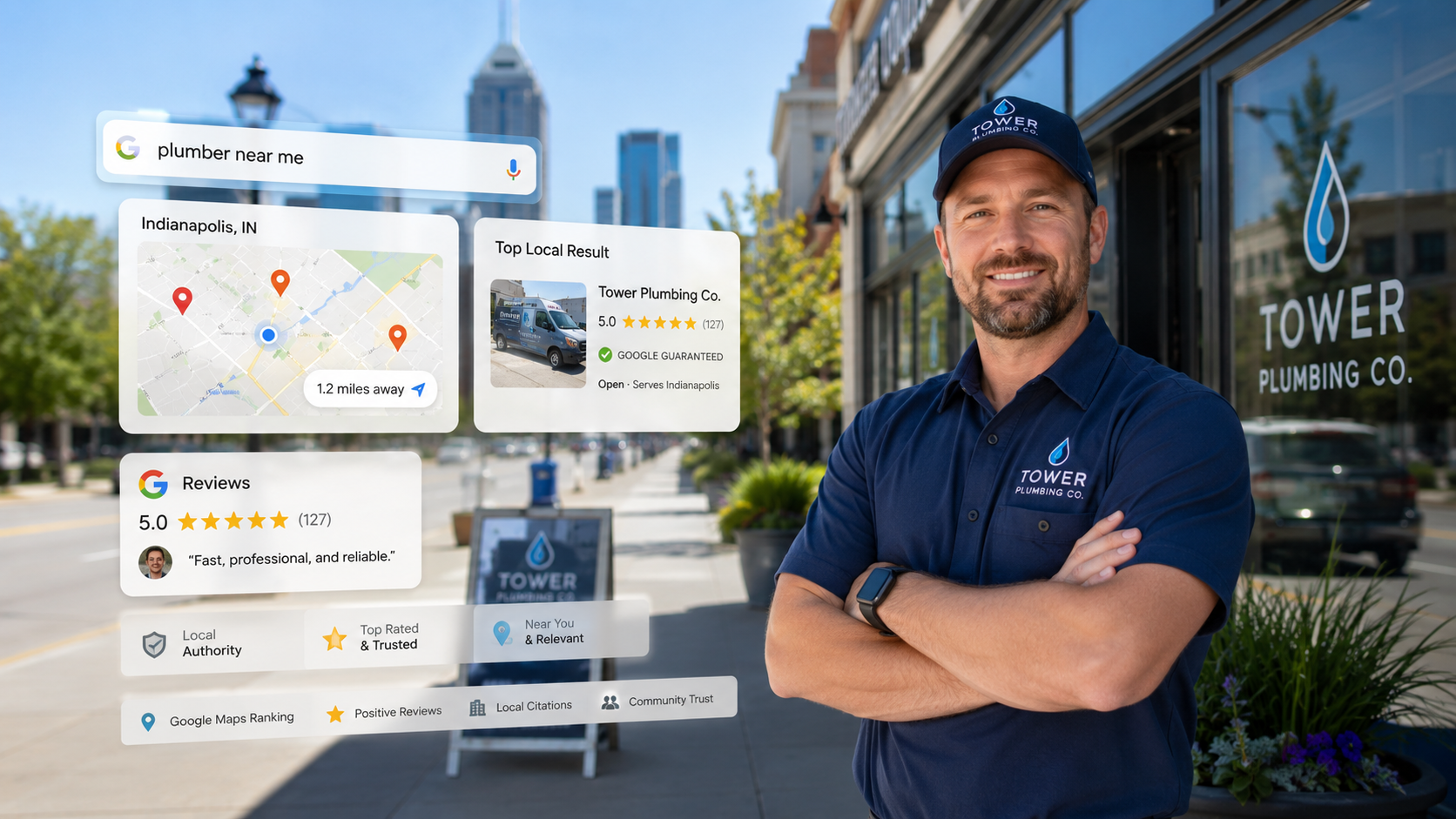
Someone in Indianapolis pulls out their phone.
They don't search:
“Indianapolis plumbing contractors comprehensive service solutions.”
They search:
“plumber near me.”
Someone's air conditioner dies in August.
They search:
“AC repair near me.”
A homeowner notices water coming through the ceiling after a storm.
They search:
“roofer near me.”
A business owner wants help showing up on Google.
They search:
“SEO company near me.”
These are some of the most commercially valuable searches a local business can attract because the person searching often isn't researching a broad topic.
They're looking for someone who can solve a problem.
And they're looking nearby.
BrightLocal's current local-search statistics report that 46% of consumers say they always or often add “near me” to local search queries. The same 2026 resource reports that 73% of local searches begin on mobile devices. (BrightLocal)
That creates an obvious question for Indianapolis businesses:
How do you rank when someone searches for your service plus “near me”?
The wrong answer is:
Put “near me” on your website 47 times.
Google's local search system is far more sophisticated than literal phrase matching.
Google says local results are primarily based on three factors:
Relevance.
Distance.
Prominence.
Relevance considers how well a business matches what the customer is searching for.
Distance considers how far the business is from the person searching—or from the location included in the query.
Prominence considers how established and well known the business appears based on signals including reviews, links, and other information Google finds across the web. (Google Business Profile Help)
That framework is the key to understanding “near me” SEO.
When somebody searches:
“electrician near me”
Google is effectively trying to answer:
Which nearby electricians are relevant enough and prominent enough to deserve visibility for this person from this location?
Your job isn't to convince Google that the phrase “near me” describes your company.
Your job is to make your business a strong answer to the local intent behind the phrase.
Here's how.
What Does “Near Me” Mean to Google?
“Near me” is a location-dependent search modifier.
The searcher is essentially asking Google:
Show me a relevant business close to where I am right now.
That makes “near me” searches fundamentally different from a query where the searcher explicitly enters:
“plumber Indianapolis.”
In the second query, Indianapolis is provided directly.
In the first, Google needs to interpret the searcher's location.
Google's Business Profile documentation says that when a customer doesn't specify a location, Google calculates distance based on what it knows about the person's location. (Google Business Profile Help)
That has a major consequence:
Your business does not have one universal ranking for “near me.”
You might be:
First near your office.
Third two miles away.
Seventh five miles away.
Invisible farther across the Indianapolis metro.
Another person performing the exact same search can receive a different group of businesses because that person is standing somewhere else.
This is why asking:
“What position do we rank for plumber near me?”
is usually the wrong question.
The better question is:
“Across which parts of our Indianapolis service market do we appear prominently when customers search for our services nearby?”
That is a geographic visibility problem.
You Do Not Need to Stuff “Near Me” Into Every Page
Let's get one of the most common myths out of the way.
Your page does not need to say:
Best plumber near me in Indianapolis near me plumbing service near me.
That sounds ridiculous because it is ridiculous.
Google's Search Essentials recommends using words people would use to search for your content in prominent locations such as page titles and headings, but Google's local-ranking documentation simultaneously makes clear that local results consider distance, relevance, and prominence. (Google Search Essentials) (Google Business Profile Help)
The practical implication is that you should build pages around the service and geographic intent, not awkwardly repeat the literal phrase.
For example, a useful title might be:
Emergency Plumber in Indianapolis | Smith Plumbing
A less useful title is:
Plumber Near Me | Best Near Me Plumber Indianapolis Near Me
The first clearly identifies:
The service.
The location.
The company.
That's what matters.
The Real Formula Behind “Near Me” Rankings
There is no published equation where:
Reviews × Keywords ÷ Miles = Near Me Ranking
Google does not disclose a formula like that.
The useful framework is still Google's own:
Relevance + Distance + Prominence.
If an Indianapolis business struggles with “near me” visibility, those are the three buckets we would investigate first.
Relevance: Does Your Business Actually Match the Search?
Suppose someone searches:
“commercial electrician near me.”
Google needs to determine whether your business is actually a commercial electrician.
That sounds obvious.
But websites and Business Profiles frequently make the answer surprisingly unclear.
Maybe your company performs commercial electrical work, but your Google Business Profile uses a category that poorly describes the business.
Maybe your website has one generic Services page where commercial electrical work appears in a single bullet.
Maybe your homepage says:
We offer innovative solutions for residential and commercial customers.
That's vague.
Compare that with a dedicated page explaining:
Commercial Electrical Services in Indianapolis
and covering the actual work you provide.
Now you give search systems far more information.
Google's guidelines say business categories help customers find accurate, specific results for services they're interested in. (Google Business Profile Guidelines)
So when “near me” rankings are weak, start by asking:
Have we made our service relevance obvious?
Distance: The Factor You Cannot Completely Optimize Away
Distance is where many local SEO strategies collide with reality.
Suppose your office is on one side of Indianapolis.
A customer searches from significantly farther away.
A competitor performing the same service has a legitimate location much closer to that customer.
That competitor may have a natural advantage.
You cannot completely SEO your way out of geography.
Google explicitly states that distance considers how far each business is from the customer searching. (Google Business Profile Help)
That is why local rankings can change dramatically as you move across Indianapolis.
It's also why fake-location strategies are so tempting.
And why you should avoid them.
Google's Business Profile guidelines require businesses to use precise, accurate location or service-area information and prohibit P.O. boxes or remote mailboxes from being treated as legitimate business locations. (Google Business Profile Guidelines)
If you operate from one eligible location, optimize the real location.
If you legitimately open another staffed location that qualifies for its own Business Profile, that's different.
But don't manufacture offices solely to manipulate proximity.
Prominence: Why the Nearest Business Doesn't Always Win
If distance were the only factor, Google Maps would simply sort every business by physical distance.
It doesn't.
Google also considers prominence.
Google says prominence reflects how well known a business is and that information such as links and reviews can contribute. Google specifically says more reviews and positive ratings can help local rankings. (Google Business Profile Help)
This is why a strong Indianapolis company can sometimes maintain visibility farther from its location than a weaker competitor.
Prominence can be supported by signals such as:
Reviews.
Backlinks.
Local citations.
Website authority.
Local media mentions.
Industry authority.
Community relationships.
Organic search strength.
It does not eliminate the distance factor.
But it is part of the reason the closest business isn't automatically number one.
Optimize Your Google Business Profile First
For many “near me” searches, Google Maps and local results are central to the customer journey.
So your Google Business Profile needs to be foundational.
Google itself recommends maintaining complete and accurate profile information and specifically identifies business details, reviews, photos, and responses as useful elements of improving local visibility. (Google Business Profile Help)
Start with the basics.
Your business name should be your legitimate real-world business name.
Your address should be correct.
Your phone should work.
Your website should point to the right place.
Your hours should be current.
Your categories should accurately describe the company.
Your service areas should reflect where you genuinely serve.
Your reviews should come from real customers.
Your photos should represent the business that actually exists.
This sounds less exciting than discovering a “near me ranking hack.”
That's because durable local SEO is usually built from accurate fundamentals rather than tricks.
For a broader Google Business Profile and Maps strategy, read Local SEO in Indianapolis: How to Rank Higher on Google Maps in 2026.
Choose Your Business Categories Carefully
Your Business Profile categories help define what the company actually is.
If you provide HVAC repair but your profile is categorized in a way that doesn't clearly reflect HVAC services, you create an avoidable relevance problem.
If you're an attorney but your category doesn't align with your actual practice, same problem.
If you're a roofer but the profile is primarily categorized around a peripheral service, same problem.
Google advises businesses to use categories that describe what the business is, not everything it happens to offer. (Google Business Profile Guidelines)
Your primary category deserves particular attention because it communicates your core business.
Do not select categories simply because competitors use them.
Do not add irrelevant categories hoping to appear for more searches.
Build accurate relevance.
Service-Area Businesses Need to Understand What Service Areas Actually Do
This is especially important for:
Plumbers.
Roofers.
HVAC contractors.
Electricians.
Landscapers.
Cleaning companies.
Mobile repair services.
Other businesses that travel to the customer.
Google defines a service-area business as a company that visits or delivers directly to customers but does not serve customers at its business address. (Google Business Profile Help)
Google currently allows businesses to define up to 20 service areas using cities, postal codes, or other geographic areas. (Google Business Profile Help)
But do not interpret that as:
“If we add 20 Indianapolis-area cities, we rank in all 20.”
Google's official documentation still says distance is one of the primary local-ranking factors. Service areas tell Google and customers where you operate; Google's documentation does not say that adding a city removes proximity considerations. That's the practical inference to keep in mind.
Adding:
Indianapolis.
Carmel.
Fishers.
Greenwood.
Noblesville.
Avon.
Plainfield.
doesn't magically create seven physical locations.
Geography still matters.
Should a Service-Area Business Show Its Home Address?
Not simply for SEO.
Google says a business that travels to customers and does not serve customers at its address should remove that address from the public Business Profile and use service-area settings appropriately. (Google Business Profile Help)
Do not expose a private residential address because somebody told you:
“Displaying it makes you rank better.”
Follow platform rules and accurately represent how the company operates.
Your Website Still Matters for “Near Me” Rankings
A common misconception is that local SEO happens entirely inside Google Business Profile.
Google's own prominence explanation says your position in web results can contribute to local prominence and specifically references links to your business. (Google Business Profile Help)
Your website therefore matters.
A strong website can reinforce:
What you do.
Where you operate.
Which services deserve visibility.
Why the business is authoritative.
How pages relate to one another.
Who the company serves.
A weak website gives Google less context.
This is one reason local SEO and traditional organic SEO should not be separated too aggressively.
They support one another.
If you're not sure whether technical or on-page problems are weakening that support, start with The Indianapolis Website Audit: 20 SEO Problems That Cost Local Businesses Leads.
Create Dedicated Pages for Important Services
Suppose you're an Indianapolis plumber.
Your website currently has:
Home
About
Services
Contact
The Services page says you provide:
Emergency plumbing.
Water heater repair.
Drain cleaning.
Sewer repair.
Leak detection.
Commercial plumbing.
All on one page.
Now compare that with a competitor that has a detailed page for each commercially important service.
The competitor can provide Google with much clearer page-level relevance.
Google's Search Essentials recommends using language people search for in prominent places such as page titles and main headings. (Google Search Essentials)
If people search:
“water heater repair near me”
you should probably have substantial content about water heater repair if it's an important service.
Not because the page needs the phrase “near me.”
Because it needs to be one of the best explanations of your water heater repair service for the market you serve.
Build a Real Indianapolis Page
If Indianapolis is one of your primary markets, your website should demonstrate that relationship.
Not with a thin page that says:
We proudly serve Indianapolis and surrounding areas.
Build something substantial.
Explain what you provide in the market.
Show Indianapolis customers or projects when appropriate.
Include local case studies.
Discuss relevant service considerations.
Use legitimate testimonials.
Answer Indianapolis-specific questions.
Explain the parts of the market you serve.
A national company may have hundreds of templated city pages.
A smaller Indianapolis-focused business can make one local page significantly better.
That's the competitive approach described in How Indianapolis Small Businesses Can Compete With National Brands on Google.
Don't Create 50 Identical City Pages
The opposite mistake is overdoing location pages.
You serve Central Indiana, so somebody creates:
Plumber Indianapolis
Plumber Carmel
Plumber Fishers
Plumber Greenwood
Plumber Avon
Then repeats the exact same content on every page with the city name changed.
That's not meaningful localization.
Google says its ranking systems are designed to prioritize helpful, reliable, people-first information rather than content created primarily to manipulate rankings. (Google Search Central)
Location pages can absolutely be useful.
But ask what makes each page deserve to exist.
Do you have:
Real projects?
Different customer needs?
Different service information?
Different coverage?
Different local proof?
Unique FAQs?
Actual market experience?
If the only difference is Find → Replace on the city name, reconsider the page.
Use Internal Links to Build Service and Location Relationships
Suppose you have:
An Indianapolis HVAC page.
An AC Repair page.
A Furnace Repair page.
An article about furnace replacement costs.
A case study from an Indianapolis customer.
These should not be isolated islands.
Link them logically.
Google recommends descriptive, crawlable internal links because link text helps both users and Google understand what the linked page contains. (Google Search Central)
Internal linking can reinforce relationships such as:
Indianapolis → HVAC → Furnace Repair → Furnace Cost Guide → Contact.
That's much stronger architecture than dumping every page into the navigation and hoping Google figures it out.
Reviews Matter for Both Ranking and Conversion
Someone searching:
“dentist near me”
may see three nearby dental practices.
Now the ranking battle becomes a conversion battle.
One has:
3.7 stars.
Another has:
4.8.
Another has:
4.9.
Customers notice.
Google says review count and positive ratings can help local rankings. (Google Business Profile Help)
BrightLocal's 2026 consumer survey reports that 97% of consumers read reviews online for local businesses and that 41% say they always read them while browsing businesses. (BrightLocal)
So reviews do two jobs.
They can support local prominence.
And they influence whether someone chooses you after you appear.
Build a steady process for asking legitimate customers for honest feedback.
Respond to reviews.
Don't buy them.
Don't incentivize sentiment.
And don't assume the business with the highest raw review count automatically wins.
We explain that misconception in Why Your Competitor Ranks Above You in Indianapolis — Even With Fewer Reviews.
Your Business Information Should Be Accurate Across the Web
If Google says:
123 Main Street
while an important directory says:
800 Previous Street
and another listing has:
317-555-OLD1
you've created an unnecessary mess.
Local citations help establish and corroborate business identity across third-party sources.
But this does not mean you need 500 directory listings.
Focus on the sources that matter.
That can include major search and mapping platforms, legitimate industry directories, local organizations, chambers, business-data providers, and other places customers genuinely use.
We already built a detailed Indianapolis-specific priority list here:
Indianapolis Local Citations: Which Business Directories Actually Matter?
Citation quality and accuracy matter more than directory-count bragging rights.
Local Backlinks Can Strengthen Prominence
Google explicitly mentions links when describing local prominence. (Google Business Profile Help)
For an Indianapolis business, useful backlink opportunities may come from real-world relationships.
An Indianapolis organization.
An Indiana industry association.
A supplier.
A manufacturer.
A nonprofit.
A local publication.
A business partner.
A conference.
A sponsorship.
A community event.
The most sustainable link-building strategy is often:
Do something worth mentioning.
Then make sure the people and organizations connected to that work know your website exists.
Mobile Experience Is Especially Important for “Near Me” Searchers
Remember that BrightLocal's 2026 local-search statistics report that 73% of local searches begin on mobile devices. (BrightLocal)
Google also uses the mobile version of site content for indexing and ranking under mobile-first indexing. (Google Search Central)
So imagine what happens when someone searches:
“emergency electrician near me.”
They click your business.
The website takes forever to load.
The phone number isn't clickable.
A giant pop-up blocks the page.
The form has 17 fields.
The customer leaves.
Technically, you ranked.
Commercially, you lost.
Near-me SEO should account for the entire journey:
Search.
Map result.
Business Profile.
Website.
Call.
Lead.
Customer.
Don't optimize only the first step.
Make the Phone Number Easy to Use
“Near me” often implies immediacy.
If a person needs:
Emergency plumbing.
Towing.
HVAC repair.
Roof leak help.
Dental care.
Urgent legal help.
they may want to call immediately.
Your mobile site should not make someone hunt for contact information.
A clear click-to-call option can make the difference between your ranking generating revenue and becoming another impression.
This is not about a secret local ranking factor.
It's conversion optimization.
And conversion matters because traffic without customers isn't the objective.
LocalBusiness Structured Data Can Clarify Business Information
Google supports LocalBusiness structured data for communicating information about local businesses, including details such as business hours and other business information. (Google Search Central)
Depending on your website, structured data may help provide clearer machine-readable information about the entity.
But don't misunderstand what schema does.
Adding LocalBusiness markup does not guarantee:
“near me ranking improved tomorrow.”
Structured data is a clarity tool.
Not a proximity override.
Use it correctly.
Keep it consistent with visible content.
Then focus on the larger local SEO system.
“Near Me” Rankings Can Change From Block to Block
This surprises business owners.
They search from the office:
“HVAC company near me.”
They rank first.
Great.
Then a customer five miles away performs the same search.
The business is seventh.
Both results can be legitimate because distance changed.
That's why local SEO rank tracking should become geographic.
Instead of checking one location, monitor a grid across the market.
For example, if Indianapolis is the target, you might evaluate search visibility from multiple points across the part of the metro that actually matters to the company.
The result becomes a map of search visibility rather than one misleading rank number.
This is also why your Google 3-Pack strategy should account for geographic variation.
Measure Share of Local Visibility, Not One Ranking
Imagine your local rank grid contains 100 relevant geographic points.
Last quarter you appeared in the top three at 22 of them.
This quarter you appear in the top three at 41.
That's meaningful improvement.
Even if one particular tracking point moved from position two to position three.
A single ranking can be noisy.
Geographic visibility patterns tell a better story.
Measure:
Where visibility is strongest.
Where it drops.
Which competitors dominate specific areas.
Which services perform differently.
How the pattern changes after meaningful SEO improvements.
Then combine that with lead data.
Don't Confuse Ranking With Revenue
Suppose you become number one for:
“roofing contractor near me.”
But your profile has:
3.2 stars.
No recent reviews.
Outdated photographs.
Wrong hours.
A slow website.
Weak CTA.
The customer can still choose competitor number two.
Winning “near me” visibility requires two separate accomplishments.
First:
Be found.
Second:
Be chosen.
The best local SEO strategy accounts for both.
That means rankings plus:
Reviews.
Trust.
Website quality.
Offer.
Proof.
Communication.
Conversion.
Google Ads and “Near Me” Searches Can Work Together
Organic local rankings aren't the only way to reach people performing high-intent local searches.
Google Ads can also target relevant search demand.
But paying for advertising does not buy improved organic local rankings.
Google says businesses cannot pay for better organic local placement. (Google Business Profile Help)
That means an Indianapolis company can use:
Google Ads
to capture immediate demand.
while using:
Local SEO
to build longer-term organic Maps and search visibility.
We've broken down the budget decision in:
SEO vs. Google Ads for Indianapolis Businesses: Where Should You Spend First?
The two channels can complement each other.
They do different jobs.
“Near Me” Search Also Matters as AI Search Evolves
Local discovery isn't happening only through classic Google searches anymore.
Someone can ask ChatGPT:
“Find an HVAC company near me.”
Or use Google's AI search experiences to investigate nearby businesses.
The exact systems differ, but the underlying business information still matters.
You want a strong digital footprint around:
Business identity.
Location.
Services.
Reviews.
Website.
Authority.
Citations.
Local relevance.
We cover that emerging layer in:
AI Search Optimization in Indianapolis: SEO for ChatGPT, Gemini & Google AI
Traditional local SEO and AI local discovery increasingly share a lot of the same foundation.
Can a Small Indianapolis Business Beat a National Brand for “Near Me”?
Absolutely possible.
The national brand may have:
A stronger domain.
More total backlinks.
More employees.
A larger marketing budget.
More brand awareness.
But “near me” introduces local factors.
Your business may have:
A closer legitimate location.
Better local reviews.
Stronger service relevance.
More Indianapolis-specific information.
More local backlinks.
Better customer experience.
A better local reputation.
That's one reason local search can create opportunities for smaller companies.
We go deeper into that strategy in:
How Indianapolis Small Businesses Can Compete With National Brands on Google.
You do not have to become a national brand.
You need to become an excellent answer to the Indianapolis customer's query.
A Practical “Near Me” SEO Checklist
If we were auditing an Indianapolis business for near-me visibility, these are the first areas we'd inspect:
Verify the Google Business Profile is legitimate, accurate, and complete; confirm the primary and additional categories match the real business; make sure the address or service-area configuration follows Google's rules; build strong individual pages for commercially important services; create useful Indianapolis content where the market genuinely matters; strengthen internal links between service, location, educational, and proof pages; develop a legitimate review-generation process and respond to customers; audit important citations and remove serious business-information inconsistencies; earn local and industry-relevant backlinks and mentions; make the mobile website fast, readable, and easy to call from; implement accurate LocalBusiness or other appropriate structured data where relevant; measure rankings geographically instead of from one device; track calls, forms, leads, and revenue instead of judging success only by rankings; and compare your local footprint against the businesses consistently winning the Indianapolis 3-Pack.
That is a much stronger strategy than adding:
“near me”
to every heading.
What to Do in the First 30 Days
Start with diagnostics.
Document the actual searches that produce valuable customers.
Not 300 keywords.
Start with the services responsible for meaningful revenue.
Then map current visibility.
Where do you already appear?
Where do competitors dominate?
Does the problem affect one service or the entire company?
Next, audit the Google Business Profile.
Look at categories, address configuration, service areas, phone, website, reviews, hours, and other relevant business information.
Then audit the website.
Can Google index the important pages?
Are service pages strong enough?
Is Indianapolis relevance clear?
Can mobile users contact you easily?
You cannot improve a system you haven't diagnosed.
What to Do in Days 31–60
Strengthen relevance.
Build or improve the important service pages.
If you're an HVAC company, that might mean turning weak one-paragraph service descriptions into substantial resources for:
AC repair.
Furnace repair.
Replacement.
Heat pumps.
Commercial HVAC.
If Indianapolis deserves a dedicated market page, improve it.
Add real local proof.
Strengthen internal linking.
Fix title tags and headings where they poorly describe pages.
Google recommends descriptive, concise page titles and warns against keyword stuffing. (Google Search Central)
Make pages clearer.
Not spammy.
What to Do in Days 61–90
Strengthen prominence.
Create a consistent review process.
Clean important citations.
Pursue legitimate local links.
Publish a useful local resource.
Build a case study.
Strengthen local partnerships.
Look at which external websites reference the competitors outperforming you.
Then measure the geographic visibility grid again.
You want evidence that your visibility footprint expanded.
Not a feeling that:
“We did SEO for three months.”
Why Your Competitor May Rank for “Near Me” While You Don't
Imagine your competitor has fewer reviews than you.
You conclude:
Google is broken.
Maybe.
But probably not for that reason alone.
The competitor might have:
A closer location.
A stronger primary category.
Better service relevance.
A stronger website.
Better backlinks.
More local authority.
Better citations.
Stronger organic visibility.
Google's local ranking system combines multiple signals, so review count alone can't explain every ranking.
That's why we wrote an entire companion article:
Why Your Competitor Ranks Above You in Indianapolis — Even With Fewer Reviews.
Near-me rankings are a system.
Don't diagnose them from one metric.
Does the Exact Indianapolis Neighborhood Matter?
It can because the searcher's physical location matters.
Someone searching in Downtown Indianapolis may receive a different local set than someone searching farther away.
But do not respond by creating a thin page for every neighborhood on the map.
Again, distinguish between:
Geographic ranking reality
and:
content strategy.
You may genuinely have enough business, experience, or useful information to justify content around certain parts of Indianapolis.
Great.
Publish it.
But if the page exists only to create another geographic keyword variation, it may not be useful.
Should You Put Neighborhood Names on Service Pages?
Use neighborhood or area references when they're legitimate and helpful.
For example, if a home-service company's work differs meaningfully because of housing stock common to certain Indianapolis areas, that could create useful local content.
If the only goal is:
“Mention every neighborhood so we rank everywhere.”
that's not much of a content strategy.
Write for customers first.
The search relevance will follow the information.
How Technical SEO Can Quietly Kill Near-Me Visibility
Sometimes businesses spend months adjusting Google Business Profile while the linked website has serious problems.
Maybe the Indianapolis page is noindexed.
Maybe important service pages canonicalize somewhere else.
Maybe internal links are broken.
Maybe mobile rendering hides important content.
Maybe a redesign removed pages that previously ranked.
These issues won't always show up as an obvious Maps error.
They simply weaken the website supporting the business.
That's why the technical foundation in The Indianapolis Website Audit belongs in a near-me SEO strategy too.
Why “Near Me” Search Is Really a Local Authority Competition
At first glance, the phrase sounds like it's mostly about distance.
But distance alone doesn't explain every result.
Once several businesses are reasonably close and relevant, Google still needs ways to distinguish them.
That's where prominence becomes increasingly important.
Which business appears more established?
Which has stronger reviews?
Which is referenced around the web?
Which has authority?
Which has a stronger website?
Which is connected to reputable organizations?
That's why the best “near me” SEO strategies eventually become broader business-authority strategies.
You aren't optimizing a phrase.
You're strengthening the entire local entity.
Frequently Asked Questions
What Is a “Near Me” Search?
A “near me” search is a query where the searcher is looking for a nearby business, service, product, or location.
Examples include:
plumber near me
dentist near me
HVAC company near me
roof repair near me
Google can use the searcher's location when deciding which businesses are geographically relevant.
Google says distance is one of its primary local ranking factors. (Google Business Profile Help)
How Does Google Decide Which Businesses Rank for “Near Me”?
Google says local results are primarily based on relevance, distance, and prominence. (Google Business Profile Help)
Relevance is how well your business matches the search.
Distance is how far your business is from the searcher or specified location.
Prominence relates to how established and well known the business appears.
Do I Need the Words “Near Me” on My Website?
You do not need to awkwardly repeat “near me” throughout your website to establish that your business is local.
Focus on clearly communicating your services, legitimate geographic market, business information, and customer value.
Google's Search Essentials recommends using language people search for in prominent page locations, but local search also incorporates distance and prominence rather than relying only on literal phrase matching. (Google Search Essentials)
Using “near me” naturally in an FAQ or article can make sense.
Stuffing it into every heading does not.
Should My Title Tag Say “Near Me”?
Usually, a descriptive service-and-location title is more natural.
For example:
AC Repair in Indianapolis | Company Name
clearly describes the page.
Google recommends descriptive, concise titles and specifically warns against unnecessary keyword stuffing. (Google Search Central)
Is Google Business Profile Important for “Near Me” Searches?
Yes.
Google Business Profile helps manage how local business information appears across Google Search and Maps. Google recommends complete and accurate Business Profile information when working to improve local visibility. (Google Business Profile Help)
Do Google Business Profile Categories Affect Near-Me Visibility?
Categories help Google and customers understand what type of business you operate.
Google says categories help customers find accurate and specific results for services they're interested in. (Google Business Profile Guidelines)
Choose categories based on the actual business rather than trying to target unrelated queries.
Does My Physical Address Affect “Near Me” Rankings?
Yes.
Google says distance is one of the primary factors used in local rankings.
Your actual location can therefore influence which searchers see your business prominently. (Google Business Profile Help)
Can I Rank for “Near Me” Across All of Indianapolis?
Potentially in some contexts, but no business should assume it will maintain the same Maps ranking across the entire city.
Distance varies depending on where the searcher is located.
A business may have excellent visibility around its location and weaker visibility farther away.
This is why geographic rank-grid tracking is more useful than one manual search.
Does Adding More Service Areas Make Me Rank Farther Away?
Do not treat service-area settings as a way to create additional physical locations.
Google lets eligible businesses describe the cities, postal codes, or other areas they serve, but its local ranking documentation still states that distance matters. (Google Business Profile Help) (Google Business Profile Help)
Google does not say that adding a service area eliminates proximity considerations.
How Many Service Areas Can I Add to Google Business Profile?
Google currently allows up to 20 service areas. (Google Business Profile Help)
Only add areas you genuinely serve.
Can a Service-Area Business Rank for “Near Me”?
Yes, eligible service-area businesses can participate in local search.
Google defines a service-area business as one that travels or delivers to customers but does not serve customers at its business address. (Google Business Profile Help)
The profile should be configured accurately according to Google's rules.
Should I Show My Home Address to Rank Better?
Not if customers don't actually visit you there.
Google says service-area businesses that don't serve customers at their address should remove the address from the public Business Profile. (Google Business Profile Help)
Follow the rules rather than exposing a private address for perceived SEO benefit.
Can I Use a Virtual Office to Rank in Indianapolis?
You should not create a Business Profile at an ineligible location simply to manipulate proximity.
Google requires precise and accurate business-location information and does not accept P.O. boxes or remote mailboxes as business locations. (Google Business Profile Guidelines)
Do Reviews Help With “Near Me” Rankings?
Google says more reviews and positive ratings can help local rankings. (Google Business Profile Help)
Reviews also strongly influence consumers after a business appears.
BrightLocal's 2026 research reports that 97% of consumers read local-business reviews online. (BrightLocal)
How Many Reviews Do I Need?
There is no universal review threshold guaranteeing “near me” rankings.
Your competitive environment matters.
So do relevance, distance, prominence, rating, website strength, backlinks, and other signals.
Build an ongoing legitimate review process instead of chasing an arbitrary number.
Can a Competitor With Fewer Reviews Outrank Me?
Yes.
Reviews are one part of local ranking, not the entire system.
A competitor may have better proximity, stronger relevance, more authority, better website SEO, or other advantages.
Read Why Your Competitor Ranks Above You in Indianapolis — Even With Fewer Reviews for the detailed explanation.
Does My Website Affect “Near Me” Rankings?
Your website can support the relevance and prominence surrounding your business.
Google's local-ranking documentation says web prominence can consider information such as links, and Google recommends standard SEO practices for broader web visibility. (Google Business Profile Help)
Strong service and location pages therefore belong in a local SEO strategy.
Should I Create an Indianapolis Service Page?
If Indianapolis is a genuine primary market for your company, an Indianapolis-focused page can make sense.
The page should provide useful information rather than simply repeating the city name.
Include real services, proof, local context, case studies, testimonials, and customer questions where appropriate.
Should I Create a Page for Every Indianapolis Neighborhood?
Not automatically.
Create location-specific pages when you can provide unique and useful information.
Avoid building dozens of nearly identical pages purely to target geographic keywords.
Google's ranking systems prioritize helpful, people-first content. (Google Search Central)
Do Local Citations Help With “Near Me” SEO?
Accurate citations can strengthen the broader local footprint surrounding your company.
Prioritize important platforms and legitimate local or industry sources instead of focusing on raw directory count.
Read Indianapolis Local Citations: Which Business Directories Actually Matter? for the full strategy.
Do Backlinks Matter for Near-Me Rankings?
Google explicitly references links when explaining local prominence. (Google Business Profile Help)
Relevant backlinks from legitimate Indianapolis, Indiana, industry, vendor, media, and organizational sources can contribute to the broader authority surrounding a business.
Does Mobile SEO Matter More for “Near Me” Searches?
Mobile experience is especially important because local searches frequently happen from phones.
BrightLocal's 2026 local-search statistics report that 73% of local searches begin on mobile devices. (BrightLocal)
Google also uses mobile-first indexing. (Google Search Central)
Does LocalBusiness Schema Help With “Near Me” Searches?
LocalBusiness structured data can communicate business details in a machine-readable way.
Google supports LocalBusiness structured data for local business information. (Google Search Central)
However, structured data is not a guaranteed ranking mechanism and does not override distance.
How Can I See Where I Rank Across Indianapolis?
Use geographic local rank tracking.
Instead of checking from one device, measure important queries across multiple points throughout the area you serve.
This can show where the business is:
Top three.
Competitive.
Weak.
Or effectively invisible.
Then track changes over time.
Why Does My Ranking Change When I Drive Across Indianapolis?
Because the searcher's location changed.
Google says distance is one of its primary local ranking factors. (Google Business Profile Help)
The same business can therefore rank differently depending on where the search originates.
Can Google Ads Help Me Show Up for “Near Me”?
Google Ads can help advertisers target relevant paid search demand.
However, advertising does not buy higher organic local rankings.
If you're deciding how paid and organic search should work together, read SEO vs. Google Ads for Indianapolis Businesses: Where Should You Spend First?.
Can AI Search Affect “Near Me” Discovery?
Yes, local-business discovery is expanding into AI-powered search and assistants.
The optimization principles overlap heavily with local SEO: accurate business information, strong services, authority, reviews, citations, and clear website content.
Read AI Search Optimization in Indianapolis: SEO for ChatGPT, Gemini & Google AI for the broader AI-search strategy.
Can Small Businesses Beat National Brands for “Near Me”?
Yes, depending on the search and competitive conditions.
A smaller Indianapolis business may benefit from better proximity, local relevance, reviews, service specificity, and local authority.
See How Indianapolis Small Businesses Can Compete With National Brands on Google for the complete strategy.
What's the Fastest Way to Improve My “Near Me” Rankings?
There is no guaranteed shortcut.
Start by identifying the biggest weakness you can actually control.
If categories are inaccurate, fix them.
If important service pages barely exist, build them.
If reviews are weak, establish a legitimate review process.
If the website is technically broken, repair it.
If important citations are wrong, clean them.
If authority is weak, build legitimate links and local relationships.
Then measure whether geographic visibility improves.
Sources
This article was researched and updated for August 2026. Google's official documentation is used as the primary authority for statements about local ranking, Business Profile categories, service-area businesses, business addresses, structured data, mobile indexing, titles, links, and website SEO.
Google Business Profile Help — Tips to Improve Your Local Ranking on Google. Google's official explanation of relevance, distance, prominence, reviews, links, and local visibility.
View source
Google Business Profile — Guidelines for Representing Your Business on Google. Google's rules regarding accurate business information, categories, locations, addresses, and eligibility.
View source
Google Business Profile Help — Manage Your Service Areas. Google's current documentation covering service-area configuration and the limit of up to 20 service areas.
View source
Google Business Profile Help — Service Businesses Overview. Google's definition of service-area and hybrid businesses.
View source
Google Business Profile Help — Manage Your Business Address. Google's current guidance for businesses that should hide addresses and operate through service areas.
View source
Google Search Essentials. Google's foundational guidance covering people-first content, crawlable links, and language customers use when searching.
View source
Google Search Central — SEO Starter Guide. Google's official guidance covering search visibility, site organization, pages, and content.
View source
Google Search Central — Creating Helpful, Reliable, People-First Content. Google's guidance on creating content for users rather than primarily manipulating search rankings.
View source
Google Search Central — Title Link Best Practices. Google's recommendations for descriptive titles and avoiding keyword stuffing.
View source
Google Search Central — Link Best Practices. Google's documentation on crawlable links and descriptive anchor text.
View source
Google Search Central — Mobile-First Indexing Best Practices. Google's documentation confirming that it uses the mobile version of site content for indexing and ranking.
View source
Google Search Central — LocalBusiness Structured Data. Google's technical guidance for communicating local business information through structured data.
View source
BrightLocal — Local SEO Statistics for 2026. Current local-search statistics including mobile search behavior and use of “near me” modifiers.
View source
BrightLocal — Local Consumer Review Survey 2026. Current research into how consumers use reviews when researching local businesses.
View source
Whitespark — 2026 Local Search Ranking Factors. Expert survey covering current observations around Google Business Profile, proximity, reviews, on-page SEO, links, citations, and other local search factors. This is industry research rather than Google's disclosed algorithm.
View source
You Don't Rank for “Near Me” by Optimizing the Words “Near Me”
That's the most important takeaway.
When an Indianapolis customer searches:
“plumber near me”
Google is not simply asking:
Which plumber used the phrase “near me” the most?
It's trying to identify businesses that make sense for that person at that moment.
Which means the competitive questions become:
Are you relevant?
Are you legitimately nearby?
Are you prominent enough to deserve visibility?
Then:
Do customers trust you enough to choose you?
That means your near-me strategy should strengthen the entire local search footprint.
Your Google Business Profile should clearly represent what you do.
Your location information should be legitimate.
Your categories should be accurate.
Your website should have substantial pages for important services.
Your Indianapolis relevance should be real.
Your reviews should reflect genuine customers.
Your citations should be accurate.
Your backlinks should come from legitimate relationships and authority.
Your mobile website should make calling you easy.
And your rankings should be measured geographically rather than from one computer at your office.
The goal isn't:
“Make Google associate us with the phrase near me.”
The goal is:
Become one of the strongest nearby answers when an Indianapolis customer searches for exactly what you provide.
That's a very different strategy.
And a much better one.
Want to Rank for More “Near Me” Searches Across Indianapolis?
Ritner Digital helps businesses diagnose the local search signals affecting visibility across Google Maps, the Local Pack, organic search, and AI-powered discovery.
That includes Indianapolis local SEO, Google Business Profile optimization, geographic Maps rank tracking, competitor analysis, review strategy, service-page optimization, Indianapolis content, technical SEO, local citations, internal linking, backlink and authority building, structured data, AI search optimization, and conversion-focused search strategy.
If your business shows up when you search from your office but disappears a few miles away—or competitors keep dominating the Local Pack across the parts of Indianapolis that matter most—we can help determine why.
Contact Ritner Digital today and tell us which services and Indianapolis areas you want to improve.
We'll look at your Google Business Profile, geographic rankings, website, reviews, citations, competitors, local authority, and conversion path—and identify what we'd prioritize first.