Local SEO for Indianapolis Law Firms: How to Win More Cases from Search
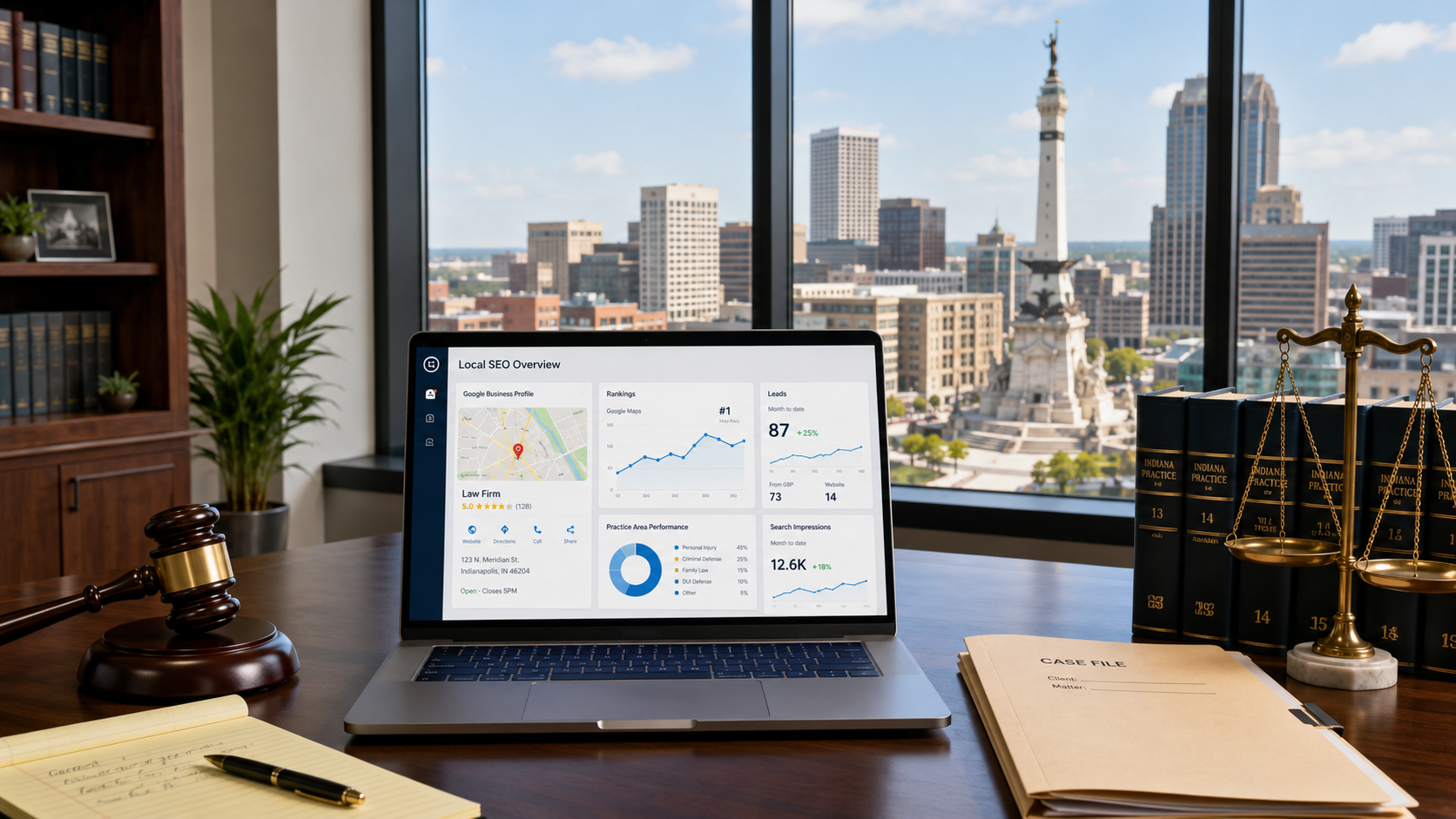
Someone in Indianapolis has a legal problem.
Maybe they were seriously injured in a crash.
Maybe they were arrested.
Maybe their spouse just filed for divorce.
Maybe an employer terminated them under circumstances they believe were unlawful.
Maybe a parent needs an estate plan.
Maybe a business dispute is escalating and litigation suddenly looks possible.
They probably aren't thinking:
“I would like to consume some legal marketing today.”
They want an answer.
Then, potentially, they want an attorney.
So they search:
“personal injury lawyer Indianapolis.”
“criminal defense attorney near me.”
“divorce lawyer Indianapolis.”
“employment attorney Indianapolis.”
“estate planning lawyer near me.”
“business litigation attorney Indianapolis.”
And your firm either enters the consideration set—
or it doesn't.
That is the commercial reality behind law firm SEO.
The goal is not merely:
More organic traffic.
It is:
More visibility for the legal matters you actually want.
Then:
More qualified consultations.
Then:
More appropriate signed cases.
And those are very different metrics.
A firm could attract 50,000 monthly visitors to broad legal-definition articles while another firm generates fewer than 5,000 visits and signs significantly more clients because its traffic is concentrated around high-intent local practice-area searches.
For Indianapolis firms, the strongest SEO strategy therefore connects four things:
Local visibility.
Practice-area relevance.
Professional credibility.
Intake conversion.
Current consumer behavior makes that increasingly important. BrightLocal's 2026 local-search research reports that 52% of consumers started their most recent local-business search on Google, while 71% used Google at some point. It also reports that 75% used more than one channel during the process.
Legal consumers are moving online too. Clio's 2025 Legal Trends research says a growing majority of consumers would look online for their next lawyer. More than half had used or would consider using AI to answer a legal question, and among people who had used AI for a legal question, 28% were directed to contact a lawyer.
So an Indianapolis law firm increasingly needs to be discoverable across:
Google organic search
Google Maps
Google Business Profile
Review platforms
Legal directories
Traditional referrals followed by online research
AI-assisted discovery
But legal marketing has another constraint that HVAC, roofing, or plumbing companies do not face in the same way:
professional-conduct rules.
Indiana Rule of Professional Conduct 7.1 prohibits false or misleading communications about a lawyer or legal services. Its commentary addresses issues including unsubstantiated comparisons, certain references to past results, testimonials that create unjustified expectations, and claims of specialization that don't comply with Rule 7.4.
So the law firm SEO strategy cannot simply be:
Say whatever converts best.
It has to be:
Create the strongest truthful, useful, locally relevant digital evidence possible while staying within the firm's professional obligations.
This article is marketing guidance, not legal-ethics advice. Indiana firms should review their own advertising and solicitation practices against the current Indiana Rules of Professional Conduct and, where necessary, obtain appropriate ethics guidance.
With that established, here is how we'd build an Indianapolis law firm's local SEO system in 2026.
Law Firm SEO Should Be Built Around Cases, Not Traffic
Start with the economic outcome.
Suppose your firm handles:
Personal injury
Criminal defense
Family law
Estate planning
Your website publishes an article:
“What Does Habeas Corpus Mean?”
It gets 15,000 visits nationally.
Great traffic chart.
How many relevant Indianapolis clients did it produce?
Maybe almost none.
Meanwhile:
“Indianapolis Criminal Defense Attorney”
gets dramatically less traffic but produces several qualified inquiries.
Which page matters more?
From a business perspective, probably the second.
That's why law firm SEO should begin with:
Which matters do we want?
Where do those potential clients search?
What language do they use?
Which pages should answer those searches?
What makes someone trust the firm enough to contact us?
What makes that inquiry turn into a signed engagement?
SEO comes after those questions.
Understand Google's Local Ranking Framework
For Indianapolis local searches, Google gives businesses a useful framework.
Google says local results are mainly based on:
Relevance
Distance
Prominence
Relevance is how closely a Business Profile matches what someone searches.
Distance considers how far each business is from the searcher or the location in the query.
Prominence reflects how well known the business appears, with Google specifically referencing factors such as websites linking to the business and reviews.
That's extremely important for attorneys.
When someone searches:
“criminal defense lawyer near me”
Google isn't just counting how many times your website says “criminal defense lawyer.”
It is evaluating a much larger local system.
Is this actually a criminal-defense practice?
Where is it located?
What does the website say?
Which category is the Business Profile using?
What reputation exists?
What other sites reference the firm?
How prominent does the business appear?
Understanding those three buckets makes local SEO much less mysterious.
For the broader Indianapolis framework, read:
What Makes an Indianapolis Business Rank in Google's 3-Pack?
Google Business Profile Should Be a Major Law Firm Asset
For many high-intent legal searches, your Google Business Profile can put the firm directly into a potential client's initial comparison set.
That means the profile deserves real attention.
Audit:
Business name
Address
Phone
Website
Hours
Categories
Reviews
Photos
Attorney/practitioner profiles where appropriate
Business description and available services
The firm should be represented exactly as it exists in the real world.
Google says businesses should use their actual real-world location, rejects virtual offices that don't meet eligibility requirements, and requires accurate address information.
That matters because competitive legal markets sometimes attract bad local SEO advice such as:
Get five virtual offices around Indianapolis so you can rank everywhere.
That can create serious Business Profile problems.
If you have a legitimate Indianapolis office that meets Google's rules, optimize it.
If the firm genuinely opens another eligible staffed location, optimize that too.
Don't manufacture geography.
Choose the Right Google Business Profile Category
Category selection helps Google understand what kind of business the firm actually is.
Google advises businesses to use as few categories as necessary, choose categories that are specific to the core business, and avoid using categories simply as keywords. Google frames the decision as completing:
“This business IS a…”
rather than:
“This business HAS a…”
That is particularly relevant for law firms with multiple practice areas.
Don't treat Business Profile categories like a bag of SEO keywords.
Use the most accurate available primary category based on the firm's principal business.
Then add appropriate secondary categories where they genuinely apply.
If your firm's dominant business is criminal defense, family law, bankruptcy, or another recognized category, evaluate the closest accurate category available in the profile interface.
The point is relevance.
Not category quantity.
Law Firms Have a Google Business Profile Opportunity Other Industries Don't Always Have
Google treats lawyers as individual practitioners.
Under Google's current guidelines, an individual practitioner may have a dedicated Business Profile when that attorney:
Operates in a public-facing role
Can be contacted directly at the verified location during the stated hours
Google specifically lists lawyers among individual practitioners.
This can create additional local visibility opportunities for firms with multiple attorneys.
But it needs to be handled correctly.
Google says that when several public-facing practitioners operate at one location:
The organization should have a Business Profile for the location.
Eligible individual practitioners may have their own profiles.
A practitioner's profile title should contain only that practitioner's name rather than adding the firm's name.
Google also says a practitioner should not create multiple Business Profiles simply to cover multiple specializations.
So this is not permission to create:
Jane Smith – Personal Injury Lawyer
Jane Smith – Car Accident Lawyer
Jane Smith – Wrongful Death Lawyer
for the same attorney.
One practitioner.
One appropriate practitioner profile.
Follow the policy.
Don't Create Attorney Profiles for Every Employee
Google limits practitioner profiles to public-facing professionals.
Support staff should not create individual profiles.
For a law firm, that means you should not start generating Maps listings for:
Intake coordinators
Paralegals
Marketing staff
Assistants
Office administrators
solely to occupy more search-result space.
If you have attorneys who legitimately meet Google's requirements, practitioner profiles may be useful.
Build around reality.
Your Practice-Area Pages Are Your Commercial SEO Engine
This is probably the single largest website opportunity for many law firms.
Imagine a firm handles:
Personal injury
Criminal defense
Divorce
Estate planning
Employment law
The website has one page:
Practice Areas
Each practice gets one paragraph.
That's not much of a search strategy.
People search for the legal problem they have.
So major practice areas often deserve substantial dedicated pages.
Examples:
Indianapolis Personal Injury Lawyer
Indianapolis Criminal Defense Attorney
Indianapolis Divorce Lawyer
Indianapolis Estate Planning Attorney
Indianapolis Employment Lawyer
Indianapolis Business Litigation Attorney
The exact pages should reflect what the firm actually practices.
Don't create pages for matters you don't want merely because the keyword has volume.
Practice-Area Pages Should Answer the Client's Problem
A personal injury page should not simply say:
We fight aggressively for maximum compensation.
A potential client wants information.
What kinds of cases do you handle?
What happens during the process?
When should someone contact an attorney?
What should they preserve?
What does representation generally involve?
How does the firm evaluate a potential case?
Which geographic areas does the firm serve?
Who at the firm handles the work?
What can the person expect when they contact you?
That's useful content.
Google's people-first content guidance says its systems aim to prioritize helpful content and gives additional weight to signals associated with experience, expertise, authoritativeness, and trustworthiness for topics that can significantly affect people's health, financial stability, safety, or welfare—what Google calls YMYL topics. Legal information can plainly fall into that high-stakes environment.
That makes shallow, anonymous legal content a poor strategic choice.
Put Actual Attorneys on the Website
A legal consumer should not have to wonder:
Who is giving me this information?
Build substantial attorney biography pages.
A useful attorney page might include:
Full name
Professional photograph
Bar admissions
Education
Practice areas
Relevant experience
Professional associations
Publications
Speaking engagements
Contact path
Appropriate credentials
Keep everything accurate.
This is good for people.
It also creates stronger entity clarity for search systems.
Google's people-first content guidance encourages clear evidence of who created content and expertise where trust matters.
Assign Legal Content to Real Authors
If your firm publishes:
“What Happens After a DUI Arrest in Indiana?”
who wrote it?
“Admin”?
“Marketing Team”?
No author?
Where feasible, legal information should be associated with an attorney who has appropriate knowledge of the subject.
That does not mean every blog needs to become a law-review article.
It means accountability matters.
Show:
Written by Jane Smith, Attorney
or:
Reviewed by John Doe, Attorney
when that's actually true.
Then link the name to the attorney biography.
Now the reader can verify who stands behind the content.
Keep Legal Content Accurate and Updated
Legal content can become stale.
Statutes change.
Rules change.
Procedures change.
Cases change.
Agency guidance changes.
An article written in 2019 may not be reliable in 2026.
Build a content-review process.
Depending on the subject, include:
Last reviewed: August 2026
if someone truly reviewed it at that time.
Then revisit time-sensitive legal resources periodically.
Do not update the date without updating the substance.
Do Not Turn SEO Into Unauthorized Legal Overpromising
Search marketing encourages strong headlines.
Professional responsibility puts limits on what attorneys should say.
Indiana Rule 7.1 says lawyers may not make false or misleading communications about themselves or their services. Its commentary identifies several specific risks, including:
Unsubstantiated comparisons with other lawyers
Statistical data or past-performance claims that imply future success
References to results that may create expectations of similar outcomes
Testimonials or endorsements likely to create unjustified expectations
Improper specialization claims
That means SEO copy such as:
“Indianapolis's #1 Personal Injury Lawyer”
needs a factual basis strong enough to support the claim—and even then the firm's ethical obligations need to be evaluated.
Likewise:
“We win every case.”
“Guaranteed settlement.”
“The best trial lawyers in Indiana.”
are not clever SEO.
They're potential compliance problems.
Write strong copy.
But make it true.
Be Careful With “Specialist” Language
There is a difference between saying:
“We practice personal injury law.”
and implying:
“We are certified personal injury specialists.”
Indiana Rule 7.4 allows a lawyer to communicate that they practice in particular fields. But it says a lawyer may not state or imply that they are a specialist unless the applicable certification requirements are met and the certifying organization is identified.
So:
Practice area
and:
specialist
are not interchangeable marketing terms.
Your SEO copy should reflect that.
Past Results Need Special Care
Law firm websites understandably want to show success.
Potential clients want evidence.
But Indiana Rule 7.1's commentary specifically addresses past-performance information and results that could create expectations of similar outcomes.
This means firms should evaluate:
Verdict pages
Settlement pages
Case-result widgets
“Millions recovered” claims
Testimonials discussing outcomes
Paid ads built around previous results
through a professional-responsibility lens.
Do not assume:
“Other law firms do it.”
equals:
“Our implementation is compliant.”
Your firm's legal marketing review process should cover these pages before publication.
Testimonials and Reviews Are Not the Same as Permission to Say Anything
Reviews matter tremendously in local search.
BrightLocal's 2026 survey says 97% of consumers read online reviews for local businesses and 71% use Google to read local-business reviews. It also reports that 65% of consumers who rejected a local business did so for a review-related reason.
But law firms must think about reviews differently from restaurants.
A lawyer's public response can potentially create confidentiality concerns.
So a negative Google review does not mean the firm should respond:
You failed to tell everyone that we represented you in your felony case and you rejected our plea recommendation.
That may create a much larger problem than the one-star review.
Build a review-response policy.
Keep responses restrained.
Avoid confirming or disclosing representation or confidential facts merely because the reviewer already mentioned them.
This is an area where firms should coordinate marketing practices with professional-responsibility obligations.
Build a Legitimate Review Process
Reviews should not be accidental.
If a matter concludes and it is appropriate to request feedback, make the process simple.
Google allows businesses to share review-request links and encourages businesses to value customer feedback.
But do not:
Buy reviews
Manufacture reviews
Ask employees to pose as clients
Offer incentives for positive sentiment
Review-gate by filtering unhappy people out of the process
For a law firm, also consider whether requesting a review in a particular matter is professionally appropriate.
The goal is authentic reputation.
Not a perfect fake rating.
For more on why raw review count isn't everything, read:
Why Your Competitor Ranks Above You in Indianapolis — Even With Fewer Reviews
Build Dedicated Indianapolis Relevance
If Indianapolis is an important market, the website should make that obvious.
But do not create an Indianapolis page that says:
Indianapolis lawyer serving Indianapolis legal clients throughout Indianapolis. Contact our Indianapolis lawyers for Indianapolis law today.
That's nonsense.
A useful Indianapolis page could explain:
The firm's services in the market
Location and office details
Attorneys working from the office
Practice areas
Courts or jurisdictions relevant to the firm's actual work
Geographic coverage
Local professional involvement
Contact and consultation process
Links to important practice-area pages
Use local information where it genuinely helps the prospective client.
The objective is not maximum city-name density.
It is legitimate local relevance.
Should an Indianapolis Firm Create Pages for Suburbs?
Possibly.
Maybe the firm genuinely handles clients throughout:
Carmel
Fishers
Greenwood
Noblesville
Avon
Plainfield
Brownsburg
Zionsville
That does not automatically justify eight copied pages.
A location page should have enough unique value to deserve its own URL.
Can you include:
Real office information if one exists
Geographic service information
Relevant attorney experience
Local cases described appropriately
Helpful procedural context
Distinct client questions
If the only difference is replacing:
Indianapolis
with:
Fishers
don't expect a strong long-term strategy.
“Near Me” Searches Matter for Attorneys Too
Potential clients search:
“criminal lawyer near me.”
“divorce attorney near me.”
“personal injury lawyer near me.”
Those results can vary significantly by the searcher's location because Google explicitly uses distance as a local-ranking factor.
That means your firm does not have one universal ranking for:
“lawyer near me.”
You may rank well close to the office and less strongly farther across the Indianapolis metro.
This is why local rank tracking should become geographic.
Read:
How to Rank for “Near Me” Searches in Indianapolis
for the full proximity strategy.
Measure Maps Visibility Across Indianapolis
A partner searches from the office:
“personal injury lawyer near me.”
The firm ranks first.
Everyone celebrates.
But that only tells you what happened at one search location.
Instead, track a geographic grid around the part of Indianapolis that matters.
For each important practice area, examine visibility from multiple locations.
For example:
Personal injury lawyer Indianapolis
Criminal defense attorney Indianapolis
Divorce lawyer Indianapolis
Then identify:
Strong areas
Weak areas
Competitors dominating certain zones
Differences by practice area
This turns:
“We rank well.”
into measurable local visibility.
Local Citations Matter for Law Firms
A law firm's business information can appear across:
Google
Bing
Apple
Yelp
BBB
Legal directories
Bar-related resources
Professional organizations
Local directories
The key information should be accurate.
Especially:
Firm name
Address
Phone
Website
Attorney names where appropriate
Avoid thinking you need:
500 directory listings.
You need consistency across meaningful sources.
For the broader Indianapolis citation framework, use:
Indianapolis Local Citations: Which Business Directories Actually Matter?
Legal Directories Can Serve More Than One Purpose
Directories such as legal and professional profiles can potentially help with:
Business discovery
Attorney validation
Referral traffic
Entity clarity
Backlinks
Reputation research
The value varies dramatically by directory.
Don't pay for every badge someone emails you.
Ask:
Do potential clients use this?
Is the directory reputable?
Does the profile accurately describe the attorney?
Does it provide meaningful third-party verification?
Does it generate traffic, leads, or authority?
Treat directories as business assets.
Not trophy collections.
Backlinks Matter Because Law Is an Authority Competition
Google says links can contribute to local prominence.
For law firms, credible backlink opportunities may come from:
Professional associations
Bar organizations
Universities
Alumni organizations
Local media
Community organizations
Legal publications
Industry publications
Conferences
Nonprofits
Chambers
Expert commentary
Original research
The strongest links often come from things the firm does in the real world.
An attorney speaks at an event.
Publishes research.
Teaches.
Provides commentary to a reporter.
Participates in an organization.
Sponsors a legitimate community initiative.
Those activities can create meaningful authority.
Digital PR Can Be Especially Powerful for Attorneys
Lawyers already possess expertise journalists need.
A reporter may need context on:
New Indiana legislation
Court decisions
Employment issues
Criminal procedure
Business disputes
Estate planning changes
Consumer legal issues
If the attorney is qualified to comment, responding quickly with useful analysis can create:
Media mentions
Backlinks
Brand awareness
Professional authority
That is significantly stronger than buying a link from:
best-seo-lawyer-directory-247.biz
Authority should look like authority.
Create Legal Content Around Real Client Questions
The best content ideas may already be sitting in your consultation notes.
Ask attorneys:
What questions do clients ask every week?
For criminal defense:
What happens after an arrest?
How does bond work?
What should I do before my first court appearance?
Can charges be dismissed?
What should I bring to a consultation?
For family law:
How long does divorce take?
How is property divided?
How does custody work?
What happens to the house?
Can support orders change?
For estate planning:
Do I need a will?
What does a trust do?
What happens without an estate plan?
When should documents be updated?
For personal injury:
What should I do after a crash?
How long might a claim take?
What evidence should I preserve?
When should I speak with counsel?
Build around actual legal-consumer needs.
Don't Turn Every Blog Into Legal Advice for Every Reader
Educational legal content needs appropriate context.
A useful article should make clear that general information may not apply to every factual situation.
Avoid writing:
If this happened, you definitely have a case.
when the answer genuinely depends on facts.
Better:
These are factors that may matter. An attorney evaluating the specific facts can explain how the law applies to the situation.
Accuracy builds trust.
Overconfidence creates risk.
Internal Linking Should Connect Questions to Practice Areas
Suppose your firm publishes:
What Happens After a Car Accident in Indiana?
That article should probably link naturally to:
Indianapolis Personal Injury Lawyer
if relevant.
An article about:
What Happens After a DUI Arrest?
can link to:
Indianapolis Criminal Defense Attorney
Google says descriptive internal links help users navigate and help Google understand what linked pages are about. It recommends making sure every important page has a link from another page on the site.
Think:
Question → legal topic → practice-area page → attorney → consultation
That's a useful site architecture.
Technical SEO Matters More Than Most Law Firms Realize
Law firms frequently focus on content while serious technical problems remain underneath.
Examples:
Practice-area pages accidentally noindexed
Duplicate city pages
Canonical errors
Broken redirects after redesign
Attorney pages orphaned
Important content hidden behind JavaScript problems
Mobile rendering failures
Slow templates
Broken internal links
A website can contain excellent legal content and still underperform because search engines cannot efficiently crawl or interpret it.
Before publishing another 100 articles, audit the foundation.
Use:
The Indianapolis Website Audit: 20 SEO Problems That Cost Local Businesses Leads
as a starting framework.
Use Structured Data for Clarity, Not Magic Rankings
Structured data can provide search engines with clearer machine-readable information.
Google supports Organization and LocalBusiness structured data for communicating details such as:
Name
Address
Phone
URL
Logo
Other organizational information
A law firm may also use appropriate schema.org types based on the site's structure and content.
But structured data is not:
“Add lawyer schema and rank #1 tomorrow.”
It helps with clarity.
It does not override:
Competition
Distance
Weak content
Poor reputation
Lack of authority
Treat schema as supporting infrastructure.
Build Strong Attorney and Firm Entities
Search engines should be able to understand:
Firm: Who is the organization?
Attorneys: Who practices there?
Location: Where is the office?
Practice areas: What does the firm handle?
Credentials: What can be verified?
Associations: Which organizations connect to the attorneys?
Mentions: Who else references the firm?
This is where:
Attorney bios
Organization markup
Legal directories
Bar listings
Media mentions
Professional associations
Consistent citations
begin to work together.
The stronger and more consistent the public evidence, the easier the firm is to understand.
Your Website Must Convert the Searcher Into an Inquiry
Ranking is not the final objective.
Someone clicks:
Indianapolis divorce lawyer
lands on the site—
and then what?
The page needs to answer:
Am I in the right place?
Practice area should be obvious.
Does this firm serve Indianapolis?
Location should be obvious.
Why should I trust these attorneys?
Credentials and proof should be available.
What happens if I contact you?
Explain the process.
How do I contact you?
Make it simple.
Potential actions may include:
Call
Contact form
Consultation request
Online scheduling
Don't bury them.
Intake Speed Can Destroy Good SEO
SEO can deliver a highly qualified inquiry.
Then the firm waits two days to respond.
Marketing did its job.
Intake failed.
Clio's current law-firm client-acquisition guidance emphasizes that converting interest into signed clients depends on fast response and easy consultation booking; it warns that prospects can drift to another firm when intake creates friction.
That means SEO strategy should connect with:
Intake
Reception
CRM
Scheduling
Call handling
Follow-up
A law firm's marketing funnel does not stop when the contact form is submitted.
Track Qualified Cases, Not Form Fills
Suppose your SEO agency reports:
36 leads this month!
Sounds great.
What were they?
Ten spam messages.
Eight people seeking a practice area you don't handle.
Five people outside the jurisdiction.
Seven people who never responded.
Four potential matters that were not economically viable.
Two strong cases.
Now you have useful information.
The metric should evolve from:
Traffic
to:
Inquiry
to:
Qualified lead
to:
Consultation
to:
Signed case
to:
Revenue or expected case value where appropriate.
That lets you determine which SEO activity actually matters.
Track SEO by Practice Area
Do not lump every organic lead together.
A family-law inquiry may have different economics from:
A personal injury matter.
A criminal case.
An estate-planning client.
A commercial litigation matter.
Track:
Landing page
Search channel
Practice area
Qualification
Consultation
Engagement
This tells you where marketing investment should expand.
Legal SEO Should Reflect Case Economics
Suppose one signed matter is worth:
$1,500
and another is potentially worth:
$50,000+
Those practice areas can support very different acquisition costs.
This does not mean blindly spending more for high-value searches.
It means SEO budgeting should be connected to business economics.
If you're deciding how much a meaningful Indianapolis SEO program should cost, read:
How Much Does SEO Cost in Indianapolis? A Real Pricing Guide
The right budget depends partly on what a qualified client is worth.
Law Firm SEO vs. Google Ads
Legal searches can be extremely commercial.
That makes Google Ads appealing.
Paid search can help a firm reach demand quickly.
SEO builds a different asset.
A simple model:
Google Ads
Faster visibility.
Pay for traffic.
Useful for immediate demand.
SEO
Slower accumulation.
Builds organic and Maps visibility.
Creates long-term content and authority.
Many firms should consider both rather than treating them as enemies.
For the full comparison:
SEO vs. Google Ads for Indianapolis Businesses: Where Should You Spend First?
The right allocation depends on:
Practice area
Margins
Search competition
Current rankings
Intake capacity
Cost per signed case
Smaller Indianapolis Firms Can Compete With Large Legal Brands
A large firm may have:
Huge advertising budget
National brand recognition
Hundreds of backlinks
Large content staff
Multiple offices
That does not mean a smaller firm cannot compete.
Local search creates openings through:
Proximity
Better practice-area relevance
Better local reviews
Strong Indianapolis content
Individual attorney authority
Better intake experience
More specific expertise
Local backlinks
You don't need a bigger website everywhere.
You need stronger evidence where it matters.
Read:
How Indianapolis Small Businesses Can Compete With National Brands on Google
for the broader strategy.
AI Search Is Already Relevant to Legal Marketing
Potential clients don't only search Google anymore.
They can ask:
“What kind of lawyer do I need for this problem?”
Then:
“Which attorneys in Indianapolis handle this?”
Clio's 2025 Legal Trends research found that more than half of consumers had used or would consider using AI for a legal question, while 28% of those who had used AI were directed toward contacting a lawyer.
Clio separately published a law-firm GEO guide in March 2026 emphasizing the increasing importance of technically accessible sites, authoritative legal content, and consistent brand/entity information for AI visibility.
That does not mean traditional SEO disappeared.
The fundamentals overlap heavily:
Crawlable website
Strong practice-area pages
Attorney authority
Consistent firm information
Third-party mentions
Reviews
Structured data
Original legal analysis
For the broader Indianapolis strategy, read:
AI Search Optimization in Indianapolis: SEO for ChatGPT, Gemini & Google AI
Law Firms Should Publish Original Expertise
A generic article:
“10 Reasons You Need an Attorney”
is easy to reproduce.
A better resource:
“What Indianapolis Business Owners Should Know About X After the 2026 Indiana Rule Change”
written and reviewed by an attorney who actually handles the issue—
has much stronger value.
Other examples:
Indiana Employment Law Update: What Changed This Year
How a New Indiana Court Decision May Affect [Relevant Issue]
Indianapolis Business Litigation Trends We Saw Across 50 Consultations
if the information can be presented ethically and without breaching confidentiality.
Original expertise is harder to commoditize.
Content Should Sound Like a Lawyer, Not a Content Farm
The internet is full of legal pages saying:
Navigating the complex landscape of legal challenges can be daunting.
Nobody talks like that.
Better:
If you've been charged with a crime in Indianapolis, your first questions are usually practical: What happens next? Do you need to appear in court? Can you go to work? What should you avoid doing?
Specific.
Useful.
Human.
Your attorneys know the questions.
Use that knowledge.
Avoid Massive AI-Generated Legal Content Programs
AI can assist legal content workflows.
It can help:
Outline
Organize
Edit
Brainstorm
Summarize source material
But publishing thousands of unsupervised legal pages is a poor strategy.
Google's people-first guidance emphasizes helpful, reliable content and says trust receives additional attention in high-stakes YMYL areas.
For law firms, human review matters for another obvious reason:
The content needs to be legally accurate.
Don't trade attorney credibility for content volume.
Indianapolis Law Firm Local Link Building Ideas
Useful local authority can come from:
Indianapolis Organizations
Participate where it makes business sense.
Professional Associations
Maintain accurate attorney and firm profiles.
Universities
Alumni profiles, teaching, speaking, research.
Local Media
Provide qualified commentary.
Nonprofits
Real participation can generate legitimate mentions.
Chambers and Business Organizations
Especially for business-law practices.
Conferences
Speaking and educational events can create authority.
Original Studies
Publish information others genuinely want to cite.
The objective is not:
Acquire exactly 10 backlinks every month.
It's:
Build a stronger professional footprint.
A 90-Day Indianapolis Law Firm SEO Plan
If a firm's local visibility is weak, sequence the work.
Days 1–30: Diagnose the Foundation
Audit Google Business Profile
Review:
Name
Address
Phone
Category
Website
Hours
Reviews
Practitioner profiles
Audit Website
Check:
Crawlability
Indexation
Redirects
Canonicals
Mobile usability
Practice-area pages
Attorney profiles
Indianapolis relevance
Internal links
Audit Tracking
Establish:
Search Console
Analytics
Call tracking
Consultation tracking
Signed-case attribution
Audit Compliance
Have the firm review:
Claims
Testimonials
Case results
Specialization terminology
Required advertising information
Solicitation processes
Indiana Rule 7.2 says covered lawyer advertising communications must include the name and office address of at least one responsible lawyer or law firm and requires the responsible party to retain a copy or recording for six years after dissemination. Firms should evaluate how those requirements apply to their own marketing program.
Days 31–60: Strengthen Practice-Area Relevance
Prioritize the services responsible for meaningful cases.
Improve pages such as:
Personal injury
Criminal defense
Divorce/family law
Estate planning
Employment
Business litigation
depending on what the firm actually handles.
Build:
Better title tags
Clear H1s
Useful explanations
Attorney attribution
Internal links
FAQs
Strong consultation CTAs
Then improve attorney pages.
Connect each attorney to the practice areas they genuinely handle.
Days 61–90: Strengthen Local Prominence
Work on:
Legitimate review process
Review-response policy
Legal directories
Local citations
Professional associations
Local backlinks
Digital PR
Original legal content
Then measure again:
Geographic Maps visibility
Organic practice-area visibility
Qualified calls
Consultation requests
Signed clients
SEO should become increasingly measurable.
Common Indianapolis Law Firm SEO Mistakes
One Generic “Practice Areas” Page
Important legal services deserve enough depth to stand independently.
Keyword-Stuffed City Pages
Repeating “Indianapolis lawyer” fifty times is not local expertise.
Fake Offices
Google specifically says virtual offices that do not meet its requirements are not eligible Business Profile locations.
Multiple Profiles for One Attorney's Specializations
Google says individual practitioners should not create multiple Business Profiles to cover different specializations.
Weak Attorney Bios
Legal trust depends heavily on knowing who is behind the advice.
Anonymous Legal Blogs
Especially weak for high-stakes topics.
Unreviewed AI Content
Speed is not worth publishing legally inaccurate information.
Misleading “Best Lawyer” Claims
Indiana Rule 7.1 prohibits false or misleading communications and places restrictions around comparisons and expectations.
Improper Specialist Claims
Indiana Rule 7.4 limits when an attorney can state or imply specialist status.
Careless Review Responses
Do not let reputation management create confidentiality problems.
Measuring Traffic Instead of Signed Cases
A legal marketing channel should ultimately be judged by case quality and economics.
A Better Indianapolis Law Firm SEO Funnel
Think of SEO as a sequence:
Potential client has a legal problem
↓
Searches Google / Maps / AI
↓
Finds firm
↓
Checks reviews
↓
Reads practice-area page
↓
Reviews attorney credentials
↓
Calls or requests consultation
↓
Intake qualifies matter
↓
Attorney consultation
↓
Signed engagement
That's the system.
Most SEO agencies report on:
Step two.
Law firms should care about:
the entire chain.
Frequently Asked Questions
What Is Law Firm SEO?
Law firm SEO is the process of improving a firm's website and broader online presence so potential clients can find the firm when searching for legal services.
For an Indianapolis law firm, that can include:
Google Maps
Google Business Profile
Practice-area pages
Attorney biographies
Indianapolis content
Reviews
Legal directories
Backlinks
Technical SEO
AI search visibility
Does SEO Work for Law Firms?
It can when prospective clients search online for the legal services the firm provides.
The business objective should be qualified inquiries and signed matters rather than traffic alone.
Clio's current research says a growing majority of consumers would look online for their next lawyer.
How Does Google Rank Indianapolis Law Firms in Maps?
Google says local rankings are mainly based on:
Relevance
Distance
Prominence
A firm can improve many relevance and prominence signals, but it cannot completely eliminate the geographic distance factor.
Is Google Business Profile Important for Attorneys?
Yes.
It can make the firm visible in Google Search and Maps and provides information such as location, phone, website, reviews, and hours.
Law firms should keep profile information accurate.
Can Individual Attorneys Have Google Business Profiles?
Yes, when they meet Google's individual-practitioner requirements.
Google says lawyers are eligible individual practitioners when they are public-facing and can be contacted directly at the verified location during stated hours.
Can Every Attorney at a Firm Have a Separate Profile?
Eligible public-facing attorneys at a multi-practitioner location may have individual profiles in addition to the organization's profile, subject to Google's guidelines.
Support staff should not create practitioner profiles.
Can One Lawyer Have Multiple Profiles for Different Practice Areas?
Google says no.
An individual practitioner should not have multiple Business Profiles merely to cover different specializations.
Can a Law Firm Use a Virtual Office for Google Maps?
Google says a rented mailing address or virtual office where the business does not actually operate is not eligible for a Business Profile.
Coworking locations also need to meet Google's signage, staffing, and customer-reception requirements.
What Are the Best Keywords for an Indianapolis Law Firm?
It depends on the firm's practice areas.
Examples can include:
Personal injury lawyer Indianapolis
Criminal defense attorney Indianapolis
Divorce lawyer Indianapolis
Estate planning attorney Indianapolis
Employment lawyer Indianapolis
Business litigation lawyer Indianapolis
Focus on services the firm genuinely provides and cases it wants.
Should Every Practice Area Have Its Own Page?
Important practice areas usually deserve dedicated pages when clients search for them independently and the firm can provide meaningful information.
Do not create separate pages simply to increase URL count.
Does a Law Firm Need an Indianapolis Landing Page?
If Indianapolis is an important market, a substantial Indianapolis page can help clarify the firm's location and services.
It should provide real information rather than city-name repetition.
Should Law Firms Create Pages for Carmel, Fishers, Greenwood, and Other Suburbs?
Only when the firm genuinely serves those markets and can create useful distinct content.
Avoid copying one page and replacing only the city name.
Do Reviews Help Law Firm SEO?
Google says reviews and positive ratings can contribute to local prominence.
Reviews also influence consumer decisions. BrightLocal reports that 97% of consumers read local-business reviews.
Can Attorneys Respond to Negative Reviews?
Firms should be cautious.
A public response should not create confidentiality or professional-responsibility problems.
Develop a response policy and have attorneys evaluate sensitive situations rather than arguing publicly about client facts.
Can a Law Firm Ask Clients for Google Reviews?
A firm can develop a process for legitimate feedback, subject to applicable professional obligations and Google's review policies.
Do not buy or fabricate reviews.
Is the Law Firm With the Most Reviews Guaranteed to Rank First?
No.
Google says local rankings consider relevance, distance, and prominence rather than review count alone.
A competitor with fewer reviews can outrank you.
See Why Your Competitor Ranks Above You in Indianapolis — Even With Fewer Reviews.
Are Legal Directories Good for SEO?
Some can be useful for:
Discovery
Referrals
Attorney validation
Links
Entity signals
Quality varies.
Focus on legitimate directories rather than maximizing listing quantity.
Do Backlinks Matter for Law Firm SEO?
Yes.
Google specifically references links when describing local prominence.
For attorneys, strong links can come from reputable media, professional associations, universities, nonprofits, organizations, and legal publications.
Should Lawyers Write Blog Posts?
Yes, when the topics support real potential-client questions and demonstrate useful expertise.
Good topics often come directly from consultations and recurring client questions.
How Often Should a Law Firm Blog?
There is no universal publishing frequency.
One strong attorney-reviewed article that supports an important practice area can be more useful than ten generic posts.
Publish strategically.
Does Google Care Who Writes Legal Content?
Google's people-first content guidance emphasizes experience, expertise, authority, and trust, particularly for high-stakes YMYL subjects.
Showing qualified authorship and review can therefore strengthen the credibility of legal content for readers and search systems.
Should Legal Articles Have Author Bios?
That is generally a strong practice.
Connect articles to genuine attorney authors or reviewers when appropriate and link to detailed professional biographies.
Can a Law Firm Use AI to Write SEO Content?
AI can assist a content workflow, but legal information should receive appropriate human review for accuracy.
Mass-producing unreviewed legal pages creates quality and accuracy risks.
What Is E-E-A-T for Law Firms?
E-E-A-T refers to experience, expertise, authoritativeness, and trustworthiness.
Google says E-E-A-T itself is not one specific ranking factor, but its systems use signals associated with these qualities and give strong trust-related signals particular weight for high-stakes YMYL topics.
Can an Indiana Lawyer Call Themselves a Specialist?
Indiana Rule of Professional Conduct 7.4 limits when a lawyer may state or imply that they are a specialist.
The rule requires qualifying certification and identification of the certifying organization.
Firms should review specific language with appropriate ethics guidance.
Can a Law Firm Advertise Past Results?
Indiana Rule 7.1's commentary addresses statistical data, past performance, and results that may create expectations of similar future outcomes.
Firms should evaluate case-result marketing carefully under the current Rules of Professional Conduct.
Can a Lawyer Say They Are the “Best Lawyer in Indianapolis”?
An unqualified comparative claim can create professional-conduct concerns.
Indiana Rule 7.1 prohibits false or misleading communications and says comparisons with other lawyers must be factually substantiated.
Do Attorney Websites Count as Advertising?
Indiana Rule 7.2 defines advertising broadly as public communication partly or entirely intended or expected to promote the purchase or use of a lawyer's professional services.
Law firms should evaluate their website and broader digital marketing against current Indiana professional-conduct requirements.
Are There Rules About Direct Solicitation in Indiana?
Yes.
Indiana Rule 7.3 places restrictions on solicitation, including certain in-person, telephone, real-time electronic, written, recorded, and electronic communications. It also contains specific provisions regarding personal injury, wrongful death, accidents, and disasters.
Firms engaging in targeted outreach should review the current rule carefully.
Does Mobile SEO Matter for Lawyers?
Yes.
Potential clients frequently research local businesses on mobile devices, and a law firm should make calls, consultation requests, navigation, and attorney information easy to access.
How Should a Law Firm Measure SEO?
Track:
Organic visibility
Maps visibility
Practice-area rankings
Calls
Forms
Consultations
Qualified cases
Signed matters
Revenue where appropriate
Traffic alone is not enough.
How Long Does Law Firm SEO Take?
There is no universal timeline.
It depends on:
Practice area
Competition
Website condition
Authority
Reviews
Location
Content
Backlinks
Highly competitive legal searches can require sustained work.
How Much Does Law Firm SEO Cost in Indianapolis?
Pricing varies substantially based on practice area, competition, website size, geographic scope, content, technical work, and authority building.
See How Much Does SEO Cost in Indianapolis? A Real Pricing Guide for the current pricing breakdown.
Should a Law Firm Use SEO or Google Ads?
Potentially both.
Google Ads can create faster visibility.
SEO can build longer-term organic and Maps presence.
The right mix depends on case economics, current rankings, intake capacity, and marketing budget.
Read SEO vs. Google Ads for Indianapolis Businesses: Where Should You Spend First?.
Can Law Firms Show Up in ChatGPT and AI Search?
Potentially.
Clio's current research indicates consumers are increasingly using AI during legal research and discovery.
Strong traditional SEO, attorney authority, technically accessible content, consistent business information, and credible third-party mentions can also support AI discovery.
See AI Search Optimization in Indianapolis: SEO for ChatGPT, Gemini & Google AI.
What's the First SEO Problem an Indianapolis Law Firm Should Fix?
Find the largest constraint.
If Google Business Profile is inaccurate, fix it.
If key practice pages don't exist, build them.
If pages aren't indexed, fix technical SEO.
If attorney credibility is unclear, improve bios and authorship.
If traffic arrives but nobody signs, investigate intake and conversion.
Audit first.
Prioritize second.
Sources
This guide was researched and updated for August 2026. Official Google documentation and the Indiana Rules of Professional Conduct are used as primary sources for local-ranking, Business Profile, structured-data, content-quality, and attorney-advertising claims.
Google Business Profile Help — Tips to Improve Your Local Ranking on Google. Google's official explanation of relevance, distance, prominence, reviews, and links in local search.
View source
Google Business Profile — Guidelines for Representing Your Business on Google. Current Google rules covering real-world locations, virtual offices, categories, individual lawyers as practitioners, and practitioner Business Profiles.
View source
Google Search Central — Creating Helpful, Reliable, People-First Content. Google's guidance covering E-E-A-T, trust, authorship, and additional scrutiny around high-stakes YMYL topics.
View source
Google Search Central — Link Best Practices. Google's official guidance on internal linking, descriptive anchor text, and helping users and Google understand site relationships.
View source
Google Search Central — Organization Structured Data. Official guidance for communicating organization identity, address, phone, URL, logo, and other administrative information.
View source
Google Search Central — LocalBusiness Structured Data. Google's guidance for providing structured local business information.
View source
Indiana Rules of Professional Conduct — Rule 7.1, Communications Concerning a Lawyer's Services. Current Indiana rule governing false and misleading communications and commentary addressing comparisons, prior results, testimonials, and specialization claims.
View source
Indiana Rules of Professional Conduct — Rule 7.2, Advertising. Current Indiana advertising rule, including responsible-lawyer identification and record-retention requirements for covered communications.
View source
Indiana Rules of Professional Conduct — Rule 7.3, Direct Contact With Prospective Clients. Current Indiana restrictions concerning certain solicitation of prospective clients.
View source
Indiana Rules of Professional Conduct — Rule 7.4, Communication of Fields of Practice and Specialization.Current Indiana rule governing practice-area and specialist terminology.
View source
BrightLocal — Local SEO Statistics for 2026. Current consumer research covering Google use, reviews, multi-channel local discovery, and local-business evaluation.
View source
Clio — 2025 Legal Trends Report Findings. Legal-industry research covering online lawyer discovery, AI use for legal questions, and client-facing technology.
View source
Clio — How to Attract and Get Clients for Your New Law Firm. Current law-firm acquisition guidance covering online research, reviews, response speed, and client intake.
View source
Clio — GEO for Law Firms: How to Stay Visible When AI Changes the Rules. March 2026 guidance on legal visibility in AI-assisted search and its overlap with SEO fundamentals.
View source
The Law Firm That Ranks Is Not Necessarily the Law Firm That Wins the Client
This is the part legal SEO discussions often miss.
Imagine two Indianapolis firms.
Both appear in Google.
Firm A
Strong ranking.
Weak reviews.
Generic attorney pages.
No clear intake process.
Slow response.
Confusing website.
Firm B
Similar visibility.
Strong reputation.
Clear practice page.
Detailed attorney profile.
Easy consultation request.
Fast follow-up.
Who wins the case?
SEO created the opportunity.
The rest of the firm converted it.
That's why Indianapolis law firm SEO should never be reduced to:
“Rank us #1 for lawyer.”
The better objective is:
Become highly visible for the legal matters the firm wants, establish enough credible evidence to earn trust, and build an intake process capable of converting the right searches into the right signed cases.
That requires:
Google Business Profile.
Practice-area pages.
Attorney authority.
Indianapolis relevance.
Reviews.
Local citations.
Backlinks.
Legal content.
Technical SEO.
AI visibility.
Conversion.
Intake.
And because this is legal marketing:
professional responsibility.
The firms that connect all of those pieces have a much stronger search strategy than firms that simply publish another article called:
“5 Reasons to Hire an Attorney.”
Want More Qualified Indianapolis Legal Leads From Search?
Ritner Digital helps businesses build search strategies around qualified demand rather than vanity rankings.
For an Indianapolis law firm, that can include:
Indianapolis law firm SEO
Google Business Profile optimization
Google Maps SEO
Local Pack strategy
Geographic rank tracking
Practice-area SEO
Attorney profile optimization
Indianapolis landing pages
Technical SEO
Internal linking
Local citations
Review strategy
Content strategy
Digital PR
Local and industry authority building
AI search optimization
ChatGPT and Google AI visibility
Lead tracking
Conversion analysis
We do not provide legal ethics advice, and the firm remains responsible for reviewing advertising, solicitation, confidentiality, testimonial, specialization, and other professional-conduct issues applicable to its marketing.
But on the search side, we can identify why competitors are getting found first and where your visibility, authority, website, or conversion process is weak.
Contact Ritner Digital today and tell us which practice areas and Indianapolis searches you want to grow.
We'll look at your Google Business Profile, Maps visibility, practice-area pages, attorney authority, reviews, citations, technical SEO, backlinks, competitors, AI-search footprint, and intake path—and identify what we'd prioritize first.