Why Philadelphia's Italian-American Community Still Does Business on a Name
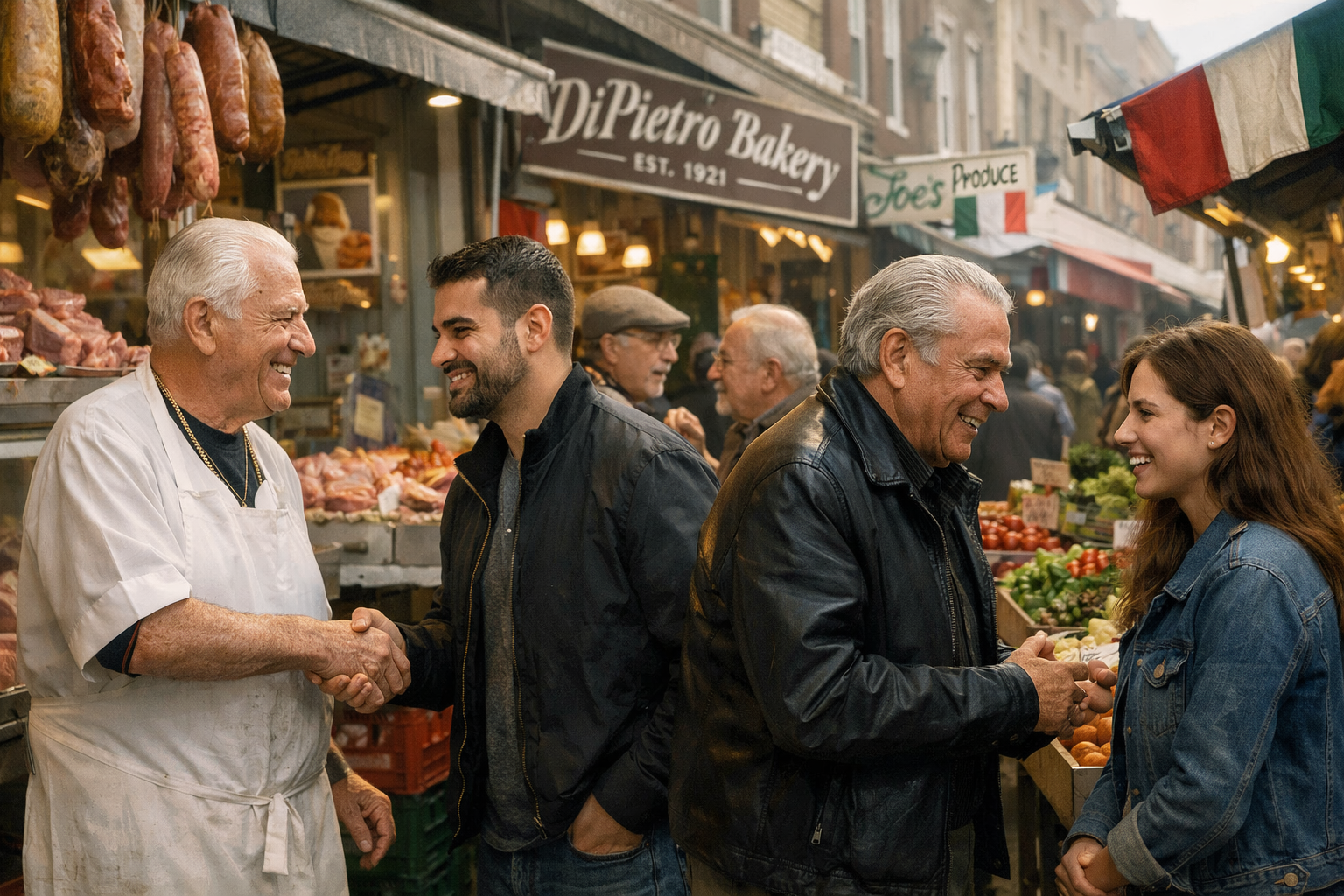
There are neighborhoods in South Philadelphia where the same families have been buying from the same families for three and four generations. Not because they don't have other options. Not because they haven't noticed the new place that opened up on the corner. But because the name above the door means something. It meant something to their grandmother. It meant something to their father. And it still means something to them today in a way that's almost impossible to fully articulate but immediately understood by anyone who grew up in it.
This isn't sentimentality. It isn't resistance to change. It is one of the most sophisticated and psychologically durable trust systems ever built into a commercial culture — and it is very much still running in 2026, on the same blocks, in the same way, for the same reasons it always has.
The Blocks That Built It
To understand why this dynamic is so strong, you have to start on the ground. South Philadelphia's Italian-American community didn't develop this way by accident. It developed this way because of exactly where and when and how it was built.
The first major wave of Italian immigrants to Philadelphia arrived in the late 1800s and early 1900s, settling densely into the blocks south of Washington Avenue. Specific regions of Italy clustered in specific blocks — Sicilians on certain streets, Neapolitans on others, Abruzzese families in their own pockets. Ninth Street, which would become the Italian Market, emerged as the commercial spine of the community. The parishes — Saint Mary Magdalen de Pazzi, Our Lady of Good Counsel, Saint Nicholas of Tolentine — became the social infrastructure. The block was the unit of life. The neighborhood was the world.
In that world, commerce and community were not separate things. The butcher on Passyunk wasn't just a butcher — he was a neighbor, a parishioner, a godfather to someone's kid, a person whose family name you knew and whose reputation you understood in full context. Buying from him wasn't just a transaction. It was a renewal of a relationship. And not buying from him — going somewhere else, giving your money to someone outside the network — was a statement that carried real social weight.
This created a commercial culture that was extraordinarily dense with accountability. Every business owner in the network knew that their reputation was inseparable from their family name, their parish, their block. You didn't cut corners because your sister-in-law's cousin would hear about it by the weekend. You didn't disappear after a bad job because you'd see the customer at the feast of Saint Anthony in August. The neighborhood was watching. The name was always on the line.
Why the Name Carried More Weight Than Any Advertisement Ever Could
In the early twentieth century, Italian immigrants in South Philadelphia were navigating a society that was not always welcoming. Institutions were unreliable. Banks were suspicious of them. Legal systems were not always accessible. The dominant culture looked down on them. In that environment, the internal trust network of the community wasn't just a preference — it was a survival mechanism.
You did business inside the network because the network protected you. A vendor who cheated you could be held accountable through social pressure in a way that no outside institution would enforce. A contractor whose work was bad couldn't hide behind a corporation — his name was on it, his family was known, and the consequences of a ruined reputation were immediate and personal. The network self-regulated in a way that formal legal and commercial systems simply couldn't match at that scale and speed.
This is what sociologists call a high-trust community — a group where the density of relationships and the strength of shared norms create an environment where people can transact with confidence even without formal contracts or third-party enforcement. The research on high-trust communities consistently shows that they generate more economic activity, more cooperation, and more durable business relationships than low-trust environments. South Philadelphia's Italian-American community was, for most of the twentieth century, one of the most concentrated examples of this in American urban history.
The name worked because the name was embedded in that system. It wasn't just a label. It was a node in a web of relationships, obligations, and mutual accountability that gave it real, enforceable meaning.
The Feast, the Parish, and the Corner — How Trust Was Maintained
The mechanism that kept all of this running wasn't formal. There were no contracts, no review platforms, no licensing boards doing the heavy lifting. The mechanism was proximity and repetition. The same people, in the same places, over and over again across decades.
The parish was central to this in a way that's hard to overstate. Saint Paul's on Christian Street. Saint Thomas Aquinas on 17th. These weren't just places of worship — they were the social operating system of the neighborhood. The same families sat near each other at Mass, ran into each other at the school fundraiser, saw each other at the feast committee meetings. That constant, overlapping contact meant that reputations were continuously updated and continuously enforced. Good work got talked about. Bad work got talked about faster.
The Italian Market on Ninth Street functioned the same way. Vendors who had been there for decades weren't just selling produce and meat and cheese — they were performing their reputation in public, every single day. The regulars who came back week after week weren't just buying groceries. They were renewing a vote of confidence. And the merchants who understood this treated every transaction as a reputation event, not just a sale.
The block parties, the feasts, the Sunday dinners that extended to half the street — all of it was social infrastructure that kept the trust network calibrated. Information moved fast in that environment. A business that did right by the community got talked about at the table. A business that didn't got talked about louder.
The Psychology Underneath It: Why This Wiring Runs So Deep
Here's what makes this more than just a cultural curiosity. The reason the Italian-American trust network was so effective — and the reason its effects are still legible in the community in 2026 — is that it was built on top of psychological mechanisms that are fundamental to how human beings make decisions.
The first is familiarity. Decades of research in behavioral psychology show that people are significantly more likely to trust, prefer, and support things they recognize. The mere exposure effect — first documented by psychologist Robert Zajonc in the 1960s — demonstrates that repeated exposure to something, independent of any other information, increases positive feelings toward it. A name you've heard your whole life, a family you've seen at church and at the feast and at the corner store, carries a warmth and credibility that no amount of advertising can manufacture from scratch. It got there through time and repetition, and it stays there the same way.
The second is social proof. When the people around you — people you trust, people whose judgment you respect — are buying from a certain business or recommending a certain name, that information is extraordinarily powerful. Not because people are blindly following the herd, but because in a dense, high-quality social network, the aggregate judgment of people who know the community is genuinely more reliable than any individual's independent research. The referral network in South Philadelphia wasn't people being lazy. It was people using the best information system available to them.
The third is identity. This one runs deepest. For Italian-American families in South Philadelphia, supporting businesses that carry familiar names and reflect shared values isn't just a purchasing decision — it's an expression of who they are. It's a way of saying this is my community and I belong to it and I participate in it. The businesses that understood this weren't just selling products. They were giving people a way to affirm their identity and their belonging with every transaction. That's not something a lower price or a slicker website easily competes with.
What Happened When the Neighborhood Changed — And Why the Culture Didn't
South Philadelphia has changed significantly over the past thirty years. Gentrification has reshaped blocks that were Italian-American for a century. Families have moved to the suburbs — to Voorhees and Medford and South Jersey — while maintaining deep ties to the old neighborhood. The Italian-American population that once blanketed everything south of Washington Avenue is now more dispersed, more suburban, more digital in how it stays connected.
And yet the culture persisted. The trust network didn't dissolve when the neighborhood boundaries got complicated — it migrated and adapted. The conversations that used to happen on the corner or after Mass now happen in Facebook groups for South Philly natives, in comment sections on Italian Market posts, in the group chats of families spread across the Delaware Valley. The question "who do you know that does good work?" that used to get asked over a fence now gets asked in a group thread with 4,000 members. The answer still comes back as a name. Still comes back as a family. Still carries the same weight it always did.
This is the resilience of a truly deep cultural norm. It doesn't require the original geography to survive. It requires the values and the psychology and the identity investment that built it — and those traveled with the people when the people moved.
Why It's Still One of the Most Powerful Forces in the Philadelphia Market in 2026
Walk into any business networking event in the Philadelphia area. Sit in on any conversation between business owners from South Philly backgrounds, or from families with deep roots in the Italian-American community. Pay attention to how decisions get made, how vendors get recommended, how trust gets established.
The name still matters. The family still matters. Someone who can say I know that family, I know their name, I know what they stand for is going to move faster toward a decision than someone evaluating a stranger on the merits of their website alone. This isn't bias in a negative sense — it's a rational response to a history of that trust network consistently delivering. The names that have lasted in this community lasted because they earned it. And the people who grew up inside that system learned, early and durably, that a known name is a reliable signal.
For businesses operating in or around that community — or marketing to it, or trying to earn its trust — understanding this isn't optional. The playbook that works in a market with no shared cultural history doesn't work the same way here. You can't manufacture the feeling of a known name with a good logo. You can't replicate decades of reputation with a clever campaign. What you can do is show up consistently, put real people behind your business, be accountable in public, and let time do what time does in a community that pays attention.
The feast still comes around every summer. The Market is still open on Ninth Street. The names that have been there for decades are still the ones people trust first. And the new names that are earning their place in this market are doing it the same way the old ones did — one honest transaction at a time, in a community that forgets nothing and rewards everything.
We Put Our Name on It Too
Ritner Digital is named after a street in South Philly. Not for the aesthetics of it — because of what that street and that neighborhood represent. A standard of accountability that doesn't need a contract to enforce it. A way of doing business where your name is on everything and that means something.
We work with businesses that were built the same way — where the owner's name is on the door and their reputation is the product. We understand that market because we come from it. And we build digital presence that reflects what those businesses actually are: trustworthy, accountable, and worth knowing.
Frequently Asked Questions
Is the Italian-American trust network in South Philly actually still active in 2026 or is this mostly nostalgia?
It's very much still active — it just looks different than it did fifty years ago. The geography has spread out as families moved to the suburbs, but the network migrated with them. The conversations that used to happen on the corner or after Mass now happen in Facebook groups, group chats, and community threads. The mechanism is the same. The name still gets passed around the same way. The trust still travels the same channels. It adapted. It didn't disappear.
Why is the family name specifically so important in this culture — why not just the business name?
Because the family name carries accountability that a business name alone doesn't. A business can close, rebrand, or walk away from its reputation. A family name follows the people who carry it everywhere they go — to church, to the market, to their kids' school, to every social interaction in the community. When a family puts their name above the door, they're putting everything on the line, not just the business. That's a fundamentally different level of commitment, and the community understands it intuitively.
What is it about Italian-American culture specifically that made this trust system so strong?
Several things converged at once. The initial immigrant experience created a genuine need for internal trust networks when outside institutions weren't reliable or accessible. The density of settlement — specific families on specific blocks, specific regions of Italy clustering together — created the proximity that high-trust networks require. The parish structure provided overlapping social infrastructure that kept relationships active and reputations continuously updated. And the cultural emphasis on family honor and communal obligation gave the whole system its teeth. Each of those elements reinforced the others, and over generations it became deeply embedded in how the community operates.
Why does familiarity have such a strong psychological effect on trust?
Because the human brain is wired to treat recognition as a proxy for safety. Psychologist Robert Zajonc's research on the mere exposure effect showed that repeated exposure to something — independent of any other information — increases positive feelings toward it. In practical terms, a name you've heard your whole life, a family you've seen in the community for decades, carries a warmth and credibility that a stranger simply can't match regardless of their actual quality. The familiarity isn't irrational. In a dense, well-functioning community where reputations are real, a name that has lasted is almost always a name that deserved to last.
Does this dynamic only apply to Italian-American communities or is it broader than that?
The psychological mechanisms are universal — familiarity, social proof, and identity-based purchasing behavior show up in every human culture. What makes the South Philadelphia Italian-American community a particularly clear example is the combination of density, longevity, and the specific historical pressures that forced the network to become so deliberate and durable. Other tight-knit urban ethnic communities developed similar systems. But few of them built it as visibly, maintained it as consistently across generations, or kept it as legible in the modern market as this one has.
How does this translate to digital marketing and online presence?
More directly than most people expect. The same psychological principles that make a known family name powerful in person — familiarity, accountability, visible humanity — are exactly what makes certain digital presences feel trustworthy while others feel anonymous and forgettable. A business where the founder shows up in the content, where real people are visible, where values are legible and consistent over time, builds trust online the same way a family name builds it on the block. The platform changed. The psychology didn't.
Can a newer business earn that kind of trust or is it only available to established names?
It can be earned — it just can't be faked and it can't be rushed. The businesses that built lasting names in South Philly didn't start with reputations. They built them one transaction at a time, over years, by being consistently accountable in a community that was paying attention. A newer business that operates with that same standard — visible, accountable, honest, present in the community — can absolutely build the kind of name that starts to carry real weight. It takes longer than a campaign. It takes as long as it takes to actually earn it.
Why do people in this community tend to refer within the network even when outside options might be cheaper or more convenient?
Because price and convenience aren't the only things being optimized for. When you refer someone to a business inside your trust network, you're putting your own name behind that recommendation. If the business does right by the person you sent, your reputation benefits. If they don't, your reputation takes a hit. That accountability makes referrals inside a tight network a much more considered act than a casual Google suggestion. People refer names they're confident in because their own credibility is on the line every time they do.