Why the Businesses That Have Been on Route 73 for 30 Years Never Needed SEO — And What That Means for Everyone Who Opened After Google Existed
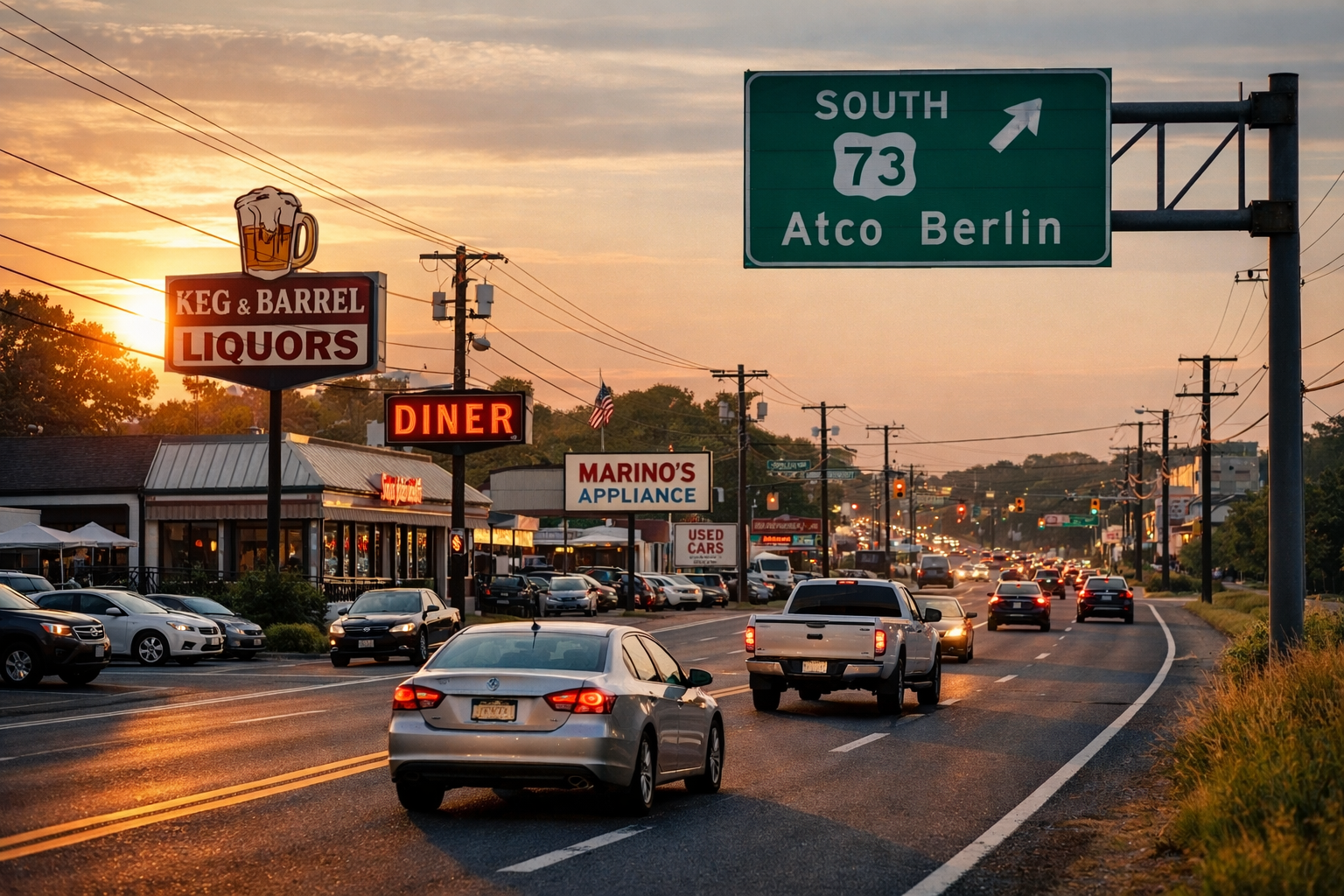
There is a stretch of road in South Jersey — running through Cherry Hill, past the old Marlton Circle, up through Evesham Township — that has been one of the most commercially trafficked corridors in the state for the better part of a century. Route 73 and its surrounding arteries are not quaint. They are not charming in the way people mean when they say charming. They are strip malls and parking lots and big-box anchors and traffic that backs up past the Turnpike on Friday afternoons. And embedded in all of that, if you know where to look, are businesses that have been operating in the same communities for decades — some for generations — without a search engine strategy, a Google Business Profile, or an agency managing their online presence.
They didn't need one. And understanding exactly why they didn't need one is the most important thing a business owner in South Jersey can do before they decide what to do next.
What the corridor actually built
Ponzio's has been on Route 70 in Cherry Hill since 1964. Wikipedia It has outlived the traffic circle it was built beside. It has outlived a dozen competitors, multiple economic recessions, the death of the diner as a cultural institution, and the rise of every food delivery app ever created. It has been a place where families celebrated weddings, birthdays, holidays, and graduations for generations. Yahoo! It didn't build a customer base. It built itself into the fabric of how South Jersey families mark time.
Howard Hill Furniture has been selling furniture in Marlton for more than 60 years. Family & Co. Jewelers has been serving South Jersey residents since the 1930s. Compass These aren't businesses that survived because they had better marketing than their competitors. They survived because they became reference points — names that exist in the mental geography of the region the way landmarks do, things people orient around without consciously deciding to.
Hutchinson was founded in 1948 — a third-generation family HVAC and plumbing business Hutchinson that grew as South Jersey grew, block by block, subdivision by subdivision, as Haddonfield became Cherry Hill and Cherry Hill sprawled into Marlton and Evesham. The company now serves more than 50,000 residential and commercial customers throughout the tri-state region. Hutchinson They got there not by running ads but by showing up reliably, for decades, in the homes of people who then told their neighbors.
And then there was Olga's Diner, which stood at the Marlton Circle for four decades. Originally opened in Camden in 1946, it moved to the Marlton Circle in 1960 and became what one writer called "the queen of South Jersey diners." Wikipedia Before the circle was demolished in 2011, Olga's was the kind of place you didn't find — you just knew about. It was on the mental map before you were old enough to drive to it.
None of these businesses were built on visibility in the modern sense. They were built on something older and harder to replicate: time, consistency, and the accumulated weight of being exactly where people expected them to be, for as long as anyone could remember.
What that actually required
It's easy to romanticize the old model. It's harder to be honest about what it demanded.
Thirty years of the same hours. The same quality. The same face at the counter or on the other end of the phone. The same willingness to fix the thing you did last time before you asked to be paid for the new thing. The businesses that built multi-generational loyalty along this corridor didn't do it by accident. They did it by showing up the same way, day after day, year after year, until the repetition became recognition and the recognition became trust and the trust became something that got handed down from parent to child the way phone numbers used to be.
What they had, in place of any digital presence, was time working for them. Every good interaction was a deposit. Every year of consistency added compound interest to a brand that no one ever sat down and built — it just accreted, the way reputations do when the work is genuinely good.
That's not a strategy. That's a consequence of strategy. And it took decades to earn.
What changed when Google showed up
Google didn't replace word of mouth. It didn't replace habit or loyalty or the kind of trust that gets built over thirty years of showing up. What it did was insert itself between the moment someone has a need and the moment they act on it.
That gap used to be filled entirely by memory and recommendation. You needed an HVAC company, you called the one your parents used. You wanted a diner, you went to the one you'd always gone to. The mental shortlist was short because the inputs were limited — your neighbors, your family, your own accumulated experience.
Now the mental shortlist has a competitor: the search results page. And the search results page doesn't know that Howard Hill has been selling furniture in Marlton since before the Marlton Circle existed. It doesn't know that Hutchinson built its reputation furnace by furnace across three generations of South Jersey families. It ranks what it can measure — proximity, relevance, authority, reviews — and it surfaces whoever has done the work to be found.
The businesses that have been operating in this corridor since before the internet are mostly fine. They're coasting on decades of embedded loyalty. Their customers are already in the habit. But those customers are aging. Their kids grew up with Google. And the families moving into Marlton and Evesham right now — buying homes in Kings Grant and Cropwell and the new developments off Tomlinson Mill Road — they don't have a thirty-year mental map of Route 73 baked in from childhood. They are starting from a search bar. And they are going to find whoever shows up first.
What that means if you opened after Google existed
You don't have thirty years. You don't have the accumulated weight of habit that Ponzio's built before anyone needed a website to find a diner. You don't have the multi-generational reputation that Hutchinson grew neighborhood by neighborhood as Haddonfield sprawled into Cherry Hill and Cherry Hill sprawled into Marlton. You are building something from scratch, in a market where the old guard already occupies the mental real estate that matters — and where the new residents arriving every year have no loyalty to anyone yet.
That is the opening. But you can't walk through it if no one can find you.
What SEO does, when it's done correctly, is compress the timeline. It puts you in front of the person who has a need at the exact moment they have it. It gets you into consideration before you've had the chance to build the kind of long-term familiarity that used to be the only way in. It doesn't replace thirty years of consistency — nothing does — but it bridges the gap between the day you open and the day your reputation is strong enough to carry you on its own.
You still have to earn it after the click. Showing up in search doesn't make you a landmark. But the landmark started somewhere. Ponzio's opened its doors in 1964 to people who had never heard of it. Hutchinson knocked on its first doors in Haddonfield when nobody knew the name. Howard Hill sold its first sofa to a family who had never bought anything from Howard Hill before. They built from zero, the same as you. The difference is they had time on their side before the search bar existed.
You don't have that luxury. But you have tools they didn't.
The businesses that do this well understand something important
The best local SEO doesn't feel like marketing. It feels like information. It tells people what you do, where you are, what hours you keep, what other people in their community have experienced — and it gets out of the way. It doesn't oversell. It doesn't perform. It puts the actual business in front of the actual person who needs it, and lets the business do what it does.
That's not so different from what word of mouth does. It's just faster, wider, and available to people who didn't grow up knowing your name.
The businesses on this corridor that have been here since before you were born built something real over a very long time. If you're building something real too — if the work is good, if the consistency is there, if you're in this for the long run — then the only question is whether the people who need you can find you before they find someone else.
In 1970, time answered that question for you. In Marlton in 2025, that's what SEO is for.
Ritner Digital works with South Jersey small businesses that are building something worth finding. If that's you, let's talk.
Frequently Asked Questions
Do I need SEO if my business already has a good reputation in Marlton or South Jersey?
A strong local reputation is a real asset — but it only reaches the people who already know you exist. SEO handles the other group: the new residents in Evesham Township, the family that just moved into a Kings Grant development, the person on Route 73 who has a need right now and no thirty-year mental map of who to call. Reputation and search visibility aren't competing strategies. One earns trust after someone finds you. The other makes sure they find you in the first place.
Why do some older South Jersey businesses rank well on Google without ever doing SEO?
Age and consistency produce signals that Google values even when they weren't built intentionally. A business that has been operating at the same address in Cherry Hill or Marlton for thirty years has accumulated citations, mentions, reviews, and links over decades without trying. A business that opened two years ago has none of that. Local SEO is how newer businesses — or older businesses that never built a digital presence — close that gap faster than time alone would allow.
What does local SEO actually do for a small business on or near Route 73?
At its core, local SEO makes sure your business appears when someone in your service area searches for what you offer. That means your Google Business Profile is complete and accurate, your website clearly communicates what you do and where you do it, and your business appears in map results when someone nearby has a relevant need. For a service business in Marlton, Voorhees, or Mount Laurel, that visibility is the difference between being found and being invisible to anyone who didn't already know your name.
How long does local SEO take to show results in a competitive South Jersey market?
Most businesses start seeing meaningful movement in local search rankings within three to six months, with more significant results compounding over the following year. The corridor between Cherry Hill and Marlton is competitive — there are established businesses with decades of digital equity and national chains with dedicated marketing budgets. The businesses that close that gap fastest are the ones that start early, stay consistent, and treat SEO as infrastructure rather than a one-time project.
Is Google the only platform that matters for local search in South Jersey?
Google dominates local search volume, so it's always the priority. But a complete local presence includes accurate listings across Apple Maps, Yelp, and industry-specific directories, consistent NAP (name, address, phone) information everywhere your business appears online, and a review strategy that generates steady, genuine feedback from real customers. Gaps in any of these create friction that costs you customers you would otherwise have won.
What's the difference between SEO and just running Google ads for my Marlton area business?
Ads buy visibility that disappears the moment you stop paying for it. SEO builds visibility that compounds over time — the longer you invest in it, the stronger your position becomes, and that position doesn't evaporate when the budget runs out. For most small businesses in South Jersey, the right answer is eventually both, but the order matters: SEO builds the foundation that makes every other form of marketing more effective.